reviewstook.com is reader-supported. When you buy through links on our site, we may earn an affiliate commission.
Where to buy
Mountaineering camera kit is chosen the way rope is chosen: for the day everything goes wrong at altitude, in cold, with gloves on. Every pick below is sold through Amazon, ranked by how it performs when the photographer is clipped in, breathing hard, and working with the dexterity of a man wearing mittens — because that is the honest condition of mountain photography.
Buy the camera with its mountain system, not alone: the tether, the pouch or mount, the spare batteries and the case are part of the purchase, and an expedition budget that funds the body and starves the system has bought a paperweight at the precise altitude where paperweights are least forgiven.
- OM SYSTEM Tough TG-7: check price on Amazon
- GoPro HERO13 Black: see the current price on Amazon
- DJI Osmo Action 5 Pro: view this camera on Amazon
- Insta360 X4: check availability on Amazon
- Nikon Z50 II: see it on Amazon
- AKASO Brave 7 LE: look at it on Amazon
A mountaineering camera lives a harder life than any other camera in photography. It is frozen overnight in a tent vestibule, operated through gloves that halve its user’s dexterity, carried against a harness where it swings into rock, and asked to perform at the one moment — the summit ridge at dawn, the rope team silhouetted against a sea of cloud — that the whole expedition exists to create.
It is worth saying plainly, because marketing will not: no camera in this guide makes a climber safer, fitter or wiser. What the right camera does is remove itself from the list of things demanding attention at the moments when attention is the scarcest resource on the mountain — and that subtraction, repeated across a summit day, is worth more than any specification ever printed. The best cameras for mountaineering are therefore not the cameras with the finest images in a studio. They are the cameras still working, still reachable, still simple enough to use when their owner is cold, tired and roped to two other people. Every ranking in this guide flows from that reality.
The field divides by philosophy. The action cameras were born for helmets and chest straps and ask almost nothing of their user. The rugged compact is the stills photographer’s mountain tool, indifferent to freezing and dropping. The small mirrorless body is the expedition photographer’s compromise — real image quality at a weight a climber will actually carry to the top camp. And the budget action camera exists because mountains lose things, and some losses should be cheap.
Read the six as a system rather than a contest: many real kits pair two of them — the rugged compact with an action camera is the classic — and the pairing logic (stills plus film, flagship plus risk-taker, quality plus witness) matters more than any single crown this guide awards. The six picks below cover the altitude range from the Alpine start to the high camp.
Key Takeaways
- Operability with gloves is the first specification: a camera you cannot run in mitts is dead weight above the snowline.
- Cold murders batteries before it touches cameras — carry spares warm, against your body, always.
- The TG-7 is the stills choice that shrugs off freezing, dropping and spindrift without a housing or a worry.
- Action cameras own the moving footage of climbing; the HERO13 and Action 5 Pro are the current standards.
- Weight is a safety variable, not a preference — every gram at altitude is carried by a tired human.
- The Z50 II is for expeditions where the photographs are a purpose of the climb, not a souvenir of it.
In this guide
Quick Picks
| Camera | Badge | Why it is here |
|---|---|---|
| OM SYSTEM Tough TG-7 | Best mountain stills camera | Freeze-proof, crush-proof and glove-friendly, with macro and logging for the expedition record. |
| GoPro HERO13 Black | Best for summit and rope footage | The helmet and chest standard, with lens mods and stabilisation for moving on steep ground. |
| DJI Osmo Action 5 Pro | Best battery and low-light action cam | Long-running, strong in dawn and dusk light, with colour that flatters snow and rock. |
| Insta360 X4 | Best for immersive expedition film | 360 capture that reframes later — shoot the climb now, choose the angles at home. |
| Nikon Z50 II | Best image quality a climber will carry | A compact mirrorless for expeditions whose photographs must stand beside professional work. |
| AKASO Brave 7 LE | Best budget and backup action cam | A capable, inexpensive second camera for risky mounts and loaner duty. |
How did we judge cameras for the high mountains?
Each camera was carried on winter and summer alpine days: a glaciated peak with a 3 a.m. start, a rock ridge in wind, a ski-mountaineering tour where every descent was filmed or it did not happen. We scored operation in the gloves actually worn at each altitude, battery behaviour after a night in a cold tent, the mount’s survival on a helmet across a via ferrata’s worth of knocks, and the pictures at the moments the mountain offered — dawn on the summit ridge, weather moving through the valley, the rope team’s small figures against immensity.
Weight and bulk were scored as safety equipment, because at altitude they are: a camera system that tires its carrier, snags on the harness or demands two hands at a belay is a liability wearing a lens. The list below is ranked for climbers first and photographers second, which is the only order the mountains respect.
One scoring note deserves emphasis because beginners invert it: we weighted a camera’s behaviour at the photographer’s worst moment — coldest, tiredest, most task-loaded — over its brilliance at their best. Mountain photographs are disproportionately taken at worst moments, the dawn push and the storm’s edge, and a ranking built on best-case performance is a ranking for a different, flatter planet.

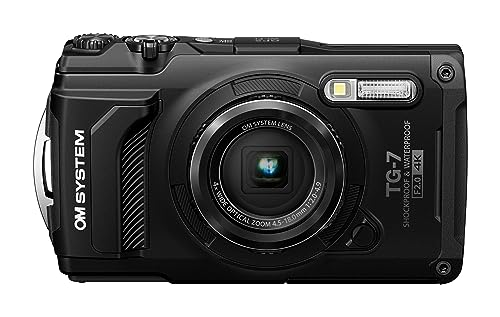
OM SYSTEM Tough TG-7 — Best mountain stills camera
The TG-7 is the camera mountaineers describe with the word “finally”: a stills camera engineered for the conditions that kill other stills cameras. It is freeze-proof to temperatures that stop mirrorless shutters sulking, crush-proof against the pack’s compression and the harness’s swing into rock, and waterproof against the spindrift and sleet that constitute mountain weather’s small talk. Its buttons work in gloves, its menus are shallow, and it wakes fast — the summit photograph is a thirty-second opportunity, and this camera spends none of it booting.
Its photographic gifts suit the expedition record specifically. The macro mode documents the mountain’s small print — rime ice feathers, alpine flowers in July, the frostbite-check photograph a leader takes of a companion’s cheek (documentation, not diagnosis). The field sensors log altitude, temperature and location into the files, so the expedition diary assembles itself. And its size means it lives in a chest pocket, warm against the body, ready — the only camera position that matters at altitude.
Its underwater-rated sealing earns a mountain footnote too: the meltwater stream crossing, the tent’s dripping condensation and the spindrift that finds every zip are all, to this camera, weather it was born in. Photographers migrating from the dive world will find its manners familiar; photographers meeting it first on a mountain will find every other camera oddly fragile thereafter.
Its sensor is a compact’s, and the files will not match the mirrorless pick’s in the dawn gloom. What they will be is taken — at the summit, in the storm, on the ridge — while finer cameras sit powered down in packs, conserving batteries that the cold was eating anyway.
Guides adopt it for a reason worth copying: a leader’s camera must document conditions for the team behind and the report after — the cornice’s state, the fixed ropes’ wear, the weather building over the next valley — and it must do so from a chest pocket in the middle of managing people. A camera that serves a guide’s working day serves any climber’s, and the TG-7’s ubiquity in professional rucksacks is the market’s most honest review.
- Format: rugged compact, freeze-proof and crush-proof
- Controls: glove-friendly buttons, fast wake
- Logging: altitude, temperature and GPS in the files
- Close focus: macro mode for expedition details
- Carry: chest-pocket size, body-warm batteries
Strengths
- Survives the mountain’s ordinary abuse without protection
- Operable in mitts at the moments that matter
- The expedition diary logs itself
Trade-offs
- Small sensor limits dawn and storm image quality
- Fixed lens fixes your framing choices
- Video is a bonus, not its profession
Best for: alpinists and trekkers whose stills must happen in any weather. Not suited for: expeditions selling professional imagery as a primary goal.

GoPro HERO13 Black — Best for summit and rope footage
The HERO13 is the moving image of modern mountaineering: on the helmet for the headwall, on the chest for the ridge traverse, on a pole at the summit for the team’s arrival. Its stabilisation irons the climber’s labouring movement into watchable footage, its voice control answers when both hands are on tools, and its lens mods let one camera cover the wide summit panorama and the close rope-work detail. Waterproof and impact-tolerant, it treats the mountain’s knocks as weather.
Battery discipline is its mountain craft: the cold saps it as it saps all electronics, so the professional habit — batteries rotated from an inside pocket, the camera itself carried against the body between shots — is part of owning it well. Its footage at dawn, the hour of summit pushes, holds together with a grace earlier generations lacked, and its slow-motion turns the spindrift’s river off a ridge into the expedition film’s poetry.
It will not make a stills photograph to hang in a gallery, and it does not apply for that job.
Its media discipline at altitude is worth one craft note: shoot the summit sequence at the settings rehearsed in the valley, because the summit is no place to discover a menu. The climbers who bring home the canonical footage — the rope arriving, the hug, the panorama — are the ones whose cameras were configured by their rested, oxygenated past selves. As the witness of the climb itself, it remains the standard the others are measured against.
Learn its one mountain-specific frailty and plan around it: wind. A helmet camera at a ridge crest records the gale more faithfully than the climb, so the expedition editor’s friend is the dead-cat wind cover on the camera and the chest position, sheltered by the body, for the exposed passages. Sound at altitude is mostly weather anyway; the film that matters is the picture, and the picture this camera brings home from a summit ridge has no substitute at its weight.
- Format: waterproof action camera
- Mounts: helmet, chest, pole and harness ecosystems
- Control: voice commands for hands-busy moments
- Lenses: interchangeable mods for different views
- Video: high frame rates and strong stabilisation
Strengths
- Films the climb from inside the climb
- Mounts survive and adapt to any position
- Voice control when hands are on tools
Trade-offs
- Cold demands a battery rotation ritual
- Stills are documentation, not art
- Small screen and gloves are uneasy partners
Best for: filming ascents, ridges and summit moments. Not suited for: stills-led expedition photography.

DJI Osmo Action 5 Pro — Best battery and low-light action cam
The Action 5 Pro’s mountain argument is endurance married to twilight. Its battery life is the action class’s marathon standard — a decisive virtue when every battery is carried up and every cold night taxes the spares — and its larger sensor holds the dawn and dusk hours when summit pushes actually happen, rendering the alpenglow’s colours with a fidelity that flatters snowfields rather than bleaching them. Subject tracking keeps a lead climber framed on a traverse without the camera’s owner touching anything.
DJI’s colour science deserves its sentence in a mountain context: rock, ice and sky are a palette of blues and greys that cheap processing turns to mush, and this camera keeps the distinctions — the glacier’s deep blue crevasses against the snow’s white, the granite’s warmth against the cold light. Mounts and accessories cross-pollinate with much of the action ecosystem, softening the switch for GoPro households.
Choose it when the expedition’s filming days are long, its light is marginal, and its battery budget is counted in grams — which is to say, on most serious mountains.
Its screens deserve their mountain sentence: readable in the glare off a snowfield, where many a rival turns to mirror, and operable in the thin gloves of a summer alpine day. Small mercies compound at altitude, and a camera that can be checked at a glance saves the fumbling that costs fingers their warmth and teams their rhythm.
Its endurance changes expedition behaviour in a way worth naming: when the camera can be left running through a whole rope-length of climbing, the film stops being a series of posed fragments and becomes a document — the leader’s breathing, the second’s arrival, the anchor built in real time. Sponsors, families and the climbers’ future selves all value that document differently from a highlight reel, and it is only available to the camera whose battery does not ration the truth.
- Format: waterproof action camera
- Battery: class-leading endurance
- Sensor: larger, for dawn and dusk quality
- Tracking: subject tracking for rope work
- Colour: faithful rendering of snow, ice and rock
Strengths
- Films longest between battery changes
- Best action-cam image in summit-push light
- Colour that respects the mountain palette
Trade-offs
- Ecosystem younger than GoPro’s
- Stills remain a secondary virtue
- Cold still taxes it — rotation ritual applies
Best for: long expedition days and twilight filming. Not suited for: photographers whose main deliverable is stills.

Insta360 X4 — Best for immersive expedition film
The X4 changes the filming contract for a climber: mount it, start it, and climb. Its 360 capture records everything — the rope ahead, the drop behind, the summit cross arriving — and the framing decisions are postponed to the edit, where the film’s director can choose angles the climber was too busy surviving to consider. For solo mountaineers, whose hands and attention are fully subscribed, that postponement is not a convenience; it is the only way the film exists at all.
The invisible selfie-stick effect gives the expedition film its signature shot — the climber mid-ridge, filmed as if by a drone that the mountain never saw — and the camera doubles as a conventional action camera in its single-lens mode for the tent-life sequences. Waterproofing and a build that tolerates the pack’s realities complete a tool that has quietly become the soloist’s favourite witness.
Its costs are workflow and delicacy: 360 files are heavy, the reframing edit is a real evening’s work, and the exposed lenses ask for case discipline in a world of crampons. Expeditions with an editor’s patience will find it transformative; those without should take the HERO13’s ready-made frames.
Its battery, sealed inside the body as 360 cameras tend to arrange things, makes the warm-rotation ritual a camera-rotation ritual: the whole unit rides against the body between sequences. Plan the filming in bursts the cold allows, and the X4 repays the planning with footage no other position on the mountain could have gathered.
Protect the lenses like the expedition’s eyes, because on this camera they literally are: a hard case in the pack’s lid, lens guards on for the climbing, and a cleaning cloth that lives in the same pocket as the camera. Teams that adopt the discipline find the 360 footage becomes the expedition film’s spine — the only record that was looking everywhere when the mountain did something unscripted.
- Format: 360 action camera with single-lens mode
- Capture: everything, reframed in the edit
- Mounting: pole for the invisible-drone effect
- Build: waterproof, pocketable
- Role: solo climbers and immersive films
Strengths
- The solo climber’s complete film crew
- Angles chosen after the climb, not during it
- Signature ridge shots no other pick can make
Trade-offs
- Editing workflow is a real commitment
- Exposed lenses need careful protection
- Files are heavy for expedition storage
Best for: solo mountaineers and film-led expeditions. Not suited for: quick-turnaround content or stills work.

Nikon Z50 II — Best image quality a climber will carry
Some expeditions exist to make photographs: the sponsored ascent, the guidebook shoot, the personal project a climber has trained years to attempt. The Z50 II is the quality ceiling of what a climbing human will voluntarily carry — a real mirrorless system with interchangeable lenses, in a body and kit-lens combination light enough for the top camp. Its files stand beside professional work because, in the right hands, they are professional work: the dawn summit portrait with depth and colour, the telephoto compression of a neighbouring peak’s ridge, the camp-life images with genuine low-light grace.
Carrying it is a discipline the guide must state plainly: it rides in a padded case inside the pack’s lid or on a chest harness built for the purpose, it comes out at chosen moments rather than living in a pocket, and its batteries join the warm rotation like everyone else’s. In exchange for that ceremony, the expedition’s photographs graduate from record to portfolio.
Nikon’s preset colour helps the tired photographer more than pride admits — a rendering chosen at base camp, applied faithfully at the summit by a climber with nothing left for menus. Choose this body when the photographs are a reason for the climb, and accept its ceremony as the price of the graduation.
One operational vow completes its mountain manners: it never comes out on ground where a drop is unrecoverable unless it is tethered and the stance is a stance, not a hope. Insurance and warranties are valley concepts; at altitude, the photographer’s discipline is the only policy in force, and this camera — the kit’s most valuable single object — deserves the strictest version of it.
Its presence changes an expedition’s evenings in a way the spec sheet cannot capture: the day’s frames reviewed on a real screen in the mess tent, the route’s condition shared with the team, the morale of a group that can see what it is accomplishing. Leaders have used photography this way for a century — the plate camera’s glass negative shown around the fire is the direct ancestor of the Z50 II’s rear screen at altitude — and the morale is a safety factor disguised as entertainment.
- Format: APS-C mirrorless, interchangeable lenses
- Files: portfolio-grade stills and strong video
- Colour: presets chosen in advance for tired hands
- Carry: padded case or chest harness discipline
- Lenses: telephoto options for ridge compression
Strengths
- Image quality nothing else here approaches
- Light enough for genuine high camps
- Lens choice designs the expedition’s look
Trade-offs
- Needs protection the rugged picks laugh at
- Gloved operation is slower and finer
- Weight and bulk are real at altitude
Best for: photography-led expeditions and sponsored ascents. Not suited for: fast-and-light climbs or storm-bound stills.

AKASO Brave 7 LE — Best budget and backup action cam
Every expedition kit has a place for the camera whose loss is a shrug: the one lent to a teammate, mounted where a fall might take it, kept charged in the tent as the spare when the main camera’s battery dies at the summit hour. The Brave 7 LE fills that place with surprising competence — 4K footage, electronic stabilisation, a touchscreen and weather-sealed body at a price that changes the emotional arithmetic of risky mounts entirely.
Its footage will not match the flagships’ in dawn gloom, and its build tolerances are a working tool’s rather than an heirloom’s. But the mountain does not grade on a curve: the backup camera that is running when the main camera is not has, on the day, the finest image quality in the world. Teams equipping several members also find it the democratic option — a camera on every rope, an expedition film with everyone’s angles in it.
Buy it as the second camera, the loaner and the risk-taker, and it will earn its trivial weight on the first trip.
Its front screen, a budget luxury, earns a specific mountain commendation: the solo climber’s summit selfie and the rope team’s quick check of framing both happen without turning the camera around in gloved hands. Small features read differently at altitude, and this one reads like it was designed by someone who has worn mitts.
It also democratises the expedition film in a way worth one sentence of respect: when every rope carries a camera, the film belongs to the whole team — the porters’ and guides’ angles included — and the resulting record is richer and more honest than any single auteur’s. Mountains are climbed by teams; a camera priced for teams is a philosophical position, and this guide endorses it.
- Format: budget action camera, weather-sealed
- Video: 4K with electronic stabilisation
- Screen: touchscreen plus front display
- Role: backup, loaner and risky mounts
- Value: flagship-risk shots at a fraction of the cost
Strengths
- Makes risky and multi-camera setups affordable
- Competent footage in ordinary mountain light
- The ideal spare for summit day
Trade-offs
- Low-light footage trails the flagships
- Build and polish are working-grade
- Battery ecosystem is its own — spares to plan
Best for: second cameras, teams and risky mounts. Not suited for: the expedition’s primary film in hard light.
How do cold and altitude change the camera rules?
Cold attacks the system at its weakest chemical point: the battery. Lithium cells deliver their charge reluctantly as the temperature falls, and a battery that reads full in the tent can plead empty on the ridge — then recover, embarrassingly, in a warm pocket, because the charge was never gone, only shy. The mountaineer’s countermeasures are liturgy: batteries sleep in the sleeping bag, travel in an inside pocket, rotate through the camera like climbers on a fixed rope, and are counted each evening with the same seriousness as food and fuel. Solar charging at a sunny base camp helps the long expeditions; above it, carried warmth is the only power station.
Altitude attacks the photographer rather than the camera, and the camera must compensate: at the heights where thought itself slows, menus become insults and every operation should be a button, a dial or a voice command rehearsed at sea level. Condensation is the third enemy — a cold camera brought into a warm, steamy tent fogs inside and out — so the mountain rule is the photographer’s plastic bag: seal the camera in it before entering warmth, and let the condensation choose the bag instead of the lens.
Altitude adds one more quiet tax that belongs in this section: storage media and screens behave, but the human reviewing them does not — photographs judged on a small screen by a hypoxic photographer are judged badly, which is why the standing order is to shoot generously, delete nothing in the field, and let the valley’s oxygen make the editorial decisions. Cards are cheap; the summit morning happens once.
How should you carry a camera on technical ground?
The carry is a safety system and should be designed like one. On a rope, the camera belongs where a fall, a swing or a chimney’s squeeze will not make it a weapon or a casualty: chest-mounted for the action cameras, inside a sternum-strap pouch for the compact, tethered always — an untethered camera dropped on a rope team is litter at best and a missile at worst. At belays, the photographer’s first job is the belay; the camera works in the margins the anchor allows, and experienced teams build the photography into the rhythm — the second’s arrival, the leader’s stance at the stance — rather than interrupting the climbing for it.
Summit discipline deserves its sentence: the photographs are taken, briefly and well, and then the camera is put away and the descent — where the accidents live — gets the team’s whole mind.
Practise the two-minute summit routine itself until it is choreography: camera out, the team arranged with the route behind them, each member’s portrait, the panorama, camera away, ropes moving. Two minutes is generous for a rehearsed team and an insult to a fumbling one — and the difference, at altitude, in weather, is measured in more than photographs. Every camera in this guide is simple enough to serve that discipline; the climber’s job is to honour it.
How do you film and photograph on a glacier?
Glacier travel is mountaineering’s most photogenic discipline and its most procedurally strict: the rope team moves as one organism, stops are negotiated, and the camera must fit inside the organism’s rhythm. The working method is the stance photograph — shots taken at the rest steps and anchor moments, when the team’s geometry against the icefall composes itself — plus the chest camera’s continuous witness for the crevasse crossings and ladder work that no one will stop to pose for. Brightness is the glacier’s technical ambush: snow and ice under sun will fool any meter into underexposing the scene’s soul, so the experienced hand dials exposure compensation upward as a standing order and checks the histogram at the first stop, not the summit.
White balance and glare discipline follow: snow in shadow is blue, snow in sun is blinding, and the cameras here differ in how gracefully their automatic systems walk that line — the DJI’s colour and the TG-7’s dedicated snow manners both earned their places in this guide on glacier days. Sunglasses off for the portrait at the rest step, because eyes matter; glasses on for the working shots, because so does the photographer’s vision, in every sense.
Rope management and camera management make one final demand together: the photographer never lets the camera delay the team’s safety rituals. Photograph the anchor after it is built and checked, the crossing after the rope is set — the glacier’s procedures are the senior partner in every frame, and the expedition’s trust in its photographer is built from exactly that order of operations, visibly kept.
What about photographing the night sky and camp life at altitude?
High camps sit above much of the atmosphere’s murk, and the night sky there is a photographic subject no lowland can offer: the Milky Way over the summit ridge, headtorches stitching the route at 2 a.m., the tent’s glow against the snowfield. The mirrorless pick owns this chapter — a small tripod or a stuff-sack of snow for a rest, a long exposure, and the expedition has its poster. The action cameras make honourable attempts in their night modes and excel at the time-lapse of the team’s dawn preparations, a sequence every expedition film should include and nobody wants to operate manually at that hour.
Camp life is the expedition’s human archive: the stove’s blue flame, the diary being written by headtorch, the boots frozen into sculptures by morning. Photograph it with the same respect as the summit — these are the images the team will actually show their families — and let the TG-7’s toughness handle the tent’s condensation and chaos while the mirrorless rests in its case for the chosen moments.
Guard the night’s sleep against the camera’s ambitions: a time-lapse ticking beside a tired climber’s tent is a theft, and the expedition’s rest is a safety system. Set the night’s sequences early, let them run in the cold outside, and review the sky’s performance at breakfast — the mountain keeps its stars on a schedule indifferent to yours.
Comparison Table
| Camera | Type | Mountain role | Key virtue |
|---|---|---|---|
| OM SYSTEM Tough TG-7 | Rugged compact | Stills in any weather | Freeze-proof, glove-friendly |
| GoPro HERO13 Black | Action camera | Rope and summit footage | Mounts and voice control |
| DJI Osmo Action 5 Pro | Action camera | Long days, twilight | Battery endurance |
| Insta360 X4 | 360 camera | Solo expedition film | Reframe after the climb |
| Nikon Z50 II | Mirrorless | Photography-led expeditions | Image quality per gram |
| AKASO Brave 7 LE | Budget action camera | Backup and loaner | Risk it without tears |
What are the ethics and rules of photographing in the high mountains?
The mountain’s rules precede the camera’s: permits and local regulations govern many ranges, drones are banned or restricted in most serious mountain parks (one reason this guide is built on cameras a climber carries), and sacred or private places on the world’s great ranges ask — and deserve — a photographer’s restraint. The porters, guides and local teams who make expeditions possible are photographed as colleagues, with names learned and copies shared, not as colour for the hero’s album. And the oldest rule is the landscape’s own: the camera leaves nothing behind, not a battery in the snow, not a mount’s broken strap on the route — what the expedition carries up, the expedition’s photographs should never outlast on the mountain.
None of this asks the photographer to be a saint — only to remember that the mountains were somebody’s home, shrine or workplace long before they were a backdrop, and that the expedition’s welcome in those valleys next season is partly written by this season’s camera manners.
How should you rehearse the camera before the expedition?
No camera should meet its first mountain on the expedition itself. The rehearsal protocol is a weekend: a local hill in the worst weather available, the full glove system worn, every operation the expedition will need performed until it is muscle — battery changes at a windy stance, the mount moved between helmet and chest with mitts on, the camera started, framed and stowed inside twenty seconds. Weaknesses found at home are adjustments; weaknesses found at the high camp are obituaries for photographs that will now never exist. Rehearse the failure drills too: the dropped battery retrieved from snow (wipe it, warm it, forgive it), the fogged lens managed by patience, the mount broken and improvised from cord and tape.
Rehearse the team’s side as well — the rope positions, the stance photograph’s choreography, the summit routine with its strict two minutes — so that on the mountain the photography is a drill everyone knows rather than a request anyone must think about. Altitude taxes thought; rehearsal is how the lowlands pay the tax in advance.
Bring the rehearsal’s findings back to the kit list with a red pen: the mount that needed two hands goes home, the pouch that froze shut is replaced, the menu setting that took a minute becomes a preset. Expeditions are edited on paper in the lowlands and merely performed in the mountains, and the camera kit obeys the same law as the route plan.
How do you compose photographs when the mountain is the subject?
Altitude’s classic photographic failure is scale: the photograph that shows a big mountain and somehow makes it look like a hill. The cure is the human figure, placed deliberately — the rope team small against the face is not a cliché but a measuring instrument, the only one the viewer trusts. The picks divide by how they serve that cure: the telephoto reach of the mirrorless compresses a distant team against the wall behind them; the wide action cameras put the viewer on the rope; the compact’s honest lens renders the scene as the eye remembers it. Choose the rendering that matches the story the expedition means to tell, and place the humans before you place anything else.
Light at altitude rewards the early and punishes the comfortable: the summit ridge at dawn, the face lit while the valley sleeps, the storm’s edge at dusk. Every schedule in this guide bends toward those hours — the 3 a.m. start is a photographic decision as much as a safety one — and the cameras that hold twilight (the DJI among the action cameras, the Nikon overall) were ranked with the dawn specifically in mind. Mountains are photographed at the day’s edges or they are merely recorded at its middle.
Weather is the third compositional partner, and the mountain photographer courts it rather than enduring it: the clearing storm that drags cloud through the cols, the lenticular stacked over the summit like crockery, the spindrift rivering off the ridge in the evening wind. These are the expedition’s signature images, and they belong to the photographer who kept a camera reachable — chest pocket, chest mount — in exactly the conditions every instinct says to batten down. The rugged picks in this guide exist for those twenty minutes.
How do ski mountaineering and summer alpinism differ for cameras?
Ski mountaineering adds velocity and consequence to every camera decision: the descent is filmed at speed, the camera’s mount must survive a fall at that speed, and the photographer skis one-handed or not at all — which is why the chest-mounted action camera, started at the top and forgotten, owns the discipline. The ascent’s skin track is the stills camera’s hour, the zigzag line against the slope composing itself for the TG-7 in the chest pocket. Cold is crueller on ski days, with windchill doing what altitude does elsewhere, and the battery liturgy applies in full.
Summer rock reverses the emphases: hands are the instruments, gloves are thin or absent, and the camera’s enemy is abrasion — rock against lens, harness metal against screen. The compact lives in its pouch on the harness’s gear loop where a draw’s swing cannot reach stone, and the action camera’s lens guards earn their keep on every pitch. Both seasons agree on the guide’s standing orders — tethered, reachable, simple — and differ only in which failure they rehearse against.
A word for the descent, which both seasons share and both cameras serve: the ski down and the down-climb are when the team’s guard is lowest and the mountain’s light is often at its most theatrical. Build the descent’s filming into the plan — the action camera started before the first turn, the stills taken at the regroup points — and the expedition film gains its natural climax instead of trailing off at the summit, as if the mountain ended where the climbing did.
How do you power and store footage on a long expedition?
Beyond a week, the camera kit becomes a logistics problem with a lens attached. Power is planned like fuel: a base-camp solar panel and a shared charging rota for the long expeditions, a strict battery inventory for the fast ones, and every cable and adapter duplicated because the mountain is a long way from a shop. Cards are treated as film once was — shot, labelled, sealed, and never formatted in the field; the footage’s backup lives in a second place from the third day onward, even if the second place is only a different tent. Expeditions have lost cameras to crevasses and rivers since the beginning; the professional standard is that the expedition’s images survive the camera.
Weight accounting closes the plan: the whole photographic system — bodies, mounts, batteries, charging, storage, protection — weighed as one line in the expedition’s ledger and argued for like any other line. The picks in this guide were chosen partly for how gracefully they scale down that ledger: the TG-7 and an action camera together weigh less than many a single mirrorless lens, and they cover ninety percent of what mountains ask cameras to do.
Label everything in the field with the discipline of a quartermaster: batteries numbered, cards dated, the charging rota on the mess-tent wall. It reads as pedantry at base camp and as genius at the high camp, where a tired team rotates batteries in the dark and the numbering is the only thing standing between the summit push and a pocketful of empty cells.
How does the team photographer’s role work on an expedition?
On any serious mountain, photography is a team job wearing one person’s name. The designated photographer carries less group gear in fair exchange for the camera kit, climbs in the rope position the light prefers, and is given the team’s patience at the photogenic moments — a social contract that must be agreed at base camp, not discovered on the headwall. In return, the photographer owes the team the whole record: every member’s summit moment, not only the photogenic ones; the unglamorous camp labour as faithfully as the ridge; and copies delivered before the reunion dinner, while the mountain is still in everyone’s legs.
Safety sits above the contract in writing: the photographer never unropes for an angle, never asks a tired climber to repeat a step for the camera, and puts the camera away — visibly, finally — when the mountain’s mood turns. Expeditions remember the photographer who honoured that order as fondly as the one who brought home the poster, and the two are usually the same person.
Deliver the record generously and promptly: the expedition’s images shared with every member, the porters and guides included, within days of the descent. Photographs hoarded become photographs resented, and the mountain community is small enough that a photographer’s generosity — or its absence — is remembered on the next valley’s trailhead with total accuracy.
What mistakes do climbers make with cameras?
Carrying the camera in the pack’s lid leads the list — unreachable on the rope, it documents the camps and misses the climb. Second is the unrotated battery: the summit reached with a camera full of cold, shy charge and a photographer full of regret. Third is photographing through the crux instead of climbing it, a safety failure wearing a creative excuse. Fourth is the unprotected lens in spindrift, filming the storm as an impressionist blur. And fifth is the descent forgotten — teams film the ascent and pocket the camera for the way down, losing the expedition’s second half and, often, its best light.
To the five, add the meta-mistake that produces them all: treating the camera as luggage rather than equipment. Luggage is packed; equipment is carried, maintained, rehearsed and integrated into the team’s systems. Every failure in this section is a luggage failure, and every success story in the guide above is equipment thinking applied to a box with a lens.
Final Recommendation
Take the TG-7 if stills are the record and weather is the certainty — it is the mountain stills camera, full stop. Film the climb on the HERO13 for the classic angles or the Action 5 Pro for the long twilight days; give the X4 to the soloist and the film-led expedition. Carry the Z50 II when the photographs are a purpose of the ascent, and tuck a Brave 7 LE into every team kit as the cheapest insurance in mountaineering. Above all: batteries warm, camera tethered, crux first and camera second — the mountain grades on those terms, and its photographs are the proof.
One last word on proportion, from every expedition photographer we debriefed: the camera is the expedition’s servant, never its master. The teams that come home with the great photographs are, without exception, the teams that would have put the camera down for the mountain without a moment’s hesitation — and did, whenever asked. That order of loyalties is itself a photographic technique, because the mountain can tell the difference, and so, eventually, can the pictures.
Climb well, photograph honestly, and bring both the team and the record home — in that order, every time, and the mountains will keep offering you their mornings.
Frequently Asked Questions
Will my camera survive a night in a cold tent?
The rugged and action picks here are built for it; the mirrorless body should sleep in its case, ideally with its battery removed to the sleeping bag. The greater risk is condensation when cold gear meets warm tent air — seal the camera in a plastic bag before bringing it into warmth and let the bag take the fog.
How many batteries do I need for a summit day?
Plan for the cold to halve what the battery promises, then add the day’s ambition: most climbers carry two to three per camera, rotated from an inside pocket, and treat the count as part of the evening’s fuel-and-food inventory. The Action 5 Pro’s endurance stretches the arithmetic furthest.
Can I use a camera with ski gloves or mitts?
That is the test this guide applied first. The TG-7’s buttons and the action cameras’ voice control and large record buttons pass it; touchscreens mostly fail it, which is why the action picks are operated by button and voice on the mountain, with the screen reserved for camp.
Is a mirrorless camera worth its weight at altitude?
When the photographs are among the expedition’s purposes, yes — and the Z50 II is the weight at which that answer turns favourable. When the climb itself is the whole purpose, the rugged compact and action cameras will bring home the record at a fraction of the burden.
What is the best camera for a beginner alpinist?
The TG-7, for the reason this guide began with: it asks the least of a climber whose attention is fully spent on the new craft of moving in the mountains. It lives in the chest pocket, works in any gloves, survives the beginner’s hundred small accidents, and its photographs will be better than the beginner’s spare attention deserves. Add an action camera when filming the learning becomes part of the pleasure.
How do I stop my lens fogging on summit morning?
Keep the camera at ambient temperature rather than warming it — a camera that slept cold stays clear in cold air — and give it time to equalise after any move between temperatures, sealed in its bag. Wiping a fogged lens in spindrift makes everything worse; patience and the plastic bag are the whole technology.
Can I charge cameras at high camp?
On longer expeditions, yes, by plan rather than by hope: a base-camp solar setup and a charging rota cover the camps below the top one, and the summit push itself runs on carried, warm, counted batteries. Fast and light ascents skip charging entirely — which is another argument for the endurance pick and the rugged compact’s modest appetite.
Related Guides
Related reading: our guides to the best cameras for trekking to Mount Kilimanjaro, action cameras for outdoor and adventure sports and the best rugged cameras for extreme weather.


