reviewstook.com is reader-supported. When you buy through links on our site, we may earn an affiliate commission.
Where to Buy a Camera That Freezes the Moment Instead of Blurring It
The best cameras for capturing movement solve photography’s oldest heartbreak: the decisive instant, smeared. A child’s goal, a dog at full stretch, a dancer’s leap, a wave breaking — the subjects worth photographing most are precisely the ones that refuse to hold still, and the best cameras for capturing movement are engineered around that refusal. They combine fast shutters and faster bursts, autofocus that predicts where a subject is going rather than reporting where it was, stabilisation that separates your shake from the subject’s motion, and sensors that stay clean when the light fades and the action, inconsiderately, does not.
Four picks below link to movement specialists in our verified pool — two action cameras built to live inside the motion, and two stills-led bodies that freeze it from the sidelines — while two professional-grade movers outside the pool are covered prose-only. The guide treats movement as three different problems wearing one name: freezing a subject dead sharp, panning to blur the world while the subject stays crisp, and filming motion smoothly enough that the eye reads it as reality. Different picks win each problem, and the sections below are organised to make that plain before you spend anything.
A liberating truth first: technique contributes more than equipment at the start. Every pick here can be defeated by a slow shutter chosen carelessly, and a modest camera in practised hands will freeze more action than a flagship left on automatic in bad light. This guide therefore teaches the technique alongside the shopping, because the camera you need depends on which movement problem is actually ruining your photographs.
Key Takeaways
- Shutter speed freezes motion; burst rate and autofocus decide whether the frozen frame is the right one.
- Action cameras capture movement from inside it — mounted, waterproof and wide — while mirrorless bodies capture it from a distance with precision.
- Predictive subject-tracking autofocus is the feature that most separates these picks from ordinary cameras.
- High frame-rate video lets you extract sharp stills from motion that no shutter finger could time.
- Low-light movement is the hardest test: sensor size and lens brightness matter more after dusk than any burst figure.
- Panning technique — blurring the background while the subject stays sharp — is a skill every pick here rewards and none can replace.
In this guide
Quick Picks
| Pick | Badge | Why it captures movement well |
|---|---|---|
| GoPro HERO13 Black | Best action all-rounder | High frame rates, superb stabilisation and lens mods for filming sport and motion from inside the action. |
| DJI Osmo Action 5 Pro | Best low-light action cam | A larger sensor and subject tracking that keeps moving people centred in the frame automatically. |
| Canon EOS R6 Mark II | Best stills movement machine | Deep fast bursts, pre-capture and autofocus that holds athletes, animals and vehicles through chaos. |
| Insta360 Ace Pro 2 | Best clarity in motion | High-resolution recording and low-light processing that keep fast footage detailed rather than smeared. |
| Sony Alpha 9 III | Best professional ceiling | A global shutter that eliminates distortion on the fastest subjects photography can find. |
| OM System OM-1 Mark II | Best burst value | Very fast bursts with pre-capture in a light body that follows the action all day. |
How Did We Choose the Best Cameras for Capturing Movement?
We broke movement into its physical components and scored each. First, temporal resolution: how finely the camera slices time, through maximum shutter speeds, burst rates with focus maintained, and video frame rates high enough to slow a wingbeat or a splash into readable frames. Second, prediction: the quality of subject detection and tracking, because a burst of twenty frames focused on where the subject was is a documentary about failure. Cameras whose autofocus names and follows people, animals, birds and vehicles — and holds them through crossings and occlusions — scored at the top of the guide’s weighting.
Third, the light equation. Movement photography burns light: fast shutters admit little of it, and action peaks at dusk games, indoor sports and grey race days. Sensor sensitivity, stabilisation that buys back shutter speed for the camera’s own shake without touching the subject’s blur, and lens brightness in each system all counted heavily. Fourth, endurance — buffers that survive a whole rally or race finish, batteries that last a meet, and bodies sealed against the weather that outdoor action refuses to reschedule.
The result is a deliberately mixed list. Purists may question action cameras beside full-frame bodies, but movement lives in both worlds: the surfer’s barrel and the photograph of the surfer are the same wave, and this guide serves the people capturing each.
What Are the Three Kinds of Movement Photograph?
The freeze is the icon: the striker’s boot an inch from the ball, every droplet of the breaking wave suspended, the dog’s ears horizontal. It demands a fast shutter, precise focus at the peak instant, and enough burst to choose the best geometry afterwards. The pan is the artist’s version: a slower shutter while you swing the camera with the subject, rendering the cyclist sharp against a streaked street — motion expressed rather than arrested. The flow is video’s territory: movement filmed at frame rates and stabilisation levels that let the viewer feel speed without seasickness, or slowed into high-frame-rate studies where a skateboard trick decomposes into its hidden phases.
Know which of the three you are chasing before reading the reviews, because the picks specialise honestly. The Canon is the freeze machine. The action cameras own the flow and join the action itself. The OM and the Sony prose picks push the freeze toward its professional limits. And every pick can pan, in the hands of a photographer who practises the swing — a skill the how-to section below teaches in an afternoon.

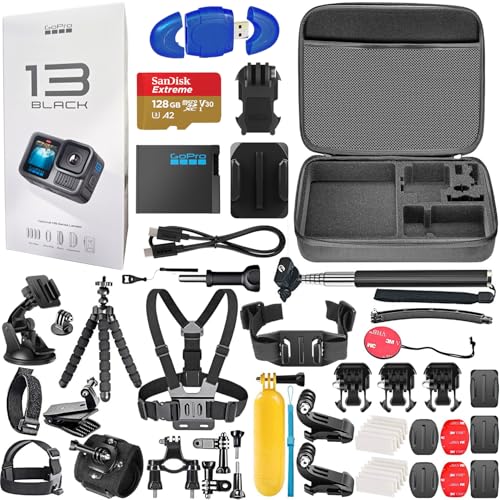
GoPro HERO13 Black — Best action all-rounder
The HERO13 is the movement camera as participant: mounted on the helmet, the board, the bike or the dog, it films motion from inside with stabilisation that irons a trail run into a tracking shot. Its high frame rates slow a jump or a trick into studyable phases, its burst photo modes catch stills at speeds no finger times, and interchangeable lens mods widen or linearise the view for different sports. Waterproof, voice-controllable and small enough to forget you are wearing, it captures the movement other cameras can only watch.
For photographers of other people’s movement it works as the wide, fearless second angle — on the goalpost, at the pool’s edge, under the skate ramp — while a main body does the precision work. Battery options and an ecosystem of mounts make it the most configurable action platform here. Its limits are the action format’s own: no optical zoom for distant action, stills that serve sharing rather than printing, and low light that improves yearly without yet matching the DJI’s larger sensor after dark.
- Format: waterproof action camera
- Video: high-resolution with high frame-rate modes
- Stabilisation: class-leading electronic smoothing
- Lens: interchangeable mods for different fields of view
- Photo modes: fast bursts for peak-action stills
Strengths
- Captures movement from inside it, where no other pick can go.
- Burst stills and slow-motion video cover both the freeze and the flow.
- The mount ecosystem adapts it to virtually every sport invented.
Trade-offs
- Distant action stays distant; there is no telephoto story here.
- Stills quality serves screens, not gallery prints.
- Low-light footage trails the DJI Action 5 Pro’s larger sensor.
Best for: participants and second-angle shooters filming sport from within it.
Not suited for: sideline photographers of distant field sports.

DJI Osmo Action 5 Pro — Best low-light action cam
DJI’s answer to the movement problem is intelligence plus sensitivity. The Action 5 Pro’s larger sensor holds detail and colour as light falls — evening skate parks, forest trails, floodlit five-a-side — where action cameras traditionally dissolve into noise. Its subject tracking keeps a moving person centred in the frame automatically, a quiet revolution for solo athletes filming themselves: set it down, perform the trick, and the camera has followed like a patient friend. Dual screens front and back make self-framing trivial, and the stabilisation matches the class standard.
battery endurance is a genuine field advantage for long event days, and the colour science flatters skin and sky without grading. As a stills camera it shares the format’s limits, and its mount ecosystem, while growing, plays catch-up to GoPro’s decade of accessories. For movement in poor light — which is where amateur action actually lives, after school and after work — it is currently the action camera to beat.
- Format: waterproof action camera
- Sensor: larger format for low-light motion
- Tracking: automatic subject centring
- Screens: front and rear touchscreens
- Battery: long endurance for event days
Strengths
- Evening and indoor action stays detailed where rivals smear.
- Subject tracking films solo performers without a camera operator.
- Endurance suits tournaments, meets and long trail days.
Trade-offs
- Mount and accessory range still trails GoPro’s ecosystem.
- Stills remain a bonus feature rather than a purpose.
- No optical zoom, as with every action camera here.
Best for: solo athletes, evening sports and low-light action filming.
Not suited for: distant sideline subjects or print-first stills shooters.

Canon EOS R6 Mark II — Best stills movement machine
From the sidelines, this is the movement camera to beat. The R6 Mark II fires deep, fast bursts with autofocus that recognises people, animals and vehicles and clings to eyes and helmets through crossings that break lesser systems. Its pre-release capture banks the fraction of a second before your press — the exact territory where take-offs, strikes and finishes live — and its full-frame sensor keeps the high shutter speeds affordable in light that would grain a smaller sensor apart. This is the body that turns “I almost got the goal” into a sequence you choose from.
Video is a genuine second craft: high-quality 4K with the same subject confidence, stabilisation that steadies a handheld pan across a pitch, and recording stamina for whole matches. The honest limits are resolution for heavy cropping — distant action photographers should mount longer glass rather than crop harder — and the full-frame system’s lens prices. Paired with a mid telephoto zoom, it is the amateur movement photographer’s most complete instrument in this guide.
- Format: mirrorless, full-frame
- Burst: fast, deep, with pre-release capture
- Autofocus: subject and eye tracking for action
- Stabilisation: in-body for stills and video
- Video: strong 4K for match and event filming
Strengths
- Pre-capture rescues the instants human reflexes structurally miss.
- Tracking autofocus holds subjects through clutter and crossings.
- Low-light sensitivity keeps fast shutters usable at dusk games.
Trade-offs
- Heavy cropping of distant action softens sooner than high-resolution rivals.
- The telephoto lenses it deserves are a serious, gradual investment.
- Rolling shutter can bend the fastest pans in electronic-shutter modes.
Best for: sports, wildlife and family action photographed from the sidelines.
Not suited for: in-the-action mounting or ultra-budget builds.

Insta360 Ace Pro 2 — Best clarity in motion
The Ace Pro 2’s movement argument is resolution married to processing: it records fast action at up to 8K-class detail with low-light image processing that keeps night streets, gym halls and evening trails readable rather than impressionistic. For the movement shooter, that clarity buys a second chance in the edit — footage can be reframed and cropped toward the subject without collapsing, and stills pulled from the video arrive with genuine detail. Its flip screen serves the self-filming athlete, and the magnetic mounting system swaps positions in seconds between attempts.
Waterproofing, voice and gesture control and a mature app complete a package aimed at creators who publish motion. It concedes the ultimate stabilisation crown to no one in particular — the class is close — while its low-light clarity is its own headline. Battery and heat discipline at the highest resolutions need the usual action-camera respect. For night rides, indoor sports and any movement that happens under artificial light, it is the connoisseur’s action pick.
- Format: waterproof action camera
- Video: up to 8K-class recording
- Processing: AI-assisted low-light clarity
- Screen: large flip touchscreen
- Mounting: quick-release magnetic system
Strengths
- Low-light motion stays detailed under gym and street lighting.
- High resolution permits reframing toward the action afterwards.
- Flip screen and fast mounts suit solo creators filming themselves.
Trade-offs
- Top resolutions demand battery and heat management on long sessions.
- Accessory ecosystem is younger than GoPro’s.
- Stills pulled from video still trail a dedicated stills body.
Best for: night and indoor action, and creators who reframe in the edit.
Not suited for: distant field sports needing optical reach.
Sony Alpha 9 III — Best professional ceiling
The Alpha 9 III exists to end an argument: its global shutter reads the entire sensor at once, so the fastest subjects in photography — a golf swing, a racing wheel, a pitcher’s arm — record without the skew and bending that rolling shutters impose. Flash sync at any speed, blackout-free bursts at extraordinary rates and Sony’s flagship tracking make it the movement camera professionals reach for when failure is printed in newspapers. We cover it prose-only as the ceiling of the genre: most readers should buy the Canon and the lens, but knowing what the ceiling looks like calibrates every judgement below it.
Its compromises are a working professional’s: resolution chosen for speed over cropping, a price that assumes invoices, and capability so deep that an amateur would use a tenth of it. As a statement of where movement capture has arrived — distortion-free, pre-capturing, effectively unlimited in burst — it earns its paragraph in any honest guide to photographing motion.
- Format: mirrorless, full-frame global shutter
- Burst: blackout-free at professional rates
- Shutter: no rolling-shutter distortion at any speed
- Autofocus: flagship subject tracking
- Role: the genre’s current ceiling
Strengths
- Global shutter removes distortion from the fastest motion entirely.
- Burst and pre-capture performance redefine reaction-time limits.
- Flash at any shutter speed opens creative movement techniques.
Trade-offs
- Priced for professionals with paying clients.
- Resolution is tuned for speed, not for cropping distant subjects.
- Its depth is wasted on casual movement shooting.
Best for: professionals and wealthy perfectionists in fast sports.
Not suited for: amateur budgets or all-round family use.
OM System OM-1 Mark II — Best burst value
If burst performance per unit of money and weight is the metric, the OM-1 Mark II embarrasses cameras costing far more. Its stacked sensor fires extremely fast bursts with focus maintained, its pre-capture banks the moments before the press, and its subject detection covers the birds, animals, cars and planes that movement photographers chase. The Micro Four Thirds format doubles lens reach, so the action photographer’s telephoto is smaller, lighter and cheaper — a combination that matters across a day on your feet at a circuit or a reserve.
Prose-only here, its caveats are the format’s: low-light ceilings below the full-frame picks and resolution that asks you to fill the frame rather than crop into it. For daylight action — motorsport, field sports, wildlife, airshows — it is arguably the smartest movement purchase on this page, and its weather sealing suits the conditions action refuses to postpone.
- Format: mirrorless, Micro Four Thirds
- Burst: very fast with pre-capture
- Autofocus: subject detection for action categories
- Reach: double effective focal length per lens
- Build: weather-sealed, light for all-day carry
Strengths
- Burst and pre-capture performance rivals flagships at a fraction of the kit weight.
- Telephoto reach is cheaper and lighter here than anywhere else.
- Sealing suits outdoor action in real weather.
Trade-offs
- Dusk and indoor action reach its sensor’s limits sooner.
- Cropping headroom is modest; technique must fill the frame.
- The system is a commitment to the smaller format’s lens line.
Best for: daylight action specialists who value bursts and reach per kilo.
Not suited for: floodlit and indoor sports as a main diet.
How Do the Best Cameras for Capturing Movement Compare?
| Camera | Movement style | Signature weapon | Light appetite | Best arena |
|---|---|---|---|---|
| GoPro HERO13 Black | Inside the action | Stabilisation and mounts | Good in daylight | Trails, water, wheels |
| DJI Osmo Action 5 Pro | Inside the action | Tracking and low light | Best after dark | Evening sport, solo filming |
| Canon EOS R6 Mark II | Sideline precision | Bursts and pre-capture | Strong at dusk | Fields, courts, reserves |
| Insta360 Ace Pro 2 | Inside, reframed later | Resolution and clarity | Strong indoors | Gyms, night streets |
| Sony Alpha 9 III | Sideline, professional | Global shutter | Professional | Stadiums, circuits |
| OM System OM-1 Mark II | Sideline, mobile | Burst value and reach | Daylight champion | Circuits, coasts, hides |
The table divides the world at the touchline: cameras that join the movement and cameras that judge it. Most movement photographers eventually own one of each, and the order of purchase should follow which side of the line your subjects live on.
How Do You Freeze Movement With Any of These Cameras?
Start with the shutter, because it does the freezing. As working rules: a walking person surrenders to a moderately fast shutter, a running child or dog needs a genuinely fast one, and wings, wheels and water need the fastest your light affords. Set the camera to shutter-priority or manual with auto ISO, choose the speed the subject demands, and let the camera balance the rest — then raise the speed further than instinct suggests, because movement blur hides in frames that looked sharp on a small screen. Shoot in bursts of three to five frames through the peak moment rather than gambling on a single press; the peak has a width, and the burst walks across it.
Position is the silent half of the technique. Movement across your view blurs more than movement toward you, so a subject running at the camera tolerates a slower shutter than one crossing the frame — a fact goalkeepers’ photographers exploit from behind the goal. Anticipate the peak: the top of the jump, the strike of the ball, the crest of the wave, and start the burst a breath before it. Pre-capture bodies forgive the breath; the rest of us practise until the breath becomes timing. Review at full magnification that evening and let the blur you find set tomorrow’s shutter speed — movement photography is a feedback loop, and every pick here shortens it.
How Do You Pan for the Shot That Feels Like Speed?
Choose a shutter several stops slower than the freeze setting, plant your feet toward the subject’s exit point, and track the subject in the viewfinder well before the shot — swinging from the hips, smoothly, like a golfer who has forgotten the ball. Fire a burst mid-swing and keep swinging after, because stopping the pan at the press is what streaks the subject. Expect a low keeper rate at first: one sharp frame in twenty is a professional yield for aggressive pans, and the nineteen failures are tuition, not evidence against the camera.
Stabilisation modes matter here: several picks offer a panning-aware mode that corrects vertical shake while permitting the horizontal streak — use it if yours does. Start with cyclists and cars at forgiving speeds, where the subject’s path is a promise it keeps, and graduate to runners and riders whose paths negotiate. The pan is the movement photograph that viewers feel in their stomachs, and it costs nothing but practice afternoons — the best-value technique in this entire guide.
Which Mistakes Ruin Movement Photographs?
Leaving the shutter on whatever automatic chose
Automatic exposure optimises for a correct average brightness, not for frozen motion, and it will cheerfully choose a shutter speed that turns your sprinter into a ghost. Movement work begins by taking the shutter away from the average — shutter-priority at minimum — and every blurred archive in the world testifies to what happens when photographers skip that step.
Standing where the action crosses instead of where it approaches
Crossing motion maximises blur and minimises the time a subject spends large in the frame. Reposition so the action comes toward you or recedes — behind the goal, at the bend’s exit, at the bottom of the slope — and the same camera with the same settings suddenly seems twice as capable.
Chimping while the action continues
Reviewing the burst while the match plays on is how the goal after the goal gets missed. Trust the burst, keep the camera up during live action, and review at breaks. The picks with pre-capture exist partly to forgive this human habit, but no buffer forgives a camera pointed at its own screen.
Freezing everything at maximum speed, always
A season of uniformly frozen action reads as a catalogue, not a story. Mix the grammar: freeze the peak, pan the journey, film the flow. The photographers whose movement work gets remembered treat shutter speed as a vocabulary, and the cameras here speak all of it.
Final Recommendation
Participants should start inside the action: the DJI Osmo Action 5 Pro for evening and solo filming, the GoPro HERO13 where mounts and daylight rule. Sideline photographers should take the Canon EOS R6 Mark II as the movement instrument that does everything well, with the OM-1 Mark II as the daylight reach-and-burst alternative. Then practise the freeze and the pan for a month before judging the results — movement is the genre where the photographer improves fastest and the camera matters most honestly, in that order.
Frequently Asked Questions
What shutter speed freezes a running child or dog?
Start genuinely fast — the kind of speed that feels excessive for a still subject — and review at full size. Crossing motion needs more speed than approaching motion, and dull light may force a compromise where a slightly soft, well-timed frame beats a sharp, mistimed one.
Are action cameras good for photographing other people’s sports?
As wide, close, fearless second angles, yes — on the goalpost, at the track’s edge, in the water. For distant field action they cannot replace a telephoto on a mirrorless body, which is why this guide treats the two families as partners rather than rivals.
Does a higher burst rate guarantee the decisive moment?
It guarantees more candidates around the moment; timing and pre-capture decide whether the moment itself is among them. Anticipation — knowing the sport’s rhythm — remains the cheapest frame rate multiplier in photography.
Can I pull still photographs from action video?
Yes, and the high-resolution picks make it respectable: a frame from 4K or higher footage serves screens and small prints well. Dedicated stills bursts remain sharper and better exposed per frame, so treat video extraction as the safety net, not the plan.
Why are my action shots sharp in the centre but blurred at the subject?
Usually the subject moved faster than the shutter across the frame, or focus sat on the background at the decisive instant. Raise the shutter, switch to subject-tracking autofocus, and position for approaching rather than crossing action — the three fixes solve most movement blur between them.
How can I test shutter speed and autofocus tracking before I buy a camera for fast subjects?
Try the camera on movement you can repeat, not on a still display shelf. Ask to step near a doorway, street or store window where people, bicycles or cars pass at a steady pace, then shoot the same crossing subject several times: first with subject-tracking autofocus and a fast shutter, then with a slightly slower one. Zoom to full magnification and check whether eyes, logos or wheel spokes stay readable, whether focus follows the subject or sticks to the background, and whether the burst keeps that sharpness across the sequence rather than only in the first frame. Next, pan smoothly with a passing cyclist or car and look for a clean subject against streaked surroundings, plus any leaning vertical lines that reveal shutter behaviour you dislike. Finish with a short approaching run or walk toward the camera, because depth tracking fails differently from side-to-side tracking. If the shop will not allow even this brief trial, rent the shortlisted body for one real match, ride or park session before committing. One honest hour with your own subjects, light and keeper-rate notes tells you more than a specification sheet, and it turns the purchase into a decision you have already tested.
How Do You Capture Each Kind of Moving Subject?
Dogs reward the low camera and the long game: get to their eye level, use animal eye autofocus where the body offers it, and shoot the recall — a dog running toward its owner crosses the frame’s depth rather than its width, which flatters both focus and shutter. Bursts through the middle of the run, not its start, hold the full-stretch frames where all four paws leave the ground. Children in sport reward the opposite discipline: pick one child, pre-focus on the zone where the play will arrive, and let the game come to your frame instead of chasing it across the pitch with the zoom, which produces a season of almosts.
Motorsport is panning’s home ground, and its photographers build the day around two corners: one for the frozen hero shot at maximum shutter, one for the slow pan that becomes the poster’s sense of speed. Water — surfers, kayakers, breaking waves — rewards the action cameras worn by participants and the longest lens the sideline budget allows, with bursts timed to the wave’s decision rather than its approach. Dance and stage movement invert everything again: light is low and theatrical, shutter speeds must negotiate with choreography, and the mirrorless picks’ sensitivity plus a fast prime produce the frames, while the action cameras stay in the bag where their wide lenses and small sensors cannot help.
What Does Slow-Motion Filming Add to Movement Work?
High frame-rate recording is both an art and a diagnostic. As art, it stretches the half-second of a dive, a trick or a splash into a sequence the eye can finally read, and audiences feel the difference instantly. As diagnosis, it is how athletes and coaches — and photographers studying their subjects — decompose motion: the skateboarder watches where the board leaves the hand, the dog trainer watches the turn, the photographer watches exactly when the wing peaks, and returns to the stills camera with timing educated by the footage. The GoPro, DJI and Insta360 picks all film serious slow motion; the mirrorless bodies add it at higher quality with real lenses.
Practise the discipline of the short clip: slow motion devours storage and attention, and a card full of forty-second slow-motion studies of a ten-second trick helps nobody. Film the attempt, review the phase that failed, film again. Used that way, slow motion is the movement photographer’s practice room — and the footage, almost incidentally, becomes the most shared material the camera produces.
How Do You Capture Movement Indoors and at Night?
Indoor sport is where movement photography goes to be humbled: gym light is dim, mixed and flickering, subjects are fast, and flash is often unwelcome. The recipe is honesty about ISO — raise it until the shutter speed the sport demands is possible, accept grain as the texture of the occasion, and prefer the full-frame picks and the DJI’s larger action sensor, which hold colour and detail where smaller sensors surrender. Fast lenses matter more indoors than any body feature; the prime that seemed a portrait luxury becomes the reason the basketball frames exist at all.
Night street movement — traffic, rain, city sport — offers the opposite bargain: motion blur becomes the aesthetic, neon supplies the colour, and the Ace Pro 2’s low-light clarity and the action cameras’ stabilisation turn a walk into cinema. Settle for the grammar the light allows rather than fighting for noon’s freeze, and night movement work becomes the most atmospheric in your archive instead of the most deleted.
Which Settings Should a Movement Photographer Save as Defaults?
Build two saved configurations and let every outing start from one of them. The freeze preset: shutter-priority or manual with auto ISO, the fastest sensible shutter for the day’s light, continuous subject-tracking autofocus with the relevant detection category selected, the deepest burst your card sustains, and stabilisation on. The pan preset: a deliberately slower shutter, continuous autofocus, a moderate burst, and panning-aware stabilisation if the body offers it. Labelling them honestly — FREEZE and PAN on the mode dial’s custom positions — converts the sudden opportunity from a settings excavation into a single turn.
Review the presets monthly against the archive’s failures. If the month’s blur is focus-shaped, the tracking zone or detection category needs widening; if it is speed-shaped, the shutter floor rises; if the keeper rate is fine but the moments are wrong, the presets are innocent and the photographer’s anticipation is the homework. This loop — shoot, diagnose, adjust one variable — is how movement photographers actually improve, and the cameras here were chosen partly for how cleanly they let you run it: custom modes that remember, autofocus that reports its behaviour honestly, and buffers that never make the loop wait.
How Should You Practise Movement Photography in One Month?
Week one belongs to traffic and water: freeze a fountain until every droplet hangs, then pan the same street’s cyclists until one frame in twenty sings. Week two is animals — the park’s dogs at the recall, birds crossing a known gap — where anticipation replaces reaction as the skill under training. Week three is people in sport at the local level, where access is free and the light is honest, shooting whole halves rather than highlights and reviewing with a notebook. Week four returns to your real subject, whatever it is, with the month’s settings written down and the presets built from them.
The month costs nothing but afternoons and produces the only specification that matters: your personal keeper rate, per subject, per camera setting. Photographers who know that number stop shopping anxiously, because they can translate any new camera’s promises into their own results. Photographers who skip the month keep buying bursts they cannot use. Every pick in this guide rewards the month extravagantly — which is a polite way of saying the camera is ready when you are, and the calendar, not the catalogue, is the next step.
Do I need a tripod or monopod for movement work?
For the freeze, rarely — shutter speed is your tripod. For long telephoto sideline work, a monopod saves your arms across a match and steadies the pan’s swing into a cleaner arc. For the action cameras, the mount is the support, and choosing it well matters more than any tripod decision in this guide.
How Do Weather and Seasons Change Movement Photography?
Rain is movement’s favourite weather and its photographers’ examination. Wet surfaces double the reflections and the drama, athletes and animals move against darker, richer backgrounds, and every pick here that claims sealing earns it — the action cameras by birth, the mirrorless bodies by gasket, provided their lenses share the sealing and a rain cover handles the rest. Snow adds exposure treachery and battery discipline: cold drains cells mid-burst, so spares live in an inside pocket and rotate warm. Summer haze and heat shimmer punish long lenses at midday, moving the serious action work to the day’s edges where the light also happens to be beautiful.
The calendar’s lesson is that movement never cancels; it reschedules and re-costumes. A photographer equipped for the seasons — sealed body, warm batteries, a cover in the bag — collects the dramatic frames that fair-weather archives lack, and the cameras in this guide were screened for that calendar as carefully as for their burst rates. The specification that matters in February is rarely the one printed largest in the advertisement, and movement photographers learn to read a weather forecast the way sailors do: as the real programme of events.
What Should You Do With a Burst of Two Hundred Frames?
Cull like an editor, not a parent. First pass at speed, marking only the frames where geometry and expression peak — in a good burst there are rarely more than three. Second pass at full magnification on those finalists, where focus honesty lives. Keep one hero frame and, where the sequence itself tells the story, a tight series of three to five; delete the rest without ceremony, because storage discipline is what makes the next burst psychologically affordable. The photographers who drown are not the ones with slow cameras but the ones whose archives became unsearchable swamps of near-duplicates.
Caption the keepers the same day with the subject, the setting and the shutter speed that worked. That notebook — paper or phone — becomes your personal movement manual, worth more within a season than any guide, including this one, because it is written in your subjects and your light. The cameras above make the bursts; the cull and the notebook make the photographer.
How Do You Choose Between an Action Camera and a Mirrorless Body for Movement?
Ask where the camera will be when the movement happens. If the honest answer is “on the subject” — helmet, board, chest, handlebar, pool edge — the action cameras win without a contest, because no mirrorless body can be there and survive. If the answer is “with me, at the side, choosing the moment”, the mirrorless bodies win on focus precision, lens reach and stills quality, and the contest is equally closed. The undecided middle — “I film my kids’ sport from the line and my own rides from the bars” — is the two-camera answer most movement households eventually reach, usually starting with whichever side produces more of their current archive.
Budget the pair honestly if you go that way: an action camera plus the Canon or OM body covers essentially every movement situation a non-professional will meet, for less than the Sony professional ceiling alone. Sequence the purchases by frustration — buy first whichever absence ruined the last event — and let each camera’s presence teach you whether the second is needed at all. Many photographers discover the first purchase, properly practised with, was the whole answer. That discovery is worth more than the saving.
What Does Movement Photography Teach You About Your Other Photography?
Everything, eventually. The movement photographer’s anticipation — reading a scene for its next half-second — transfers to street photography, weddings and family candids, where the decisive moments are merely slower. Burst discipline teaches editing ruthlessness that improves every archive it touches. Even the failures instruct: a season of analysing blur teaches the exact relationship between shutter, subject and distance that portrait and landscape work usually leaves vague. Photographers who spend a year on movement return to their other genres visibly sharper, which is why this guide treats the genre as a school and not just a shopping category.
Choose the camera that fits your movement, practise the month’s curriculum, and keep the notebook. The frozen goal, the panned cyclist, the wave from inside — they are all waiting at shutter speeds you now understand, in light you have learned to read, for a photographer who has done the afternoons. That photographer is about six weekends away, and every pick above is ready to be carried there.
Which lens matters most for sideline movement photography?
The mid-to-long telephoto zoom that covers your venue’s distances at the fastest aperture your budget allows — because indoor and dusk action will spend that aperture constantly. Buy reach and brightness before body upgrades; a modest body behind bright, long glass out-shoots a flagship behind a slow kit zoom at every floodlit match ever played. The OM system’s compact telephotos make this purchase lightest, the Canon and Sony shelves make it most various, and the used market makes it survivable for all three.
Is electronic or mechanical shutter better for fast action?
Mechanical and electronic first-curtain modes avoid the skew that a fully electronic readout can give the fastest subjects and pans; electronic wins on silence, burst ceiling and pre-capture on the bodies that gate those features behind it. The global-shutter Sony prose pick exists to retire the question. For most movement, choose electronic for bursts and pre-capture, and switch if straight lines start leaning in your pans.
How Do You Film Movement That Looks Fast Without Looking Chaotic?
The paradox of motion footage is that maximum smoothness can read as slowness: a perfectly stabilised, high-frame-rate clip of a descent can feel like a lift ride. The craft lies in keeping the cues of speed — foreground objects streaking close to the lens, sound rising, the frame’s edges alive — while stabilising the subject’s path. Mount action cameras where the near ground rushes through the frame’s edge, choose frame rates that match the delivery rather than the maximum available, and let a whip pan or a cut carry transitions instead of smoothing them into soup. The DJI’s tracking and the GoPro’s lens mods are tools in that grammar; the grammar itself is learned by filming the same run three ways and watching which version makes a viewer’s stomach move.
Sound is the unlisted stabiliser. Wind-managed audio of tyres, water, breath and crowd tells the brain the speed the picture is politely smoothing, which is why the action picks’ microphone and wind solutions matter to movement work out of proportion to their size. Film one run with the sound muted in the edit and one with it alive, and the lesson teaches itself permanently.
What Safety and Courtesy Rules Govern Cameras in Motion?
Action cameras invite proximity, and proximity has rules. Mounts on helmets and vehicles must be secure enough that a detached camera never becomes a projectile in a crash or a hazard on a piste or road — tether secondarily wherever the mount allows it, and check fixings the way you check straps and brakes. Drones and remote placements near sport belong to their own regulations and permissions; this guide’s cameras earn their drama without borrowing that paperwork. On sidelines, stay behind the lines officials draw, never let a lens or a monopod become a trip hazard in a player’s path, and accept the photograph the position allows rather than poaching the one it forbids.
Courtesy is the other half: athletes, parents and performers have a say in being filmed at the moments of failure as well as triumph, and the movement photographer’s reputation in a local scene is built on honouring it. The best action archives are made by welcomed photographers. Be one, and the access that no camera can buy will keep arriving — along with the movement it lets you capture.
One last thought before the shopping resumes: movement photography’s failures are unusually instructive and its successes unusually repeatable, which makes it the most learnable genre in this entire batch of guides. Buy the camera that matches your side of the touchline, set the two presets, and give the genre a month of afternoons. By the end of it, the question will no longer be which camera captures movement — it will be why you ever photographed anything standing still. Keep the bursts honest, the notebook current and the spare batteries warm, and the moving world — which is, on inspection, the only world there is — will start posing for you at exactly the shutter speeds you have learned to choose.
How Do You Photograph Children’s Sport Without Missing Your Own Child’s Moment?
The parent-photographer’s dilemma is real: the camera that captures the goal can also exile you from experiencing it. The working compromise most families settle on is rotation — photograph one half properly, with the freeze preset and the good position, then put the camera down for the second half and be a spectator whose cheering is unmediated. The bursts from one half, shot with intent, outnumber the distracted season most parents otherwise accumulate, and the action cameras offer the alternative absolution: mount one, press record, and watch the match with your eyes while it watches with its lens.
Share the archive generously with the team’s other parents, whose children appear throughout your frames; the goodwill returns as their photographs of your child in the matches you missed, and the team’s season becomes a collective record no single camera could have made. Movement photography at this level is a community practice wearing a technical disguise — the final lesson this guide has to teach, and the one that makes the other lessons worth learning.
What is the best camera for capturing movement on a tight budget?
Second-hand is the movement bargain: previous-generation action cameras and earlier burst-capable bodies sell for a fraction of launch prices while retaining most of the technique this guide teaches. Pair a used OM-system or earlier Canon body with one good telephoto, or a used GoPro-class camera with fresh batteries, and the keeper rate you achieve will embarrass new-camera owners who skipped the practice month. Movement rewards the trained hand more than the funded one — the most encouraging sentence in this guide, and a true one.
Finally, a note on expectations for the first season: your keeper rate will climb in steps, not slopes — a plateau of blur, then a weekend where anticipation suddenly clicks, then another plateau at a higher level. Every movement photographer alive has climbed those stairs, and the cameras in this guide are the ones that make each step as short as equipment can make it. The rest is afternoons, and the afternoons are the fun part. Bring the camera to them charged and preset, stand where the action approaches, and let the bursts fall where they may — the archive you build this season will be the one your family asks to see again, because nothing in a life stands still for long, and you were ready for it. Readiness, in the end, is the product this whole guide has been selling — the cameras are simply how you buy it, and these six are the honest ways. One of them belongs at your next match, ride, recital or river day, set to the preset that matches the light, in the hands of a photographer who has stopped hoping for the moment and started preparing for it. That preparation is learnable, this month, with afternoons you were going to spend watching the action anyway. Spend them behind the camera instead, and bring the action home. The first framed print — the goal, the leap, the wave, frozen at the exact instant your old camera would have smeared — will repay every paragraph of this guide and every afternoon of the practice month in a single glance, and it will hang there quietly arguing for the next outing, the next burst and the next small improvement in a craft that never quite lets its practitioners rest. Choose the camera, set the presets, and go and stand where the action approaches. It is already moving. Now you are ready for it.
Related Guides
Continue with best cameras for birders, best action cameras for fly fishing and best cameras for both photo and video amauter.


