Disclosure: As an Amazon Associate, reviewstook.com earns from qualifying purchases. Links on this page are affiliate links; they cost you nothing extra. Prices and availability change often, so check the current Amazon listing before you buy.
Every sim racing forum eventually hosts the same argument: gear driven vs belt driven racing wheel — which mechanism actually belongs on your desk? The argument persists because both sides are describing something real. Gear-driven wheels like Logitech’s long-running G29 and G923 transmit force through toothed gears and feel direct, mechanical and faintly notchy. Belt-driven wheels like Thrustmaster’s T300 RS GT transmit force through a toothed belt and pulleys and feel smoother, quieter and more fluid, at a higher price. Neither mechanism is a defect or a luxury for its own sake; each is a set of trade-offs about how force reaches your hands. This guide explains how both systems work, where you feel the difference corner by corner, what each costs you in noise, maintenance and upgrade paths, and which verified wheels exemplify each design — ending with a direct recommendation for the main kinds of buyer.
Key takeaways
- Gear drives feel mechanical and transmit fine detail with a slight notchiness and gear noise; belt drives feel smoother and quieter with a more fluid centre.
- The difference is largest in slow, precise driving — drifting, rally corrections, cruising — and smallest in the heat of a fast lap where both are busy.
- Belt wheels generally cost more and sit in stronger ecosystems for interchangeable rims; gear wheels dominate the entry tier and go on sale constantly.
- Pedals matter as much as the wheel mechanism. A load-cell brake upgrade transforms lap consistency more than the gear-versus-belt choice does.
- Direct drive has reset the ceiling above both: if your budget reaches it, the mechanism argument ends there.
- Buy the mechanism that matches your room and hours: shared walls and late-night sessions argue for a belt; a tight budget and a first season of racing argue for gears.
In this guide
Gear Driven Vs Belt Driven Racing Wheel: the short answer
If you want the one-paragraph version: a belt-driven wheel feels like a more expensive instrument because it is one — smoother force delivery, less noise, less mechanical chatter through the rim — while a gear-driven wheel gives you honest, strong force feedback for notably less money, with a grainier texture and more audible mechanics. Lap times between comparable models are close enough that driver skill swamps the difference. Comfort over long sessions, noise in a shared home, and the ecosystem you are buying into should decide the purchase more than any spec-sheet line about peak torque.
| Trait | Gear driven (G29 / G923) | Belt driven (T300 RS GT) |
|---|---|---|
| Force path | Motor pinion into helical gears | Motor pulley, toothed belt, wheel pulley |
| Feel at centre | Slight notchiness, mechanical grain | Smooth, fluid, minimal grain |
| Noise | Audible gear chatter under strong effects | Mostly fan and motor hum |
| Typical price tier | Entry | Mid-range |
| Maintenance | Essentially none | Belt can stretch or need service over years |
| Ecosystem | Fixed rim; shifter add-on | Interchangeable rims, multiple pedal sets |
How a gear-driven wheel works
Inside a Logitech G29, an electric motor turns a small pinion gear. That pinion meshes with larger gears connected to the steering shaft, multiplying the motor’s torque while stepping its speed down — the same reason a bicycle’s low gears let your legs move a heavy load. Logitech uses helical gears, whose angled teeth engage gradually, to soften the clatter that straight-cut gears would make. The design is compact, cheap to manufacture, tolerant of abuse and capable of roughly two newton-metres of torque, which is plenty to wrestle your hands in a virtual crash.
The feel follows directly from the mechanics. Because gear teeth engage in discrete steps, small movements around the centre carry a faint grain — drivers describe it as notchiness, or as feeling the machinery between them and the road. Strong effects arrive with mechanical immediacy, including a rattle when the game asks for kerb strikes or collisions. Some drivers genuinely like this rawness; it reads as information. Others find that the grain masks the subtle signals — the first hint of front tyre slip — that smoother wheels reveal. Both reports are accurate descriptions of the same physics.
How a belt-driven wheel works
The Thrustmaster T300 RS GT replaces the gear mesh with a belt: the motor drives a pulley, a reinforced toothed belt carries that rotation to a larger pulley on the steering shaft, and the ratio between the pulleys sets the torque multiplication. A belt is a continuous, slightly compliant medium, so the tiny discontinuities of tooth engagement never reach your hands. What arrives instead is a smooth, damped force that most drivers compare to power steering in a real car — which is fitting, because real cars isolate you from the road through hydraulics, rubber and geometry in much the same spirit.
Thrustmaster pairs the belt with a brushless motor and contactless Hall-effect sensing on the shaft, and the combination delivers around four newton-metres with a notably clean centre feel. The costs are literal and figurative: the mechanism needs more room, the belt is a wear item over a long enough horizon, and the wheel sits a full price tier above the gear-driven Logitechs. A hybrid variant exists too — the Thrustmaster T248 drives its shaft through a belt-and-gear combination, landing between the two camps in feel and price, and it appears below as a reviewed pick because it is the honest middle answer many buyers actually want.
The reviewed wheels
Five current wheels cover the whole argument: two gear-driven Logitechs, one belt-driven Thrustmaster, one hybrid, and one direct-drive bundle included deliberately — because any honest mechanism comparison in 2026 has to acknowledge the technology that is displacing both.
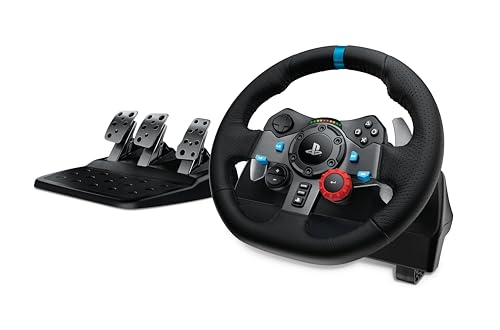
Logitech G29 Driving Force — the gear-driven benchmark
Best for: first-time sim racers and PlayStation players who want proven hardware at the entry price. Not suited for: noise-sensitive homes or drivers who know they will chase high-end feel within a year.
- Drive: helical gear, dual-motor force feedback
- Pedals: three-pedal set with progressive brake spring
- Compatibility: PlayStation and PC (the Xbox sibling is the G920)
- Extras: leather-wrapped rim, steel paddle shifters, optional shifter add-on
Strengths
- Enormous installed base: every sim has a sensible default profile for it.
- The three-pedal set in the box is better than its price tier suggests.
- Build quality has survived a decade of desks, stands and younger siblings.
Trade-offs
- Gear grain around the centre is always present, however you tune it.
- Strong effects produce audible chatter that carries through a desk.
- The rim is fixed; your upgrade path is a whole new wheel base.
The G29 is the wheel that introduced a generation to sim racing, and its gear drive is exactly why it could: cheap, strong, compact and honest. Buy it knowing the mechanism’s character and it will not disappoint you. Check price on Amazon

Logitech G923 TRUEFORCE — gears, refined
Best for: gear-drive buyers who want the newest Logitech iteration and its TRUEFORCE vibration layer in supported titles. Not suited for: buyers expecting a belt-like smoothness — the mechanism underneath is familiar.
- Drive: helical gear with TRUEFORCE high-frequency feedback in supported games
- Pedals: three pedals, dual-clutch launch assist from the wheel
- Compatibility: PlayStation/PC and Xbox/PC versions (check the listing variant)
- Extras: rev indicator LEDs, leather rim, steel paddles
Strengths
- TRUEFORCE adds a tactile layer of engine and road texture where games support it.
- Refined pedal feel and small quality-of-life touches over the G29.
- Same vast game support and community knowledge as its predecessor.
Trade-offs
- The core gear feel — grain, chatter — remains, because the mechanism remains.
- TRUEFORCE support varies by title; in unsupported games it is a G29-class wheel.
- Its price sometimes crowds the belt-driven tier, where the comparison turns against it.
Think of the G923 as the gear design fully matured: better dressed, slightly cleverer, and still unmistakably a gear wheel. Check price on Amazon
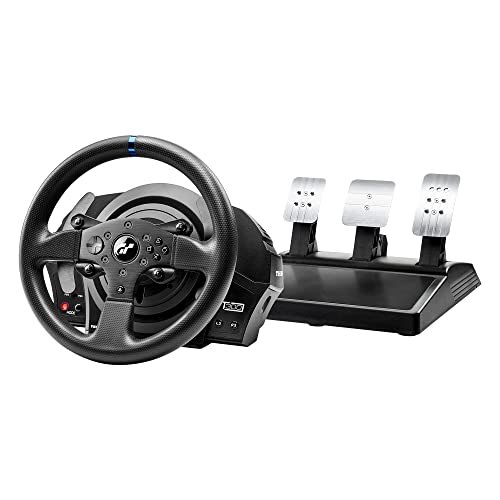
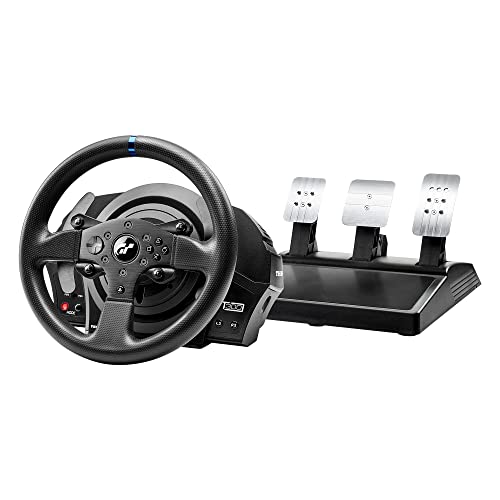
Thrustmaster T300 RS GT — the belt-driven benchmark
Best for: PlayStation and PC drivers who value smoothness, quiet and an interchangeable-rim ecosystem. Not suited for: Xbox players (this model is PlayStation/PC) or anyone who needs the cheapest possible entry.
- Drive: belt-driven, brushless motor, Hall-effect shaft sensing
- Pedals: T3PA three-pedal set with conical brake mod in the GT edition box
- Compatibility: PlayStation and PC
- Extras: detachable GT rim; wide Thrustmaster rim and pedal ecosystem
Strengths
- The smooth centre feel is the single clearest upgrade over gear wheels.
- Quieter under load — the deciding factor in many shared homes.
- Rims, pedal sets and shifters can grow with you instead of replacing the base.
Trade-offs
- Costs meaningfully more than the gear wheels before any ecosystem extras.
- The cooling fan is audible in a quiet room during long sessions.
- The belt is a long-term wear item the gear designs simply do not have.
If the gear-versus-belt question brought you here and your platform matches, this is the wheel the belt side of the argument is about. Check price on Amazon

Thrustmaster T248 — the hybrid middle
Best for: Xbox and PC drivers who want smoother-than-gear feel without the T300’s price. Not suited for: purists on either side; it is deliberately a compromise.
- Drive: hybrid belt-and-gear system, around 3.1 Nm class output
- Pedals: T3PM magnetic pedal set
- Compatibility: Xbox and PC (a PlayStation variant exists as the T248R line)
- Extras: built-in display for settings and telemetry in supported titles
Strengths
- Smoother and quieter than pure gear wheels at a mid-tier price.
- The magnetic pedals are a genuine step up from potentiometer sets.
- The onboard screen makes force and rotation changes painless mid-session.
Trade-offs
- Some gear character survives in the feel; it is a middle, not a conversion.
- The rim materials feel less premium than the T300 GT’s.
- Ecosystem depth is thinner than the T300’s rim library.
The T248 exists because the binary argument is false for many buyers: you can buy part of the belt experience at part of the belt price. Check price on Amazon

MOZA R5 Bundle — the direct-drive context
Best for: PC racers whose budget stretches past both mechanisms and who want to stop upgrading. Not suited for: console players or first-week beginners unsure the hobby will stick.
- Drive: direct drive, 5.5 Nm peak torque, motor mounted straight on the shaft
- Pedals: two-pedal set in the bundle; load-cell upgrades available in the ecosystem
- Compatibility: PC
- Extras: quick-release rim, desk clamp included in the bundle
Strengths
- No gears, no belt: the smoothest, fastest, most detailed force of any pick here.
- Torque headroom means effects stay clean instead of clipping at the peaks.
- The bundle is genuinely ready to race out of the box.
Trade-offs
- PC only, and the priciest option in this guide by a clear margin.
- The included pedals are the bundle’s weakest link over time.
- Strength demands a solid desk or stand; a wobbly table wastes it.
Direct drive is where this whole debate retires. If it is within reach and you race on PC, it is the correct answer; if it is not, the gear-versus-belt choice below remains a good one. Check price on Amazon
Corner by corner: where the difference actually lives
Abstract feel descriptions become concrete on track. In a fast, loaded corner — a long sweeper taken at the limit — both mechanisms are working hard and the forces are large; the gear wheel’s grain is buried under the load and the two feel surprisingly similar. The differences gather at the extremes of the force range. At the gentle end, in a slow hairpin or during the first degrees of a drift correction, forces are small and the belt wheel’s clean centre lets you sense the front tyres loading and unloading, while the gear wheel interposes its faint mechanical texture between you and the same information. At the violent end — a snap of oversteer, a kerb strike, a collision — the gear wheel delivers a sharper, rattlier jolt and the belt wheel a heavier, smoother thud. Rally drivers, whose entire discipline is small corrections on loose surfaces, tend to be the strongest belt partisans; arcade-leaning racers who enjoy drama often prefer the gear wheel’s liveliness. Neither preference is wrong, and knowing your games tells you your camp.
Noise, heat and living with the mechanism
Force feedback wheels live in homes, not laboratories, and the ownership differences are mostly domestic. A gear wheel under a desk in a flat with thin walls announces itself: the chatter transmits through the desk surface and the floor, and late-night sessions become a negotiation. Belt wheels hum and whir instead — audible in the room, rarely through a wall. Heat separates them less; both Logitech and Thrustmaster designs manage long sessions without drama, though the T300’s fan cycling is a known soundtrack. Maintenance is minimal for both in any realistic ownership span: gear wheels ask for nothing, belt wheels ask for nothing until, many years in, a belt may stretch enough to notice — a serviceable part, not a death sentence. Dust, spilled drinks and over-tightened desk clamps kill more wheels than either mechanism ever has.
How to set up either wheel properly
Half the feel differences blamed on mechanisms are actually settings. A short, correct setup pays off on any wheel:
- Clamp or bolt the wheel firmly; a base that rocks even slightly eats fine detail before the mechanism gets a vote.
- Update firmware and install the maker’s driver before launching a game, then set rotation to match the car class — road cars use more lock than formula cars.
- Start from the game’s default profile for your exact wheel model, not a generic one; defaults encode real tuning work.
- Set overall force so the strongest effects are firm but never clip: if every corner feels equally violent, the signal is saturating and detail is being thrown away.
- Change one slider at a time and run the same corner five times. Sim settings reward the scientific method and punish slider tourism.
- Save separate profiles per game. A rally title and a GT title want different wheels, and both are right.
For a fuller treatment, see our racing wheel setup guide and the rotation question in 900-degree vs 1080-degree racing wheels.
Buying guidance by driver
The curious beginner. Buy the G29 or G923 on whichever platform you play. The gear mechanism’s flaws are real and irrelevant to your first season; its price leaves budget for the games and a stand, and its resale market is deep if the hobby does not take. The committed improver. Buy the T300 RS GT (or the T248 on Xbox). You are now sensitive to exactly the signals the belt delivers more cleanly, and the ecosystem lets your pedals and rims grow instead of restarting. The PC devotee with budget. Skip the argument and buy direct drive — the MOZA R5 bundle above, or its rivals in the best direct drive racing wheels. The household diplomat. Let noise decide: belt, or direct drive, and race at midnight in peace. The full field is surveyed in our roundup of the best racing wheels, and the keyboard that shares most sim racers’ desks is reviewed in our G Pro X TKL Rapid keyboard review.
Common mistakes
- Judging by peak torque alone. Delivery quality — smoothness, speed, low grain — shapes feel more than the headline number at this tier.
- Ignoring pedals. Braking decides lap times. A mid wheel with a load-cell brake beats a better wheel with toy pedals.
- Buying the wrong platform variant. PlayStation, Xbox and PC versions are distinct SKUs; the G29/G920 and T248/T300 splits have caught out thousands of buyers.
- Maxing every force slider. Clipping destroys the detail you paid for, on either mechanism.
- Mounting to a flimsy desk. Flex in the furniture reads as vagueness in the wheel and gets blamed on gears or belts unfairly.
Final verdict
Gear driven vs belt driven racing wheel is a real distinction with a modest consequence. Belts feel smoother, quieter and more refined; gears feel rawer and cost less; both will make you faster than a controller and slower than your own practice schedule. Choose by platform, budget and household noise, in that order — and if direct drive is honestly within reach on PC, it dissolves the question entirely. What no mechanism can do is substitute for seat time, which remains, as ever, the only upgrade that always works.
Frequently asked questions
Is a belt-driven wheel always better than a gear-driven wheel?
It is smoother and quieter, which most experienced drivers prefer, but “better” depends on budget and taste. A gear wheel’s mechanical grain bothers some drivers and reads as useful texture to others, and the price difference buys a lot of games, a stand or better pedals.
Do belt-driven wheels last as long as gear-driven wheels?
Both last for years of normal use. Gears essentially never wear out in this application; belts can stretch or wear over a long horizon but are serviceable parts. In practice, electronics, fans and potentiometer pedals age out before either drive mechanism does.
Can you feel the gears in a G29 or G923?
Yes — a faint notchiness around the centre and grain during light forces, plus audible chatter under strong effects. Tuning can minimise it and load hides it, but it is inherent to the mechanism and no setting removes it entirely.
What about hybrid wheels like the T248?
They split the difference honestly: smoother than pure gear drive, less pristine than a full belt system, priced between the two. For Xbox players especially, the hybrid is often the sweet spot of the whole category.
Should I just buy direct drive instead?
If you race on PC, expect the hobby to stick, and the budget reaches it, yes — direct drive is smoother and stronger than both mechanisms here and ends the upgrade ladder. If any of those conditions fail, gear and belt wheels remain excellent, proven choices.
Does the wheel mechanism affect lap times?
Only marginally at comparable skill. Smoother feedback helps consistency in precision disciplines like rally and drifting, but braking quality and practice dominate. The fastest driver on a G29 will beat a newcomer on direct drive every single session.
A brief history of how we got here
Consumer force feedback began in the late 1990s with gear-driven wheels from Microsoft and Logitech, and for two decades gears were simply what wheels were. The belt era arrived when Thrustmaster’s T500 RS showed, in 2011, that a belt could deliver force that felt like a car rather than a machine, and the T300 that followed made the approach the mid-range standard. Logitech, meanwhile, kept refining gears — the line from the G25 through the G27 and G29 to the G923 is one long argument that a well-made gear wheel at an aggressive price serves more drivers than a smoother wheel at a higher one. Both companies were right about their customers, which is why the argument never died. Direct drive, arriving at consumer prices in the last few years from MOZA, Fanatec and others, is the first development that genuinely threatens both — not by winning the argument but by removing the transmission entirely.
What force feedback is actually telling you
It helps to know what the forces are for. A racing sim computes the self-aligning torque at the front tyres: the tendency of a loaded tyre to straighten itself, which rises as grip builds and collapses the instant the tyre starts to slide. That signal — building, peaking, releasing — is the single most valuable thing a wheel communicates, because it tells you where the grip limit is before the car visibly moves. Everything else, kerbs, engine vibration, collision thumps, is garnish. Now the mechanism question sharpens: the grip signal lives in small, smooth changes around moderate forces, exactly the region where gear grain intrudes and belt smoothness shines. This is the technical core of the belt case, and why experienced drivers describe the upgrade as information, not luxury. It is also why the difference shrinks in arcade racers with exaggerated effects: when the garnish is the meal, both mechanisms serve it fine.
Discipline by discipline
GT and circuit racing. Long, loaded corners and fine braking trails reward the belt’s clean signal, but the fields are full of fast G29 drivers; mechanism is not the ceiling here. Rally. The strongest case for belt or direct drive — constant small corrections on surfaces where the grip signal is faint and fast. Drifting. Self-steer speed matters: the wheel must spin freely and catch predictably. Belt wheels’ low internal friction helps; gear wheels work but fight you slightly. Truck and cruising sims. Low forces, long hours, gentle inputs — smoothness and quiet dominate, and this is where gear grain is most noticeable simply because nothing masks it. Arcade racers. Big effects, big fun, mechanism nearly irrelevant; buy on price and platform.
The ecosystem question, honestly
A wheel base is a platform purchase whether you intend it or not. Logitech’s platform is a cul-de-sac with excellent paving: the rim is fixed, the shifter is an inexpensive add-on, the pedals can be upgraded only by leaving the platform. Thrustmaster’s is a road network: rims for formula, GT and rally styles, several pedal tiers including load-cell sets, and shifters, all attaching to the base you already own. MOZA’s direct-drive platform is the newest network and growing fastest. None of this matters if you will race happily with the box contents for years — many do. It matters enormously if you are the kind of hobbyist who upgrades in chapters. Be honest about which person you are before the mechanism debate consumes the decision, because the ecosystem, more than gears or belts, determines what your setup looks like in three years.
Pedals: the upgrade that outranks the mechanism
Ask experienced sim racers what single change most improved their lap times and the chorus is boring: a load-cell brake pedal. Ordinary pedals measure how far your foot travels; a load cell measures how hard you press. Braking by pressure matches how your muscles actually learn consistency, and trail-braking — bleeding off pressure as you turn in — becomes repeatable instead of approximate. Every ecosystem here offers a path to load-cell pedals, and the G29’s included set can be supplemented in the aftermarket. The budget logic follows: a gear wheel plus a load-cell pedal set will usually produce faster, happier laps than a belt wheel plus basic pedals at the same total spend. Mechanism comparisons that ignore pedals are answering the second question first.
Buying second-hand: mechanism-specific checks
The used market is thick with both types, and each has its own inspection list. For a gear wheel, centre the rim and rock it gently: a small amount of play is normal, a clunk is not. Run the maker’s calibration and feel for grinding or dead spots through the rotation, then drive a slow lap listening for chatter that changes with direction — worn gears announce themselves asymmetrically. For a belt wheel, the equivalent test is smoothness under load: a belt that has stretched or a pulley that has worn produces a faint pulsing at one point in the rotation, easiest to feel in a long constant corner. On both, test every button and paddle, check the pedals through their full travel for spiking (a potentiometer problem, cheap to fix, annoying to inherit), and confirm the correct platform variant — the used market is where PlayStation and Xbox versions go to be confused. A wheel that passes these checks at half its new price is one of the best-value purchases in gaming hardware, whichever mechanism turns it.
Torque, rotation and the numbers that matter less than you think
Spec sheets foreground peak torque, and at this tier it misleads. The gear wheels here produce roughly two newton-metres, the T300 around four, the hybrid about three, the direct-drive bundle five and a half. Doubling torque does not double information; it mostly buys headroom so that strong effects do not clip into each other, and it matters most in high-downforce cars on slicks. Rotation range — 900 or 1080 degrees — matters for road cars and truck sims and is adjustable downward for everything else, so it should never decide a purchase. The number nobody prints, internal friction, quietly decides how a wheel feels at the gentle end: it is the sum of gear mesh drag, belt tension and bearing quality, and it is why two wheels with identical torque can feel like different instruments. Reviews that describe centre feel in slow driving are measuring it for you; weight those passages more than the torque line.
So, gears or belt?
Strip the argument to its frame and it is a question about what you are buying with the price difference. The belt’s premium purchases smoothness at the centre, quiet in the room, and an ecosystem with headroom. The gear wheel’s saving purchases everything else on your list — the stand, the games, the pedal upgrade — while delivering force that is stronger in character than in refinement. New drivers should usually take the saving; drivers who already know the hobby owns them should usually take the smoothness; PC drivers with the budget should consider ending the debate with direct drive. That is the whole answer, and it has the virtue of being true for almost everyone who asks the question.
Tuning each mechanism: settings that close the gap
Owners can narrow the feel difference considerably with honest tuning, and the adjustments run in opposite directions. A gear wheel’s grain is worst at low forces, so a small amount of minimum-force setting — telling the game to never ask for truly tiny forces — lifts the signal above the mechanical noise floor. A touch of damping smooths the chatter, at the cost of some liveliness. A belt wheel needs the opposite care: its smoothness can turn to vagueness if damping and spring effects are layered on by default profiles, so belt owners often reduce canned effects and let the raw aligning torque speak. On both, the road-texture and kerb sliders should be set lower than instinct suggests; those effects are the loudest and the least informative, and on a gear wheel they are the primary source of the rattle that gives the mechanism its reputation. Ten patient minutes with one corner and one slider at a time will teach you more about your wheel than a month of forum threads.
Mounting: the invisible third mechanism
Between the wheel and your hands sits a third transmission nobody lists on the box: your furniture. A gear wheel bolted to a heavy stand feels dramatically better than the same wheel clamped to a light desk, because the desk stops participating in every effect — flexing, resonating, and returning its own delayed wobble to your hands. Belt wheels suffer less from this (their forces are smoother) but gain the same solidity. If your budget forces a choice between the belt upgrade and a proper stand for a gear wheel, the stand is frequently the better purchase: it improves feel, posture, pedal stability and your willingness to race for long sessions, all at once. Folding stands serve small rooms well; a fixed rig is the endgame the ecosystems above are quietly selling you toward. Judge your space honestly, because a rig you must dismantle after every session is a rig you will stop using.
What changes when you race in VR or on a big screen
Display choice interacts with the mechanism in ways buyers rarely anticipate. In VR, you cannot see your hands or the wheel, so every cue arrives through the force channel alone; the belt wheel’s cleaner centre signal earns more there, and the gear wheel’s grain becomes proportionally louder in your awareness. On a large screen or triple monitors, visual information is rich enough that the wheel’s subtleties matter less and its strength matters more. Neither effect is decisive, but VR racers should weight smoothness a step higher in their decision, and screen racers can weight price a step higher in theirs.
Game by game: where each mechanism earns its keep
Gran Turismo and Forza. Polished, controller-friendly force models that flatter both mechanisms; the G29’s native PlayStation support and the T300’s smoothness both feel at home, and the choice reduces to budget and noise. iRacing and Assetto Corsa Competizione. Detailed, uncompromising force models built for wheels; the aligning-torque signal is the game, and belt or direct drive repay their cost here in information per corner. EA’s F1 games. Strong, stylised effects with plenty of vibration layered on; gear wheels feel lively, belt wheels feel composed, and TRUEFORCE support gives the G923 a small home advantage. Dirt Rally and rally titles. The belt’s best showcase — loose surfaces, faint signals, constant correction. Euro and American Truck Simulator. The quietest possible wheel wins; forces are gentle and sessions are long, so smoothness and silence outrank everything. Wreckfest and arcade racers. Collisions and chaos; the gear wheel’s rattle is practically a feature, and nobody’s lap time depends on centre feel.
Reliability, warranties and the decade test
The G29’s design is old enough that its failure modes are public knowledge: they are few, they are mostly pedal potentiometers and worn clamps, and they arrive after years rather than months. The T300’s known watch-points are its fan and, over a long life, its belt — both serviceable, neither common in the first ownership span. The hybrid and direct-drive designs are younger, with thinner long-term data, though direct drive’s lack of a transmission removes the wear items entirely and its brushless motors are rated for very long service. The practical advice is unglamorous: buy from a retailer with a painless returns policy, register the warranty, keep the receipt, and run the wheel hard in its first fortnight, because infant failures announce themselves early in every mechanism. After that fortnight, the odds strongly favour years of trouble-free racing from any pick in this guide.
The one-sentence version for every buyer
Beginners on any platform: the gear-driven G29 or G923, and spend the saving on games. Improvers on PlayStation or PC: the belt-driven T300 RS GT. Improvers on Xbox: the hybrid T248. PC racers with the budget and the commitment: the direct-drive MOZA R5 bundle, and the debate is over. Night racers in shared homes: anything but gears. Everyone else: the wheel you will use three times a week beats the theoretically better wheel you will feel guilty about, so buy the one that fits your room, your platform and your life — then go and drive.
Head to head: G29 vs T300 RS GT, criterion by criterion
Since most buyers land on this exact pairing, here is the honest scorecard. Centre feel: T300, clearly — the first thing you notice and the thing you cannot un-notice. Peak strength: T300 again, roughly double the torque, felt in high-grip cars. Fine detail: T300, for the reasons the force-feedback section explained. Pedals in the box: closer than expected — the G29’s set is sturdy and its brake spring is well judged; the GT edition’s T3PA set answers with a conical brake mod and metal faces. Call it even, with different strengths. Noise: T300 in a quiet room, though its fan keeps it from silence. Value: G29, by a distance — it is routinely the cheapest complete, credible force-feedback setup on sale anywhere. Upgrade path: T300, unopposed. Longevity evidence: G29, simply because its design has a decade of public history. Six criteria to the Thrustmaster, two to the Logitech — and yet the Logitech remains the right answer for the majority of people who ask, because its two wins (value and proven-ness) are the ones that govern a first purchase. Scorecards inform; circumstances decide.
A plain-English glossary for wheel settings
Every sim exposes the same handful of controls under different names, and understanding them matters more than the mechanism under your desk. Gain is the master volume for force; too high and strong effects clip into mush. Minimum force sets a floor so tiny signals still move the wheel — the gear owner’s best friend. Damping is resistance to movement, like steering through honey; a little stabilises, a lot suffocates. Friction is constant drag, similar in effect and equally easy to overdo. Spring pulls the wheel back to centre artificially and should usually be left to the game’s own physics. Road effects, kerb effects and slip effects are canned vibrations layered on top of the physics signal; they add theatre and subtract information, and lowering them is the fastest way to make any wheel — gear or belt — feel like a more expensive one. Learn these six ideas and you can tune a wheel you have never seen, in a game you have never played, in about five minutes.
Families, gifts and shared setups
A meaningful share of these wheels are bought as gifts or for households, and the mechanism choice shifts there too. For a younger driver, the gear wheels’ toughness and price are decisive, and their liveliness reads as fun rather than flaw; the G29 on a folding stand has started more racing hobbies than every other product combined. For a shared living-room setup, the belt wheel’s manners matter: it can live under a television without turning film night into an argument about whose desk is rattling. For a gift to an adult who has mentioned sim racing twice, buy the platform-correct gear wheel and a gift receipt; if the hobby catches fire, they will enjoy choosing their own upgrade, and if it does not, you have not spent belt money learning so. These are not the considerations of forum arguments, but they are the considerations of actual purchases, and they resolve the gear-versus-belt question faster than any torque figure.
Resale values and the upgrade ladder
Both mechanisms hold value unusually well for gaming hardware, because wheels do not become obsolete the way graphics cards do — a G29 from years ago runs today’s sims with today’s drivers. Expect a clean, complete gear wheel to recover a healthy share of its price and a belt wheel likewise, with the Thrustmaster’s ecosystem pieces (rims, load-cell pedals) selling separately and briskly. The ladder logic follows: buying the G29 first and the T300 later costs more in total than buying the T300 once, but only if you are certain you will climb. Most people are not certain, and the G29’s resale strength is precisely the insurance that makes starting cheap rational. Direct drive complicates the ladder’s top by being a genuine end-point; nobody resells an R5 to buy a belt wheel. Buy the rung you are sure of, and let the ladder take care of itself.
What the numbers on the box cannot tell you
Two wheels can share a torque figure and feel unrelated, because torque is a single measurement of a system’s strongest moment, while feel is the system’s behaviour across thousands of small moments. Response speed — how quickly the wheel can change force when the sim changes its mind — never appears on packaging, yet it separates instruments from toys: a wheel that lags the physics feels like driving through fog even at high strength. Belt systems earned their reputation partly here, since a compliant belt with a strong brushless motor reverses cleanly, while gear systems must push through their own mesh backlash, a microscopic looseness that manifests as a dead, vague instant at every direction change. Direct drive removes both the lag and the lash, which is why its advantage feels larger than its torque advantage. None of this is measurable from a listing page; it is why this guide leans on mechanism, physics and reported experience rather than the three numbers marketing chose to print.
A first month with either wheel: what to practise
Whichever mechanism you bring home, the first month decides whether it becomes furniture or a hobby. Week one belongs to setup: mounting, drivers, one game’s defaults, and laps slow enough to feel the aligning torque build and release without crashing into the lesson. Week two belongs to braking — pick one corner and brake later in five-metre increments until the pedal, not the wheel, is your instrument; this is where lap time actually lives. Week three adds a second discipline — rally if you started on circuits, circuits if you started in the dirt — because each teaches the wheel’s language faster than repetition of one. Week four is for a race against real people or hard AI, where the force feedback stops being information you study and becomes information you use. Drivers who follow roughly this arc stop asking whether they bought the right mechanism somewhere around week three, which is the surest sign that they did.
The environmental footnote nobody prints
One last consideration, small but real: these wheels are among the longest-lived products in gaming. A gear wheel bought today may still be racing in a decade, through several PCs and consoles, which makes its cost per hour of use almost absurdly low and its electronic-waste footprint equally modest. That longevity cuts in favour of buying the wheel you actually want rather than the wheel you can justify this month — a belt wheel used for eight years is a better purchase, financially and environmentally, than a gear wheel replaced in year two by the belt wheel you wanted all along. It is also an argument for the repairable, ecosystem-based designs: a Thrustmaster with a worn belt or a Logitech with a tired pedal potentiometer can be serviced back to health, while a sealed novelty wheel cannot. Durability is the quietest criterion in this entire comparison and, over a long enough ownership, the loudest.
Questions this guide did not ask, answered anyway
People researching this comparison often carry a second question underneath the first: am I the kind of person who will still be racing in a year? The mechanism cannot answer that, but behaviour can. If you already watch real motorsport, play racing games weekly on a controller, and find yourself reading setup guides for fun, you are not testing a hobby — you are equipping one, and the belt or direct-drive purchase will not be wasted. If racing games are a twice-a-year mood, the gear wheel is not a compromise at all; it is the correct full stop. The worst purchase in this category is not the wrong mechanism. It is the expensive wheel bought to motivate a habit that was never there, gathering dust as a monument to optimism. Buy for the driver you observably are, and the gear-versus-belt question shrinks to its proper size.
A note on evidence
The torque classes, drive layouts, pedal types and platform compatibilities in this guide come from the manufacturers’ published specifications and the verified product listings recorded in the sources file, while the feel descriptions synthesise the consistent reporting of the sim racing community across many years of both mechanisms being on sale. Where this guide gives a number, it is a specification; where it gives an impression, it is labelled as one. Wheels are revised quietly over their production lives — a pedal spring here, a firmware behaviour there — so confirm the current listing’s details before purchase, and treat any single review, including this one, as one testimony among many rather than a laboratory result.
One more test before you buy: the two-minute showroom drill
If you can reach a store or a friend’s setup, two minutes tells you which camp you live in. First, with the wheel powered and a sim paused on track, turn the rim slowly through the centre: feel for grain, steps or pulsing. Second, drive one slow lap of a circuit you know, hands relaxed, and notice whether you are reading the front tyres or reading the machinery. Third, provoke one strong effect — a kerb, a wall brush — and judge the noise as your household will hear it at midnight, not as you hear it in a bright shop. Drivers who shrug at the first test and smile at the third are gear people, whatever the forums say. Drivers who wince at the grain and light up at a smooth centre have their answer too. The drill works because this purchase is, in the end, about a physical sensation delivered to your palms for hundreds of hours; no specification table outranks your own hands given two honest minutes.
Finally, remember that this decision is unusually reversible for gaming hardware. Wheels hold their value, drivers upgrade in both directions as budgets and tastes change, and the community market is liquid on every platform. A first wheel is a beginning rather than a commitment, which is one more reason to start where your budget is comfortable and your platform is certain. The mechanism debate will still be there when you return for your second wheel — and by then, you will not need a guide to know which side of it you are on, because your hands will have formed their own opinion across a few thousand corners.
And if, after all of this, you remain genuinely torn between a gear wheel and a belt wheel at similar money, choose the belt. Not because it wins the argument in general — this guide has been careful to show where it does not — but because the qualities it adds, smoothness and quiet, are the ones owners report appreciating more with every passing month, while the qualities it costs, a higher price and a serviceable belt years from now, fade from memory fastest. Torn decisions should be settled by the factor that ages best, and in this comparison, that factor is feel.