A direct drive racing wheel attaches the rim straight to the shaft of the motor, with no gears or belts in between. Drivers who move up to this design usually do so for finer detail in the force feedback, quicker response when the car slides, and fewer moving parts to wear. It also means a bigger commitment in desk space, mounting hardware and compatibility checks.
We have not used these products ourselves, so this guide offers no driving impressions. It simply shows how to read a listing, which details matter most, and what to confirm with the maker. Work through the table below, then compare each candidate against your own rig, console or computer and the games you play most.
As an Amazon Associate we earn from qualifying purchases. Links on this site are affiliate links, and they do not change the information we give.
In this guide
Quick Picks
| Pick | Product | Best For |
|---|---|---|
| Best for Beginners | MOZA R5 Bundle | A complete PC kit with base, wheel, pedals and desk clamp in one box |
| Best for PlayStation | Fanatec Gran Turismo DD Pro | The officially licensed Gran Turismo set for PS5, PS4 and PC |
| Best for High Torque | Logitech G PRO Racing Wheel | 11 Nm of direct drive force for PlayStation and PC |
| Best Complete PC Pack | Thrustmaster T818 EVO 32R | 10 Nm constant torque with a leather rim and pedal set included |
| Best for Xbox | Logitech G RS50 Racing Wheel | 8 Nm direct drive built for Xbox and PC |
Our Picks

1. MOZA R5 Bundle — Best for Beginners
The R5 Bundle is the simplest way into direct drive because the box covers the guide’s add-on row in full: the 5.5 Nm direct drive base, the 11-inch ES steering wheel, the SR-P Lite two-pedal set and a desk clamp are all included, so there is no separate rim or pedal order to sort out before you can drive. The base uses a 15-bit encoder and an aluminium housing with intelligent temperature control, and the wheel attaches through Moza’s quick release if you later swap to another rim in the range. It is PC-only in this configuration, and the listing is explicit that it does not work with Xbox, so check the guide’s platform row first if you split time between console and computer. Tuning runs through Moza’s Pit House software on Windows. At 5.5 Nm it sits at the modest end of the torque range the guide describes, which suits a desk setup. Choose it if you race on PC and want one box that mounts up and works the same day. Model MOZA-R5BUNDLE.

2. Fanatec Gran Turismo DD Pro — Best for PlayStation
The GT DD Pro is the officially licensed Gran Turismo wheel, and like the Moza above it arrives as a complete set: the base, a 280 mm Polyphony-designed rim and a two-pedal set in one box, covering PC, PlayStation 5 and PlayStation 4. Fanatec rates the FluxBarrier direct drive motor at 5 Nm as standard, with the optional Boost Kit 180 raising output to 8 Nm later if you want more headroom, which is a clear answer to the guide’s peak-torque check because the upgrade path is stated up front. The base hard-mounts to a rig with its underside bolt pattern, and settings can be adjusted through the tuning menu on the wheel as well as through the PC driver. Because PlayStation support is licensed into the base itself, there is no add-on wheel needed to make the console recognise it. Choose it if Gran Turismo or other PlayStation titles are your main games and you want console compatibility handled by the maker rather than by workarounds. Model CRD-9020007-US.
View Fanatec Gran Turismo DD Pro on Amazon
3. Logitech G PRO Racing Wheel — Best for High Torque
The G PRO is the torque step up in this group: Logitech rates its direct drive motor at 11 Nm maximum, paired with TRUEFORCE, the extra feedback layer that supported titles use to add fine vibration detail on top of the main forces. This version covers PC, PlayStation 5 and PlayStation 4, so confirm the platform line on the listing before ordering, because Logitech sells a separate Xbox version of the same wheel. The rim carries magnetic gear shift paddles, dual clutch paddles and an onboard OLED settings display with five stored profiles, so adjustments happen at the wheel itself instead of in a driver window between sessions. Check the box contents against the guide’s add-on row before you buy: pedals are a separate purchase here, and at this strength the base needs a solid clamp or a rig rather than a lightweight desk. Choose it if you want the strongest console-compatible feedback in this list and already own, or plan to buy, a separate pedal set. Model 941-000175.
View Logitech G PRO Racing Wheel on Amazon
4. Thrustmaster T818 EVO 32R — Best Complete PC Pack
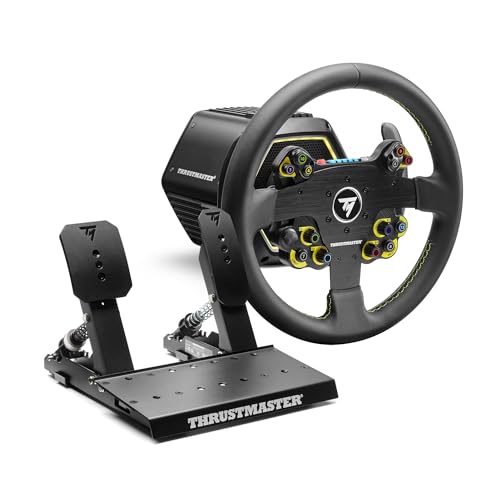
The T818 EVO 32R pack pairs Thrustmaster’s direct drive base with the parts PC drivers usually end up buying next: a base rated at 10 Nm of constant torque, the EVO Racing 32R leather wheel at 12.6 inches across, and the Raceline Pedals LTE pedal set, with the desk mounting kit included for desks between 0.6 and 1.6 inches thick. The 10 Nm figure is quoted as constant rather than peak, which matches the guide’s advice to compare sustained numbers when you read a listing. The base uses Thrustmaster’s quick release system, so rims from the wider ecosystem swap over in seconds, and this pack uses the revised base with a reinforced connector and optimised motor assembly. It is PC-only on Windows 10/11, which makes the guide’s platform check the first thing to confirm. Choose it if you drive on PC, want a complete round-rim setup for rally and GT racing in a single purchase, and like the idea of a large add-on rim ecosystem later. Model T818 EVO 32R.
View Thrustmaster T818 EVO 32R on Amazon

5. Logitech G RS50 Racing Wheel — Best for Xbox
The RS50 fills the Xbox gap the other console pick in this list leaves open: this listing covers Xbox and PC, with an 8 Nm direct drive base, the RS Wheel Hub and an 11-inch round wheel in the box. It carries the same TRUEFORCE support as the G PRO for the titles that use it, processing feedback at up to 4,000 Hz according to Logitech, and the hub’s integrated quick release lets you swap to other rims in the RS range later without tools. The hub puts 13 buttons within reach, which covers the in-race adjustments the guide’s rim row points to. As with the G PRO, read the box contents carefully: pedals are sold separately, so budget for a pedal set before the guide’s add-on check catches you out, and tuning on a computer runs through Logitech’s G HUB software. Choose it if Xbox is your main platform and you want direct drive detail a step below the G PRO’s 11 Nm, in a package that still includes the rim. Model 941-000272.
View Logitech G RS50 Racing Wheel on Amazon
What to Look For
| Factor | Why it matters | What to check |
|---|---|---|
| Peak and continuous torque | Torque sets how strong and how detailed the force feedback can feel. | Compare the maker’s peak and sustained figures, and consider how much force you actually want. |
| Platform support | A wheel is useless if it will not talk to your console or computer. | Confirm the exact console or computer type, and whether a bundled base works with your games. |
| Mounting | Strong forces need a rigid mount or the whole desk will flex. | Look at clamp, rig and bottom-mount hole patterns, and the weight and size of the base. |
| Rim and quick release | Rim diameter, grip material and buttons shape comfort and control. | Check which rims fit, the release system, and whether the rim is sold with the base. |
| Pedals and add-ons | Many bases ship without pedals, a shifter or a handbrake. | Read exactly what is in the box and what connects to the base. |
| Software and updates | Settings software lets you tune strength, damping and effects. | See whether it is available for your platform and how updates are delivered. |
Setup and Care Tips
- Mount the base on a rigid surface or a dedicated rig, and tighten the hardware again after the first few sessions.
- Keep the base clear of dust and drinks, and leave space behind it for airflow and cables.
- Begin with the force feedback strength turned down, then raise it gradually as you get used to the feel.
- Follow the maker’s instructions for connecting power and the order in which to plug in components.
- Check for software and firmware updates now and then, since they can change compatibility with newer games.
Mistakes to Avoid
- Buying a base without confirming that your console or computer supports it.
- Forgetting that rims, pedals and mounting hardware may be separate purchases.
- Pairing a strong base with a flimsy desk that wobbles under load.
- Chasing the highest torque figure when a more modest setting would suit your games.
- Ignoring cable length and power adapter placement until the rig is built.
How much torque does a direct drive racing wheel need?
Most drivers need less torque than the biggest number on a listing, and a modest base is often enough for a desk setup. Torque describes how hard the motor can push on the rim, not how good the feedback feels.
Peak torque is the brief maximum the motor can deliver, such as during a heavy impact or a slide. Continuous or constant torque is what it can sustain without backing off, and it tells you more about everyday behavior. When a listing gives both, compare like with like.
A stronger direct drive racing wheel can show finer detail, but it also brings costs:
- It needs a more rigid mount, because strong forces flex a weak desk.
- It can tire your arms on long sessions if you leave strength settings high.
- It often means a larger base with more weight and heat to manage.
Many drivers lower the strength setting anyway, so paying for headroom you never use is common. A lower-torque base with good resolution and a sturdy mount can feel more precise than a stronger one wobbling on a thin desk.
Ask yourself which cars you drive. Road cars and GT racing are comfortable at moderate strength, while heavy open-wheel cars and rally can reward more headroom. Keep the strength dial low at first and raise it gradually as you learn what the wheel is telling you.
Also remember that in-game settings shape the feel as much as the hardware. Most titles let you adjust overall strength, damping and minimum force, so a few evenings of tuning can matter more than a step up in torque.
Will a direct drive wheel work with your console or PC?
Only if the exact base and wheel are listed for your platform, so check the compatibility line before anything else. A wheel that works on one console may not work on another, and some versions are sold separately for each platform.
Read the listing for the specific console generation or Windows version, and watch for notes about which games are supported. Some wheels work on a console only with specific rims or hubs, and some work on PC only.
- PC-only sets usually rely on the maker’s tuning software on Windows.
- Console sets may be licensed for one brand of console, so a wheel for one platform will not automatically work on the other.
- Multi-platform sets often cover a console plus PC, but confirm the exact console named.
Do the same for the games you play. Check the game’s own list of supported wheels, and confirm whether force feedback features, such as extra vibration layers, are supported in your titles.
If you plan to change platform later, factor that in. A set tied to a single platform may be fine for years, but switching consoles could mean buying a new base or hub. Keep the receipt details and any platform notes so you can compare what a later upgrade would involve.
Which direct drive racing wheel should you buy?
Choose by platform first and by torque and included parts second. The five picks above each suit a different driver.
- If you race on PC and want everything in one box, go for the MOZA R5 Bundle, which includes base, wheel, pedals and a desk clamp.
- If PlayStation and Gran Turismo are your focus, choose the Fanatec Gran Turismo DD Pro, which is the officially licensed set and arrives with pedals.
- If you want the strongest feedback in the group on PlayStation or PC and already own pedals, pick the Logitech G PRO Racing Wheel.
- If you drive on PC and want a complete round-rim pack with leather rim and pedals, the Thrustmaster T818 EVO 32R fits.
- If Xbox is your main platform, the Logitech G RS50 Racing Wheel covers Xbox and PC.
When two options appeal, look at the extras. The Logitech wheels need a separate pedal set, so add that to your plan, while the bundles include pedals. If you have a rig or a heavy desk, the stronger bases make more sense. On a light desk, favor the more modest torque and a good clamp.
A beginner on PC with a limited budget usually gets the most from the all-in-one set, because there is less to match and fewer surprises when the box arrives.
What to check before you buy a racing wheel
Confirm platform, box contents, mounting and return terms on the listing before you order. Most unhappy purchases come from a missing pedal set or a mount that does not fit.
- Platform: match the exact console or Windows version named by the maker.
- In the box: check whether pedals, a rim, a clamp and power supply are included.
- Mounting: measure your desk thickness and check clamp limits, or look at the bolt pattern for a rig.
- Rim fit: confirm the quick release system and whether other rims fit later.
- Space: allow room for the base, cables and power adapter behind and below the desk.
- Software: check that the tuning program supports your system.
- Warranty and returns: read the terms on the listing, since they differ by seller.
- Care: keep the base clear of dust and drinks, and follow the power-up order in the manual.
Look at how many people have rated a product and read comments about setup and support, rather than leaning on one score. Pay attention to remarks about mounting, since that is where many setups run into trouble.
Cables deserve a moment too. Check the length of the power lead and USB cable against where your computer or console sits, because a base that cannot reach its outlet is a common setup frustration.
Finally, think about the seat. A good wheel on a wobbly chair is a poor experience, so plan your seat position, pedal placement and screen distance before you commit.
Direct drive vs belt and gear wheels: is it worth the step up?
Direct drive is worth it if you want finer detail and quicker response and can handle a sturdier mount. Belt and gear wheels cost less and are often easier to fit on a regular desk.
The difference comes from construction. A direct drive base has the rim attached straight to the motor shaft, so forces travel without a belt or gears in between. Gear and belt designs pass forces through those parts, which can add some play or noise but also soften forces.
- Direct drive: typically smoother and more detailed, with fewer wear parts, but a larger base and stricter mounting needs.
- Belt-driven: a middle path, often lighter and quieter.
- Gear-driven: usually the most accessible choice for casual play on a desk.
Is it worth paying more? If you drive several times a week and notice the lack of detail in a lesser wheel, probably yes. If you play occasionally, a lighter wheel may satisfy you and spare you the rig.
The honest downsides of direct drive are weight, a bigger footprint, cost of add-ons and the need for care with strong settings. Wrists and desks both feel it if the strength is set too high.
Who should skip a direct drive wheel?
Skip it if you have no stable place to mount it, play only a few times a year, or want a quick plug-and-play toy. A direct drive wheel is a commitment in space and setup.
Think about these cases before you order:
- A thin or wobbly desk will flex under strong forces, and the clamp may not hold.
- A shared living room may not suit a rig that is hard to pack away.
- Some users find strong forces tiring, particularly with older wrists or injuries.
- If your games do not support the wheel well, the benefits shrink.
Also think about total cost. Pedals, a better rim, a shifter or a rig can add up after the base, so compare the full setup, not only the base. A bundle may look pricier at first but cover more of what you need.
The answer for a casual driver may be a lighter wheel now and a direct drive later. That is a sensible path, and many people take it.
When you are ready, compare the picks above, check the listing for platform support and what is in the box, then choose the set that fits your rig and how often you will drive.
A Deeper Look at Choosing Direct Drive Racing Wheels
The shortlists above give you a strong starting point, but the right choice among direct drive racing wheels depends far less on any single feature than on how well a product fits your space, your routine and your expectations. This extra section slows the decision down and works through the questions experienced buyers ask before they commit. None of it replaces the details in the individual reviews above; instead, it gives you a framework for reading those reviews with your own situation in mind, so the strengths and compromises of each pick become easier to weigh.
Start by writing down the job you actually need done, in plain language, before you look at any product names again. Many disappointing purchases happen because the buyer solved a slightly different problem from the one they had: they bought for the largest, loudest or most occasional scenario instead of the ordinary Tuesday that repeats all year. If your honest description mentions one main use, one secondary use and one frustration you want to avoid, you already have a better buying brief than most shoppers ever make, and you can test every option among the direct drive racing wheels against those three lines.
Size, Fit and the Space You Really Have
Measure before you fall in love with a particular model. Record the width, depth and height of the space, then add the clearance needed to open, move, clean or comfortably use the product once it is in place. Doorways, stairs, cupboard doors and tight corners all count, because a product that technically fits its final spot can still be miserable to get there. With direct drive racing wheels, the difference between a good fit and a daily annoyance is often a small margin that only a tape measure will reveal, so take the measurements twice and keep them in your phone while you shop.
Fit also means fitting the people involved. Consider heights, reach, strength and mobility in your household, and whether children, older relatives, guests or pets will interact with the product as well. Controls, handles, openings and adjustments should be comfortable for the person who will use them most, not just acceptable in a showroom moment. If two people will share the direct drive racing wheels, agree in advance whose priorities win on the points where you disagree, because shared products that suit nobody in particular tend to be replaced fastest.
Materials, Build Quality and Honest Durability
You can learn a lot about likely durability without any technical knowledge. Look for even finishes, tidy joins or seams, parts that move without grating or wobbling, and fixings that feel firmly seated rather than decorative. Where the maker describes materials, think about what those materials are good at and what they ask of you in return: some shrug off moisture but mark easily, others feel premium yet need regular care. The right answer among direct drive racing wheels is the material whose maintenance rhythm matches the time you will genuinely give it.
Pay particular attention to the parts that will be touched, loaded or exposed every day, because those are the places wear appears first. Hinges, handles, edges, feet, fastenings and contact surfaces tell you more about long-term satisfaction than a rarely used extra feature. If a listing is vague about the parts that matter, treat that vagueness as information in itself and favour the option whose construction is described clearly and modestly. Honest descriptions that mention limits usually come from makers who expect their direct drive racing wheels to be used hard and judged fairly.
Ease of Use in Ordinary Daily Life
Imagine the full routine, not just the main event. How does the product arrive, where does it live between uses, how long does setup take, and what has to be cleaned, charged, emptied, folded or put away afterwards? A design that saves a minute during use but costs five minutes of fiddly preparation will quietly fall out of favour. The most satisfying direct drive racing wheels tend to disappear into the routine: they are ready when needed, forgiving when you are tired, and simple to hand over to someone else without a long explanation.
With any connected or powered product, set aside time for the unglamorous essentials: firmware or software updates, account security, cable management and a sensible backup of your settings. These steps rarely feature in advertisements, yet they decide how reliable the direct drive racing wheels feel after six months of daily use. A short setup session done carefully at the start prevents most of the frustration people blame on the hardware later.
Getting the Most From Your Direct Drive Racing Wheels
Setup and the First Few Days
Unpack carefully and keep everything together until you are sure the product is staying. Photograph the unboxing if parts are numerous, lay pieces out in the order the instructions use them, and resist the urge to force anything that resists: a pause to reread one step is cheaper than a damaged fitting. Once your direct drive racing wheels are assembled or installed, run through the basic functions gently, check that everything operates as described, and only then move packaging out of the way. Register the warranty if the maker offers one, and save the receipt and manual somewhere you can actually find them again.
Treat the first week as a trial you are conducting, not a verdict you have already reached. Use the product in the situations you bought it for, notice where you hesitate or improvise, and adjust placement, settings or accessories before deciding anything is wrong. Small changes in position, order or routine often transform the experience. If a genuine fault or mismatch appears, early notes with dates and photographs make any conversation with the seller far easier, and they help you distinguish a real defect from a setup detail among your direct drive racing wheels that simply needs correcting.
Cleaning, Care and Storage Habits
Regular light care beats occasional heroic cleaning almost every time. Wipe, empty, shake out or inspect on the rhythm the maker recommends, using the mildest cleaning approach that does the job, and dry parts fully before storing or closing them away. Damp left in seams, folds or enclosed spaces is a quiet cause of odours and deterioration, whatever the product. Build the care step into the routine it belongs to, such as after the last use of the day or the end of the week, so maintaining your direct drive racing wheels never becomes a separate project you keep postponing.
Storage matters as much as cleaning. Keep the product in the conditions the maker describes, away from extremes of heat, cold or damp where possible, with any cables, accessories or small parts stored together rather than scattered through drawers. If space is tight, store the items you use together in one place so setup stays quick. Before a longer period without use, clean everything, check for wear while you can still act on it, and make a note of anything that needs attention when the direct drive racing wheels come back into service, rather than discovering it at the busiest moment.
Compatibility is worth checking twice before you buy. Look at the connections, formats, operating systems or mounting standards your current setup already uses, and confirm the new addition speaks the same language. Keep a note of model details, passwords stored in your password manager, and any adapters you rely on, stored somewhere you can find them when you add the next piece of equipment or troubleshoot a problem.
How the Picks in This Guide Compare
Read the individual reviews above as a set rather than as a ranking to obey blindly. Each pick earned its place for a particular kind of buyer, and the short labels are the quickest guide to those differences. The notes below simply restate the positioning already given in the guide, in a form that makes side-by-side thinking easier when two options both look appealing.
The MOZA R5 Bundle, presented above as the choice for best for beginners, is best understood through that role. If the situation described in its review sounds like your household, its compromises are probably the ones you will mind least; if that situation belongs to somebody else, a different pick will likely serve you better even if this one first caught your eye. Return to its section above for the specific strengths, limitations and who-should-skip guidance before deciding, and compare it honestly against the alternative you are considering rather than against an imaginary perfect product.
The Fanatec Gran Turismo DD Pro, presented above as the choice for best for playstation, is best understood through that role. If the situation described in its review sounds like your household, its compromises are probably the ones you will mind least; if that situation belongs to somebody else, a different pick will likely serve you better even if this one first caught your eye. Return to its section above for the specific strengths, limitations and who-should-skip guidance before deciding, and compare it honestly against the alternative you are considering rather than against an imaginary perfect product.
The Logitech G PRO Racing Wheel, presented above as the choice for best for high torque, is best understood through that role. If the situation described in its review sounds like your household, its compromises are probably the ones you will mind least; if that situation belongs to somebody else, a different pick will likely serve you better even if this one first caught your eye. Return to its section above for the specific strengths, limitations and who-should-skip guidance before deciding, and compare it honestly against the alternative you are considering rather than against an imaginary perfect product.
The Thrustmaster T818 EVO 32R, presented above as the choice for best complete pc pack, is best understood through that role. If the situation described in its review sounds like your household, its compromises are probably the ones you will mind least; if that situation belongs to somebody else, a different pick will likely serve you better even if this one first caught your eye. Return to its section above for the specific strengths, limitations and who-should-skip guidance before deciding, and compare it honestly against the alternative you are considering rather than against an imaginary perfect product.
The Logitech G RS50 Racing Wheel, presented above as the choice for best for xbox, is best understood through that role. If the situation described in its review sounds like your household, its compromises are probably the ones you will mind least; if that situation belongs to somebody else, a different pick will likely serve you better even if this one first caught your eye. Return to its section above for the specific strengths, limitations and who-should-skip guidance before deciding, and compare it honestly against the alternative you are considering rather than against an imaginary perfect product.
Choosing Between Two Close Options
When two options among the direct drive racing wheels remain after you have eliminated the rest, stop looking for new features and start looking at friction. Which one will be easier to live with on a tired evening, quicker to clean, simpler to store, or less annoying for the other people who share your space? Which one has the limitation you are more willing to accept for years? Buyers rarely regret choosing the product with the kinder daily routine, whereas a small advantage on paper that demands constant workarounds wears thin remarkably quickly.
It can also help to imagine owning each finalist after the novelty has gone. Picture the product a little dusty, the household a little busier, and your enthusiasm replaced by habit. The option that still seems sensible in that picture is usually the right purchase. If you remain torn, revisit the measurements and the original three-line brief you wrote at the start of this section; one of the finalists almost always answers that brief more directly, and that answer matters more than any extra flourish either direct drive racing wheels can offer.
A Final Practical Check Before You Decide
Decision-making gets easier when you separate needs from preferences. Needs are the points where the wrong choice stops the product working for you at all, such as a size that does not fit, a function you rely on daily, or a care requirement you cannot meet. Preferences are everything else: finishes, styling details and nice-to-have extras. Among direct drive racing wheels, spend your attention and your budget on the needs first, let preferences break ties between otherwise equal options, and be suspicious of any product that asks you to trade a genuine need for an attractive extra.
Talk to the people who will share the product before you order, not after it arrives. A five-minute conversation about where the direct drive racing wheels will live, who will clean or move them, and what would genuinely annoy each person prevents the quiet resentment that builds around a purchase nobody else chose. Households that agree the practical basics in advance almost always end up happier with the result, and the discussion often surfaces a requirement, such as storage space or noise, that the main buyer had not considered at all.
Think about accessories and consumables as part of the purchase, even if you buy them later. Some direct drive racing wheels need covers, refills, replacement parts, batteries, cleaning products or a particular storage solution to work at their best, and discovering that afterwards can turn a bargain into a false economy. You do not need to buy everything at once, but knowing what ownership involves helps you compare options fairly and plan the order in which extras are genuinely worth adding.
Keep a simple ownership note once you have bought. The date of purchase, where the receipt lives, any warranty registration, and a line about settings or arrangements that worked well will save you surprising amounts of time later. When something eventually needs adjusting, repairing or replacing, that note turns a vague memory into clear information, and it helps anyone else in the household understand the direct drive racing wheels without having to repeat your whole learning process from the beginning.
Finally, give yourself permission to choose the sensible option. Marketing rewards the newest, largest and most feature-filled version of everything, yet most households are best served by the product that matches their space, does the main job reliably and asks little of them in return. If one of the direct drive racing wheels above keeps meeting your brief while the others need excuses, that consistency is the answer. A calm, well-matched purchase used happily for years beats an exciting one that never quite fits your life.
FAQ
Is direct drive better than a belt or gear wheel?
It is different rather than automatically better. Direct drive tends to be smoother and more detailed, while belt and gear designs are often lighter and easier to fit on a regular desk. Match the design to your space and how seriously you drive.
Do I need a dedicated rig?
Not always, but stronger bases push hard on whatever holds them. A sturdy desk with proper clamps can work for a lighter base, whereas a rig gives a fixed seat position and a stable mount for pedals and the wheel.
What does direct drive mean on a racing wheel?
Direct drive means the wheel rim attaches straight to the motor shaft, with no gears or belts between them. This usually gives smoother, more detailed force feedback and fewer wear parts. It also tends to need a sturdier mount.
How many Nm of torque do you need for sim racing?
There is no single answer, since many drivers are happy with moderate torque and lower the strength setting anyway. Consider your games, your mount and how long you drive per session. A rigid mount and good tuning often matter more than the highest number.
Do direct drive wheels work on PlayStation and Xbox?
Only versions listed for your console will work. Some wheels are sold in separate versions for PlayStation and Xbox, so read the compatibility line carefully. PC support is often included but should be confirmed.
Do I need to buy pedals separately with a racing wheel?
It depends on the set. Some bundles include pedals, while others sell the base and rim only. Check the box contents on the listing before you order.
Can I mount a direct drive wheel on a desk?
A lighter base can work on a sturdy desk with a proper clamp. Stronger bases push hard on the mount, so a rig is a better choice. Check the maker's clamp limits and desk thickness range.
Do direct drive racing wheels need software?
Most use maker software or an onboard menu to adjust strength, damping and effects. Some settings can be changed at the wheel itself, while others need a computer. Check which platforms the software supports.
Can you change the wheel rim on a direct drive base?
Many bases use a quick release system so you can swap rims. The rims that fit depend on the maker and the system, so confirm compatibility before buying a second rim.
Is a direct drive racing wheel good for beginners?
It can be, especially in a complete set with pedals and a clamp. Start with the force strength turned down and raise it gradually. A modest base is often a better first step than the strongest one.
How do I know which size or style of direct drive racing wheels is right for me?
Start from the space and the people, not from the product page. Measure where the item will live and be used, think about who will use it most often, and match those facts against the guidance in the reviews above. If you fall between two sizes or styles, the safer choice is usually the one that leaves you comfortable clearance and room to adjust, rather than the one that only just fits on paper and leaves no margin for ordinary life.
What should I check as soon as my direct drive racing wheels arrive?
Check the contents against the packing list, look over seams, surfaces, moving parts and fastenings for transit damage, and test the basic functions before you throw any packaging away. Photograph anything that looks wrong straight away. A calm ten-minute inspection on delivery day is far easier than discovering a problem weeks later, and keeping the packaging until you are satisfied protects your options if an exchange turns out to be necessary.
How often should I clean and maintain direct drive racing wheels?
Follow the maker’s guidance first, and otherwise adopt a little-and-often approach: a brief wipe, empty or inspection after regular use, and a more thorough clean at sensible intervals such as the change of season or before storage. Maintenance done early is almost always quicker, because dirt, moisture and loose fittings are easier to deal with before they combine into a bigger problem that affects how the product works.
What is the most common mistake people make with direct drive racing wheels?
Buying for an imagined routine instead of the real one. People overestimate how much time they will spend on setup and care, underestimate the space a product needs in use, and choose features for rare occasions while tolerating daily inconveniences. The reviews above flag the honest limitations of each pick; take those limitations seriously, because living with a limitation every day feels very different from reading about it once.
Can I return or exchange direct drive racing wheels if they do not suit my home?
That depends on the seller and on the condition of the product, so read the returns terms before you order and keep receipts, packaging and accessories together during the first days. Use the product fairly but carefully while you decide, note any problem promptly, and contact the seller sooner rather than later if something is wrong. Clear, polite messages with dates and photographs usually resolve issues faster than waiting and hoping the problem will settle by itself.
How long should good direct drive racing wheels be expected to last?
There is no single honest answer, because lifespan depends on materials, frequency of use, conditions and care far more than on the calendar. Well-made products that are used as intended, cleaned on a sensible rhythm and stored properly will generally serve for years, while heavy use in harsh conditions shortens the life of almost anything. Judge value over the whole period of ownership, including how easy the product is to maintain, rather than by the purchase moment alone.
The Short Version
Pick a base that works with your platform, fits your mounting setup, and offers a torque level you will really use. Check what is in the box, then confirm rims and pedals with the maker before you order.
Related Guides
- 6 Best Raised Planters for Patios: Legs and Wheels (2026)
- 6 Best Room Dividers: Folding Screens, Wheels and Bamboo (2026)
- 6 Best Ab Roller Wheels: Single and Kit Options (2026)
- 6 Best Hot Wheels Track Sets: Garages, Loops and Circuits (2026)
- How to Choose the Best Pottery Wheels: Buyer's Guide (2026)