Disclosure: As an Amazon Associate, reviewstook.com earns from qualifying purchases. Links to Amazon on this page are affiliate links; they cost you nothing extra.
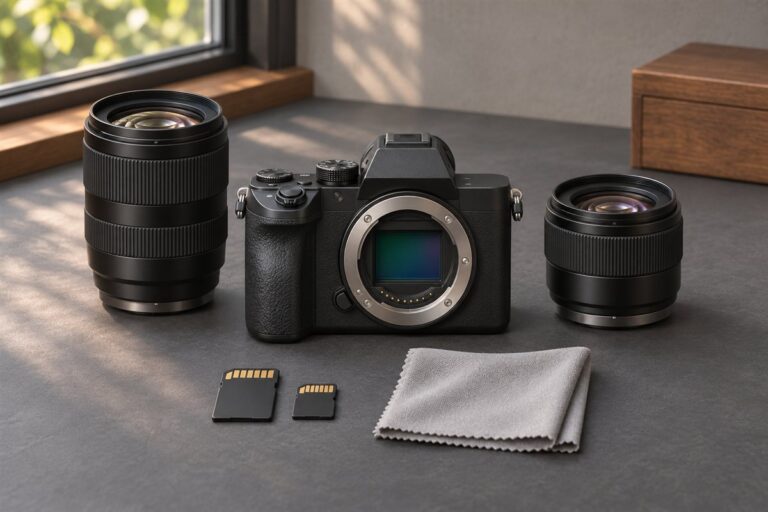
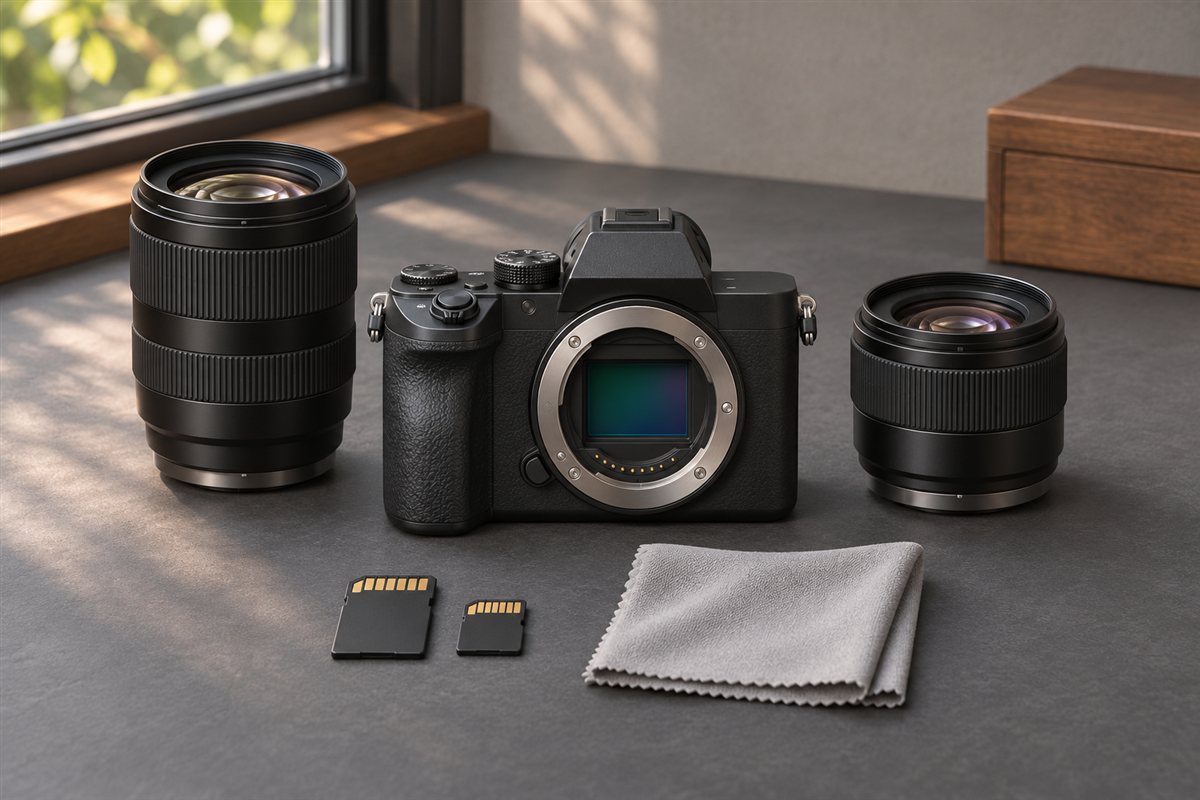
Mirrorless bodies lack the mirror box, so they can be smaller and use electronic viewfinders.
Last updated: October 31, 2026.
Size and weight
Mirrorless bodies are usually smaller; lenses can still be large.
In this guide
Viewfinder
DSLRs use optical viewfinders; mirrorless use electronic ones.
Which to buy
New models are mostly mirrorless. See best mirrorless cameras.
How each design works
In a DSLR, light passes through the lens and bounces off a mirror up into an optical viewfinder. When you press the shutter, the mirror flips out of the way and the sensor records the image. A mirrorless camera has no mirror, so the sensor is always exposed to light and the image is shown on the rear screen or in an electronic viewfinder.
That difference explains most of the practical gaps. Removing the mirror box allows a thinner body and a shorter distance between lens and sensor. It also means focus and exposure can be calculated from the live sensor image, which is why face and eye detection is so common on mirrorless models.
DSLRs rely on a separate focusing sensor for fast tracking through the viewfinder, a system that is mature and well understood. Neither design is inherently better at making a photo. The question is which handles better for the way you shoot.
Autofocus behavior compared
Mirrorless cameras generally focus using points across much of the frame, so you can place a subject near an edge and still have focus coverage. DSLR focus points tend to cluster toward the center when shooting through the viewfinder, which can make composing off-center slightly more work.
In live view, a DSLR often focuses more slowly than it does through the viewfinder, because it works differently once the mirror is raised. Mirrorless bodies use the same method all the time, so behavior is consistent between viewfinder and screen.
Performance differs a lot between individual models and generations, so do not assume a rule applies to every camera. Read the specifications for the exact model, and consider your subjects: portraits, pets and action benefit most from modern subject detection.
Lenses and adapters
Lens choice is a major reason to pick one system over the other. DSLR systems have a large back catalog of lenses, both new and used, which can make building a kit affordable. Mirrorless systems are growing fast, and new lens releases tend to focus on them.
Adapters let some DSLR lenses work on mirrorless bodies, usually from the same manufacturer. They can preserve autofocus and stabilization, but this depends on the specific lens and body, so check the compatibility notes. An adapter also adds length and another connection point.
If you already own DSLR lenses, a same-brand mirrorless body may let you move over gradually. If you are starting from nothing, look at the lenses you want and ask whether they are made for the mount you are considering.
Who each type suits
Mirrorless suits people who want a compact body, strong video features, and a viewfinder that previews exposure before you press the shutter. It is a sensible default for travel, vlogging and learning, since you see the result of your settings immediately.
A DSLR can suit someone who prefers a natural optical view, likes a larger grip, or has found a good used body and lens set at a low cost. Because the viewfinder is optical, it works with no battery drain from the display.
- Travel and street: mirrorless is usually lighter overall, though long lenses stay large.
- Video: mirrorless bodies are generally designed with it in mind.
- Tight budget with used gear: a DSLR can be good value if the lens set suits you.
Buying new or used today
Because new development has shifted toward mirrorless, the choice often comes down to whether you want a current system or a bargain. A used DSLR can deliver excellent images, but you should check the shutter count where available, inspect the sensor and mirror area for marks, and confirm the seller offers returns.
For a new purchase, think about where the system will be in a few years. A mount that keeps receiving new lenses gives you more room to grow. Whichever way you go, factor in a second battery, memory cards and a bag, which matter as much as the body.
If you cannot decide, handle both types in a store. How a camera feels in your hands tends to decide long-term satisfaction more than any specification.
Handling, Grip and Ergonomics
Specifications tell only part of the story, because a camera is something you hold for hours. DSLR bodies often have a deeper grip and more physical space for buttons and dials, which some people find more secure with a heavy lens attached. Mirrorless bodies range from very compact to nearly as large as a DSLR, so size is not guaranteed by the design alone.
Pay attention to how the controls fall under your fingers. Can you reach the exposure dial, the focus selector and the playback button without shifting your grip? Are the buttons large enough for your hands, and do they work if you wear gloves? Small bodies can feel cramped if you have big hands, and a lighter body can feel unbalanced with a large telephoto lens on the front.
- Hold the camera with the lens you plan to use, not just the body alone.
- Check the menu layout, since you will use it often.
- Look at the tilting or fully articulating screen if you shoot from low or high angles.
- Think about weather sealing if you shoot outdoors, and check the listing for what is stated.
Good ergonomics lead to better photos simply because you reach for the camera more often. If you cannot try the camera in a shop, read the manual online to see how the controls are laid out.
Battery Life and Power Habits
Battery life is a common point of difference. A mirrorless camera powers an electronic viewfinder or rear screen whenever it is on, while an optical viewfinder uses no power to show the image. This is why DSLRs often last longer on a charge, as the post notes in its short answer, though the exact figure depends on the model, the screen use and the shooting style.
The rated number of shots in a listing is usually measured under set conditions, and real use differs. Reviewing images on the screen, shooting video, using the wireless features and cold weather all drain the battery faster. Treat the listed number as a comparison tool rather than a promise.
- Plan on carrying at least one spare battery for a day of shooting.
- Check whether the camera can be charged by a USB cable, which is handy when traveling.
- Find out whether it can run from a power bank during long video recording.
- Turn off features you do not use, such as constant wireless connection, to save power.
Spare batteries are model-specific, so check that they are available and what the listing says about compatibility before relying on a third-party option. Keep spare batteries in a pocket in cold conditions, since low temperatures reduce capacity temporarily.
Video Features to Check
If video matters to you, the mirror question is only the start. Mirrorless bodies are generally designed with video in mind, but models differ widely in resolution options, frame rates, how long they can record and whether they handle heat well. Read the specifications for the exact camera rather than assuming all mirrorless bodies behave alike.
Look at the details that affect daily use. Does the camera have a microphone input and a headphone connection for monitoring? Does it have stabilization in the body, or does it depend on the lens? Does the screen flip to face you for vlogging? How does the autofocus perform when a person moves toward the lens?
- Recording limits, which can be set by file size, heat or regional rules.
- Rolling shutter, which can make fast pans look wobbly on some models.
- Card requirements, because high-quality video may need cards with a specific speed rating.
- Crop factors, which can narrow the view in certain video modes.
A DSLR can record good video, but its design was built around still photography, and live view focusing is often less smooth. If you shoot mainly photos and only occasional clips, this matters less. If you plan to film often, lean toward a body built for it.
Budget Tiers and What Else to Buy
The camera body is only part of the cost. Think about the whole kit before you set a budget, and consider the tier you are shopping in. Entry-level bodies of either type cover everyday photos well and often come with a basic zoom lens. Middle tiers tend to add faster focus, better build and more control points. Upper tiers focus on speed, durability and professional features, and may be more than a hobbyist needs.
Plan for the extras that make the camera useful:
- One or two memory cards, with a card reader for your computer.
- A spare battery and a charger that suits your travel habits.
- A bag or strap that fits the body and the lens you will carry.
- Lens filters or a hood to protect the front glass.
- A small tripod if you shoot in low light or want sharp landscapes.
It often pays to spend more on lenses than on the body, since a lens stays useful across several camera generations. A mid-range body with a good lens usually produces better results than a top body with a weak lens. If money is limited, buy the body that suits your needs now, and add lenses as you learn what you miss.
Questions to Answer Before You Decide
If the choice still feels unclear, write down answers to a few plain questions. They will do more to settle it than comparing long specification lists.
- What do I photograph most, and does it involve fast motion or low light?
- Do I want to carry the camera every day, or only for planned outings?
- Do I already own lenses, and do they work with a modern body through an adapter?
- How important is video to me?
- Am I comfortable with an electronic viewfinder, or do I prefer an optical view?
- Will I edit files on a computer, and is it ready for large image files?
Also consider support. Check what the warranty covers, how easy it is to get service, and whether firmware updates are offered, since updates can add features or fix issues. If you buy used, ask about the return policy and check that all accessories are included.
Finally, remember that upgrades are normal. Many photographers change bodies after a few years while keeping their lenses. Choose a system that will let you do this without starting over, and do not wait for a perfect model, since there will always be a newer one.
Common Mistakes When Switching Systems
Switching from one system to another is easy to get wrong, and the costs add up. One common mistake is selling all your lenses before you know how an adapter will behave with your new body. Test the combination first, and check the manufacturer’s notes about autofocus and stabilization.
Another mistake is judging a camera only by its megapixel count. More pixels create larger files and need faster computers and more storage, and they do not guarantee better pictures in everyday use. A third is ignoring the lens lineup. A body with a wide range of lens options may suit you better than one with a few attractive bodies and limited glass.
- Buying the body without checking the lens mount of the lenses you want.
- Assuming that all features of an old camera carry over to a new one.
- Forgetting that menus and button layouts differ, which takes time to learn.
- Skipping a test shoot before selling the old equipment.
Give yourself some time to adapt. A new camera may feel slower at first simply because you are learning where things are. Spend a few outings with it before judging, and keep the old kit until you are sure the new one does everything you need.
Mirrorless or DSLR: Which One Should You Buy?
Buy a mirrorless camera if you want a compact body, strong video features and a live preview of your settings, and consider a DSLR if you want an optical viewfinder, a larger grip or a low-cost used kit.
- If you are buying new and want a system that will keep growing: mirrorless is the sensible default, since new development has shifted that way.
- If you travel, shoot street or carry the camera daily: mirrorless bodies are usually lighter, though long lenses stay large.
- If you film often or vlog: mirrorless is generally designed with video in mind, with better live autofocus.
- If you already own DSLR lenses: a same-brand mirrorless body with an adapter may let you move over gradually. Check compatibility first.
- If your budget is tight and you can buy used: a DSLR with a lens set that suits you can be good value.
- If you dislike electronic viewfinders: a DSLR keeps the direct optical view and avoids display battery drain.
- If you are a beginner who wants to see exposure before pressing the shutter: mirrorless makes learning easier.
Whichever type you lean toward, the lens lineup matters as much as the body. Look at the lenses you expect to want in a year or two and confirm they exist for the mount you are considering.
If you still cannot decide, handle both types in a shop. A camera that feels right in your hands usually gets used more, and a camera you use is the better camera.
What to Check Before You Buy, and Who Should Skip It
Before you buy a mirrorless or DSLR camera, check the lens mount, what is in the box and the return terms. The body is only part of the cost, and a mismatch is expensive to fix.
- Is the lens mount supported, with the lenses you want available new or used?
- Does the listing say whether a lens, battery, charger and strap are included?
- Which memory card type does it use, and does your video plan need a faster card?
- Does the camera suit your hand size and how you hold it?
- What are the warranty and return terms, especially for used or open-box items?
- Can you get spare batteries for that model?
Be honest about the trade-offs. Mirrorless bodies often use more battery, and some electronic viewfinders take time to get used to. DSLRs are bulkier, and new releases are rarer, so the system may offer fewer fresh lenses over time. Neither type will fix a weak lens or poor technique.
You may want to skip an upgrade if your current camera already does what you need. Switching costs lenses, adapters and learning time, and it only helps if you are missing a specific feature, such as better subject tracking or video.
Compare the options above, check the current listing for the lens kit and what is included, then choose the camera that fits how you will use it.
Ready to Buy? Start Here
If this guide helped you decide what to look for, these products are a place to start.
As an Amazon Associate we earn from qualifying purchases. Prices and availability are shown on Amazon.
Worked Scenarios: Choosing for the Photography You Actually Do
The comparison above stays fair in the abstract. It sharpens when you follow specific kinds of photography through both systems, because each genre leans on different strengths and forgives different weaknesses.
Family and everyday photography
For the unpredictable, always-moving photography of family life, the mirrorless strengths compound: autofocus that follows eyes, a screen that works at arm’s length and at waist level, and silent shooting that does not announce itself at a school play. A DSLR still takes beautiful family pictures, and an owned DSLR with a fast prime is a better family camera than a mirrorless body still on a wish list. But a buyer starting fresh today, for this work, is swimming with the current by choosing mirrorless, and the saved size means the camera is present for the unposed moments that become the family archive.
Sports, wildlife and reach
This is the genre where the honest answer is most mixed. Modern mirrorless autofocus tracking is a genuine advantage for erratic subjects, and silent high-speed shooting changes what you can attempt near wildlife. Against that, the used market in DSLR telephoto lenses is one of photography’s great bargains, and a long lens matters more to the final picture than the body behind it. A buyer whose budget is dominated by the lens should run the numbers both ways: a used DSLR telephoto system can put remarkable reach in your hands, while a mirrorless path buys the tracking and the future. Neither is the wrong door; they open onto different compromises.
Travel and street photography
Travel punishes weight and rewards discretion, which is mirrorless home ground: smaller bodies, smaller lenses, silent shutters and screens that let you shoot without raising the camera to your eye. The DSLR counterargument is endurance and simplicity: a battery that lasts for days of shooting, an optical finder that asks nothing of you in bright sun, and a kit whose used prices leave more of the budget for the trip itself. Travellers who shoot sparingly and walk far sometimes prefer exactly that. Travellers who shoot constantly, and video as well, will feel the mirrorless advantages every single day of the trip.
Video and hybrid work
Here the comparison is shortest. Mirrorless is simply where video development lives: autofocus designed for moving subjects, screens and ports arranged for creators, and stabilisation in the body on many models. A DSLR can record perfectly good simple video, and for a locked-off tripod shot the difference may never show. The moment the work involves movement, sound and solo operation, the mirrorless design assumptions take over. Hybrid shooters should not agonise over this section; your system has already chosen itself, and your deliberation belongs on lenses, audio and support.
Living With the Choice: A Year Later
Buyers imagine the first week with a camera. Satisfaction is decided in month six, by habits. Mirrorless owners tend to report that they shoot more, carry the camera more, and review settings in the finder as a matter of routine; their recurring costs are batteries and their recurring discipline is charging. DSLR owners tend to report that the camera simply works whenever it is picked up, that the finder feels like looking at the world rather than at a screen, and that their kit stopped asking for money some time ago.
Neither report is a verdict on the other. They are descriptions of two mature tools with different rhythms. The practical advice is to choose the rhythm that matches your temperament. If you enjoy systems, settings and steady small improvements, mirrorless will keep rewarding you. If you want the camera to disappear into a purely optical habit you may already have spent years building, a DSLR respects that completely. Cameras are kept by photographers whose daily experience of them is pleasant, and pleasant is personal.
If You Already Own a DSLR: The Sensible Paths
Owners are not buyers starting from zero, and the right question is not which system wins but what your current kit cannot do. If the answer is nothing that matters, the sensible path is to keep shooting and spend on lenses, trips and printing, which improve pictures more reliably than a body change. If the answer names autofocus on moving subjects, video, size or silent shooting, you have a genuine mirrorless brief, and the adapter path lets you cross gradually: body first, native lenses as the old ones are replaced, no single painful purchase.
Watch for the two failure modes of switching. The first is the like-for-like swap, replacing a DSLR kit with a mirrorless kit of the same capability and discovering the pictures did not change, only the bank balance did. The second is the half-switch, where neither system ends up complete and both bags feel compromised. A switch done for a named reason, funded honestly and completed over a season, is one of photography’s pleasures. A switch done because a launch made an owned camera feel old is an expense dressed as an upgrade.
If You Are Buying Your First Real Camera
First-time buyers should hear the calm version: buy mirrorless unless you have a specific reason not to, because that is where lenses, accessories and development are heading, and because its feedback-rich way of shooting teaches exposure faster. The specific reasons that can still justify a DSLR are real: an exceptional used deal on a complete kit, a strong preference for an optical finder, or access to a mentor or household already stocked with DSLR lenses you can borrow.
Whichever you choose, reserve a real share of the budget for the unglamorous parts: a second battery, good cards, a bag you will actually carry and, soon after, the second lens your own pictures ask for. A modest body with those things in place will outshoot a flagship body bought alone, in the only sense that matters, which is that it will be with you, powered, carried and ready when the picture happens.
The Secondhand Question: Where DSLRs Quietly Win
Any honest comparison in this decade has to reckon with the used market, because it changes the arithmetic for one side dramatically. As photographers migrate, complete DSLR kits, bodies with low shutter counts, excellent lenses, flashes and accessories, circulate at prices that would have been unthinkable when the gear was current. For a learner, that market is an education fund: a used DSLR kit buys not just a camera but years of serious lenses to learn on, and the skills transfer completely if a mirrorless body comes later. For a working photographer with a tight budget, it can put professional telephoto reach within reach years earlier than the mirrorless path would.
The disciplines of used buying apply with full force: shutter counts where available, sensor and glass inspection, every control exercised, and sellers who accept returns. Factor in that support and repair for older bodies will slowly narrow, and that batteries and chargers for discontinued lines should be stocked while they are easy to find. None of that cancels the opportunity; it prices it correctly. A comparison that ignores the used market is comparing launch prices in a world that no longer shops that way, and buyers who include it often find their answer changes, in either direction, for reasons that have nothing to do with viewfinders.
A Note on Renting, Borrowing and Camera Clubs
The cheapest way to settle this comparison for yourself is to shoot both, and the infrastructure for that is wider than most buyers realise. Rental houses will put either system in your hands for a weekend at a fraction of a purchase. Camera shops often know which customers would lend or trade an afternoon. Photography clubs and meetups are full of owners who will happily hand you their camera for an hour in exchange for conversation, because photographers enjoy exactly this debate in person. However you arrange it, go in with your subjects planned: your street, your family, your dog, your dim living room. A borrowed hour on your own ground teaches more than a day of other people’s test charts, and it converts this entire article into a checklist you can verify rather than an argument you have to trust.
The Bottom Line, Restated for Three Buyers
For the beginner with no kit: mirrorless, bought modestly, with the budget protected for a second battery, good cards and the second lens your own pictures will request within the year. For the DSLR owner whose kit still does everything asked of it: keep shooting, spend on lenses and pictures, and let a named limitation, not a launch, start any switch. For the DSLR owner whose work has genuinely outgrown the system, in autofocus, video, silence or size: switch deliberately, by adapter if your lenses deserve it, completing the move over a season rather than a weekend. Three buyers, three answers, one principle underneath all of them: the right camera is the one matched to your subjects, your habits and your budget, and both systems in this comparison can be that camera.
What This Comparison Will Look Like in a Few Years
Comparisons age, and it is worth saying plainly how this one is likely to age, because it affects how much weight to put on longevity arguments today. The DSLR side of the shelf will become steadily more of a used-market story: fewer new bodies, deepening bargains, and a slowly narrowing circle of service and support. The mirrorless side will keep absorbing development, lenses and accessories, and its own early models will join the used shelves at attractive levels. None of that makes a DSLR bought today a mistake; a tool does not stop working because its maker moved on, and film cameras still take beautiful pictures decades after their lines ended.
What it does mean is that the two purchases age differently. A mirrorless kit bought now is buying into a living system whose lens shelf will grow around you. A DSLR kit bought now, especially used, is buying a finished system at a finished system’s prices, complete on day one in a way living systems rarely are. Some photographers prefer to arrive at a complete library; others prefer a shelf that is still being written. Knowing which temperament is yours is, in the end, as decisive as any specification in this guide, and considerably more honest.
A Final Word on Lenses, Whichever System You Choose
Notice how often this comparison, which began as a question about camera bodies, has ended up talking about lenses. That is not a drift; it is the conclusion. Bodies are the part of a system you replace, lenses are the part you marry, and the pictures remember the lens long after they forget which body held it. So whichever system the sections above point you toward, spend your deliberation in proportion: an afternoon on the body, a week on the lens shelf it opens. Check that the focal lengths you live at exist at the brightness and the tier your budget respects, in the system you are joining. A camera chosen that way rarely needs this article read twice.
Frequently Asked Questions
Is DSLR dead?
New development focuses on mirrorless.
Battery?
DSLRs often last longer.
Video?
Mirrorless is usually better.
Do mirrorless cameras take better photos than DSLRs?
Image quality depends mostly on the sensor, the lens and your technique, not on whether there is a mirror. Two cameras with similar sensors can produce very similar results. Choose based on handling, features and lenses.
Are DSLR lenses compatible with mirrorless bodies?
Often through an adapter, especially within the same brand, but support varies. Autofocus and stabilization may or may not carry over. Check the lens and adapter documentation before buying.
Is an electronic viewfinder hard to get used to?
Most people adapt quickly. It shows exposure and settings live, which many find helpful. Some prefer the direct optical view, so try both if you can.
Which is better for sports and wildlife?
Both can work well. Look at tracking performance, burst rate and lens availability for the specific models. Long telephoto lenses are large on either system.
Which is better for beginners?
Mirrorless is often easier to learn on, because you see the effect of settings before shooting. A DSLR is also fine if you find a good deal. Pick the one that feels comfortable and has lenses you want.
Does mirrorless have more shutter noise or less?
Many mirrorless bodies offer a silent electronic shutter option, which can be useful in quiet venues. It can cause distortion with fast motion in some cases. Check the manual for the limits.
Should I sell my DSLR gear and switch?
Not necessarily. If your DSLR meets your needs, there is no urgency. Consider switching when you want features your current body lacks, such as better video or modern subject tracking.
Do mirrorless cameras have worse battery life?
Often they do, because the electronic viewfinder and screen use power constantly. The difference varies between models and depends on how you shoot. Carrying a spare battery is a simple fix.
Can a DSLR still be a good choice for a beginner?
Yes, especially if you find a used body and lens at a fair price. Learning the basics of exposure and composition works the same on either type. Make sure the lens mount you choose still has lenses you can buy.
Does the lens matter more than the camera body?
For many shooters, yes. A lens shapes sharpness, background blur and low-light ability, and it often outlasts several bodies. Spending wisely on lenses is usually a better long-term plan.
What should I check when buying a used DSLR?
Look at the shutter count if it is available, check for marks on the sensor area and test all the buttons and dials. Confirm that the lens mount is not damaged and ask about the return policy. Request photos of the actual item.
Are electronic viewfinders good in bright sun?
Many handle bright conditions well, but quality varies between models. Some have brightness settings and eyecups that help block stray light. Try the camera outdoors if you can, or read about the viewfinder in the manual.
Is image stabilization built into the body or the lens?
It depends on the system. Some bodies have it built in, some rely on lenses, and some use both together. Check the listing for the exact arrangement, especially if you plan to use older or adapted lenses.
How many megapixels do I need?
Most people do not need many. Moderate resolution is enough for prints and screens, and higher counts mean larger files and more demanding editing. Choose by how you plan to use your photos.
Should I buy a kit lens with the camera?
A kit lens is a practical starting point and often costs less when bundled. It lets you learn what focal lengths you use before spending more. Upgrade later if you find its limits.
Is mirrorless better than DSLR for video?
Usually yes, because mirrorless bodies are built around live sensor focus, which works smoothly while recording. A DSLR can record good video but often focuses less smoothly in live view. Check the exact model's video specifications.
Are DSLRs still worth buying in 2026?
They can be, especially used, if you find a good body and lens set at a fair price. The main drawback is that new development favors mirrorless. Think about future lens availability before you commit.
Which type is lighter to carry?
Mirrorless bodies are usually smaller and lighter. The lens often adds most of the weight, so a big telephoto lens makes either type heavy. Judge the whole kit, not just the body.
Do mirrorless cameras have a mirror at all?
No. Light reaches the sensor directly, and the image is shown on the rear screen or in an electronic viewfinder. This is what allows the thinner body.
Can I use film-era or older lenses on a modern camera?
Some can be adapted, but autofocus and stabilization may not work. Mirrorless bodies are often easier to adapt because of the short distance between lens and sensor. Check the adapter notes for your mount.
What should a beginner buy first, the body or the lens?
Start with a body that comes with a basic lens kit, then add lenses once you know what you miss. A good lens usually outlasts several bodies. Avoid spending your whole budget on the body.
Bottom Line
For a new camera, mirrorless is the sensible default.
More Camera Guides
- Best Mirrorless Cameras
- Best Mirrorless Cameras for Beginners
- Best Full-Frame Mirrorless Cameras
- Best Canon Mirrorless Cameras
- Best Sony Mirrorless Cameras
- Best Fujifilm Mirrorless Cameras
- Best Panasonic Lumix and OM System Cameras
- Best Mirrorless Cameras for Video
- Best Mirrorless Cameras Under $1000
- Best Mirrorless Cameras Under $1500
- Best Mirrorless Cameras Under $2000
- Best Compact Mirrorless Cameras
- All camera guides
Related Guides
- 7 Best Mirrorless Cameras: Canon, Sony, Fujifilm, Lumix (2026)
- 6 Best Mirrorless Cameras for Beginners: Canon, Sony (2026)
- 7 Best Full-Frame Mirrorless Cameras: Sony, Canon, Nikon (2026)
- 5 Best Canon Mirrorless Cameras: R100, R10, R8, R7 (2026)
- 8 Best Sony Mirrorless Cameras: a6100, a6700, a7 IV, ZV-E1 (2026)