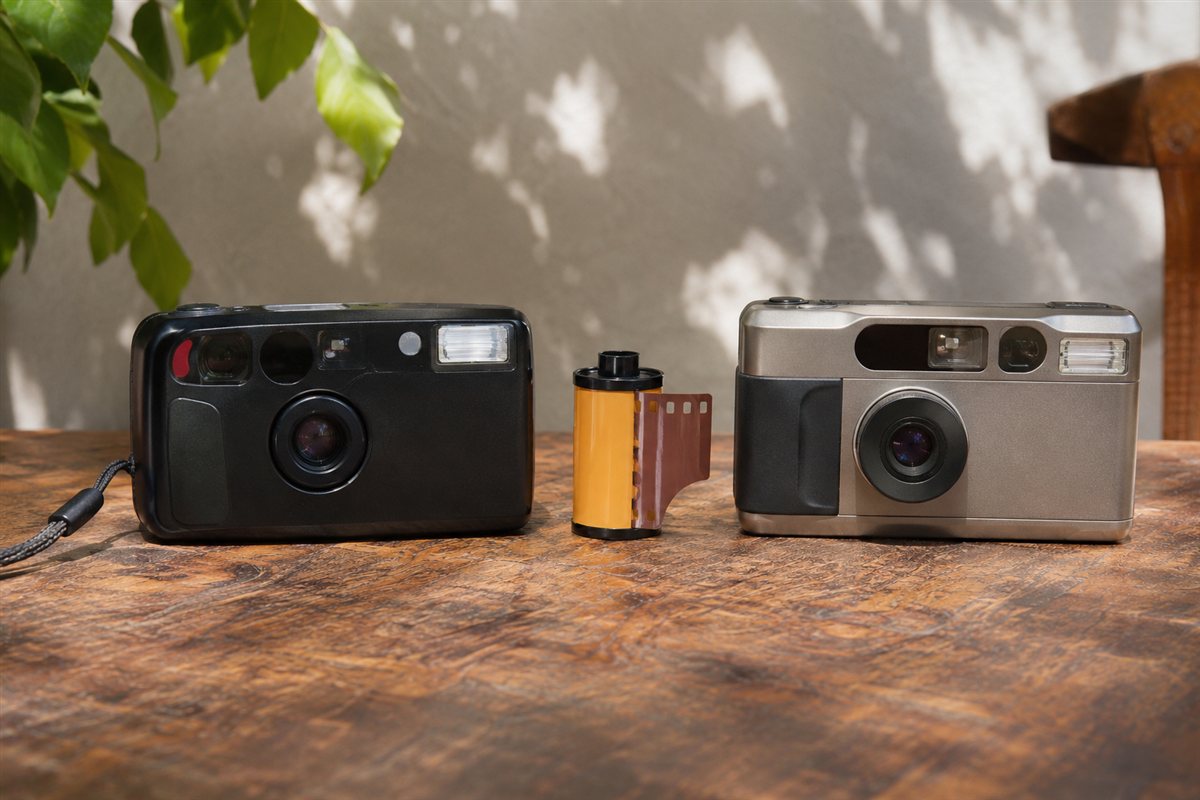
The Yashica T4 and the Contax T2 are both pocketable 35mm film compacts with Zeiss lenses, and both have a loyal following. The T4 is the simpler, lighter point-and-shoot, while the Contax T2 adds more manual control and a more premium build, usually at a much higher cost on the used market. We have not used either camera ourselves, so confirm exact specifications on a maker or trusted reference page.
What Each Camera Is For
The Yashica T4 is a compact autofocus film camera with a fast, sharp fixed lens, designed for walking around and quick candid shots. The Contax T2 is a compact autofocus camera with a fixed Zeiss lens and a more premium body that is aimed at photographers who want a pocket camera with extra control.
In this guide
Key Differences
| Trait | Yashica T4 | Contax T2 |
|---|---|---|
| Type | 35mm film compact | 35mm film compact |
| Lens | Fixed Zeiss Tessar | Fixed Zeiss Sonnar |
| Focal length | Close to 35mm | Slightly longer, near 38mm |
| Exposure control | Mostly automatic | Aperture priority available |
| Body feel | Lightweight, plastic | Metal, dense |
| Weather sealing | Reported splash resistance | Not designed as weather sealed |
Check each detail before buying, because older cameras vary by unit and by version.
Handling and Workflow
- The T4 favors speed. You switch it on, point and shoot, with a flash that fires automatically in dim light unless you turn it off.
- The T2 invites more deliberate shooting. You can set an aperture and let the camera choose the shutter speed, and it has manual focus options through a dial.
- The T4 is lighter in a pocket, while the T2 feels heavier and more solid.
Condition and Care
Both cameras are older and are sold used or refurbished. Ask about battery condition, autofocus, flash, the viewfinder, the film door seal and any service history. Repairs for older electronics can be hard to arrange, so a seller who offers a return option is valuable. Use the correct batteries and film for your model.
Which Should You Choose
- Choose the Yashica T4 for casual, quick snapshots, travel days and a lighter carry.
- Choose the Contax T2 if you want aperture control, a metal body and a longer standard view.
- Choose based on what you can find in good condition, as condition often matters more than the badge.
Shooting in Different Light
Pocket film compacts behave differently depending on the light, and knowing how each camera tends to handle conditions helps you get better results. In bright daylight, both are straightforward, and the main task is to place your subject well and avoid pointing at strong backlight. Check the manuals to see how each camera meters and whether it offers a way to adjust exposure.
In dim light, the choice of film speed and the flash behavior matter. The T4 fires its flash automatically in dim light unless turned off, which suits quick candid snapshots but can be unwelcome in some places. The T2 offers more control for people who like to choose an aperture, which can help when you want a deliberate look. Check whether flash can be disabled and how that setting is reached.
- Use a medium-speed film for general daylight and a faster film for evenings.
- Hold steady at slower shutter speeds.
- Step toward available light rather than relying on flash.
- Be careful in backlit scenes, where the meter can be fooled.
Read a roll’s results, note the settings and conditions, and adjust your habits as you learn how each camera responds.
Autofocus and Focusing Quirks
Compact autofocus systems of this age work differently from modern cameras. They typically measure distance to the subject in the center of the frame and set focus accordingly. If your subject is off-center, you may need to focus on it by half-pressing the shutter, then recompose without changing the distance.
Close subjects can be difficult. Check the minimum focus distance in the manual, and do not shoot closer than that. Low contrast scenes or very dark conditions may cause the system to hunt or misfocus. The Contax T2 offers manual focus options through a dial, which can help when the autofocus struggles, while the Yashica relies mostly on automatic focusing, so check each manual.
- Practice recomposing smoothly after focusing.
- Estimate distance when using manual focus.
- Keep fingers and straps clear of the lens and sensors.
- Test the autofocus on subjects at several distances before an important trip.
If focus seems unreliable on a used camera, ask the seller about its history, because a fault may require repair.
Batteries, Storage and Everyday Care
Both cameras need batteries to operate, so know which type and carry a spare. Weak batteries can lead to strange behavior such as the lens not extending or the shutter not firing. Replace batteries before suspecting a fault. Remove them when you store the camera for a long time to avoid leakage damage.
Protect the lens. A fixed lens cannot be replaced, so scratches and haze are permanent concerns. Keep the camera in a soft pouch, keep the cover closed when not in use and avoid carrying it loose with keys or coins. Clean the front glass with a blower and a soft lens cloth, avoiding pressure.
- Store in a cool, dry place with low humidity.
- Keep the camera away from direct heat and sunlight.
- Run the shutter and moving parts occasionally.
- Check the light seals on the door for age.
Handle sliding covers and doors gently, and do not force anything that resists, as small parts can be fragile.
Buying Used: Checks and Seller Questions
Prices and conditions vary widely, so careful checking is essential. Ask the seller whether the camera has been tested with film, and request clear photos of the lens, viewfinder, battery compartment and body. Look for scratches on the front element, haze inside the lens and dirt in the viewfinder.
Request a description of how everything works. Does the lens extend and retract smoothly? Does the autofocus respond? Does the flash fire and recharge? Does the film advance and rewind properly? Are the date and film settings accurate? If there is a display, is it readable? Compare answers against the manual.
- Ask about servicing or repair history.
- Check the return policy before paying.
- Be wary of listings with vague descriptions or stock photos only.
- Compare several listings to understand condition ranges.
Take care with claims of rarity or special editions, and verify them from reliable sources. A working camera in honest condition is better than a rare one that does not function properly.
Running a First Test Roll
Once the camera arrives, test it before relying on it. Load a common film and shoot a variety of scenes: bright outdoors, shaded areas, indoor light and a flash portrait. Keep notes on what you shot, including approximate settings and distances.
When you get the film back, check several things. Look at sharpness across the frame, which indicates lens and focus accuracy. Look for even exposure from frame to frame. Check for light leaks, such as streaks near the edges, which may mean the seals need replacement. Compare indoor shots with and without flash.
- Shoot a full roll so you can check consistency.
- Label the roll with the camera name.
- Contact the seller soon if there are problems.
- Repeat the test after any repair.
The test roll also helps you learn how the camera behaves. After a few rolls, you will know its strengths, and you can plan your shooting around them with confidence.
Composing With a Wide-Normal Lens
Both of these compacts carry a lens in the wide-normal range, roughly the view of a 35mm lens, and learning to compose with that field of view makes your film go further. This focal length is wide enough to include context and close enough to feel intimate. It forgives small errors in framing and invites you to step in close to your subject.
Use your feet. Because the lens does not zoom, closeness creates impact. For portraits, stand an arm’s length or two from your subject for a relaxed, informal feel. For street scenes, wait for someone to walk into a pleasing patch of light and press the shutter as they cross it. For travel, look for layers: a foreground element, a middle subject and a background that adds depth.
Check the edges of the viewfinder before each shot. Compact cameras show a slightly different view from the one the lens records, an effect called parallax, which becomes noticeable at close distances. Leave a little extra room around your subject at close range, and tilt the camera slightly upward or toward the side where the lens sits relative to the viewfinder. The manual or a short practice roll will teach you how much to allow.
Selecting Film for the Light You Have
A film compact is only as good as the film inside it, and choosing the right type for the light makes a big difference. Film speed, shown as a number on the box, describes sensitivity. A lower number needs more light and gives finer grain, while a higher number copes better with dim scenes at the cost of more visible grain.
| Situation | General direction |
|---|---|
| Bright sunny days | A lower speed film for fine detail and rich color |
| Mixed or cloudy weather | A medium speed film for flexibility |
| Indoors or evenings | A higher speed film, with flash if the camera allows it |
| Travel with changing light | A medium speed color negative film that tolerates mistakes |
| Graphic, high-contrast scenes | Black and white film for a timeless look |
Color negative film is forgiving and works well for most people. Slide film gives vivid color but demands accurate exposure. Black and white film is flexible and inexpensive to develop at home. Whatever you choose, check that the speed is set correctly on the camera, since many compacts read it automatically from the film cartridge.
Exposure Tips for Tricky Scenes
Automatic exposure works well in ordinary light, but certain scenes fool meters. A bright sky behind a person can cause the subject to look dark. A dark room with a single bright lamp can lead to overexposure of the lamp and loss of detail. Learn to recognize these situations and respond.
If your camera offers a backlight or exposure compensation control, use it to add light when your subject is darker than the background. Otherwise, move so that the light falls on your subject, or fill in with the flash if the camera lets you. In snow or on bright sand, you may need to add a little exposure so that the scene does not look gray.
Film has generous tolerance for overexposure, especially color negative. If you are unsure, it is usually safer to give a little extra light than too little. Underexposed negatives lose shadow detail and look muddy, while slightly overexposed ones keep a pleasing richness. For black and white, expose for the shadows and let development take care of the highlights.
- Meter off your subject’s face rather than the background.
- Avoid shooting directly into strong light unless you want silhouettes.
- Keep a note of tricky shots, then compare them with the results.
Using Flash Thoughtfully
Built-in flash is a gift in dim places, but it can make pictures look harsh. Direct flash flattens faces and creates hard shadows behind subjects. Used with care, it can also give the punchy, informal look that many film photographers enjoy.
Stay within the range the manual recommends, because flash power is limited. Place your subject close enough to be lit but far enough from the wall to avoid sharp shadows. Fill flash outdoors, used on a sunny day, softens shadows on faces and lifts the subject against a bright sky. If the camera lets you switch the flash on and off, make a habit of checking its setting at the beginning of each roll, since a flash that fires when you do not want it can spoil a quiet moment.
Think about red eye in portraits. Some cameras have a pre-flash to reduce it. If you notice it often, ask people to look slightly away from the lens, or raise the ambient light in the room so their pupils are smaller.
From Roll to Pictures: Developing and Scanning
The camera is only the first half of a film workflow. Once the roll is finished, you must develop it and turn the negatives into pictures you can view and share. There are three common routes. A local lab can develop and scan your roll for a fee, giving you digital files and negatives. A mail-in service offers the same results if no lab is nearby. Developing at home is possible for black and white and gives you full control, though it requires equipment and care.
When you hand film to a lab, mention the type you used and any special requests, such as a brighter or more natural scan. Ask about file sizes, since larger scans reveal more detail but take more storage space. Keep the negatives in sleeves, in a cool, dry place away from sunlight.
Name your scans by roll and date, and write the camera, film and conditions in a notebook. This record helps you learn which combinations work and creates a personal archive that will be valuable years from now.
Handling Both Cameras Day to Day
Compact film cameras are small, and their size encourages careless handling. Develop a few habits that protect them. Carry the camera in a soft pouch or a pocket without keys or coins. Keep the lens cover or sliding door closed when the camera is not in use, since this protects the front element.
Make a habit of checking the camera before you leave home. Confirm that film is loaded, the counter shows frames remaining, the battery is fresh and the flash setting is as you want it. After a shoot, rewind the film completely before opening the back, and write the roll details on the canister.
- Check battery and film before leaving.
- Hold the camera with both hands and keep fingers away from the lens and sensors.
- Press the shutter gently to avoid shake.
- Rewind fully, then remove the film.
- Store the camera with a fresh battery only if you plan to use it soon; otherwise remove the battery.
These simple routines keep the camera reliable and your rolls safe.
Common Mistakes With Film Compacts
New film shooters often repeat the same errors. One is loading film poorly, so the first few frames do not advance. Listen and watch for the film advance and confirm the counter moves. Another is covering the lens or sensors with a finger or strap, which appears as a dark blur or an odd glow in a corner.
A third mistake is shooting too fast and treating film like digital. Each frame costs something, and slowing down improves your keeper rate. Consider your composition, light and subject before each press. A fourth is leaving a roll in a hot car, which can harm the film. Keep unshot and shot film in a cool, shaded place.
Finally, many people never test their camera after buying it used. Run a trial roll, develop it and examine the results for light leaks, focus errors and exposure problems. If something is wrong, you will know early enough to ask for help or a return.
A Closing Checklist
- Decide whether you value light weight and simplicity or more control and a premium feel.
- Confirm current condition and working order of any camera you plan to buy.
- Choose film suited to your usual light and plan for development and scanning.
- Learn how the camera meters, focuses and fires its flash.
- Keep a notebook of settings and results.
Follow these steps and either camera will reward you with a personal collection of pictures that feel different from anything a phone can make.
Keeping a Shooting Journal That Teaches You
Film gives no instant feedback, so a journal fills the gap between pressing the shutter and seeing the result. Carry a small notebook or use a notes app on your phone. For each roll, record the film type, the date, the places you visited and the weather. For difficult frames, jot down what the light was doing and any adjustments you made, such as compensation or flash.
When the scans return, sit down with the notes and the pictures together. You will quickly notice patterns: perhaps backlit portraits come out too dark, or indoor scenes without flash look soft. Each pattern points to a habit you can change. Over several rolls, your keeper rate improves because you are learning from evidence rather than guesses.
The journal also becomes a personal record of your travels and daily life. Years later, a line such as a cold morning market with a low sun brings back memories that the pictures alone may not. Add a favorite frame number from each roll and a sentence on why it works. That small effort turns casual shooting into a practice with steady growth, and it helps you decide which film and camera setup truly suits your eye.
If you share a camera with a friend, keep the journal together so you can compare approaches and learn from each other’s mistakes and successes.


Ready to Buy? Start Here
If this guide helped you decide what to look for, these products are a place to start.


As an Amazon Associate we earn from qualifying purchases. Prices and availability are shown on Amazon.
Living With a Film Compact Day to Day
Choosing between two celebrated film compacts on paper is one thing; living with either is another, and the daily texture of use is where preferences actually form. Both cameras ask you to accept their automation as a partner rather than a servant. They decide a great deal for you — exposure, focus, flash behaviour — and the photographer’s skill shifts toward choosing the moment, the light and the position, then trusting the camera to execute. People who love that arrangement describe the cameras as liberating. People who want aperture dials and manual override describe the same arrangement as a cage. Knowing which temperament is yours predicts your happiness with either camera better than any specification comparison.
Carrying is part of living with them. A compact that genuinely fits a coat pocket gets carried on the days when photography was not the plan, and those unplanned days produce a disproportionate share of the photographs people keep. A camera that needs its own bag competes with every other plan for the day. When you handle both cameras, handle them as you would on an ordinary Tuesday — in a pocket, in a hand with a wrist strap, out and back a dozen times — rather than as precious objects on a counter. The one that disappears into your routine is the one that will make your photographs.
The Sound and Feel of the Thing
It sounds trivial until you live with it: compacts announce themselves. Lens motors whir, shutters click with varying discretion, and film advances with a little mechanical song after each frame. In quiet places — a church, a gallery, a sleeping household — those sounds decide whether you shoot or abstain. Photographers differ in how much this matters, but nobody who has winced at their own camera in a silent room calls it trivial afterwards. If you can, hear both cameras work before you choose, and imagine them in the quietest place you like to photograph.
Feel matters similarly over months. Buttons you can find by touch, a viewfinder you can use with glasses, a body that does not slip in cold hands — these small kindnesses compound across hundreds of rolls. The camera that wins a specification comparison but annoys your hands will slowly be left at home, and a camera left at home takes no photographs at all. This is why experienced buyers of classic compacts talk so much about handling and so little about numbers.
Film Choices That Flatter Each Camera
Both cameras reward film chosen with their automation in mind. Because you have limited exposure control, the film’s speed and character become your main creative levers. A forgiving colour negative film with generous exposure latitude suits the point-and-shoot life perfectly: it absorbs the camera’s occasional metering surprises and still delivers a printable negative. Faster film extends either camera into evenings and interiors, at the cost of more visible grain; slower film in bright conditions gives the finest results these lenses can offer, and shows what the optics are truly capable of.
Black and white film deserves a serious trial in both cameras. It removes colour from the decision-making, suits the snapshot rhythm these cameras encourage, and ages gracefully in a shoebox of prints. It also changes how the automation behaves in practice, because contrast and light become the whole picture. Many photographers who bought a compact for colour travel work keep it loaded with black and white for daily life, and find the second role becomes the beloved one.
Reading Your First Rolls Honestly
Your first rolls with either camera are diagnostic documents, and reading them well sets up everything after. Look for patterns rather than individual failures. Are the misses mostly focus, mostly exposure, mostly timing? Focus misses in a particular distance range suggest how that camera’s autofocus sees the world and where you should help it — by pre-focusing on a substitute subject at the same distance, a classic compact technique. Exposure misses in backlit scenes suggest when to expect trouble and compensate by moving or waiting. Timing misses are yours alone, and they improve with every roll.
Keep the negatives and a few notes together: film type, place, light, and what surprised you. After three or four rolls you will own a small, personal manual for your camera that no review can give you, because it describes the partnership between that specific camera, your subjects and your habits. Buyers who skip this reading often blame the camera for patterns that a single afternoon of honest review would have explained.
The Economics of Shooting Classic Compacts
Owning a sought-after film compact involves costs beyond the purchase, and thinking about them clearly helps the choice between the two. Film and processing are the steady costs, the same for both. The variable costs are repairs and the risk that a repair is impossible: these are electronic cameras from an era whose parts and specialists grow scarcer, and a fault in a motor, a flex circuit or a control board can end a camera’s life regardless of its optical quality. That reality argues for buying the best-kept example you can find of whichever you choose, from a seller who describes faults honestly, rather than the cheapest example of the more prestigious name.
It also argues for a particular mindset: buy the camera to use it, not to preserve it. A compact kept in a cabinet as an appreciating asset takes no photographs and still ages. The photographers who get value from these cameras shoot them regularly, accept the running costs as the price of the look and the process they love, and keep a modest digital or phone backup for the moments when the film camera must not be risked. Judged that way, the difference in purchase price between the two matters less than the difference in how each fits your shooting life.
Insurance, Travel and Care in the Real World
If you travel with a classic compact, plan for its fragility and its value. Carry it in hand luggage, request hand inspection of film where security allows rather than sending film through strong scanners repeatedly, and keep the camera in a padded wrap inside your bag rather than loose among chargers and bottles. A simple record of the serial number and a photograph of the camera, stored with your other documents, costs nothing and helps if anything is lost or stolen. These are dull precautions that take ten minutes and protect an object that may be effectively irreplaceable.
At home, storage is the other half of care. Cameras dislike damp more than almost anything: fungus in a lens element begins in humid storage and is effectively permanent. A dry cabinet is ideal, but a shelf in a lived-in, heated room, away from steamy bathrooms and cold external walls, serves most owners well. Exercise the camera occasionally even in quiet months — a few shutter firings and a run of the lens in and out keep lubricants distributed and reveal developing faults while they are still small.
What These Cameras Teach You
There is a reason photographers keep returning to limited, automatic film cameras in an age of total digital control: the limitations are instructive. With thirty-six frames, no review screen and a camera that insists on making its own decisions, you learn to look longer before shooting, to accept the photograph the moment offered rather than the one you wished for, and to value the discipline of finishing a roll before seeing anything. Those habits transfer. Photographers who spend a season with a compact often return to their digital cameras slower, more selective and oddly more confident.
Whichever of the two you choose, give it that season before judging. Shoot it in your ordinary life rather than saving it for occasions, finish rolls promptly so the feedback loop stays tight, and let the comparison that matters — between your early rolls and your later ones — be the verdict. The better camera, in the end, is the one whose limitations you have learned to play like an instrument, and that title can only be earned by use.
Two Cameras, Two Tempers: A Longer acquaintance
Spend enough time in owner communities and you will notice that each of these cameras has gathered a distinct folklore, and the folklore is itself evidence — not about specifications, but about the emotional texture of ownership. One camera’s owners talk about trust: the meter they stopped second-guessing, the focus they learned to pre-set, the way the camera disappears during a day out. The other’s owners talk about occasion: the rendering on a particular film, the pleasure of the object’s design, the sense that using it marks the day as chosen rather than ordinary. Neither folklore is wrong, and neither is transferable. The useful question is which conversation you want to join — the one about a tool that vanishes, or the one about an instrument that performs — because you will be having that conversation, with yourself, for as long as you own the camera.
It is worth seeking out the dissatisfied in both camps and reading their complaints with care, because complaints reveal the fit-faults that specifications hide. Owners who parted with one of these cameras rarely cite image quality; they cite the viewfinder that fought their glasses, the automation that overruled them once too often, the repair bill that arrived at the wrong year, the size that turned out to be a pocket too small. Every one of those complaints is a question you can ask about your own life before you buy, which is a far better use of other people’s disappointments than entertainment.
The First Photograph You Should Take With It
Whichever camera comes home with you, make its first roll a deliberate one rather than a test of random snaps. Photograph the people and places of an ordinary week — the kitchen in morning light, the street you walk daily, a friend across a café table — on the film you intend to use most. Those frames become your baseline: the honest record of what this camera does with your life before you have learned any of its tricks. Every later improvement will be visible against them, and years from now, when the camera is an old companion, that first roll will read like the opening page of a diary you are glad you kept.
Borrowing Trouble: What Can Go Wrong on a Trip
Travel concentrates the risks of classic compacts, so plan for the three failures that actually happen. The first is battery death far from a supplier: carry the spare, always, in a different pocket from the camera, because a single point of failure is a choice rather than a fate. The second is a film mishap — a roll finished and rewound incorrectly, a back opened in a moment of confusion — and the defence is routine: finish rolls at calm moments, label them immediately, and store exposed film separately from fresh. The third is the camera fault that ends its trip: the defence there is philosophical as much as practical. Carry the phone without resentment as a backup, and remember that a trip measured by one camera’s survival was too fragile a plan to begin with. The photographs that matter from a journey are the ones in your memory of being there; the film is their souvenir, not their substitute.
Lending, Borrowing and the Social Life of a Classic
These cameras attract requests to borrow, and lending one is a genuine decision rather than a pleasantry. A classic compact is fragile, valuable and effectively irreplaceable in kind, and its automation makes it easy for a borrower to open the back mid-roll or force a control they do not understand. If you lend, lend with a five-minute briefing and a fresh roll loaded by you, and lend to the person whose care you have actually observed rather than whose enthusiasm is loudest. Many owners instead keep a sturdier, simpler film camera as the lending copy and the classic for themselves — an arrangement that preserves both the friendship and the camera, which is the correct order of priorities.
How the Choice Looks Five Years On
Project yourself forward five years and the comparison resolves into a surprisingly simple picture. The camera you chose will have travelled or it will not; its shutter will have fired through seasons of your life or rested in a cabinet; it will have needed nothing, or a battery, or a repair you either arranged with equanimity or resented. In that future, the differences that dominate today’s comparison — a fraction of rendering character, a nuance of automation — will have faded to footnotes, and the differences that remain will be the human ones: whether the camera fitted your hand and your habits, whether you trusted it enough to carry it unplanned, whether its limitations taught you things you still use. Buy for that five-year picture and the choice between these two becomes less a verdict on the cameras than a description of the photographer you intend to be.
That framing also settles the question of condition and completeness that runs through used buying. Five years on, the example that was honestly described, fully working and gently kept will have justified every penny of its premium, because it spent those years making photographs instead of excuses. The bargain that needed immediate attention will have spent them in drawers and workshops. Cheap classics are expensive in the only currency that cannot be refunded, which is time with the camera in your hand.
The Companion You Already Own
One often-missed consideration is the camera already in your life — the phone, most likely — and how a film compact partners with it rather than competing. The healthiest arrangement treats them as different instruments for different movements of the same music: the phone for immediacy, communication and the photographs that must be shared today; the compact for slowness, deliberation and the photographs that can wait a week to exist. Owners who force the two into rivalry usually end up dissatisfied with both. Owners who let each do what it is for find that the film camera improves the phone work — through the patience it teaches — and the phone protects the film camera, by absorbing the risky, hurried, disposable shooting that was never its strength.
A Purchase Day Checklist
When the day comes, carry a short list and honour it. Confirm the exact model and variant in your hands, not merely in the listing. Work every control, fire the shutter at several settings, run the lens through its travel, and inspect the glass against a bright light. Load or simulate loading film if the seller permits, and confirm the camera winds and counts. Check the seals and the battery compartment for the corrosion that betrays a damp past. Ask the questions whose answers cannot be photographed: history, faults, returns. And if anything about the encounter pressures you to skip the list — hurry, charm, another buyer supposedly waiting — treat the pressure itself as information and walk away. The right example of either of these cameras will still be findable next week. The wrong one would be yours for years.
Repairs, Servicing and the Questions to Ask a Technician
Classic electronic compacts eventually meet a technician, or fail to find one, and the difference between those outcomes often lies in how the owner approaches the search. Specialists in film-era electronics are a small, networked community: camera shops that sell these models usually know who services them, and owner communities maintain hard-won lists of who accepts which cameras and what their work is like. Approach with information — the camera’s symptoms described plainly, when they occur, what you have already tried — and ask the questions that reveal competence: whether the fault is one they have seen, whether parts are likely to be needed and available, and what happens to your deposit if the camera proves beyond repair.
Understand the economics before you agree to work. A service that costs a substantial share of the camera’s value can still be rational — you are buying back a known camera whose habits you have learned, rather than gambling on another stranger’s example — but it should be a decision, not a surprise. Ask for the likely range, the point at which the technician will stop and consult you, and whether a simpler fault found along the way changes the estimate. Owners who have these conversations first rarely feel cheated afterwards, whichever way the repair goes.
Keeping a Camera Alive Between Services
Regular, gentle use is itself a form of maintenance for these cameras: mechanisms stay exercised, lubricants stay distributed, and developing faults announce themselves in ordinary shooting rather than on the first day of a holiday. A camera that will sit unused for months is better stored with its battery removed, in a dry place, after a final check that everything retracts and closes as it should. When it comes back into service, give it a cheap test roll at home before trusting it with anything that matters. This rhythm — exercise, rest properly, test on return — is how owners coax long lives from electronics that were never designed to be heirlooms.
The Photographs Each Camera Wants to Take
Every camera has a centre of gravity — subjects and conditions where it feels inevitable rather than adequate — and finding it is the pleasure of ownership. Wide, fast compacts of this kind tend to shine in the photography of daily life: interiors, evenings, streets, friends across tables, travel without ceremony. Their lenses see roughly as the eye sees, their automation is quickest in ordinary light, and their size means they are present for the unplanned. Photographers who fight that centre of gravity — demanding landscapes of cathedral precision or wildlife at impossible distances — conclude the camera is overrated. Photographers who work within it produce the images that built the reputation.
Test your own example against that centre deliberately in its first month: a roll of evenings, a roll of days out, a roll of people. Read the results for where your camera is happiest and where your own pleasure concentrates, because the overlap of those two is your real answer to the comparison this guide began with. Specification sheets can rank cameras; only film through the camera, in your life, can rank the partnership.
A Word About Scanning and Sharing Film Work
How your film is digitised shapes how the photographs are judged, sometimes more than the camera does. A poor scan can make a fine lens look ordinary — soft, oddly coloured, noisy in a way the negative is not — while a careful scan reveals what the compact actually captured. If your first rolls disappoint, hold judgement until you have seen the negatives themselves or a better scan, because many cameras have been condemned by their digitising rather than their optics. When you find a lab or a scanning routine whose results you trust, stay with it: consistency in the chain lets you attribute changes to the camera and the film, which is the information you actually need.
Deciding, Finally, as an Owner Rather Than a Collector
The last consideration is identity. One of these cameras carries a certain glamour — the famous name in the famous story — and glamour is a real pleasure, but it is a pleasure that fades at the rate of fashion, while the pleasure of a tool that fits your hand and your habits compounds daily. Ask yourself which camera you would choose if neither had a reputation: same photographs, same handling, no story attached. The answer to that stripped-down question is usually the honest one, and buying on it protects you from paying for a legend you will be too nervous to carry in a coat pocket — which is the one place these cameras were always meant to live.
FAQ
Is one sharper than the other?
Both have well regarded Zeiss lenses. Real results depend on the individual camera, your film and your technique.
Which is better for beginners?
The T4 is simpler. The T2 is manageable too, but it offers more settings to learn.
Which camera is easier to use in dim light?
Both rely on film speed and flash. The T4 uses automatic flash, while the T2 gives more control. Check the manuals for details.
Do these cameras use the same batteries?
Battery types can differ, so check each manual. Carry a spare of the right type.
Can I turn off the flash?
Check each camera's controls. If flash can be disabled, learn how to do it before you shoot indoors.
What film should I start with?
A common medium-speed film is a good start for varied conditions. Move to faster film for evenings.
How do I clean the lens safely?
Use a blower first, then a soft lens cloth with light pressure. Avoid liquids unless the maker advises.
Is a used example risky?
There is some risk, since the cameras are old. Ask about testing, servicing and returns to reduce it.
Should I get the camera serviced?
If you notice problems or the seller reports no servicing, a check by a technician may be worthwhile.
The Short Version
Choose the T4 for simplicity and a light carry, and the T2 for extra control and build. Whichever you choose, buy from a seller who describes the condition clearly.
