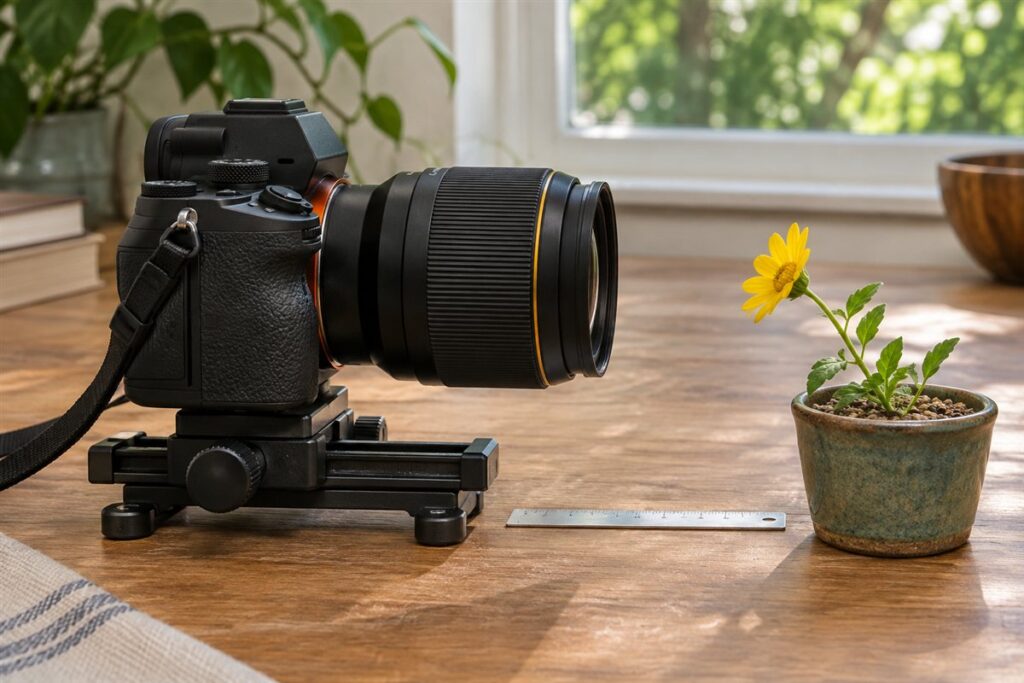
Focus distance is the distance from the camera’s sensor plane to the subject that is sharply in focus, and minimum focusing distance is the closest that a lens can focus. If you move nearer than that limit, the subject turns soft and the lens cannot lock focus. Knowing the figure for your lens helps you plan close-up shots and avoid frustration.
Where the Distance Is Measured
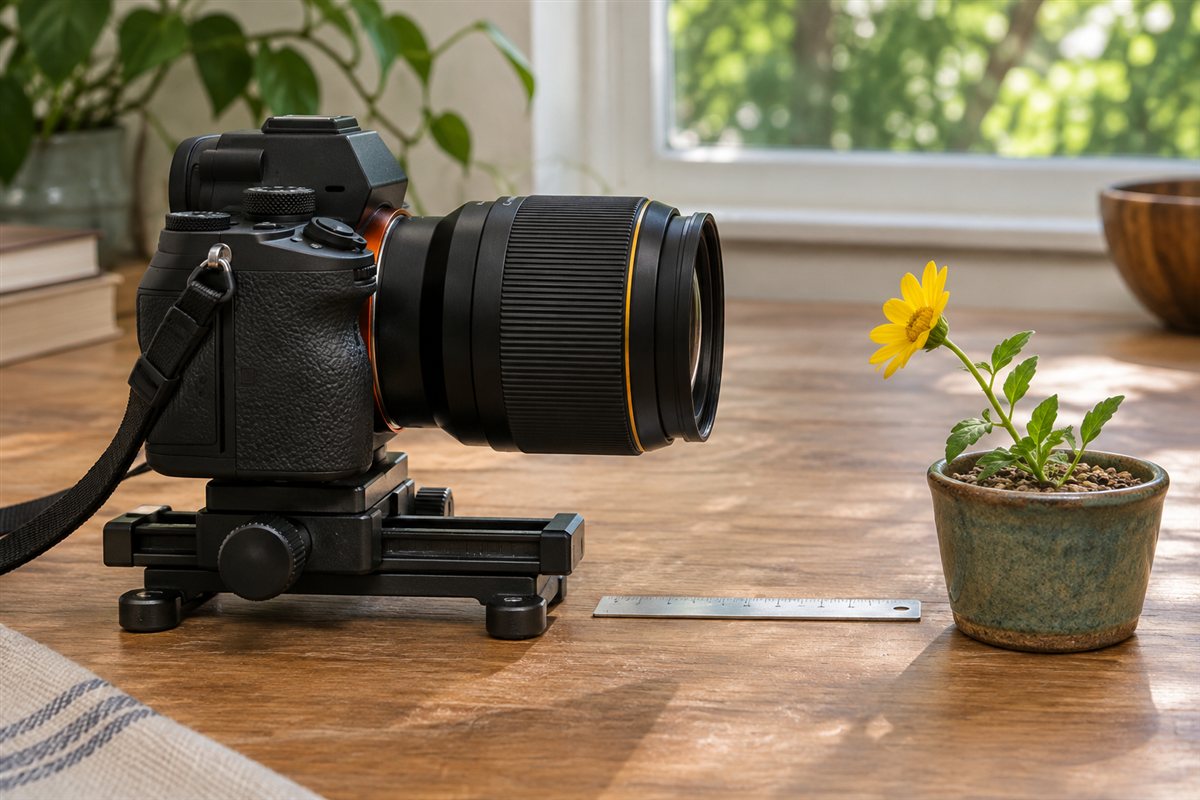
Many people assume the distance is measured from the front of the lens, but makers normally measure it from the sensor plane. Most cameras have a small mark on the body, often a circle with a line through it, that shows where the sensor sits. The actual gap between the front of the lens and the subject is therefore shorter than the number on the spec sheet.
- Spec sheet figure: sensor to subject.
- Working distance: front of lens to subject, which is the useful number for lighting and approach.
In this guide
Why Minimum Focusing Distance Matters
A short minimum distance lets you fill the frame with small subjects, such as flowers, jewelry or food details. It also affects how close you can stand to a person for a tight portrait. Lenses with long minimum distances, like many telephoto zooms, require you to stay farther back.
| Lens type | General tendency |
|---|---|
| Macro lens | Very short, allows large magnification |
| Standard prime | Short to moderate |
| Wide zoom | Often short |
| Telephoto zoom | Often longer |
These are general tendencies only. Check the exact figure on the maker’s page for any lens you plan to buy.
Magnification and the Close-Up Link
Minimum focusing distance is tied to maximum magnification. The shorter the distance, the larger the subject can appear on the sensor. A true macro lens reaches a 1:1 ratio, meaning the subject is recorded at life size on the sensor.
Working Around Limits
- Step back and crop later if you only need a slightly tighter view.
- Zoom out slightly, since some zooms focus closer at certain focal lengths.
- Use extension tubes, which move the lens farther from the sensor and let you focus nearer.
- Try a close-up filter that screws on the front for an easy, light option.
- Switch to manual focus and rock gently toward the subject until it sharpens.
Reading Lens Specifications for Close-Focus Ability
When you compare lenses for close work, two numbers do most of the talking: the minimum focusing distance and the maximum magnification. They are related but they are not the same thing, and neither tells the whole story. Minimum focusing distance is how close the subject can be to the sensor plane. Maximum magnification, usually written as a ratio, tells you how large the subject appears on the sensor compared with its real size.
A ratio of 1:1 means a subject is recorded at life size on the sensor. A ratio such as 1:4 means the image on the sensor is one quarter the real size. Because a longer focal length magnifies more at a given distance, two lenses with the same minimum distance can have different ratios. A telephoto lens with a moderate close-focus distance may magnify more than a wide lens that can focus closer, which surprises many people.
When you read a product page, look for both figures, and check whether the quoted distance is measured from the sensor plane. Some lenses change their close-focus ability across the zoom range, so look for a note about the focal length at which the figure applies. A listing might also mention the front-element distance or working distance, but if it does not, you can estimate it by subtracting the length of the lens and the distance from the lens mount to the sensor.
- Compare ratios for lenses of similar focal length before you compare distances.
- Check if close focus is only available at one end of a zoom.
- Be cautious about marketing phrases like macro-style, and look for the actual ratio.
Using the Focus Scale and Distance Window
Many lenses have a printed distance scale, sometimes in meters and feet, and some have a small window showing the current focus setting. This gives you a quick view of where the lens is focused. The scale is useful in manual focus, where you can pre-set the distance for a planned shot, such as in street photography when you expect people to pass at a particular distance.
The scale has limits. Many modern lenses focus by wire, meaning the ring sends signals to a motor rather than moving the glass directly, and these lenses may not have a scale at all, or may show it on the camera display. The accuracy of any scale also varies, so use it as a guide and check with the live view. If the lens has a hard stop at infinity, you can rely on it more, but some lenses go slightly past infinity to allow for temperature changes, so a lens at the stop may not be perfectly focused on distant objects.
Try an experiment. Focus on a subject at a known distance and compare it with the scale. Repeat at a few distances. This tells you how closely the scale matches the real focus on your lens.
- Use the scale for zone focusing when you cannot rely on autofocus.
- Do not rely on a printed scale for critical close-up work.
- Check the camera display for a focus distance readout, if your camera offers one.
Depth of Field at Close Range and Focus Stacking
The closer you focus, the thinner the zone of sharpness becomes. At very short distances, even a small aperture may give only a sliver of the subject in focus. This is why a close-up of a flower can show a sharp petal edge and a soft center. It is not a fault of the lens but a natural result of the optics.
Closing the aperture helps, but there is a limit. Very small apertures introduce diffraction, which softens the whole image. Moving the camera slightly farther away and cropping, or choosing a different angle where the important parts lie in the same plane, can give a better result. Aligning the sensor so it is parallel with the subject’s main surface puts more of it within the sharp zone.
For static subjects, focus stacking is the most reliable method. You take a series of photos at slightly different focus distances and combine them in software. Many cameras offer a focus bracketing feature to automate this, and some software can merge the files automatically. Use a tripod, keep the lighting steady, and make sure the subject does not move. Take more frames than you think you need, since gaps produce soft bands.
- Use manual focus or a precise focus point, and check with magnified live view.
- Try to keep the subject plane parallel to the sensor.
- Stop down moderately and avoid the smallest apertures.
Lighting and Working Distance in Practice
Working distance, the gap between the front of the lens and the subject, is the number you feel when shooting. When it is very short, the lens and camera can cast a shadow on the subject, and you may find it hard to place a light. It can also startle living subjects like insects, which may fly away as you approach. A longer working distance, which many longer macro-style lenses provide, is more comfortable for these situations.
Light is often the biggest practical problem. At high magnification, the effective aperture is smaller than the number marked on the lens, because light is lost as the lens extends. This is called the exposure factor, and it means that you need more light or longer exposures than you might expect. Some cameras calculate exposure through the lens and compensate automatically, but in manual flash setups you may need to adjust.
Use diffusers or reflectors to soften the light on small subjects, and place a light to the side of the lens to avoid shadows. A ring or twin flash designed for close work can help, but it is not essential. For still subjects, a continuous light and a tripod give you time to check your result. Remember that small movements are magnified in close-up work, so even a light breeze or a vibration can ruin a shot.
- Shade the subject from the wind with your body or a cardboard sheet.
- Use a remote release or a timer to avoid shaking the camera.
- Check the position of the lens hood, since it may block light at short distances.
Troubleshooting Autofocus and Choosing a Lens for Close Work
If your lens hunts back and forth near the minimum distance, the cause is usually that the subject is too close, the light is too dim or the subject has too little contrast. Move back slightly, add light or switch to manual focus. Some lenses include a focus limiter switch that restricts the search range, which helps when you know your subject is far away, but it can prevent focus if you leave it set to the wrong range.
Also be aware of focus breathing, where the field of view changes as you move focus. At close distances, some lenses effectively reduce their focal length, so the framing differs from what you expect. This is common and is not necessarily a defect, but it is worth knowing about when you plan a shot.
When choosing a lens for close work, start with what you photograph. For small subjects such as jewelry, insects or fine details, a dedicated macro lens is the most flexible, and the focal length decides the working distance. For general use with occasional close-ups, a lens with a short minimum distance and a modest ratio can be enough. For food and product photography, a standard lens with good close focus often works well. Read the specifications, look at sample images and, if you can, test the lens before purchase.
- List the smallest subject you want to photograph and the distance you can work at.
- Compare ratios and minimum distances across several lens candidates.
- Buy from a seller with a clear return policy if you cannot test in a shop.
A Quick Glossary of Focus Terms
Lens specifications use several similar-sounding words, and mixing them up leads to confusion when you compare lenses or read a manual. These short definitions keep the vocabulary straight.
- Focus distance: the distance from the sensor plane, usually marked on the camera body with a small circle and line, to the point that is sharply focused.
- Minimum focusing distance: the shortest focus distance the lens can achieve. Anything closer than this cannot be rendered sharp.
- Working distance: the gap between the front of the lens and the subject. It is shorter than the focus distance, because the lens itself and the space inside the camera take up room.
- Maximum magnification: how large the subject appears on the sensor compared with its real size, written as a ratio such as 1:4 or 1:1.
- Infinity focus: the setting for very distant subjects, shown on many lenses as a sideways figure eight.
- Focus breathing: a slight change in the field of view as you adjust focus, noticeable mainly in video.
The difference between focus distance and working distance trips up many people. A lens with a minimum focusing distance of thirty centimeters does not let you hold the front element thirty centimeters from the subject. The true gap is smaller, and with a long lens and a hood, it can be quite small indeed. That matters for lighting, for shadows and for skittish subjects such as insects.
Common Misunderstandings That Cause Frustration
When a lens will not focus on something nearby, the cause is often one of a few predictable misunderstandings rather than a fault. Checking them first saves time and worry.
The first is measuring from the wrong place. Photographers sometimes measure from the front of the lens and decide that the subject is far enough away, when the specification is measured from the sensor plane. Add the length of the lens and the camera body depth to your estimate.
The second is assuming a zoom keeps one limit across its range. Many zooms allow closer focus at one end of the range than the other, and some change their limit as you turn the zoom ring. Check the specification sheet or the maker’s description for the exact behavior of your model.
The third is mistaking a focus hunt for a mechanical problem. If the autofocus system cycles back and forth, it may simply be asked to focus on something too close. Step back a little, and it usually locks on immediately.
The fourth is confusing close focus with macro. A lens can focus fairly near without producing a large image of the subject. True macro lenses reach a high magnification, often life size, while ordinary lenses may only reach a fraction of that.
The fifth is forgetting that adding extension tubes or close-up filters changes the picture. These accessories shift the focus range, which can be handy, but they also change how the lens behaves at distance. Read the accessory maker’s notes about the focus range you can expect.
How to Read a Product Listing for Close-Focus Details
Listings present focus information in slightly different ways, and a careful read saves disappointment. Look for these items on the specification page or in the manual before you decide.
- The minimum focusing distance, along with whether it is measured from the sensor plane.
- The maximum magnification or reproduction ratio, ideally for each end of a zoom.
- Whether the figures apply to the full-frame format or a crop format, since the stated field of view may differ.
- Any mention of a focus limiter switch, which restricts the range the autofocus will search and can speed it up.
- Notes about internal focusing, which means the lens barrel does not extend as you focus.
- Remarks about image stabilization at close range, since the benefit can differ for near subjects.
If a listing quotes only one number, be wary. Ask what the number represents, or consult the official maker’s page, which is usually the most reliable source. Where figures conflict between sellers, trust the manufacturer’s own specification over a third-party summary.
Finally, consider how you actually plan to shoot. If you photograph flowers, food or small objects, a short minimum distance and a decent magnification ratio matter a great deal. If you shoot distant landscapes or sports, you may never come near the limit, and other qualities of the lens deserve more attention.
Comparing Two Ways to Get Closer
When your lens will not focus as near as you would like, you have two broad options. The table sets them side by side.
| Option | How it works | Points to consider |
|---|---|---|
| Dedicated macro lens | Built to focus very near with high magnification and strong sharpness | A bigger commitment, but it is optimized for the job and often doubles as a normal lens |
| Accessories such as tubes or close-up filters | Move the focus range nearer without a new lens | Simpler and more modest in outlay, but may reduce light or limit distant focus |
A dedicated lens gives the best quality and the most comfortable handling, while accessories let you experiment before you commit. Many photographers begin with accessories to find out whether they enjoy close work, then move to a proper macro lens if the interest grows. Always follow the maker’s guidance about compatibility, because not every accessory works with every lens or camera.
When Autofocus Is Not the Answer
At very short range, autofocus can struggle, particularly in dim light or on low-contrast surfaces. In those situations, switching to manual focus often gives a better result. Use the magnified live view on your camera screen, and turn the ring slowly until the part of the subject you care about looks crisp.
Another reliable technique is to set the focus ring and move your body instead. Fix the lens at its closest setting, then lean slowly forward or backward until the subject snaps into focus. This approach is especially useful for small, steady subjects such as coins, stamps or jewelry, because tiny movements of your body give fine control.
If your results still look soft, consider whether camera shake, subject movement or a very narrow zone of sharpness is the real cause. A steady support such as a tripod can make a larger difference than any change of lens.
Focus Distance in the Field: Where the Numbers Become Pictures
Theory meets practice at the moment a subject refuses to focus. You are close to a flower, a product, a child’s hands at work, and the lens hunts, overshoots, gives up. Knowing the lens’s minimum focusing distance — and, more usefully, your working distance at that point — converts the frustration into a decision: move back a hand’s width and crop, change to a lens that focuses closer, add extension if your work justifies it, or recompose so the subject sits inside the range the lens can serve. Every one of those is a legitimate photographic answer. The only illegitimate one is continuing to wrestle a lens at a distance it has told you, in its specifications and now in person, that it cannot do.
Build the knowledge into your hands before you need it. With each lens you own, find its closest focus on a patient subject at home and notice what the framing looks like there: how large a flower fills the frame, how much of a face, how the background behaves. That memory is your field instrument. When a real subject appears, you will know before raising the camera whether this lens can take the picture you are imagining, and the knowing will look, to anyone watching, like experience — which is exactly what it is.
Working distance is the number your subject cares about
Minimum focusing distance is measured from the sensor, but the space that matters — between the front of the lens and the subject — is the working distance, and it is always smaller, sometimes dramatically. A long lens focused at its minimum may leave a comfortable gap that suits shy subjects, lights and reflectors; a wide lens at its minimum may leave only a few centimetres, in which the lens itself shadows the subject and every breath moves the focus. When you plan close work, plan in working distance: it decides whether the insect stays, whether the light fits, and whether your own head becomes part of the lighting design.
Choosing a Lens for Close Work Without Buying Regrets
Shoppers compare close-focus ability by the magnification figure, and that figure deserves its place — it tells you how large the subject can be rendered. But three companions matter as much. First, the working distance at that magnification, for the reasons above. Second, how the lens behaves at its closest settings: some lenses are sharpest at distance and soften noticeably at their minimum, while true macro designs are built to peak exactly there. Third, how focus is achieved — a lens that extends dramatically, or whose front element rotates, changes your lighting and your subject’s patience at the very distances you bought it for.
Read reviews with those three in hand, and test in the shop with a coin, a banknote’s fine print or a piece of jewellery rather than with the shop’s distant shelves. The close-focus test takes ninety seconds and answers the only question that matters for this purchase: what does this lens do at the distance I actually intend to use. A lens bought on that evidence rarely disappoints; a lens bought on a specification table alone is a lottery ticket with good optics.
Zooms that focus close, and what near-macro really means
Many zooms advertise a close-focus or near-macro capability, and the honest ones deliver a useful middle kingdom: flowers, products, details, food — subjects that want framing tighter than ordinary shooting allows but do not need life-size reproduction. Judge such a zoom at its closest setting in the focal length you will actually use, since close ability often lives at one end of the range and vanishes at the other. If your close work is occasional and your subjects are cooperative, a good near-macro zoom may be the sensible whole answer. If your subjects are insects, coins or watch parts, it is a pleasant introduction to a dedicated lens.
Focus Technique at Close Range, Where Everything Is Magnified
At close distances the ordinary rules of focus tighten. Depth of field shrinks to millimetres, so focus placement becomes composition: choose the exact point that must be sharp — the insect’s eye, the product’s logo, the nearest petal’s edge — and put your focus there deliberately rather than accepting the lens’s first suggestion. Autofocus may hunt in low contrast or low light at these ranges; manual focus with magnification, or rocking your whole body gently through the focus point with the shutter firing at the moment of sharpness, are the classic field techniques, and both reward practice on patient subjects before the unrepeatable one arrives.
Breathing — yours — is now a camera movement. So is the wind in a leaf, the vibration of a floor, the subject’s own small life. Raise the shutter speed beyond what the framing seems to need, support the camera or the subject where you ethically can, and take more frames than pride suggests, because at close range the keeper rate falls for reasons nobody can fully control. Review at full magnification in the field; the rear screen’s small mercy hides exactly the softness that close work punishes.
Light at close range is a design problem
The closer you work, the more your own equipment becomes the weather. The lens blocks the light it needs; your shadow falls across the subject; flash fired from the camera’s position flattens what it illuminates. Solutions are old and effective: work in bright open shade where direction matters less, use a small diffuser to soften and spread the light you have, position a reflector to fill from the side the lens does not occupy, and where flash is needed, move it off the camera so modelling survives. Plan the light before the final approach to a shy subject, because you may get only one.
Close Focus Across Subjects: A Short Field Guide
Flowers forgive: they hold still in calm air, tolerate your shadow’s arrival, and reward the closest distances with structure invisible from standing height — but their depth at close range means choosing which layer of petals carries the focus, and a breeze you cannot feel at head height is a gale at theirs. Insects negotiate: approach slowly, from the front-side rather than from above, work in the cool of morning when they are sluggish, and accept the working distance their wariness sets as the real specification of the day. Products obey: they wait while you perfect light and focus, which makes them the ideal training ground for every technique in this article. People, at close range, are a portrait discipline of their own — hands, details, the tools of their trade — where consent and comfort outrank magnification every time.
The ethics of the very close
Working distance is also an ethical distance. A lens pressed close to a nesting bird, a resting insect chilled into stillness, or a stranger’s hands has obligations that pure technique ignores. Learn your subjects’ tolerances, obey the protections that cover them, and let some frames go unmade. The close-up tradition at its best is a literature of patience and respect; its worst is a record of disturbance with good sharpness. Choose which tradition your archive joins.
When the Answer Is to Step Back
Stepping back and cropping is treated as defeat by photographers who have not done the arithmetic. Modern sensors hold generous resolution, and a frame taken at a comfortable distance — with focus nailed, light well placed and the subject undisturbed — cropped moderately will defeat a frame taken at the lens’s ragged minimum with focus missed by a breath. The minimum focusing distance is a boundary of the possible, not a target for the wise. Work at the distance where everything else about the photograph is at its best, and let the boundary be what it is: the place you visit deliberately, for subjects that demand it, rather than the place you live.
Troubleshooting the Three Classic Complaints
It will not focus is the first complaint, and its causes queue in a reliable order: you are inside the minimum distance; the subject offers too little contrast or light for the autofocus to grip; a focus limiter switch, if your lens has one, is set to exclude the close range; or the camera is trying to focus with a point that sits on a featureless part of the subject. Work the queue in order and the fault usually confesses at step one or three — the two that embarrass, because both were knowable before the subject was disturbed.
It focuses but the pictures are soft is the second complaint, and its causes are movement magnified, depth thinner than the subject, and focus placed a breath behind the point you intended. The cures are the section above in uniform: support, shutter speed, deliberate placement, review at full size. It focuses on the wrong thing is the third, and it is a settings conversation — too many focus points invited to vote. Restrict the camera to one point or a small group for close work, place it like you mean it, and the democracy of points stops electing the background leaf.
Above all, let the subject set the distance more often than the specification does. The flower, the insect, the product and the person each have a range at which the photograph becomes possible and kind; the lens’s minimum is only the floor beneath that conversation, and the best close photographers are the ones listening upward from it.
A Practice Afternoon for Close Focus
Spend one session at a table with patient subjects — coins, leaves, a watch, a piece of fruit cut open — and work each lens you own at its minimum. Note the working distance, the framing, the depth you get at several apertures, and how the light behaves when the lens is that close. Photograph the same subject with each method available to you: stepping back and cropping, extension if you own it, the dedicated close lens if you have one. The comparisons, saved with notes, become your personal answer to every future question in this area — which lens for the small product shoot, which for the garden, which to pack for the trip where close subjects will appear unannounced.
Recording what you learn
Keep a small card or phone note per lens: minimum distance, working distance, magnification, and one line about its behaviour at the minimum — sharp, soft, shadows the subject, breathes heavily. Such notes look humble and save shoots, because the field is no place to rediscover that your chosen lens leaves three centimetres of working room for a subject that needs a lamp beside it.
Keep the two distances straight — the one measured from the sensor, the one lived in front of the lens — and close photography stops being a fight with your equipment and becomes what it should be: a way of paying very near attention.
FAQ
Why will my lens not focus up close?
You are most likely inside the minimum focusing distance. Move back until the focus indicator confirms.
Does focus distance affect depth of field?
Yes. Closer focus gives shallower depth of field at the same aperture.
What does 1:2 magnification mean?
It means the subject is recorded at half its life-size dimensions on the sensor. A 1:1 ratio is full life size, which is usually called true macro.
Is the minimum focusing distance the same on all focal lengths of a zoom?
Not always. Some zooms focus closer at certain focal lengths, so check the maker's note for the figure at each end.
Why does my lens show a different distance from the scale?
Printed scales are approximate, and focus-by-wire lenses may not show accurate marks. Use the camera display or live view for precise focus.
How do I find the working distance of a lens?
Subtract the lens length and the distance from the mount to the sensor plane from the minimum focusing distance. This is an estimate, so check with a test.
Can I focus closer with a longer lens?
Not necessarily. Longer lenses often have longer minimum distances, though their magnification may still be similar or higher. Check both numbers.
Does a crop sensor change the minimum focusing distance?
The distance stays the same, but the subject fills more of the frame, making the effective magnification look higher in the final image.
Why is my close-up shot soft even at a small aperture?
Diffraction, tiny movements or a shallow depth of field can all cause softness. Try a moderate aperture, a tripod and focus stacking.
How can I measure my lens’s real minimum focusing distance at home?
Set a small, detailed subject on a table — a coin or printed text works well — and move the camera toward it on a ruler’s line, focusing manually at each step, until the image is as close as it will come while still focusing. Measure from the subject back to the camera’s focal-plane mark, the small symbol on the body that shows where the sensor sits; that distance is the true minimum focusing distance. Then measure from the subject to the front of the lens for your working distance, and note both in your lens records.
Why does my lens focus closer at some zoom settings than others?
Because a zoom is several optical designs sharing one barrel, and its closest focus is specified per design rather than per barrel. Many zooms focus closest at one end of the range — often the wide end, where the resulting magnification may still be modest, or the long end, where it can be surprisingly strong. The specification that matters is the combination: closest distance and magnification at the focal length you intend to use, which is why close-focus tests should be run at your working settings rather than assumed from a headline figure.
Do extension tubes change the minimum focusing distance?
Yes — that is precisely their job. Moving the lens farther from the sensor shifts its whole focus range nearer, so it focuses closer and gains magnification, at the cost of no longer reaching infinity while the tube is fitted. They are an inexpensive, optically honest way to explore close work with lenses you own, since they add no glass of their own. Expect to lose light and to work at very short working distances with shorter lenses; on longer lenses the combination is often at its most graceful.
What is focus breathing and why do close shooters care?
Focus breathing is the change in framing as focus moves: many lenses effectively widen or narrow their view as they focus closer, so the composition you set at one distance shifts at another. In stills it is a minor annoyance; in focus stacking and in video it can complicate everything, because frames or shots no longer align as expected. Cine lenses are corrected against it, which is part of their cost. For ordinary close work, simply recompose after focusing rather than before, and the breathing stops mattering.
Can I focus closer by zooming with my feet after the lens gives up?
No — once the lens is at its minimum, moving closer only takes the subject further out of focus; the limit is optical, not a suggestion. The honest options are the ones listed throughout this article: step back and crop, fit extension, choose a lens built for closer work, or reframe the picture at a distance the lens can honour. Recognising the limit quickly is a skill, and it saves the subject, the light and your temper for a picture that can actually be made.
Does image stabilisation help at close range?
It helps with your movement, which at close range is magnified along with everything else, so handheld close work benefits noticeably in calm conditions. It cannot help with the subject’s movement or with focus drifting as you sway forward and back — at minimum distances, that forward-back sway is often the dominant blur, and only a support, a faster shutter or the rocking technique addresses it. Use stabilisation gratefully and support honestly.
What magnification do I need for flowers and products?
Far less than marketing suggests. Most flower and product work lives comfortably at modest magnifications, where the subject fills the frame from a workable distance and depth of field remains manageable. Life-size reproduction is the world of small insects, coins and details within details. Buy for the subjects you actually photograph: a lens whose closest framing matches your typical subject at a sane working distance will be used weekly, while an extreme specification may be used twice a year.
Why are my close-ups sharp in the centre but soft at the edges?
At close range, depth of field is a thin plane, and any subject that is not flat presents most of itself outside that plane — so edges fall soft because they are nearer or farther, not because the lens failed. Lenses also vary in how flat their field is at minimum distance. Align the camera parallel to flat subjects, stop down within reason, or embrace the falloff as the look of close work; each is correct for a different picture.
Starting now.
Always, at every distance.
Precision is kindness here.
Meet them there, precisely, soon.
The small subjects are waiting, at exactly the distance your lens can honour.
Begin this weekend, with whatever small subject your own garden offers first.
Readiness, at close range, looks like stillness — and stillness, practised, photographs beautifully.
Go and practise on the patient subjects first — the coin, the leaf, the patient flower — so the impatient ones meet a photographer who is ready.
Memorised, practised and finally forgotten into instinct — which is where all good technique ends up, working quietly underneath pictures that look like pure seeing.
That reward — a world most people walk past, rendered at the size it deserves — is why photographers keep kneeling in gardens with their measuring knowledge and their slow approaches, long after the specifications have been memorised.
Bring both to your next small subject — the measured distances in your notes and the patience in your hands — and the little world in front of your lens will reward you at a scale far beyond its size.
Patience is the unlisted specification in every close photograph ever made: the patience to measure, to approach slowly, to wait out the breeze, to take the extra frames. Lenses publish their distances; photographers supply the patience, and the pictures show both.
Check the limiter, the distance and the light, in that order, and most close-focus mysteries solve themselves before the subject has noticed you at all — which, for the best close subjects, is exactly the outcome everyone wanted.
What is a focus limiter and when should I use it?
A limiter restricts the lens’s search to part of its range — far subjects only, or the full range — so autofocus stops wasting time travelling through distances your subject cannot be at. For close work, set the full range or the close range if offered, because a limiter left on its distance setting is a classic cause of a lens that refuses to focus on the flower in front of it. For distant work the same switch, reversed, is a gift of speed. It is a small control with an outsized talent for being forgotten in the wrong position.
Why does my lens show a longer distance on its scale than I measure?
Scales are approximate, engraved for guidance rather than surveying, and they are read against the same sensor-plane reference as the specification — if you measured from the lens front, the difference between your number and the scale’s is simply the lens’s own length announcing itself. Trust your tape for working distance, trust the scale for a quick estimate, and trust neither to the millimetre; close focus is judged in the viewfinder, where the truth is visible.
How does sensor size affect close-up framing?
Magnification is magnification on any sensor, but the smaller sensor frames a smaller area at the same magnification, so the subject appears larger in the finished picture and the combination feels more powerful for small subjects. Depth of field at the same magnification and aperture is a subtler comparison, and in practice close work on any format is governed by the same thin plane and the same need for deliberate focus placement. Choose the body you enjoy; the discipline transfers whole.
What is a reverse ring and should I try one?
A reversing ring mounts a lens backwards on the body, which turns many ordinary lenses into surprisingly capable high-magnification tools, because their optics were designed to project a large scene onto a small sensor and reversing them exploits that geometry in reverse. It is inexpensive, educational and fiddly — exposure and focus become manual arts, and the rear element faces the world unprotected. As an experiment and a teacher it is excellent; as a daily tool it suits the patient.
Should I turn autofocus off for all close work?
Not all — autofocus serves well at moderate close distances on cooperative subjects, especially with a single, deliberately placed focus point. Switch to manual when the lens begins to hunt, when the subject is smaller than the focus point’s judgement, or when you are stacking frames and focus must move by your command alone. The choice is per scene, and making it consciously is the technique.
The Short Version
Focus distance is measured from the sensor to the subject, and the minimum figure is the closest sharp focus the lens offers. Check it before buying for close-up work, and use tubes, filters or cropping if you need a tighter view.