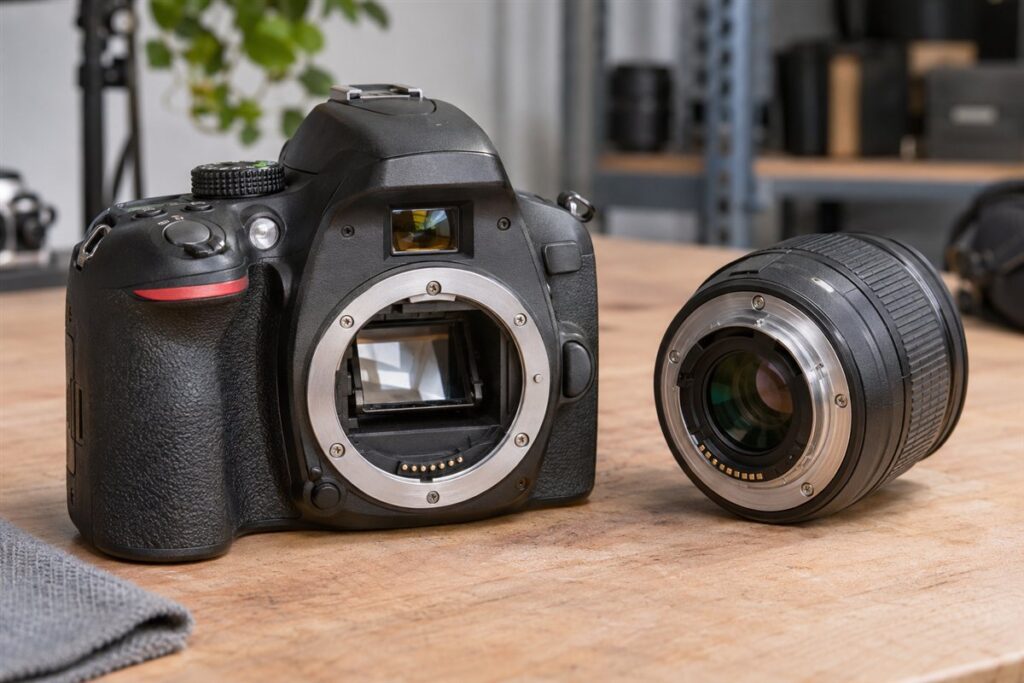
A DSLR is a digital single-lens reflex camera, which uses a mirror to send the view through the lens up to an optical viewfinder. When you press the shutter, the mirror flips out of the way so light reaches the sensor and records the photo. It is a camera type with interchangeable lenses and a long history.
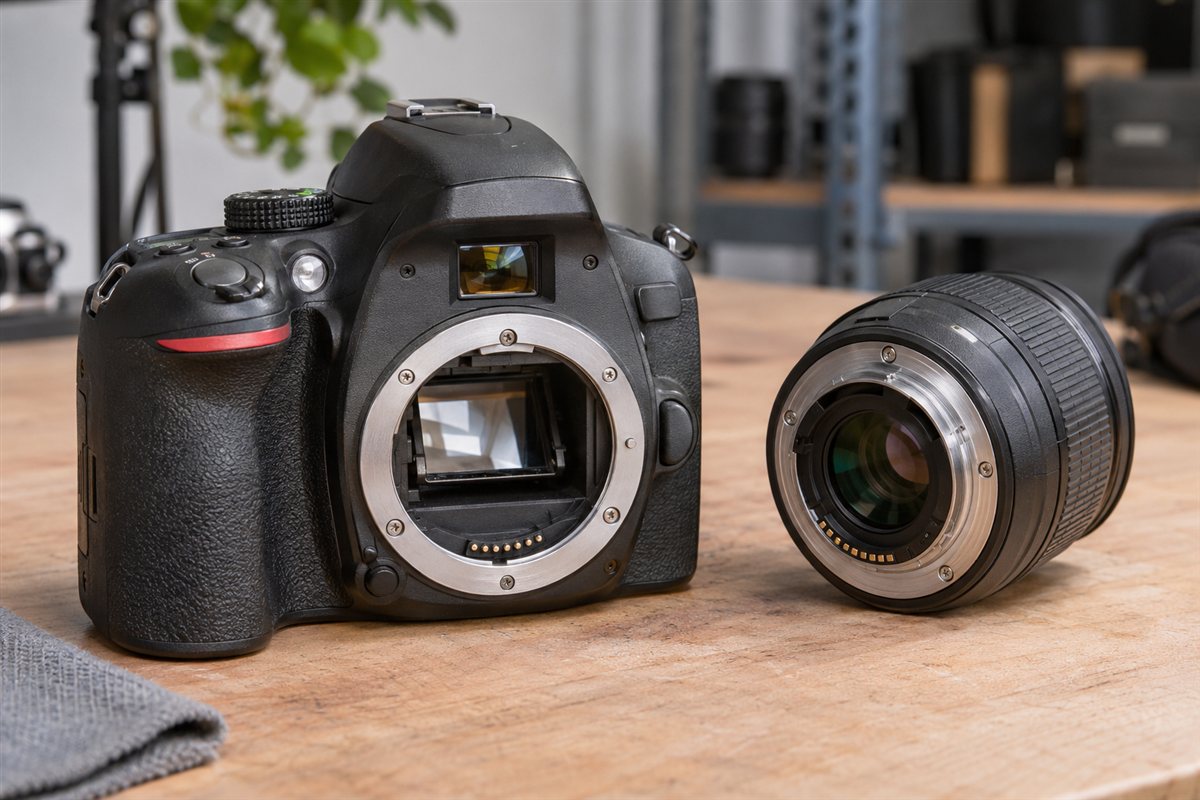
How a DSLR Works
- Light enters through the lens and hits an angled mirror inside the body.
- The mirror reflects that light up into a prism, which flips the image the right way round and sends it to the viewfinder.
- You see the scene directly through the lens, with no screen delay.
- When you press the shutter button, the mirror swings up, the shutter opens, and light reaches the sensor.
- The shutter closes, the mirror drops back, and the image is saved to the memory card.
That moving mirror is the cause of the familiar clack sound of a DSLR. A separate autofocus module, usually under the mirror, measures focus while you look through the viewfinder.
In this guide
Key Features of a DSLR
- Optical viewfinder: a clear, lag-free view that does not use battery power.
- Interchangeable lenses: a wide choice of lenses, including many older ones available used.
- Larger body: the mirror box and prism add size and weight.
- Battery life: often long, because the viewfinder is not electronic.
- Manual controls: dedicated dials and buttons for common settings.
DSLR Compared with Mirrorless
| Trait | DSLR | Mirrorless |
|---|---|---|
| Viewfinder | Optical, through a mirror | Electronic screen |
| Body size | Usually larger | Usually more compact |
| Battery life | Generally long | Generally shorter |
| Video features | Often more limited | Often more advanced |
| Current focus of makers | Mature, fewer new models | Main area of development |
Both types use the same basic principles of aperture, shutter speed and ISO, so the skills you learn carry across.
Who Might Choose a DSLR
Choose a DSLR if you like an optical viewfinder, want long battery life, or want to use a large collection of lenses. Shoppers looking at used gear often find DSLR bodies and lenses easy to come across. If you want a lighter kit or advanced video, a mirrorless camera may fit better. Check the maker’s pages for current model details.
Sensor Sizes and the Crop Factor
DSLRs come with different sensor sizes, and this choice affects image quality, lens options and the angle of view. The two main categories are full-frame sensors, which match the size of a traditional 35mm film frame, and smaller APS-C sensors. Some makers have also used other sizes, so check the listing for the camera you are considering.
A larger sensor can gather more light overall and usually gives a shallower depth of field at the same framing and aperture, which many portrait photographers like. It also tends to mean a larger and heavier body and lenses. A smaller sensor allows more compact cameras and lenses, and it often costs less, with the trade-off that image quality at high ISO and the background blur are typically somewhat different.
The crop factor describes how much narrower the view becomes on a smaller sensor. A lens on a smaller sensor frames a tighter view than the same lens on a full-frame camera. This helps wildlife and sports photographers who want reach, but it makes it harder to get very wide views.
- Check which lenses are made for your sensor size, as some are designed for smaller sensors only.
- Full-frame lenses work on smaller sensors in many systems, but the reverse can limit the image or require a crop mode.
- Think about the lenses you will buy, not just the body, because they will stay with you longer.
Lens Mounts and Compatibility
A DSLR can only use lenses that fit its mount, and each maker has its own. This is one of the strongest reasons to think about the whole system before you buy a body. A long-established mount can offer a large choice of new and used lenses, including older designs that still perform well.
Compatibility is not always simple. A lens from an older generation may fit physically but lose features such as autofocus or aperture control on some bodies. Lenses made by independent manufacturers are also available in many mounts, and they can offer good value, but you should check that a lens works with your specific camera model and firmware.
- Check the mount name on both the camera and the lens, and consult the maker’s compatibility notes.
- Look for a built-in focus motor on the lens if your body does not have one in the camera.
- Find out whether a lens has image stabilization, as not all do, and whether the camera has its own in-body version.
- Remember that adapters can allow lenses from one system to be used on another, but they may reduce functions.
Before buying used lenses, inspect the glass for fungus, haze and scratches, and test the aperture and focus. A lens with a smooth, responsive ring and a clean interior is a sound purchase, even if the barrel shows cosmetic wear.
Buying a Used DSLR With Confidence
Used DSLRs are easy to find, and they can offer a lot for a modest outlay. A careful check protects you from hidden problems. The main wear item is the shutter, which has a rated number of actuations that varies by model. Ask the seller for the shutter count if available, and compare it to the maker’s stated rating, which you can look up on the product page.
Examine the body for dents, loose parts and signs of moisture. Test the buttons, dials, memory card slot, ports and battery door. Look through the viewfinder for dust, and check that the focus screen is clean. Take a few test shots, and inspect the images for dark spots, which may point to sensor dust, and for odd color or banding.
- Insert a battery and a card, and confirm the camera starts and saves images.
- Check the autofocus on several subjects at different distances.
- Test the flash and hot shoe, if you plan to use them.
- Review the playback screen for dead pixels and brightness.
- Ask about accessories included and about a return policy.
A body from a reputable seller with a stated condition grade and a return period reduces risk. A very low price with vague photos is a reason to ask more questions.
First Settings and Habits for New Owners
A DSLR has many controls, and the number of buttons can be overwhelming. A few early steps make it easier. Begin by setting the image quality, as in raw or JPEG, and check the date, time and card format. Then explore the mode dial, which usually has automatic, program, aperture priority, shutter priority and manual modes.
Aperture priority is a good learning mode. You choose the aperture, which controls depth of field and light, and the camera sets the shutter speed. Shutter priority lets you choose the speed to freeze or blur motion. Manual mode gives full control once you understand exposure. Keep an eye on ISO, and raise it only as much as needed.
- Use the optical viewfinder for steady, quick shooting and live view for tripod work and precise focus.
- Learn how to move the focus point and how to switch between single and continuous focus.
- Check the histogram on playback to judge exposure instead of relying only on the screen brightness.
- Practice holding the camera with your left hand under the lens and your elbows tucked in.
Read the manual once, even briefly, since it explains your model’s menus. Take the camera out often, and review your pictures to see which settings produced the results you like.
Care, Battery Use and Knowing When to Move On
A DSLR contains a moving mirror and shutter, so careful handling extends its life. Keep the lens cap or body cap on when the camera is stored, and change lenses quickly with the camera pointed down to limit dust. Use a blower to clear dust from the lens and viewfinder, and a soft cloth with proper lens cleaner for glass. Avoid touching the mirror or the shutter curtain.
Protect the camera from moisture, sand and extreme heat. After shooting in humid places, let it warm up and dry before closing it in a bag. Remove the battery if you will not use the camera for long periods, and store it in a cool, dry place. Charge batteries before trips, and carry a spare.
Think about when a different camera might serve you better.
- You want a lighter kit for travel, and the weight of your DSLR keeps it at home.
- You need video features or focus performance that your model lacks.
- Your lenses and accessories limit you, and the system has few new options.
- The camera has developed faults that cost more to repair than the body is worth.
Many photographers keep a DSLR for years, enjoying the optical view and long battery life. The right moment to switch is when your current camera, not a trend, is holding back your pictures.
Inside the Body: A Walk Through the Light Path
Understanding a DSLR becomes much easier when you follow a single ray of light from the scene to the sensor. Light enters through the lens, passes through the aperture opening, and travels back to a mirror angled at forty-five degrees. That mirror sends the image upward to a focusing screen, then through a five-sided mirror or prism, and finally out through the eyepiece to your eye.
When you press the shutter button, the mirror swings out of the way, the shutter curtains open for the chosen time, and light falls directly onto the sensor. The mirror then drops back down. That quick sequence explains the distinctive clack of a DSLR and why the finder blacks out for an instant during each exposure.
Parts worth knowing by name
- Mirror: directs light to the finder, then lifts out of the way.
- Pentaprism or pentamirror: flips the image so it appears the right way round in the finder.
- Shutter: controls how long the sensor receives light.
- Autofocus module: a separate sensor that measures focus while the mirror is down.
- Metering sensor: reads scene brightness to suggest exposure.
Why Optical Viewfinders Still Appeal
Looking through a DSLR finder, you see the scene directly, with no electronics between you and the subject. There is no lag, no refresh and no change in brightness when you look at a dark room or a sunlit field. For people who shoot fast action or who simply enjoy a direct connection with the world, this experience remains a major reason to pick one.
There is a trade-off. What you see is not a simulation of the final picture. The finder does not show you how exposure, white balance or depth of field will change the result, so you learn to judge those from experience or by checking the screen after a shot. Beginners sometimes find that a little tiresome, while others enjoy the discipline it builds.
Controls You Will Meet on the Camera
A DSLR body is covered in dials and buttons. They look intimidating at first, yet most of them fall into a handful of groups, and understanding the groups removes much of the confusion.
| Control group | What it does | Example of use |
|---|---|---|
| Mode dial | Selects how much the camera decides for you | Automatic for easy snapshots, aperture priority for portraits |
| Command dials | Change aperture, shutter speed or exposure compensation | Adjust brightness quickly |
| Autofocus controls | Choose focus mode and area | Switch to continuous focus for moving subjects |
| Drive mode | Single frame, burst or timer | Burst for sports |
| Playback and menu buttons | Check and set options | Check sharpness on the screen |
Lenses, Mounts and What Fits
A DSLR is a system rather than a single object. The body accepts lenses that fit a specific mount, and each maker uses its own design. A lens from one maker will not normally fit another maker’s body without an adapter, and some adapters limit features. Third-party lens makers produce versions for several mounts, so a given lens model may be offered in more than one fit.
Before buying any lens, check that the mount name matches your camera. Also check whether the lens is designed for the smaller sensor size or the larger one, since some lenses designed for smaller sensors will crop the picture or show dark corners on larger ones. The product listing and the maker’s compatibility chart will tell you which combinations are supported.
Learning Path for a New DSLR Owner
- Read the quick guide and the sections of the manual that cover the basic controls.
- Spend a week in aperture priority mode, watching how changing the f-number changes background blur.
- Move to shutter priority and photograph moving people, cars or pets to see motion effects.
- Try full manual mode on a static subject with a tripod.
- Learn the autofocus area options and pick one that suits your favorite subjects.
- Shoot raw files, and open them in editing software to see what extra information they hold.
Accessories That Actually Help
New owners often buy a pile of extras they rarely use. A short list of genuinely helpful items is easier to manage.
- A spare battery, since the finder and screen can drain a single charge on long days.
- A second memory card, so a full card does not end your outing.
- A basic camera bag with padding and room for one extra lens.
- A blower and microfiber cloth for lens and body cleaning.
- A sturdy tripod if you enjoy landscapes, night scenes or long exposures.
Common Misunderstandings
More megapixels always means better pictures
Resolution matters for large prints and heavy cropping, but light, lens quality and technique usually make a bigger difference to everyday results.
A bigger camera is a better camera
Size often brings a larger grip and more physical controls, but it does not ensure a better photograph. Pick the body you will be willing to carry.
Automatic mode is cheating
There is nothing wrong with using it. Many professionals use semi-automatic modes every day. Use whatever helps you get the picture.
Glossary for Quick Reference
- Aperture: the opening in the lens that controls how much light enters.
- ISO: the sensor sensitivity setting.
- Live view: using the rear screen to frame, with the mirror locked up.
- Crop sensor: a sensor smaller than a traditional full frame.
- Kit lens: the basic zoom often sold together with a body.
Keep this list nearby while you learn. Within a few outings, the terms become second nature, and the camera stops feeling like a puzzle and becomes a tool you understand.
Maintenance Habits That Extend a Camera Life
A DSLR has moving parts, so a little care goes a long way. Store the camera in a dry place with the caps on, and avoid leaving it in a hot car. When you change lenses, turn the camera off, point the opening downward and work quickly to reduce dust entering.
Dust can reach the sensor over time. Many cameras have a built-in cleaning function, and a blower can remove loose particles from the lens surfaces. For sticky spots on the sensor, follow the maker’s guidance or have a professional technician handle it, since the part is delicate.
Judging Whether a DSLR Still Fits Your Needs
A DSLR can serve you well for many years, but the ecosystem is shifting toward mirrorless designs. This does not make your camera useless. It means new lens and body development is increasingly focused elsewhere, so consider how long you expect to keep your kit.
- If your current camera does everything you need, there is no pressing reason to change.
- If you miss features such as a silent shutter or an electronic finder, a switch could be worth exploring.
- If you own several lenses, check which adapters allow them to be reused on newer bodies.
Where to Learn More
The maker’s manual is the best first resource, followed by free tutorials from camera makers and local photography clubs. Take a short course if you prefer guided teaching. Practice with a simple project, such as photographing one subject every day for a month, and look back over your results to see progress.
Reading Specifications Without Getting Lost
Spec sheets can feel like a wall of numbers. Focus on a few that affect daily use: sensor size, continuous shooting speed, number of focus points, battery life figures from the maker, and the type of memory card slot. Treat the rest as background. Compare these few points across two or three bodies and ignore marketing phrases that do not describe a measurable feature.
FAQ
Is a DSLR still worth using?
Yes, if it suits your style. Photos depend on lenses, light and technique, and a DSLR can capture excellent images.
What does single-lens reflex mean?
It means one lens is used both to form the image on the sensor and to show it to you in the viewfinder, with a mirror redirecting the light.
What does the mirror do besides show the viewfinder image?
It also directs light to the autofocus module and to the metering sensor on many models. When the shutter fires, it moves out of the way for exposure.
Can a DSLR shoot video?
Many models do, but features and handling vary. Check the maker's specifications for resolution, frame rates and focus behavior in video mode.
What is live view?
It is a mode where the mirror stays up and the image appears on the rear screen. It helps with tripod work and precise focus, though the autofocus method may differ.
Is a DSLR heavy to carry?
They are often larger and heavier than mirrorless cameras, especially with big lenses. Try one in a store to see how the weight feels.
Do I need image stabilization?
It helps with slow shutter speeds and handheld shooting. It may be built into the lens or the body, depending on the system.
How often should the sensor be cleaned?
Only when you see dust spots in your pictures. Use the camera's cleaning function and a blower first, and have a professional service the sensor if you are not comfortable.
Are DSLR lenses usable on mirrorless cameras?
Often yes with the right adapter, but features such as autofocus may be affected. Check the maker's guidance for your pairing.
Living With a DSLR Day to Day: The Details Reviews Forget
The daily experience of a DSLR is shaped by small things that specification lists rarely mention. The viewfinder shows the scene with no delay and no battery cost, so the camera feels awake the instant it reaches your eye, even if it has sat for a week. The shutter’s mechanical sound and feel give a clear confirmation that a frame was taken, which photographers working in bright, noisy places quietly rely on. Controls on most DSLRs are generous physical dials and buttons that can be operated with gloves or without looking, a legacy of decades of refinement for working professionals. Battery life is the famous example: a DSLR sips power through its viewfinder because the sensor sleeps between frames, so a day of shooting that would exhaust a mirrorless camera several times over may barely dent a DSLR’s battery. For travel, festivals and long events, that stamina changes how you pack and how you feel at the day’s end.
The trade-offs are equally daily. A DSLR is larger in the hand and in the bag, and its mirror mechanism makes it louder, which matters in ceremonies, theatres and wildlife hides. Live view on most DSLRs is slower to focus than the viewfinder, so the camera gently pushes you toward one way of working, eye to the finder, which many photographers find focusing for the mind as well as the image. Video is where the age of most DSLR designs shows most plainly, with focusing and features that trail current mirrorless models. None of these daily details decide the matter alone; together they describe a tool with a strong personality, and the question is always whether that personality matches the photography you actually do.
What a DSLR Teaches You That Transfers Everywhere
Photographers who learn on a DSLR acquire habits that serve them on every camera they will ever touch. Because the viewfinder shows the scene optically, you learn to judge light with your eyes rather than trusting a screen’s brightness. Because changing settings often means dials rather than menus, your fingers learn the exposure triangle until it is reflex. Because the camera does not show you a perfect preview of the finished exposure, you learn to predict, to check the histogram, and to understand what you did when a frame surprises you. Mirrorless cameras have softened the need for some of these skills by showing the result in advance, which is convenient, but photographers educated by a DSLR tend to keep a diagnostic ability that helps when any camera, of any type, produces something unexpected.
There is also a financial education embedded in the DSLR ecosystem. Because the great DSLR systems were built over decades, their lenses and accessories exist in enormous variety at every price, and the second-hand market is deep and liquid. A learner can assemble a genuinely capable kit gradually, a body first, then a fast prime, then a telephoto, each bought used and each sellable later for much of its cost if interests change. That gentle economics is a real feature of the platform in its mature years, and for many photographers it outweighs the appeal of newer technology they would have to buy at full price.
The Mirror’s Character in Different Kinds of Light
One underappreciated DSLR trait is how its focusing system behaves across conditions. The dedicated focus sensors that work through the mirror are fast and decisive in good light and for moving subjects along predictable paths, which is why sports photographers clung to DSLRs long after mirrorless arrived. In very low light or with slow lenses, those same sensors can hesitate where a modern on-sensor system would keep hunting successfully. Knowing which regime your photography lives in tells you more about whether a DSLR will delight or frustrate you than any general verdict about old versus new. The camera has not changed; the match between its strengths and your subjects is the whole question.
More Questions From Readers
Is a DSLR still worth buying as a first serious camera?
For many learners, yes, particularly on the second-hand market, where the money saved can fund lenses and learning instead. Judge the specific kit in front of you: its condition, its lenses, and whether its way of working appeals to you after handling it for an afternoon. A new mirrorless camera offers modern focusing, video and a smaller body, and if those matter to your plans the newer route is sensible. The DSLR’s case rests on value, stamina and teaching habits, which are real virtues, not nostalgia.
Why do DSLRs have a reputation for lasting so long?
Because the mature models were built as professional tools with generous mechanical tolerances, weather sealing on higher models, and shutters rated for very large numbers of frames. Just as importantly, they were sold in huge numbers, so parts, batteries and repair knowledge remain widely available. Longevity is partly engineering and partly ecosystem, and a camera that can be repaired economically will outlive a technically finer one that cannot.
Can I use DSLR lenses on a mirrorless camera later?
Usually yes, through the maker’s adapter, and this is one of the kindest features of the transition between the two eras. Adapted DSLR lenses commonly keep autofocus and automatic exposure on their own brand’s mirrorless bodies, which lets photographers move systems gradually, body first and lenses over time. Check the specific combination before relying on it, since older lenses and third-party lenses vary, but the general principle protects your investment in glass whichever direction the industry moves next.
What wears out on a DSLR, and what should I check on a used one?
The shutter and mirror mechanism do the physical work and carry a rated life, so ask about the shutter count and listen for a healthy, consistent sound. Check the sensor for marks by photographing a plain bright surface at a narrow aperture, test every dial and button, examine the mount contacts, and confirm the battery holds a charge. Cosmetic wear on the body is mostly honest history; sluggish controls, focus inconsistency or sensor spots that cleaning does not remove are the warnings that matter.
Does the mirror make DSLR photos sharper or less sharp?
Neither, in ordinary use. The mirror is out of the light path when the exposure is made, so it plays no part in the image itself. Its movement can add a whisper of vibration at certain shutter speeds on a tripod, which is why mirror lock-up and electronic first-curtain options exist on many models for critical work. In handheld photography at normal speeds, technique matters far more than the mirror, and generations of sharp professional work on DSLRs settle the question in practice.
A DSLR Owner’s Year: How the Camera Fits Real Life
Follow a DSLR through an ordinary owner’s year and its character emerges better than any comparison chart can show. In spring it shoots a child’s football matches from the sideline, its fast through-the-lens focusing and long battery making light of a cold morning. In summer it travels, heavier than a mirrorless kit would be, but shrugging off a week of daily shooting on a small rotation of batteries and producing files from a lens collection assembled patiently over years, much of it bought used. In autumn it does the school portraits and the family gathering, its optical viewfinder feeling like home to hands that learned on it. In winter it shoots the indoor concert under stage lights, where its age shows a little in focusing and video, and its owner makes a private note of which frustrations actually mattered. That note, written from a year of evidence, is how sensible photographers decide about upgrades: not from launch events, but from the small list of moments their current camera genuinely failed them.
Notice how rarely the failures in such a year are about image quality. The sensor in a mature DSLR resolves more detail and handles more light than most owners’ technique can exploit, so the year’s real friction points are speed of focusing in odd light, size on long walks, video for the school play, and the wish to see the exposure before taking it. Those are workflow wishes, and they are exactly what mirrorless answers, which is why the migration between the systems has been a story of habits rather than of picture quality. A DSLR owner who rarely meets those frictions owns, in every way that matters to their photographs, a current camera.
Learning to See Through an Optical Viewfinder
There is a skill specific to the DSLR that deserves naming: composing in a view that does not preview the photograph. The optical finder shows the scene, not the exposure, so the DSLR photographer learns to imagine the finished frame, brighter or darker than the view, with shadows that will close down or highlights that will burn out. That imagination, practised over thousands of frames, is a form of photographic literacy that transfers to film photography, to large format, and to any future camera whose preview might mislead. Mirrorless previews are a gift, but they can also become a crutch that hides whether the photographer actually understands light. DSLR owners who learned the older way often describe their skill with quiet pride, and they are right to: they can predict a photograph, which is a deeper thing than reviewing one.
DSLRs in Education, Clubs and Community Photography
There is a reason photography courses, camera clubs and school programmes still run on DSLRs, and it is not inertia. A teaching camera should make its workings visible, and the DSLR’s mirror, its dedicated dials and its honest viewfinder turn abstract ideas, aperture, shutter, focus, into physical things a student can watch and feel. A class set of identical DSLRs also survives student handling with a grace that delicate equipment rarely matches, and when one is damaged, the deep second-hand market replaces it for the price of a textbook. Clubs benefit from the same ecosystem: members lend each other lenses across decades of models, mentors demonstrate on equipment students can actually afford, and the shared mount becomes a small commons of glass. Any account of what a DSLR is that ignores this social life misses part of the machine’s real function in the world, which is to be photography’s most widely shared teaching tool.
Community and volunteer photography tells the same story at a larger scale. The photographer covering the village fete, the school play and the local team’s season for the parish magazine is very often working with a DSLR kit assembled gradually and maintained for years, because the economics of unpaid work demand equipment that is capable, durable and already owned. Those photographs, multiplied across every town, are a substantial part of the visual record of ordinary life in the DSLR era, and they were made on cameras chosen for stamina and value rather than for novelty. When future historians browse the period’s community archives, they will be looking, to a remarkable degree, through DSLR viewfinders.
Deciding Your Own Relationship With the Format
By now the pattern of this guide should be clear enough to apply to yourself. If you own a DSLR and it serves your subjects, the arrival of newer technology changes nothing about your next photograph, and the wisest upgrade is usually a lens, a light or a journey. If you are buying and your subjects prize stamina, value and an optical viewfinder’s immediacy, a DSLR remains a rational, satisfying choice, especially used. If your subjects demand the newest focusing, the quietest operation or serious video, the mirrorless route answers needs the DSLR was never designed to meet, and choosing it is not a betrayal of anything. What does not serve any photographer is drifting: keeping a camera whose frustrations you can name, out of habit, or replacing one whose work you love, out of fashion. Name what your photography needs, in the order your own failures have taught you, and let the format follow. That is how the photographers in every era have chosen, and the DSLR’s long, honourable career is simply what that process looks like when a design gets almost everything right for almost everyone, for a very long time.
Keeping a DSLR Healthy for Its Second Decade
If your DSLR is settling in for a long life, a few habits protect it. Exercise the shutter occasionally during quiet months rather than leaving the mechanism asleep for a year. Store the body with a charged battery removed if it will sit for long, in a dry place with moving air, since fungus prefers still damp darkness and attacks lenses even more eagerly than bodies. Keep the mount cap on and the sensor’s chamber closed to dust, blow the focusing screen’s area gently rather than touching it, and have the sensor cleaned properly when spots survive the camera’s own shaking routine. None of this is precious; it is the same care any mechanical instrument deserves, and it is why so many DSLRs are entering their second decade still ready to work, which may be the format’s most eloquent testimonial.
The DSLR Sound, the DSLR Feel: Sensory Details That Shape Work
Photographers are sometimes embarrassed to admit that how a camera feels and sounds affects their work, but the admission is simply honest. The DSLR’s shutter sound, a mechanical event with a beginning and an end, gives the photographer and the subject a shared punctuation: something has been taken. In quiet venues that sound can be a liability, and the mirrorless era’s silent shutters exist because of it, but in the noise of ordinary life the sound is information, confirming the frame to hands and ears alike. The feel matters similarly. A DSLR’s size, which critics call bulk, is also grip, balance with long lenses, and buttons that can be found by touch in the dark or through gloves. Photographers who work in winter, on boats, at sidelines, in the physical world generally, often defend that size with feeling, because they have operated the alternative with numb fingers. Judging a camera purely by its files is like judging a car purely by its engine: true as far as it goes, and silent about the journey.
There is a discipline embedded in the DSLR’s constraints that many owners credit for their development. A limited burst, a viewfinder that does not preview exposure, a screen best used sparingly: each pushes the photographer toward anticipation rather than reaction, toward deciding before the moment rather than reviewing after it. Mirrorless cameras have made photography more forgiving, which is a genuine good, but forgiveness and education are different goods, and the DSLR’s mild strictness has educated two generations. If you learn on one today, accept the strictness as tuition. The habits it builds, pre-visualising, exposing deliberately, focusing with intent, will make you formidable on any camera you touch for the rest of your photographic life.
Repairs, Service and the Long Tail of Support
A mature format’s support network is one of its least glamorous and most decisive advantages. Independent repairers know the great DSLR models intimately, parts circulate widely, and the knowledge base of fixes for every known fault is deep and public. A professional whose DSLR fails in a distant city has a realistic chance of a local repair or an identical replacement from the used market within a day, which is a form of insurance no specification sheet lists. When you buy into any system, you are also buying its repair ecology, and for working photographers that ecology can matter more than the difference between two excellent sensors. Ask, before committing to any camera, who within reach can fix it, how long parts are likely to circulate, and what the community does when one dies mid-season. The DSLR’s answers to those questions, built over decades, are the strongest in the industry, and they are a large part of why so many working cameras with high shutter counts and worn grips are still, unglamorously and profitably, at work.
One Camera, One Lens: The DSLR as a Deliberate Constraint
End with an experiment that reveals what the format is really for. Take a DSLR and a single prime lens, nothing else, for one full month of your ordinary photography. The constraint will annoy you for a week and educate you for three. You will learn your lens’s distances in your body, learn to move instead of zoom, learn the viewfinder’s honesty until exposure guesses land close before the meter speaks. At the month’s end, review the work as a set. Most photographers who run this experiment report the same surprise: the photographs got better as the options narrowed, because attention, finally undivided, did the work that equipment variety had been postponing. That is the DSLR’s deepest lesson, and it has nothing to do with mirrors. It is the lesson the whole history of the format teaches: a well-understood tool, used deliberately, beats a succession of marvels, every time.
What the DSLR Era Leaves Behind
Whatever the future of camera design holds, the DSLR era has already written its legacy into the culture of photography. It carried the craft from film to digital without breaking the photographer’s hand or eye, preserving a century of lenses and habits while the sensor revolution happened inside a familiar body. It taught more people photography, more thoroughly, than any format before it, because its used prices put a serious instrument within reach of nearly anyone willing to learn. It produced the defining documentary record of roughly two decades of ordinary and extraordinary life, from family kitchens to conflict zones, through viewfinders that showed the world plainly and asked the photographer to do the seeing. When the last DSLR is retired from professional service, that record remains, and so do the habits its strictness taught. A format is finally judged not by its specifications but by the photographs and photographers it produced, and by that judgement the DSLR needs no defence from anyone. It has its archive, and the archive is enormous, and much of it is beautiful.
A Last Word to the Photographer Holding One Now
If you are reading this guide with a DSLR in the next room, the most useful conclusion is also the simplest: the camera is ready when you are. Charge its battery, mount the lens you know best, and spend your next session on the photographs rather than on the question of whether the tool is modern enough to deserve them. It is. It was designed, across decades of refinement, to disappear into the act of seeing, and the photographers whose work fills this format’s history did not wait for permission from the future before making it. Should the day come when your subjects genuinely outgrow it, you will know from your own frames, not from a launch event, and you will move on with a trained eye that any new camera will be lucky to serve. Until that day, the mirror waits, the viewfinder is honest, and the next photograph is yours to take.
The Viewfinder’s Farewell Gift
Photographers raised on optical viewfinders carry one habit into every later technology: they look at the world first and the photograph second. The finder showed them the scene itself, unprocessed and unpromised, and trusted them to imagine the rest. That trust, exercised over thousands of frames, built a kind of visual self-reliance that no preview can give and no preview can take away once it exists. If the DSLR’s long career is ever summarised in a single sentence, it might be that one: it trusted the photographer’s eye, and the eye, trusted, grew worthy of the trust.
The Short Version
A DSLR uses a mirror and prism to show you the scene through the lens, then flips the mirror aside to record the photo. It offers an optical view, interchangeable lenses and long battery life. Choose it for those strengths, or consider mirrorless for size and video.
Related Guides
- Aimchess: Does Personalized Chess Training Actually Work?
- SmugMug vs Zenfolio for Photographers: Which Suits Your Work?
- How Camera Metering Modes Work and When to Use Each One
- 6 Best Camera Bags For Photographers (October 2026)
- 6 Best Camera Backpacks for Travel Photographers (2026)
