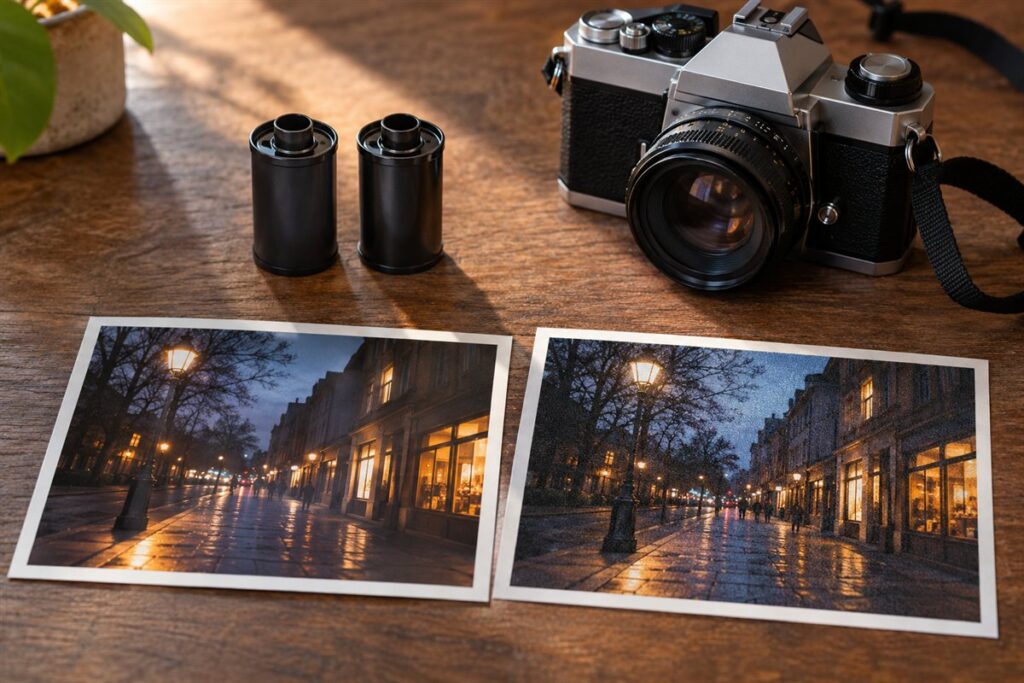
Film speed, shown as an ISO number, tells you how sensitive the film is to light. ISO 400 film is a flexible all-round choice for daylight and moderate indoor light, while ISO 800 film gives you about one extra stop of sensitivity for dim scenes and faster shutter speeds. Choose 400 for versatility and finer grain, and 800 when light is low or action is fast.
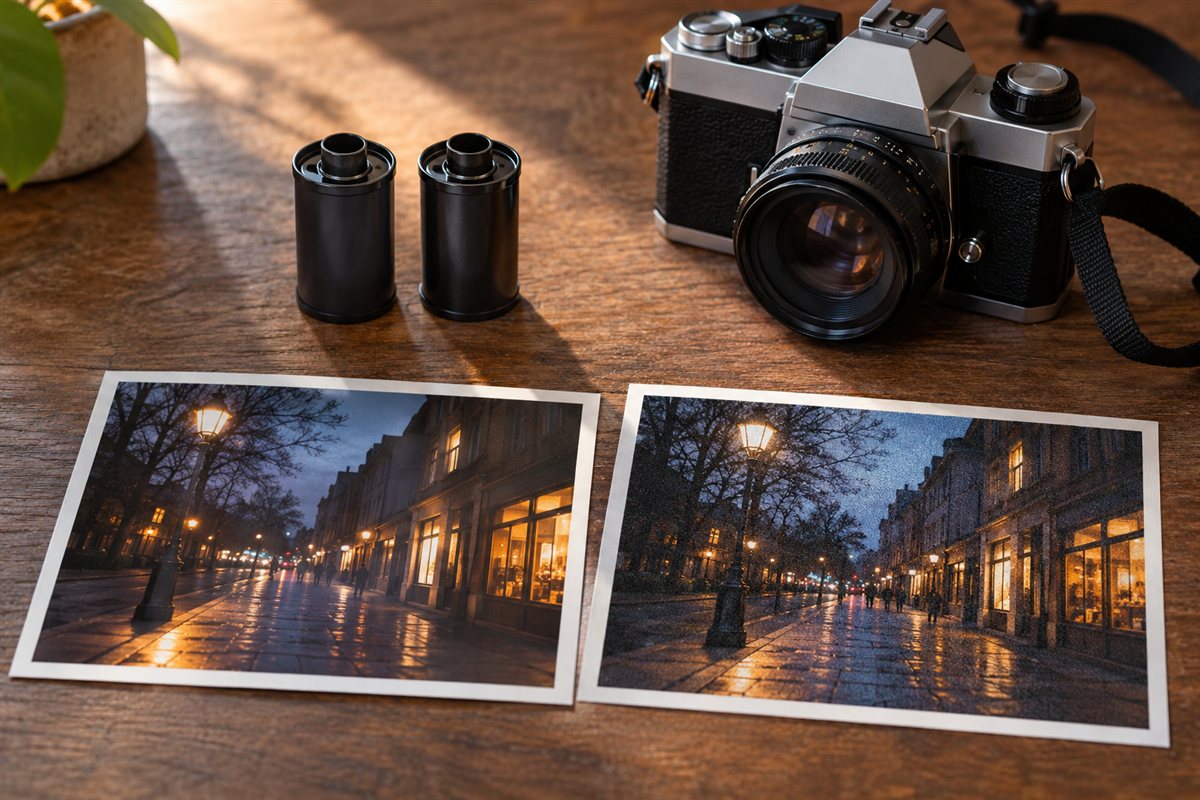
What Film Speed Means
A higher ISO number means the film needs less light to make an image. Each doubling of the number is one stop, so ISO 800 needs half the light of ISO 400 for the same exposure. In practice, that lets you use a shutter speed twice as fast, or an aperture one stop smaller, in the same conditions.
The trade-off is grain. Faster films tend to show more visible grain and sometimes lower contrast or color saturation, though this varies by brand and by emulsion. Many photographers enjoy the texture of grain as part of the film look.
In this guide
ISO 400 and ISO 800 Side by Side
| Situation | ISO 400 | ISO 800 |
|---|---|---|
| Bright daylight | Works well, wide choice of apertures | Can need small apertures or fast shutter speeds |
| Overcast or shade | Comfortable | Gives extra speed |
| Indoor window light | Often workable with a wide aperture | More comfortable handheld |
| Evening street | May need a slow shutter | Helpful |
| Grain | Finer | More noticeable |
How to Decide What to Load
- Think about where you will shoot most of the roll. If the plan is mixed daylight and shade, 400 is a safe choice.
- If you expect dusk, interiors or night streets, 800 gives you room.
- Think about your lens. A lens with a wide maximum aperture can make 400 film work in dim light, while a slower zoom may call for 800.
- Think about movement. Children playing, pets and street scenes benefit from faster shutter speeds, roughly 1/250 or faster as a general guide.
- Think about how you will print or scan. Grain is more visible in large prints.
Exposure Tips
- Print film, which is negative film, handles overexposure well, so when in doubt, give a little more light rather than less.
- A common rule for sunny days is to set the shutter speed near the reciprocal of the film speed with an aperture around f/16. For ISO 400, that is roughly 1/500 at f/16. Treat this as a rough base.
- Some 400 film can be pushed to 800 in development, which raises effective speed but also grain and contrast. Tell the lab before you hand in the roll.
- If your camera lets you set the ISO dial, set it to the box speed unless you have a reason to change it.
Availability
Film lines change over time, and not every brand makes both speeds. Check what your local shops and online sellers currently carry. Store film in a cool place and use it before the expiry date for the most reliable results.
How Film Type Changes the Choice
Film speed is not the only variable. The type of film affects how forgiving it is, and that changes what a particular speed can do. Color negative film generally has a wide tolerance for exposure errors, especially overexposure, which makes it a friendly choice for beginners and for unpredictable light. Black and white negative film also has good tolerance, and its look in grain and contrast varies by emulsion.
Slide film, also called reversal film, is different. It produces positive transparencies, and the exposure margin is much tighter. A slightly under- or overexposed slide can look noticeably off. If you use slide film, speed matters even more because you have less room for error, and you may want to use a meter carefully.
Within each type, different emulsions are designed with different priorities. Some emphasize fine grain and strong color, while others aim for neutral skin tones or a more relaxed look. A faster film in one brand may show less grain than a slower one in another brand, so do not assume that ISO alone predicts the look.
The practical lesson is to choose speed and type together. If you want maximum latitude for run-and-gun shooting, a negative film at 400 or 800 is a sensible default. If you want strong color and are comfortable with careful metering, you might consider slide film at a speed that suits your light. Read the maker’s technical data for the film you have in mind.
Grain, Scanning and Printing
Grain is part of the appeal of film, but how it looks depends on how you view the picture. In small prints, grain from ISO 800 film may hardly be visible, while on a large print or a high-resolution scan it can become a strong texture. If you plan to enlarge, test a roll first and view the results at the sizes you intend to use.
Scanning changes grain too. High-resolution scans can emphasize it, while low-resolution scans smooth it out. Scanning software may offer grain reduction, but heavy reduction can make the picture look soft. A balanced approach is to keep some grain and accept it as part of the image.
If you send film to a lab, ask what scanning resolution and file formats they provide and whether they can adjust settings. Different labs have different house styles, so the same roll can look different depending on who scans it. If you scan at home, consistency in your settings helps you compare rolls.
For traditional darkroom printing, grain interacts with the enlarger and the paper. Black and white printers often like grain and use it deliberately. For color, faster films can have a different feel than slower ones in the print. Make notes about each roll and its results, and use that record to guide your next choice.
Pushing, Pulling and Rating Film Differently
Box speed is the manufacturer’s recommended rating, but you can change it. Rating a film at a higher speed than the box and developing it for longer is called pushing, and doing the opposite is called pulling. Pushing is a common way to get extra speed when light is low. For example, some photographers rate 400 film at 800 and ask the lab to adjust development.
The results are not identical to using a true higher-speed film. Pushing often increases contrast and grain, and shadow detail may suffer. Some films respond better than others, and photographers often discuss which emulsions push well. Check the maker’s data sheet, which may suggest how the film behaves.
Communicate clearly with the lab. Mark the roll or fill out the form so they know your intended rating. Everything on the roll will be developed the same way, so rate the whole roll at the same speed. If you want to shoot different speeds, use different rolls or separate camera bodies.
Pulling, or rating a film slower, can give a gentler contrast and finer grain. It is less common but useful in bright conditions or when you want a softer look. Experiment cautiously with a few rolls and keep notes. If the camera has a manual ISO dial, set it to your chosen rating and record it so you remember what you did.
Camera, Metering and Lens Considerations
Your gear affects which film speed suits you. Many film cameras read the film speed from a code on the cartridge, while others need you to set it by hand. Check your camera manual. If the camera reads the code automatically, you may need to override the setting manually to push or pull.
The meter is the next consideration. Older cameras may have meters that have drifted with age, or no meter at all. A handheld meter or a metering app can serve as a check, though you should still confirm the results by looking at your negatives. If your meter reads consistently high or low, adjust the ISO setting to compensate.
Consider the camera’s shutter speeds and your lens. A camera with a top speed that is not very fast can struggle with high-speed film on a sunny day at a wide aperture. If you want to shoot wide open in bright light, a slower film or a neutral density filter helps. If your lens has a small maximum aperture, a faster film gives you more room indoors.
Think about steadiness too. A fast film allows quicker shutter speeds, which reduces the chance of blur from handshake or subject movement. If you use a tripod and shoot static scenes, you can pick a slower film for finer grain. Fit the film to the camera and to how you hold it.
Storage, Travel and Ongoing Costs
Film is a physical product, and how you store it affects results. Keep unexposed film in a cool, dry place, and avoid leaving it in a hot car. Many photographers store film in a refrigerator or freezer for long-term keeping, and let it warm to room temperature before use. Check the manufacturer’s storage guidance on the packaging.
Exposed film should be developed soon, although many rolls survive for a while if kept cool. Note the date you shot the roll, and mark the cartridge if you pushed or pulled. Do not leave exposed rolls in the camera for months.
When traveling, plan for security scanners. High-speed film can be more sensitive to repeated X-ray exposure than slower films, though the effect depends on the scanner and the number of passes. Ask the airline or security staff about hand inspection and follow current guidance. Carry film in a clear bag for easy inspection.
Finally, think about costs. Film, development and scanning add up, so budget them as part of each shoot. Buying film in multi-roll packs, shooting with care and choosing the right speed for the situation reduce waste. A little planning helps you enjoy the process without worrying about each frame.
The Stop Arithmetic Behind the Numbers
Film speed numbers follow a simple pattern. Doubling the number doubles the sensitivity, which equals one stop of light. So ISO 800 is one stop faster than ISO 400, and ISO 400 is one stop faster than ISO 200. In practical terms, if you meter a scene at ISO 400 and get a shutter speed of 1/125 at a given aperture, the same scene at ISO 800 allows 1/250 at that aperture. This simple relationship makes it easy to switch between films: whichever you load, you adjust your settings by the matching number of stops.
| Film speed | Shutter speed at f/8 in similar light | Notes |
|---|---|---|
| ISO 200 | 1/125 | Good in bright light |
| ISO 400 | 1/250 | All-round daylight and shade |
| ISO 800 | 1/500 | Gives you a stop of extra speed |
| ISO 1600 | 1/1000 | For dim light or very fast action |
The numbers are illustrative and depend on the light you meter, so treat them as relative guidance rather than fixed readings.
What an Extra Stop Buys You in the Field
A stop might not sound dramatic, but it changes what you can photograph without a tripod. In a dim cafe, it could mean the difference between a sharp handheld picture and a blurry one. On a cloudy afternoon, it lets you use a smaller aperture for more depth or a faster shutter for moving subjects. At dusk, it extends the time you can keep shooting before the light fades. These gains come with trade-offs, such as more grain and sometimes lower contrast, so decide whether the extra speed suits your style.
- Choose the faster film when the light is unpredictable and you want flexibility.
- Choose the slower film when you shoot mainly in bright light and value finer grain.
- Remember that you can often reduce speed on a bright day by closing down the aperture.
Cameras With Limited Shutter Speeds
Some older or simpler cameras have a limited top shutter speed. If your camera tops out at a modest value, a fast film can become hard to use in bright sun, because even the smallest aperture may not tame the light. In that case a slower film is the more sensible partner. Check your camera’s highest shutter speed and smallest aperture, and compare them with the settings you would need on a sunny day with each film. A quick calculation avoids overexposed frames and wasted rolls.
Handling Mixed Conditions on One Roll
A single roll often travels through bright streets, shaded alleys and dim interiors. Film that is flexible across these situations reduces the need to swap rolls. ISO 400 handles a surprising range, while ISO 800 gives extra room indoors but may require a smaller aperture or faster shutter outside. Some photographers carry two bodies, one for each film, but that adds weight. Others simply choose the film for the darkest conditions they expect, then adjust other settings for brighter parts of the day.
Storing, Carrying and Traveling With Film
Faster films are more sensitive to stray radiation, so they deserve a bit of extra care when traveling. Airport scanners and repeated screenings can fog film over time, particularly higher speeds. Keep film in a clear bag so that inspectors can check it by hand if you ask, and consult the airport and the maker’s advice before you travel. At home, store film in a cool, dry place, and keep exposed rolls away from heat. Mark the speed on the canister or case if you remove the original box.
Reading the Edge Codes and Box Details
The box and canister carry information worth checking. The ISO number sets the film speed, the film name tells you the emulsion, and the expiry date indicates how fresh it is. Cameras that read the canister’s code set the speed automatically, while manual cameras need you to set the dial. Write the speed on your notes so you remember it when you load, and if you change the dial on purpose to push or pull, record that too. The lab will want to know how you shot the roll.
Deciding for a Specific Trip or Project
Planning helps. For a sunny city break, ISO 400 offers an easy balance. For a concert, a candlelit dinner or an evening street walk, ISO 800 or faster is worth considering. For a long road trip with changing weather, carry one roll of each. Think about the camera you will use, the lens apertures available, and whether you plan to use a flash. Decide what you are willing to lose, whether grain, contrast or flexibility, and let that choose the film.
Keeping a Simple Log
A log pays off across a few rolls. For each one, write the film, the date, the camera, the light and the settings you used for key shots. Add a comment on whether the exposure felt right. Soon you will see how each film behaves in your hands, and your choices will become quicker. The log also helps when you send rolls to a lab, because you can give clear instructions.
Quick Decision List
- Note your camera’s fastest shutter speed and smallest aperture.
- Estimate the brightest and darkest light you expect.
- Decide how much grain you accept in return for speed.
- Pick ISO 400 for flexible daylight work, ISO 800 for dim conditions.
- Carry a spare roll of the other speed if you are unsure.
- Record what you shoot and learn from each roll.
Understanding film speed means understanding light. Once you can picture the stops, loading the right roll becomes a quick, confident decision.
Pairing Film Speed With Flash and Indoor Light
Indoor photography brings its own demands. Window light on a bright day may be enough for ISO 400, while a dim living room in the evening favors ISO 800 or more. With flash, film speed affects how far the light reaches and how much ambient glow appears in the background. A faster film lets you use a lower flash power or a smaller aperture, and it helps the background show through instead of dropping into black. Check the guide numbers or the manual for your flash, and be prepared to experiment, keeping notes so you can repeat what worked.
Warm indoor bulbs create a strong color cast on color film, so think about whether you want to keep the glow or correct it with a filter or later in scanning. Black and white film avoids that problem altogether, which is one reason many people reach for a faster black and white roll when they photograph indoors.
Common Mistakes With Film Speed
- Forgetting to set the dial after loading a different roll.
- Assuming a faster film always gives better low light pictures, even when the lens is slow.
- Pushing a roll without telling the lab.
- Leaving the camera in a hot place, which affects fast film more.
- Judging the film by a single frame instead of a whole roll.
A quick check before each outing, covering the dial, the light and the notes, prevents most of these errors and keeps your results consistent.
Going Deeper: Reading Light the Way Film Will See It
Choosing between film speeds is really choosing how you will read light for the next thirty-six frames, because film commits you in a way digital never does. That commitment, often described as a limitation, is also a discipline that improves photographers. Before loading, you survey the day honestly: the interiors you will enter, the hour you will finish, the fastest lens you brought, whether flash is welcome where you are going. The roll you choose becomes a small contract with those conditions. ISO 400 signs a flexible contract, comfortable outdoors and workable indoors near windows or with support. ISO 800 signs a contract weighted toward the dark: evenings, interiors, movement, at the price of grain and of care needed in bright sun. Photographers who choose well are not guessing; they are reading their own plans the way a sailor reads a forecast.
Metering habits should be part of that reading. Film, particularly colour negative, forgives overexposure far more gracefully than underexposure, and the shadows are where thin negatives go to die. Whichever speed you load, a gentle bias toward generosity with light protects the shadow detail that gives film its beloved depth. With the faster stock, that generosity must be balanced against bright conditions where shutter speeds run out; with the slower stock, against interiors where generosity may demand a tripod or a braced elbow. The two films are not rivals so much as two answers to the question of where your risk lives today: in the highlights or in the shadows.
Grain as a Creative Decision, Not a Defect
Modern eyes, trained by clean digital files, often meet film grain as a flaw to be minimised, but grain is also the visible texture that tells a viewer the photograph was made of something. In a night street scene, the faster film’s grain is part of the atmosphere, inseparable from the sodium light and the wet pavement. In a formal portrait or a detailed landscape, the slower film’s finer grain protects the smoothness the subject deserves. Choose grain the way you would choose a lens: by the statement you want. It also behaves differently at different print sizes and in scans; grain that feels bold on a screen at full magnification may settle into a pleasant texture in a modest print, while a scan sharpened carelessly can turn gentle grain into gravel. Judge your films at the size you actually share or print, and tell your lab or scanner operator the look you are after, because default sharpening settings are rarely a film photographer’s friend.
Pushing and pulling belong in this same conversation as deliberate tools rather than emergency measures. Rating a film at a different speed and compensating in development trades contrast, grain and shadow detail in predictable directions, and experienced film shooters use it to stretch one stock across mixed conditions. If you experiment, change one variable at a time, keep notes, and inform the lab clearly, since development instructions are part of the exposure decision. The log you keep, roll by roll, is how scattered experiments become personal knowledge.
The Camera in Your Hands Votes Too
Not every film camera can exploit both speeds equally. A camera whose fastest shutter is modest will struggle to tame the faster film in bright sun even with the lens stopped down, while a camera with slow lenses and no flash options may starve the slower film indoors. Older meters drift, shutters tire, and a camera that underexposes by habit quietly converts your careful film choice into thin negatives. If you shoot a new-to-you camera, sacrifice an early roll to testing across its shutter range in honest light, and compare the negatives, not just the scans, because negatives tell the truth about exposure that scanning software politely hides. Knowing your own equipment’s habits turns film selection from folklore into arithmetic you can trust.
Lens choice votes alongside the camera. A fast prime transforms the slower film’s indoor prospects, while a slow zoom quietly demands the faster stock as soon as the light dips. When packing, think of film, lens and light as one budget with three currencies, and balance the books before you leave the house.
Planning a Roll From First Frame to Last
A roll is a small narrative with a beginning, a middle and an end, and planning its arc produces better sets than treating frames as unrelated lottery tickets. Load with the first location in mind and you will not waste the freshest frames; know roughly what the last frames are for, perhaps the evening gathering the whole roll was chosen to serve, and you will ration your way toward them instead of arriving with the counter exhausted. Half-used rolls that sit in cameras for months are the enemy of coherence: light changes, subjects change, and the roll returns from the lab as a stranger. If a roll must wait, a note taped to the camera, speed, subject, date started, prevents the classic accidents of double exposure, wrong metering assumptions and forgotten pushes.
Travel sharpens all of this. Airport scanners, heat in parked cars and the simple scarcity of your favourite stock abroad all argue for carrying more film than you expect to shoot, storing it cool and dry, and hand-inspection requests where they are customary. Decide in advance which speed is your travel default, most travellers choose the flexible middle, and carry the other as a specialist for evenings or interiors, clearly labelled so a tired photographer at midnight loads the intended roll.
Extended Questions on Film Speed
Can I change my mind about a roll’s speed halfway through?
You can change the rating you expose at, but development treats the whole roll the same way, so mid-roll changes create compromises frame by frame. It is occasionally useful in an emergency, but as a habit it produces inconsistent negatives; finishing the roll as planned is almost always wiser.
Why do my ISO 800 negatives look thinner than expected?
Usually exposure, not the film: dim scenes fool meters into optimism, and fast film is often used exactly where light is worst. Meter for the shadows you care about, be generous, and check your camera’s meter against a known reference if thin negatives become a pattern.
Does faster film scan worse than slower film?
It scans differently. Grain is more prominent and demands gentler sharpening and realistic expectations at large sizes, but a well-exposed fast negative scans beautifully for the subjects it suits. Most disappointment traces back to underexposure, which no scanner can fully forgive.
How should I store a half-finished roll if I must swap cameras?
Rewind carefully, note the frame count and the rating you used on the canister itself, and store it cool and dry. When reloading, advance past the exposed frames with the lens capped. Clear labelling is the entire system; memory alone will betray you eventually.
Going Further: Building a Film Habit That Survives Real Life
The photographers who shoot film for years rather than for a season share a set of unglamorous habits, and film speed choice sits inside all of them. They buy film in batches when they find it, store it properly, and always know what is loaded in every camera they own, because a label on the camera, tape, a notebook, a phone note, prevents the small disasters that sour beginners on the whole medium. They finish rolls promptly instead of letting them age in half-used cameras, and they keep a relationship with a lab whose habits they know, or they develop with a routine they have practised into reliability. None of this is romantic, and all of it is what the romance is built on: a system that delivers negatives you can trust, roll after roll, so that your creative attention can go entirely to light, subject and the question this guide began with, which speed today’s conditions deserve.
Cost belongs in the habit conversation, honestly faced. Film, processing and scanning make each frame carry a small price, and that price is often credited with film’s famous deliberateness. It can also curdle into anxiety that empties the photography of joy, if every frame feels like burning money. The sustainable middle is a budget treated like any other: a monthly allowance of rolls, chosen speeds that serve the work, and the freedom, inside that allowance, to shoot without flinching. Photographers who flinch make timid pictures on any medium; the budget exists to protect boldness, not to ration it.
Matching Film to the Story, Season by Season
Over a year, a film photographer’s speed choices trace the seasons as faithfully as a diary. Winter’s short days and long interiors pull the faster stock from the shelf; summer’s abundance makes the slower film the default and the faster one a specialist for evenings. Weddings and events impose their own calendar, with their dim halls and moving subjects, while landscape work in patient light asks for fineness above all. Planning purchases around that rhythm, stocking the faster film before winter, the slower before a bright trip, turns supply from a recurring emergency into a background hum. It also deepens your knowledge of each stock, because concentrated seasons with one film teach its character the way scattered rolls never do: its grain in your prints, its colour in your light, its forgiveness at the edges of exposure. Character knowledge is the real product of film photography’s constraints, and it is why two photographers using identical film produce recognisably different negatives.
Keep the diary literal for a while. A notebook page per roll, date, camera, lens, speed, subject, and one line of verdict when the scans return, builds the personal reference that no guide, including this one, can hand you. Within a dozen rolls, your future choices stop being guesses, because the notebook remembers what your enthusiasm forgets.
When Film Is the Wrong Tool, Said With Love
Honesty completes any film guide: some assignments should not be shot on film, and recognising them protects both the work and your love of the medium. Work that demands instant verification, hundreds of frames, delivery tonight, or absolute exposure certainty in unrepeatable chaos belongs to digital, and shooting it on film is not purity but risk transferred to the client or the occasion. The photographers who sustain film for decades are ruthless about this boundary, which is exactly why their film work flourishes: the medium is reserved for the subjects it serves gloriously, personal work, deliberate portraits, slow landscapes, the family archive, and never resented for failing at jobs it was never hired to do. Choose the film, choose the speed, and just as deliberately, on the right days, choose to leave both at home.
Film Speed in the Hands of Different Photographers
The portraitist working in available light lives closest to this guide’s dilemma. Indoors, at the mercy of windows and lamps, the faster film buys shutter speeds that keep gestures sharp and apertures that keep backgrounds gentle, and its grain becomes part of the portrait’s intimacy. Yet the same portraitist, given a bright studio or a garden at noon, will reach for the slower stock and its finer rendering without a moment’s nostalgia for speed. Their craft is reading the room before loading, and their failure mode is optimism: loading for the light they hope the venue has rather than the light it had last time. The cure is a small archive of memory, notes on the venues they repeat, the church that is a cave, the hall whose windows save everything, consulted in the calm of packing rather than discovered in the panic of the doorway.
The landscape photographer inverts every term. Light is abundant or the tripod makes it so, subjects hold still for minutes, and fineness is the whole game; the slower film is not a compromise but the point. Their speed problem arrives disguised as weather: the week of storms when the light never rises and the slower stock’s discipline turns to struggle. Even here the answer is rarely to abandon the fine film but to lean on the craft that surrounds it, support, patience, and the willingness to let a scene go unphotographed rather than badly photographed. Film has always charged that willingness as part of its price, and its devotees consider the charge a feature, because it keeps their archives honest.
The documentary and family photographer, working everywhere at once, is the true audience for the flexible middle speed and the true judge of this comparison. Their rolls span kitchens and football matches, christenings and night trains, and the film that survives that span with the fewest casualties earns a loyalty that specification sheets cannot argue with. If that is your practice, let the guide’s balance tip toward versatility, keep the faster stock for the seasons and occasions that demand it, and judge both films by the only metric that matters in documentary work: how many of the moments you cared about are on the negatives, recognisable and printable, when the roll comes home.
The Lab Relationship and the Development Conversation
Film is the only photographic medium where a stranger’s hands complete your exposure decisions, and the relationship with that stranger deserves cultivation. A good lab wants to know how you rated the film, what you were hoping for, and which frames matter most; a good photographer tells them, on the order form, in a note, in person, rather than expecting telepathy. Pushes and pulls, in particular, exist only if communicated, and the classic disaster of the pushed roll developed normally is a failure of conversation, not chemistry. If you develop at home, the conversation is with your future self, and the notebook is its medium: times, temperatures, dilutions and verdicts, recorded while the negatives dry. Either way, development is not an afterthought to film speed but its second half, and photographers who treat the two as one decision produce negatives of a consistency that purely camera-side thinking never achieves.
Scanning completes the triangle, and the same communicativeness applies: tell the operator the look you want, ask for the sharpening to be restrained, and review the first roll from a new lab as a calibration exercise rather than a verdict. Labs, like films, have characters, and matching yours to theirs is part of the craft’s quiet infrastructure.
A Season-Long Experiment Worth Running
If this comparison still feels theoretical, run the experiment that settles it personally: buy both speeds, shoot them in rotation across one season on the same camera and the same kinds of subjects, keep the notebook honestly, and print the best of each at the size you favour. Pin the prints where you live with them. By the season’s end you will know, in your hands and your light, what each film gives and what it charges, and your subsequent purchases will be boring in the best way: routine restockings of a decision already made from evidence. That is the destination of every comparison in photography when it is done properly, not a winner declared but a question retired, freeing your attention for the only comparison that never retires, the one between the photograph you imagined and the one you are about to make.
A Practical Buying and Storage Routine
Film buying rewards the same calm system as film shooting. Buy in batches from sellers you trust, check dates and storage claims with a sceptical eye, and keep a simple inventory, what you have, where it lives, when it expires, so that the freezer or the cupboard never surprises you with a forgotten fortune or an empty shelf before a trip. Freeze or refrigerate according to the maker’s guidance for long storage, let refrigerated film return to room temperature before opening its packaging so condensation forms on the wrapper rather than the emulsion, and rotate stock so the oldest is shot first. None of this is thrilling, and all of it is the difference between film as a reliable medium and film as a lottery. The photographers who complain loudest about inconsistency are very often shooting film whose biography they never asked about.
On the road, the routine adapts rather than abandons: film travels in hand luggage where regulations allow, in a clear bag for inspection, away from heat and the parked car’s greenhouse, with the fastest stock’s sensitivity to cumulative scanning kept in mind on multi-leg journeys. Ask for hand inspection politely where it is customary, accept the answer gracefully where it is not, and remember that millions of rolls survive ordinary travel unharmed; the routine exists to protect the odds, not to manufacture anxiety. Label exposed rolls immediately, speed, subject, rating notes, because the journey home is exactly when memory begins its quiet editing.
Back home, process promptly, scan or print while the subjects can still be asked their names, and file the negatives as the archive they are: sleeved, dated, and stored away from heat and damp, with the digital files backed up as their working copies. The negative is the master in this medium, the one artefact no reshoot can replace, and treating it with a master’s respect completes the philosophy that began with choosing its speed. Choose deliberately, expose generously, develop honestly, archive carefully: the whole of film photography is in those four phrases, and the ISO number on the box is simply where the first of them starts.
The beginner’s most common question deserves a direct closing answer: if you can only afford one speed this month, buy the flexible one, load it, and go and photograph your actual life without waiting for perfect conditions. Film rewards the photographer who is shooting over the one who is preparing to shoot, and a roll of the middle speed, honestly exposed in ordinary light, will teach more in a weekend than a shelf of specialised stock teaches in a season of hesitation. The faster film will have its evenings, and you will know them when they come, because by then you will have the notebook, the habits and the eye that this guide has been describing, all earned the only way they can be earned, which is frame by frame.
Keep the first roll’s negatives forever, whatever is on them. They are the record of a beginning, and beginnings become more precious, not less, as the archive grows. Somewhere in those thirty-six frames is the moment the medium either claimed you or released you, and either verdict deserves its evidence preserved.
And if the medium does claim you, welcome to a slower, grainier, more deliberate photography, in which the choice between two speeds of film, made at a kitchen table the night before, is not a limitation but the first creative decision of every roll. Make it well, and the rest of the roll will follow.
Share the craft while you are learning it. A friend loading their first roll beside you, a teenager handed the spare camera and a honest explanation of why this speed and not that one, doubles the pleasure and halves the errors, because teaching exposes the gaps in your own understanding faster than any notebook. Film survived its supposed death precisely through this hand-to-hand transmission, kitchen table to kitchen table, and every photographer who explains a film choice to a newcomer is doing archival work for the medium itself. The explanation, as this guide has tried to show, is not long: read the light, know your day, choose the speed that serves both, and expose like you mean it.
The roll you load next is the whole argument in miniature. Load it deliberately, and the deliberation will show in every frame.
FAQ
Can I use ISO 800 film in bright sun?
Yes. Negative film is forgiving, but you will need a fast shutter speed or a small aperture. Check that your camera can reach the speed you need.
Is ISO 400 or 800 better for beginners?
ISO 400 is usually the easier all-round choice because it works across more conditions.
Can I mix ISO 400 and ISO 800 rolls on the same trip?
Yes. Carry both and load the one that suits each situation. If you have two camera bodies, you can keep one loaded with each speed.
Does fast film look different from slow film?
Typically it shows more grain and may have lower contrast or saturation. Individual films vary, so check sample scans for the ones you are considering.
Can I shoot ISO 800 film at night?
Yes, with a wide aperture and a steady hand, or with a tripod. Even 800 may need slow shutter speeds in very dark scenes.
Do I need a light meter?
Many film cameras have a built-in meter. If yours does not, a handheld meter or a metering app can help. You can also use daylight exposure rules of thumb.
What happens if I forget to change the ISO dial?
Your exposures will be off by the difference. Negative film often forgives it, but slide film does not. Check the dial each time you load a roll.
How long does film last after expiry?
It varies with storage and film type. Film kept cool often works beyond the expiry date, but expect some loss of speed and color accuracy.
Should I tell the lab what I shot?
Yes, especially if you pushed or pulled. Clear instructions help the lab develop the roll correctly.
The Short Version
Load ISO 400 for mixed everyday light and finer grain, and load ISO 800 for dim places, evening and quick action. Match the film to the conditions you expect, and note how each roll looks so your next choice is easier.
