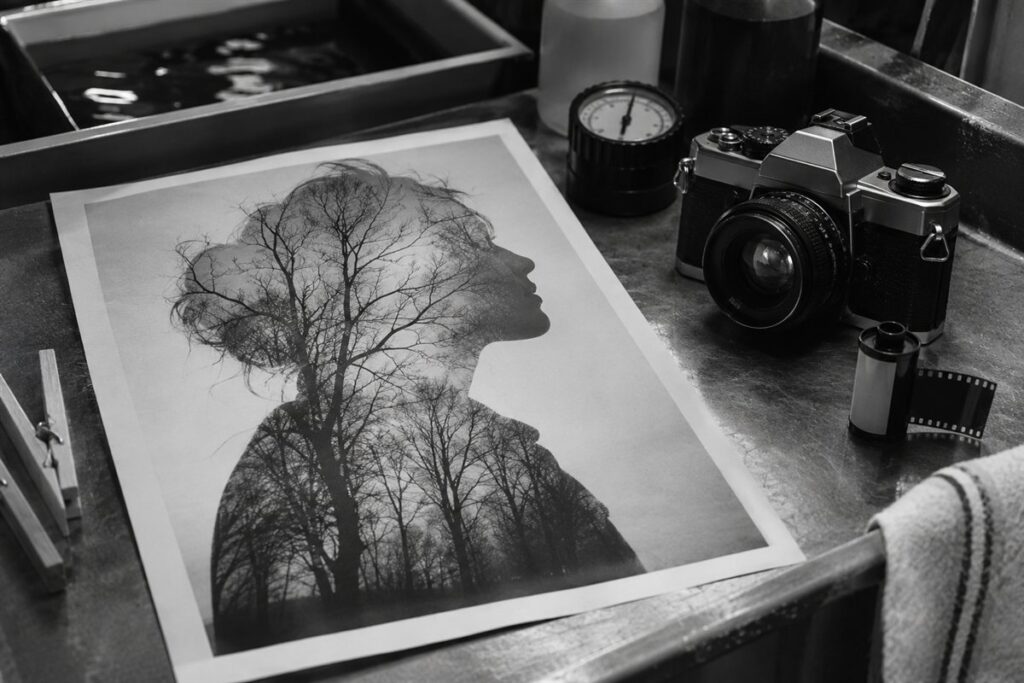
Double exposure photography, recording two images on the same piece of film or plate, appeared in the nineteenth century as a technical accident and quickly became one of the first special effects. It gave photographers ghosts, twins and impossible scenes long before digital editing existed.
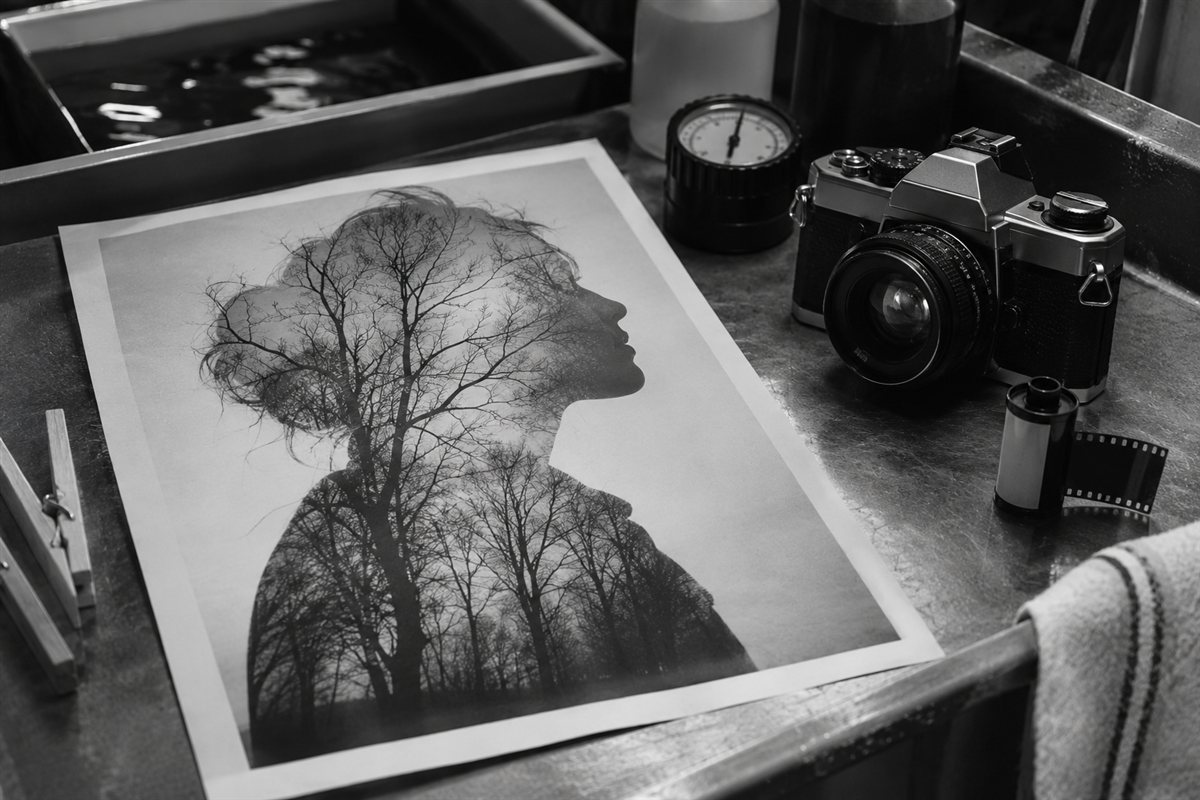
How It Began
Early photographic plates and film had to be exposed once and developed. If a plate was exposed twice by mistake, the two scenes overlapped in one image. Photographers noticed that this mishap could be repeated on purpose, and that bright areas of one exposure showed through dark areas of the other. The method needed no extra tools, only careful planning of where subjects sat in each frame.
In this guide
Spirit Photographs and Trick Pictures
In the second half of the nineteenth century, studios sold portraits that showed faint, translucent figures standing behind sitters. These so-called spirit photographs were made by exposing a plate to a draped figure, then exposing it again for the sitter. Some customers believed the results, while skeptics and other photographers showed how they were produced.
The same ideas spread to humor and entertainment. Photographers made images of a person shaking hands with himself or playing every part in a band, usually by masking part of the lens or plate during each exposure.
Moving Pictures Borrow the Trick
Early filmmakers applied the technique to motion picture cameras. By rewinding the film and exposing it again, they produced disappearing characters, ghostly overlays and dream sequences. Georges Melies is the name most often linked with these early camera tricks, which also included stop motion substitution and dissolves.
Double Exposure Today
Many digital cameras have a multiple exposure mode, and editing software offers blend modes that imitate it. To try the classic look:
- Choose a strong silhouette, such as a profile against a bright window or sky, for the first image.
- Plan a texture-rich second subject, for example trees, city lines or leaves.
- Expose for the highlights so the second image shows through the dark shape.
- If using film, remember that each exposure adds light, so reduce exposure for each frame, roughly halving it for two layers as a rough guide.
In software, the Screen and Lighten blend modes suit a bright background, while Multiply works for darker layers.
Why Early Materials Made Multiple Exposures Possible
Double exposure was not a clever gadget but a side effect of how early photography worked. The cameras of the nineteenth century had no shutter in the modern sense. The photographer removed a lens cap or covered and uncovered the lens by hand, and the plate or film inside recorded whatever light reached it. Nothing in the camera prevented a second exposure on the same plate unless the photographer changed the plate.
The slow speed of early materials also mattered. Because exposures lasted long enough to count in seconds or more, there was time to uncover the lens, let a scene register, cover it and then uncover it again after a change. A person could step into a scene halfway through, or a figure could be posed in front of a dark background and recorded separately. The long exposure made these manipulations practical for studio photographers who already controlled the light.
Dark backgrounds were the key technical trick. Where a plate receives little light in one exposure, a second exposure can add new content without the first showing through, and where the first exposure was bright, the second barely registers. This is why classic double exposures use a figure against black velvet or a dark wall: the empty dark areas stay free to receive the other image. The same principle still guides photographers today when they plan a two-layer image.
- Hand-operated lens covers made it simple to expose in stages.
- Long exposures gave time for a subject to move or be added.
- Dark areas kept the first exposure clean while a second was added.
Understanding these conditions explains why the technique appeared so early and why it required no special equipment.
Combination Printing: A Related Craft
Double exposure was not the only way early photographers built an image from more than one scene. Another approach, usually called combination printing, used several negatives and printed them onto a single sheet of paper. It took more time and skill than a simple double exposure, but it gave more control.
In a combination print, the photographer exposes parts of the paper in turn, covering the rest with masks. Each negative contributes a section, and the joins are hidden or softened. Photographers in the mid-nineteenth century used this to create large, staged scenes with many figures, which would have been difficult to pose together in a single camera exposure. Names such as Oscar Rejlander and Henry Peach Robinson are often connected with this method, and their work is commonly cited in photographic histories as an example of picture-making by assembly. Check a history of photography for specific works and details.
The difference from double exposure is worth keeping clear. A double exposure combines scenes at the moment of shooting or in the camera, with the results fixed on one piece of film. Combination printing occurs afterward in the darkroom, using separate negatives and selective masking. Digital compositing in modern software is the descendant of the second method, while the multiple exposure mode in a digital camera is the descendant of the first.
- Double exposure: layers light on one frame, with limited control.
- Combination printing: joins separate negatives, with more control and more effort.
- Digital compositing: uses masks and layers, with the most control.
Tools and Tricks of the Early Studio
Studios that produced trick pictures developed a set of simple tools. None required advanced technology, but they demanded careful planning.
The first was the dark backdrop. A black cloth or painted board behind the performer ensured that the background stayed empty and ready for the second exposure. Performers sometimes wore pale clothing so that they would register strongly on a dark background. The second was the mask or card. By holding a piece of card in front of part of the lens, or placing a stencil near it, the photographer could block half the frame for one exposure and the other half for the next. This is how pictures of one person appearing twice in the same room were made: the person sat on the left in the first exposure, with the right side covered, and then moved to the right for the second.
Third, careful registration. Because the camera had to stay in the same position between exposures, a firm stand was essential. A shift of even a small amount would show up as a double outline. Fourth, measured exposure. Each exposure had to be shorter than a normal one, or the combined image would be too dense and bright areas would burn out. Photographers learned by trial and error how much to reduce each exposure.
Seen this way, trick photography was mostly a matter of discipline: fix the camera, plan each placement, control the light and keep notes about what worked.
- Black backdrop, mask, firm stand, reduced exposure: the four basics of the method.
- Assistants and props helped with draped figures and quick placements.
Spirit Photographs in Context
The use of double exposure to make ghostly figures belongs to a particular period, when many people were grieving, curious about the unseen and interested in new technology. A photograph was widely seen as an objective record, and that reputation made a ghost on a plate more persuasive than a painting would have been.
A portrait photographer such as William Mumler in the United States became well known for this kind of picture, and his work led to public controversy and a court case, according to common histories of the subject. Check a reliable source for details. Other photographers in different countries produced similar images, and some openly described the method as a trick, while others presented the results as evidence of spirits. Critics demonstrated how the images could be made by exposing a plate to a draped figure and then to the sitter, and they sometimes produced their own examples to show the process.
For a modern reader, the lesson is partly about how people interpret images. The technical explanation is simple, but the emotional context shaped how the pictures were received. Sitters hoping to see a lost relative could be moved by an indistinct face behind them, and the photographer could profit from that hope. Today, the pictures are appreciated as historical objects and as early examples of staged imagery, and also as a reminder to ask how a picture was made before accepting what it seems to show.
- Look for signs of staging: transparent edges, folds of cloth and repeated figures.
- Read the surrounding history to understand why the images mattered.
Recreating the Effect on Film and What It Teaches
If you want to understand the early work, try making a double exposure yourself on a film camera. Some cameras allow multiple exposures by a lever or a setting, and others do not, so check your camera manual. If it does not, you may be able to rewind carefully, but this can cause frame misalignment, so use a roll you do not mind losing for tests.
Plan the image before you shoot. Choose a bold first subject with a simple shape, preferably a dark figure against a bright sky, and a second subject with texture, such as foliage or a patterned wall. Remember that two exposures add up. As a rough guide, reduce the exposure for each layer so the total comes out near normal, and consider bracketing on a test roll to find your preference. Keep notes of each frame so you can learn what worked.
Use a tripod or steady support if the subjects are in the same position, and mark where your first subject was so you can place the second. Shoot in good light for the first exposure, and make the second exposure in a different place or at a different time. Embrace the surprises: film can give unexpected overlaps that you could not plan on a screen.
If you use a digital camera, the in-camera mode shows a preview, which helps with alignment. In editing software, you can mimic the effect with blend modes, and you can experiment safely before committing to film.
- Begin with simple shapes and high contrast between layers.
- Write down settings for each frame.
- Compare film and digital results to see what each teaches.
A Plain Timeline of the Technique
Dates in photographic history can be slippery, since many people experimented at once and records are patchy. The table below sketches the general sequence in broad terms rather than exact years, so treat it as a map and not a ledger.
| Period | What was happening | Why it mattered for multiple images |
|---|---|---|
| Early nineteenth century | First practical photographic processes appear | Exposures were long, so accidents with reused plates were common |
| Mid nineteenth century | Glass plate studios spread across cities | Portrait studios gained space and tools for trick pictures |
| Later nineteenth century | Faster dry plates and flexible film arrive | Shorter exposures made planned layering more practical |
| Turn of the twentieth century | Motion pictures begin to borrow stills tricks | Filmmakers masked and re-exposed film for vanishing and doubling effects |
| Later twentieth century | Cameras add built-in multiple exposure controls | The effect becomes a creative choice for hobbyists |
What the sequence shows is a slow shift from accident to craft to everyday feature. Each new material made the trick easier to control and easier to share.
Common Misunderstandings About Early Trick Photography
Stories about old photographs tend to grow in the retelling. A few ideas are worth correcting or at least handling with care.
- Not every ghostly image was a deliberate hoax. Accidental double exposures happened when a plate was reused or a holder was loaded twice.
- Not all trick pictures were meant to fool people. Many were sold as novelties, jokes or portraits of imaginary twins.
- Double exposure is not identical to a composite. One layers light in the camera, the other combines separate pieces in printing.
- Modern digital blending is not the same process as the chemical original, even when the look is similar.
When you read a caption on an old print, treat claims about who made it and why with some caution. Museums and archives often add notes about what is known and what is only assumed, and those notes are worth reading before you repeat a story.
A Short Glossary of Early Photographic Terms
- Plate: a sheet of glass coated with light-sensitive material that captured the image.
- Emulsion: the sensitive layer that records light on a plate or film.
- Latent image: the invisible record held by an exposed emulsion before development.
- Masking: blocking part of the lens or frame so only some of the scene is recorded.
- Studio backdrop: a painted or plain screen behind a sitter.
- Exposure: the amount of light allowed to reach the plate or film.
Knowing these words makes museum labels and old manuals easier to follow, and they explain why a dark backdrop was so useful when layering a second image on top.
How to Read a Historic Photograph for Clues
If you come across an old print that seems to show a double image, a calm look can reveal a good deal. Check whether a figure appears transparent while the background stays solid, which often points to a second exposure on the same plate. Look at the edges, since a blended scene may show a slight mismatch in light direction or scale.
Notice the card mount, the studio stamp and the style of dress, which help place the picture in a general period. Do not rely on one clue alone. For anything valuable or fragile, a museum conservator or archivist can examine it properly and advise on handling and storage, and you should avoid cleaning or flattening it yourself.
Why the Story Still Matters
Looking back at these early tricks does more than satisfy curiosity. It shows how photographers solved creative problems with the materials they had, long before software. The same ideas of masking, timing and controlling light echo in modern multiple exposure modes and even in film effects.
It also reminds us that special effects are not purely modern. Audiences in the nineteenth century were as curious and as easily delighted as any today, and studios competed to offer something new. Seeing the craft behind the illusion makes the pictures more interesting, not less, and it sharpens your eye for the same ideas in films and photographs made today.
Planning a Visit to a Photography Collection
If this history has caught your interest, many museums, libraries and local archives hold early studio portraits and trick prints. A little preparation makes the trip more rewarding.
- Check the institution’s website to see what is on display and what is held in storage.
- Ask whether a curator or reference librarian can show items by appointment.
- Follow the rules about handling, lighting and cameras, which exist to protect fragile material.
- Bring a notebook to record titles, dates and catalog numbers for later reading.
- Look for exhibition catalogs and guides in the shop, which often explain techniques in plain language.
Many collections also publish scans online, so you can study details at home. When you do, zoom in on edges and shadows, where the seams of a layered image tend to show. Staff are usually glad to answer questions about how an object was made, and their answers will teach you more than guesswork.
Why Early Photographers Embraced the Accident
Double exposure began as a failure mode: a plate or frame exposed twice because the photographer forgot to advance it, or reused a plate that still held an earlier image. What turned accident into art was the nineteenth century’s appetite for wonder. Audiences of the era delighted in marvels that blurred the line between science and magic, and photography, itself still half miraculous, was the perfect medium for manufactured ghosts. Photographers who might have discarded a ruined plate instead studied the effect, learned to control it and built reputations on images that showed the dead visiting the living or a sitter shaking hands with themselves.
There was also a practical, democratic charm to the technique. It needed no special apparatus beyond the camera already owned, no chemicals beyond the normal darkroom. A village portraitist could offer a novelty that city studios advertised, and amateurs could experiment at home. Techniques that spread without equipment tend to shape a medium’s folk culture, and double exposure became part of photography’s folk culture early, passed between practitioners as recipes and warnings.
The trick’s dual reputation, art and fraud at once, is part of its history. The same method that let artists explore memory and dream let charlatans sell comfort to the grieving, and the court cases and exposés that followed forced photography to argue about its own truthfulness for the first time. That argument never really ended; it simply changed subjects with each new technology.
The Techniques Behind the Early Effects
Control, for the early experimenters, meant managing what each exposure contributed. A subject photographed against a black background in one exposure left the rest of the plate unexposed and ready to receive a second scene, which is why so many early ghosts float in dark rooms: the darkness was the technique. Exposure had to be divided between the two images, giving each a share of the total, so both printed with a transparency that read as supernatural. Too much exposure on either and the balance collapsed into confusion.
Some effects were made in the camera and others in the darkroom. Sandwiching two negatives in the enlarger or contact frame, masking parts of the paper during printing, and combining elements at the printing stage gave more control and repeatability than in-camera work, at the cost of spontaneity. Studios that sold spirit portraits as a business preferred the repeatable methods; artists exploring chance preferred the camera, where registration was imperfect and surprise survived.
Motion complicated everything. Long exposure times meant sitters had to hold still twice, in two poses or two positions, and any drift between them softened the result. The famous images of a person playing chess with their double or reading beside themselves required careful marking of positions, patient sitters and a floor plan of the composition worked out in advance, a kind of early storyboarding.
Spirit Photography and Its Reckoning
The most famous chapter of the double exposure story is also its most sobering. In the decades after great wars and epidemics, grief created a market, and some photographers supplied it with portraits in which a faint figure, identified as a lost loved one, hovered behind the sitter. The methods were the standard ones, double exposure, prepared plates, darkroom combination, but the claim was different: these were sold as evidence, not entertainment, and priced accordingly.
Investigators, including famous skeptics of the era and rival photographers who resented the trade, exposed the methods publicly, sometimes in court. The trials and demonstrations did lasting work: they taught the public that a photograph could be constructed, a lesson each generation since has had to relearn with new tools. They also left a complicated legacy, because some of the accused images remain genuinely moving as art, whatever their makers claimed.
For photographers today, the episode is a useful mirror. The tools have changed beyond recognition, but the questions have not: what does an image claim, what does the maker owe the viewer, and where does creative license end? Double exposure’s history is the first draft of every modern debate about manipulated imagery.
From Darkroom Trick to Modern Feature
Twentieth-century artists took the technique somewhere more personal. Surrealists and experimental filmmakers used layered exposures to picture dreams, memory and the unconscious, and the great modernist photographers folded double exposure into a serious visual language. Film cameras eventually formalized the trick: many offered a multiple exposure mode that cocked the shutter without advancing the film, turning an accident into a menu item, and generations of students learned the exposure arithmetic that the pioneers had worked out by feel.
Digital photography completed the journey from accident to feature to filter. Cameras now offer multiple exposure modes with live preview of the blend, phones layer images in an instant and editing software gives total control over opacity and masking. The modern tools remove the risk that made the old method exciting, which is why many contemporary photographers deliberately reintroduce chance: shooting a full roll or card of first exposures, then exposing over them blind, or collaborating with another photographer who provides the second layer unseen.
What survives every version of the technology is the underlying pleasure of the form: two moments sharing one frame, neither fully in control. In a medium built on single instants, the double exposure insists that photographs can also be about accumulation, memory and time layered rather than sliced.
Trying the Classic Methods Today
In camera
If your camera has a multiple exposure mode, start with a dark, simple first frame and a brighter, simpler second; simple shapes layer legibly while busy scenes turn to mud. Halve the exposure for each layer as a starting point and adjust after reviewing the blend. Subjects against plain backgrounds, silhouettes and textures are the beginner’s friends.
With film
On a film camera that allows re-cocking without advancing, or by carefully rewinding and re-shooting a roll, the old gamble returns in full. Keep notes on frame numbers and subjects, because the results arrive days later and the notebook is your only memory of intention.
In software, honestly
Layering in editing software gives the control the darkroom printers had, and there is no shame in it; the darkroom masters used the equivalent. The craft lies in choosing images that converse rather than collide, and in keeping a light hand with opacity so both moments remain present.
What the Early Experiments Teach Modern Photographers
Beyond their charm, the early double exposures teach three durable lessons. The first is that constraints breed style: black backgrounds, divided exposures and patient sitters were limitations that produced a recognizable aesthetic, just as today’s limitations will quietly define the look of our era. The second is that audiences forgive, and even love, technical imperfection when the idea is strong; the soft registrations and uneven densities of the pioneers never stopped their images working. The third is that every generation must negotiate honesty in images for itself, with its own tools, and the negotiation goes better when photographers know they are not the first to have it.
There is a practical inheritance too. The pioneers’ method, plan the combination, expose for the blend, keep the layers simple, remains the correct method with a modern camera’s multiple exposure mode. Their failures are equally instructive: busy layers collapse into confusion, unbalanced exposures drown the weaker image, and unmarked positions betray the sitter. A photographer who has read their century-old mistakes gets to skip making most of them.
So try the technique with respect for its history. Make a portrait of a friend doubled with the place they love, or layer your street with its own history by combining today’s scene with textures from the same spot. The pioneers would recognize the impulse instantly, and would probably ask, with professional envy, to see the preview screen.
The Aesthetics of Transparency: Why Layered Images Move Us
There is a reason the layered image survives every change in technology: it pictures something ordinary photography cannot, the coexistence of moments. A single exposure says this happened; a double exposure says these things belong together in memory, whatever the clock says. That is why the form returns whenever photography turns inward, in eras of mourning, of surrealism, of personal documentary, because grief, dreams and memory are all, structurally, double exposures: the absent present alongside the present, neither fully opaque.
Transparency itself carries meaning. A figure you can see through is, in every visual culture that has used the device, a figure not entirely of this world: a ghost, a memory, a thought. The pioneers exploited that reading commercially, but artists recognized its honesty, because that is genuinely how the past exists inside the present, visible and untouchable at once. The technique’s persistence is not nostalgia for an effect; it is loyalty to a metaphor that no other photographic device states so directly.
Modern viewers, raised on layered screens and blended media, read the device fluently and instantly, perhaps more fluently than any audience before. That fluency is an invitation to contemporary photographers: the double exposure is no longer a trick to be explained but a sentence in a language everyone now speaks, waiting for something worth saying.
Reading an Early Double Exposure: A Viewer’s Guide
Old multiple images reward slow looking, and a few questions unlock them. First, find the layers: what belongs to the first exposure and what to the second, and where do they interfere? The interference, the place where a face dissolves into a landscape or a hand passes through a table, is usually where the maker hid the meaning, or the mistake. Second, ask what is opaque and what is transparent, because the maker controlled that balance with exposure, and emphasis in these images is expressed as density: the solid figure claims reality, the faint one claims the other world.
Third, look for the seams of the method: the black backgrounds that made layering possible, the repeated furniture that betrays two sittings in one room, the edge where a darkroom mask slipped. Far from spoiling the image, those seams are its biography, evidence of the labor and ingenuity between the idea and the print. Museums increasingly display such works with their making explained, because the craft is part of the content.
Finally, ask the historical question: what did the first audience believe they were seeing? A parlour amusement, a proof of survival after death, an avant-garde statement? The same arrangement of tones carried each of those meanings in different decades, and holding them together in your mind as you look is the closest a modern viewer can come to seeing the photograph as it was seen. That double vision, fittingly, is the medium’s own trick played on its audience.
Collecting and Preserving the Early Works
Early multiple-exposure works survive in albums, studio archives and museum collections, often unattributed and sometimes unrecognized, catalogued as novelties among straighter portraits. Their preservation poses gentle problems: the same thin densities that made figures ghostly make prints vulnerable to fading and stains, and digitization, done carelessly with automatic corrections, can normalize away exactly the transparency that constitutes the work. Archivists have learned to scan such images flat and honest, corrections off, so the ghost stays a ghost.
For collectors, the field is one of photography’s remaining pleasures: significant early examples still surface in estate sales and album lots, identifiable by the tells this history describes, the black ground, the doubled sitter, the impossible handshake. Attribution is detective work, matching studio marks, furniture and printing styles, and a confirmed early spirit photograph with its story intact is a document of both craft and belief.
Whether in a museum or a family album, these images deserve their labels explained rather than apologized for. They are not failed photographs. They are evidence of the moment photography discovered it could imagine, and argued, for the first time, about whether it should. Every layered image made since, including the one you may make this weekend, is part of that argument’s long and honorable history.
The Double Exposure as Autobiography
There is a final chapter to this history that the pioneers could not have foreseen: the double exposure as the natural form of the personal photograph. In an era when everyone carries an archive of their own past in a pocket, layering a present scene with a meaningful second image, a childhood street over its modern self, a parent’s portrait over the house they built, has become a way ordinary photographers write autobiography without words. The technique that began as a darkroom accident and matured through fraud and surrealism ends, democratically, as a folk form, used at kitchen tables to say what a single frame cannot: that a life is not a sequence of moments but a stack of them, all faintly visible through each other.
That folk use would not have surprised the nineteenth century’s amateurs, who layered images for love and mischief in equal measure, but it might have moved the spirit photographers’ sitters, whose longing for exactly that visible coexistence of past and present was the market’s engine. The longing was never foolish. It was the technique’s true subject all along, waiting for an era honest enough to want it as art rather than as evidence.
Make one yourself with that intention, and the history becomes practical knowledge in your hands: the divided exposure, the simple shapes, the patience. You will be practicing a craft that connects your desk to a Victorian studio in an unbroken line of experimenters, and the print, two moments sharing one frame, will explain to anyone who sees it why the line never broke.
An Invitation, With Instructions From the Pioneers
The pioneers left no manuals, but their working method can be reconstructed from their prints, and it makes a fitting close to this history because it is still the correct way to begin. Choose two simple subjects, one for each layer, and give each a dark, plain ground to live against. Divide the exposure between them as you would divide attention between two speakers, favoring neither so much that the other vanishes. Mark your positions, breathe, and accept that the registration will be imperfect, because the imperfection is the signature of the method and the source of half its charm. Then look at the result the way its first audiences did, not asking whether it is true, but asking what it says, since saying, rather than proving, was the better half of the technique’s purpose from the very beginning.
Do that once, with intention, and the century of experiment in this guide stops being a story about other people. It becomes a craft in your hands, with its frauds and masterpieces, its courtrooms and darkrooms, all present in the small act of exposing one frame twice. Few techniques offer so much history per shutter press, and none offers it so cheaply. The pioneers, who had to load their plates in darkness and guess their exposures by candlelight arithmetic, would envy your ease and approve your curiosity, which is, in the end, the only credential this art form has ever required.
A Last Word on Layers
Every photograph is a layer, whether its maker admits it or not: a layer of intention over a layer of chance, a layer of the moment over the long layer of everything the photographer has seen and been. The double exposure simply refuses to pretend otherwise, and in that refusal lies its century of life, through fraud and art, through film and sensor, into the pockets of a generation that layers its images as casually as it breathes. The pioneers who first watched a ghost condense in the developing tray were not discovering a trick. They were discovering, earlier than most, what photography was always going to be: not a window but a palimpsest, written and written over, with all the earlier writing still faintly, beautifully visible to anyone who learns to look.
Why Museums Keep These Pictures
Institutions do not preserve curiosities for a century by accident, and the presence of early double exposures in serious collections, catalogued, conserved and exhibited alongside the era’s straight photography, is itself an argument worth weighing. Curators keep these works because they document something no other artifact can: the moment a technology of truth learned to dream in public, and the public’s complicated delight in being fooled beautifully. A spirit photograph is evidence twice over, of the sitter’s grief and hope on its surface, and of the photographer’s craft and commerce beneath it, and that double evidence makes it a richer historical document than many a more honest picture. To stand in a gallery before one, knowing how it was made and why it was bought, is to feel the whole nineteenth century looking back, credulous and skeptical, tender and shrewd, exactly as divided about its images as we are about ours.
That divided feeling is the correct souvenir of this history. The next time a layered image moves you, or a too-perfect photograph makes you suspicious, you will be reenacting, with better tools, the exact education the Victorians received from these ghostly plates. The technique’s pioneers could not have imagined our screens, but they would have recognized our arguments instantly, and there is something steadying in that recognition: the questions were never really about the technology, and they never will be.
One More Consideration: Making Your Own, Carefully
A small, practical coda for readers inspired to try the technique this weekend: begin with gratitude for how easy the pioneers have made it to learn from their mistakes. Keep the layers simple, keep the exposures divided, keep notes as they kept notebooks, and resist the software’s invitation to perfect the blend, because a double exposure polished into seamlessness has usually lost the quality that made the form worth reviving, the visible evidence of two moments negotiating. Let the edges show. Let the ghost be a ghost. The Victorians, working with plates they had to coat themselves, would have traded a great deal for your tools; the least their inheritors can do is use those tools with the same willingness to be surprised that made the pioneers’ accidents into art.
A Final Note for the Curious
If this history has done its work, you now own a small, portable piece of critical equipment that no camera shop sells: the ability to look at any layered image, from a Victorian parlour ghost to a phone’s portrait-mode composite, and ask the questions the pioneers taught us to ask. What is claimed here? What is shown, and what is merely suggested by transparency? Whose longing does the layering serve? Those questions, asked kindly and answered honestly, are the technique’s real inheritance, worth more than any single photograph it ever produced, because they apply to every image the future is preparing for us, including the ones that have not yet been invented.
FAQ
Is double exposure the same as a composite?
The results can look similar. Double exposure happens in camera or on one piece of film, while a composite is built from separate files in editing software, with masks and fine control.
Why do my double exposures look muddy?
Usually both images are busy or both are too bright. Use a simple, high contrast first image and a detailed second one, and keep the overall exposure in check.
Why did early photographers need dark backgrounds for double exposures?
A dark area records little light, so it stays free to receive a second image. A bright background in the first exposure would show through and mix with the second, making the result muddy. Dark backdrops gave clean layers.
How is combination printing different from double exposure?
Combination printing joins several negatives onto one sheet of paper in the darkroom, using masks. Double exposure layers light on a single plate or frame. Combination printing gave more control but took more work.
Were spirit photographs always intended to deceive?
Accounts differ. Some photographers presented the images as real, while others described the methods openly as tricks. Historians usually read them in the context of grief, belief and the trust placed in photographs.
Can I make a double exposure on any film camera?
Not every camera allows it. Some have a multiple exposure setting or lever, and others advance film automatically. Check your manual before trying, and test with a spare roll.
How much should I reduce exposure for each layer?
A common rough guide is to reduce each exposure so that the layers add up to a normal total, which is about half for two layers. Scenes vary, so bracket and note your results.
What subjects work best for a first attempt?
A simple, dark shape such as a profile against a bright background pairs well with a detailed second subject such as leaves or city lines. Busy images in both layers tend to look muddy.
How does the modern camera mode compare with the old method?
Many digital cameras blend two or more frames and show a preview, which makes alignment easier. The idea is the same, but you get immediate feedback and can retry without wasting film.
Why do early double exposures so often show ghosts?
Because the technique naturally produces translucency. Each exposure receives only part of the total exposure, so subjects recorded in one layer appear semi-transparent where the other layer shows through. In an era fascinated by spiritualism, that transparent figure read instantly as a spirit, and commercial photographers leaned into the interpretation.
How did photographers focus and compose without previews?
Carefully, and on paper first. Compositions were sketched, positions on the floor were marked, and each layer was usually photographed against darkness so the layers would not fight. The discipline of pre-visualizing the combined image, rather than either layer alone, is the same skill modern multiple exposure modes reward, even with a live preview to help.
Is a double exposure considered a manipulated photograph?
It is a constructed one, and its long history is exactly why context matters. As art, the construction is the point and needs no apology. As evidence or journalism, undisclosed layering would mislead. The technique itself is neutral; the claim made for the image decides the ethics, a principle that runs from spirit portraits to present-day editing.
The Short Version
Double exposure began as a darkroom and camera accident, became the basis for spirit photographs and early film effects, and now survives as a creative mode in cameras and software. Simple shapes and careful exposure give the best results.
Related Guides
- How to Create a Double Exposure Effect in Camera Step by Step
- The History of Infrared Photography From Early Film to Digital
- Drone Photography at Golden Hour: How to Nail the Exposure
- HDR Merge vs Exposure Blending for Landscape Photography
- Long Exposure vs ND Filter Stacking for Waterfall Photography
