The Sony A7R V is the newer successor to the Sony A7R IV, and both are high resolution full frame E-mount cameras. If your pictures are mostly landscapes or studio work on a tripod, the older A7R IV can still deliver superb detail. If you work with moving subjects, shoot video or want newer handling, the A7R V is the stronger choice.
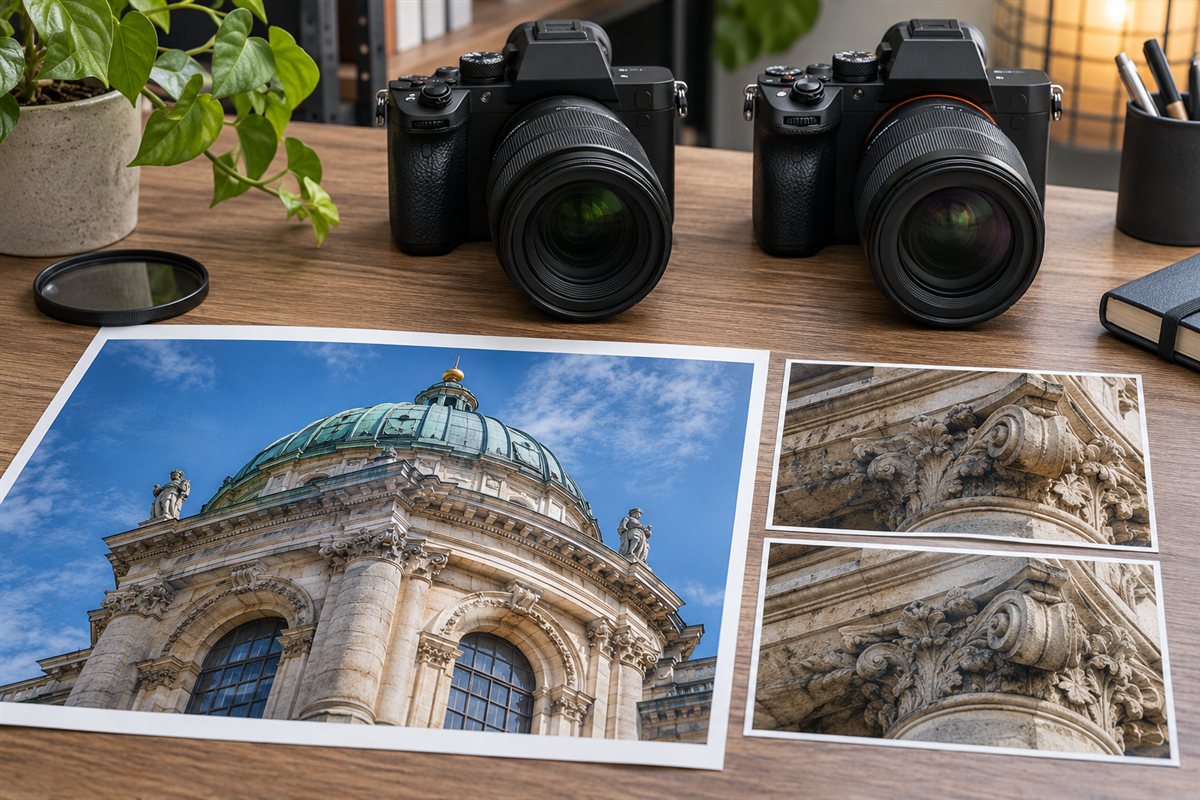
What Stays the Same
Both cameras belong to Sony’s R line, which is built around high resolution for photographers who crop heavily or print large. They share the E mount, a similar overall body concept and the same general purpose. That means a good lens makes a major difference on either one, and your existing E-mount lenses carry over.
In this guide
Where the Newer Body Moves Ahead
Successors in this line typically improve in a few predictable areas. Confirm the details on Sony’s official pages before buying.
- Autofocus intelligence: newer processing generally improves subject recognition and tracking.
- Handling: refinements to the grip, controls, screen and menus.
- Video features: a more current set of options than the older body.
- Overall responsiveness: faster operation in daily use.
Upgrade Checklist
| Your situation | Suggestion |
|---|---|
| Tripod landscapes, studio, product | A7R IV may be enough |
| Portraits with eye tracking needs | Consider A7R V |
| Wildlife or action | Consider A7R V |
| Buying used to save money | A7R IV is a sensible target |
| Frequent video | Consider A7R V |
How to Judge for Yourself
- Review your last few months of photos and note the shots you missed.
- Decide whether the problems were focus, speed, handling or file quality.
- If they were focus or handling, the newer body is more likely to help.
- If sharpness was the issue, check technique and lenses first.
- Compare what you could do with the money, such as one better lens, before deciding.
Buying Used or New
The older body is easier to find second hand, and a used unit in good condition can leave room in your plan for a lens or a tripod. When you shop used, ask about shutter use, check the sensor for marks, test every control and confirm a return window. The newer body is usually bought new, which brings a warranty and the full feature set. Weigh that peace of mind against the saving.
Getting the Most From a High-Resolution Body
A high-resolution sensor reveals both fine detail and technique flaws. Camera shake, missed focus and lens softness all become more visible when you view pictures at full size. To benefit from either camera, use a sturdy tripod for still subjects, a fast enough shutter speed for handheld work and a lens that can resolve the detail the sensor offers.
Technique habits matter. Use a remote release or a short timer to avoid touching the camera during exposure, and turn on any electronic shutter or silent mode only if you know how it behaves with moving subjects and artificial light. Stop down a little from the widest aperture on most lenses to improve edge sharpness, but avoid extremely small apertures, where diffraction softens the image. Check the lens maker’s guidance on its sharpest settings.
- Focus carefully, using magnified live view for still subjects.
- Check results at full size on your computer, not only on the camera screen.
- Keep sensor and lens clean, since dust spots are easier to see at high resolution.
Why Lens Quality Matters More Than the Body
If a lens cannot resolve the detail, a new body will not fix it. Older or budget lenses can look soft on a high-resolution sensor, especially at the corners or at wide apertures. Before paying for an upgrade, test your lenses on your current body at their best aperture, and look at fine detail at full size.
This is one reason many photographers put money into a better lens rather than a new camera. A well-regarded prime or a professional-grade zoom may make a bigger visible difference than a new body. If you shoot landscapes, check the corner sharpness of your wide-angle lenses. If you shoot portraits, check how your lens renders skin and eyelashes.
When you read lens reviews, look for sample images from similar high-resolution cameras and remember that your own copy may vary. Check the maker’s page for the full lens lineup and for any recent updates.
Storage and Computer Demands
High-resolution raw files take space and processing power. If your computer already feels slow with your current files, a move to a newer body may not add much to your workflow. Look at the options for compressed raw formats if the cameras offer them, and check how they affect quality and file size. Some formats trade a small amount of data for a large saving in space.
Think about the number of cards you need and about backup. Many photographers use two copies of every file, plus an off-site or cloud backup. This multiplies storage needs, so plan the cost of drives. Consider also the time spent on culling and editing. If you shoot large events, files add up quickly and the workflow can become the bottleneck.
- Check your editing software for support of the camera’s raw files.
- Consider an upgrade of storage or memory only if your current system struggles.
Resale and Timing the Upgrade
If you decide to upgrade, timing and resale affect cost. Camera prices tend to drop over time, and used values for older models fall when a successor arrives. Selling your old camera yourself may return more than a trade-in, though it takes more effort. Keep the box, manual, charger and original accessories, since complete kits sell more easily.
Think about whether you want the newest features now or can wait. If your current camera works well and you can name the specific problems a new one would solve, an upgrade makes sense. If you are mainly attracted by a newer model name, you may find the difference small in daily use. Set a clear reason for the change before you buy.
Also consider keeping the older body as a backup. A second body protects you if one fails during an important shoot and can carry a different lens so you do not change lenses in dusty places.
Checking a Used High-Resolution Body
When you buy a used high-resolution camera, check the sensor for dust and marks by photographing a plain bright surface at a small aperture and inspecting the picture at full size. Test the autofocus on a still subject and on a moving one. Check the shutter by listening for irregular sounds, and ask the seller about shutter count if known.
Test the stabilization system by listening for rattles when the camera is powered off and by taking handheld shots at slow shutter speeds. Inspect the screen and viewfinder for dead pixels or marks, and check ports and the card slot. Look at the mount for wear and make sure the battery holds a charge.
Ask about a return period and whether any warranty remains. Buying from a seller who tests and describes gear honestly gives you the most protection.
Making the Decision From Your Own Files
The most reliable way to judge an upgrade is to study what you shoot today. Open a folder of your recent keepers and sort them into groups: landscapes on a tripod, portraits, events, wildlife, video and travel. For each group, ask what limited the result. Was it missed focus, slow handling, a cramped menu, a small screen, noisy files in dim light, or simply your own technique? An upgrade solves specific problems. If your frustrations are mostly about technique or lenses, a newer body will not fix them. If the camera itself was the obstacle, an upgrade might be worth considering.
Handling and Interface Differences
Newer bodies often refine the interface: menus are reorganized, screens change, grips are reshaped and customization expands. These improvements are subtle on paper but noticeable over a long day. Hold both cameras if you can. Check how the grip suits your hand, whether the buttons are reachable with gloves, and how the viewfinder and screen feel. A body that fits your hands and habits encourages you to shoot more, which improves your photography more than a marginal technical difference.
Autofocus Approach to Different Subjects
Autofocus systems evolve between generations, and newer ones usually add smarter subject recognition and tracking. This matters most for people, animals and moving subjects. If you mainly photograph still scenes such as architecture or landscapes, the difference may not alter your results. If you photograph children, pets, sports or events, better tracking can raise your success rate. Read the maker’s pages for the supported subject types and focus modes, and remember that firmware updates can change behavior.
Comparing the Two in a Table
| Question | Older body | Newer body |
|---|---|---|
| Still landscapes on tripod | Very capable | Very capable |
| Moving subjects | Workable with care | Often easier |
| Video | Basic to moderate | Generally stronger |
| Handling updates | Familiar | Refined controls and screen |
| Cost of ownership | Lower on the used market | Higher |
Treat the table as general guidance and confirm exact specifications on the maker’s pages.
Image Stabilization and Shooting Handheld
High-resolution sensors reveal tiny movements. A camera with in-body stabilization helps you shoot handheld at slower speeds, though it cannot freeze subject motion. Whether the newer body has a stronger system is a question for the maker’s specifications. In practice, good technique remains vital: a fast enough shutter speed, a firm stance, gentle shutter presses and a steady breath. A tripod, remote release or timer eliminates shake for static scenes.
File Management at High Resolution
Large files demand planning. Each image takes more storage, and editing slows down on older computers. Calculate how many images you shoot per year and how much space that requires. Plan for fast memory cards, a reliable backup system and perhaps a better computer or faster drives. If you only occasionally need the highest resolution, some bodies let you shoot in smaller file modes to save space. Use these options wisely and keep your workflow smooth.
Lens Compatibility and Sharpness Demands
Both bodies use the same lens mount, so your lenses should work on either. Still, resolution reveals lens flaws. A modest lens may look fine on a lower-resolution camera but soft at the edges on a high-resolution sensor. If you plan to use the sensor’s full detail, consider whether your lenses are up to the task. Investing in a sharper lens often improves results more than changing the body.
Timing the Purchase Sensibly
- Wait until you have a clear need that your current camera cannot meet.
- Look at the used market, where a previous generation can be a sensible value.
- Check shutter counts and condition on used bodies.
- Consider selling your current camera first to fund the change.
- Avoid buying right before a major trip, so you can learn the new body calmly.
A Test You Can Do at a Shop
Bring a memory card and shoot the same scene with each body, using the same lens and settings. Compare focus speed, menu feel, viewfinder view and screen. Zoom in on the files at home. Do you notice differences that matter for your work? If not, save your money. If yes, you have a clear reason to upgrade. Respect your own judgment, since you are the one who will use the camera every day.
Summing Up the Practical Side
For tripod work and careful shooting, an older high-resolution body remains a fine tool. For action, video and ease of handling, a newer model may offer worthwhile improvements. Whichever you choose, invest in good lenses, learn your gear thoroughly and back up your files with discipline.
Sensor Resolution and What It Means for Printing
Higher resolution lets you crop more, print larger and see fine detail in textures such as fabric, foliage and architecture. However, you only benefit if your technique, lens and light support it. A blurry image remains blurry at any resolution. If you rarely print above moderate sizes and mostly share images on screens, the extra pixels may go unused. Think about the largest print you realistically plan to make, and consider that both cameras offer far more resolution than most screens can display. The real gain often lies in cropping flexibility for wildlife and sports from a distance.
Video Features Worth Comparing
If you record video alongside photos, compare the maker’s listings for supported resolutions, frame rates, recording formats and heat management. Newer bodies often add more flexible codecs and improved stabilization. Check whether you need extra accessories, such as faster memory cards or a small external recorder. Also consider the effect of video on battery life and storage; high-quality recording quickly fills cards. If video is secondary for you, these differences may matter little.
Connectivity and Workflow Convenience
Modern cameras connect to phones and computers for image transfer, remote control and tethering. These features save time for commercial work, studio sessions and event coverage. Look at how each camera handles file transfer, naming and sending images to a laptop. If you work with clients who want quick looks at images on location, smoother connectivity could be a real benefit. If you shoot privately and import files at home, it matters far less.
Ergonomics for Long Days
Consider how the camera behaves after several hours: how the grip feels, whether buttons are intuitive, and whether the screen and viewfinder remain comfortable. Small improvements in a body can reduce fatigue, which keeps you attentive. Try both with the lens you use most. Walk around, raise the camera to your eye many times and look at the menu. This is especially valuable if you work in challenging conditions, such as cold weather, where gloves and cramped controls become important.
Cost of Switching Systems and Accessories
An upgrade may involve more than the body. Batteries, chargers, grips and memory cards may differ between generations. Check which accessories carry over and which do not. Add the cost of any extra cards, a stronger computer and storage. If you sell your old camera, subtract that from the total. A clear tally avoids surprises and helps you see whether the upgrade makes financial sense for your situation.
Techniques That Reveal the Sensor’s Detail
High-resolution bodies reward careful habits. Use a tripod whenever the scene allows, and let any vibration settle after you place the camera. Choose a middle aperture to keep the lens at its best, and avoid very small apertures that soften detail through diffraction. Focus precisely, using magnified live view for static subjects. Use a remote release or the timer, and switch to a silent or electronic shutter option if the camera offers one and the scene has no fast-moving subjects or flickering lights. Handheld, raise the shutter speed beyond what you would use on a smaller sensor, as small movements show up readily at high resolution.
Editing and Computer Demands
Large raw files make editing programs work harder. Check that your computer has enough memory, a fast drive and a decent graphics unit. Consider organizing files by year and project, using consistent names and keeping a second copy on another drive. Delete obvious rejects soon after import to save space. Many editors offer smaller proxy files that speed up browsing; use them wisely. A reliable backup routine protects your work, and a well-organized catalog saves time when you search for a particular picture later.
Who Gains the Most From Each Body
- Landscape and architecture photographers on tripods may find the older body perfectly adequate.
- Studio and product shooters value stable, high-resolution files, which both provide.
- Wildlife, sports and event photographers may notice more benefit from newer focus tracking.
- Hybrid shooters who record video may prefer the newer body’s features.
Use this list as a prompt for your own thinking, then check the maker’s specifications for the details that matter most to your work.

Ready to Buy? Start Here
If this guide helped you decide what to look for, these products are a place to start.

As an Amazon Associate we earn from qualifying purchases. Prices and availability are shown on Amazon.
Putting the choice to work: four real situations
Specifications only become useful when they meet an actual day of photography. The four situations below are the ones readers most often describe when weighing the Sony A7R V against the Sony A7R IV, and each one shifts the balance in a slightly different direction. Read them against your own calendar rather than against an abstract idea of a typical photographer, because the right answer for a wedding shooter can be the wrong answer for a landscape walker even when both are choosing between the same two products.
You shoot landscapes on a tripod most weekends
This is the scenario where the older body defends itself best. On a tripod, with a still subject and time to focus carefully, the gap between generations narrows to handling and convenience rather than image quality you can see in a print. If that describes most of your photography, an upgrade buys you comfort more than pictures, and the honest advice is to keep shooting the older body and put money into a lens, a better tripod head, or travel to better locations. Upgrade when the subjects start moving, not when a newer box appears.
Your subjects started moving: kids, dogs, events
The moment your photography shifts toward subjects that will not hold still, the newer generation’s focusing behavior becomes the story. Tracking that stays with a running child or a dog changing direction turns frustrating outings into productive ones, and that keeper-rate difference is something you feel in the first hour. If you have noticed your older body missing focus on the moments you care about most, that frustration, documented across a few real shoots, is the strongest upgrade argument there is, stronger than any resolution or menu improvement.
You are adding video to a stills practice
Photographers who begin filming family films, behind-the-scenes clips, or client content quickly discover that video exposes every handling difference: screen movement, stabilization behavior, and how easily you can switch between stills and movie modes without losing your place. If video is becoming a real share of your work rather than an experiment, weigh the newer body as a workflow tool. If video remains an occasional extra, the older body will serve, and your money is better kept for audio and lighting, which shape video quality more than a body swap does.
You found a used older body at a tempting price
A well-kept used example of the older camera is one of the sensible ways into high resolution photography, provided you check it properly: shutter count where available, sensor cleanliness, mount wear, and a full set of test frames at home during the return window. Compare the total cost honestly, including a spare battery and fast cards, against the newer body. Many photographers are better served by the used body plus an excellent lens than by the newest body plus a compromised one, and that arithmetic deserves a written list rather than a gut feeling.
Setup and first-session checks that pay off
Start with the unglamorous foundations. Charge every battery the night before, format cards in the camera you will use rather than in a computer, and set the date, time, and copyright information once so every file is correctly stamped from the first frame. Then set the camera to record the file type you actually edit: raw if you process your pictures properly, raw plus a small jpeg if you also share quickly. These habits sound basic, but they remove the three most common causes of a ruined shoot, which are a flat battery, a card the camera dislikes, and files you cannot organize afterward.
Next, build two or three saved configurations around your real subjects rather than around the menu itself. One setup for still subjects, one for moving subjects, and one for video if you film is enough for most photographers. Give each a sensible focus mode, a drive mode, and an exposure approach, and save them where your body allows it. The point is not to collect settings; it is to make the camera predictable under pressure, so that when a subject appears you are thinking about position and light instead of hunting through pages of options you set once and forgot.
Focus deserves its own deliberate pass. Learn how your body selects and tracks a subject, practice moving the focus point or area quickly with your eye at the finder, and test the behavior on the subjects you really photograph: a child crossing a room, a dog changing direction, a bird against a busy hedge. Automatic subject detection is a powerful helper, but it is not magic, and the photographers who get the most from it are the ones who have watched it fail in practice and know which simpler mode to fall back on without panic.
Exposure discipline matters more as files get larger and more detailed, because mistakes are easier to see. Decide how you will protect highlights, since bright areas that clip to pure white rarely recover gracefully, and learn to read the histogram or highlight warnings as a quick field check rather than as decoration. Set an upper sensitivity limit you are genuinely happy with, not the maximum the camera offers, and review a test frame at full magnification early in every session so a systematic problem, a dirty sensor, a wrong focus mode, a shutter speed quietly too slow, is caught while it can still be fixed.
Technique: getting consistent results in the field
Technique with a modern body is mostly about removing hesitation. Keep the camera ready at settings that suit the scene in front of you rather than the scene you hope for later, because the first frame of a moment is often the best one and a camera set for a different subject will miss it. Review less than beginners do and zoom in more when you do review: a quick full-size check of focus and exposure at the start of a session, then trust yourself and work. Chimping after every frame breaks your connection with a moving subject and drains batteries, while never reviewing at all lets a small error ruin an entire set.
For moving subjects, your feet and your anticipation matter as much as the tracking system. Position yourself where the action will come to you, keep backgrounds as clean as the location allows, and begin following the subject early so the focus system settles before the decisive moment. Shoot in short, deliberate bursts rather than holding the button down in hope, and cull honestly afterward: keeping a handful of strong frames teaches you more than archiving hundreds of near misses, and it keeps your storage and your editing time under control as file sizes grow.
For still subjects, slow down and spend the time the subject gives you. Work the angles, watch the edges of the frame, and use the larger file as permission to refine composition rather than as an excuse to crop carelessly later. A detailed sensor rewards precision in focus placement, so put the focus point exactly where the picture lives, the eye, the inscription, the leading flower, and confirm it at magnification when the subject allows. Photographers often discover that the upgrade they needed was not a new body but this slower discipline applied to the body they already owned.
In poor light, technique becomes a negotiation among shutter speed, aperture, and sensitivity, and there is no setting that wins all three. Decide what the picture cannot sacrifice: a moving subject needs shutter speed, a group needs depth of field, and a printable file needs restraint with sensitivity. Brace against walls, use stabilization properly by giving it a moment to settle, and take several frames of important moments because one will usually be sharper than the others. Grain can be beautiful and can be reduced in editing; motion blur from a timid shutter speed is forever.
Care, storage and troubleshooting
Care for a modern body is mostly cleanliness and calm storage. Keep the sensor protected by changing lenses with the body facing down, away from wind and dust, and use a blower before any contact cleaning. Learn to recognize sensor dust for what it is, small dark spots that appear in plain areas like sky at narrow apertures, and do not panic the first time you see it; a blower cures most cases, and a proper wet clean or a service visit cures the rest. Wipe the body with a slightly damp cloth after dusty or coastal days, because salt air and fine grit are quiet enemies of dials, seals, and screens.
Batteries reward simple habits. Rotate your packs so they age together, store them partly charged if they will sit for months, and keep them warm in cold weather, where a spare in an inside pocket can rescue a winter shoot. Cards deserve the same respect: format them in camera, retire any card that has ever corrupted a file, and never fill a card completely on an important job when a swap costs nothing. None of this is exciting, and all of it is the difference between a tool you trust and a tool you worry about.
Troubleshooting should start with the boring causes, because they are the usual ones. Soft pictures are most often focus placement, a shutter speed too slow for the subject, or a dirty front element, in that order, before they are a faulty camera. Strange exposure is usually a metering mode meeting a scene it was not chosen for. A camera that seems to hunt for focus in dim rooms is often asking for a higher-contrast target or a different focus area, not for a repair. Change one variable at a time, test against a known subject, and keep notes; methodical checking finds faults faster than forum folklore.
When something is genuinely wrong, document it before you seek help: example files, the settings in force, and a plain description of when the fault appears. Makers and repairers solve documented problems quickly and vague ones slowly. Keep firmware notes as part of your records too, updating deliberately when an update addresses your subjects or your lenses, and never on the morning of an important shoot. A camera system is a small ecosystem of body, lenses, cards, and software, and treating it as one, with occasional calm maintenance, is what keeps it invisible in your working life.
Mistakes that make good equipment look bad
The commonest mistake with a capable body is letting its automation make every decision and then blaming the camera for the results. Automatic modes are excellent servants for exposure in changing light, but focus placement, shutter speed for moving subjects, and the choice of what to photograph remain yours. A second mistake is pixel-peeping every frame at maximum magnification and judging a camera by a standard no print or screen will ever apply; evaluate files at the size you will actually share or print, and you will make calmer, cheaper decisions. Finally, many photographers upgrade bodies to fix problems that were actually lens, light, or technique problems, so before any purchase, name the specific failure you keep meeting and confirm that the new body, and not practice, is what removes it.
More questions readers ask about this comparison
Will the newer body make my existing lenses look worse?
A demanding sensor shows lens weaknesses more clearly at full magnification, but it does not make a good lens bad. Lenses that pleased you on the older body will still please you; you may simply notice their soft corners more when you zoom to full size. Judge prints and normal viewing first before blaming a lens.
Is it worth upgrading if I mostly share images online?
For screen-sized sharing, both cameras produce far more resolution than the display can show, so the upgrade case rests on focusing, handling, and video rather than detail. If those matter in your shooting, the upgrade can still be right; if you are happy with your current results, your audience will not see a difference.
Should I sell the older body or keep it as a backup?
Keeping it as a second body is attractive if you shoot events or travel far from repair shops, because a backup that shares lenses and batteries removes a whole category of risk. Sell it if it would fund a lens you need more, or if it would simply sit unused while its value falls.
How long will the older body remain useful?
A camera does not stop making good pictures when a successor appears. With normal care, a high resolution body remains a serious tool for many years, and support questions are best checked against the maker current service information when they arise. Buy and upgrade on your subjects schedule, not the product cycle.
Field notes: habits that improve results with either choice
A useful exercise before any upgrade decision is the two-week diary. For two ordinary weeks of shooting, note every moment your current camera frustrated you and every moment it delighted you, in plain words, at the moment it happens. Patterns emerge quickly: focusing complaints cluster around particular subjects, handling complaints around particular lenses or weather, and many photographers discover their frustrations point at one lens or one habit rather than at the body at all. A diary like this turns a vague urge to upgrade into a specific shopping list, or into the satisfying discovery that the money is better spent on travel to better subjects.
Renting is the most underused tool in camera buying. A weekend rental of the body you are considering, used on your own subjects with your own lenses and cards, answers questions that no comparison table can: how the finder feels after an hour, whether the menus disappear under pressure, how the files behave in your editing software, and whether the size encourages or discourages you from carrying it. Rental fees are small against the cost of a body kept for years, and a rental that talks you out of a purchase has saved you far more than it cost.
Think about the second body question early if you shoot anything unrepeatable. Weddings, travel to distant places, and paid work all carry the same risk: a single body is a single point of failure. Your older camera, kept when you upgrade, often makes the ideal backup because it shares lenses, batteries, and your muscle memory. Photographers who plan this way upgrade less often and worry less, because each purchase has a role waiting for it in the kit rather than a predecessor heading for a drawer.
Editing is where large files either reward or punish you, so set your software habits before the new body arrives. Learn to cull at full speed with flags rather than deleting in the field, apply a consistent starting preset so you judge pictures rather than processing, and archive with a folder structure you can still understand in five years. Storage is cheap compared with reshooting an unrepeatable day, but disorganized storage is its own kind of loss: the photograph you cannot find might as well not exist.
Light remains the cheapest upgrade in photography. A photographer who learns to see window light, open shade, and the blue minutes after sunset will improve more in a season than a body swap delivers in a day. When you test any new camera, test it in the light you actually love, at the hours you actually shoot, and judge whether it helps you work in that light with less friction. Tools that serve your light serve your style, and style is what makes a body of work recognizably yours.
Finally, give any new body a proper settling-in period before judging it. Menus, dial positions, and focus behavior all feel wrong for the first few sessions simply because they are new, and many returned cameras were victims of unfamiliarity rather than faults. Commit to a month of regular use, customize the controls once you know your habits, and only then decide what the camera truly is. Familiarity is a feature, and it is one you build yourself.
Second-hand buying deserves a method rather than a hunch. Handle the body, work every dial and button, mount your own lens, and shoot a deliberate test set: a plain sky or wall at a narrow aperture to reveal sensor marks, a detailed subject at your usual distances, and a short burst to hear and feel whether the camera behaves evenly. Check the screen, the finder, the ports, and the battery door, because small faults in these areas are the ones that annoy daily. A seller who welcomes this routine is telling you something good about the camera history.
Weather changes how a camera should be judged. A body that feels perfect in a warm shop may feel cramped with gloves, slippery in rain, or blinding in bright sun at the finder. If your photography lives outdoors, test in conditions close to your real ones, or at least simulate them honestly: gloves on, strap over a jacket, screen in sunlight. Handling is not a soft, secondary quality; it is the interface between you and every photograph you will ever make with the tool, and it deserves the same seriousness as any specification.
Sound and discretion are real working qualities that specification sheets ignore. In a ceremony, a theater, or a quiet street, how a camera sounds and how large it feels to the people around you can decide whether you are welcome to keep photographing. Electronic shutter options, smaller bodies, and calm handling all contribute to a lower profile. Photographers who work in sensitive places should weigh this as a first-order quality, because access is worth more than resolution once you are asked to stop.
A word about megapixel expectations, because disappointment often starts there. More resolution does not make a bad photograph better; it makes a good photograph bigger and a flawed one more visibly flawed. Photographers who thrive with detailed sensors are the ones who enjoy that honesty: they refine focus, light, and composition because the file shows them exactly what they did. If that feedback loop excites you, a high resolution body will make you better. If it irritates you, a more forgiving camera may suit your temperament, and temperament is a legitimate buying criterion.
Accessories should be bought in the order your failures demand them. A spare battery after the first day you ran dry, a faster card after the first burst you missed, a better strap after the first long walk, a small blower after the first dusty sky. Bought in that order, every accessory has a job waiting for it. Bought in advance from a checklist, accessories become drawer clutter and the money that should have funded a trip sits in a pouch. Let the work write the shopping list.
Insurance and records sound dull until they are suddenly the whole story. Photograph your gear and serial numbers, keep receipts somewhere searchable, and note firmware versions when you update. If you travel for photography, check what your household or travel cover actually says about equipment before you need it. None of this improves a single frame, but it protects the ability to keep making frames, which is the asset that actually matters.
Learning a new body is fastest with a project, not with a manual. Give yourself a small, definite assignment for the first month: one subject, one lens, a fixed number of finished pictures. A project forces the repetitions that build muscle memory, exposes the settings you actually need to customize, and produces a set of pictures by which the camera can be judged fairly. Manuals answer questions; projects create the questions worth answering.
Resale thinking has one healthy form: buy equipment you would be happy to keep if the market moved against you. Photographers who buy for use are never trapped, because a tool that serves weekly has already paid its way in pictures. Check that chargers, batteries, and straps are complete when you buy used, since replacing small missing items quietly erases the saving that made the used purchase attractive.
FAQ
Will I get sharper pictures from the newer model?
Not necessarily. Resolution is in the same class, so sharpness depends mostly on the lens, light and your technique. The gains are mainly in handling and focus behavior.
Do the cameras share lenses?
Yes, both use the Sony E mount.
Will my current lenses be good enough?
Test them on your current body at full size. If they look sharp at their best apertures, they may be fine; if not, a lens upgrade may help more than a new body.
Are the files from the newer camera much bigger?
Resolution is in the same class, so file sizes are broadly similar. Check each model's raw options and settings for exact differences.
Do I need a new computer for the newer camera?
Not necessarily. If your computer handles your current files comfortably, it will likely handle these. Check your editing software's support for the camera first.
Is the older camera still supported with firmware updates?
Support varies by maker and age. Check Sony's official site for the status of firmware and service for the exact model.
Should I buy the older body as a second camera?
It can make a good backup or second body, particularly if your lenses and batteries are shared. Check whether the two models use the same battery type and accessories.
How do I reduce shake with a high-resolution sensor?
Use a faster shutter speed, a tripod for still subjects and the stabilization your camera offers. A remote release or timer reduces vibration from pressing the button.
What matters more, camera or lens?
For sharpness, the lens and technique often matter more. A new camera improves handling and focus, but cannot create detail that the lens or settings lose.
The Short Version
The A7R IV remains a capable detail machine, and the A7R V is the refined successor. Choose the older body for still subjects and value; choose the newer one for action, video and a smoother experience.
