Postal scales fall into a few families: digital, mechanical spring, balance beam and hanging models. Each measures weight differently, and each suits a particular kind of work. This plain guide defines them and gives an example use for each.

Digital Scales
A digital scale uses a sensor under the platform and shows the result on a screen. Most have a tare button, a unit switch and a hold function.
- Example use: a home seller weighing varied parcels each day.
- Good points: easy to read, quick, often has several units.
- Watch for: power source and whether the platform flexes under big loads.
In this guide
Mechanical Spring Scales
A spring scale uses a spring that stretches or compresses under load, and a dial shows the weight. It needs no power.
- Example use: a workshop corner where a plug is not handy.
- Good points: simple, works without batteries.
- Watch for: the dial can drift over time, and the reading may be harder to judge between marks.
Balance Beam Scales
A beam scale compares the parcel against sliding weights along a beam. You move the weights until the beam sits level, then add up the markings.
- Example use: a shared space where a steady, simple instrument is wanted.
- Good points: few parts that can fail.
- Watch for: slower to use, and it needs a stable, level surface.
Hanging Scales
A hanging scale carries the parcel from a hook. It can be digital or spring based.
- Example use: bulky or awkward parcels that do not rest well on a platform.
- Good points: no platform size limit.
- Watch for: the parcel must hang still, and the hook and straps must carry the load.
Side by Side
| Type | Reads by | Needs power |
|---|---|---|
| Digital | Screen | Yes, batteries or adapter |
| Spring | Dial | No |
| Beam | Sliding weights and markings | No |
| Hanging | Dial or screen | Depends on the model |
Terms You Will Meet
- Capacity
- The heaviest load the scale is meant to carry.
- Increment
- The smallest step in the displayed reading, sometimes called resolution.
- Tare
- A function that sets the display to zero with a container on the platform, so only the contents are counted.
- Platform
- The surface on which the parcel rests.
Knowing these words makes maker’s guides much easier to read, and it helps when you compare two models side by side.
Capacity and Increment: How to Pick the Right Range
Two numbers on a scale’s listing matter most: capacity and increment. Capacity is the heaviest load the scale is meant to weigh, and increment is the smallest step it shows. A scale with a large capacity and coarse increment suits heavy parcels but may be too blunt for light letters, while a scale with a fine increment and small capacity suits letters and small items but may be overloaded by a box.
Start by thinking about what you actually send. List the lightest and heaviest typical parcels, and choose a capacity comfortably above the heaviest, so you do not work at the very limit all the time. Then check that the increment is fine enough for the weight bands your carrier uses, since charges often change at certain weights. If a charge band changes at a small step, a scale that rounds coarsely might hide a difference. Check the listing for whether the stated increment applies across the whole range, as some scales are less fine at higher loads. Do not buy a scale only because of a high capacity number. Bigger is not always better, and a smaller, more precise scale may suit a seller of small goods. If your parcels vary a lot, consider whether one scale can cover both or whether two would be easier to use.
Platform Size, Power and Display Features
The platform is where the parcel sits, and its size and shape affect daily use. A small platform may be fine for letters but awkward for boxes that overhang. A large platform handles bulky parcels, though it takes more desk space. Check that the platform is rigid and does not flex under load, and that the parcel stays balanced and does not tip.
Power is another point. Digital scales run on batteries, an adapter or both. Battery models can be moved around, but you need spares, while plugged models need an outlet nearby. Some have an auto-off feature that saves power but may shut down at inconvenient times, so check whether it can be adjusted. Look at the display: a clear, backlit screen is easier to read in dim light, and a large digit size helps if you work quickly. Useful features include tare, unit switching, a hold function for items that do not sit still, and an overload warning. Some models offer a separate display tilt or a remote display on a cable. Read the manual for how to calibrate the scale, if the maker supports it, and for care points such as keeping the platform clean and avoiding impact. Check whether the surface can be wiped and whether it resists moisture.
Checking Accuracy and Calibration at Home
A scale is only useful if you can trust it, and a few simple checks help. First, place the scale on a flat, firm, level surface and let it settle. Zero it with nothing on the platform. Then weigh an item whose weight you know, such as a sealed packaged product with a printed weight, and compare the reading. Be aware that printed weights have tolerances, so do not expect a perfect match.
Next, test repeatability: weigh the same item several times and move it to different spots on the platform. A reliable scale should show the same or nearly the same value each time. If the reading changes with position, the platform or sensor may be faulty or the surface may be uneven. Check at low, middle and high loads, not just one point. Some makers sell calibration weights, and some scales have a calibration mode, which the manual explains. Do not open the scale or adjust it unless the maker says so. Test again after moving the scale, replacing batteries or changing the room temperature, since conditions can shift readings. If the scale drifts or gives odd readings, replace batteries first, then clean it, and finally contact the maker. Keep a record of your checks, so you can see changes over time.
Which Scale Suits Which User
Different senders have different needs. A person who posts a few letters or small items a month may need only a small, simple scale with fine steps. A home seller who packs many parcels each week benefits from a digital model with tare, a clear display, a good-sized platform and a solid build. Someone who ships heavy boxes needs a higher capacity and a stable base, and possibly a floor-style model.
A workshop or hobby space with no power may suit a spring or beam scale, as long as the user is comfortable reading dials or sliding weights. People who send bulky or awkward items, such as long tubes or odd shapes, may find a hanging scale easier to use, provided the hook and any straps are rated for the load. In a shared office, a sturdy, easy-to-read digital scale reduces mistakes between users. Think also about storage: will the scale be left on a desk, or put away after use? A compact model may be easier to store, while a bigger one can stay in place. Check that you can reach the controls easily and that the unit display matches what your carrier uses. If you are unsure, begin with a simple digital model, and upgrade if your needs grow.
Care, Handling and When to Replace
Scales are measuring instruments, and rough treatment shortens their life. Keep the platform clear of dust and debris, wipe it with a slightly damp cloth, and avoid spraying liquids into the casing. Do not drop items onto the platform or exceed the stated capacity, as overload can damage the sensor. Store the scale flat and away from heat, moisture and heavy objects. Remove batteries if you will not use it for a long time to avoid leakage.
Signs that it is time for a replacement include readings that drift, do not return to zero, change with position or jump around. A cracked platform, a sticky tare button, a dim or broken display and damage from spills are other signs. For spring scales, a pointer that does not return to zero or a spring that has lost tension suggests wear. Beam scales may develop worn pivots or lost weights. Before replacing, try fresh batteries, a different surface and a recalibration if the maker allows it. If the scale is used for business, check whether local rules require certain checks or approvals, and ask the relevant authority rather than assuming. When buying a new scale, apply what you learned about capacity, increment and features, and choose one that suits how you work now.
Weighing a Parcel Correctly, Step by Step
A good scale still gives bad numbers if the weighing routine is sloppy. The steps below apply to most digital and mechanical postal scales, though you should always check your model’s manual for anything specific.
Preparing the scale
- Place the scale on a hard, level surface. A soft tablecloth, carpet or a wobbly table can distort readings.
- Turn the scale on and wait for it to settle at zero before touching it.
- If you use a box or tray to hold items, place it on the platform first and press tare so the container weight is ignored.
- Keep the scale away from drafts, vibrations and direct sunlight, which can affect sensitive electronics.
Placing and reading the load
Set the parcel gently in the center of the platform, not dropped from a height. A sudden impact can briefly read much higher than the true weight and, over time, can damage the sensor. Wait for the number to stop changing, and then read it. If the display keeps drifting, check for air movement, a flexing table or a weak battery.
Writing down the result
Note the weight in the unit the carrier uses, usually ounces or pounds in the US and grams or kilograms elsewhere. If the carrier charges by weight bands, check whether it rounds up to the next band. A parcel that weighs a hair over a limit can jump to a higher price, so a precise reading is worth the extra seconds.
Understanding Carrier Weight Rules
Scales and postage rates are linked, and knowing how the carrier counts weight keeps you from guessing. Rules differ by carrier, country and service, so treat this section as general background and check the carrier’s current rate tables for specifics.
Weight bands and rounding
Many services price in steps. A parcel that weighs just over one step is charged at the next higher step. This is why a scale with fine increments helps when your parcels fall close to a limit. If a package is borderline, trimming packaging or choosing a lighter filler can sometimes save money.
Actual weight versus dimensional weight
Some carriers charge by the greater of the actual weight and a calculated dimensional weight based on the package size. A large, light box can cost more than a small, heavy one. Your scale only measures actual weight, so you will also need a tape measure to see whether dimensional pricing applies to your parcel.
Why packaging counts
- The weight a carrier charges for includes the box, padding, tape and labels.
- Heavy-duty boxes and thick padding can add noticeable weight, especially on small parcels.
- Weigh the final, sealed parcel, not just the contents, and add any labels that will be attached.
- If a parcel sits close to a band limit, repack with lighter materials where it is safe to do so.
Troubleshooting Strange Readings
Most scale problems have simple causes. Before you decide the scale is broken, try the checks below in order.
Reading drifts or never settles
Move the scale away from fans, vents and heavy foot traffic. Check that the surface under the scale is rigid. Replace batteries if the display dims or flickers, since low power is a common cause of erratic numbers. If the problem continues, try a different power source or cable if the scale uses an adapter.
Scale will not return to zero
Remove everything from the platform and check for debris underneath it, such as a label, a crumb or a bit of tape. Power the scale off and on again to reset. On mechanical scales, look for a zero adjustment knob and turn it until the pointer sits at zero.
Readings differ from a second scale
Two scales rarely match exactly. Test both with the same known weight, such as a sealed item with a printed weight or a calibration weight. If one scale is consistently off by a fixed amount, you can account for that difference, but if it varies across the range, replace it.
Error messages
- An overload message means the load exceeds the scale’s capacity. Remove the item at once to avoid damage.
- A low battery icon means replace the batteries before trusting the numbers.
- An error on startup often means something was resting on the platform when the scale was turned on.
A Worked Example: Setting Up a Small Shipping Station
Imagine a seller who ships small packages from home a few times a week. Most parcels weigh between a few ounces and a few pounds, and the occasional heavier order goes up to about ten pounds.
A digital platform scale with a capacity comfortably above their heaviest parcel and fine increments for lightweight items is the natural fit. They place it on a firm shelf at waist height next to the packing table, so they do not have to carry boxes across the room. A small tray for loose items and a marker for notes complete the station.
They build a habit: pack the parcel, seal it, put on the label and weigh it. If the weight falls close to a price step, they check whether a lighter mailer or less padding would do the job without risking damage. Every month or so they test the scale with a known weight, such as a sealed item with a printed weight, to confirm it still reads correctly.
This kind of simple routine means fewer postage surprises, fewer returned parcels and less time spent second-guessing the numbers. It also shows that the best scale is the one that fits the work you actually do.
Mistakes Sellers and Home Users Make
- Buying a scale with too high a capacity, so small parcels read with coarse steps.
- Weighing the contents but forgetting the packaging and labels.
- Leaving a scale on a soft or uneven surface.
- Ignoring the zero reading before each weighing.
- Using a kitchen scale beyond its rated capacity or letting it get wet.
- Storing the scale with heavy items stacked on top of the platform.
Avoiding these habits costs nothing and keeps readings more consistent. If you ship regularly, consider writing a short checklist and keeping it near the scale until the habits become automatic.
Using the Tare Function for Faster Work
Tare is the feature that makes everyday weighing quicker, and it helps with more than just containers. Knowing the few ways to use it can cut down on arithmetic and mistakes.
Handy tare routines
- Subtract a box: place the empty box on the scale, press tare, then add the items and read only their weight.
- Add items one at a time: after each addition, press tare so the display shows just the latest item, which helps when making a packing list.
- Check packaging weight: weigh the empty mailer and padding, write it down, and use it to estimate the weight of future parcels.
- Compare two items: tare with the first item on the scale, then replace it with the second to see the difference as a positive or negative number.
Remember that tare does not extend the maximum capacity. The scale still carries the full weight on its sensor, so the container plus the contents must stay under the stated limit.
Using tare for odd shapes
If a parcel is too large for the platform, some people rest a flat board across it and tare the board first. Only do this if the whole load stays within the capacity and sits stably on the platform, and never let anything overhang so far that it tips. When in doubt, use a larger scale instead of improvising.
Ready to Buy? Start Here
If this guide helped you decide what to look for, these products are a place to start.
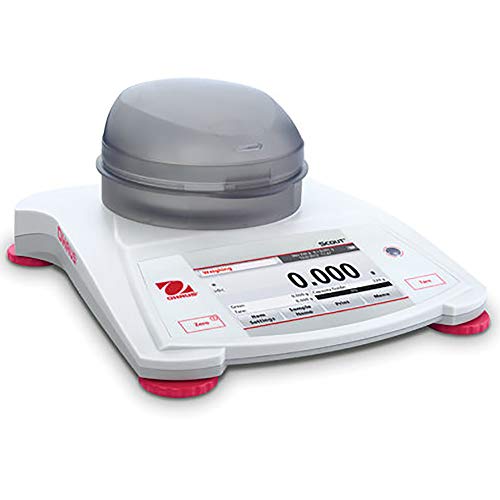
View Ohaus Scout Portable Balance on Amazon
As an Amazon Associate we earn from qualifying purchases. Prices and availability are shown on Amazon.
A Classification Frame That Makes Sense of the Shelf
Postal scales look like a bewildering range of products until you sort them by three questions. First, how does the scale sense the load: a digital sensor, a spring, a balance mechanism or a hanging arrangement each suits different work. Second, what is the working range: the heaviest parcel it handles comfortably and the smallest change it can show. Third, how do you interact with it: platform size, display position, power source and any connection to a computer. Every model on the market is simply a set of answers to those three questions, and once you see the frame, comparison stops being a fog of model names and becomes a checklist you control.
Reading a specification sheet without being misled
Read specifications as claims about conditions, not as promises about your bench. Capacity tells you the maximum the scale is built to weigh, not the weight at which it is happiest all day; a scale used constantly at its very limit lives a harder life than one with headroom. The increment, sometimes called readability, tells you the smallest step the display can show, which is not the same as accuracy: a display can count in fine steps and still be off by several of them. Look for how the maker describes accuracy and repeatability, expect those figures to assume a level surface, a settled load and sensible temperatures, and treat any specification you cannot find as a question to ask rather than a detail to assume.
Features that earn their place, and features that do not
A tare function earns its place in almost every setup, because containers are a fact of packing life. A hold function, which keeps a reading on screen after a large parcel is lifted away, earns its place if you weigh boxes that hide the display. A separate, wired or raised display solves the same problem more elegantly for bulky work. Unit switching matters if you genuinely work in two systems; a counting mode matters only if you count small parts by weight. Extra modes you will never open are not value, they are menu clutter, and a simpler scale that does the few things you need, reliably, is usually the better instrument.
Choosing by Scenario Instead of by Superlative
Forget the search for the best scale and describe your parcels instead. The letter-and-small-parcel sender needs modest capacity, fine increments and a small footprint, and will use the scale many times a day for seconds at a time. The marketplace seller with mixed parcels needs a middle range, a platform that takes a typical box without hiding the display, and a tare habit built into the routine. The sender of occasional heavy or bulky items needs capacity with headroom and a way to read the display when the load covers it, and will accept a larger footprint as the price of that range. The shared or mobile setup needs sturdiness, simple controls that a helper cannot misconfigure, and power that does not depend on one cable living in one place.
Questions to answer before you compare models
Write down your heaviest realistic parcel, your lightest, how many parcels you weigh in a busy week, where the scale will live, and whether the display will be hidden by your typical box. Those five answers narrow the field more honestly than any ranking. Then check the candidates against the frame: sensing type you are comfortable maintaining, range that covers your extremes without living at its limit, and an interaction style that fits your bench. A scale chosen this way rarely disappoints, because the choice was made from your work rather than from a headline.
Living with the scale you chose
Whichever type you settle on, its accuracy in your hands depends on boring habits: a firm level spot, a settled reading, an occasional check against a known weight, and a record of what you weighed. Types differ in mechanism, but no mechanism survives being rushed, overloaded or stored under a pile of boxes. Treat the scale as a measuring instrument rather than furniture, and every type in this guide will repay you with numbers you can defend.
How Each Type Behaves Over Years, Not Days
Choosing a scale type is partly choosing how it will age. Digital models live or die by their electronics and sensors: treated kindly they hold their calibration well, but a heavy overload, a liquid spill into the platform or a battery left to corrode can end them suddenly. Spring mechanisms age gradually, stretching and tiring with use and with being left under load, so their readings drift slowly rather than failing outright, and storing them unloaded is a genuine act of maintenance. Balance designs have few parts to age and can serve for decades, at the price of speed and a dependence on their weights staying complete and undamaged. Hanging scales share the spring family’s gradual ageing, with the added wear of hooks, handles and the knocks of travel. None of this makes one type the winner; it tells you what kind of attention each type will ask of you, and the best choice is the one whose asking price in care you will happily pay.
Environment: the specification nobody lists
Every scale type has weather it dislikes. Electronics dislike damp, condensation and temperature swings. Springs dislike being stored loaded and being jerked by snatched loads. Fine mechanisms of any kind dislike dust, vibration and a bench that wobbles. Before blaming a type for poor service, audit its environment honestly: a modest scale on a firm, dry, level bench will out-measure a superior instrument balanced on a carton in a damp shed. The room is part of the instrument, and improving the room is often the cheapest accuracy upgrade available at any price.
Redundancy and the second opinion
Where weighing really matters, a second opinion settles arguments. That need not mean two expensive scales: a simple known check weight, a comparison against a recently verified parcel, or an occasional cross-check on another scale all serve. What matters is the habit of verification, because any single instrument of any type can drift while looking perfectly confident. A scale that is never checked is a rumour with a display, whatever its mechanism, and a modest scale that is checked on a rhythm is a trustworthy colleague.
A Decision Walkthrough From Parcels to Purchase
Walk the decision in the order the work demands. Begin with the loads: list your lightest and heaviest realistic parcels, and be honest about the rare extremes rather than buying for a parcel you may send once. Move to the bench: measure the space the scale may occupy, and decide whether a typical large parcel will hide the display. Move to the people: count the users, and prefer controls the least technical user cannot accidentally misconfigure. Move to the power and place: fixed bench with a socket, shared table, or mobile use each favour different designs. Only now look at models, through the classification frame, and let each candidate answer the questions your walk produced. A model that answers all of them adequately beats a model that answers one brilliantly and the rest by apology.
The first week with a new scale
Spend the first week building trust deliberately. Weigh familiar objects, repeat readings, test the tare with your real containers, and try your largest typical box to learn the display’s behaviour. Record those early readings; they become the baseline against which future doubts are judged. Learn the error messages calmly now rather than during a busy dispatch, and decide where the scale will live permanently, because a scale that migrates between surfaces inherits a new personality at every address. By the end of the week the scale should feel less like a purchase and more like a colleague whose habits you know, which is precisely the relationship accurate weighing requires.
Cost of Ownership, Told Honestly
The purchase is the smallest part of what a scale costs. Add the space it occupies, the batteries or power it consumes, the check weights or verification it deserves, the cleaning and care its type asks for, and the cost of the errors it prevents or permits. A very cheap scale that drifts will tax you in corrected postage, reweighed parcels and doubt, while a sturdier instrument taxes you once and then quietly serves. Equally, an elaborate instrument bought for simple work taxes you in menus, fragility and features maintained but never used. The honest comparison is between total costs of ownership matched to your actual parcels, and it usually favours the simpler, sturdier answer in every type family.
Second-hand scales and inherited equipment
A used scale can be a bargain or a story someone else finished telling. Before trusting one, run the beginner’s checks as if it were new: level surface, settled zero, repeated readings of the same object, a known weight if you can manage one, and a test at both a light and a heavy load within its range. Missing weights on a balance design, a tired spring that no longer returns to zero, or electronics that flicker under a steady load are all honest reasons to walk away. If it passes, record its baseline readings; inherited equipment earns trust the same way new equipment does, by evidence.
When one scale becomes two
Growth announces itself through friction: queues at the scale during busy sessions, a platform forever too small for the new parcel mix, or light work suffering on a heavy instrument. A second scale earns its place when it removes a named friction, not when it merely sounds professional. Keep the duties of each scale distinct and labelled, verify both on the same rhythm, and let each live where its work happens. Two scales with clear jobs are simpler to run than one scale asked to be everywhere at once.
Placement, Storage and the Scale’s Home Address
Every scale type assumes a home, and eviction harms them all. A platform scale wants a permanent, level station where its feet are not forever being re-seated on new surfaces. A hanging scale wants to hang or rest unloaded, never to live under a pile of parcels that keeps its mechanism strained. A balance wants its weights kept with it, clean and complete, because a balance separated from its weights is furniture. Storage is part of accuracy: dust kept off the platform, moisture kept away from mechanisms, and a cover where the environment is busy all extend the honest life of any type. When you choose a scale, choose its home in the same decision, and let visitors to the bench learn that the scale’s spot is not a parking place for parcels awaiting labels. Instruments that are housed like instruments measure like instruments.
Reading the Room: Matching Scale Type to Workspace Character
Beyond parcels and benches, match the scale to the character of the room it will serve. A calm, dedicated packing corner can house a sensitive instrument and reward it with years of steady service. A bustling shared kitchen table, a market stall, a workshop bench that doubles for everything: these rooms favour the forgiving types, simple controls, robust construction, a display that can be read at a glance and a mechanism that tolerates being moved, bumped and borrowed. There is no shame in choosing the rugged answer; accuracy that survives the room beats precision that the room defeats weekly. Visit your real workspace in your mind before ordering, listen to its noise, count its users, watch its surfaces fill and clear, and let that honest picture cast the deciding vote between types that all, on paper, would do.
Borrowing the Right Scale Before Buying the Wrong One
If your weighing needs are still forming, let experience precede ownership. Borrow time on a friend’s or a workplace’s scale, or use counter services for a few weeks, and keep notes on the parcels you actually handled: their weights, their sizes, how often the display hid, how often a finer increment would have changed anything. Those notes become the most honest buying brief imaginable, written by your own work rather than by a catalogue. You may discover that your parcels cluster in a narrow band that one modest type serves beautifully, or that one awkward weekly parcel justifies a feature you would never have thought to want. Either discovery saves money and regret. Equipment bought after evidence fits like a tool; equipment bought before evidence fits like a costume, impressive for a day and quietly wrong for a year.
Calibration, Verification and the Vocabulary of Trust
Two words are often tangled in scale talk, and untangling them clarifies what your habits should be. Verification is checking: placing a known weight on the scale and seeing whether the reading agrees. Calibration is adjusting: changing the instrument’s behaviour so that it agrees. Most home and small-business users should verify often and calibrate rarely, following the maker’s instructions when they do, because an adjustment made casually, on a doubtful check weight or an unlevel bench, can make a good scale worse while feeling like maintenance. Keep the distinction in your log as well: record verifications with their results, and record any calibration with its date and reason. A scale with a written history of successful verifications has earned trust in the only currency that matters, repeated agreement between what it says and what is true.
Scales in sheds, stalls and other honest workplaces
Plenty of good weighing happens far from a tidy bench: in garden sheds, at market stalls, in garages and at kitchen tables pressed into service. The principles travel even when the furniture does not. Find the firmest, flattest spot available and use it consistently, shield the scale from wind and weather as the type demands, let it settle in the conditions of the place, and verify it there rather than trusting a verification performed in a different room at a different temperature. A scale treated with this respect will serve honestly almost anywhere; a scale treated casually will disappoint in a palace.
The scale you will actually use
Every comparison in this guide ends at the same place: the best type is the one whose habits match yours closely enough that using it properly feels effortless. A scale that invites correct use, quick to wake, easy to read, simple to verify, will produce better numbers in a real kitchen, stall or packing corner than a theoretically superior instrument that everyone rushes, misreads or avoids. Choose for the user you are on your busiest day, and the scale will serve that user faithfully.
FAQ
Which type is easiest for beginners?
Most people find a digital model easiest, because the number appears directly and the tare button handles trays.
Does the type change accuracy?
Each type can be accurate or off depending on build, care and use. Follow the maker’s guide for limits and check against a known weight.
What does tare do?
It sets the display to zero with a container or packaging on the platform, so only the contents are counted. Press it after placing the empty container.
How accurate does a postal scale need to be?
It should be fine enough for the weight steps your carrier uses. Check the carrier's current guidelines and the scale's stated increment.
Can I weigh a parcel that overhangs the platform?
It can work if the weight sits on the platform and nothing touches other surfaces, but results may be less reliable. A larger platform or a hanging scale may be better.
Why does my scale not return to zero?
Check for debris, an uneven surface or weak batteries. If the problem continues, contact the maker.
Should I buy a scale with several units?
It is handy if your carrier or customers use a different system than you do. Make sure the unit is clearly shown on screen.
Is a kitchen scale suitable for parcels?
It may work for small, light items if the capacity and increment suit them. Check the platform size and the maker's limits.
How often should I check the scale?
Check it whenever readings seem odd and after moving or dropping it. Regular users may do a quick test with a known weight each week.
How do I choose a postal scale for small parcels?
Pick a capacity somewhat above your heaviest typical parcel and look for fine increments, such as 0.1 ounce or 1 gram, for light items. A platform large enough for your boxes and a clear display also help day-to-day.
Do I need to calibrate a postal scale?
Many digital scales include a calibration mode, and the manual explains how to use it with a known weight. For occasional use, a regular check against a known weight is enough. If readings drift or disagree, calibrate or replace the scale.
Can a postal scale be used for kitchen ingredients?
Often yes, but check the scale’s minimum weight and increments. Some postal scales are less precise at very small weights. Keep it clean and dry, and use a bowl or tray with the tare function so food does not touch the platform directly.
Why does my postal scale show a different weight each time?
Common causes are drafts, a soft or shaky surface, low batteries or dropping items onto the platform. Move the scale to a firm spot, replace the batteries and place items gently. If it still varies a lot, the sensor may be failing.
How much weight can a postal scale handle?
Capacity depends on the model, and common ranges include a few pounds for small desktop scales and many pounds for larger platform units. Always check the stated maximum and stay below it to protect the sensor and keep readings accurate.
Does a finer display increment always mean a better scale for parcels?
No. Parcels are bought and charged in comparatively coarse steps, so beyond a sensible point a finer increment adds cost and fuss without changing any postage decision. What matters more is that the scale is accurate and repeatable at the weights you actually send, on the surface you actually use.
How do I know whether I need a remote or raised display?
Put your most typical large box on the platform you are considering, or on any flat surface of the same size, and see whether you could read a display at platform level. If the box hides it, you need the display moved: raised, separate or paired with a hold function. Deciding with a real box beats imagining one.
Can one scale serve both letters and heavy parcels well?
Only within limits. A scale sensitive enough to shine at very light weights usually has a modest capacity, and a high-capacity scale usually shows coarser steps at the light end. If your work truly spans both extremes every week, that is the honest case for two simpler scales rather than one compromised one.
What should I check first when a scale of any type starts reading oddly?
The environment, before the instrument: confirm the surface is level and firm, nothing touches the platform or the parcel from the side, the load is centred and settled, and the scale returns to zero when emptied. Many odd readings are the room, the load or the rush, and they vanish when the setup is corrected.
The Short Version
Digital scales suit daily use, spring and beam scales work without power, and hanging scales handle awkward shapes. Choose by space, power and the parcels you send.