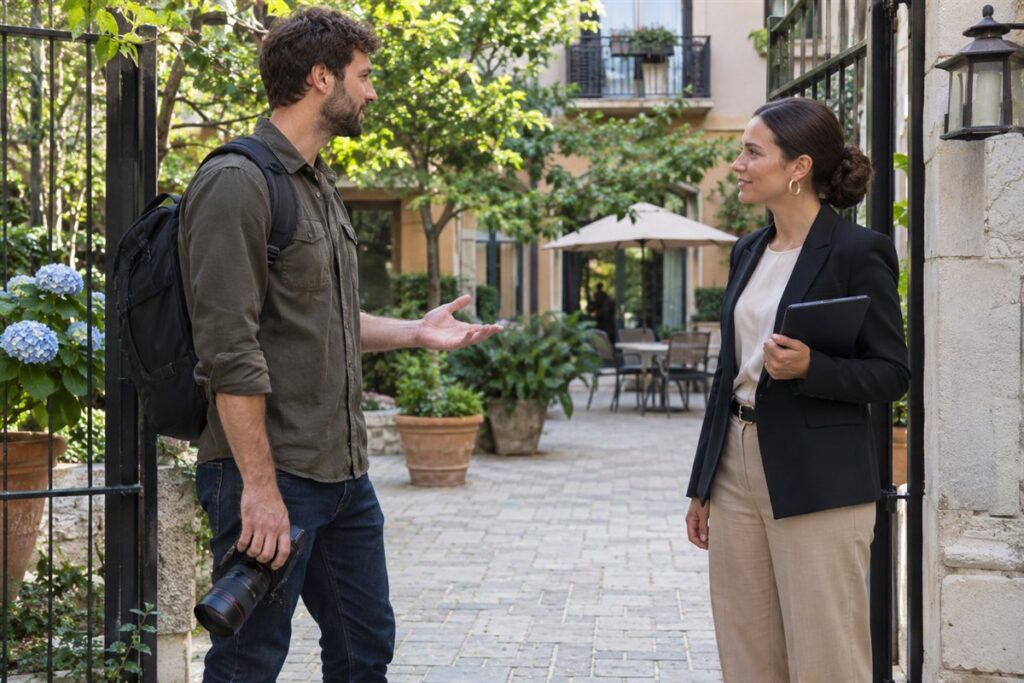
Photographing on private property often involves the owner’s permission, but the exact rules depend on the place, the type of property and what you plan to do with the pictures. This guide offers general concepts and practical habits. It is not legal advice, rules vary by country and state, and you should consult a qualified professional or the relevant authority for specific situations.
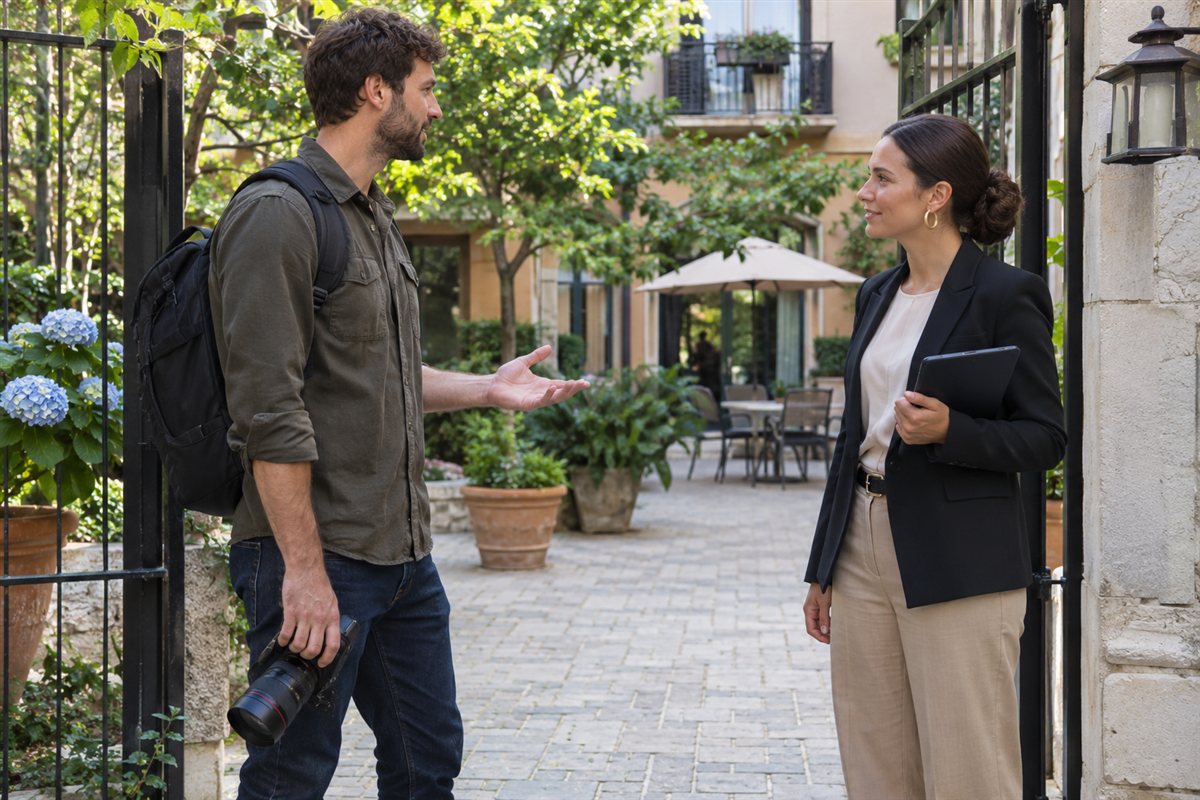
What Counts as Private Property
Private does not only mean a home. Many places that feel public are owned by businesses or organisations that set their own conditions.
- Shopping centres, malls and plazas that look like public squares
- Restaurants, cafes, museums and event venues
- Farmland, estates and gated communities
- Office lobbies, campuses and transport stations
- Rented or hired locations, including studios
Some venues allow casual photography but restrict tripods, commercial shoots or certain subjects.
In this guide
Situations That Often Call for Permission
Common examples include professional or commercial shoots, using props or crews, shooting inside buildings, and photographing for advertising. Ownership of what appears in your frame can also matter, such as artwork, trademarks and distinctive buildings. Whether a release is needed varies by use and by place, so ask about both the shoot and the way you intend to publish.
How to Ask Well
- Identify who controls the site, such as an owner, manager or events team.
- Contact them in advance with a short, polite message.
- Describe the purpose, number of people, equipment and timing.
- Ask whether there are fees, insurance requirements or conditions.
- Request the agreement in writing, including how you may use the photos.
- Keep a copy with you on the day.
Respecting Boundaries in the Moment
If you are asked to stop or leave, comply calmly, even if you disagree, and take up the matter later through proper channels. Be mindful of neighbours, staff and visitors who did not agree to be photographed. Where children or private spaces are involved, extra care is wise.
Keeping a Paper Trail
Save emails, signed agreements and permit details in one folder for each location. If you later sell or publish the pictures, these records show what was agreed. Note the name of the person who approved the shoot, and check whether their approval covers your specific uses.
Personal Use Versus Commercial Use
One of the most important distinctions in this area is what you plan to do with the pictures. Taking holiday snapshots for a family album is different from shooting an advertising campaign or selling prints. Many places tolerate casual photography but require permission, fees or insurance once the work becomes commercial, involves a crew, or uses extra equipment. The line between the two is not the same everywhere, so avoid assuming where it falls.
Signs that your project may count as commercial or professional:
- You are being paid, or a client will use the images for marketing.
- You plan to sell prints, license images to agencies or use them on products.
- You are bringing lights, stands, props, models or a team.
- You are staging a shoot that interrupts staff or other visitors.
- The location, its logo or its artwork is a central part of the image.
When in doubt, ask the property manager directly and describe the planned use in plain terms. Some venues have a written photography policy on their website or an events contact who handles requests. Being open about your purpose usually leads to a smoother conversation than hoping nobody notices. Remember that this is general information, not legal advice, and that rules differ by country, state and even by individual venue.
People, Privacy and Consent
Property is only one part of the picture. The people in your frame also have interests, and privacy expectations vary by place and situation. Photographing someone in a private setting, such as inside a home or a changing area, raises more concerns than photographing a crowd at a public festival. Rules about publishing recognizable individuals, especially for commercial use, can differ widely, so check local guidance.
Good habits that help regardless of the rules:
- Ask people before photographing them closely, especially children, and speak to a parent or guardian first.
- If someone asks not to be photographed, respect that and move on.
- Use a model release when you plan to use portraits commercially, and keep a signed copy.
- Be careful with photos taken in sensitive places such as clinics, schools or places of worship, where extra rules often apply.
- Avoid publishing images that reveal private details such as a house number or a license plate when it is unnecessary.
A friendly conversation often solves problems before they begin. Explain what you are doing, offer to share a copy and be ready to delete or skip a frame if the person is uncomfortable. Respect is a better guide than a technicality, and it keeps both subjects and venues willing to welcome photographers in the future.
Logos, Art and Distinctive Buildings
Even when you have permission to enter, what appears in the frame can raise separate questions. Artwork, murals, sculptures, product packaging and trademarks may be protected, and some buildings or interiors have particular rules about commercial use of their image. Whether this matters depends on how prominent the item is, how you use the picture and the law where you are.
Practical steps to reduce risk:
- Note any artwork, signs or logos that are prominent in your shots.
- Ask the venue whether it has rules about commercial use of its interiors or exteriors.
- Check whether the artist or owner of a mural or sculpture needs to approve commercial use.
- For stock or client work, ask the agency or client what they require, since many demand releases for recognizable property.
- Consider framing the shot to avoid unneeded logos when they are not essential.
Editorial use, such as news or documentary storytelling, is often treated differently from advertising, but the distinction is not identical everywhere. If a project is large, expensive or likely to be published widely, consult a qualified professional who knows the rules where you work. A short consultation costs far less than a dispute over a published image.
Drones, Tripods and Special Equipment
Equipment choices can change the rules. A handheld camera may pass unnoticed, while a tripod, a lighting kit or a drone can require specific approval. Many venues ban tripods because they block walkways, and some prohibit flash for reasons of safety or preservation. Drones add layers of regulation, including aviation rules, privacy considerations and landowner permission to take off or land.
- Check the venue’s published rules on tripods, monopods, flash and lighting before you arrive.
- Ask about insurance requirements if you will bring a crew or heavy equipment.
- If you plan to fly a drone, read your national aviation authority’s guidance and ask the landowner about launching from their land.
- Avoid flying over people, crowds or sensitive sites without clear permission.
- Bring the minimum gear you need, as it reduces both risk and disruption.
Weather, wildlife and hazards on a site are also your responsibility. Farmland may have livestock, gates and machinery. Construction areas may have safety rules. Always follow instructions from site staff, and wear appropriate clothing. If you are unsure about access, ask in advance rather than hoping for the best.
If Someone Challenges You
Sometimes a guard, owner or neighbor objects to your photography. How you respond matters. Stay calm, polite and cooperative. Explain what you are doing in a few words, and ask what the issue is. If you are asked to stop or to leave a private site, comply, and take any disagreement up later with the owner or relevant authority instead of arguing in the moment.
Helpful steps in a tense situation:
- Keep your permission documents handy, on paper or on your phone.
- Do not block exits or touch anyone, and keep a respectful distance.
- If asked to delete images, understand that practices and rights differ, and consider offering to show them what you shot instead of arguing.
- Write down what happened, including names, times and what was said, as soon as it is safe.
- Seek advice from a qualified professional if a serious dispute follows.
Prevention is far better than argument. Scout locations, read posted signs, ask in advance and carry written agreements. When a request is refused, accept it and look for an alternative location. Most owners respond well to professional, polite communication, and a good relationship may open the door to future shoots.
Why the Rules Differ From Place to Place
There is no single global rule for photography on private property. Laws about trespass, privacy, publicity and commercial use vary between countries, and sometimes between regions or cities within a country. A practice that is routine in one place can lead to trouble in another. Because of this, the safest approach is to treat general guidance as a way to ask better questions, not as legal advice, and to check the rules that apply where you are, ideally with a licensed professional if your project is important or commercial.
It also helps to understand that permission is a separate issue from legality. Even where a law allows something, a property owner may set conditions on entry, and breaking those conditions can mean being asked to leave. Respecting those wishes is both polite and practical, and it keeps doors open for future visits.
Types of Places and the Kind of Permission They Often Need
| Type of place | Common situation | What to check |
|---|---|---|
| Private home and garden | Entry requires the owner’s consent | Ask the owner before you enter or set up |
| Shops and malls | Open to the public, but policies apply | Ask the manager about photography rules |
| Restaurants and cafes | Customers may take casual photos; other people may object | Ask staff, and respect other guests |
| Offices and workplaces | Often restricted for security and privacy | Get written permission from management |
| Museums and galleries | Rules vary by exhibit and item | Read signs and ask at the desk |
| Farmland and estates | Entry usually needs consent | Contact the landowner in advance |
| Event venues | Organizers set the rules | Check the terms of entry or ticket |
Writing a Clear Permission Request
A good request is short, polite and specific. Explain who you are, what you want to photograph, when and for how long, how many people will be present and what you plan to do with the pictures. Offer to share images with the owner, and respect any conditions. A short email or letter with all of this information gives the owner what they need to decide, and it creates a record of the agreement.
- Introduce yourself and give contact details.
- Describe the purpose, such as a personal project, a portfolio or a commercial job.
- State the dates, times and areas you wish to use.
- Mention any equipment, such as lights, stands or a drone.
- Ask about any rules or restrictions they want to set.
- Offer to follow up with a signed note if they prefer.
Working With Models and Other People on Private Premises
When you bring a model or a group onto private property, you are responsible for their behavior as well as your own. Make sure everyone understands the boundaries, respect plants, furniture and property, and clean up after the shoot. Be aware that the people in your pictures may also need to give their consent, especially if you plan to use the images commercially. Use a simple release form signed by the people who appear, and ask a professional about the wording that suits your location.
Handling Privacy for Neighbors and Bystanders
Even when you have permission for a location, neighbors and passers-by may be affected. Avoid pointing a camera into windows or private spaces, keep noise and equipment out of walkways, and be ready to explain your activity politely. If someone objects, stop and listen. Their concern may be reasonable, and a calm conversation can prevent a dispute. For sensitive locations such as schools, hospitals and places of worship, ask the responsible authority first and follow their rules.
- Keep a respectful distance from windows and entrances.
- Do not block paths, driveways or emergency exits.
- Keep voices low during early or late shoots.
- Carry identification and a copy of your permission.
Insurance, Liability and Practical Protection
Professional shoots sometimes require insurance to cover damage or injury, and some venues ask for proof before they grant access. Check with the owner whether they have such requirements. If you work regularly on location, speak with an insurance adviser about suitable cover. Keep a basic first aid kit on hand, secure cables and stands so no one trips, and take care with fragile or valuable items. A responsible, organized approach makes owners comfortable.
Records That Protect You and the Owner
Keep copies of your permission request, the reply and any signed agreement, along with the date, time and contact details. Photograph the condition of the location before and after, to show that you left it as you found it. If the owner’s conditions change, note the update in writing. Good records settle misunderstandings quickly and show professionalism.
Publishing, Selling and Sharing the Pictures
Permission to take photographs is not always permission to publish or sell them. Some owners allow you to shoot for personal use but not to license the images, and others ask to see the results before publication. Make the intended use clear in your request, and get any additional consent in writing before you post, print or sell. If a location is recognizable and the owner has distinctive property, such as artwork, signs or unusual architecture, additional rules may apply, so check with a professional when in doubt.
When you share pictures online, think about what they reveal. Location tags, house numbers and visible alarm systems can expose a property to risk. Consider removing metadata and avoiding precise location information, particularly for private homes. This protects the owner and shows respect.
What To Do If Someone Challenges You
Stay calm, polite and cooperative. Explain what you are doing, show your permission if you have it and offer to stop if asked. Do not argue, raise your voice or block anyone. If the situation becomes tense, leave the area and seek advice later. Never put a photograph above your own safety or the comfort of others. Local authorities can explain rules in your area, and a licensed professional can advise on any legal question.
A Short Checklist Before You Shoot
- Identify who owns or manages the place.
- Ask for permission and record the answer.
- Understand the rules about people, equipment and publication.
- Prepare releases for any recognizable people.
- Plan to leave the place tidy and respectful.
Most owners respond well to courteous, clear and honest requests, and many will help you get the shots you want once they trust you.
Worked Examples of Common Situations
A portrait session in a friend’s garden
Even among friends, agree on the day, the areas you can use and what happens to the pictures. A short message is enough, and it prevents surprises if the images are later shared widely or used in a portfolio.
A product shoot in a rented space
Check the rental agreement for rules about lighting, floors, walls and noise. Ask whether you may move furniture, and photograph the room before you start so that you can restore it. Confirm that your insurance covers equipment on the premises.
Street scenes that include shopfronts
Photographing a public street usually includes shopfronts in view, but entering a shop, photographing staff or customers or using the images commercially may involve different rules. Ask the manager if you plan to shoot inside or to focus closely on a business.
Photographing a distinctive building
Some buildings and artworks have protections that affect how pictures can be used commercially. If your image prominently features a landmark, a mural or a branded facade, check the rules before you license it.
Working With Property Managers and Agents
Many sites are managed by agents who handle bookings, rules and fees. Contact them early, ask about their process and expect that approval may take time. Some charge fees for commercial use, and some require proof of insurance, an itinerary and a list of crew members. Be patient, provide what they ask and keep the tone friendly. A good relationship with a manager can lead to repeat access and recommendations.
Public Land, Private Land and the Grey Ground Between
The hardest cases are rarely the clear ones. A photograph taken from a public pavement of a building’s exterior sits, in most places, at the comfortable end of the spectrum; a photographer stepping onto a private drive for a better angle has crossed a line that matters regardless of the picture’s innocence. Between those poles lies the grey ground where most real disputes happen: privately owned spaces open to the public, public spaces managed with private rules, and viewpoints where the camera stands legally while the lens looks somewhere sensitive. Learning to recognise which ground you are on — before the shutter, not during the argument — is the practical core of this whole subject.
Privately owned public-feeling spaces deserve special care because their welcome is conditional. Shopping centres, station concourses, campuses, sports grounds and many plazas are owned and managed, and their conditions can restrict photography — especially commercial photography, tripods and anything that obstructs other users — even though thousands of people photograph there casually every day. Enforcement is usually graduated: a word from staff, a request to stop, a request to leave. The photographer’s skill is to read the space’s signals early, comply gracefully when asked, and know that “everyone does it” describes enforcement habits, not rights.
- Ask where you are standing and who manages the ground before setting up.
- Treat privately owned public spaces as conditional welcomes, not public rights.
- Expect graduated enforcement and comply at the first step of it.
- Remember that casual tolerance is not the same as permission for a production.
Public land has its own conditions. Parks, streets and squares may require permits for commercial shoots, crews, vehicles or structures, while leaving casual photography free. The distinction that runs through nearly every system is scale and purpose: the lone photographer is welcomed almost everywhere; the production with lighting rigs, models and a client is regulated almost everywhere. Knowing which of those you resemble, from a ranger’s or an officer’s point of view, predicts your afternoon better than any statute.
Asking Permission Well: A Practical Script
Most permissions are won or lost on the quality of the ask. Ask early — days before for anything with a crew or a client — and ask the person who can actually say yes, which may take one phone call to identify. State plainly who you are, what you want to photograph, when, for how long, with how many people and what equipment, and what the pictures are for. Offer the things owners care about: minimal disruption, care for the property, insurance details if you carry them, credit where appropriate, and a contact who answers the phone. Then accept the answer, including a no, with the same grace — a reputation for accepting no travels, and doors open later for photographers who were pleasant when refused.
Put agreements in writing proportionate to the stakes. A neighbourly favour needs a friendly message thread; a commercial location deserves a short written agreement covering dates, areas, fees if any, restrictions and image use. Read any location’s own paperwork before signing, especially clauses about indemnity and about rights in the resulting images. And photograph the permission itself into your records — the email, the signed form — kept with the shoot’s files, so that a question raised a year later meets documentation rather than memory.
- Ask early, and find the person with authority to answer.
- Describe purpose, people, equipment, timing and image use plainly.
- Offer care, minimal disruption and a reachable contact.
- Keep written agreements proportionate, and file them with the shoot.
If permission is refused, alternatives usually exist: a different vantage from public ground, a different location with a similar quality, a licence from an image library for the truly irreplaceable view. The professional habit is to treat refusal as a routing problem rather than a defeat — and never as an invitation to trespass quietly, which converts a photography question into a legal one and risks the client relationship the shoot was meant to serve.
People in the Frame: Privacy Beyond Property
Property permission and people’s privacy are separate questions, and a shoot can satisfy one while failing the other. Photographing a building with permission says nothing about the identifiable people inside the frame; photographing from public ground does not erase the sensitivity of photographing children, patients, worshippers or anyone in a moment of vulnerability. Laws differ widely on where photography of people is permitted and what publication requires, and they tighten sharply around children and around commercial use of a person’s likeness. The working habit is consent proportionate to exposure: the more identifiable the person and the more public or commercial the use, the clearer the agreement you need.
Releases are the written form of that agreement for planned work — models, clients, employees appearing in a business’s photography. For candid and street work, practice varies by place and purpose, and the ethical layer runs ahead of the legal one: a photograph can be lawful and still be a cruelty, and photographers with long careers guard their judgement about which frames to publish as carefully as any legal compliance. When a subject objects in the moment, most experienced photographers weigh deletion or a polite stop heavily in the subject’s favour, because goodwill is the currency street photography spends.
- Separate the property question from the people question on every shoot.
- Scale consent to identifiability and to how public or commercial the use is.
- Use written releases for planned work involving recognisable people.
- Let ethical judgement run ahead of the legal minimum, especially with children.
Interiors multiply the sensitivity: homes, clinics, places of worship and workplaces carry expectations of privacy that a street does not. Even with the owner’s permission, ask who else will be in the frame and whether they know. The question takes ten seconds and prevents the particular misery of a published photograph that surprises the person in it — a misery that attaches to the photographer’s name far longer than to the image.
Commercial Use, Landmarks and Other People’s Property in Your Pictures
Selling a photograph, and using it to sell something else, are different acts with different rules. Editorial use of a location is broadly tolerated in many places; advertising use can engage the property’s own identity — distinctive buildings, designed interiors, artwork and branded environments may carry rights that an advertisement cannot borrow freely. This is why stock libraries ask contributors for property releases for recognisable locations in commercial licensing, and why a photograph that is safe in a newspaper may be unsafe on a billboard. Know which market your image is entering before you promise it to anyone.
Artwork deserves its own caution. A photograph in which someone else’s painting, sculpture, mural or design is the main subject reproduces their work, not merely your view of it; incidental inclusion in a wider scene is a different matter in most systems. Museums and galleries set their own photography conditions partly for this reason. When a location’s appeal is an artwork, the permission conversation should name the artwork explicitly, so nobody discovers later that the agreement covered the room but not the reason you came.
- Distinguish editorial use from advertising use before promising an image.
- Treat distinctive buildings and interiors as identities, not backdrops, in commercial work.
- Name artwork explicitly in permission requests when it is the subject.
- Check the licensing terms your outlets require for recognisable property.
None of this requires a lawyer on every shoot. It requires the habit of asking, at planning time, three questions: whose ground, whose likeness, whose work appears in this picture, and what will the picture be used for. Photographers who ask those four things routinely almost never meet the problems this guide describes; those who meet the problems almost always skipped one of the questions.
Handling a Challenge on the Day
Sooner or later, a person in authority — or claiming it — will question your right to photograph. The encounter goes best when it stays boring. Be calm, be brief, and identify yourself and your purpose plainly. Ask what rule they are applying and who manages the location, because the answer sorts genuine authority from enthusiasm quickly. If you have permission, produce it. If you are on public ground exercising a right you are confident of, you may say so once, courteously, without turning the pavement into a courtroom. If there is doubt, the professional move is usually to pause, move on, and resolve the question later from a desk — photographs are rarely worth an escalation, and never worth a physical one.
Know the few hard lines in advance. Do not delete images because someone demands it unless a genuine legal obligation applies — that judgement is best made later, advised, not under pressure. Do not hand over equipment or cards to private individuals. Do not trespass to finish a shot, and do not misrepresent who you are or what the pictures are for, because deception converts most defensible positions into indefensible ones. Write down what happened while it is fresh, with names, times and exact words where you can, and tell your client or editor the same day.
- Stay calm and brief; identify yourself and your purpose plainly.
- Ask which rule applies and who manages the location.
- Produce permission if you hold it; pause and relocate if in doubt.
- Never delete under pressure, hand over gear, or misrepresent the shoot.
Most challenges end with information: a permit you did not know about, a boundary you had not seen, a manager who needed to be asked. Treat each as the location teaching you its rules, file the lesson with the location’s name in your notes, and you will find the same places easier every year — which is, in the end, the real professional asset this subject builds: a map of welcome, earned one courteous conversation at a time.
Planning a Location Shoot: The Permission Timeline
Permissions fail more often from lateness than from refusal. Work backwards from the shoot date: identify the location’s owner or manager in the first week, send the request with a clear margin for a reply, agree terms and paperwork in the second week, and confirm details — access times, contacts on the day, restrictions — in the final days. Commercial locations with committees, insurers or councils in the chain need longer; build it in rather than discovering it. A location secured early also protects everything scheduled around it: models, clients, equipment hire and your own fee.
Keep a location file as you go: contact names, the agreement, fees, house rules, parking and access notes, and a line about how the shoot went. The second visit to any location is dramatically easier than the first, and photographers who keep such files accumulate a private atlas of workable places that becomes a real business asset. Note refusals too, with their reasons — a location closed for renovation this year may welcome you next, and a file that remembers the difference saves you asking the wrong question twice.
- Work backwards: owner first, request early, paperwork next, confirmation last.
- Allow extra weeks where committees, councils or insurers are involved.
- Keep a location file with contacts, terms and how each shoot went.
- Record refusals and their reasons; circumstances change.
Photographing Businesses, Markets and Workplaces
Working premises add a layer to the permission conversation: the business’s own operations. A shop, market stall, workshop or farm is someone’s livelihood in motion, and a shoot that obstructs customers, endangers stock or photographs trade details the owner considers sensitive will be remembered unkindly whatever the legal position. Ask about the day’s rhythm and schedule around it; offer to share images the business can use; agree which areas, processes and people are in or out of bounds. Photographers who behave as guests in workplaces get invited back, and workplaces — full of real light, real texture and real people — repay the invitation photographically like nowhere else.
Employees and customers inside a business are subjects with their own standing, separate from the owner’s yes. Build the consent conversation into the shoot plan: who tells staff, what signage or announcements are appropriate, how anyone who prefers not to appear is respected in framing. These courtesies are also practical — relaxed, informed people photograph better than surprised ones, and a business whose staff felt ambushed will not host the second shoot that a good first one usually generates.
- Schedule around the business’s rhythm, not against it.
- Agree in-bounds and out-of-bounds areas, processes and people in advance.
- Plan how staff and customers are informed and can opt out of the frame.
- Offer the business usable images; guest behaviour earns return invitations.
FAQ
Can I photograph a private building from the street?
Often discussed, but the answer depends on location and how you use the image. Check local rules or ask a qualified professional.
Do I need a property release for sales?
It can depend on the property, the use and the buyer. Agencies and clients may have their own requirements, so ask them directly.
Do I need permission to photograph inside a shop or cafe?
Often you do, because these are private businesses with their own policies. Ask a manager first, particularly if you plan to use a tripod, lighting or to publish the images commercially.
What is a model release?
It is a written agreement in which a person allows you to use their image for specified purposes. It is commonly requested for commercial work, but requirements vary, so check with your client or a qualified professional.
What is a property release?
It is similar, but it comes from the property owner and covers use of images of their property. Whether you need one depends on the use, the place and your client or agency.
Can I take pictures of my own rented home?
Your lease may set limits, particularly for commercial use. Read the agreement and ask your landlord if you plan a professional shoot.
Is it fine to post photos of a private event on social media?
Check the host's wishes and the event rules first. Guests may not expect their image to be posted, so ask when in doubt.
Do the rules change if I am a hobbyist?
Possibly less for personal use, but permission to enter and venue policies still apply. Publishing or selling the images can raise more questions.
Who should I ask for advice?
For a specific case, consult a qualified legal professional or the relevant local authority. This guide gives general ideas only.
Can I photograph a house from the street?
In many places, photographing exteriors from public ground is broadly permitted, and such images appear constantly in journalism, listings and art. The sensitivities are publication and purpose: commercial use of a recognisable private home, images that peer into interiors or private life, and any step off public ground onto the property all change the picture. When a specific home is the subject rather than part of a streetscape, a courteous conversation with the owner is cheap insurance and often produces a warmer welcome than the law alone.
What if security staff tell me to stop on public ground?
Stay courteous and establish the facts: private security authority generally ends at their property line, but scenes are poor places to litigate. Ask what location they represent and what rule they are applying; state your position once, plainly, if you are confident of it. If the encounter heats up, withdraw and resolve it later through the location’s management or your own advice channels. Photographers who work public ground regularly keep exactly this script because it protects both the shoot and the photographer.
Do I need permission to photograph in a shop or restaurant?
Treat the premises as private ground open conditionally: casual snapshots are commonly tolerated, but anything resembling a production — tripod, lighting, models, a client — needs the management’s agreement, and some venues prohibit photography outright as a condition of entry. Ask at the door or by message beforehand, describing the scale honestly. Small businesses often say yes gladly when asked well, especially with credit offered; the same businesses understandably refuse photographers who simply set up and assume.
Can I sell prints of a famous building?
Often, but the answer turns on the building, the place and the use. Many jurisdictions allow considerable freedom for photographs of buildings visible from public places, while certain landmarks and recent or distinctive designs carry restrictions, and trademark issues can arise when an image is used to market goods. Fine-art prints and editorial use sit at the freer end; advertising at the restricted end. For a landmark you intend to sell seriously, a specific check against current local guidance is worth its small cost.
What about photographing through windows or over fences?
Height and optics do not launder intent. Using ladders, long lenses or drones to see into spaces a person has shielded — gardens behind fences, interiors behind glass — invades privacy in most legal and every ethical reading, whatever the camera’s physical position. The test photographers use is the subject’s reasonable expectation: a scene arranged to be private, reached only by defeating its arrangements, is private. Public life photographed plainly is the street photographer’s charter; defeated privacy is not.
Are the rules different for drones?
Yes, in layers. Aviation rules govern where and how drones may fly in most countries, with registration, altitude and proximity rules that apply regardless of photography. Privacy and property questions then stack on top, and some locations prohibit drone photography specifically. A drone shoot needs both checks — the flying permission and the photography judgement — done in advance. Because rules change quickly in this area, verify the current requirements with your national aviation authority before any specific project.
What should a permission email actually say?
Who you are, what you want to photograph, when and for how long, how many people and what equipment, what the images are for, and what you offer in return — care, minimal disruption, credit, a fee where appropriate. Keep it short enough to be answered from a phone. Name a specific date and a specific contact. Most refusals of well-written requests are about timing or fit rather than hostility, and a graceful reply that leaves the door open frequently converts a no for this month into a yes for next season.
When do I genuinely need a lawyer’s advice?
When money, scale or sensitivity rises: advertising campaigns using recognisable property or people, shoots involving children or vulnerable people, work in jurisdictions you do not know, disputes that have already begun, and any situation where someone has threatened action. A short consultation at planning stage is inexpensive compared with a dispute after publication. Think of legal advice as you think of insurance — part of the production budget for substantial work, and a sign of professionalism rather than of trouble.
Can I photograph private property during an open event?
An open gate is an invitation to enter for the event’s purposes, not a blanket licence for every kind of photography. Casual photographs of the event itself are normally within the spirit of the invitation; a commercial shoot using the event as a backdrop, or photography of areas outside the event’s scope, goes beyond it. Organisers’ own conditions — often printed on tickets or signage — govern, and asking the event team about anything beyond personal use is the quick, safe route that usually ends in a helpful answer.
What if the owner says yes but asks for a fee?
Location fees are normal in commercial photography and are a legitimate part of many properties’ income. Treat the fee as a production cost: agree it in writing with what it covers — hours, areas, exclusivity, facilities — and reflect it in your client quote rather than absorbing it silently or resenting it. For small personal projects, a modest fee or an exchange of images may suit both sides better than cash. What matters is that the arrangement is explicit before the shoot, not negotiated on the doorstep.
How do I photograph abandoned or derelict places responsibly?
With great caution, and usually not at all without the owner’s permission. Abandoned is a visual description, not a legal one — derelict buildings have owners, and entering them is trespass in most places, with real physical dangers added: unstable floors, contamination, security systems. The photographs are rarely worth the combined risk. Where a derelict site genuinely matters to a project, find the owner through public records and ask; owners of such sites are asked less often than you would expect, and some are glad of respectful interest.
Should I credit locations in published work?
Where the agreement asks for it, always; where it does not, crediting is still often wise. A named location shares the photograph’s audience with a place that hosted you, which builds the goodwill your location file runs on. The exceptions are private homes and sensitive sites, where naming can direct unwanted attention — there, discretion is the courtesy. Read each situation with the owner’s interests in view, and when the shoot came through a permission, let the permission’s terms settle the question.
The Short Version
Many places that look public are private, and permission questions grow with commercial use. Ask in advance, get agreements in writing and check local rules with a qualified professional.
