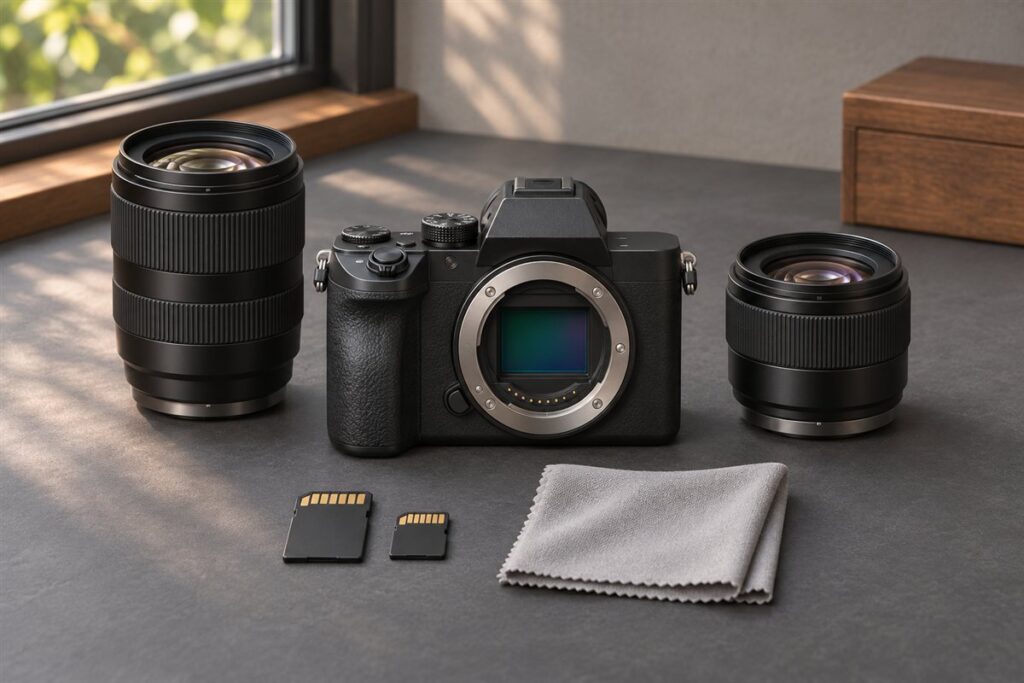
The Panasonic Lumix S 50mm f/1.8 and the Sigma 50mm f/1.4 DG DN Art are both 50mm prime lenses available for L-mount cameras. The Sigma has the wider maximum aperture and is generally the larger lens, while the Lumix is the more compact and lighter option. Choose the Sigma for low light and shallow depth of field, and the Lumix for easy carry.
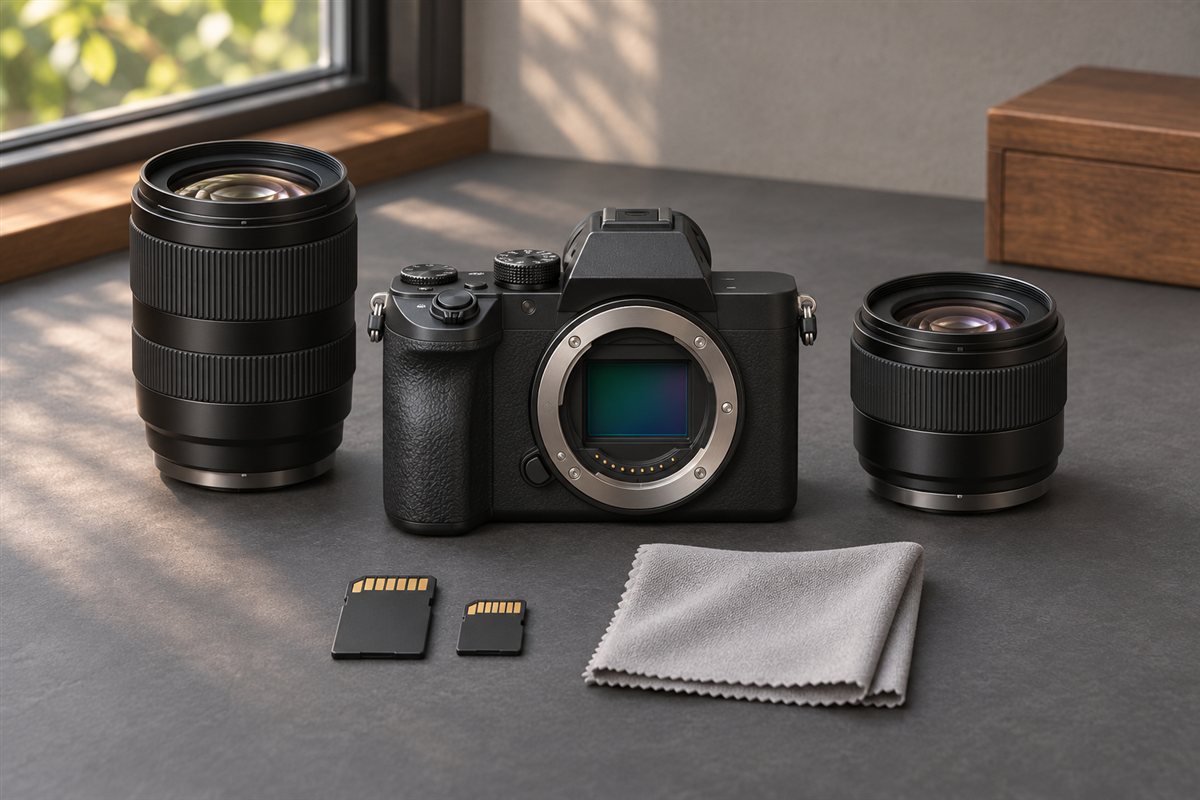
What a 50mm Prime Does
A 50mm lens gives a natural field of view that resembles what the eye sees. It suits portraits, street scenes, food and everyday work, and its simple design usually yields sharp images at a modest size.
Wide maximum apertures such as f/1.8 and f/1.4 let in more light and blur backgrounds more strongly than a typical zoom lens.
Comparing the Two
| Trait | Lumix S 50mm f/1.8 | Sigma 50mm f/1.4 DG DN Art |
|---|---|---|
| Maximum aperture | f/1.8 | f/1.4 |
| Size and weight | Smaller and lighter | Larger and heavier |
| Maker | Panasonic | Sigma |
| Mount | L-mount | Offered in L-mount and E-mount versions |
The difference between f/1.8 and f/1.4 is a bit less than one stop of light. That helps in dim rooms and gives somewhat more background separation, but it also adds size and weight.
Which Fits Your Work
- Portraits indoors: the wider aperture of the Sigma gives more room to work in dim light.
- Travel and walk-around: the smaller Lumix is easier to carry all day.
- Video: consider weight on a gimbal and focus behavior; check the makers’ notes.
- Mixed system: if you might change brands, note that the Sigma also comes in other mounts.
Using a Fast 50mm
- For portraits, try apertures of roughly f/1.8 to f/2.8 as a general guide to balance blur and sharpness on the face.
- Keep a shutter speed of roughly 1/100 or faster for handheld portraits.
- Focus on the nearest eye and recompose carefully, or use eye detection if your camera has it.
- Stop down to around f/4 to f/8 for groups or scenes where more is in focus.
These figures are general guidance, and your results will vary with the camera and the scene.
Handling matters as much as optics. A larger lens balances better on a larger body but feels heavy on a long walk, while a smaller lens makes a compact camera feel natural. If you can, mount each lens on your own body in a shop and walk around with it for a few minutes. Also check filter sizes, hood design and whether you want an aperture ring or a customizable control.
What Less Than One Stop Really Buys
The gap between f/1.8 and f/1.4 is easy to overstate. In exposure terms it is a bit less than one stop, which means you can raise your shutter speed or lower your ISO by a small step, not a dramatic one. In a dim restaurant that might be the difference between a shutter speed that freezes a gesture and one that leaves a slight blur, but in ordinary indoor light you may never notice it.
The same is true of background blur. A wider aperture produces a thinner plane of focus, but subject distance and background distance matter just as much. A portrait taken from close range with the background far behind will look soft at either aperture. Moving the subject away from a wall often does more for separation than changing lenses.
It helps to ask where you really shoot. Look through your own photos and check the aperture values in the file details. If most of your keepers were taken at f/2.8 or smaller, the wider lens spends its life stopped down, and you are carrying the extra glass for little benefit. If you regularly shoot at the widest setting available, because the light is poor or you like the look, then the brighter lens earns its place.
- Review your past apertures before deciding.
- Remember that distance to subject and background affects blur as much as the number.
- Treat the extra light as a modest advantage rather than a transformation.
Focus Accuracy at Wide Apertures
The wider you shoot, the less forgiving focus becomes. At the widest setting on a 50mm lens, the depth of field is only a thin slice, and a small shift of your body between focusing and shooting can move the focus off an eye. That is a matter of technique as much as lens choice, and it applies to both lenses here.
Use the camera’s eye detection if it has one, and keep the focus point on the nearest eye. If your subject is moving toward or away from you, use continuous autofocus and take several frames. For a seated portrait, ask the subject to hold still and take a burst to improve your chances. When you cannot afford a miss, such as at a family event, close the aperture a stop or two and accept a little less blur in exchange for dependable sharpness.
Also check how each lens behaves when focusing. Some lenses are quiet and smooth, which helps video, while others may produce a little audible movement or a small amount of focus breathing. Look for sample clips that show a rack focus, and read the maker’s notes on supported autofocus features for your camera body and firmware. If a lens ever seems consistently front or back focused on your body, check for a firmware update and ask the maker or seller about adjustment options before assuming a defect.
Size, Hoods and Filter Habits
A fifty is often the lens left on the camera for months, so its size shapes how you shoot. A smaller lens makes a compact body feel balanced and invites you to carry the camera everywhere. A larger lens can look intimidating to street subjects and is harder to fit in a small bag. On the other hand, a bigger barrel often gives a better grip on a large body and makes a heavy hand feel more comfortable.
Check the filter thread sizes on the maker pages. If both lenses use different sizes, any filters you own may not carry across, and you may need step rings or new filters. Think about whether you shoot with a variable neutral density filter for video or bright-day portraits at wide apertures, because a good one can let you keep a wide opening in sunlight without exceeding your shutter speed limit.
Hoods deserve attention too. A deeper hood reduces flare and protects the front element, but a bulky one can make the lens harder to pack. Check whether the hood reverses onto the barrel for storage. If the lens has an aperture ring or customizable buttons, confirm how they behave on your camera. These small physical details decide whether a lens feels natural in the hand after a few weeks of use.
Mounting on Different Bodies
One of the points made above is that the Sigma comes in more than one mount, and that deserves a closer look. If you plan to stay in one system for years, the mount matters little. If you may switch brands, a lens that exists in several mounts can move with you, though you still need to buy the version for each new body. Check the exact listing to make sure the mount matches your camera, since the versions look similar.
Also consider the rest of your kit. A system with many native lenses gives you room to add a wide prime, a zoom and a macro later. If you are building a kit from scratch, think about how a 50mm fits among your other focal lengths. Many photographers find that a fifty complements a wide zoom and a short telephoto prime nicely, and that a smaller fifty is easier to justify as the third lens in a bag.
For budget thinking, compare qualitatively. A larger, brighter lens usually costs more and is built for demanding work, while a smaller lens leans toward value and portability. Decide which of those qualities will matter on a typical weekend, not just on a rare special occasion. If you are unsure, rent or borrow either lens for a few days.
Care, Checks and Signs of Trouble
A prime lens has fewer moving parts than a zoom, which generally makes it easier to look after, but a few habits still pay off. Use a hood to protect against bumps and stray light, store the lens with both caps on, and keep it away from heat and damp. Clean the front element with a blower and soft brush first, then a clean cloth with a small amount of lens fluid for stubborn marks.
When buying used, shine a light through the lens and look for haze, scratches, dust and signs of fungus. Check that the aperture blades are clean and move smoothly. Mount it on your camera, and take test shots at the widest aperture and at a couple of stops down, checking the corners and the center of the frame for even sharpness. Test autofocus on near and far subjects, and listen for grinding noises.
Signs it may be time for service include autofocus that hunts more than it used to, focus that is consistently off on one side, an aperture that sticks, or a ring that feels rough. A lens that has been dropped can develop misalignment that shows up as one soft side of the frame. If you spot any of these, contact the maker or a qualified repair shop rather than continuing to shoot with a problem lens.
FAQ
Is f/1.4 always better than f/1.8?
Not always. It offers more light and blur, but the lens is larger. If you rarely shoot wide open, the smaller lens may serve you better.
Will both lenses autofocus on my camera?
Both are designed for modern mirrorless bodies, but confirm compatibility with your specific camera and its firmware on each maker’s page.
Which lens is better for beginners?
Either works, so choose by budget tier, size and how often you shoot in dim light. A smaller lens is often easier to carry daily, which means you practice more.
Does a wider aperture mean sharper photos?
Not by itself. Aperture affects light and blur, while sharpness depends on lens design, focus accuracy and technique. Many lenses are sharper after stopping down a little.
Can I use a 50mm for video?
Yes, it works well for interviews and cinematic shots. Check focus breathing, focus ring feel and weight on a gimbal before you commit.
How do I avoid missed focus at wide apertures?
Use eye detection or a small focus point, take several frames and stop down a little when the subject moves. Practice with a still subject first to learn your camera's behavior.
Do I need a filter for the front element?
It is optional. A hood gives physical protection, while a clear filter guards against scratches but can add flare in some conditions.
What should I check on a used 50mm?
Look for haze, scratches and fungus, test the focus ring and aperture and take test shots to check for uneven sharpness across the frame.
Is a 50mm a good only lens?
Many people use one as a main lens for a season, which teaches framing by moving your feet. If you find yourself wanting wider or longer views often, a zoom may suit you better.
The Short Version
The Sigma f/1.4 is the choice for low light and a shallower look, while the Lumix f/1.8 is the choice for size and ease. Decide how much weight you will accept, then confirm details with the makers.