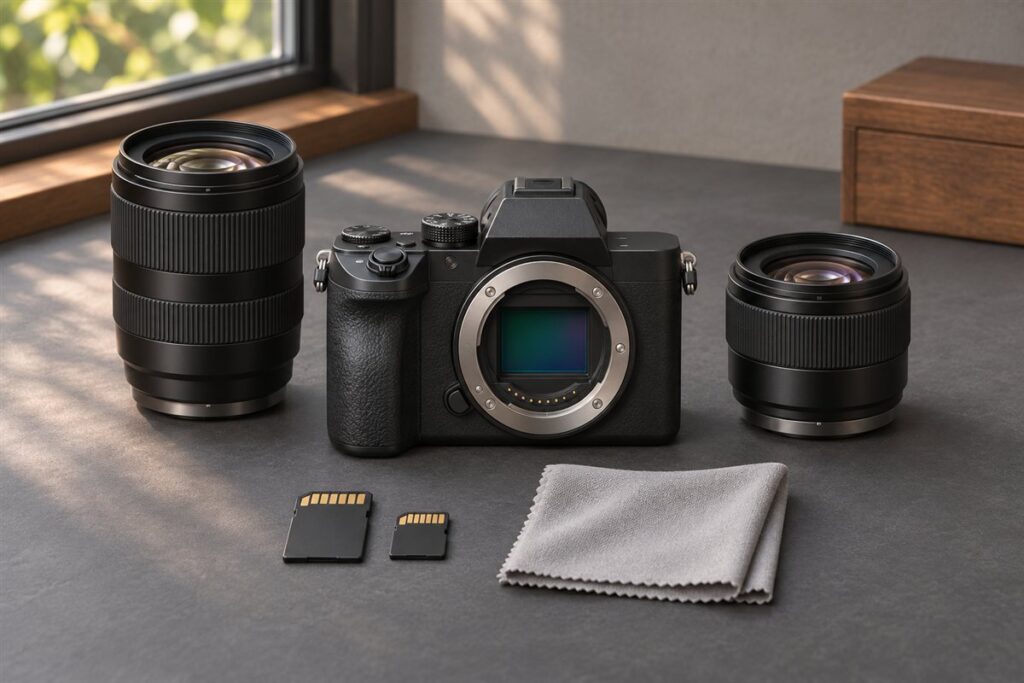
The Nikon Z 24-50mm f/4-6.3 and Canon RF 24-50mm f/4.5-6.3 IS STM are compact, light zooms made as everyday lenses for each brand’s full-frame mirrorless cameras. They are close in range and concept, so the right choice depends on your camera mount more than on lens details.
What these lenses are for
Both lenses cover a short standard range, from a wide angle at 24mm to a normal view at 50mm. They are designed to keep size and weight low, making them easy companions for walking around, travel and family snapshots. Because the range is modest, they are not telephoto tools, and they are not fast lenses for dim rooms.
Side-by-side basics
| Trait | Nikon Z 24-50mm | Canon RF 24-50mm |
|---|---|---|
| Mount | Nikon Z | Canon RF |
| Range | 24 to 50mm | 24 to 50mm |
| Aperture range | f/4-6.3 | f/4.5-6.3 |
| Lens stabilization | Check the maker’s page | Yes, per the name (IS) |
| Focus motor type | Check the maker’s page | STM |
The Nikon opens a touch wider at the wide end, according to the aperture numbers in its name. Details like weight, sealing and optical build should be confirmed with each maker.
Where they shine
- Travel and city walks, where light gear matters.
- Daytime family photos and landscapes with a mild wide angle.
- Video clips that need a small, balanced lens on a compact camera.
Where they fall short
The variable aperture narrows to f/6.3 at 50mm, which limits background blur and low-light use. If you want portraits with soft backgrounds or indoor shots without flash, a fast prime such as a 50mm f/1.8 style lens is a useful addition.
How to choose
- Match your camera mount. These lenses are not interchangeable between the systems.
- Check whether the lens is sold in a kit with your body, which can make buying simpler.
- Think about stabilization. If your body has in-body stabilization, lens stabilization is less critical.
- Plan a second lens for telephoto or low light.
- Try both for handling if you are still choosing a system.
For daylight use, an aperture of f/5.6 to f/8 and a shutter speed near 1/250 is a general guide for sharp, handheld results.
Video and stills notes
Compact kit zooms like these often use quiet focus motors, which is helpful for video. Lens stabilization and in-body stabilization may work together on some cameras, so check your body’s manual. For the sharpest stills, close the aperture by a stop or so from wide open.
Kit Bundles and Getting Value
Lenses like these are often sold together with a camera body as a kit, and bundling is one of the main ways people end up owning them. A kit usually costs less than buying the body and lens separately, and it gives you a lens that matches the body from day one. The trade-off is that the kit lens may not be the one you would pick if you chose freely, so look at what you actually plan to shoot before accepting the bundle.
When comparing options, think about three questions. Does the kit include the lens you want, or only a different zoom? Is the body-only price plus a separate lens lower or higher than the bundle? And does the bundle include extras such as a memory card or a bag that you will use, or ones you will ignore? Check the retailer’s listing and the maker’s site for the exact contents, and do not assume that every kit is the same.
A kit zoom is also a sensible starting point for learning. It lets you explore wide angles, normal views and a bit of reach before you invest in specialist lenses. After a few months, you will know which focal lengths you use most. Many people find that they stay within a narrow part of the range, and that tells you what to buy next. If you decide to upgrade, a used kit lens often has a modest resale value, so you can sell it to help fund the new one.
- Compare bundle and separate prices in qualitative terms before buying.
- Check the box contents and the warranty terms.
- Keep the box and receipt in case you resell.
Choosing a Second Lens
The post mentions that a fast prime is a useful addition, and it is worth thinking about what else would fill the gaps of a compact standard zoom. Three gaps are common: low light, background blur and reach. A fast prime of 35mm or 50mm equivalent addresses the first two, letting you shoot in dim rooms and isolate a subject from the background. A telephoto zoom addresses reach for sports, wildlife and distant details.
Choose according to what you miss. If your photos in restaurants and at home come out dark or grainy, buy a fast prime. If your pictures of people look flat, a fast prime or a short telephoto will help. If you stand on the sidelines of a sports game or a school performance, a telephoto zoom is the answer. If you like landscapes and interiors and wish you could fit more in the frame, consider a wider lens.
Check that any lens you consider matches your camera mount, and check its size next to your body. A compact camera becomes less compact when a large lens is attached, so consider how the combination will feel in your bag. Look at the filter thread size, because sharing one size across lenses saves money on filters. Do not overbuy: one extra lens that you use often is worth more than three that stay in a drawer. When you test lenses in a shop, take photos of a familiar scene with each so you can compare results at home.
Raw Files, JPEGs and Software Corrections
Compact zooms are designed with software correction in mind. To keep the lens small and light, designers often accept some distortion and corner darkening in the optics, and let the camera or editing software fix it. This is a normal approach and nothing to be alarmed about, but it affects how you handle your files.
If you shoot JPEG, the camera usually applies the corrections automatically, so you get a clean result straight away. If you shoot raw, check whether your editing software includes a profile for the lens and whether corrections are switched on. Some programs apply them by default, others do not. Compare an image with and without correction to see how large the effect is, particularly at 24mm, where distortion and vignetting are most noticeable.
Raw gives more room for adjusting exposure, white balance and noise, which helps with a lens whose aperture narrows as you zoom. Shoot raw plus JPEG if you want a quick copy for sharing and the full file for editing. Keep an eye on file size and storage. Be aware that corrections may crop the edges slightly or change how a wide shot looks, so leave some space around important subjects.
When judging the lens, view your photos after correction, because that is how most pictures are seen. Compare corners at 100 percent, at a couple of apertures, and decide whether the result meets your standard.
Stabilization and Slow Shutter Techniques
With a narrow maximum aperture, you will sometimes need slower shutter speeds, and stabilization is the tool that makes that practical. The post notes that the Canon lens includes stabilization and that the Nikon’s status should be checked on the maker’s page. If your camera body has in-body stabilization, it can help with either lens, and the manual will explain how the two systems cooperate where both are present.
Stabilization helps with static subjects, but it does not freeze movement. A person walking or a child playing can still blur at a slow shutter speed. For people, aim for a shutter speed fast enough to stop their motion, then raise ISO. For still scenes such as interiors, cityscapes at dusk and food on a table, use stabilization and brace your body against a wall or table.
Good habits add up. Hold the camera with both hands, keep your elbows in and breathe out as you press the shutter. Use the burst mode to take a few frames and choose the sharpest one. Switch stabilization off on a tripod if the manual recommends it. At night, turn the camera’s self timer on to avoid shake from pressing the button.
Combining a modest zoom with these habits can produce surprisingly good results in dim light. For anything darker, add a fast prime or a small flash, and be prepared to accept some grain.
Care, Resale and When to Upgrade
Compact lenses are light, but they are not toys. Keep the lens caps on when stored, avoid pressing on the front element, and use a blower and a soft cloth for cleaning. If the lens retracts or extends when you power on, make sure nothing blocks the barrel and do not force it. Keep the lens out of hot cars and damp places. A hood, where available, adds protection and improves contrast in bright light.
When buying used, check for smooth zoom movement, clean glass and no rattling noises. Test autofocus and stabilization, and take sample shots at both ends of the range. A lens that was heavily used may show slight looseness in the barrel. Ask about the return window so you can verify that it works on your camera.
You will know it is time to upgrade when the lens limits your results rather than your technique. Common signs include frequent frustration with low light, a wish for stronger background blur, a need for more reach, or a desire for better corner sharpness. Before upgrading, consider whether an extra lens would solve the issue more cheaply. If you do replace the lens, keep it as a lightweight backup or sell it to someone starting out.
Is a 24-50mm zoom enough for everyday photography?
For many people a 24-50mm zoom is enough for everyday photography, because it covers the two views most snapshots use: a wide scene and a natural, eye-like perspective. It is less suited to distant subjects, which need a longer lens.
At the wide end you can fit a room, a street corner or a group of friends into the frame without backing into a wall. At the long end the view feels close to what you see with your own eyes, which suits people, food and small details. Most travel and family pictures fall inside this range.
Where the range runs out is easy to spot. If you keep wishing you could get closer to a performer on a stage, a bird on a branch or a child across a field, you need a telephoto. If you often shoot cramped interiors or big landscapes and feel boxed in, you may want something wider than 24mm.
A useful test is to look through your last few hundred phone photos. Note how many were taken at the widest setting, how many were zoomed in and how many were cropped later. That pattern shows whether a short standard zoom matches your habits.
- Good fit: walking around, city trips, daytime events, simple video clips.
- Weak fit: sports, wildlife, stage shows, shooting through crowds.
- Needs a helper lens: low light, strong background blur, long reach.
Think of a compact standard zoom as the lens that stays on the camera most of the time, with a second lens added for the jobs it cannot do. That approach keeps your bag light and your spending focused on a real gap rather than a guess.
How to get sharper photos from a compact kit zoom
To get sharper photos from a compact kit zoom, steady the camera, pick a middle aperture and keep the shutter speed fast enough for your subject. Small habits matter more than small differences between lenses.
Start with focus. Choose the autofocus area deliberately instead of leaving it on a wide zone, so the camera locks onto the thing you care about, such as a face or a building edge. For portraits, place the focus point on the nearest eye.
Next, think about aperture. Zooms with a variable maximum aperture are usually a little softer wide open, especially in the corners. Closing down by a stop or two often tightens the image. Do not close down too far, because very small apertures can soften fine detail and force a slower shutter speed.
Then watch the shutter speed. At the long end the lens lets in less light, so the camera may pick a slower speed than you expect. Check the number before you press the button, particularly indoors and at dusk. If it is low, raise ISO a little instead of risking a blurred frame.
- Brace your elbows against your body and exhale before pressing the shutter.
- Clean the front glass; a smudge softens contrast more than most people expect.
- Use a hood outdoors to cut flare when the sun is low.
- Review a few frames at full size to confirm focus, not just on the back screen at a glance.
Finally, remember that sharpness is not the only quality. Good light, a clean background and a clear subject make a photo look better than a slightly crisper corner ever will.
Which 24-50mm lens should you buy?
Buy the lens that matches your camera mount: the Nikon Z 24-50mm f/4-6.3 for Nikon Z bodies and the Canon RF 24-50mm f/4.5-6.3 IS STM for Canon RF bodies. Because the two are close in purpose, the system you already own settles most of the decision.
Use these pairings as a guide.
- If you shoot Nikon Z, go for the Nikon Z 24-50mm f/4-6.3. It opens slightly wider at the wide end according to the aperture numbers in its name.
- If you shoot Canon RF, choose the Canon RF 24-50mm f/4.5-6.3 IS STM. Its name tells you it has lens stabilization and an STM focus motor.
- If your camera lacks in-body stabilization, the lens-based stabilization named in the Canon model is a practical advantage for handheld video and dim scenes. For the Nikon, check the maker’s page, then decide.
- If you are still choosing a system, do not pick on this lens alone. Compare bodies, the lenses you want next and how each camera feels in your hands.
- If you want the lightest possible setup, either lens suits a small body, but confirm the weight and size on each maker’s page.
Also consider how you will buy. Both lenses are often offered with a body as a kit, so look at the bundle first and compare it with a body-only purchase plus a separate lens. A kit is usually the simpler route when you are starting out.
If you already own a different lens in your system, such as a larger standard zoom, ask whether this compact one adds anything. Its value is mainly in being small, so it makes most sense as a travel or everyday lens.
What to check before you buy a 24-50mm lens
Before you buy a 24-50mm lens, confirm the mount, the kit contents and the return terms on the current listing. A few minutes of checking prevents most disappointments.
- Mount and body: The Nikon is for Z mount and the Canon is for RF mount. Make sure your body is a full-frame or compatible model from the same system, and read the manual for any limits.
- What is included: Check for a lens cap front and rear, a hood and a pouch. Some listings sell the lens alone, others in a kit with a camera.
- Stabilization: Confirm whether the lens has it and whether your body also stabilizes the sensor. Read how the two work together.
- Filter size: Note the thread size if you plan to use filters, and see whether it matches other lenses you own.
- Firmware and compatibility: Some bodies need an update to work fully with newer lenses. The maker’s support page will say.
- Warranty and returns: Read the seller’s return window and the warranty terms, and keep the receipt and packaging.
- Retractable design: Compact zooms often extend or collapse when you power on. Check the manual for how to lock or unlock the barrel.
Also compare the listing against what you actually shoot. If your plan involves dim restaurants, concerts or indoor sports, a variable-aperture zoom will feel limiting, and a faster lens may deserve the budget instead.
Look at how many people have rated the listing and read the written comments for patterns, such as handling, noise or compatibility, rather than focusing on a single score. Use feedback to form questions, then confirm answers on the maker’s page.
Is a compact 24-50mm zoom worth it, and who should skip it?
A compact 24-50mm zoom is worth it if you value small size and a wide-to-normal range, and it is not worth it if you need low-light speed or reach. The trade-offs are clear, so match them to your habits.
The main downside is the narrow aperture. The maximum opening shrinks as you zoom, so you get limited background blur and need higher ISO indoors. A fast prime handles those jobs better. The second downside is range: 50mm is not long, so you may crop distant subjects or carry a second lens.
Another trade-off is reliance on software correction. As covered above, makers of small lenses often let the camera fix distortion and corner darkening, which is fine for most users but worth knowing if you edit raw files.
Who might skip it?
- Event and wedding shooters who need wide apertures and robust build.
- Sports and wildlife shooters who need reach.
- Portrait specialists who want strong background separation.
- Anyone who already owns a larger standard zoom they are happy with.
Is it worth paying more for a bigger lens? Only if your photos are held back by what a compact zoom cannot do. If you mostly shoot in daylight, travel often and care about weight, a compact zoom gives you the most use for its size.
To decide, compare the two lenses against your camera mount, check the current listing for what is included and for the return terms, and then choose the one that fits the way you will actually shoot. Use the buttons above when you are ready to view the current details.
FAQ
Are these good for portraits?
They work for environmental portraits in good light, but background blur is limited. A fast prime does better for that look.
Can I use one on the other brand’s camera?
No, the mounts differ, so choose the lens made for your camera system.
Should I buy the camera and lens together as a kit?
Often it is simpler and costs less than buying separately. Check the kit contents and make sure the lens suits what you plan to shoot.
What second lens should I buy first?
Choose based on what you miss. A fast prime helps in low light and portraits, and a telephoto zoom helps for distant subjects.
Do I need to shoot raw with a kit zoom?
Not required, but raw gives more room to adjust exposure and noise. JPEG applies corrections automatically, which is convenient.
Why are lens corrections used?
They let designers keep the lens small and light by correcting distortion and vignetting in software. Check that your editing software applies them.
Will stabilization stop motion blur from moving people?
No. It reduces camera shake, but a person who moves still needs a fast shutter speed.
How do I know if a used compact zoom is in good condition?
Check for smooth zoom movement, clean glass and no rattles, then test focus and stabilization at both ends of the range. Ask about returns.
Can I use a filter on these lenses?
Usually yes, but check the filter thread size on the maker's page. A hood and clear filter are optional protection.
What does the IS in Canon RF 24-50mm f/4.5-6.3 IS STM mean?
IS stands for image stabilization, which means the lens helps reduce blur caused by camera shake. It is most useful for handheld photos at slower shutter speeds and for video. It does not stop blur from a moving subject.
What does STM mean on a lens?
STM is the maker's label for a stepping focus motor designed to be smooth and quiet. That quiet operation is helpful when recording video. Check the manual for how it behaves with your camera.
Is a variable aperture zoom bad for video?
Not necessarily. The maximum aperture narrows as you zoom, so brightness can shift if you zoom during a clip, which some cameras compensate for. Many people zoom first, then record.
Are 24-50mm lenses good for travel photography?
Yes, they suit travel well because they are small and cover wide scenes and normal views. They fall short for distant subjects and dark interiors, so a second lens is often useful.
Do I need a lens hood on a compact zoom?
A hood is not essential, but it reduces flare in bright or low sun and gives some bump protection. Check whether one is included, since this varies by listing.
Should I buy a 24-50mm lens or a larger standard zoom?
Choose the 24-50mm if size and weight matter most. Choose a larger standard zoom if you want a wider maximum aperture or more reach, and accept the extra bulk.
Can a compact zoom replace several prime lenses?
It can replace some of them in good light, but not for low light or strong background blur. Primes with wide apertures still do those jobs better.
How can I tell whether my camera needs a firmware update for a new lens?
Check the camera maker's support page for your body and the lens you plan to use. It will list required versions and how to update. Do this before an important trip.
The Short Version
These two compact zooms are close in purpose, so let your camera mount decide. Choose either for light everyday shooting, add a fast prime for dim scenes, and confirm details on the maker’s page.