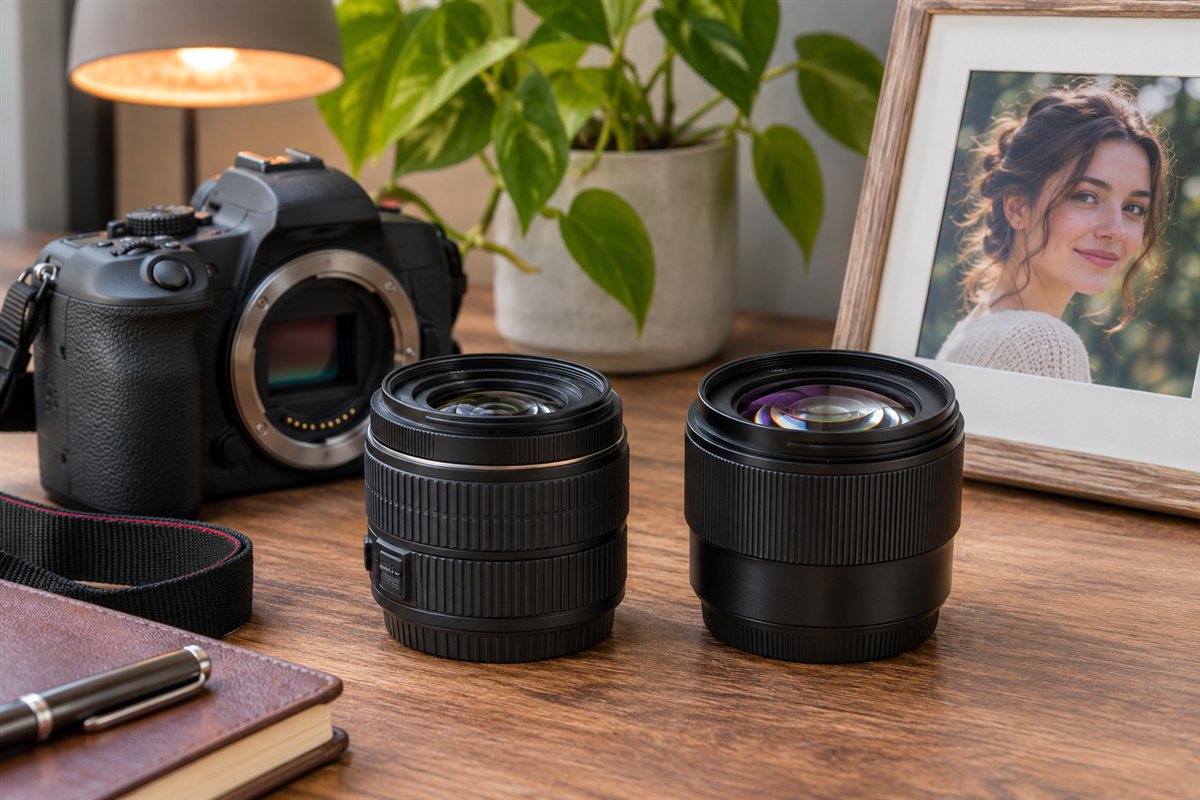
A kit lens is the zoom that comes bundled with many cameras, and it is a perfectly good way to learn. A prime lens is a fixed focal length lens that usually has a wider aperture. Switch to a prime when your kit lens limits you in dim light or when you want softer backgrounds in portraits.
What a Kit Lens Does Well
Kit lenses cover everyday needs. They zoom from wide to short telephoto, are fairly light, and often include image stabilization. If you are still learning what you like to shoot, a kit lens helps you discover your favorite focal lengths without any extra outlay.
Their weakness is a modest maximum aperture, which narrows further as you zoom in. That means less light reaches the sensor and background blur stays limited.
In this guide
What a Prime Adds
- Wider aperture: lets in more light for indoor scenes and evening shots.
- Background separation: a wide aperture isolates a subject from its surroundings.
- Compact size: a small prime keeps the camera discreet.
- Focus on framing: a single focal length encourages you to move and compose.
Signs It May Be Time
- You often raise the ISO setting indoors and see grainy results.
- You find portraits look flat with a busy background.
- You always shoot at the same focal length on your zoom.
- You want a smaller kit for walks and travel.
If none of these sound familiar, your kit lens may still be doing everything you need.
Comparison at a Glance
| Area | Kit lens | Prime lens |
|---|---|---|
| Flexibility | High, zooms | Single view |
| Low light | Limited | Stronger |
| Background blur | Modest | More pronounced |
| Weight | Light to moderate | Often lighter |
Before spending anything, try a simple experiment. Set your kit lens to a single focal length, such as the one that matches a prime you are considering, and shoot only at that setting for a week. If you enjoy the discipline and find yourself wishing for a wider aperture, you have a strong sign that a prime will suit you.
Remember that the lens is only half the story. Learning to control light, choose a clean background and time your shots will improve your images with either lens. A prime is a helpful tool, but it will not fix composition by itself, so keep practicing with whatever you already own.
Understanding Aperture Numbers Before You Switch
The main promise of a prime is a wider maximum aperture, so it helps to know what the numbers mean. A smaller f-number means a larger opening. A lens that opens to a low f-number lets in far more light than one that stays at a higher number, which allows a faster shutter speed or a lower ISO in the same scene. Many kit zooms start at a modest aperture at the wide end and narrow as you zoom, while many primes keep their widest opening at all times because there is no zoom range to compromise.
What does that mean in daily use? Indoors in the evening, a kit lens may push you to a high ISO or a slow shutter speed that blurs moving people. A prime with a wide opening often lets you keep the ISO moderate and the shutter fast enough to freeze motion. For portraits, the same wide opening makes the background softer, which helps a subject stand out.
Wider is not always better, though. At the widest setting, the zone of sharp focus is thin, so a slight movement of you or the subject can put the eyes out of focus. Many photographers stop down a little for group shots or detailed work. Treat the widest aperture as a capability to use when the scene calls for it, not a setting to leave on all the time.
Choosing Your First Prime Focal Length
Picking a focal length is easier if you look at what you already shoot. Check the photos you have taken with your kit zoom and see which zoom setting you used most. Many editing programs and file browsers can show the focal length stored in each photo. If the pile clusters around one value, that points to the prime you should try.
- Wider primes: suit interiors, street scenes, travel and environmental portraits where you want context around the subject.
- Normal primes: give a view close to what the eye sees and work for everyday life, food, friends and general carrying.
- Short telephoto primes: are popular for head-and-shoulders portraits because they compress features in a flattering way and give more background blur.
Remember that the same number gives a different view depending on sensor size. A lens on a smaller sensor will look tighter than the same number on a larger one, so use the maker’s equivalent view guide when comparing. Also check that the lens mount matches your body. Many makers offer both full and cropped-sensor designs, and mixing them can limit the field of view or require an adapter. Confirm compatibility in the manual or listing before you order.
How Primes Change the Way You Shoot
Moving from a zoom to a fixed focal length changes habits more than gear. Without a zoom ring, you reposition your body to change the frame. Step closer for detail, back up for context, kneel for a lower angle. This feels slow at first, then becomes a way to think about composition before raising the camera.
There are practical adjustments too. You will miss shots because you cannot zoom quickly, especially at events where subjects move unpredictably. Some people solve this by carrying two bodies or by keeping the zoom for events and the prime for slower, deliberate outings. Others accept that a few missed shots are the price of simpler, lighter kit.
Autofocus behavior can also feel different. Wide-aperture primes have less depth of field to hide errors, so check focus carefully on your first sessions and use the focus mode that suits moving subjects. Many beginners find it helpful to review images at full zoom on the back screen after a few frames and adjust the focus point if it seems off. With a few outings, the routine becomes automatic.
Budget Tiers and What to Trade Off
Primes come in a spread of quality and price. Describing them qualitatively, lower-priced options often use simpler construction and may have slower or noisier autofocus, a plastic mount, and more softness at the widest setting. Mid-range options typically add better build, quieter focus motors and sharper results at wide openings. Higher-end options chase the widest openings, premium coatings and stricter control of optical flaws, usually at the cost of size and weight.
When you weigh these, ask what is limiting you now. If you only need dimmer-light capability and softer backgrounds, a modest prime is a big step up from a kit zoom. If you shoot for clients or large prints, paying more for corner-to-corner sharpness may be worthwhile. Also consider used lenses from reputable sellers, which can lower the cost, but inspect the glass for haze, scratches and fungus, and test the focus and aperture ring if there is one.
Finally, factor in extras: a lens hood helps with flare, a cap protects the front element, and a clear filter is optional. None of these needs to be expensive, but they extend the life of the lens.
Mistakes to Avoid When Moving to a Prime
- Shooting everything wide open. Use the widest setting when you want the effect, and stop down for sharpness and for scenes with several subjects at different distances.
- Buying the wrong focal length. Review your own photos first rather than following a general recommendation.
- Selling the zoom too soon. Many photographers regret selling a flexible lens before they know how often they will miss it. Keep it for a few months.
- Ignoring mount and sensor fit. Check the manual to confirm the lens works with your body, including autofocus support.
- Expecting it to fix composition. A prime changes background blur and light capture, but framing and timing still depend on you.
A final check before buying is to rent or borrow a prime for a weekend, if a local shop offers it. Real use, in your own home and neighborhood, tells you more than any chart.
A Fair Way to Compare Your Own Lenses
Online debates about kit lenses and primes often miss the point, because the answer depends on what you shoot and where you shoot it. The best way to compare is to run a simple experiment with the gear you already have or can borrow. Pick one subject and one location, then take the same set of pictures with each lens. Keep your camera on a tripod or a steady surface, use the same focal length where possible, and change only one setting at a time.
- Choose a scene with detail, such as a bookshelf or a patterned wall, and a second scene with a person.
- Shoot with the kit lens at its widest aperture, then at a middle aperture.
- Match the prime to a similar view by moving your feet, and repeat both apertures.
- Compare the sharpness at the center and the corners at full size.
- Look at background blur, color and contrast.
- Repeat in dim light, using the same sensitivity limit for each.
This test reveals the real differences for your camera and your eye, rather than leaving you with an abstract claim about one type being better.
Light Gathering in Plain Numbers
Aperture numbers can feel confusing, but there is a simple way to think about them. Each full step in the series lets in roughly twice or half as much light. A lens that opens one full step wider than another lets you use a shutter speed twice as fast, or a sensitivity setting half as high, in the same conditions. Many kit lenses have a maximum aperture that narrows as you zoom in, while a typical prime keeps a wide opening at its only focal length.
Imagine a room lit by ordinary lamps. A kit lens might force you to raise sensitivity until the picture becomes grainy or to use a slow shutter speed that blurs moving people. A prime with a wide opening can keep the sensitivity low and the shutter speed fast. The difference is often more noticeable in practice than in technical charts.
Comparison Table for Everyday Situations
| Situation | Kit lens | Prime lens |
|---|---|---|
| Bright outdoor day | Excellent and flexible | Excellent but fixed view |
| Indoor family event | May struggle with light | Often much easier |
| Travel with one lens | Very convenient | Requires choosing a view |
| Portraits with soft backgrounds | Limited blur | Better separation |
| Learning composition | Good for exploring | Teaches you to move |
How Composition Habits Change
With a zoom, it is tempting to stand in one place and adjust the lens until the scene fits. With a prime, you have to move, and that simple change often improves your pictures. You may find new angles, discover better backgrounds and become more aware of distance. Walking closer to a person for a portrait changes expression and interaction, and stepping back for a landscape reveals foreground elements you might have missed.
Some people find this limitation freeing, since it removes one decision. Others feel restricted, particularly in crowds or tight spaces. Be honest about your temperament and your usual shooting conditions before you decide.
Cost of Switching and What to Keep
You do not have to give up your kit lens when you buy a prime. Many photographers keep both, using the zoom for general days and the prime for dim venues and portraits. Selling the kit lens may bring some money, but it can also leave you without a flexible option when you need it. If your budget is tight, buy the prime first, keep the zoom and see which one you reach for most often over a few months.
- Check that the prime fits your camera mount and supports autofocus on your body.
- Look at used options carefully, inspecting glass, mount and focus function.
- Consider the weight and size, since a small prime makes a camera feel very compact.
- Think about a lens hood and a basic filter for protection.
Problems and Fixes When You Switch
Pictures are blurry at the widest aperture
Very wide apertures give a thin zone of focus, so small focus errors show. Stop down a little, or use a focus mode that tracks your subject.
Backgrounds look distracting
A wide aperture does not hide a messy background if it is close to your subject. Increase the distance between them or change your angle.
The view feels too tight
Step back or choose a wider focal length next time. Remember that each prime has a character you learn by using it.
Autofocus seems slow
Check the camera settings, update firmware if the maker offers it, and try a different focus area mode.
Short Glossary
- Prime lens: a lens with one fixed focal length.
- Zoom lens: a lens that covers a range of focal lengths.
- Aperture: the opening that controls light and depth of field.
- Depth of field: the zone of the scene that looks sharp.
- Bokeh: the quality of out-of-focus areas.
- Sensitivity: the camera setting that amplifies the signal from the sensor.
Making Your Decision
If you mostly shoot in bright light, travel often and value convenience, your kit lens may serve you well for a long time. If you feel limited by dim rooms, want softer backgrounds or enjoy a more deliberate style, a prime is a natural next step. Try one before you buy if you can, take your normal subjects and give yourself a week or two to adjust. At the end of that period, ask yourself which pictures you like most and which lens made you eager to go out and shoot again.
Worked Example: Indoor Birthday Party
Imagine a children’s birthday party in a living room with ordinary lamps and a closed curtain. With a kit lens at its widest setting, the camera may ask for a high sensitivity or a slow shutter, and moving children come out smeared or grainy. Using flash can solve the exposure but changes the mood and may surprise people. A prime with a wide opening lets you use a faster shutter speed at modest sensitivity and keep the warm light of the room.
You stand in a corner, frame a medium shot of the cake and the faces around it, then step in for close expressions. The background blurs gently, which hides the clutter on shelves and brings attention to the children. Afterward you notice that more of your pictures are usable, and that you did not need to edit away noise. That practical gain is the strongest argument for adding a prime.
Worked Example: A Day Trip With One Lens
Now picture a day trip where you wander a town, enter a church, climb a hill and eat lunch in a market. A kit zoom lets you capture wide street scenes, details of carvings and distant views without changing anything. With a single prime, you would choose a moderate focal length and live with its limits, perhaps skipping some wide interior shots. For many travelers the zoom wins here because flexibility matters more than the last bit of image quality. Some bring both, with the prime in a pocket for evening dinners and the zoom on the camera for the day.
Maintenance and Care for Either Lens
Both lens types benefit from the same simple habits. Keep caps on when not shooting, use a hood to shield the front element, and clean the glass gently with a blower and a soft cloth instead of your shirt. Store lenses in a dry place and avoid sudden temperature changes that can fog the glass. Follow the maker’s instructions for cleaning fluids and service. If a lens develops unusual noise, stiff rings or dust inside, consult an authorized service center rather than trying to open it.
- Check the mount and contacts for dirt from time to time.
- Rotate zoom and focus rings occasionally so grease stays distributed.
- Keep a silica packet in your bag in humid climates.
Quick Checklist Before You Buy a Prime
- List the three focal lengths you use most, from your own picture library.
- Confirm the lens mount and whether your camera body supports full autofocus with it.
- Decide the widest aperture you actually need, rather than the widest available.
- Think about weight, size and whether you will carry it every day.
- Look at used options and return policies.
- Plan a first outing to learn the view before an important event.
Ready to Buy? Start Here
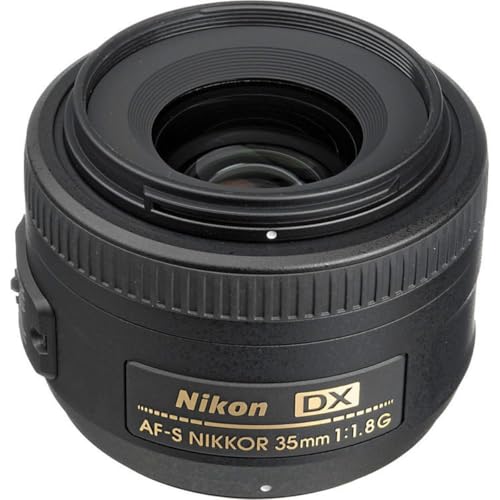
If this guide helped you decide what to look for, these products are a place to start.
As an Amazon Associate we earn from qualifying purchases. Prices and availability are shown on Amazon.
What a Kit Lens Actually Does Well
The kit lens suffers from an unfair reputation, largely because it is judged against lenses costing many times more in the situations those lenses were built for. Judged on its own brief — daylight, family events, travel, learning — it is a genuinely capable tool. Its zoom range covers the focal lengths most photographs are actually taken at. Its stabilisation, where fitted, is usually excellent. Its close focusing is often surprisingly good, and its weight lets the camera come along on days when a heavier system would stay home. In good light, stopped down a little, its sharpness satisfies large prints; the gap to expensive glass narrows to something most viewers cannot find.
Understanding this matters because the upgrade decision should be made against evidence, not embarrassment. Photographers who upgrade because their photographs are failing — too dark, too noisy, backgrounds too busy to separate a subject — buy the right prime. Photographers who upgrade because the internet implies their lens is beneath them often buy a prime that gathers dust, having solved a problem they never had. The kit lens’s real limits are specific: a modest maximum aperture that starves the camera in low light and offers little background separation, autofocus that may hesitate in dim conditions, and build that assumes gentle use. A prime should be bought to defeat named items on that list.
The aperture gap, in real photographs
The difference between a kit zoom’s aperture at its long end and a fast prime is not a number — it is several stops of light, and stops are the currency of low-light photography. In a living room in the evening, those stops decide whether the shutter speed freezes a child’s gesture or smears it, and whether the sensitivity stays clean or climbs into noise. They also decide depth of field: at portrait distances the prime can dissolve a cluttered room into softness while the kit lens renders the bookshelf recognisably behind your subject. Neither rendering is morally superior, but they are different photographs, and if the dissolved-background, available-darkness look is the one you keep admiring, the aperture gap is your answer.
What Changes When You Mount a Prime
The first surprise is usually not sharpness but freedom in poor light. Rooms that forced compromises become workable; evenings open up; the flash stays in the bag. The second surprise is discipline. A fixed focal length removes the zoom decision and replaces it with movement: you walk toward the detail and back for the context, and within weeks most photographers find their compositions improving, because position is a stronger compositional tool than focal length. The third surprise, less welcome, is exposure of your habits: the prime’s clarity at wide apertures shows focusing errors and camera shake that the kit lens’s smaller apertures were politely hiding. Technique tightens because the lens demands it.
There is also a change in how the camera feels and travels. A small prime makes the whole outfit lighter and less conspicuous, which changes where you take it and how people react to it. Family and street photography both benefit: the camera becomes a guest rather than an event. Against that, you lose the ability to reframe from a fixed seat — at a school concert or a ceremony, the zoom’s reach from your chair is a real capability, and the prime owner must accept the framing their seat provides or crop afterwards.
Sharpness, honestly compared
At shared apertures in good light, a good kit lens and a prime are closer than marketing suggests, particularly in the centre of the frame. The prime’s advantages concentrate where the kit lens cannot follow: wide open, it is already sharp, while the kit lens at its maximum aperture is at its weakest; toward the corners, the prime usually holds together better, which matters for landscapes and group shots; and its contrast and flare resistance in backlight often reveal a class difference that resolution charts understate. The honest summary is that a prime is not buying you sharpness everywhere — it is buying you quality at the apertures and conditions where the kit lens has already gone home.
The Focal Length Question: Which Prime First?
The classic first prime sits near the standard range, because it matches the photographs most people take: people, gatherings, everyday scenes, details. On crop-sensor cameras, the standard prime is a shorter focal length than on full-frame, and choosing by equivalent view rather than by the number on the barrel keeps the advice straight. Photographers whose hearts are in portraits often start with a short telephoto prime instead, gaining flattering perspective and background melt for people, at the cost of versatility for groups and interiors. Those drawn to street and travel scenes may start wider.
Your own archive is the best consultant. Review your kit-lens photographs and note the focal lengths you actually used — most cameras record them, and most photographers discover a pattern: a cluster at one end of the range, or at one favourite framing. Buy the prime that serves the cluster. This evidence-based approach beats the conventional wisdom, because it buys speed exactly where your photography already lives.
Living with one focal length: a month-long experiment
Before buying, rehearse. Set the kit zoom to the candidate focal length — a strip of tape on the zoom ring helps — and shoot with it fixed for a few weeks. You will learn whether the framing feels like home or like a straitjacket, and whether you compose by moving with pleasure or resent the constraint daily. Photographers who enjoy the experiment almost always thrive with the prime; those who hate it have saved themselves an expensive lesson and can upgrade the zoom instead with a clear conscience. Either outcome is a success: the point is to buy from knowledge.
Cost Thinking: The Prime, the Better Zoom, or Neither
The money for a first prime could also buy a faster zoom that replaces the kit lens — one with a constant, wider aperture across its range and better build. That path suits photographers whose frustration is versatility in low light rather than ultimate speed: event and travel shooters who live at many focal lengths and cannot walk to reframe. The prime path suits photographers whose frustration is specific: darkness, background separation, size. Lay the two side by side against your last hundred photographs and the answer is usually visible in the failures — blur from slow shutter speeds argues for light, missed framings from fixed positions argue for the zoom.
And “neither” deserves its dignity. If your photographs are not failing on light or sharpness, the kit lens may be serving you perfectly, and the money may belong to a tripod, a course, a printing session or simply a journey to somewhere photogenic. Lenses are means. The photographers who upgrade best are those who can name the photograph they could not take, in the past tense, with a date on it.
Keeping the kit lens after the prime arrives
Most photographers should keep the kit lens even after falling for a prime. It remains the travel-light zoom, the bad-weather lens, the loaner for a learning relative, and the backup that covers every focal length if the prime is ever in for repair. Its resale value is modest precisely because so many exist, which argues for keeping the utility rather than banking the small sum. Kits evolve; the photographers who think of them as systems rather than ladders — each lens with a role, none of them a rung to be ashamed of — make the calmest decisions.
Subjects That Reveal the Difference Fastest
If you want to feel the prime’s case in one afternoon, photograph three things. First, a person indoors in the evening, lit by lamps: the prime’s light-gathering turns a noisy, blurred struggle into a relaxed portrait with a melted background. Second, a subject against a busy background in daylight — a market stall, a garden — where separation is the whole photograph. Third, a detailed subject in open shade, where the prime’s wide-open clarity and contrast show what the kit lens reserves for its best apertures. Then photograph the same subjects with the kit lens and compare honestly. For many photographers this single comparison ends the debate in both directions: some see their future, others see that their photography never visits the conditions where the prime wins, and both have learned something worth more than the lens.
Autofocus, Build and the Ownership Experience
Beyond optics, the switch changes daily ownership. Primes are usually simpler machines: fewer compromises in the focus system, which often feels more decisive, especially in the low light where you bought the lens to work. Their build tends to be denser and more confidence-inspiring than a kit zoom’s, and their smaller size changes how the camera balances and how long you can shoot one-handed at a family event. None of this photographs anything by itself, yet it shapes how often the camera is in your hand — and frequency of use is the strongest predictor of good photographs that exists.
The kit zoom answers with its own ownership virtues: one lens that is always mounted and always adequate, weather tolerance that varies by model, and a zoom range that forgives the unplanned. There is a real creative stance in that adequacy — the photographer who never thinks about lenses thinks about photographs instead. The mature position is to hold both truths: choose the tool whose strengths match your failures, and refuse to feel that the other camp’s choice indicts yours.
Video and hybrid shooting
If you shoot video, the comparison shifts. Zooms let you reframe without moving the camera and hold composition as subjects move; many kit zooms are designed with video in mind, with smooth, quiet zooming on power-zoom models. Primes offer the low-light and background qualities filmmakers love, at the cost of fixed framing and focus pulls that demand practice. Hybrid shooters often end up owning both for exactly this reason, using each where the medium flatters it. Decide with your real ratio of stills to video in mind, not the ratio you imagine.
A Decision Framework You Can Run in Ten Minutes
Gather your last two hundred photographs — the camera’s card, your phone backup, wherever they live. Sort them mentally into four piles: failures from darkness or motion blur; failures from backgrounds that would not separate; failures from framing you could not achieve from where you stood; and successes you are proud of. The first two piles are the prime’s manifesto. The third is the zoom’s. The fourth tells you what to protect: if your proudest work is travel variety, do not endanger it for low-light speed you rarely need; if it is evening portraits of your family, the prime is not an indulgence but the tool your photography has been requesting.
Then run the tape experiment for a fortnight at the focal length the evidence names. Buy afterwards, from knowledge. Photographers who follow this sequence almost never regret the purchase, whichever way it lands — because they did not buy a lens, they answered a question their own photographs had asked.
The Second Month: What Settles and What Surprises
Photographers who switch often report the same second-month story. The low-light freedom stops feeling novel and starts feeling normal, which quietly expands the hours they photograph in. The fixed focal length stops feeling like a constraint at exactly the moment their feet learn the framings. And the kit lens, far from being disgraced, finds its second life: the school trip, the beach day, the borrowed-camera weekend. The comparison that began as a contest ends as a division of labour, which is why this guide resists declaring a winner. The kit lens and the prime are answers to different questions. Your photographs — reviewed honestly, sorted by their failures — will tell you which question you have been asking.
FAQ
Should I replace my kit lens or keep it?
Most people keep it. The zoom stays handy for travel and fast-moving moments, while the prime handles dim light and portraits.
Which prime should I try first?
A 35 mm or 50 mm style lens is common for general use. The right focal length depends on your sensor size, so check the maker’s guide for the equivalent view.
Will a prime make my photos sharper than my kit lens?
Often, yes, especially at wide openings, but it depends on the specific lenses. Check independent sample images and reviews for the models you are considering rather than assuming all primes are sharper.
Do I need a prime for portraits?
No. A zoom can make good portraits, especially at its long end. A prime mainly adds a wider aperture for softer backgrounds and better results in dim rooms.
Is a prime good for video?
It can be, since the wide aperture helps in low light and gives a shallow focus look. Check that the autofocus is quiet and smooth if you plan to record with it.
Does a prime have image stabilization?
Many do not, while many kit zooms do. If your camera body has stabilization built in, that can help, but check your model's manual to see how it works with different lenses.
Should I buy a prime second hand?
It can be a good way to save, as long as you inspect the glass, test focus and aperture action, and buy from a seller with a return policy. Avoid lenses with visible haze or fungus.
Can I use a prime for travel?
Yes, especially a compact one. Many travelers carry one prime for evenings and one zoom for daytime flexibility.
How do I know if my kit lens is holding me back?
Look at your photos for repeated problems such as high ISO grain indoors, blurry shots from slow shutter speeds, and flat portraits. If those show up often, a prime could help.
Will a prime lens make my photos sharper?
At the apertures where you will actually use it, very likely yes — especially wide open and toward the corners. But if your current softness comes from missed focus, camera shake or slow shutter speeds, a prime may initially make things look worse by revealing those habits at wider apertures. The lens raises the ceiling; technique decides whether you reach it.
Is the kit lens holding back my camera?
In good light, barely — modern sensors out-resolve kit lenses less dramatically than folklore claims, and prints will look excellent. In low light and at wide apertures, yes: the lens, not the sensor, sets the limit there. The fairest test is your own failure log. If your missed shots are dark, noisy or blurred by motion, the lens is the bottleneck; if they are poorly timed or composed, it is not.
Which is better for travel: the kit zoom or a prime?
For most travellers, the zoom — its range covers the day without changes, and travel light is usually kind. The prime wins for travellers who shoot evenings, food, streets and people, and who value a small bag over coverage. Many experienced travellers carry both: the zoom for the day’s variety, one small fast prime for after dark, which is when travel photographs turn memorable.
Can I use a prime lens for landscapes?
Yes, and many landscape photographers prefer primes for their corner quality, contrast and flare resistance. The cost is compositional: you frame with your feet and by cropping, and some viewpoints simply will not fit the fixed view. If your landscapes are made from paths and viewpoints with room to move, a prime is a pleasure; if you shoot from fixed ledges and bridges, the zoom’s flexibility may matter more.
Should I sell my kit lens when I buy a prime?
Usually not. Its resale value is low, and its utility as a travel zoom, backup and bad-weather option is high. Photographers routinely rediscover the kit lens for the roles the prime cannot play — the fixed seat at the concert, the group shot in a small room. Sell it only if it has genuinely sat unused for a year and the space matters more than the insurance.
What aperture should my first prime have?
Fast enough to transform your low-light work — that is the point of the purchase — without paying for exotic speed you will rarely use. The mainstream fast primes hit the sweet spot of size, price and performance for most photographers. If your heart is set on the most extreme background separation or the darkest venues, the faster options exist; buy them for a named need, not for the number.
Why do my prime photos sometimes look worse than my kit lens photos?
Because the prime removes the kit lens’s camouflage. At wide apertures, depth of field is thin, so focusing errors show; shutter speeds you got away with at smaller apertures may now pair with a moving subject differently; and the sharper lens renders camera shake honestly. Treat the first weeks as calibration: practise focus placement, watch your shutter speeds, and the prime’s advantages will surface as your technique tightens to meet it.
Is one prime enough, or will I need a set?
One prime plus your kit zoom is a complete and balanced kit for most photographers — the prime for light and separation, the zoom for range and convenience. A second prime earns its place when a specific, repeated need appears, such as portraits that want a longer lens or interiors that want a wider one. Buy primes the way you bought the first: from evidence in your own photographs.
Does a prime lens hold its value?
Generally better than kit zooms, because primes are bought deliberately, built to last, and remain desirable across camera generations — especially within the same mount. That said, buy a lens to use it, not as an investment. Its real return is measured in photographs that the kit lens could not have made.
Can a prime lens replace my kit lens entirely?
If your photography lives at one focal length and your venues let you move, yes — many photographers work happily that way for years. If you photograph groups in small rooms, subjects from fixed seats, or travel scenes that swing from wide to long, the prime alone will frustrate you. The honest test is the tape experiment: live at the focal length for a few weeks and count the photographs you could not make.
What should I check when buying a used prime?
The same things as any lens, with emphasis on the aperture mechanism and focus action, since primes are often bought for wide-aperture work: blades that open and close cleanly and evenly, focus that is smooth without play, glass free of fungus and cleaning damage, and a mount without excessive wear. Test it on your camera at its widest aperture on a detailed subject before paying.
Do I need image stabilisation in a prime lens?
It depends on your subjects. For still subjects in low light, stabilisation — in the lens or the body — extends the prime’s advantage further, letting you work at slower shutter speeds. For moving subjects, shutter speed must rise anyway, and stabilisation matters less. If your body already stabilises the sensor, a non-stabilised prime loses nothing; if it does not, a stabilised prime is worth weighing for handheld evening work.
Why do professionals still own kit-class zooms?
Because adequacy at every focal length, in one light package, is a professional virtue on the days when conditions are kind and the schedule is not. Travel, scouting, family and backup duties all reward the lens that simply covers the ground. Professionals judge tools by the job in front of them, and some jobs ask exactly for what a kit zoom does.
How long does it take to get used to a fixed focal length?
Most photographers feel the awkwardness fade within a few weeks of regular shooting, and fluency — seeing the frame before raising the camera — within a few months. The tape experiment compresses the awkward phase into your practice period, so by the time a purchased prime arrives, your feet already know its geography.
Should my first prime be the same brand as my camera?
Not necessarily, but there are conveniences in staying native: full autofocus feature support, weather sealing that matches the body, and firmware updates through the camera. Independent makers offer excellent primes, sometimes with character photographers seek out deliberately. Check compatibility of the features you use — eye detection, stabilisation coordination — rather than assuming either way.
What if I buy the prime and still reach for the kit lens?
Then you have learned something valuable about your photography: it values range and convenience over speed, at least in this season of your work. Keep the prime for the evenings and subjects it suits, or sell it on while its value is high. Either way the purchase did its diagnostic work — the worst outcome in equipment is not a wrong lens but an unexamined one.
The Short Version
A kit lens is flexible and a great learning tool. A prime brings brighter light gathering and nicer background blur. Choose a prime when your kit lens holds you back, and keep both for different situations.
