Store camera gear in a cool, dry, dust-free place away from direct sun, with caps on and batteries out for long breaks. Damp air, heat and dust do most of the harm to cameras and lenses, so controlling these three matters more than any single product. A few habits keep gear ready to use.
What Harms Gear
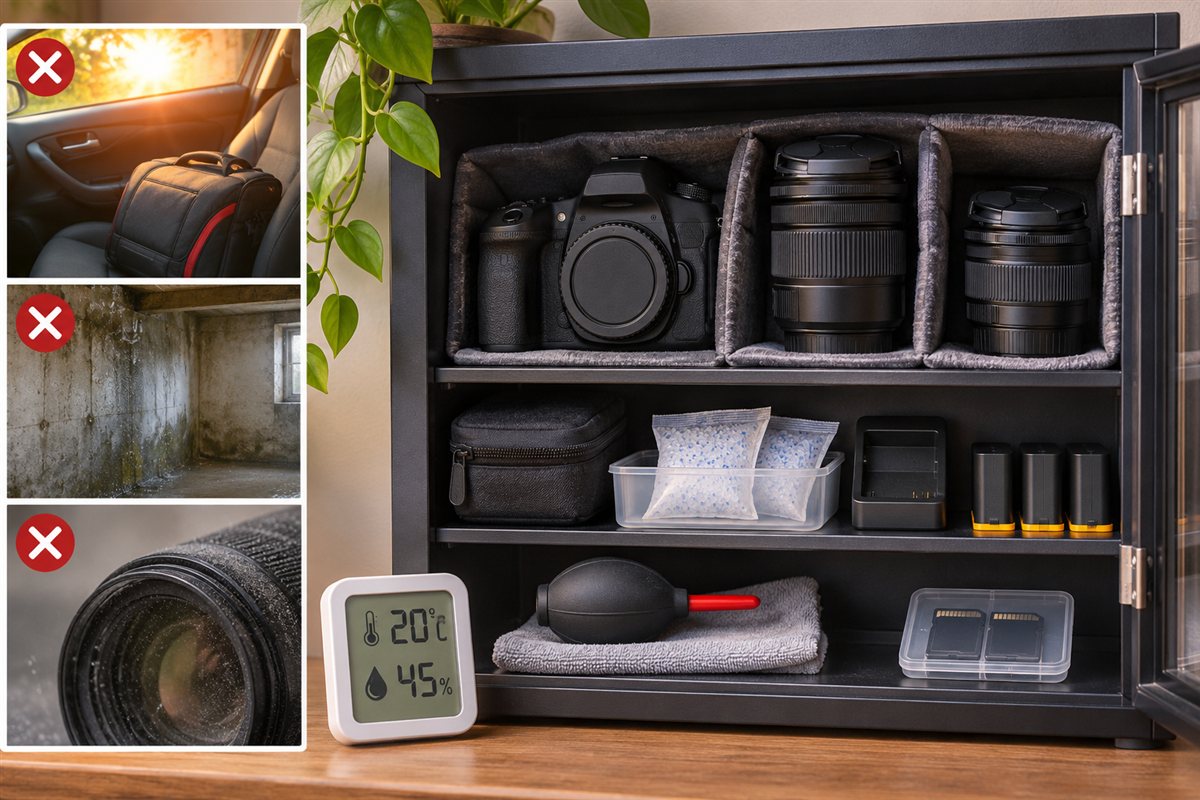
- Humidity: damp air can encourage fungus to grow on and inside lenses.
- Heat: hot cars and sunny windows can stress seals, glue and plastics.
- Dust: fine particles work into rings, mounts and the sensor chamber.
- Knocks and pressure: loose gear piled in a bag can scratch or get bent.
- Old batteries: a cell left inside for years can leak.
In this guide
Setting Up a Storage Spot
- Choose an indoor cupboard or shelf in a room with steady temperature. Avoid damp basements, lofts and garages.
- Put lens caps on both ends of each lens, and a body cap on each camera.
- Keep each item in a padded pouch, drawer insert or bag compartment.
- Add silica gel packs to a closed box or cabinet, and dry or replace them as the maker of the packs directs.
- Store lenses upright or flat in a way that does not press on the glass or the rings.
- Check the area every few months for any musty smell or visible moisture.
Long-Term Care
For storage lasting weeks or months, take the batteries out and keep them separate, as the maker advises in the manual. Take cards out of the camera. Every so often, take the gear out, switch it on, zoom and focus the lenses and press the shutter so that parts do not stiffen.
Before putting anything away, brush off dust with a blower and wipe the outside of bodies and lens barrels with a dry cloth. Make sure everything is dry after rain or a humid day.
If you live somewhere humid, a sealed box with a drying agent is often more helpful than an open shelf. If your home is dry, a closed cupboard and a regular check may be all you need. Whatever you choose, keep the spot tidy so you can see every item at a glance and notice problems early.
Storage Options
| Option | Good for | Watch out for |
|---|---|---|
| Padded camera bag | Short breaks and travel | Trapped damp if stored closed in a humid room |
| Airtight box with silica gel | Keeping air dry | Packs need refreshing |
| Dry cabinet | Larger collections | Needs a power supply and some space |
Measuring and Managing Humidity
Humidity is the quiet enemy of lenses and cameras, and it is easier to manage when you can see it. Guessing from how a room feels is unreliable, because a place can seem comfortable while the air holds enough moisture to encourage mold.
A small hygrometer, which is a simple device that displays relative humidity, can be placed inside your cupboard, box or cabinet. Many also show temperature. Check it regularly and note the readings in different seasons. Look at the guidance from lens and camera makers, or from the maker of your drying products, for the range they recommend. If readings stay high, take action instead of waiting for symptoms.
There are several ways to lower moisture. Silica gel packs absorb water until they are full, and then they need to be dried or replaced as their maker directs. Dehumidifying boxes and cabinets use a gentle heater or a desiccant to keep air dry, and they need a power supply or periodic refreshing. In a damp home, a dehumidifier in the room, good ventilation and moving gear away from external walls can all help.
- Do not let the gear get too dry either. Follow the guidance for the range of humidity that suits your equipment, and avoid extreme drying.
- Avoid storing gear next to bathrooms, kitchens or laundry areas.
- Open storage boxes occasionally so that air circulates, and check that the drying agent is working.
- After a trip to a humid place, let the gear acclimatize in its bag before opening it.
Combine measurement with action: a reading that is often high is a signal to improve the storage.
Storing Batteries, Chargers and Memory Cards
Batteries and cards are small, easy to lose and sensitive to the environment. They deserve their own storage routine, separate from the lenses and bodies.
For batteries, follow the camera maker’s storage advice. In general, rechargeable lithium-type batteries are better kept partly charged and cool for long breaks than stored empty or fully charged in heat, but your manual is the final authority. Store batteries out of the camera and away from metal objects that could short the contacts. A plastic case or the cover supplied with the battery helps. Mark the date of the last charge on a label so you know when to check them.
Memory cards need protection from moisture, static and bending. Keep them in a hard case with labeled slots. Separate blank cards from full ones using clear marking, so you do not format cards with photos you have not copied. Back up your photos before storing full cards, and do not rely on a single copy.
- Check batteries every few months, and recharge them as the manual advises.
- Keep chargers and cables in a pouch together with the correct plug adapters, so everything is ready for the next outing.
- Dispose of swollen, leaking or damaged batteries safely, and do not keep them in the bag. Follow local rules about recycling.
- Store spare batteries at room temperature, not in a vehicle that gets hot or cold.
An organized pouch for power and media reduces last-minute searching, and it protects delicate parts that would otherwise be thrown loose into a bag.
Storing Tripods, Flashes, Filters and Straps
Not all photography equipment is optical, and the accessories have their own needs. Treating them well extends their life and prevents damage to the main kit.
Tripods can collect sand, salt and moisture in leg joints. After outdoor use, wipe them down, extend the legs fully and let them dry before collapsing. Store them in a bag with legs retracted and locks open, so seals are not under pressure, if the manufacturer’s guide says this is acceptable. Check the head and plate for dirt, and keep the quick-release plate attached to the camera or in a known place.
Flashes and external lights should be stored with batteries removed, because leaking batteries can corrode the contacts. Wrap the flash head and keep the diffuser and cables with it. Filters belong in their cases or in padded pouches, with the glass kept free from touching other items. Fingerprints left on the glass can etch over time, so clean filters before storing them.
- Straps and bags should be allowed to dry fully, then stored loosely to prevent mildew.
- Keep cleaning supplies, such as blowers, brushes and cloths, in a sealed pouch so they do not pick up dust.
- Store gimbals and motorized devices according to their manuals, with batteries removed if instructed.
Make a habit of putting each accessory back in its place after use, so you always know where it is.
Keeping an Inventory and Records
A tidy storage space is easier to manage when you know exactly what you own. A simple inventory helps you check that nothing is missing, supports insurance claims and makes it easier to plan upgrades or sales.
Create a list in a spreadsheet or notebook that includes each item, a description, the serial number, the date of purchase and where it is stored. Serial numbers are usually found on the body or the lens barrel, or in the settings menu for some cameras. Photograph each item along with its serial number, and keep the pictures with the list. Keep a copy of the list somewhere other than your gear storage, such as an online account or with someone you trust.
Add receipts, warranty details and manuals to the record. If your gear is covered by an insurance policy, read it to see what documentation is required and what the policy does and does not cover. Ask the insurer about items kept at home compared with those carried while traveling.
- Update the inventory whenever you buy, sell or give away gear.
- Label cases and boxes so you can see what is inside without opening them.
- Do a quick check each season to see that everything on the list is where it should be.
- Keep a note of repairs and service dates for important items.
The inventory also tells you which items you no longer use, which can free up space and money.
Warning Signs and What to Do About Them
Even with good habits, gear sometimes shows signs of trouble. Catching them early prevents small issues from becoming major repairs.
A musty smell in a bag or cupboard suggests excess moisture and possible mold. White, hazy or thread-like marks inside a lens may be fungus, and a dull film on glass can come from oils or residue. Sticky or gummy buttons, stiff rings, corroded battery contacts and a battery door that no longer closes well also need attention. Condensation inside a lens or viewfinder after moving between cold and warm places is another signal to dry the gear properly.
- Musty smell or visible spots in storage. Remove everything, wipe the area, improve ventilation and use drying agents. Do not put clean items back until the space is dry.
- Haze or fungus on glass. Keep the lens away from other gear and consult a qualified service provider. Avoid opening it yourself.
- Corrosion on contacts. Remove the battery, and follow the maker’s cleaning guidance. Corrosion often needs professional attention.
- Stiff zoom or focus rings. Use the gear gently and consult a service provider if the stiffness continues.
- Dust inside the lens or on the sensor. Check the maker’s instructions, and use professional help for internal cleaning.
Do not mix affected items with healthy ones in the same box, since spores and damp can spread. Act promptly, record what you found and note how it was resolved. Prevention through dry, clean storage is far cheaper than repair.
A Monthly Storage Checklist
Gear that sits in a cupboard still needs attention. A few minutes each month catches small problems before they grow, and it keeps everything ready for the day you want to shoot. Print a copy of this list or save it on your phone.
- Open each bag or box and look for damp spots, odors or visible mold.
- Check that silica gel packs are still doing their job, following the maker’s notes on drying or replacing them.
- Make sure lens caps and body caps are in place and that nothing is touching glass.
- Look at rubber grips and straps for stickiness or cracking.
- Power up each camera briefly and fire the shutter a few times to keep moving parts working.
- Check battery condition and top up any that the maker advises charging periodically.
Write the date on a card in the storage spot and tick it each time. A routine that takes ten minutes is easy to keep, while a big yearly clear-out rarely happens. If you spot a problem, follow the equipment maker’s guidance or consult a qualified service center before trying any home fix.
Comparing Dry Boxes, Padded Bags and Hard Cases
Different containers solve different problems, and the best choice depends on your climate and how often you shoot. The table sets out what each does well and where it falls short.
| Container | Strengths | Limits |
|---|---|---|
| Padded camera bag | Easy to carry and good for daily use | Fabric can hold moisture and is not sealed |
| Hard case with foam | Strong protection from knocks and dust | Can trap humidity without a drying agent |
| Sealed dry box with a humidity gauge | Lets you control and watch moisture | Takes space and needs some attention |
| Cabinet with gentle warming | Suits large collections in damp climates | Needs a power supply and a steady setup |
| Open shelf with covers | Easy access and good airflow | Dust gets in over time |
For many people, a padded bag for travel and a dry box for long-term storage is a sensible pair. Whichever you pick, follow the container maker’s directions about drying agents and avoid sealing anything damp inside.
Mistakes That Harm Gear Without You Noticing
Most storage damage builds slowly. A few common habits explain a large share of it.
Storing gear in a closed bag straight after a damp shoot
Moisture from rain, sea air or sweat stays trapped. Let items air out in a clean, dry room before packing them away.
Using the garage or attic
These spaces swing between hot and cold, damp and dry. Gear does better in a stable room inside the home.
Leaving lenses uncapped
Open glass collects dust and fingerprints. Keep both front and rear caps on, and cover the camera body opening as well.
Pressing straps or foam against rubber
Some materials react over time and leave sticky marks. Choose inert padding and check it on your monthly look.
Ignoring small signs
A musty smell or a faint haze on glass is an early warning. Act on it quickly, because delay makes cleaning harder and sometimes impossible.
Where to Keep Gear in Different Homes
The right place depends on your living space. Think about moisture, temperature and how often you reach for your equipment.
Small apartments
A shelf in a wardrobe away from outside walls often works well. Use a compact dry box if humidity is a concern.
Humid or coastal homes
Choose an interior room, keep gear off the floor and watch humidity more closely. A humidity gauge is a simple way to check your conditions.
Shared houses
Use a lockable cabinet or a case with a clear label. Tell others what is inside so that it is not moved or stacked carelessly.
Studios and workspaces
Keep everyday gear within reach on closed shelves, and store backups and rarely used items in sealed cases.
Handy Storage Terms
A few terms come up often in advice on storing equipment, and a clear meaning for each helps you follow instructions.
- Relative humidity: the amount of moisture in the air compared with the most it could hold at that temperature.
- Desiccant: a drying material, such as silica gel, that absorbs moisture inside a container.
- Fungus: a growth that can form on lens elements in damp conditions and cloud the glass.
- Condensation: water that forms when cold equipment meets warm, moist air.
- Self-discharge: the slow loss of charge that batteries experience even when not in use.
When in doubt, the maker’s manual is the best guide for your particular camera and lens. For anything involving batteries, chargers or electrical parts, follow the maker’s instructions exactly, and consult a professional if a unit looks swollen, damaged or unusually hot.
Packing Gear for Short Trips and Transport
Storage at home is one thing, but gear also spends time in cars, trains and hotel rooms. A little planning keeps it in good shape between locations.
- Clean the outside of each item and dry it before it goes in a bag.
- Fit caps on every lens and keep the body cap on any camera without a lens attached.
- Place heavier items at the bottom and use dividers so pieces do not rub together.
- Carry delicate or valuable items in your hand luggage or in the passenger area of a vehicle, not in a hot trunk.
- When you arrive, take gear out of the bag and let it settle to room temperature before use, especially after cold or damp conditions.
That last step matters more than it looks. Moving from cold outdoor air into a warm room can create condensation on glass and inside housings, so give equipment time in a closed bag to warm slowly. If you travel regularly, keep a small pouch with spare caps, a cloth and a few desiccant packs, and refresh it before each trip.


Ready to Buy? Start Here
If this guide helped you decide what to look for, these products are a place to start.


As an Amazon Associate we earn from qualifying purchases. Prices and availability are shown on Amazon.
Storage for Different Kinds of Photographers
The right storage setup depends on how your photography actually flows through your home. A hobbyist with one camera and two lenses needs a single good home for the kit: a shelf or box in a living space, away from radiators and sunny windows, where the gear is visible enough to be used and protected enough to be safe. The biggest risk at this scale is not humidity but neglect — gear pushed into a damp cupboard or a dusty attic because it has no proper place. One designated spot, used consistently, solves most of it.
An enthusiast with several bodies, a shelf of lenses and accessories gathered over years faces an organisation problem as much as a preservation one. Gear that cannot be found might as well not be owned, and gear stored in layers — lenses behind lenses, accessories buried under straps — gets handled roughly and checked rarely. Shallow storage, where everything is visible in one layer, is worth real effort: a cabinet with shelves sized to the kit, each lens capped and standing in its own space, small items in labelled pouches. The monthly check described elsewhere in this guide becomes a pleasant five minutes when everything can be seen at a glance, and a chore to postpone when it cannot.
Professionals and serious collectors add volume and value, and with them, questions of security and environment control. A dedicated cabinet in a stable room, humidity monitored rather than assumed, an inventory with serial numbers kept separately, and insurance that reflects replacement cost are the professional baseline. At this scale it also becomes worth separating working kit from stored kit: the equipment in daily use lives ready in bags, while the reserves live in the controlled cabinet, and the two rotate deliberately rather than drifting into whichever corner they were last set down.
Seasonal Storage and Long Breaks From Photography
Life interrupts photography — a busy season at work, a new baby, an injury, a winter — and gear that will sit unused for months needs a slightly different preparation than gear stored between weekends. Clean everything before the break, because dirt and skin oils left on surfaces for months do more harm than the same dirt left for a week. Charge batteries to a partial level rather than storing them fully charged or fully flat, following the maker’s guidance for long storage, and remove them from bodies so that a leaking or failing battery cannot harm a camera unnoticed. Take cards out, copy their contents, and store them separately.
Choose the storage place for the break with extra care. It should be the most temperature-stable, driest spot available, away from exterior walls that condense in winter and from any room that will be unheated and unvisited for the whole period. Add fresh or recharged desiccant, close the cabinet or box, and then — the part people skip — set a reminder to check it partway through the break. A single mid-break inspection catches the early signs of mould, a failed desiccant or a pest problem while they are still trivial, instead of at the end, when they are not.
When the break ends, bring the gear back gently. Inspect before powering on, let everything reach room temperature, charge batteries fully, and exercise the mechanical parts: turn every ring, work every dial, fire a few test frames and listen. Equipment that has sat still for months appreciates being woken gradually, and faults are far easier to attribute and address when you have a clear before-and-after picture. Then update your inventory notes with anything the inspection revealed.
Storing Gear Safely Around Children, Pets and Guests
Real homes contain other people and animals, and storage that ignores them fails. Children are curious about cameras precisely because cameras are interesting, and a camera stored at child height on an open shelf will eventually be explored by small hands — not maliciously, just inevitably. Store gear up high or behind a closed door, and satisfy the curiosity safely instead: a retired compact camera or an inexpensive instant camera that children are allowed to use turns a forbidden attraction into a shared pleasure, and teaches care with something whose loss would not hurt.
Pets contribute hair, moisture and the occasional collision with a tripod leg. Keep storage closed rather than open where animals roam, and never store gear on the floor where it can be knocked, slept on or investigated. Pet hair finds its way into bags and onto rear elements with remarkable persistence, so bags stored in pet territory should be zipped shut, and a blower pass before a shoot becomes part of the routine in a pet household.
Guests and cleaners present the subtler risk: well-meaning people moving gear to dust a shelf, or setting a drink beside it, or helpfully closing a damp bag. The defence is the same designated, closed, out-of-the-way storage that serves every other purpose in this guide. Gear that lives in its proper place, in a closed cabinet, is largely invisible to the life of the house — and invisible, for stored equipment, is exactly what you want.
The Storage Audit: A Once-a-Year Walk-Through
Once a year, audit your storage the way you would audit anything you care about: slowly, with a list, and with permission to fix what you find. Open every box, bag and cabinet where photographic equipment lives — including the forgotten ones, the bag in the car, the lens in the desk drawer — because an audit’s first discovery is usually that gear has drifted into places you would never have chosen. Bring everything back to the system, and note what drifted and why; the reason usually points to a gap in the setup, such as a lens with no assigned space.
During the audit, handle every item. Check lenses against the light for fungus or haze, work the rings and blades, look at battery contacts, sniff bags and cases for the musty note that betrays damp, and inspect desiccant to see whether it is doing its job. Photograph the current state of the collection for your records, update the inventory with anything bought or sold, and confirm the total still matches your insurance. An audit like this takes an hour for most collections and converts vague confidence into actual knowledge.
Finish by questioning the setup itself. Has your photography changed — new subjects, more travel, a growing collection — in ways your storage no longer fits? Is the room still the right room? Is anything stored that you no longer use and could sell, give away or retire to less prime space? Storage is not a decision you make once; it is a system that should evolve with the photography it protects. The gear you own represents money, memories and capability. An hour a year is a small rent to pay for keeping all three safe.
Storage Mistakes That Look Like Good Ideas
Some storage errors persist because they sound sensible. Storing gear in its camera bag feels tidy, but a bag is a transport device, not a storage environment: its foam holds moisture, its closed spaces restrict air, and it usually lives wherever it was dropped rather than in the room you would choose. Gear that lives in a bag between shoots ages faster than gear that lives in open, dry storage and visits the bag only for travel. A related error is the sealed plastic box with no desiccant and no thought for the air sealed inside it — if damp air went in, damp air stays in, in intimate contact with your lenses. Sealed storage works only when the air inside is dried deliberately and the desiccant is maintained.
Another plausible mistake is storing gear wherever there is space rather than where conditions are right: the top of a wardrobe in a steamy bathroom-adjacent room, a cupboard on a cold exterior wall, a garage that swings between damp winters and hot summers. Each of these places fails on stability, and stability — of temperature, of humidity — is the quality storage most needs. A smaller space in the right room beats a generous space in the wrong one, every time. Similarly, scented products, moth treatments and other household chemicals kept beside gear can deposit films and attack rubbers and coatings; camera storage should be chemically boring.
Finally, beware of over-handling disguised as care. Gear does not benefit from being taken out, admired and repacked weekly; each handling is a small risk and an opportunity for dust and fingerprints. The monthly check described in this guide is quite enough contact for stored equipment. Good storage is mostly the art of leaving things alone, in the right place, in the right conditions — and the confidence to trust the setup you have made.
When Storage Reveals a Problem: Responding Calmly
Sooner or later, a storage check turns up something unwelcome: the first threads of fungus in a lens, a battery that has swollen, a strap going musty, corrosion beginning on a contact. The first rule is isolation. Move the affected item away from the rest of the collection, because fungus spreads by spores, a failing battery is a hazard in itself, and a musty bag will share its smell and its mould with everything near it. The second rule is assessment before action: photograph the problem, note when the item was last checked and found healthy, and think about what changed — a wetter season, a new storage place, a trip after which the item was put away damp.
Fungus found early, on an external surface, can often be cleaned safely by a professional before it etches anything. Fungus established inside a lens is a specialist job whose cost must be weighed against the lens’s value, and the honest answer is sometimes that a modest lens is retired while a valuable one is saved. A swollen battery is not a cleaning problem at all: it should be handled carefully, kept away from heat, and taken to a proper recycling or hazardous-waste point, never punctured and never charged again. Musty textiles usually respond to thorough airing and sunlight; cases whose foam has begun to crumble should be replaced, because crumbling foam sheds particles over everything it touches.
The third rule is to fix the cause, not just the item. A problem discovered in storage is the storage system reporting a weakness: humidity higher than you believed, a room that changed with the seasons, a routine that slipped. Measure properly this time, adjust the desiccant or the location, and shorten the check interval for a while until the system proves itself again. Collections are not harmed by problems that are caught, understood and answered; they are harmed by problems that are cleaned away and forgotten, free to return in a worse form.
The Quiet Satisfaction of Gear That Is Ready
There is a pleasure, rarely mentioned, in opening a cabinet and finding every item clean, dry, capped, charged appropriately and exactly where it belongs. It is the pleasure of readiness: the knowledge that if the light turns beautiful this evening, or a friend calls with an unexpected opportunity, your photography can begin in minutes rather than after a hunt and a clean-up. Storage, done well, is not really about preservation at all. It is about removing friction between you and your photographs, permanently, in the background of your life.
That readiness also protects the value of what you own in the most practical sense. Gear kept well works when sold, photographs when borrowed, and lasts when kept. Photographers who store carefully routinely use lenses for decades, and the per-year cost of their equipment becomes remarkably small. Care is the cheapest photography purchase there is, and storage is where most of that care quietly happens — in a dry room, in a closed cabinet, in a habit of checking that takes minutes a month. Build the system once, keep it lightly, and let it serve every photograph you have yet to make.
Storing Gear You Lend, Borrow and Share
Photography gear circulates — lent to a friend, borrowed for a trip, shared within a family or a club — and circulation is where storage systems meet their social test. When you lend, lend from your system rather than around it: the lens goes out capped, in its case, with a note of when it left and what went with it, and it returns to inspection before it returns to the shelf, because a borrowed lens has lived a week of someone else’s habits. A quick check against the light, a wipe, a night in the dry cabinet, and it rejoins the collection with its condition known. That small ceremony protects both the gear and the friendship, since damage discovered immediately is a conversation, while damage discovered months later is an accusation looking for an author.
When you borrow, store the borrowed item to a higher standard than your own: it lives in the best place, travels in the best protection, and goes home clean and early. Photographers who borrow well get offered the good lenses again, and the informal lending networks among photographers are worth more than most rental arrangements. Clubs and shared workspaces need the same ideas written down: a labelled place for every shared item, a simple in-and-out record, and an agreed person responsible for the monthly checks. Shared gear fails socially before it fails physically — nobody’s job becomes nobody’s check — and the written system is what keeps generosity sustainable.
Insurance, Records and the Value of Knowing What You Own
Storage and record-keeping are the same habit viewed from two sides: you cannot protect what you cannot list. Keep an inventory that matches the physical collection — item, serial number, where it lives, when it was last checked — and keep a copy somewhere other than with the gear itself. Photograph the collection annually as part of the audit described earlier. If the worst happens, through theft, fire or flood, that file converts a chaotic claim into a documented one, and it equally serves the mundane moments: settling what a kit contains before a sale, answering a repairer’s question, or proving to a lender that their lens is present and correct.
Review the inventory against your insurance whenever the collection changes significantly, because growing kits quietly outgrow old cover, and lenses stored at home are usually insured as part of household arrangements that have limits worth knowing before they are tested. None of this administration is photography, but all of it is what makes photography’s tools a durable asset rather than a slow leak of value. An hour with a list, once a year, is the premium you pay yourself.
Storage for the Digital Side of the Kit
A modern camera kit includes things that are not cameras, and they need storing with the same thought. Memory cards hold your photographs and deserve better than a drawer of loose cards in unknown states; a simple case, a convention for which side means full and which means empty, and a rule that cards are never stored holding the only copy of anything are the whole system, and it prevents the two classic card disasters — formatting the wrong card and losing a small card entirely. External drives and backup media belong in the inventory too, stored away from the computer they mirror, because a backup kept beside the original shares most of the original’s risks.
Cables, chargers and adapters multiply quietly and vanish reliably. Give them one home — a pouch or a drawer section — and return them to it without exception, because the charger left in a hotel room and the cable lent and forgotten are how kits become incomplete. Label chargers that resemble each other; several black bricks with different outputs are an accident waiting for a tired evening. Batteries in storage deserve their caps or their case, both to protect their contacts and to prevent the small but real risk of a short in a drawer of metal objects. None of this is glamorous, and all of it is the difference between a kit that is complete every time you reach for it and one that must be reassembled, with frustration, before every outing.
Passing the Habit On
Storage knowledge, like most photographic craft, traditionally travelled from photographer to photographer — the mentor who showed you where lenses should live, the friend whose cabinet you quietly copied. If your own system now works, consider passing it on deliberately, because the people around you are storing gear too, often badly, and a five-minute conversation about humidity, caps and a dry room can save a lens they love. Show them your setup rather than lecturing; a working cabinet persuades faster than any principle. Lend the hygrometer. Share the checklist. Photography’s communities have always run on this kind of practical generosity, and storage is one of its least glamorous and most valuable currencies.
Within a family, the habit has a longer horizon. The person who will inherit your cameras — and the photographs they made, and the archive that holds them — will inherit your storage system as well, whether you design that inheritance or leave it to chance. A labelled cabinet, a written inventory and a one-page note about what lives where and what to check is a genuine gift to that future person, and it takes an afternoon. Gear kept well outlives its owner in working order; that is not a morbid thought but a tribute to care, and one more reason the quiet routines in this guide are worth the small effort they ask.
The Five-Minute Version of Everything in This Guide
If a fellow photographer asked you to summarise good storage while the kettle boils, the honest summary is short. Keep gear in a dry, stable, ordinary room — not the garage, not the bathroom, not the attic. Keep it capped, cased and visible, in one designated place, with desiccant if your climate is humid and a simple gauge so you know rather than guess. Keep batteries sensible, cards emptied, and an inventory that matches reality. Look at everything once a month, properly once a year, and act early on anything that smells, swells, threads or fades. That is the whole system, and its power lies not in its sophistication but in its repeatability: five quiet habits, kept for years, will preserve a collection better than any single expensive cabinet bought and forgotten. Storage is a practice, not a purchase — and now it is yours.
Storage Decisions When Space, Climate and Budget Collide
Few photographers get the storage spot they would draw on paper. Most get a shelf that is a little too warm, a cupboard that is a little too damp, or a room that doubles as somewhere else entirely. The useful skill is ranking the risks and fixing the worst one first. Damp does the fastest and least reversible damage, so humidity control outranks almost everything: move gear out of a damp room before buying any container, and add simple moisture control before adding organisation. Heat comes next, because a hot spot quietly stresses seals, lubricants and batteries all year. Dust and knocks matter, but they harm slowly and forgive delay; fungus does not.
A Rotation Habit That Catches Problems Early
Stored gear stays healthy when it is looked at regularly, and the easiest way to guarantee that is to rotate what you use. Photographers with several lenses can work through them in turn rather than always reaching for a favourite, so every lens gets mounted, focused and checked across the year. While each item is out, give it the short inspection: glass clear, rings smooth, caps present, no musty smell from the pouch or case. Ten unhurried minutes during a normal shoot prevents the classic discovery — opening a bag after a long break and finding a problem that started months earlier and grew in the dark.
Condensation, Musty Smells and Other Early Warnings
Gear brought in from cold air into a warm room collects condensation, so let it warm gradually inside its bag before opening anything. A musty smell from a case is not a cosmetic issue; treat it as a humidity report, air the case thoroughly, replace tired moisture absorbers, and move the gear while you investigate the spot itself. If one item shows early signs of fungus, separate it from the rest until you have taken advice, because spores and neglect are travelling companions. None of this needs alarm. Storage problems announce themselves quietly and early, and a photographer who listens at that stage rarely faces the expensive version later.
FAQ
Should I keep lenses attached to the camera?
For short periods, yes, with the caps on. For long storage, many people keep lenses and bodies separate with caps fitted, which protects the mount and glass.
Is a sealed plastic bag enough?
A sealed bag keeps dust out, but it can also hold any moisture already present. Add a drying agent and make sure the gear is dry first.
How often should I replace silica gel packs?
It depends on the product and the humidity in your storage. Follow the maker's directions, and replace or dry them when they show they are saturated or when your hygrometer readings rise.
Is it safe to store camera gear in the fridge or freezer?
No. Cold storage invites condensation when you take gear out, which can harm electronics and lenses. Keep gear in a cool, dry room at a stable temperature.
Should I leave a lens mounted on the body for long storage?
Many people store them separately with caps on both ends. A mounted lens is fine for short breaks, but long-term storage with caps protects the mount and glass.
Where should I keep gear when traveling between hotels?
Keep it in a padded bag in a dry place away from heaters, windows and car trunks. Let the bag adjust to room temperature before opening it after a cold or humid journey.
Can I use rice to dry wet camera gear?
Rice is not a reliable drying agent. Use proper desiccants, wipe the outside, and follow the maker's guidance for damp or wet equipment, or contact a service provider.
How can I protect gear from pests and mildew in a tropical climate?
Keep it in sealed containers with drying agents, check it regularly and let it air in a dry room. Avoid leaving bags closed when they are damp.
The Short Version
Keep gear cool, dry and covered, with caps on and batteries out for long gaps. Use padded compartments and a drying agent, and take everything out now and then to use it.