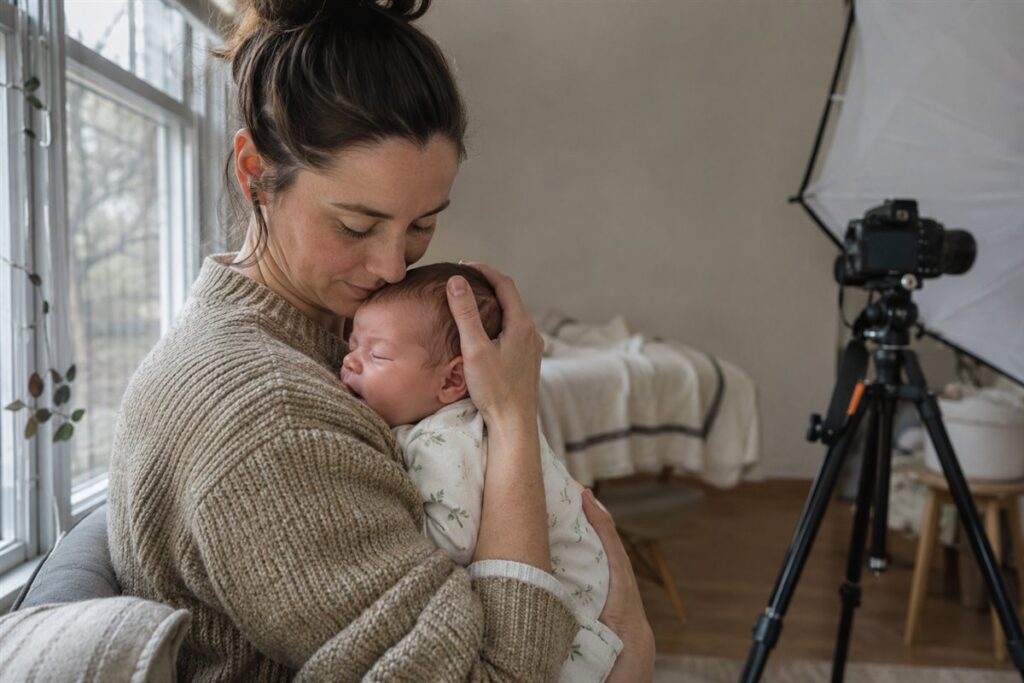
When a newborn is fussy during a photo session, the best response is patience: pause the camera, let the parents comfort the baby, and return to simple, supported poses. This is general photography guidance only. The baby’s comfort and safety come first, and a parent should always hold or stay within arm’s reach.
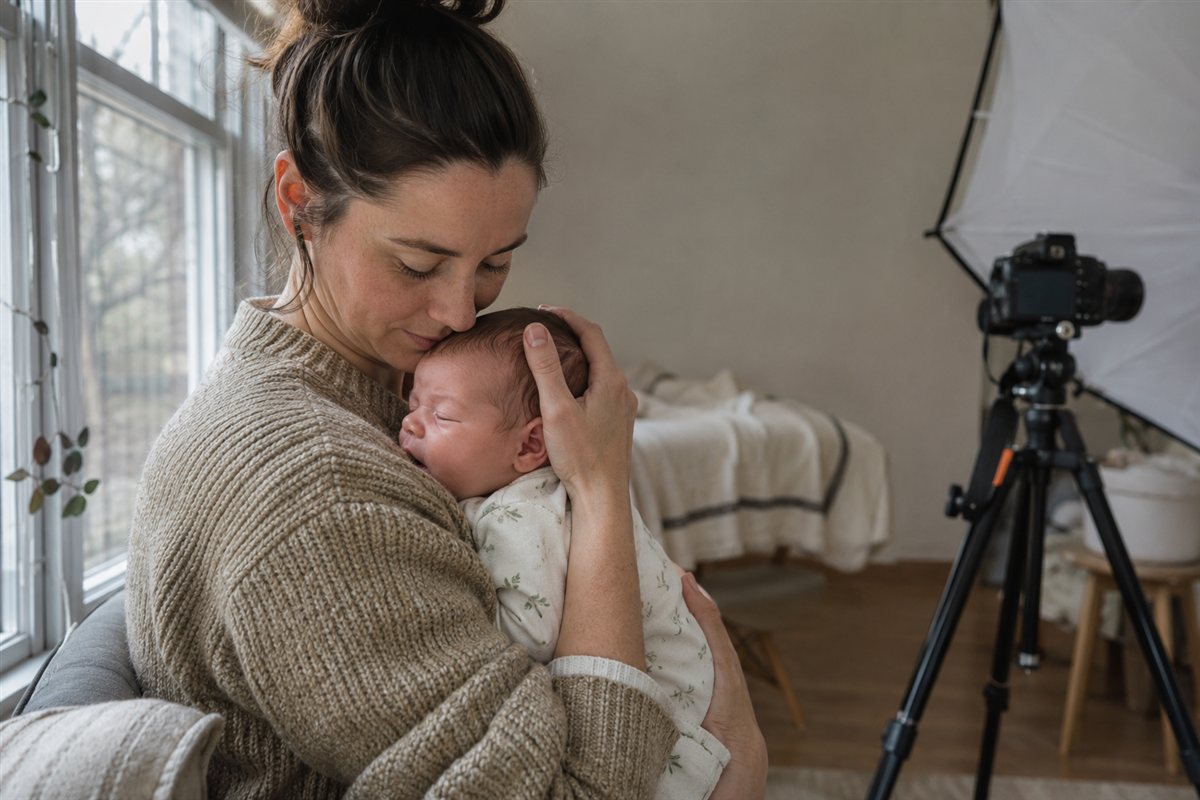
Plan the Session Around the Baby
A calm session begins before you arrive. Ask the parents which times of day the baby is usually content, and schedule around feeds and naps.
- Allow extra time so nobody feels rushed.
- Keep the room comfortably warm for a baby who may be undressed for part of the session.
- Prepare props, blankets and lighting before the baby is placed in position.
- Switch off bright flashes and loud sounds.
In this guide
Ways Parents Often Soothe a Baby
Parents know their baby best, so let them lead. These are everyday comfort habits, not medical advice.
- Feeding or cuddling pauses, as the parents prefer.
- Gentle rocking, swaying or walking.
- Soft background sound such as quiet music or a steady hum.
- Skin contact and the familiar voice of a parent.
- A short break in a quieter room.
If the baby remains upset, end or reschedule the session. A calm baby on another day is better than a stressed baby today.
Posing With Support
Keep poses simple and always supported by a parent’s hands.
- Photograph the baby in a parent’s arms, with faces close together.
- Shoot close details such as hands, toes and sleeping faces.
- Use a soft surface at a safe height, with a parent right beside it and hands ready.
- Avoid any pose that needs the baby balanced, propped or held in an unusual position.
- For tricky compositions, take separate frames and combine them in editing, with the parent’s hands removed afterward.
Camera Approach
| Goal | General idea |
|---|---|
| Soft light | Use a large window, turned side-on to the baby |
| Sharp eyes and features | Aperture around f/2.8 to f/4, shutter speed roughly 1/160 or faster |
| Quiet operation | Use a quiet shutter mode if available |
| Fast response | Keep the camera ready and pre-focused |
Work quickly when the baby is calm, and lower the camera when they are not.
Whatever light you use, keep your own comfort in mind too. A relaxed photographer, with spare time, spare batteries and a plan, makes the room feel calmer, and that calm shows in the pictures.
Preparing Parents Before the Session Day
A calm session starts with a conversation days before anyone picks up a camera. Parents who know what to expect are more relaxed, and babies often sense that. Send a short message explaining the plan, how long you expect to take, and what the parents can do to help. Ask about the baby’s usual routine, including feeding and sleeping patterns, any health notes the parents wish to share, and anything that tends to upset the baby.
Offer simple guidance on preparation:
- Suggest feeding the baby shortly before the session if that fits their routine, since a content baby settles more easily.
- Recommend comfortable, loose clothing for the baby and easy-to-remove layers, so changes do not wake or upset them.
- Ask parents to bring spare clothing, nappies or diapers, wipes, pacifiers if used, and a favourite blanket.
- Agree on a few shots the parents would like most, such as hands, feet, a sleeping face or a family portrait.
- Explain that the session may pause often and that this is normal.
Discuss expectations about editing and delivery as well, so nobody feels pressured to get every image in one sitting. If the family has older children or pets, ask whether they will attend, and plan how to keep the room calm. Make it clear that the parents can stop at any time. Setting this tone early reduces tension and lets everyone enjoy the process.
Setting Up the Room for Comfort and Safety
A well-prepared room does half the soothing for you. Aim for a warm, quiet space with soft light and as few distractions as possible. Newborns can be sensitive to temperature, and parents will often want the room warmer than usual if the baby will be lightly dressed. Follow the parents’ lead on comfort, and check with them often.
Think about the practical layout:
- Clear the floor of cables, stands and bags so nobody trips while carrying the baby.
- Place a soft, stable surface at a safe height, away from edges, and keep a parent’s hands on or beside the baby whenever they are on it.
- Keep lights soft and indirect. Avoid flashing lights, and use window light or a continuous light if available.
- Test any backdrop, blanket or prop for stability before the baby arrives.
- Keep wipes, towels and a change of clothes within reach.
- Keep the space free from strong smells, and avoid anything that could irritate skin.
Props deserve caution. Only use items that are clean, sturdy and appropriate for newborns, and avoid anything that could cover the face or restrict breathing or movement. If you are unsure, keep it simple and rely on parents’ hands and soft blankets. This guide offers general photography advice only, and the parents, with guidance from their health professionals, should make decisions about the baby’s care and safety.
Working With the Baby’s Natural Rhythm
Newborns cycle through sleeping, feeding and fussing, and sessions go best when you follow that rhythm instead of fighting it. Plan for extra time and expect pauses. When the baby is asleep, work quietly on gentle poses and close-up details. When the baby is awake and alert, capture eyes and expressions. When the baby is hungry or upset, put the camera down and let the parents care for them.
Learn to read signals. Clenched fists, arching, grimacing and rising cries often show discomfort. Calm breathing, relaxed hands and soft faces suggest the baby is settled. If signs of distress build, stop the pose, return the baby to a parent and give time to recover. Never keep a baby in a position after they show distress.
- Shoot in bursts when the baby is settled, then rest.
- Work on different shots in turn, so you can switch when the baby stirs.
- Keep your voice soft and movements slow.
- Photograph the parents’ soothing moments, which often make touching images.
- Let the parents decide when a break, feed or change is needed.
Be flexible about the schedule. A session that begins at a planned hour but needs to move later is better than a rushed one. Remember that patience is a skill, and the babies who seem difficult often just need a quiet, unhurried approach.
Including Siblings and Family Members
Family frames are among the most treasured images, and they bring extra challenges. Older children may be excited, shy or tired, and they need as much consideration as the baby. Give them a simple role and keep their part short.
Ideas that tend to work:
- Let a sibling sit and hold a supported baby only if a parent is right beside them with hands ready. Always follow the parents’ wishes.
- Ask siblings to look at the baby, give a gentle kiss on the head or touch a tiny hand, rather than posing stiffly.
- Keep an eye on the older child’s mood. Offer short breaks, a snack or a quiet activity.
- Photograph the family close together, with hands and faces overlapping, which feels warm and keeps the baby supported.
- Consider taking sibling shots first, while they are fresh, then letting them go play.
Grandparents and other relatives may want to join. Check with the parents first, and keep groups small so the room stays calm. Make sure everyone has clean hands and avoids strong scents if the parents prefer. Take group photos efficiently, then give the baby a break.
Direct gently and avoid turning the session into a performance. Candid moments, such as a parent smiling at the baby or a sibling peeking over, often become the favourites.
Finishing the Session and Handling the Results
Knowing when to stop is part of the craft. If you have a handful of good frames and the baby is tiring, wrap up. Thank the parents, help them settle the baby, and offer a short summary of what you captured. Leave the space as you found it, and agree on when and how they will receive the images.
When you edit, keep the style natural. Newborn skin can look blotchy or red, and gentle colour correction can help, but heavy smoothing quickly looks artificial. Keep tones soft and avoid extreme filters. Check each image for safety, particularly where a parent’s hands were supporting the baby. If you combine images to remove hands, make sure the final result is honest to the original moment, and explain to the parents that some frames are composites if that applies.
- Cull carefully and choose a small, strong set over many similar frames.
- Back up the files soon after the session.
- Deliver in the format and way you agreed, with clear information on usage and sharing.
- Be mindful of privacy, and do not share a baby’s images without the parents’ permission.
Ask the parents for feedback when appropriate, and note what worked for next time. Each session teaches something about timing, communication and comfort, and calm, respectful habits are the most reliable way to earn parents’ trust.
Learning to Read a Newborn’s Signals
Newborns cannot tell you what they need, but they communicate constantly through movement, sound and expression. A photographer who learns to read these signals can respond early, before a small fuss becomes a long cry. Watch for fists that clench, a face that scrunches, legs that pull up, and a tone of crying that rises. Notice also the quieter signs of comfort: relaxed hands, slow breathing and a soft face.
The parents know their baby best, so ask them what usually works and what the baby’s pattern is. Let them lead on feeding, comfort and any decision about the baby’s care. Your role is to be patient, to keep the room calm, and to work around the baby’s needs. This is general photography guidance only, and for any question about a baby’s health or safety you should follow the advice of the parents and a qualified professional.
Preparing the Room as a Calm Space
A comfortable room makes a large difference. Choose a space with soft, even light, such as a window with sheer curtains, and keep the room at a temperature that suits the baby, as the parents advise. Reduce loud noise, and consider a gentle steady sound if the parents like to use one. Keep the number of people small, since a crowd can add tension.
- Set up the area before the baby arrives so you can work quickly.
- Keep wraps, blankets and props clean and within reach.
- Place a soft, stable surface where the parents are comfortable supporting the baby.
- Have a place for the parents to sit and rest between sets.
- Keep your camera bag and cables out of the way.
Session Flow Table
| Phase | What to do | Why it helps |
|---|---|---|
| Arrival | Chat, settle in, let the baby adjust | Reduces tension |
| Feeding and comfort | Allow time on the parents’ terms | A settled baby is easier to photograph |
| First set | Simple, supported positions | Builds a safe base of images |
| Family frames | Parents holding the baby | Often the most loved photos |
| Detail frames | Hands, feet, small features | Quiet moments between larger sets |
| Wrap-up | Thank the family, discuss delivery | Leaves a positive impression |
Camera Settings That Keep You Quiet and Quick
A baby can wake at a click or a flash, so choose settings that let you work softly. Avoid flash, and use window light or a gentle continuous light that the parents approve. Switch off beeps and focus assist lights, and use a silent or quiet shutter mode if your camera has one. Use a moderate aperture so that tiny features, such as eyelashes and fingers, are sharp, and raise the sensitivity to keep the shutter speed fast enough to avoid blur from small movements.
- Set aperture priority or manual mode with a moderate aperture.
- Raise sensitivity until the shutter speed is comfortably fast.
- Turn off sounds and any bright assist lights.
- Pre-focus on a nearby point and compose carefully.
- Take several frames, since expressions change quickly.
Comforting Ideas Parents Often Use
Parents have their own ways to soothe, and these are best left to them. Common approaches include holding the baby close, gentle rocking, quiet humming, feeding, and a short break from the camera. As the photographer, you can support them by keeping the room calm, pausing when needed and never hurrying. If the baby needs a longer break, use the time to adjust props or look over the images you have so far.
Avoid taking the baby from the parents’ arms unless they invite you to help, and never position a baby in any way that the parents are uncomfortable with. Safety is the priority, so follow the guidance of the parents and trained professionals for any handling or positioning, and do not attempt poses that depend on balance or support that you cannot provide.
Simple Poses That Rely on Parents’ Hands
The safest and most heartfelt images often involve parents’ hands in the frame. Ask a parent to cradle the baby while you photograph from above or from the side. Include a parent’s hand under the baby’s head or around the feet. These images show the connection between parent and child, and they are easy to recreate without elaborate props.
- Parent holding the baby against the chest, face turned toward the camera.
- Parent’s hands cupped around the baby’s feet.
- Parent kissing the baby’s forehead while you photograph from the side.
- Close-up of tiny fingers wrapped around a parent’s finger.
Worked Example: A Session That Needed a Long Pause
Imagine a photographer named Lena arriving at a family’s home for a morning session. The baby is awake and fussy, and the parents look tired. Lena chats for a few minutes, sets up near a large window and tells the parents to feed or comfort the baby whenever they like. Twenty minutes pass without a single photograph, and Lena uses the time to adjust her camera and plan the first frames.
When the baby settles, Lena photographs the parents holding him, with soft light from the window. She takes only a handful of frames, then waits again when he stirs. Later, in a calm moment, she captures his hands and feet. By the end of the session she has a small but heartfelt set. The parents are relieved and happy, and they thank her for her patience.
The session succeeded because the photographer accepted the baby’s rhythm and kept the pressure low.
Common Mistakes to Avoid
- Rushing the family because of a tight schedule.
- Using a bright flash close to the baby’s face.
- Trying a pose that the parents are not comfortable with.
- Filling the room with people and noise.
- Forgetting to take a break and offer water to the parents.
Glossary
- Swaddle: a way of wrapping a baby snugly in a blanket, as guided by the parents.
- Soft light: light that falls gently without harsh shadows.
- Continuous light: a light that stays on, unlike a flash burst.
- Silent shutter: a camera mode that reduces or removes the shutter sound.
After the Session: Editing and Delivery
Editing newborn photos is best done gently. Keep skin tones natural, avoid heavy smoothing, and use soft contrast. Remove small distractions such as stray hairs or minor marks on the blanket, but keep the baby’s features true. Choose a consistent set of edits so the gallery looks cohesive. Deliver the images with a short note thanking the family, and explain how to download and store them safely.
- Cull to the strongest frames.
- Adjust exposure and white balance.
- Apply a gentle, consistent style.
- Check each image at full size.
- Back up the gallery before sending.
Communication Tips Before the Session
Good communication prevents stress. Send the family a short guide before the session explaining what to expect, how long it may take and what to prepare. Encourage them to keep the baby fed and comfortable, and to wear simple clothing that photographs well. Reassure them that a fussy baby is normal and that you are happy to wait. This sets a relaxed tone for everyone.
Lenses and Distance for Gentle Work
A short telephoto or a standard lens lets you keep a little distance while still filling the frame. This gives the baby more space and the parents more privacy. A wide lens used too close can stretch features and feels intrusive. Choose a lens with a wide aperture so you can work in soft light without raising the sensitivity too far. Keep your movements slow and avoid sudden changes in position, which can unsettle a light sleeper.
- Use a standard prime for natural proportions.
- Try a short telephoto for detail shots from a comfortable distance.
- Keep extra lenses within reach so you do not rummage in the bag.
FAQ
How many photos should I aim for?
A handful of strong images beats dozens of rushed ones. Focus on hands, faces and a family frame.
What if the baby will not settle at all?
Stop, thank the parents, and offer another date. Their comfort and the baby’s matter more than the schedule.
When is the best time of day for a newborn session?
Ask the parents when the baby tends to be content, and plan around feeds and naps. The best time is individual to each baby.
Should I use flash with a newborn?
Many photographers prefer soft natural or continuous light and avoid sudden bright flashes. Ask the parents for their preference.
How long should a newborn session last?
There is no set length. Plan extra time for breaks, and be ready to finish early or reschedule if the baby needs it.
Can I photograph a newborn without a parent nearby?
A parent should stay within arm's reach and be ready to support the baby at all times. Safety comes before any shot.
What lens works well for newborn photos?
Many people like a short to medium lens with a wide aperture for soft backgrounds and low light. Choose what lets you work quietly and from a comfortable distance.
What if the baby has a rash or marks on the skin?
This is common, and gentle editing can reduce the look of it. Ask the parents what they prefer, and keep edits natural.
How do I keep myself calm if the session is going badly?
Slow down, breathe and let the parents lead. Taking a break and offering to reschedule often turns a tense session into a good one.
Reading a Newborn’s Signals During the Session
A fussy newborn is communicating, and a photographer who learns the vocabulary works faster and more kindly than one who simply waits out the crying. The early hunger signals come well before tears: rooting, hands drifting to the mouth, small restless movements. Catching those signs lets the parent feed the baby before a full cry builds, and a baby fed at the rooting stage settles far more easily than a baby fed after ten minutes of crying. Full crying, by contrast, is a late signal, and it usually means the session should pause properly — pick the baby up, settle them completely against a parent’s chest, and let the stress leave their body before any posing resumes.
Sleep signals matter just as much. The deep sleep that posing requires has recognizable signs: limbs that hang heavy when gently lifted, a soft and regular breathing rhythm, small twitches and facial movements that show the baby is dreaming rather than stirring. A baby in light sleep, with fluttering eyelids and tense little fists, will wake at the first adjustment. Learning to wait the extra minutes for deep sleep, rather than beginning poses the moment the eyes close, is one of the clearest differences between sessions that flow and sessions that fight.
Overstimulation has its own signs: hiccups, turning the head away, splayed fingers, a frown that builds. A newborn showing these is asking for less — less handling, less noise, less light change. The correct response is a genuine break in a quieter, dimmer space, not a quicker attempt at the next pose. Sessions built around the baby’s signals feel slower minute by minute and finish faster overall, because so little time is lost to recovering from avoidable upsets.
The Parent’s Role: Your Most Important Assistant
In a newborn session the parent is not a bystander; they are the photographer’s most important assistant, and briefing them well at the start changes everything that follows. Explain the rhythm honestly: the session moves at the baby’s pace, feeding and settling breaks are part of the work rather than interruptions, and the parent’s one job during poses is to stay close, ready to place a steadying hand exactly where the photographer asks. A parent who understands the plan relaxes, and a relaxed parent is the single most effective soothing tool in the room, because babies read tension through the hands that hold them.
Give the parent specific, small tasks rather than general reassurance. Holding a supporting hand under a blanket, keeping a gentle hand on the baby’s back while the photographer steps back for the frame, rocking the baby during a pause — concrete jobs occupy anxious hands and make the parent a partner in the session. Parents who feel useful stay patient through the long settling periods that newborn work demands.
Manage expectations with the same clarity. Show the parent early frames on the camera screen when a pose succeeds, so they can see the session is working even when it feels slow. Mention, kindly and in advance, that some planned poses may be dropped if the baby dislikes them, and that the final gallery will be better for choosing the poses the baby accepted. Parents who hear this before the session defend the baby’s pace alongside you; parents who hear it afterward may feel something was lost.
Temperature, Sound and the Settling Environment
The main guide covers warmth and white noise; this section is about managing them as a system rather than as separate tips. A newborn settles when the whole environment agrees: warm air, a warm surface, a warm pair of hands, a steady sound, low light changes, and no sudden noises. Each element you get right lowers the amount of soothing the others must do. Photographers often discover that a session failing despite correct posing is actually failing on environment — a room that cooled as the morning went on, a heater that clicks loudly each time it cycles, a door that bangs in a draft.
Warm your hands and any props that will touch the baby, and keep a folded blanket over the posing surface between setups so it does not cool while you adjust lights. If you use a space heater, position it to warm the area without blowing directly on the baby, and check its noise; a heater that roars and cuts out repeatedly is worse than a slightly cooler room with steady conditions. Steady beats ideal, in temperature as in sound.
White noise works best when it is continuous, unremarkable and already running before the baby is brought to the setup, so it is part of the world’s background rather than a new stimulus. Keep the volume modest and the source out of the frame’s reach of cables and stands. Parents’ voices, kept low and conversational, layer comfortably over it; sudden silence when a noise machine stops can wake a baby as surely as a sudden sound, so if you start it, plan to run it to the end of the session.
A Realistic Session Timeline, Breaks Included
New photographers often ask how long a newborn session should take, and the honest answer is that the clock matters less than the sequence. A typical flowing session might run like this: the family arrives and settles while the room is already warm and ready. The baby feeds, ideally in the session space, and drifts toward sleep in the parent’s arms. The photographer begins with the simplest wrapped poses, which tolerate light sleep and gentle handling, and takes the essential family frames early while everyone is fresh. Then come the unwrapped poses the baby’s sleep depth allows, in order from most to least important, so that whenever the baby declares the session over, the gallery is already complete in its essentials.
Breaks are scheduled by the baby, not the clock, and a session with two or three proper feeding and settling pauses is normal and healthy. Use the pauses productively: adjust the next setup, review the frames you have, back up the card, and note which poses remain. A photographer who treats pauses as working time never feels rushed when the baby wakes, and that calm transmits itself to everyone in the room.
Know the signs that the session is truly finished rather than merely paused: a baby who has fed, been changed, been held and still cannot settle after patient effort is telling you the day is done. Rescheduling the remaining poses, or accepting the gallery you have, is professional judgment, not defeat. Families remember a photographer who protected their baby’s limits far longer than they remember any single pose.
Safety Habits That Should Be Automatic
Every pose in newborn photography is built on support, and the habits behind that support should be automatic rather than remembered. Hands stay on or immediately beside the baby during any setup until the pose is proven stable, and a parent’s spotting hand remains within reach in any pose where the baby’s head or body is elevated or balanced. Composite techniques exist precisely for the poses that look unsupported: the final image may show a baby apparently holding a position, but it was made from frames in which a hand never left the baby.
Props deserve the same skepticism as poses. Buckets, bowls and baskets must be weighted and stable, lined and padded, and tested with a firm push before a baby goes anywhere near them. Surfaces must be checked for splinters, sharp edges and wobble. Anything vintage, borrowed or handmade gets extra scrutiny, because charm is not a safety feature. If a prop cannot pass a skeptical inspection, it does not appear in the session, whatever it cost or how lovely it looks.
Hygiene is the third automatic habit: hands washed before handling the baby, fabrics laundered between sessions, surfaces wiped down, and a session postponed without apology if the photographer is unwell. Newborns have immature immune systems, and the family’s trust includes trusting your judgment about your own health. These habits, repeated until they are reflexes, are what allow the creative parts of the session to feel relaxed: nobody is improvising safety while trying to make art.
What if the baby sleeps through everything and we finish early?
Celebrate quietly and use the gift well. Work through your secondary pose list, take the detail frames — hands, feet, the curve of an ear, the baby in a parent’s hands for scale — and capture the sibling or family variations you might otherwise have rushed. Then stop while the experience is still pleasant for everyone. A shorter, happy session that ends on time builds your reputation better than an exhausted marathon that fills a checklist.
How do I handle a session with twins?
Plan for two rhythms, not one. Photograph each baby individually when that baby sleeps, and attempt the together poses in the windows when both are settled at once, accepting that those windows may be brief. An extra pair of adult hands is close to essential, so brief the parents and, if possible, have another helper present. Build the gallery baby by baby so that even if the together frames are few, each child has a complete set of their own.
Should I use a pacifier during posing?
Many photographers do, with the parent’s agreement, because sucking is a newborn’s strongest self-soothing reflex and a few seconds with a pacifier can settle a baby into a pose that then photographs cleanly once it is gently removed. Keep it clean, use it briefly and purposefully, and never force it on a baby who rejects it or on a family who prefers not to use one. It is a tool among several, not a requirement.
What should I do if the baby cries inconsolably?
Stop posing, hand the baby to the parent, and let the session become a break for as long as the baby needs. Check the basics together: hunger, a wet or soiled wrap, temperature, wind, and simple overstimulation. If the baby still cannot settle after patient care, end the session kindly and reschedule the remainder. A baby who may be unwell should never be worked through distress for photographs, and parents will trust you more, not less, for calling it.
Working With Siblings: The Toddler in the Frame
Adding an older sibling to a newborn session multiplies both the charm and the chaos, and the sessions that succeed treat the sibling as a guest with a short attention budget rather than as a small adult who can be directed. Photograph the sibling frames early, while goodwill is fresh, and keep them few and specific: one lying beside the baby with a parent’s arm providing both safety and comfort, one holding the baby with full adult support doing the actual holding, one close moment — a kiss, a hand on the baby’s blanket — that can be captured in seconds when it happens naturally. Prepare the sibling beforehand with a job and a promise: their job is to be gentle and to show the baby how it is done, and the promise is that their part will be quick and followed by something they enjoy.
Safety with siblings is about enthusiasm, not malice. A loving toddler leans, squeezes and climbs with a whole heart and no judgment, so an adult’s hands and body must always be the structure that makes the pose safe, with the sibling arranged inside that structure. Never place a newborn where a sibling’s sudden movement — and sudden movement is a toddler’s native language — could reach them unsupported. The photographs should show closeness; the engineering behind them should be entirely adult.
Between the sibling’s frames, let them leave. A sibling who can go and play, with a grandparent or the other parent, and return for one more short appearance stays cooperative; a sibling confined to the room for the whole session spends their patience and then spends yours. Photographers who plan the sibling’s entrances and exits like a theatre performance get the performances they need, and the child remembers the day as fun, which matters for every session that follows as the family grows.
When the Baby Has Medical Considerations
Some newborns arrive with circumstances that change the session’s rules, and a photographer who asks, listens and adapts is worth more than one with a longer pose list. Babies who spent time in hospital, who came home with feeding equipment or monitors, who have healing procedures or sensitive conditions, or who were born early and are being photographed around their due date all deserve a conversation before the session: what does the baby tolerate, what positions are comfortable or advised against, what equipment needs to stay connected or be worked around, and what would the parents like documented honestly rather than hidden.
The adaptations are usually simple once known. Sessions may be shorter, with the essential frames prioritized ruthlessly. Posing may stay entirely in parents’ arms, which produces beautiful, honest photographs in any case. Props and wraps may be chosen to accommodate rather than conceal. What matters is that the decisions come from the parents’ knowledge and, where relevant, medical guidance the family already has — the photographer’s role is to ask respectfully, plan accordingly, and never improvise around a medical question on the day.
These sessions often carry extra emotional weight, and the photographs can matter to a family out of all proportion to their number. Handle the gallery with the same care: deliver promptly, present the images gently, and let the parents lead on how the story of their baby’s beginning is told. Professionalism in this corner of newborn work is mostly kindness with good preparation behind it.
Communicating Before, During and After: Scripts That Calm
Much of a newborn photographer’s soothing work is done with words, and a few prepared ways of speaking prevent most of the anxiety that unsettles sessions. Before the session, a short message that sets expectations — the room will be warm, the pace will be the baby’s, feeding breaks are built in, siblings appear briefly and then play — answers the questions new parents are carrying and arrives as competence. Parents who know what to expect bring a calmer baby, because they are calmer, and they bring the right things: spare clothes for themselves against the warmth, patience, and nothing to prove.
During the session, narrate lightly. Say what you are doing and what you are seeing — that the baby is settling beautifully, that this pose is nearly there, that a break now will make the next pose work — because silence from the photographer reads to anxious parents as a problem they cannot identify. When a pose is abandoned, frame it as the baby’s preference and the gallery’s gain, never as a failure; parents take their emotional cues from you, and a photographer unbothered by a dropped pose teaches them to be unbothered too.
Afterward, a prompt message with a small preview does more for your reputation than any advertisement: it confirms the session worked, gives the parents something to share in the days when everyone asks, and sets the delivery expectation clearly. Then meet the expectation. The newborn photographer’s entire business runs on the testimony of tired, grateful parents, and communication — before, during and after — is where that testimony is written.
How warm should the room be, and how do I manage the adults’ comfort?
Warm enough that an unwrapped newborn stays comfortable — noticeably warmer than a normal living room. The adults will be too warm; plan for it rather than apologizing for it. Dress in layers you can shed, keep water at hand, open a door briefly between setups if the room becomes stifling, and warn parents in advance to dress lightly themselves. A photographer wilting in the heat works slowly and handles a baby less surely, so your own comfort is a safety matter, not a luxury.
What should I say if the parents want a pose I consider unsafe?
Decline kindly, explain briefly and offer the safe version. Parents usually request such poses because they have seen the finished image, not the supported process behind it, so explaining that the photograph they love was made with hands on the baby throughout — and that you will happily create it that way — satisfies most requests completely. If a parent insists on something genuinely unsafe, the answer remains no, delivered warmly and without negotiation; your reputation for protecting babies is worth more than any single frame.
How do I keep the session on track when relatives are watching?
Give the audience a place, a role or a kind limit. A grandparent holding the next blanket is an ally; a semicircle of commentators is a pressure source for the parents and a distraction for you. It is entirely acceptable, and expected by most families, for the photographer to ask that the room hold only the people the session needs, with others welcomed for the family frames at the end. Said warmly and early, the request protects the calm everyone came for.
Documenting the Session: Notes That Make You Better
Keep a brief session log, written the same day while the details are warm, and within a season it becomes the most useful document in your newborn practice. Record what the baby responded to — the settling methods that worked, the poses accepted and refused, the feeding rhythm, the room conditions — and what you would change: the setup that took too long, the prop that underperformed, the moment you missed and why. Five honest lines per session are enough; the value is in the accumulation, not the prose.
Review the log before each new session, the way a pilot reviews a checklist, and patterns will surface that memory alone hides. Perhaps your babies settle fastest when a particular pose order is followed, or sessions starting at a certain point in the family’s morning reliably run calmer, or one wrap technique consistently buys you the deepest sleep. These are your practice’s private statistics, and acting on them is how experience becomes expertise rather than merely repetition.
The log also protects the business side: dates, deliverables, what was promised and what was sent, kept alongside the creative notes, answer client questions months later without excavation. One notebook or one file per session, kept faithfully, is the whole system — another case, in a field full of elaborate tools, of the simplest record being the one that survives.
The Photographer’s Own Composure: The Session’s Hidden Instrument
Every tool discussed in this guide is operated by a person whose state the baby can read. Newborns settle against calm bodies and startle against tense ones, and a photographer who arrives rushed, overheated or anxious about the clock transmits all of it through their hands. Prepare yourself as deliberately as the room: arrive with time to spare, set up without hurry, eat and drink before the session rather than wilting through it, and settle your own breathing before you first lift the baby into a pose. It sounds like a small thing because it is said quietly; in practice it is one of the largest.
When a session runs long or a baby will not settle, monitor your own frustration as carefully as the baby’s signals, because the two escalate together. A photographer who notices their patience thinning and calls the break themselves — stepping back, letting the parent hold the baby, reviewing frames — protects the session from the hurried handling that frustration produces. Composure is not a personality trait some photographers are born with; it is a practice, renewed per session, and it belongs on the checklist beside the warm room and the spare blankets.
The Short Version
Build the session around the baby, let the parents soothe and hold, and keep every pose simple and supported. Be ready to stop when the baby needs it.
