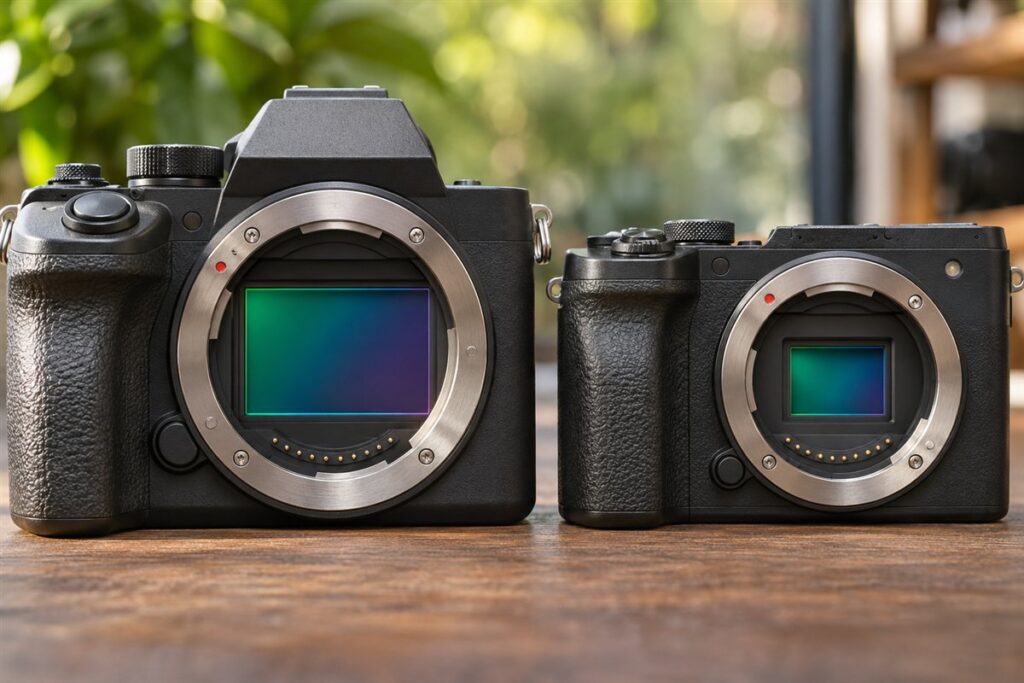
A full frame sensor is about the size of a classic 35 mm film frame, while an APS-C sensor is smaller. Both make excellent images. The larger sensor gathers more light and gives a wider view with the same lens, but the smaller one usually means lighter, more compact gear. This guide covers the differences, a worked conversion, common cases and mistakes.
Definitions with Examples
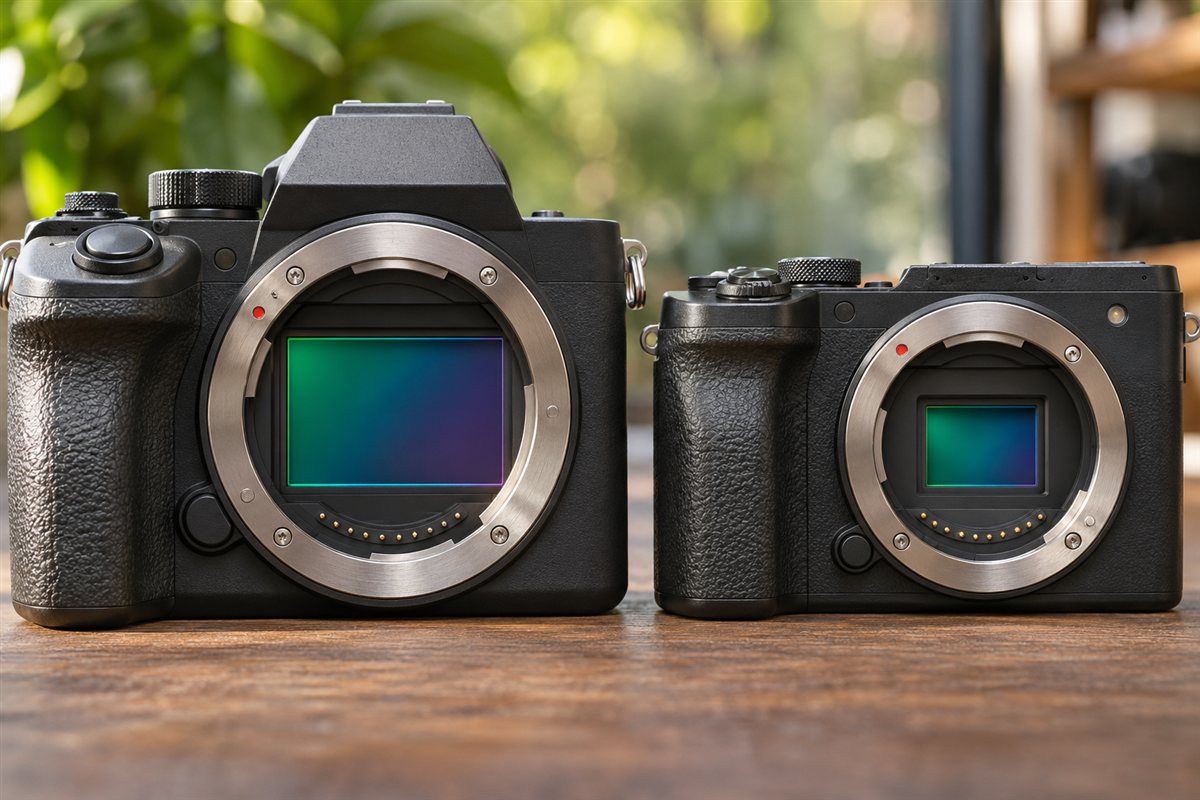
Full frame: measures roughly 36 by 24 millimeters. A 50 mm lens on a full frame body gives the natural view that lens is known for.
APS-C: measures a little over 22 by 15 millimeters, with exact figures varying by maker. The smaller area crops the view, so a 50 mm lens frames more tightly, as if it were a longer lens.
How the Difference Shows Up
- Field of view: APS-C looks tighter at the same focal length, which can help with distant subjects.
- Depth of field: full frame can give a softer background at the same framing and aperture.
- Low light: larger sensors collect more light overall, which can mean cleaner images in dim conditions.
- Size and weight: APS-C bodies and lenses tend to be smaller.
Side-by-Side Table
| Area | Full frame | APS-C |
|---|---|---|
| Sensor size | Larger | Smaller |
| Typical gear weight | Heavier | Lighter |
| Wide-angle views | Easier to achieve | Needs wider lenses |
| Reach for distant subjects | Less | More from the same lens |
| Lens range | Broad, often larger lenses | Broad, often compact lenses |
Who Should Choose Which
Choose full frame if you shoot in dim places, want very shallow background blur, or work with wide landscapes and interiors. Choose APS-C if you value portability, travel often, or want extra reach for wildlife and sports without hauling big lenses.
A key point: skill and lighting influence your results more than sensor size. Many professionals work happily with APS-C.
Cost of ownership is part of the story, too. Larger sensors usually pair with larger lenses, and those lenses can add weight to your bag and expense to your kit over time. If you already own lenses for one format, check the maker’s guide before changing, because adapters and mounts can limit autofocus or image coverage. A thoughtful plan avoids surprises.
When in doubt, try both formats in a shop and look at how each feels in your hand. Handling often settles the question faster than a long comparison.
Worked Example: Matching the Same Picture on Both Formats
Say you want the same framing on both sensors, using a typical crop factor of 1.5 for APS-C. Some makers use a slightly different factor, such as 1.6, so check the maker’s guide.
- Choose the full frame view you want, for example a portrait at 85 mm and f/2.
- Divide the focal length by the crop factor to find the matching APS-C lens: 85 divided by 1.5 is about 57 mm. A lens near 56 mm gives the same framing from the same spot.
- Match the depth of field by also dividing the aperture by the crop factor. f/2 divided by 1.5 is about f/1.4.
- Compare the light. Because the sensor is smaller, the APS-C camera gathers less total light for the same view, so noise may be slightly higher at the same ISO.
- Compare the size and weight of the lens you would carry for each, as the APS-C option is often smaller.
This is why a lens can feel different on each body without the glass itself changing.
Common Scenarios
Travel and hiking
Smaller bodies and lenses make long days easier. APS-C also offers extra reach without a very large telephoto.
Indoor events and weddings
Full frame helps in dim halls, where its larger sensor tends to produce cleaner images at high ISO. You will carry a little more weight.
Wildlife and sports
The crop factor makes a lens look longer, so a 300 mm lens behaves like about 450 mm on APS-C. That can be a major advantage for distant subjects.
Landscapes and architecture
Full frame offers easier wide views, although a wide lens on APS-C can do an excellent job. Dynamic range and detail depend on the specific sensor.
Mistakes to Avoid
- Assuming full frame guarantees better pictures. Light, composition and technique matter more.
- Buying lenses before choosing a mount. Lenses are tied to a system, so plan the system first.
- Forgetting that crop factor affects wide lenses. A 24 mm lens becomes about 36 mm on APS-C, which is no longer very wide.
- Using a full frame lens on APS-C without thinking about its size. You may carry more glass than your camera needs.
- Ignoring file size. Full frame bodies with many pixels create large files that need more storage and a faster computer.
Care and Upkeep Over Time
Larger sensors show dust more easily because more of the surface is exposed. Change lenses quickly, with the camera pointing down and away from wind. Use a rocket blower for light dust, and have a professional clean the sensor if specks persist.
Keep lenses capped and stored in a dry place. Note which lenses you own for each format, and keep your firmware updated through the maker’s guidance.
Quick Troubleshooting
| Symptom | Likely cause | What to try |
|---|---|---|
| Lens looks tighter than expected | Crop factor on a smaller sensor | Divide the focal length by the crop factor to find a wider match |
| Dark corners with a lens | Lens built for a smaller sensor on a larger one | Use the crop mode or a lens made for the sensor |
| Not enough background blur | Small sensor or narrow aperture | Open the aperture, move closer to the subject or increase subject-to-background distance |
| Images noisy in dim rooms | High ISO on a smaller sensor | Use a faster lens, add light or slow the shutter on support |
| Bag feels too heavy | Large full frame lenses | Carry fewer lenses or consider compact primes |
Glossary
- Sensor: the chip that records the image.
- Crop factor: how much smaller a sensor is compared with full frame, used to compare views.
- Field of view: how much of the scene appears in the frame.
- Depth of field: the range of distance that appears sharp.
- Image circle: the area a lens projects, which must cover the sensor.
- Mount: the connection between lens and camera.
FAQ
Can I use full frame lenses on an APS-C body?
Usually yes within the same mount, and the view will be cropped. Lenses made only for APS-C may not cover a full frame sensor, so check the maker’s guide.
Is full frame worth the extra investment?
Only if its strengths match what you shoot. If you rarely work in dim light or need extreme background blur, APS-C may serve you well.
Does APS-C mean lower image quality?
Not necessarily. Modern APS-C sensors produce excellent images. The difference appears mostly in very dim light and in extreme background blur.
Will an APS-C lens work on a full frame body?
Often the camera switches to a cropped mode, which uses only part of the sensor. This reduces the image size, and some lenses show dark corners if used uncropped.
Which format is better for video?
Both work well. Full frame can give a shallower background and better low-light results, while APS-C gives lighter kits for handheld shooting. Check the specific video features in the maker’s guide.
Do crop factors apply to aperture?
The lens aperture itself does not change, but the depth-of-field look and total light gathered do differ between formats. Equivalent comparisons divide the f-number by the crop factor to compare the blur.
The Short Version
Full frame offers larger sensor area, wider views and softer backgrounds. APS-C offers smaller kit and extra reach. Choose by what you photograph and how much you want to carry, not by sensor size alone.