The Fujifilm X100VI and the Ricoh GR IV are fixed-lens compact cameras aimed at enthusiasts who value portability and image quality. The X100VI is the larger, dial-driven option with a viewfinder, while the GR line has long focused on being as small and quick as possible.

What Each Camera Is For
The X100VI continues Fujifilm’s long-running X100 series. It features a fixed lens, a hybrid viewfinder and film simulations, and it is often chosen for travel, street and everyday photography.
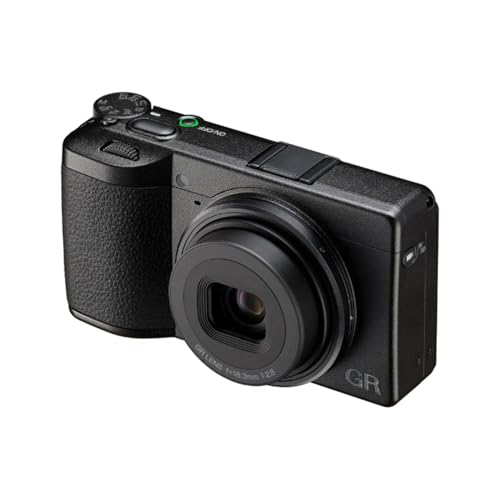
The GR IV belongs to Ricoh’s GR family, which is known for slim bodies, a wide fixed lens and a street-ready design. Because details of this newer model are best taken from the maker, treat the table below as a general guide based on the series, not a spec sheet.
In this guide
Key Differences
| Trait | Fujifilm X100VI | Ricoh GR IV |
|---|---|---|
| Series character | Retro, dial-led, viewfinder-equipped | Slim, pocketable, wide lens |
| Typical use | Travel, documentary, portraits | Street, snapshots, daily carry |
| Handling | Aperture ring and top dials | Compact grip and button layout |
| Lens | Fixed | Fixed |
Check the Ricoh page for the exact sensor, lens, stabilization and battery details of the GR IV, and the Fujifilm page for the X100VI. Do not rely on older model descriptions for the current features.
Decision Criteria
- Pocket test: Think about whether the camera has to fit in a trouser pocket every day.
- Viewfinder: The X100VI series is known for its hybrid finder, which suits people who dislike screen-only shooting.
- Field of view: Choose based on the focal length you use most, not just the body.
- Handling style: Dials and rings suit slower, deliberate work; a minimal body suits quick snapshots.
- Accessories: Look at what filters, converters and cases exist for each camera.
Because fixed-lens cameras cannot change focal length, your choice commits you to a single way of seeing. Before buying, look through your own photo library, sort by focal length and see which field of view you used most. That quick exercise often settles the question better than any list of features, and it costs nothing.
How to Decide Step by Step
- Write down the places you will carry the camera, such as city streets, hikes or trips.
- Decide whether a viewfinder is essential.
- Read the current maker pages for both models.
- Compare accessory options and case sizes.
- Handle each camera, if possible, before committing.
Choosing Your Focal Length Honestly
A fixed-lens camera makes one decision for you, and that decision is the focal length. The two cameras are known for wide lenses, but they are not necessarily identical in view, so check the maker pages for the exact field of view of each. The question is not which camera is better but which view suits the way you see.
A moderately wide view is a classic choice for street photography, travel and documentary work. It lets you include context, such as buildings, signs and people, in the frame. An even wider view fits tight interiors, architecture and dramatic landscapes, but it can distort faces near the edges and demands more care about composition. A slightly tighter view helps with portraits and candid scenes, since it flattens perspective a little and lets you stay farther from your subject.
To make a good choice, review your existing pictures. If you use your phone, check which lens you reach for most. If you have a camera with a zoom, sort images by focal length. Note which view feels natural and which you struggle with. You can also practice by holding a cardboard frame cut to the proportions of a camera, or by using a phone feature that shows a crop, to simulate each field of view while you walk around.
- Choose the view that you will use most, not the one that looks impressive.
- Remember that cropping is possible if the sensor has enough pixels.
- Check whether the maker offers a converter for a different view, and what it costs in size and quality.
Pocketability in Practice
The word pocketable is used loosely, and it deserves a closer look. A camera that technically fits in a pocket may still feel awkward there, snag on the fabric or print through a slim jacket. Consider what you wear and carry in daily life. A trouser or jacket pocket, a small sling bag and a coat pocket each have limits.
Compare the physical dimensions on each maker’s page, and also consider the shape. A slimmer body with few protrusions slips in and out easily, while a camera with a pronounced grip, a thicker lens barrel or a lens that extends can catch. Weight matters too. A heavier camera in a pocket can pull on a waistband or bounce while you walk.
The ability to grab the camera quickly is part of the equation. A camera that you can take from your pocket, turn on and use in a second is more likely to capture fleeting moments. Check startup time and how the camera behaves when you switch it on, and whether the lens needs to extend before shooting.
Think about protection, too. A camera carried loosely in a pocket can pick up lint, keys and scratches. A soft pouch or a case keeps it safe, though it adds bulk.
- Try each camera in the pockets of the clothes you wear most.
- Think about how often you truly want to carry it everywhere.
- Pick a strap style that works with your habits, such as a wrist strap.
Viewfinder Versus Screen Shooting
How you frame an image affects both your results and your enjoyment. A viewfinder lets you raise the camera to your eye, which steadies it and blocks distracting glare. It also gives a sense of focus on the scene, which many photographers prefer. A screen-only camera is held out in front of you, which makes it faster to raise and less obtrusive for some people, but harder to see in bright light and a little less steady at slow shutter speeds.
Think about the light where you shoot. In strong sun, a screen can wash out, forcing you to shade it with your hand or guess at framing. In dim conditions, a viewfinder can be brighter and easier to read than a screen. If you wear glasses, check that the viewfinder is comfortable and shows the full frame.
Consider also the social effect. Some people find a camera held to the eye more noticeable, while others find a screen held at chest height draws less attention. Neither is universal; it depends on the setting and the people around you. Street photographers use both methods, sometimes switching to a quick hip shot with a wide lens.
- If you often shoot outdoors in bright light, favor a viewfinder.
- If you prefer fast, casual snapshots, a screen-based approach may be enough.
- Check whether the camera offers a screen that tilts for low angles.
Use a short trial to find which method you enjoy more, because that preference is hard to predict from a spec list.
Speed of Operation and Snapshot Habits
For this type of camera, the speed from thought to picture can matter more than any single spec. Consider how quickly the camera starts up, how fast it focuses, and how many steps it takes to change an important setting. A moment on the street passes in a second, and a camera that makes you dig through menus will miss it.
Learn about the shortcuts each camera offers. Some provide a snap focus feature, in which the camera pre-sets focus at a chosen distance so you can shoot instantly. Others rely on strong autofocus. Custom buttons, quick menus and dial functions can be set to your most used actions, such as switching between aperture priority and manual, or toggling exposure compensation. Check the manual to see what can be assigned and how many steps each change takes.
Practice with the camera until operating it becomes automatic. Set the camera to a simple starting mode, such as aperture priority with auto ISO, and a chosen maximum ISO. Learn how to adjust exposure compensation without looking. Practice raising the camera and taking a shot in a single motion.
- Choose a consistent set of default settings.
- Learn to shoot at a fixed distance or zone when speed matters.
- Review your pictures later to see which habits produce the best results.
Accessories, Care and Long-Term Ownership
A compact fixed-lens camera needs few accessories, but a few choices improve the experience. A good strap or wrist loop is the first priority, since a dropped camera is a common source of damage. A protective case or pouch that suits your carrying style helps prevent scratches, and a spare battery gives you freedom on long days. Check the maker’s pages for compatible filters, hoods and converters, and be wary of third-party items unless they clearly state compatibility.
The fixed lens and sensor share one body, so dust on the sensor can be more troublesome, as you cannot swap lenses to isolate the problem. Keep the camera off when changing batteries or cards in dusty places, and store it in a clean bag. If dust spots appear in your pictures, take a test shot of a plain surface at a small aperture to check, and consult the manual or a service center before attempting a cleaning.
Keep firmware up to date, following the maker’s instructions. Check the battery condition over time, and replace it when capacity drops noticeably. Clean the front element gently, as described in the manual, and avoid touching it.
Signs that it is time to replace the camera include a lens that no longer focuses accurately, a mechanism that jams, a screen that fails, or a persistent loss of image quality. Compare the cost of repair with the cost of a replacement before deciding.
- Back up your pictures often, because small cameras are easy to lose.
- Write your contact details inside the case or on the strap.
- Keep the box and receipt for warranty claims.
A Week-Long Trial Plan for Choosing a Compact
Fixed-lens compacts are very personal tools. Two cameras that look similar on a spec sheet can feel completely different in the hand and in the habits they encourage. Before you commit, try to simulate ownership for a week, even if that means borrowing, renting or handling the cameras in a shop several times. Here is a plan you can adapt.
- On day one, write down the kinds of pictures you want: street scenes, family moments, travel, documentary or quiet details.
- On day two, hold each camera and note how it fits your hand, whether the controls fall naturally under your fingers and how the weight feels in a coat pocket.
- On day three, shoot the same scene with both, noting how quickly you can get a usable frame.
- On day four, try them in dim light and in strong contrast, and look at the files on a larger screen.
- On day five, carry each one all day without a bag, and ask yourself which you reached for more often.
- On day six, go through the menus and see how easy it is to change the settings you use most.
- On day seven, decide which camera you would take on a short trip, and explain why in two sentences.
Even a rough version of this trial shows what charts cannot, namely how a camera makes you behave.
Mistakes People Make When Buying a Premium Compact
Fixed-lens cameras involve a compromise, and misunderstanding it leads to regret. Watch for these slips.
Buying without testing the field of view
The built-in lens fixes your perspective. Take a prime lens or a phone set to a similar view for a few days and check whether it suits your style.
Expecting zoom flexibility
You will move your feet instead of your zoom ring. If that frustrates you, a different type of camera may be a better fit.
Overlooking accessories
Filters, hoods, grips and cases change how the camera handles. Read the maker pages to see what is available and what is included.
Ignoring availability and support
Popular compacts can be hard to find at times. Be careful with sellers you do not know, and check warranty and service arrangements.
Forgetting battery and card planning
Small bodies often use small batteries. Carry a spare and learn how the camera charges.
Comparing Two Philosophies of the Pocket Camera
These cameras share a basic idea but express it differently. The table summarizes areas worth examining. For exact specifications, always consult the maker pages, because details can change.
| Area | What to compare | Why it matters |
|---|---|---|
| Size and shape | Dimensions, grip and weight | Determines how often it goes in a pocket |
| Lens view | Equivalent focal length and aperture | Sets your natural framing and low-light ability |
| Viewfinder | Built-in, optional or none | Changes how you hold and compose |
| Controls | Dials, rings and customizable buttons | Affects speed and enjoyment |
| Image character | Color rendering and file options | Influences editing needs |
| Stabilization and focus | Built-in systems and modes | Impacts keeper rates in low light |
| Ownership | Accessories, availability and service | Shapes long-term satisfaction |
If a feature on this list does not matter to you, skip it. The best camera is the one that matches your priorities.
A Glossary of Compact Camera Terms
- Equivalent focal length: the field of view expressed as if the lens were on a full-frame camera.
- Leaf shutter: a shutter built into the lens that can allow flash at faster speeds and tends to be quiet.
- Snap focus: a mode that sets focus to a chosen distance for quick shots.
- Zone focusing: pre-setting focus to cover a range of distances.
- Hybrid viewfinder: a viewfinder that can switch between optical and electronic views.
- ND filter: a filter that reduces light so you can use wider apertures or slower speeds in bright conditions.
- Film simulation or image control: a preset that alters color and tone in the image.
- Crop mode: a feature that uses a smaller part of the sensor to simulate a different focal length.
With this vocabulary, spec sheets and tutorials become easier to read.
Decision Guide by Shooting Style
- Street and candid work: favor discretion, quick focus and a size you will not mind carrying all day.
- Travel and family: think about versatility, battery life and ease of sharing.
- Quiet documentary photography: look for a camera that disappears in the hand and keeps controls simple.
- Enthusiast with other cameras: consider how the compact complements your main system.
- Beginner learning composition: a fixed view can be a useful teacher, but be prepared for a learning period.
Care, Setup and Long-Term Ownership
Treat a compact with respect. Keep the lens clean, use a cap or hood, and avoid carrying it loose with keys or coins. Update the firmware as the maker recommends, and set up custom buttons to match your style. Dust on the sensor can be a concern on cameras with fixed lenses, so follow the maker guidance for cleaning and ask a service center if you notice spots. Store spare batteries in a protective pouch, and back up your files on a regular schedule.
Learning One View Well
A fixed lens trains your eye. Instead of zooming, you walk closer, step back and look for the position that makes the scene work. Give yourself a month to learn the angle of view. Carry the camera everywhere, take a handful of pictures each day and look them over weekly, looking for patterns in framing. You will begin to see compositions before you raise the camera, and you will know instinctively how far to stand from a subject. Many photographers find this constraint freeing, because it removes one decision and lets them focus on light, timing and people.
Everyday Carry Habits
Because these cameras go with you, small habits matter. Use a wrist strap or a slim neck strap that does not snag on clothing. Keep a lens cap or hood in place when the camera is in a pocket, and avoid placing it with keys or coins. Pack a spare battery in a small pouch, and carry a memory card case with at least one extra card. Wipe the lens with a microfiber cloth before important shots. At home, store the camera in a dry place, and charge batteries using the method described by the maker. A little care keeps a small camera ready for years.

Ready to Buy? Start Here
If this guide helped you decide what to look for, these products are a place to start.

As an Amazon Associate we earn from qualifying purchases. Prices and availability are shown on Amazon.
Start With the Photograph, Not the Product Page
These two cameras share a sensor size and a fixed lens, and diverge on almost everything else, so the honest comparison begins with your photographs rather than their specifications. The Fujifilm frames the world at a classic, natural distance and asks to be operated: dials turned, finder raised, exposure chosen. The Ricoh frames the world wider and asks to be present: carried always, raised quickly, its lens preset to a distance so the moment is caught rather than constructed. If your favorite photographs were made by watching and waiting, the first temperament will feel like home. If your favorites were made by being inside the moment as it happened, the second will. Product pages cannot make this judgment for you, and it outweighs every other difference in this comparison, including resolution, stabilization, and price.
Because the GR IV is the newer entrant in a long-running line, treat its fine details as the maker’s to confirm: exact menus, modes, and refinements over its predecessor should be checked on Ricoh’s own pages before you buy, and this guide’s comparison is deliberately built on the durable character of the two lines, which is what a buyer lives with after the launch details are forgotten. The X100 line’s character is ceremony and the viewfinder; the GR line’s character is speed and disappearance. Generations polish those characters; they do not swap them.
The two fields of view, and what they do to people
The GR family’s wider lens includes more environment and exaggerates depth, which flatters places and makes people small within them unless you step close, and stepping close with a wide lens changes the social contract of a photograph: you are in the conversation, not observing it. The X100 family’s classic field of view keeps people at a natural proportion from a comfortable distance, which is why it has been the documentary and portrait photographer’s companion for so long. For travel, the wide lens swallows cathedrals and markets whole; for family, the classic lens keeps faces honest across a table. Most photographers lean one way within a single test roll, so if you can borrow either style of camera, or even simulate both with a phone’s lenses for a weekend, do that before you spend anything.
Handling, Speed, and the Shape of a Shooting Day
A day with the Fujifilm is punctuated by small, satisfying operations: the aperture ring clicks, the shutter speed dial turns, the finder comes to the eye. Photographers who love process find the day richer for them, and the camera’s stabilization and finder steadiness extend the day into dusk. A day with the Ricoh is punctuated by almost nothing: the camera is simply there, in the pocket, out for three seconds, back again, and the day’s photographs accumulate like notes in a diary. Neither day is better. They produce different archives, the first more considered, the second more continuous, and after a year the archive, not the specification sheet, is what you own.
Speed comparisons should be made at the level of the whole gesture, not the autofocus motor. The Ricoh’s preset-distance shooting removes focusing from the gesture entirely for street work, which is why its owners describe it as instantaneous. The Fujifilm’s gesture includes a half-press and a confirmation, slower in milliseconds and richer in control, and its autofocus is the more capable tool for portraits, moving children, and any subject where focus must be placed precisely rather than zoned. Choose the gesture that matches your subjects: zones for the street’s flow, precision for the portrait’s eyes.
Files, Color, and What Happens After the Shutter
Both cameras write files with generous editing room, so your post-capture habits should arbitrate. Fujifilm’s film simulations are a complete color philosophy in-camera; many owners share JPEGs the same evening with no editing session at all, which suits travel and family life beautifully. The GR line’s rendering is quieter, with color modes its owners prize for street work, especially in monochrome, and its raw files respond well to a consistent personal preset. If you edit everything, the difference narrows to taste. If you share straight from the camera, it may decide the purchase, so compare full-size galleries of your own subjects from both lines before deciding, and weight skin, foliage, and night scenes, where rendering philosophies show most clearly.
Resolution and cropping follow the same logic as elsewhere in this class: the fixed lens means cropping is your only zoom, so a higher-resolution file buys framing freedom after the fact. Photographers who compose tightly in camera need less of that freedom. Photographers who shoot fast and fix geometry later, the Ricoh’s street method often works this way, should weigh it more. Either way, technique dominates: a level, well-focused, well-exposed file from either camera prints larger and better than a careless file from a nominally superior sensor.
More Questions About This Pairing
Which camera should a street photographer choose?
The one whose method matches their street. Zone-focused, close, fast, and invisible points to the Ricoh; deliberate, finder-led, and comfortable at a classic distance points to the Fujifilm. Street photography has no single orthodoxy, and both cameras carry decades of serious work in their lineages. A weekend of shooting your own streets, with borrowed or simulated fields of view, will answer this more truthfully than any verdict.
Is the viewfinder worth the extra size?
For photographers who shoot in bright light, who wear glasses comfortably with it, or who simply think through a finder, yes: it steadies the camera, clarifies composition, and shuts out the world’s distractions. For photographers whose work is fast and social, the size is a real cost paid every day for a benefit used rarely. The viewfinder is the Fujifilm’s soul, so if it does not move you in a hands-on test, the camera’s case weakens considerably.
Which is the better travel camera?
The Ricoh for the traveler who wants a camera that is never a decision: it rides in a pocket on museum days, market days, and mountain days alike. The Fujifilm for the traveler whose photography is a purpose of the trip, who will carry a small bag happily and work scenes deliberately at dawn and dusk. Both have crossed the world in photographers’ hands; the difference is whether the camera is your companion or your instrument on the journey.
What should I verify about the GR IV before buying?
Confirm the details that generations change: the exact lens and focus features, the stabilization arrangements, the battery and charging method, and any changes to the controls and menus, all from the maker’s own documentation, and handle the camera if you can, because the GR line’s appeal is tactile and immediate. Launch-period information ages quickly, and a considered purchase checks the source rather than summaries of summaries.
Ownership Diaries: What a Year With Each Camera Teaches
Ask owners of either line what a year taught them and the answers converge on habits rather than specifications. The Fujifilm owner has usually become a more deliberate photographer: exposure set before the camera rises, compositions considered through the finder, and an editing folder full of finished-looking color that needed little work. They have also learned the camera’s boundaries, the subjects where its autofocus or its single field of view asks for help, and they have built techniques around those boundaries that feel like style. The Ricoh owner has usually become a more observant one: the camera was present for thousands of small moments a larger camera would have missed by being at home, and their archive reads like a diary of a year actually lived. They have learned to see at the wide field of view until it feels like their own eyesight. Both transformations are valuable, and both are available only to photographers who carry the camera constantly, which returns the decision, as always, to which camera you will actually carry.
Failure stories are equally instructive. The Fujifilm disappoints the owner who discovers they never use a viewfinder and shoot everything at arm’s length on the screen, because they are paying in size for the camera’s soul and not using it. The Ricoh disappoints the owner whose photography centers on their children’s faces across rooms and fields, because no technique fully substitutes for reach and a kinder field of view for portraits. Notice that neither failure is about image quality. Both are about fit between a life and a tool, which is why this comparison keeps returning to your archive, your subjects, and your carry habits as the court of final appeal.
Money, Timing, and Buying Either Camera Well
Fixed-lens premium compacts hold a peculiar place in the market: they are bought deliberately, kept long, and often sell used for strong prices when complete and clean. Buy either camera as a long-term instrument rather than a gadget: the complete kit, a sensible warranty where available, and accessories limited to a strap, spare batteries, and a case. If you are choosing the newer Ricoh at launch, confirm availability and the maker’s own listed details rather than relying on early summaries, and be patient through the first wave of scarcity pricing that popular compacts attract; the camera will be just as good when the frenzy passes. If you are buying the Fujifilm, compare new and excellent used examples honestly, because a well-kept used body plus a season of shooting is worth more than a new body bought with anxiety.
Whichever you choose, insure the decision with a return window and a first weekend of real shooting: your streets, your family, your light. Photograph the same walk with the new camera and with whatever you use now, and compare not just the files but your memory of making them. The camera that made you slower in a good way, or faster in a good way, is the one the comparison was always about. Specifications start arguments; weekends settle them.
Learning Curves: The First Month With Each
Budget a month to become fluent in either camera, and notice how differently the month is spent. The Fujifilm month is front-loaded with decisions: which simulation becomes home, how the control ring and buttons are assigned, when the finder shows lines and when it shows the electronic preview. Once made, those decisions disappear into habit, and the camera becomes an extension of a settled practice. The Ricoh month is front-loaded with distances: learning what its field of view includes from where you stand, which preset focus distance covers your street work, how close is too close for a face. Once learned, those distances disappear into the body, and the camera becomes an extension of your eyesight. Both months are enjoyable homework for a photographer who likes their tools, and both punish the owner who expects fluency on day one and blames the camera on day three.
Whichever month you choose, structure it: one outing devoted to the finder or the screen alone, one to the camera’s color or monochrome character, one to low light, and one to the subjects you actually bought it for, ending with prints or a shared album that forces honest review. The camera that survives its month with your enthusiasm intact is the right camera, and if neither does, the lesson, that your photography wanted a zoom or a system camera all along, was worth the month’s tuition.
The Verdict in One Honest Paragraph
Choose the Fujifilm if your photography is deliberate, your subjects are people and places at natural distances, and the act of operating a beautiful instrument is part of your pleasure; it will reward you with finished color, a peerless finder, and files that print with ease. Choose the Ricoh if your photography is opportunistic, your camera must live in a pocket to live at all, and your best pictures happen inside moments rather than in front of them; it will reward you with presence, speed, and an archive of a life actually witnessed. Refuse to choose by specification, because on paper these cameras are cousins, and in the hand, in the pocket, and across a year of days, they are different species of joy.
The Social Life of the Two Cameras
Cameras change the rooms they enter, and these two change them in opposite directions. The Fujifilm starts conversations: people recognize it as a serious, beautiful object, ask about it, and often pose a little more willingly and formally because the occasion feels marked. Photographers who work with willing subjects, portraits, weddings, editorial assignments, find this social presence an asset that never appears in a specification table. The Ricoh ends conversations about cameras entirely: it is beneath notice, mistaken for nothing in particular, and the room continues being itself, which is the entire point for the documentary and street photographer. Neither effect is universally good. The portraitist’s asset is the documentarian’s obstacle, and the honest buyer asks which rooms their photography lives in and how they want to be read when they raise a camera in them.
There is a third social consideration, the photographer’s own confidence. Some photographers shoot better when their tool feels significant in their hands, the way a musician plays better on an instrument that inspires them; others shoot better when the tool vanishes and only the seeing remains. Both responses are legitimate data about yourself, available free in any camera shop: hold each style of camera, raise it, and notice whether your attention goes to the camera or through it to the world. Buy the direction your attention prefers, because you will repeat that gesture ten thousand times.
Exercises That Reveal the Right Camera in a Weekend
If you can borrow either style of camera, or simulate both with the lenses on a phone, a weekend of three exercises will answer this comparison for your own photography. The first exercise is the market hour: one busy place, one hour, no deleting in camera. The wide pocket style will push you into the crowd’s flow and reward nerve; the classic finder style will reward the considered frame at the crowd’s edge. Count your keepers and, more importantly, notice which hour you enjoyed. The second exercise is the family table: photograph a meal and the people around it, in ordinary indoor light, without directing anyone. The classic field of view will flatter faces across the table; the wide lens will include the room, the food, and the chaos, and ask you to step into the scene. The third exercise is the evening walk: one neighborhood at dusk, still subjects and moving ones, where stabilization, finder comfort, and sheer carry-ability all report for duty at once. Review all three sets the following morning, at real size, with the ruthless question of which set looks like the photographer you are trying to become.
These exercises work because they sample your actual life rather than a test chart’s. Most failed camera purchases are not failures of research but failures of sampling: the buyer tested the camera against photography they admire rather than photography they do. A market, a meal, and an evening walk are unglamorous, and they are precisely the material of most archives, which is why a weekend spent on them predicts a decade of satisfaction better than any launch-day review.
The Long View: Skills Compound, Specifications Date
Five years from now, both of these cameras will have successors with better numbers, and the photographs you make this year with either will be indistinguishable in quality from the ones those successors would have made of the same moments, because moments do not wait for product cycles. What will differ is the skill you built: the zone-focus instincts from the pocket camera’s discipline, or the exposure fluency from the dial-led camera’s ceremony. Skills compound like interest and transfer to every future tool; specifications merely date. So buy the camera whose daily use teaches the lessons your photography most needs, commit to it for a full cycle of seasons, and measure the purchase not by how it compared on the day it arrived but by the archive that exists because it was in your hand, understood and trusted, when your life presented its unrepeatable frames.
A Closing Exercise in Honesty
Before you buy either camera, perform one final, slightly uncomfortable exercise: write down the last twenty photographs you took with any device and mark each with the camera in this comparison that would have made it better, and the one that would have made it harder. Tally without mercy. Most photographers discover the tally is lopsided in a way their reading never suggested, because reading flatters the photography we admire and the tally counts the photography we do. If the tally is close, buy on the tie-breakers this guide has offered, hands, pockets, finder, temperament, and never reopen the question. If the tally is lopsided, obey it even when it surprises you, especially when it surprises you, because it is the only data in this entire decision that was collected from your actual life. Cameras are bought with money but paid for in years, and the tally is how the years vote in advance.
What the Second Month Feels Like
Reviews end at the unboxing, but ownership begins at the second month, and the second month with either of these cameras has a recognizable shape worth anticipating. The novelty of the controls or the pocketability has faded, and what remains is the working relationship: the settings you no longer change because they have become yours, the subjects you now attempt because the camera invites them, and the one or two frictions that have survived every adjustment and must simply be accepted as the price of the tool’s virtues. Photographers who reach the second month with either camera and find the frictions small and the invitations large have chosen correctly, whatever the specifications said. Photographers who reach it still fighting the camera daily have information no review could have given them, and the healthy response is to act on it without shame, because the used market for both lines is kind and a camera is a tool, not a vow. Anticipating the second month while you shop, asking of every feature not how it demos but how it will feel on an ordinary Tuesday in month two, is the most adult question in this entire comparison, and asking it faithfully is nearly a guarantee against regret.
The Photograph That Settles It
Every photographer carries one imagined photograph that quietly governs their equipment choices: the frame they most want to exist. Say yours plainly. If it is a face you love, lit by a window, composed with care, the finder camera has been answering this entire comparison in the affirmative. If it is a stranger’s gesture on a night street, caught before it knew it was seen, the pocket camera has been doing the same. Equipment arguments dissolve in the presence of that one imagined frame, because it converts specifications into a story with you inside it. Buy for that photograph, forgive the camera its failures at every other kind, and go and stand where the photograph can happen. It is closer than the product pages suggest.
FAQ
Are both cameras good for street photography?
Yes, both are widely used for it. The right one depends on your preferred focal length and whether you want a viewfinder.
How can I find reliable specs?
Use the maker’s own product page and manual. Third-party summaries can be out of date or incomplete.
How do I decide which focal length suits me?
Review your own pictures and note the view you use most. Try the camera in a shop if you can, and check the maker pages for the exact field of view of each model.
Can I crop to get a tighter view?
Yes, to a point. A high-resolution sensor gives more room to crop, but cropping reduces pixel count and can limit large prints.
Is a viewfinder necessary for street photography?
No. Many photographers shoot with a screen, and others prefer a viewfinder for steadiness and glare. Choose the style that suits your habits and the light where you shoot.
What is snap focus?
It is a feature on some compact cameras that pre-sets focus at a chosen distance so you can shoot instantly. Check the manual for the model you are considering.
Do I need a case for a compact camera?
A soft pouch or case protects against scratches and knocks in a bag or pocket. Choose one that keeps the camera quick to reach.
How can I protect the sensor from dust?
Avoid changing batteries or cards in dusty places, store the camera in a clean bag and use a blower carefully. Persistent spots may need a service center.
Should I buy a spare battery?
Yes, it is wise for long days and travel. Choose a replacement that the maker lists as compatible.
The Short Version
Choose the X100VI if you want a viewfinder, tactile controls and a classic fixed-lens experience. Choose the GR IV if your priority is the smallest possible camera for daily carry. Confirm all current details with the makers before deciding.
