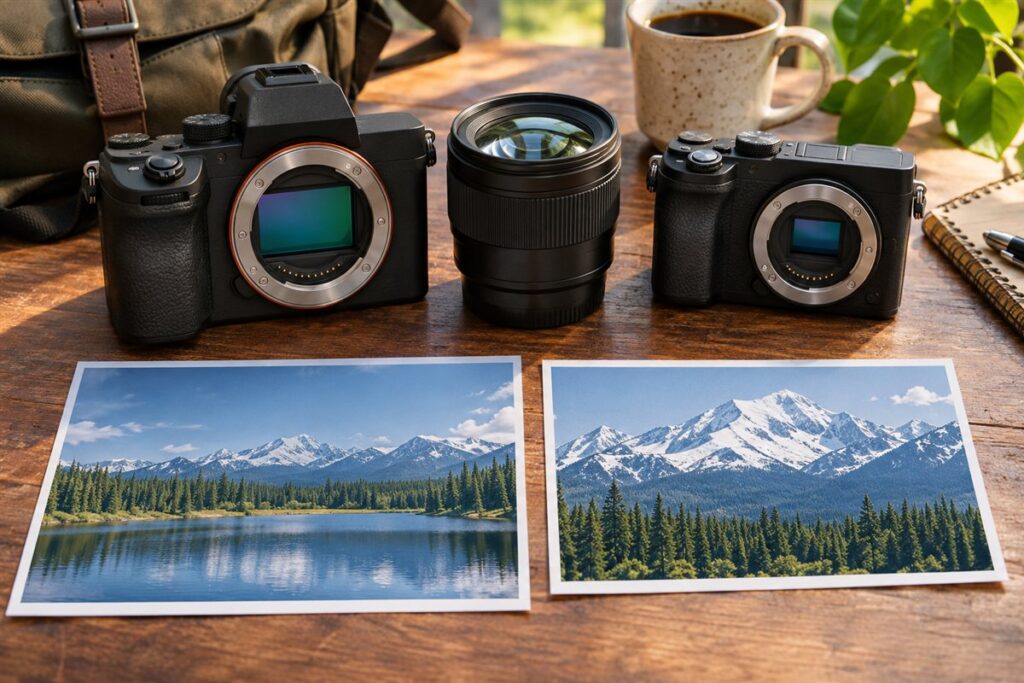
Crop factor is a number that compares a camera’s sensor with a full frame sensor. It tells you how much tighter a lens will look on a smaller sensor. Multiply the lens focal length by the crop factor and you get the full frame equivalent view, which makes it easy to compare lenses across different cameras. This guide adds worked examples, common situations, a troubleshooting table and a glossary.
The Basic Idea
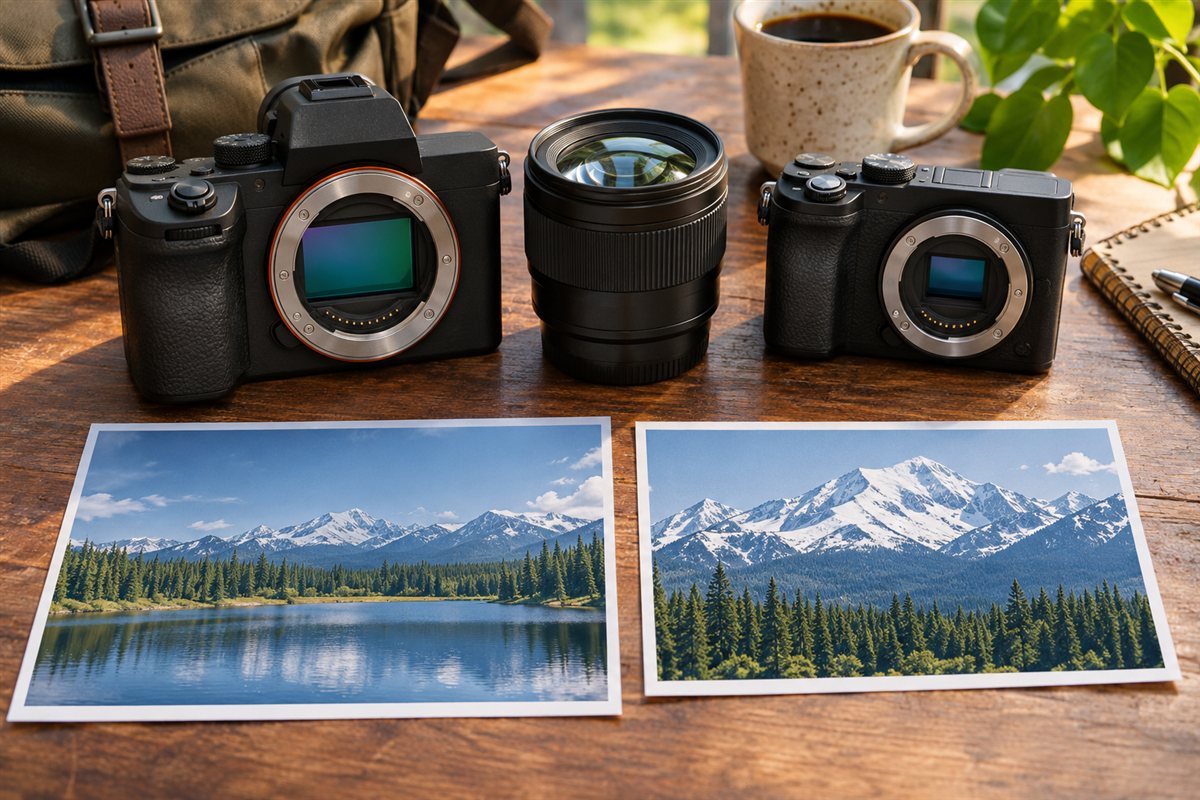
A lens projects a circle of light. A sensor records a rectangle inside that circle. A smaller sensor records only the middle part, so the scene appears magnified. Nothing about the lens changes. You are simply seeing less of the picture.
Crop factor is the ratio of the diagonal of a full frame sensor to the diagonal of your sensor. A sensor half that size has a crop factor of about two.
Common Values
| Sensor type | Typical crop factor | Example |
|---|---|---|
| Full frame | 1.0 | A 50 mm lens gives a 50 mm view |
| APS-C | About 1.5 to 1.6 | A 50 mm lens looks like about 75 to 80 mm |
| Micro Four Thirds | 2.0 | A 25 mm lens looks like about 50 mm |
Exact values vary a little by maker, so check the camera’s specification page.
Working It Out Yourself
- Find your camera’s crop factor in the maker’s guide.
- Note the focal length printed on your lens.
- Multiply the two numbers.
- Compare the result with full frame lenses to picture the view.
For example, a 35 mm lens on a body with a 1.5 crop factor gives a view similar to a 52 mm lens on full frame.
What Crop Factor Does Not Change
- The lens still has its own focal length and its own maximum aperture.
- Perspective depends on where you stand, not on the sensor.
- Depth of field and low light behavior do differ by sensor size, but those effects are separate from the field of view.
Some people also multiply the aperture by the crop factor to compare depth of field. This is a handy rule of thumb but not essential for beginners.
It helps to remember that crop factor is just a convenient comparison tool. Photographers who grew up with film use full frame as the reference, so the numbers feel familiar. Newer shooters can ignore the multiplier and simply learn how each lens frames a scene on their own camera. Experience with your own gear is the best teacher.
More Worked Examples
Practising the arithmetic a few times makes it automatic. Use the crop factors in the table above, and round to a sensible number.
- A 24 mm lens on a body with a crop factor of 1.5 gives a view like a 36 mm lens on full frame, a mild wide angle.
- A 18 mm lens on the same body gives about 27 mm, a wide view useful for rooms and street scenes.
- A 200 mm lens on a body with a crop factor of 1.6 gives about 320 mm, which helps with distant subjects.
- A 12 mm lens on a body with a crop factor of 2.0 gives about 24 mm, a wide view for landscapes.
- To go the other way, divide the view you want by the crop factor. If you want a 50 mm view on a body with a factor of 2.0, choose a lens near 25 mm.
Common Scenarios
Moving from full frame to a smaller sensor
Your old lenses will look tighter, so a favourite wide angle may feel less wide. Look for shorter focal lengths to recover the framing you remember.
Using full frame lenses on a smaller sensor body
Many lenses made for larger sensors work on smaller ones, where they simply show a narrower view because the sensor uses the central part of the image circle. Check the maker’s guide for compatibility and any adapter you need.
Wildlife and sports
A crop factor brings subjects closer in the frame without a longer lens. The trade is a narrower field of view, so tracking fast subjects can feel harder.
Landscapes and interiors
Wide views need short focal lengths on smaller sensors. Compare the equivalent angle, not the number printed on the lens, when you plan a purchase or a trip.
Comparing phone cameras
Makers often quote equivalent focal lengths because the actual lens is tiny. These figures already include the crop factor, so compare them directly with full frame numbers.
Mistakes to Avoid
| Mistake | Why it matters |
|---|---|
| Thinking the lens itself changes | The focal length stays the same, and only the visible area shrinks |
| Multiplying twice | If a figure is already stated as equivalent, applying the factor again overstates the view |
| Assuming perspective changes | Perspective depends on your position, not on the sensor |
| Ignoring the aperture effect | Depth of field and light gathering differ by sensor size, so equal f-numbers do not look identical |
| Using rounded numbers as exact | Real crop factors vary slightly, so treat results as a guide |
Quick Troubleshooting
| Symptom | Likely cause | What to try |
|---|---|---|
| Lens looks tighter than expected | Smaller sensor crops the view | Multiply the focal length by the crop factor to predict it |
| Cannot fit a room in the frame | Focal length too long for the sensor | Use a shorter lens or step back |
| Equivalent figures disagree | One is already equivalent, one is actual | Check which type of focal length each figure is |
| Dark corners with a lens made for a smaller sensor | Image circle smaller than the sensor | Use crop mode or a lens made for your sensor |
Terms Worth Knowing
- Full frame
- A sensor about the size of a traditional 35 mm film frame.
- Focal length
- The lens measurement, in millimetres, that largely sets the angle of view.
- Field of view
- How much of the scene the camera captures.
- Equivalent focal length
- The full frame focal length that would give the same field of view.
- Image circle
- The circle of light the lens projects, within which the sensor sits.
- Crop mode
- A camera setting that uses only part of the sensor for a tighter view.
FAQ
Does crop factor make my lens zoom in more?
It narrows the view, which looks like more zoom. The lens itself does not change, and you also lose the edges of the scene.
Do I need to think about crop factor with a phone?
Phone makers often quote equivalent focal lengths, which already include the crop factor, so you can compare them straight away with full frame lenses.
Does crop factor affect image quality?
Not directly. Sensor size influences light gathering and depth of field, but the crop factor itself is only a way of describing the field of view.
Why do some lenses say they are for smaller sensors?
Those lenses project a smaller image circle, sized for the sensor they are made for. On a larger sensor they may show dark corners, or the camera may crop automatically.
Is a bigger crop factor better for telephoto work?
It gives more reach for the same lens, but it also gives less light and less background blur than a larger sensor. Which matters depends on the subject.
How do I find my camera’s crop factor?
Look in the maker’s specifications, which often state the sensor size or the equivalent factor. If only the sensor dimensions are listed, comparing them with full frame dimensions gives the ratio.
The Short Version
Crop factor is a simple multiplier that shows how a lens will frame a scene on a smaller sensor. Multiply it by the focal length to find the equivalent view, and remember that it describes framing rather than any change in the lens. Check whether a quoted figure is already equivalent before you multiply.