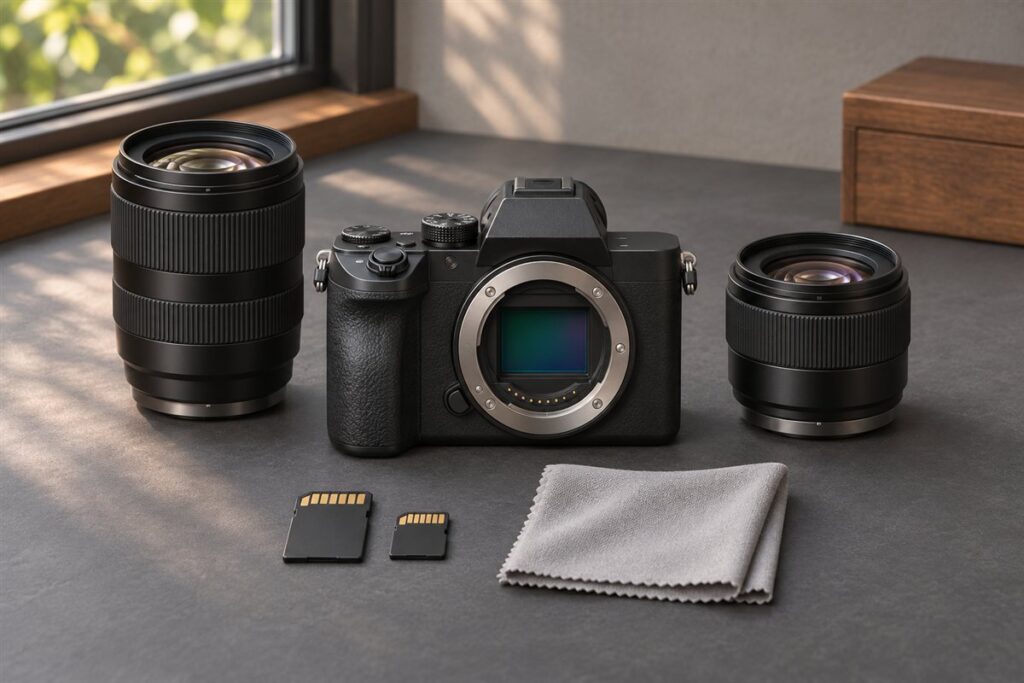
The Canon RF 24-70mm f/2.8 L IS USM is the practical standard zoom, while the RF 28-70mm f/2 L USM is a specialist lens built around an unusually wide constant aperture. Choose the 24-70 for everyday flexibility, a wider view and easier carrying; choose the 28-70 f/2 when shallow depth of field and low-light performance matter more than size. Confirm exact specs on Canon’s product pages.
What Sets Them Apart
Both lenses keep a constant aperture across the zoom range, which means your exposure settings stay put as you zoom. The difference is how wide that aperture is. An f/2 aperture lets in roughly twice the light of f/2.8, which allows faster shutter speeds or lower ISO in dim rooms, and it gives a softer background at the same framing.
The cost is size and handling. A lens with a very wide zoom aperture needs large glass, so the 28-70 f/2 is a bigger lens than the 24-70 f/2.8 and is meant for people who want that look badly enough to carry it. The 24-70 also opens a touch wider, with a 24mm view that suits interiors, groups and landscapes.
Comparison Table
| Trait | RF 24-70mm f/2.8 | RF 28-70mm f/2 |
|---|---|---|
| Wide end | 24mm | 28mm |
| Constant aperture | f/2.8 | f/2 |
| Image stabilization in the lens | Yes | Check Canon’s page |
| Size and carry | More compact | Larger, more deliberate |
| Strength | All-round flexibility | Low light and background blur |
Who Should Choose Which
- Choose the 24-70 f/2.8 if you shoot events, travel, family and landscape work and want one lens that is comfortable to carry all day.
- Choose the 28-70 f/2 if you shoot portraits, weddings in dim venues, or video where a wide aperture and shallow focus are a core part of your look.
- Choose the 24-70 if you often need a very wide frame for rooms or groups. The extra 4mm at the wide end is noticeable.
- Choose the 28-70 if you would otherwise carry several fast prime lenses and want one zoom to replace some of them.
Working With a Very Wide Aperture
These are general baselines, not fixed rules. At f/2, depth of field is thin, so focus accuracy matters.
- For a single portrait subject, try an aperture of roughly f/2 to f/2.8 and focus on the nearer eye.
- For two people, close down to around f/4 so both faces stay sharp.
- In dim rooms, keep the shutter speed at roughly 1/125 or faster for people who are moving a little, and raise ISO only as needed.
- In bright sun, a wide aperture can push the shutter speed past the camera limit, so a neutral density filter or a smaller aperture may be needed.
Depth of Field and the Look of f/2
The main reason to consider a zoom with an f/2 aperture is the look it produces. A wider aperture makes the zone of acceptable focus thinner and the background softer, which separates a subject from its surroundings. The effect depends on three things at once: the aperture, the distance to your subject and the distance from the subject to the background. A person standing close to the camera with a distant, cluttered background gives the strongest blur. A distant landscape shows almost no difference between f/2 and f/2.8.
That means the benefit is greatest for portraits, product shots, close-ups of people at events and video interviews, and almost irrelevant for scenery. If you mostly photograph wide scenes, the extra stop is mostly a cost you carry in weight and size rather than a gain you see in the picture.
It also helps to think about what you do with the thin focus. At f/2 on a close subject, the tip of a nose and the ears can fall out of focus while the eyes stay sharp. Some people love that, others find it hard to manage with a moving subject. Try your own camera at both apertures on the same subject and compare the results on a large screen. Remember that you can always stop down a lens, but you cannot open it wider than its maximum, so the f/2 lens includes the f/2.8 look in its range as long as you accept the weight.
Low Light and Shutter Speed Gains
One stop of extra light is the practical advantage you can count. In a dim room, it lets you double the shutter speed at the same ISO, or halve the ISO at the same shutter speed. For people who move a little, such as guests at a gathering or a speaker on stage, a faster shutter speed means fewer blurred frames. For video, it allows you to keep a standard shutter setting without raising the ISO as far.
A wider aperture also helps autofocus in some situations, because the camera sees a brighter image to work from. Check Canon’s notes and your camera manual for how autofocus behaves at lower light levels, since the details depend on the body.
Do not overstate the gain, though. Modern sensors perform well at high ISO, and good stabilization allows slow shutter speeds with still subjects. For many shooters, an f/2.8 lens combined with a high ISO setting delivers images that are entirely satisfactory. The extra stop matters most when you are already at the limits of your camera, such as wedding receptions, small theaters or evening events, and when you cannot use flash. If you often work with flash or in good light, the extra stop may rarely be used.
Size, Weight and Working Comfort
A lens you leave at home takes no photographs. Large aperture zooms are heavy and large because the optical design must collect a lot of light across the whole zoom range. Check Canon’s page for each lens’s weight and dimensions, and think about how long you carry your camera. A long wedding day, a full day of street photography or a hike will make small differences feel large.
Think about how the weight sits on your camera. A heavy lens on a small body can make the grip feel awkward, and some people add a battery grip or a hand strap. Consider your neck and shoulder, too: a heavy setup on a thin strap can dig in after an hour, and a wider strap or a sling design may help.
Handling extras also matter. Look at the filter size, because a large front element may need larger and costlier filters. Check whether the lens has a customizable control ring, switches for focus mode and stabilization, and a hood that locks securely. If you can, hold both lenses on your own camera for several minutes in a shop. A lens that feels slightly too heavy in the first minute will feel much worse by the end of an event. If you value discretion, such as in quiet venues or candid settings, remember that a very large lens attracts attention in a way a standard zoom does not.
Video and Hybrid Shooting Considerations
If you shoot video as well as stills, both lenses offer a constant aperture, which keeps exposure steady as you zoom. That is a practical advantage over variable-aperture zooms, which darken slightly as the focal length increases.
For video, think about the following points and verify them on Canon’s pages and in independent video reviews where available:
- Focus breathing: how much the field of view shifts when focus moves from near to far.
- Autofocus noise: whether the focus motor can be heard on the built-in microphone.
- Stabilization: whether lens stabilization works well with your camera’s own system for handheld footage.
- Control ring: whether it can be assigned to exposure settings for quiet adjustments.
- Zoom ring feel: whether it is smooth enough for gentle zooms without a motor.
A very wide aperture also demands good focus technique on moving subjects, because the thin depth of field is unforgiving. Use eye detection or subject tracking when your camera offers it, and test your technique before an important job. In bright conditions, an f/2 lens may need a neutral density filter to keep a standard shutter speed, which is another accessory to carry and another cost to plan for. If your video work is occasional, the f/2.8 lens will often be easier to live with.
Budget, Versatility and Thinking Ahead
Large-aperture zooms are significant purchases, so it helps to think about total cost of ownership rather than the sticker price alone. Consider filters, a good bag, a sturdy strap and insurance. A heavy lens may also justify a better tripod or monopod, and a lens that is hard to handle may lead you to buy support gear you would not otherwise need.
Versatility is worth weighing carefully. A standard zoom that can cover most of your work is valuable because you rarely miss a shot while changing lenses. A specialist lens that excels in one narrow situation is exciting but can sit unused for the rest of the year. Ask honestly how many of your recent paid or personal projects would have benefited from the extra stop.
Think about alternatives, too. If shallow depth of field is your main goal, a pair of fast prime lenses can offer wide apertures at a smaller size. If low light is your main problem, better stabilization, a flash or a faster body might solve it more cheaply. If you are unsure, renting the lens for a weekend is a low-risk way to learn whether the look and weight suit you. Finally, remember that lenses tend to hold value better than camera bodies, but condition and market demand vary, so check current listings before you assume a particular resale outcome.
FAQ
Is f/2 versus f/2.8 a big difference?
It is one full stop, which means roughly double the light gathered, and a visibly softer background when you are close to your subject. For distant scenes the look changes very little.
Can the 24-70 f/2.8 handle portraits?
Yes. At the long end and a wide aperture it gives pleasing background separation for most portrait work, just not as much as an f/2 lens.
Will the f/2 lens make every photo look blurry in the background?
No. Background blur depends on aperture, subject distance and how far the background is behind the subject. You can stop down to f/2.8 or beyond whenever you want a deeper zone of focus.
Is the 24-70 f/2.8 good for weddings?
Many photographers use this type of lens at weddings because it covers wide scenes, groups and portraits in one lens. In very dark venues the brighter f/2 lens offers more light, at the cost of size and weight.
Do I need image stabilization if I have a fast aperture?
A wide aperture helps with shutter speed, but stabilization helps with hand shake at slower speeds, especially for still subjects and video. They solve different problems, so check what your camera body and the lens each provide.
What filter size and accessories should I check?
Look at the front filter thread size on Canon's page, since larger lenses can need larger and more expensive filters. Also check whether a hood is included and whether the lens works with the accessories you already own.
Is an f/2 zoom a replacement for prime lenses?
It can replace some of them in convenience, but prime lenses may be smaller, lighter or offer even wider apertures. Decide by comparing the specific primes you would carry with the zoom's size and range.
Can I rent before buying?
Yes, renting is a good way to try size, handling and the look of the lens on your own camera. Check the rental terms and make sure you receive the exact model you want to test.
The Short Version
The RF 24-70mm f/2.8 is the sensible do-everything standard zoom, and the RF 28-70mm f/2 is for shooters who want prime-like light gathering in a zoom. Choose by what you value more: carrying ease and range, or the widest aperture available.