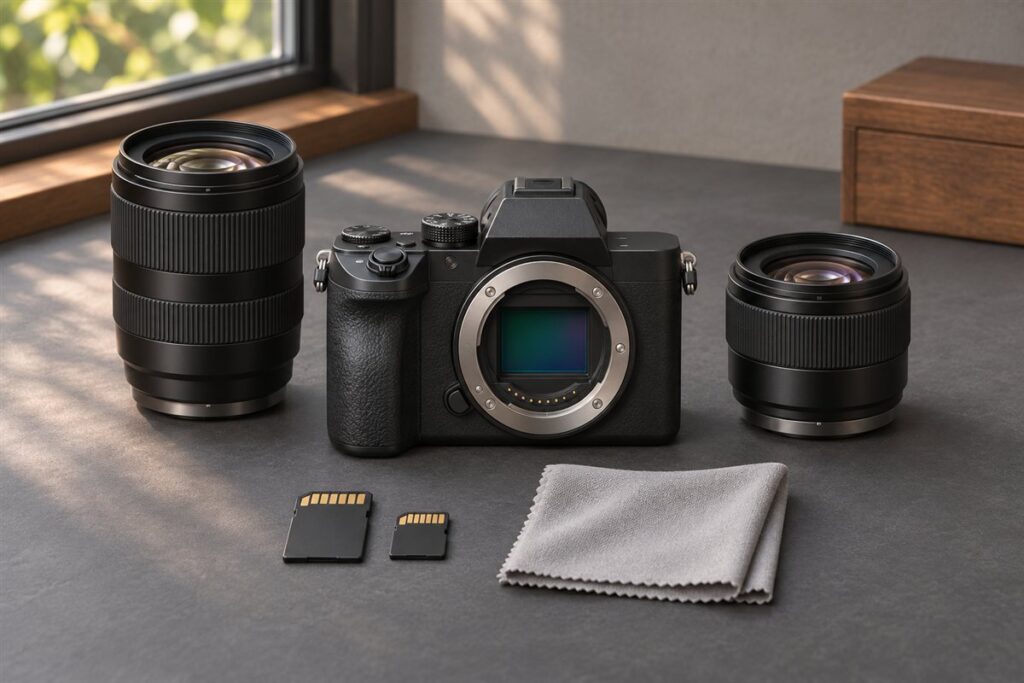
These two all-in-one zooms solve the same problem in different ways. The Canon RF 24-240mm f/4-6.3 IS USM gives you a wider view at the short end and a more modest reach, while the Nikon Z 28-400mm f/4-8 VR reaches much farther but is a little narrower at the wide end. Your camera mount decides most of this, so use the guide below to compare the traits that matter, then confirm exact specs on each maker’s page.
Two Different Takes on One Idea
A super-zoom exists to save you from carrying several lenses. Canon’s version focuses on a gentle, flexible range that handles travel snapshots, family events and everyday scenes. Nikon’s version stretches into serious telephoto territory, which opens the door to distant wildlife, sports from the sidelines and far-off landmarks.
The cost of any super-zoom is aperture. Both lenses get narrower as you zoom, and the Nikon narrows further at its long end. That means more reliance on good light, higher ISO settings and the built-in stabilization of the lens or camera body.
Where They Differ
| Trait | Canon RF 24-240mm | Nikon Z 28-400mm |
|---|---|---|
| Mount | Canon RF | Nikon Z |
| Wide end | 24mm | 28mm |
| Long end | 240mm | 400mm |
| Aperture range | f/4 to f/6.3 | f/4 to f/8 |
| Best fit | Travel, events, general use | Wildlife, sports, distant subjects |
The wide end matters more than it looks. A 24mm view fits a room, a group or a building more easily than 28mm does. The long end matters just as much: 400mm brings far subjects much closer than 240mm.
How to Choose
- Begin with your system. These lenses are made for different mounts, so most people will simply choose the one that matches their camera.
- Choose the Canon if you shoot interiors, groups and travel scenes, and rarely need a very long view.
- Choose the Nikon if distant subjects are a regular part of your photography and you accept a slower aperture at the long end.
- Think about light. At f/8, a dim day or an indoor arena asks a lot of the camera sensor.
- Think about handling. Long-reach zooms are usually larger and heavier, so check size and weight on the maker’s page.
Settings That Suit This Kind of Lens
These are general baselines, not rules. In daylight with moving subjects, a shutter speed of roughly 1/500 and faster freezes most movement at long focal lengths. For still subjects, a slower shutter speed works when stabilization is active, but it is wise to shoot a few extra frames. Let auto ISO handle exposure with a ceiling you are comfortable with, because a narrow aperture pushes ISO up in shade.
FAQ
Can I use one of these lenses on the other brand’s camera?
Not directly, because the mounts differ. Adapters exist for some combinations, but they can limit features, so check with the maker before assuming it works.
Is a super-zoom as sharp as separate lenses?
Generally, single-purpose lenses are designed for higher peak sharpness, while super-zooms trade some of that for convenience. For web sharing and standard prints, many people find the convenience worth it.
The Short Version
The Canon RF 24-240mm is the wider, more balanced travel lens, and the Nikon Z 28-400mm is the long-reach option for distant subjects. Choose the one that fits your mount first, then let your subjects decide how much reach you really need.