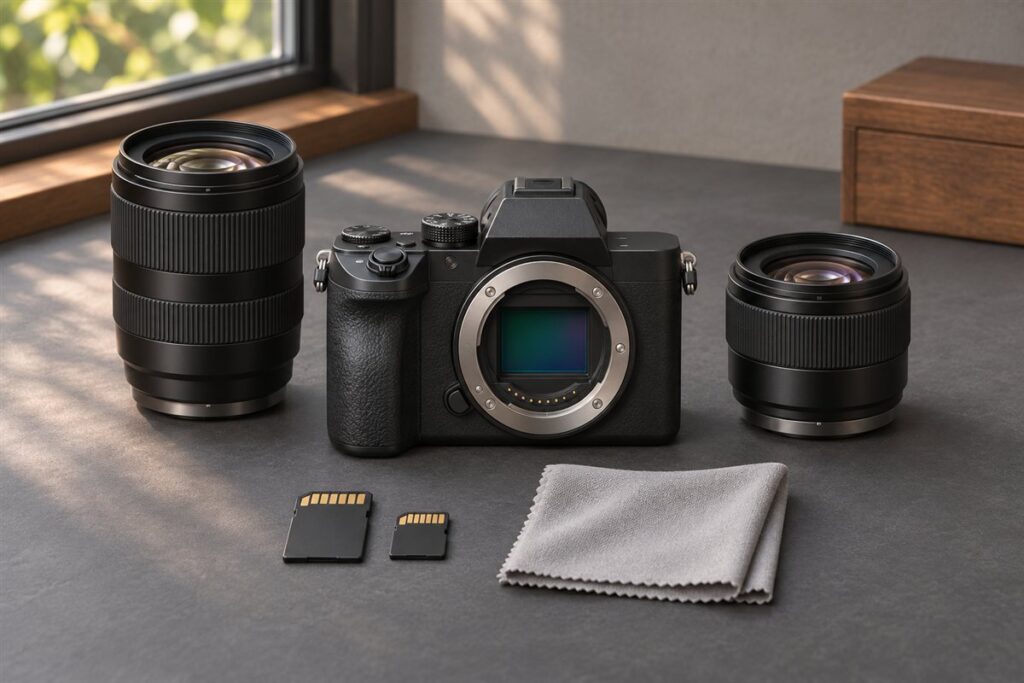
The Canon EOS R7 and the Canon EOS R10 are both APS-C mirrorless cameras in the RF mount, but the R7 is the more enthusiast-oriented body and the R10 is the lighter, simpler one. Choose by how much control and build you want, and confirm exact specs on Canon’s product pages.
Two Tiers of APS-C
The EOS R10 is a compact, lightweight camera that suits people stepping up from entry-level cameras. It has a friendly layout and is easy to carry. The EOS R7 sits above it in the lineup. It is aimed at enthusiasts who want a sturdier body, more physical controls and the features that wildlife and sports shooters often value.
Because both use APS-C sensors, they share the same lens reach advantage: telephoto lenses frame subjects tighter than they would on a full-frame body.
Differences at a Glance
| Trait | Canon EOS R7 | Canon EOS R10 |
|---|---|---|
| Lineup tier | Enthusiast APS-C | Lighter, simpler APS-C |
| Lens mount | Canon RF | Canon RF |
| Body | Larger, more controls | Smaller and lighter |
| Typical user | Wildlife, sports, serious hobbyist | Travel, family, step-up shooter |
| Learning curve | Moderate | Gentle |
Features such as stabilization, card slots and burst performance are worth checking on Canon’s specification pages for each model.
Who Should Choose Which
- Choose the R7 if you shoot moving subjects often, like birds or sports, and want a body with more dials and a sturdier feel.
- Choose the R10 if you want a light camera for travel and everyday use and do not need the extra controls.
- Choose the R7 if you plan to use larger telephoto lenses, where a bigger grip can balance better.
- Choose the R10 if you want to keep the whole kit small.
How to Decide
- Write down your main subjects and how often they move.
- Think about the lenses you plan to buy and how heavy they are.
- Hold both cameras to compare the grip and controls.
- Check Canon’s pages for any feature you consider essential.
Lens Planning
Both cameras work well with Canon’s compact RF-S lenses designed for APS-C, as well as RF lenses made for full-frame. If you expect to buy a long telephoto zoom, the larger R7 body usually feels better balanced. If you want a small walk-around kit, the R10 keeps the whole package light.
Autofocus and Subject Tracking for Action
If you are comparing these two bodies for birds, sports or pets, the autofocus system and how you set it up matter as much as the body itself. Both cameras offer subject detection modes according to Canon’s descriptions, but how many subject types are supported, how large the focus area is and how well tracking holds on difficult scenes are details to confirm on Canon’s pages and in the manuals.
Whatever the body, good technique helps tracking. Start by choosing a focus area size that suits the subject: a small point for a bird against a clean sky, a larger zone for a player moving through a crowd. Use continuous autofocus and a drive mode that fires bursts. Practice panning smoothly and keep the subject near the center of the frame at first, since tracking can struggle at the very edges.
Know the situations that confuse any system: busy backgrounds with branches, subjects that cross in front of each other, low contrast between subject and background, and flickering indoor lights. When tracking fails, switch to a smaller focus area or a different mode and try again.
It is also worth setting up a back-button focus arrangement if your camera supports it. Separating focus from the shutter button lets you stop and restart tracking without taking your finger off the shutter. Test your setups on moving friends or passing cars before the day that matters, and review the results at full size to see how many frames are sharp.
Wildlife and Sports Kit Planning
Action photography is as much about the lens and support as the body. Because both cameras use an APS-C sensor, a telephoto lens gives you a tighter view than it would on a full-frame body, which is a real advantage when subjects are far away. Think about the focal range you need before choosing a lens, and consider both the maximum aperture and the weight.
Plan your kit around these questions:
- How far away are your usual subjects, and can you get closer by changing your position?
- How much light do you usually have? Morning and evening call for wider apertures or higher ISO.
- How long will you carry the gear? A heavy lens can tire you quickly.
- Do you need a monopod, a tripod with a gimbal head or a bean bag for support?
Consider a rain cover, a lens hood and spare batteries and cards. Action shooting uses lots of power and fills cards quickly, so carry extra of both. Use fast cards that match the body’s requirements to avoid the buffer filling during long bursts.
Fieldcraft matters too. Learn the habits of the animals or the rhythm of the sport, arrive early, wear quiet clothing and keep your movements slow. A modest kit used with good technique beats expensive gear used carelessly. If you are unsure about spending on a large lens, rent one for a weekend and see whether you enjoy it.
Build, Weather Resistance and Handling in the Field
Handling decides whether you enjoy using a camera for hours. A sturdier body usually has a deeper grip, more dedicated dials and buttons, and a layout that lets you change settings without looking. A lighter body prioritizes carrying comfort, with a simpler arrangement that relies on menus and the touchscreen more.
Check what Canon states about weather sealing for each model. Terms like “dust and splash resistant” are not the same as waterproof, and the level of protection varies by model and also depends on the lens you attach. Use a lens with similar protection if you shoot in dust or rain, and use a cover in heavy weather. Never change lenses in the rain or on a sandy beach.
Hold both cameras with the lens you plan to use. Notice where your fingers fall, whether the buttons are reachable and how the weight balances. Try operating them with gloves if you shoot in cold conditions. Check the screen mechanics, as a movable screen helps with low angles for ground-level wildlife.
Think about accessories that improve handling, like a hand strap, a camera plate for a tripod or a grip extension. Customize the buttons so that frequently used functions such as focus mode, ISO and drive mode are within easy reach. After a few outings, adjust the layout based on what frustrated you, and write down your favorite settings so you can restore them.
Storage, Battery and Workflow for Burst Shooting
Burst shooting fills cards and drains batteries faster than casual use, so plan your workflow ahead. Check Canon’s pages for the card type and speed classes each camera supports and how many card slots it has. A second slot lets you record backups or split raw and JPEG files, which is a safety benefit during important events. If you have only one slot, carry several cards and swap them regularly.
Batteries drain quickly with continuous autofocus, a bright viewfinder and wireless features on. Carry spares and keep them warm in cold weather. Check how the camera shows remaining charge, and replace batteries before they reach empty at a critical moment.
After a shoot with hundreds of frames, you need an efficient way to sort them. Try these steps:
- Copy files to a computer and a backup drive before formatting the cards.
- Use a viewing program that lets you flag sharp frames quickly.
- Pick the best in each burst and reject the rest, to keep storage manageable.
- Apply consistent edits to the selected group, then export.
Be aware that long bursts produce large amounts of data, so make sure your drive has space. Label folders by date and subject. If you use the camera’s silent or electronic shutter modes, test them first, since fast motion and some lighting can cause distortion or banding. Keep notes on what worked.
Upgrade Paths and Resale Considerations
Choosing between these bodies is also a decision about how your kit develops. Because both use the RF mount, your lenses carry over if you change bodies later. That makes lenses the more important investment, and a sensible approach is to buy the body that fits your current needs and put extra money into good glass.
If you start with the lighter body and later find that you want more controls or a sturdier feel, you can sell it and move up while keeping your lenses. If you start with the higher-tier body and find it larger than you need, the same applies in reverse. Used prices depend on demand and condition, so treat resale as uncertain and do not count on a particular figure.
Keep your equipment in good shape to protect its value. Use a case, clean it carefully, and keep the original box, manuals and accessories. Register your camera for the warranty and retain the receipt. When you sell, honestly describe wear, include the shutter count if you can and use a platform that protects buyers and sellers.
Also consider whether a different system might suit you better at some point. Compare lens lineups, adapters and available sizes before committing deeply. Revisit your choice after a year of real use, asking whether the camera has limited you or whether the limit was technique. Make upgrades based on specific, repeated problems, not on a general sense that something newer must be better.
Which Canon APS-C Camera Should You Buy: R7 or R10?
Buy the Canon EOS R7 if handling, controls and long-lens balance matter most to you, and buy the Canon EOS R10 if low weight and a simple layout matter most. Both are APS-C bodies in the RF mount, so the choice is about how you will carry and operate the camera, not which lenses you can mount.
Match your situation to the body with this quick guide:
- You photograph birds, sports or pets regularly: go for the Canon EOS R7. A larger grip and more dedicated controls make it easier to change settings while following a subject.
- You mostly travel, shoot family events or walk around town: choose the Canon EOS R10. A lighter body stays comfortable over a long day.
- You plan to buy a big telephoto lens: the Canon EOS R7 usually balances better with heavy glass.
- You are moving up from a phone or an older compact: the Canon EOS R10 has the gentler learning curve.
- You want to keep the full kit small: the Canon EOS R10 paired with a compact RF-S lens is the lighter combination.
If you fit more than one profile, rank them by how often you do each activity. A camera that suits the thing you do every weekend will serve you better than one aimed at a rare trip.
Do not choose on the idea that the higher tier automatically produces better pictures. Technique, light and lens choice shape results as much as the body does. The R7 gives you more physical control and a sturdier feel; it does not replace knowing how to use autofocus and exposure well.
R7 or R10 for Everyday Photos and Travel?
For everyday photos and travel, the R10 is usually the easier camera to live with because it is smaller and lighter, while the R7 suits people who accept extra bulk in exchange for more control. The best way to settle it is to think about the last trip you took and what you carried.
A camera you leave at the hotel takes no pictures. If your bag already holds a jacket, water, a guidebook and a phone, every added bit of weight counts. A light body with one compact lens fits in a small shoulder bag and does not draw attention in a market or a museum.
The R7 makes more sense if your trips are built around photography, such as a wildlife safari, a sports weekend or a hiking trip where you plan to shoot at dawn and dusk. In those cases you will probably carry a longer lens anyway, and the sturdier grip becomes a benefit rather than a burden.
Think about these everyday factors:
- How long do you carry the camera in one go, and on a strap or in a bag?
- Do you change settings often, or leave the camera in an automatic mode?
- Will you hand the camera to a friend or relative who wants simple operation?
- Do you need quick access to dials while wearing gloves or holding an umbrella?
If most of your answers lean toward simple and light, the R10 is the natural fit. If you keep wishing for a faster way to reach a setting, the R7 layout is likely to feel better. Confirm the exact differences in dials and buttons on Canon’s pages before you decide.
What to Check Before You Buy an R7 or R10
Before buying either camera, confirm what is in the box, which lens it comes with, and what the return and warranty terms are on the listing. Camera listings often offer body-only and kit versions, and mixing them up is the most common buying mistake.
Use this checklist:
- Body only or kit: check whether a lens is included, and which one. A kit lens is useful for starting out, but you may prefer to choose your own.
- Battery and charger: see whether a charger is supplied or whether charging happens through the camera. Plan to buy a spare battery either way.
- Memory cards: cards are usually not included. Check the card type and speed requirements on Canon’s pages, and remember that the two bodies may differ in slot count.
- Lens plan: decide whether you will use compact RF-S lenses, RF lenses designed for full-frame, or adapted EF lenses, and confirm compatibility on Canon’s pages.
- Seller and warranty: confirm that the listing states the warranty terms and who provides them, plus the return window.
- Condition: if buying used or open-box, ask about shutter count, cosmetic wear and whether the original accessories are included.
Also check practical details such as the strap, a protective case, a screen protector and a cleaning kit. These are small purchases, but forgetting them can delay your first outing. If you plan to shoot video, check the recording options and any time limits in the manual before assuming they suit your needs.
Is the EOS R7 Worth Paying More For, and Who Should Skip It?
The R7 is worth the extra investment only if you will use what it adds, namely more controls, a sturdier feel and better balance with long lenses. If you rarely shoot moving subjects and prefer a light bag, the R10 is the more sensible purchase and you can put the difference toward a better lens.
Be honest about the trade-offs. The R7 is larger and heavier, which can be tiring on long walks and less discreet on the street. It also has more controls to learn, which some beginners find unnecessary at first. The R10 is easier to carry and learn, but it has a smaller grip and fewer physical controls, so changing settings may mean using menus or the touchscreen more often.
Who should consider skipping the R7:
- People who shoot mostly landscapes, family snapshots or travel scenes in good light.
- Anyone who finds a small body more important than extra dials.
- Buyers whose budget is tight and who would have to compromise on lenses to afford the body.
Who should consider skipping the R10:
- Photographers who expect to use a large telephoto lens often.
- People who want to change core settings quickly without looking at a screen.
- Shooters who already know they want a sturdier body and will otherwise upgrade soon.
Lenses outlast bodies, and both cameras share the same mount. If you are torn, buy the body that fits your current habits, then invest in glass.
Choosing a Canon APS-C Mirrorless Camera: Your Next Step
The simplest way to pick between these two Canon APS-C mirrorless cameras is to write down your main subject, the lens you want, and how far you will carry the kit. That short list will point to one body in most cases.
If you still hesitate, handle both in a shop. Mount a lens similar to the one you plan to buy, hold the camera at eye level for a minute, and notice whether your hand tires, whether you can reach the key buttons, and whether the viewfinder feels comfortable. Those impressions are hard to judge from a listing.
Also ask what you will do when you outgrow the body. Because both use the RF mount, your lenses move with you, so the body choice is less final than it feels. Picking the one that gets you shooting this month is better than waiting for a perfect answer.
Compare the two cameras above, check the current listing for what is included and the warranty and return terms, then choose the one that fits how you will use it. Use the buttons above when you are ready to view the listing.
FAQ
Do they use the same lenses?
Yes. Both use the RF mount, so RF lenses work on either one, as do EF lenses with an adapter.
Is the R10 a good first mirrorless camera?
It is a common choice for people moving up from a smaller camera, thanks to its light weight and approachable controls.
Can the R10 handle wildlife photography?
It can work well in good light with a suitable lens, but compare the speed and tracking details on Canon's pages. The R7's handling is often favored for long lenses.
Do I need two card slots?
Not strictly, but a second slot gives a backup for important events. Check Canon's specification pages for the slots on each model.
Is APS-C good for telephoto work?
The smaller sensor gives a tighter field of view with the same lens, which helps reach. Image quality in low light depends on the sensor and lens, so check samples.
How do I stop my camera from filling the buffer?
Use fast cards, avoid holding the shutter down for long, and shoot in shorter bursts timed to the action. Check the manual for buffer behavior.
Should I shoot in raw for action?
Raw gives more editing flexibility but uses more storage. Choose based on how much editing you plan to do and how much storage you have.
Do I need a gimbal head?
For heavy lenses on a tripod, a gimbal head can make panning smoother. For lighter setups, a monopod may be enough.
Will lens stabilization work with the body's stabilization?
Canon's pages describe how the systems work together on each camera and lens. Check the combination you plan to use.
Is the Canon EOS R7 better than the R10 for beginners?
Not necessarily. The R7 offers more controls and a sturdier body, but the R10 is lighter and has a gentler learning curve. Beginners who want an easy start often prefer the R10, while those who expect to grow into action photography may prefer the R7.
Which Canon APS-C camera is lighter to carry?
The Canon EOS R10 is the smaller and lighter of the two. Check Canon's specification pages for the exact weights, and remember that the lens you attach adds to the total.
Can I use full-frame RF lenses on the R7 and R10?
Yes. Both bodies use the RF mount, so RF lenses made for full-frame cameras fit, as do compact RF-S lenses. On an APS-C body, the field of view is tighter than on full-frame.
Should I buy a camera kit or body only?
A kit makes sense if you need a lens right away and want a simple start. Body only suits buyers who already own lenses or want to pick a specific one. Read the listing carefully to see exactly what is in the box.
Do I need a spare battery for the R7 or R10?
A spare battery is a good idea, especially for action, travel or video. Continuous autofocus and screen use drain batteries faster. Make sure any spare is the type listed for your model.
Is it worth buying a used R7 or R10?
It can be, if the seller describes the condition honestly and offers a return option. Ask about shutter count, check the lens mount and buttons, and confirm that the accessories are included.
What lens should I buy first for an APS-C Canon body?
Choose based on your main subject. A compact standard zoom suits general use, while a telephoto zoom suits wildlife and sports. Think about weight, since a heavier lens suits the larger R7 grip better.
The Short Version
Choose the Canon EOS R7 for a sturdier, more capable APS-C body suited to action and long lenses. Choose the Canon EOS R10 for a lighter, simpler camera that is easier to carry. Both share lenses, so the decision is about body and handling.