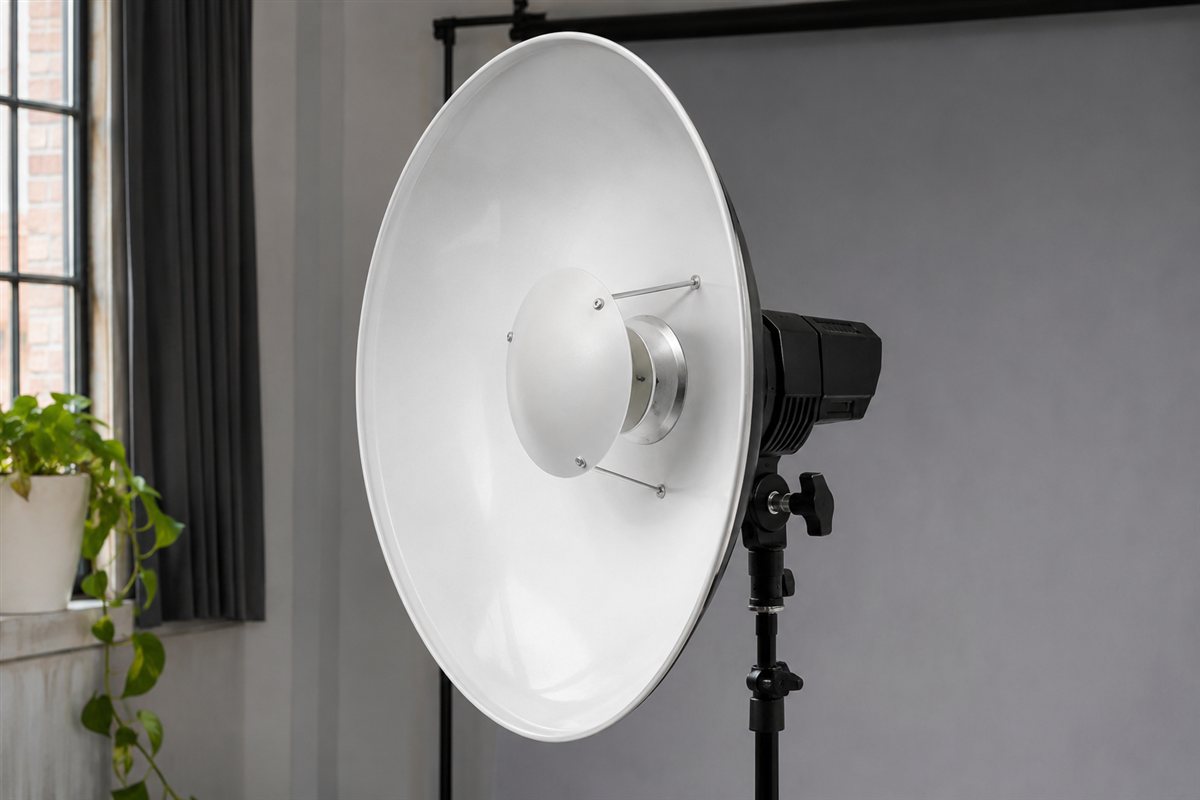
A beauty dish is a shallow reflector with a central plate that sits in front of the flash. It produces a crisp but soft light often used in portraits and fashion work. White interiors give a slightly softer, more even result than silver, which makes them a popular choice for skin tones. Compatibility with your lights is the first thing to check.
We have not used these products ourselves, so this guide does not claim personal experience with any of them. Instead it shows how to choose: which features matter, what to confirm on a product page, and which common mistakes to avoid before you buy. Think about your flash or strobe mount, your studio space and how you shoot, then compare dishes on size, build and accessories. Look at sample portraits shot with a white dish to judge the quality of light you like, and keep in mind that the wall and ceiling color around your set will also change the final look.
As an Amazon Associate we earn from qualifying purchases. Links on this site are affiliate links, and they do not change the information we give.
In this guide
Quick Picks
| Pick | Product | Best For |
|---|---|---|
| Best Overall | Glow EZ Lock 34″ Collapsible White Beauty Dish (Bowens) | Big soft light that folds down for location work |
| Best for Multi-Light Studios | Westcott Beauty Dish Switch 36″ (White Interior), by Manny Ortiz | One dish that swaps mount inserts between brands |
| Best Compact Metal Dish | Godox BDR-W420 42cm White Beauty Dish | Small rigid Bowens dish for tight spaces |
| Best for Profoto Users | Profoto OCF Beauty Dish White 2′ | Folding white dish made for Profoto OCF lights |
| Best Classic Studio Dish | Paul C. Buff 22″ High-Output Beauty Dish, White (22HOBD-W) | Traditional 22-inch metal dish for PCB lights |
Our Picks
1. Glow EZ Lock 34″ Collapsible White Beauty Dish (Bowens) — Best Overall
The EZ Lock 34 is the white dish that answers the most checkpoints in the guide above at once. It opens to 34 inches across and 15.5 inches deep, then folds umbrella-style on its 16-rib frame down to roughly 24.5 by 7 inches, so it travels like an umbrella instead of a rigid reflector — a real advantage for the build-and-weight factor. The interior is white with a matte black exterior, and Glow supplies a Bowens speedring in the box (150mm insert), with the mount system interchangeable if you change light brands later. A centre deflection disk is included, and the kit also carries an inner diffuser, a front diffuser and an eggcrate grid, so the grid-and-diffuser options are covered without extra purchases. At about 3 pounds for the dish alone it is manageable on a boom, though the guide’s advice to counterweight the stand still applies. Choose it if you want one large, soft white dish for portraits at home or on location.
View Glow EZ Lock 34″ Collapsible White Beauty Dish (Bowens) on Amazon
2. Westcott Beauty Dish Switch 36″ (White Interior), by Manny Ortiz — Best for Multi-Light Studios
Westcott’s Switch dish (model 2547) is built around the mount problem the guide puts first. The 36-inch dish itself is collapsible and opens or closes in seconds, and instead of a fixed fitting it takes interchangeable Switch mount inserts, so the same dish can move between Bowens, Profoto, Elinchrom and other light brands by swapping the insert rather than buying a second dish. The inserts are sold separately, so budget for the one your lights need when you order. The interior is white, giving the softer, more even light the guide describes for skin tones, and the design was developed with portrait photographer Manny Ortiz around fast location and studio changes. At 36 inches it sits at the larger, softer end of the sizes here, so check your working distance and ceiling height against the diameter advice above. Pick the Switch if your kit mixes light brands, or you expect it to, and you want one white dish that follows the lights instead of tying you to one mount.
View Westcott Beauty Dish Switch 36″ (White Interior), by Manny Ortiz on Amazon
3. Godox BDR-W420 42cm White Beauty Dish — Best Compact Metal Dish
The BDR-W420 is Godox’s traditional rigid dish in the smaller 42cm (16.5-inch) size, with the white interior the guide recommends when you want a softer result with less contrast than the silver version (Godox sells the same dish as the BDR-S420 in silver). It is a metal reflector with a central deflector plate that blocks direct flash and spreads the light across the bowl, and it mounts natively on Bowens-fit strobes and monolights, which covers most studio lights from Godox itself and many other brands. Because the diameter is compact, it suits head-and-shoulders work in a small room and is easy to place close to the subject, where the guide notes softness is strongest. Godox makes a matching honeycomb grid (BDR-C420) for this size when you need to control spill, and a diffusion sock can soften it further. Choose the BDR-W420 if you want a simple, sturdy metal dish at the compact end and your lights are Bowens mount. The button below runs an Amazon search for this exact model.
View Godox BDR-W420 42cm White Beauty Dish on Amazon

4. Profoto OCF Beauty Dish White 2′ — Best for Profoto Users
Profoto’s OCF Beauty Dish White is the dedicated option for photographers already in the Profoto off-camera flash system. It measures 2 feet (about 24 inches) across, with a white interior for the softer, more even light this guide is about, and it folds flat like the collapsible dishes above rather than shipping as a rigid bowl, so it fits the location kits the OCF line is designed for. A built-in deflector plate shapes the centre of the light, and Profoto offers a diffuser and a grid as matching accessories for this dish when you want to soften it further or control spill. The mount checkpoint is the deciding factor: it attaches through an OCF Speedring made for Profoto’s off-camera flashes such as the B10 and B1X families, and that speedring is a separate part of the system, so confirm you have or order the right one. If your lights are Bowens instead, one of the dishes above is the simpler match. The button below runs an Amazon search for this exact model.
View Profoto OCF Beauty Dish White 2′ on Amazon
5. Paul C. Buff 22″ High-Output Beauty Dish, White (22HOBD-W) — Best Classic Studio Dish
The 22HOBD-W is the long-running classic in this group: a rigid 22-inch metal dish with a white interior finish, made in the size generations of portrait photographers have treated as the standard beauty dish for head-and-shoulders work. That diameter matches the guide’s advice for tight spaces and closer working distances, where a smaller dish keeps its character and is easier to position just above the camera. The mount is the deciding check, as the guide stresses: this dish is built for Paul C. Buff’s own flash units (the AlienBees, DigiBee and Einstein lines), so it is the natural pick if those are your lights and the wrong one if they are not. The maker offers matching accessories for the 22-inch size, including a honeycomb grid for spill control and diffusion options, so the dish can grow with your setup. It does not fold, so allow storage room for a rigid reflector. Paul C. Buff sells mainly direct, so the button below runs an Amazon search for this exact model.
View Paul C. Buff 22″ High-Output Beauty Dish, White (22HOBD-W) on Amazon
What to Look For
| Factor | Why it matters | What to check |
|---|---|---|
| Diameter | A larger dish gives softer light but needs more room | Compare common sizes with your working distance |
| Mount type | The dish must fit your strobe or flash | Match the mount name to your light, or check for an adapter |
| Interior finish | White is softer than silver | Read the maker’s description of the surface and edge |
| Deflector plate | It shapes the center of the light | See if the plate is removable or comes in more than one style |
| Build and weight | Light dishes are easier on stands and booms | Compare weight and material, and check stand capacity |
| Grid and diffuser options | They control spill and softness | See what accessories fit the dish |
Setup and Care Tips
- Attach the dish to a sturdy stand with a counterweight if needed.
- Let the flash cool before changing modifiers.
- Keep the interior free of dust and fingerprints.
- Store it in a padded bag or its box.
- Begin test shots at a modest power level, then adjust.
Mistakes to Avoid
- Ordering a dish with the wrong mount.
- Placing it too far from the subject and losing softness.
- Putting a heavy dish on a light stand.
- Touching the interior surface with oily fingers.
- Skipping a grid when you need to control spill.
Light Quality from a White Dish
A white beauty dish produces a different quality of light from a bare reflector or a large softbox. The central deflector plate blocks the direct beam from the flash tube and sends light bouncing around the inside of the dish before it exits. The white interior scatters that light more broadly and softly than a metallic surface. The result tends to be a gentle but defined look: shadows have more shape than a big softbox gives, yet edges are less harsh than a bare bulb.
Distance matters. The closer the dish is to the subject, the larger it appears relative to them, and the softer the light. Moving it back increases contrast and makes the light more directional. Angle also changes the result: placing the dish above and slightly in front of the face creates the classic portrait pattern, while moving it to the side adds drama.
White dishes can be a good choice for skin tones because they are generally forgiving, but the final look depends on exposure, background and posing. Compare sample images by photographers who use dishes of a similar size and color, remembering that post-processing and set design vary. Consider the room too: walls and ceilings reflect light back, which changes contrast. If your studio is small, a dish may bounce more light than you expect. Experiment with power, distance and angle, and take notes so you can repeat a look you like.
Size and Working Distance
Beauty dishes are sold in several diameters, and size is a trade-off. A smaller dish is easier to position in tight rooms and gives a more concentrated, contrasty light. A larger dish produces softer light, wraps more around the subject and suits head-and-shoulders and half-length portraits at moderate distances. Very large dishes can become awkward to mount and may need heavy-duty stands or booms.
Think about your shooting space. Measure the distance from the subject to the light position, and ensure there is room for the stand footprint, the boom arm if used and your own movement. Ceiling height matters if you want the light above the subject, since a dish on a boom may need considerable height.
Consider the subjects. For single portraits, many photographers use a mid-size dish. For full-length work, a larger dish or a different modifier might be easier. For groups, a dish alone may not cover everyone evenly. Check the listed dimensions for the outer diameter and depth, since a deep dish projects further from the flash and shifts the balance of the stand. Also think about how the dish will be stored and transported. A larger dish needs a bigger bag or case, and a collapsible design might help if you travel. Choose a size you can handle comfortably during a whole session.
Mounts, Adapters and Stand Support
Mount compatibility is the most common reason a dish does not work. Strobes and flashes use different mounting systems, and a dish with the wrong mount will not attach safely. Check your light’s mount name in its manual, then compare it with the dish listing. If an adapter ring is needed, confirm that it is included or available, and that it holds the dish securely and without wobble. Do not force a mismatched fitting.
Weight and balance come next. A dish with a flash head can be front-heavy, so use a sturdy stand with a wide base, and add a sandbag or counterweight when the dish extends over the stand. Boom arms need counterbalance to avoid tipping. Check the stand’s load rating against the combined weight of the light, dish and any accessories, and leave a safety margin.
Also consider how the dish attaches. Some use a locking collar or knob, while others rely on friction. Make sure the dish locks firmly before raising the stand. Keep the light and modifier clear of people, and never leave a dish on a tall stand in a walkway or near a draft without securing it. If you work on location with wind, use extra weights and consider whether the dish will catch the wind like a sail. For safety, lower the stand before changing modifiers, and always allow the flash head to cool, since hot components can burn.
Accessories, Grids and Diffusion
Accessories change how a dish behaves. A grid narrows the spread of light and reduces spill onto backgrounds and walls, which helps create focused, moody lighting. A diffusion sock or cover softens the light further and reduces contrast, making the dish behave more like a small softbox. Some dishes allow different deflector plates, such as larger, smaller or alternative finishes, to alter the center of the beam.
Check which accessories fit the dish you are considering, and whether they are included. Grids and socks are often sold separately, and fit depends on the dish diameter and rim design. A poorly fitting grid can slip or reduce light output unexpectedly. Ask the maker or check the listing for compatible accessory sizes.
Other helpful items include a protective bag, a mounting adapter, spare plates or screws and a clean cloth for the interior. Consider a reflector or fill card to open up shadows. Remember that every accessory adds weight and cost, so choose those that match your work. A basic setup with a dish and grid may be all you need. For a looser, glowing look, add diffusion. Experiment with how each accessory changes the pattern on a wall or a test subject before an important shoot so you know what to expect. Store accessories with the dish so you do not forget them.
Care, Budget Tiers and Replacing a Dish
A white interior is easy to mark. Handle the dish by the rim and the outside, keep fingers off the inside, and use a soft, dry or slightly damp cloth for dust. Avoid harsh cleaners that might yellow or damage the paint. Store the dish in a padded bag or its box, and keep it away from heat and damp. Do not stack heavy items on top.
Beauty dishes span several tiers. Basic dishes use lighter materials and simpler finishes, which may suit occasional use or learning. Mid-range options typically offer sturdier construction, better paint and more accessories. Premium dishes may have thicker metal, refined mounts and extras like integrated grids or cases. Match your choice to your usage; hobbyists may not need professional build, while working photographers benefit from durability.
When comparing, look at the maker’s description of the material, finish and mount, and check the warranty and return policy. If you are unsure about compatibility, ask before buying.
Signs that it is time to replace a dish include dents that distort the shape, peeling or discolored interior paint, a loose mount, a damaged deflector plate that wobbles and corrosion. A bent rim can affect accessory fit. Minor scuffs rarely matter, but a damaged reflecting surface changes the light and may produce hot spots. Keep spare screws and parts handy, and consider whether a replacement plate or adapter can fix the issue before buying a new dish.
How the Picks in This Guide Differ From Each Other
Readers often reach the end of a list of white beauty dishes with a simple problem: several options sound suitable, and the differences that matter are easy to miss. This section compares the picks already reviewed above side by side, using only the roles and strengths described in this guide, so you can match a pick to your own situation in photo and video studios for portraits and beauty work rather than choosing on a headline alone.
Glow EZ Lock 34″ Collapsible White Beauty Dish (Bowens). It is presented in this guide as the choice for best Overall. Choose it when that description matches the job you actually have, the space you measured, and the way you expect to use it week after week. Skip it, and look at the neighbouring picks instead, if its stated strength solves a problem you do not have, if it duplicates a product you already own and are happy with, or if the fit, mounting, sizing or capacity details described above do not line up with your own measurements. A pick that is wrong for your space will disappoint even when its build quality is excellent, so let your own constraints, not the order of this list, make the final call.
Westcott Beauty Dish Switch 36″ (White Interior), by Manny Ortiz. It is presented in this guide as the choice for best for Multi-Light Studios. Choose it when that description matches the job you actually have, the space you measured, and the way you expect to use it week after week. Skip it, and look at the neighbouring picks instead, if its stated strength solves a problem you do not have, if it duplicates a product you already own and are happy with, or if the fit, mounting, sizing or capacity details described above do not line up with your own measurements. A pick that is wrong for your space will disappoint even when its build quality is excellent, so let your own constraints, not the order of this list, make the final call.
Godox BDR-W420 42cm White Beauty Dish. It is presented in this guide as the choice for best Compact Metal Dish. Choose it when that description matches the job you actually have, the space you measured, and the way you expect to use it week after week. Skip it, and look at the neighbouring picks instead, if its stated strength solves a problem you do not have, if it duplicates a product you already own and are happy with, or if the fit, mounting, sizing or capacity details described above do not line up with your own measurements. A pick that is wrong for your space will disappoint even when its build quality is excellent, so let your own constraints, not the order of this list, make the final call.
Profoto OCF Beauty Dish White 2′. It is presented in this guide as the choice for best for Profoto Users. Choose it when that description matches the job you actually have, the space you measured, and the way you expect to use it week after week. Skip it, and look at the neighbouring picks instead, if its stated strength solves a problem you do not have, if it duplicates a product you already own and are happy with, or if the fit, mounting, sizing or capacity details described above do not line up with your own measurements. A pick that is wrong for your space will disappoint even when its build quality is excellent, so let your own constraints, not the order of this list, make the final call.
Paul C. Buff 22″ High-Output Beauty Dish, White (22HOBD-W). It is presented in this guide as the choice for best Classic Studio Dish. Choose it when that description matches the job you actually have, the space you measured, and the way you expect to use it week after week. Skip it, and look at the neighbouring picks instead, if its stated strength solves a problem you do not have, if it duplicates a product you already own and are happy with, or if the fit, mounting, sizing or capacity details described above do not line up with your own measurements. A pick that is wrong for your space will disappoint even when its build quality is excellent, so let your own constraints, not the order of this list, make the final call.
Two habits help with this comparison. First, write down your non-negotiables before you re-read the reviews: the measurements of your space, the tasks in photo and video studios for portraits and beauty work that happen every week rather than once a year, and anything your household will not compromise on. Second, compare the picks in pairs. Put the two closest candidates next to each other and ask which stated strength you would genuinely notice in the first month of use, and which limitation described above would bother you most by the third month. That simple exercise usually produces a clear winner, and it protects you from paying for capability, size or features that your routine will never use.
Matching White beauty dishes to Real-Life Situations
Most buying mistakes with white beauty dishes happen because the buyer pictured an ideal situation instead of their real one. Work through the situations below and find the one closest to your life in photo and video studios for portraits and beauty work; the right choice for that situation is usually clearer than a general verdict, and it often points to a different pick than you first expected.
The everyday situation: Beauty portraits
For beauty portraits, start from the constraints, not the product. Note how often this happens, who else is involved, and what has frustrated you with your current setup or with doing without. Then return to the reviews above and look for the pick whose described strengths speak directly to that frustration, and whose described limitations fall in areas this situation rarely touches. If two picks still tie, choose the one that is easier to live with on an ordinary day: simpler to use, simpler to clean, and simpler to store or access. In photo and video studios for portraits and beauty work, convenience compounds quietly, and the option you use happily every day beats the theoretically stronger option that feels like a chore.
The demanding situation: Fashion headshots
For fashion headshots, start from the constraints, not the product. Note how often this happens, who else is involved, and what has frustrated you with your current setup or with doing without. Then return to the reviews above and look for the pick whose described strengths speak directly to that frustration, and whose described limitations fall in areas this situation rarely touches. If two picks still tie, choose the one that is easier to live with on an ordinary day: simpler to use, simpler to clean, and simpler to store or access. In photo and video studios for portraits and beauty work, convenience compounds quietly, and the option you use happily every day beats the theoretically stronger option that feels like a chore.
The limited-space situation: Product work with a soft directional look
For product work with a soft directional look, start from the constraints, not the product. Note how often this happens, who else is involved, and what has frustrated you with your current setup or with doing without. Then return to the reviews above and look for the pick whose described strengths speak directly to that frustration, and whose described limitations fall in areas this situation rarely touches. If two picks still tie, choose the one that is easier to live with on an ordinary day: simpler to use, simpler to clean, and simpler to store or access. In photo and video studios for portraits and beauty work, convenience compounds quietly, and the option you use happily every day beats the theoretically stronger option that feels like a chore.
The shared or long-term situation: A compact location kit
For a compact location kit, start from the constraints, not the product. Note how often this happens, who else is involved, and what has frustrated you with your current setup or with doing without. Then return to the reviews above and look for the pick whose described strengths speak directly to that frustration, and whose described limitations fall in areas this situation rarely touches. If two picks still tie, choose the one that is easier to live with on an ordinary day: simpler to use, simpler to clean, and simpler to store or access. In photo and video studios for portraits and beauty work, convenience compounds quietly, and the option you use happily every day beats the theoretically stronger option that feels like a chore.
If none of the situations matches you exactly, combine the two closest. Many households buying white beauty dishes sit between cases: a space that is small but heavily used, or a task that is occasional but demanding when it happens. Weight the situation that occurs most often more heavily, because frequency, not the rare extreme, decides whether you will still be pleased with your choice a year from now.
A Deeper Look at the Checks That Matter Before You Buy
The buying advice earlier in this guide can be reduced to a short pre-purchase routine. Before ordering any of the white beauty dishes above, work through these checks in order: your light mount and existing modifiers, subject distance and studio space, whether you shoot on location or in one studio, and the look you want compared with softboxes you already own. Each one eliminates some options and strengthens others, and together they take far less time than returning a product that never suited your home.
Start with measurement and honest observation. Spend a few days noticing how the task actually happens in photo and video studios for portraits and beauty work: where clutter gathers, where light, water, power or access is missing, and where people hesitate or improvise. Those observations are worth more than any general recommendation, because white beauty dishes are bought for a specific place and a specific routine. Photograph the space, note dimensions in your phone, and keep the notes beside you while you compare the picks; small mismatches in size, clearance or access are the most common reason a well-reviewed product gets sent back.
Next, separate needs from preferences. A need is something that decides whether the product works at all in your home: correct size, compatible fittings or connections, safe installation, and enough capacity for your household. A preference is everything else: finish, styling, extra modes or accessories. Fund the needs fully first, even if that means choosing a plainer pick from the list, and only spend remaining budget on preferences. Reversing that order is how buyers end up with an attractive product that cannot be installed, does not fit, or is undersized for the job it was bought to do.
Finally, check the practicalities that listings make easy to overlook. Confirm what is included in the box and what must be bought separately, such as fixings, filters, batteries, hoses or mounting hardware mentioned in the reviews above. Read the maker’s own manual or support page for the exact model you choose before it arrives, note the warranty terms and the retailer’s returns window, and keep packaging until you have used the product properly at least once. These unglamorous steps are what separate a smooth purchase from an expensive lesson, whatever you spend.
Getting Set Up and Using Your Choice Well
Good results with white beauty dishes depend as much on the first week as on the purchase itself. When your choice arrives, unpack it somewhere with room to lay out every part, check the contents against the maker’s list before anything is fitted or assembled, and keep the instructions open rather than relying on memory or guesswork. If anything looks damaged or missing, photograph it and contact the seller before you install or use the product, because fitted and used items are much harder to exchange.
Follow the maker’s setup sequence in order, even where a step looks skippable. Manufacturers write those sequences around the mistakes they see most often, and shortcuts at this stage are a common cause of poor performance that gets blamed on the product. Work on a clean, clear surface or floor area, keep small parts in a tray, and test each function as you complete it rather than discovering a problem only when everything is finished. Where installation involves walls, water, gas or electricity and the guide above or the manual calls for a qualified professional, treat that as a requirement, not a suggestion.
During the first few uses, go gently and pay attention. Learn how the product behaves at its normal settings before pushing it to its limits, notice sounds, smells, movement or results that differ from the manual’s description, and adjust your technique rather than forcing the product to work your way. Most white beauty dishes reward a short learning period: small changes in position, pace, loading or settings, of the kind described in the technique advice earlier in this guide, usually matter more than buyers expect. Keep notes if it helps; what you learn in week one prevents the frustrations that otherwise appear in month three.
Build a simple household routine around the product once it is in regular use in photo and video studios for portraits and beauty work. Agree who uses it, where accessories and instructions live, and what ‘finished’ looks like after each use: cleaned, emptied, switched off, stored or left ready for the next person. Products that are left ready get used; products that need ten minutes of hunting and untangling before they work quietly stop being used, whatever they cost.
Cleaning, Care and Storage: A Routine That Lasts
Long service from white beauty dishes rarely comes from one big effort; it comes from small, regular care. For this category that means keeping the interior clean and dust free, storing diffusers and grids flat or as directed, and checking mounts and locking parts before shoots. Put those tasks on a rhythm you will actually keep: a quick check after each use, a slightly deeper clean on a weekly or monthly cycle depending on how hard the product works, and a proper inspection once or twice a year.
Use only cleaning products and methods the maker approves for the materials involved. Harsh abrasives, solvents and pressure or steam where they are not recommended can damage finishes, seals, fabrics and coatings in ways that are not covered by warranty and cannot be undone. A soft cloth, warm water and a mild cleaner handle most routine dirt on most products in this category; anything stronger should be tested on a hidden area first and used only when the manual allows it. Always let cleaned parts dry fully before reassembly or storage, because trapped moisture causes odours, corrosion and mould in enclosed spaces.
Storage deserves the same attention as cleaning, especially for products used seasonally or kept in garages, lofts and utility rooms. Store the product clean, dry and protected from knocks, with cords, hoses or accessories kept with it rather than scattered. Keep manuals and spare parts in one labelled place, and note dates for filter changes, servicing or part replacements on a calendar rather than trusting memory. When you bring a stored product back into use, inspect it before switching on or loading it: check for damage, pests, perished seals or stiff moving parts, and test it empty or gently first.
Finally, learn the difference between normal ageing and a fault developing. Gradual, even wear is expected; sudden changes are information. A new noise, a drop in performance, a smell, looseness, leaks or visible damage are all reasons to stop, consult the manual’s troubleshooting section, and contact the maker or a professional if the cause is not obvious. Acting early usually keeps a small, inexpensive fix from becoming a replacement, and it keeps the product safe for everyone in the household.
FAQ
White or silver?
White gives a softer, more even light, while silver is punchier and more contrasty. Choose by the look you want.
What size is best for portraits?
Common sizes suit different working distances and spaces. A larger dish is softer, a smaller one is easier to place in a tight room. Think about whether you shoot head and shoulders or full length, since that changes how far back the light must sit.
Can I use a beauty dish with a speedlight?
Some dishes work with speedlights through a mount or bracket, but compatibility varies. Check the listing for supported flashes and whether an adapter is needed. Consider the weight on your stand.
Do I need a grid?
A grid is optional but helps control spill and creates a more focused light. It is useful when you want a darker background or less light on walls. Check that it fits your dish.
What stand do I need?
Choose a sturdy stand with a wide base and a load rating above the weight of your light and dish. A boom arm with a counterweight is useful for overhead positions. Always secure the stand.
Can I use a dish outdoors?
Yes, but wind and weather are concerns. Use sandbags, keep electronics dry and avoid leaving the dish unattended. Check your flash's guidance.
Is white or silver better for skin tones?
White is softer and more forgiving, while silver is punchier. The right choice depends on the look you want. Test both if possible.
How far should I place the dish from my subject?
The distance changes softness and contrast. Closer gives softer light, and farther gives more contrast. Experiment and watch how shadows change.
Does the deflector plate matter?
The plate shapes the center of the beam and prevents a hot spot. Some dishes let you remove or swap it for a different look. Check the maker's notes.
How long should I expect white beauty dishes to last with normal home use?
Longevity depends far more on correct sizing, correct installation and regular care than on the badge on the box. A well-matched product that is used within its limits and maintained on the rhythm described in this guide should give years of service, while an undersized or poorly fitted one can wear out quickly even if it is well made. Follow the maker’s service and replacement-part guidance, act on early warning signs such as new noises, leaks or falling performance, and keep your proof of purchase so warranty support stays available if you need it.
What is the most common mistake first-time buyers of white beauty dishes make?
Choosing for an idealised version of their home instead of the real one. Buyers measure optimistically, overestimate how often they will use advanced features, and underestimate everyday constraints such as storage, cleaning access and other people in the household. The fixes are simple: measure carefully and write the numbers down, be honest about frequency of use, and read the limitations in each review above as seriously as the strengths. A modest pick that fits your real routine will satisfy you more than an ambitious one that fights it.
Should I buy the largest or most powerful option to be safe?
Not automatically. Oversizing {t} can bring its own problems: higher running effort, more space taken up, harder handling, more cleaning, and features you pay for but never use. Undersizing is equally unhelpful, because a product that struggles with your normal workload will frustrate you daily. The right answer is the middle discipline used throughout this guide: size for your typical workload with a sensible margin for busy days, and let the specific measurements and tasks in your home, rather than a fear of missing out, set that margin.
What should I check in the first week of ownership?
Confirm that everything promised was in the box, that the product performs each of its main functions as the manual describes, and that nothing about its size, noise, fit or handling surprises you in your actual space. Use it several times under normal conditions rather than judging it on a single first attempt, because both you and the product may need a short settling-in period. Keep all packaging during this week, note the returns deadline, and raise any defect with the seller promptly and in writing while your options are widest.
How do I know when it is time to repair, replace a part, or replace the whole product?
Start with the manual’s troubleshooting steps and the maker’s support resources, because many performance drops trace back to cleaning, a worn consumable or a simple adjustment rather than a failed product. Repair or replace a part when the rest of the product remains sound and the fix restores full, safe function. Consider full replacement when faults recur, when safety is involved, when parts are no longer available, or when the product no longer suits how your household has changed. Never keep using a product that shows damage affecting safety, whatever its age.
Are extended warranties or service plans worth considering for white beauty dishes?
They can be, but only after you understand the standard warranty already included, what it covers, and for how long. Compare that with the plan’s exclusions, excess charges and claim process, and weigh the cost against how heavily the product will be used in your home and how disruptive a breakdown would be. For lightly used products in an average household, careful use and prompt attention to small faults often give better value. Whatever you decide, register the product if the maker offers registration, and store warranty documents with the manual.
The Short Version
Confirm the mount, choose a size for your space, and check the build and accessories. White interiors suit a softer look. A well-matched dish will work with the lights you already have. Check the maker’s notes on included parts such as the plate, sock diffuser and carry bag, and confirm the return terms in case the mount turns out to be a poor match. A little care here saves a messy setup on shoot day.