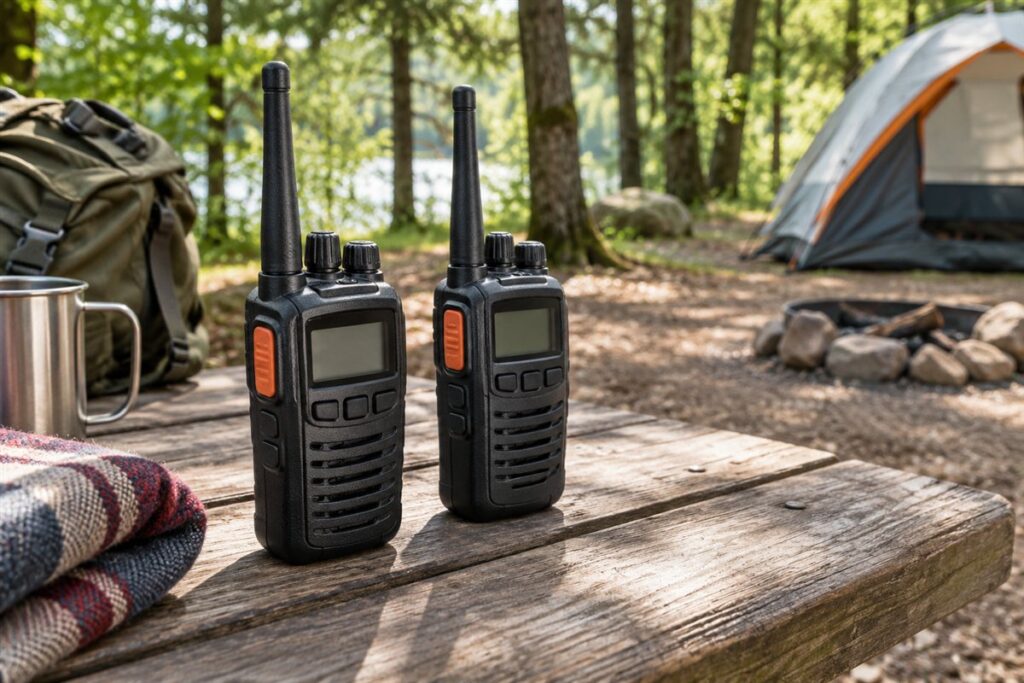
Walkie-talkies give you instant voice contact without mobile coverage, which suits camping trips, job sites, events and family outings. The challenge is that sets vary widely in range claims, channel options, battery type and durability, so a quick comparison pays off.
We have not used these products ourselves, so this guide describes features and construction rather than personal results. Use it as a checklist for reading listings, and remember that maker range figures are usually given for open ground with a clear line of sight.
As an Amazon Associate we earn from qualifying purchases. Links on this site are affiliate links, and they do not change the information we give.
In this guide
Quick Picks
| Pick | Product | Best For |
|---|---|---|
| Best Overall | Midland GXT1000VP4 Two-Way Radios | Long channel list, weather alerts, water resistance |
| Best Weatherproof | Motorola Talkabout T470 Two-Way Radios | Outdoor use with IPX4 shell and dual power |
| Best Smart Features | Motorola Talkabout T803 Two-Way Radios | Bluetooth app messaging off the grid |
| Best Value Pair | Midland X-Talker T51VP3 Two-Way Radios | Everyday family and campsite use |
| Best for Groups | Retevis RT22 Walkie Talkies (4-Pack) | Events, warehouses and larger teams |
Our Picks
1. Midland GXT1000VP4 Two-Way Radios — Best Overall
The GXT1000VP4 is Midland’s long-running flagship consumer set, and it answers the guide’s checklist directly: 50 GMRS channels with 142 privacy codes for finding a quiet frequency, a maker-stated range of up to 36 miles in open ground, and NOAA weather scan with weather alerts for outdoor trips. The casing is rated to JIS4 splash resistance, and the set supports hands-free VOX operation plus a headset jack. Power is flexible — each radio runs on the included rechargeable battery pack or standard AA cells, which matters on multi-day trips where charging is not guaranteed. Note the licensing point from the guide: GMRS operation requires an FCC licence in the US, which is a household licence rather than a per-radio one. As a pair with a desktop charger included, it suits job sites, hunting camps and family convoys that want the widest channel choice in this class.
View Midland GXT1000VP4 on Amazon
2. Motorola Talkabout T470 Two-Way Radios — Best Weatherproof
The T470 is built for the weather-resistance row of the guide’s table: its housing carries an IPX4 rating against splashing water, and it adds NOAA weather channels with alerts so a set left on at camp warns about incoming storms. It works on the licence-free FRS service with 22 channels and 121 privacy codes, and Motorola states up to 35 miles in ideal open conditions — treat that as the best-case figure the guide warns about, with far less in woods or suburbs. Dual power is the practical highlight: the supplied NiMH pack recharges by USB, and the radio also accepts AA batteries as a field spare. A built-in LED flashlight and hands-free iVOX round out the outdoor feature set. Sold as a pair, it is the straightforward choice for hiking, skiing and campsite use where rain is likely and nobody wants to deal with licences.
View Motorola Talkabout T470 on Amazon
3. Motorola Talkabout T803 Two-Way Radios — Best Smart Features
The T803, from Motorola’s T800 series, is the pick that adds the extra features the guide says to look for: it pairs with a smartphone over Bluetooth, and through the Talkabout app users can exchange text messages and share locations off-grid, radio to radio, when there is no mobile signal at all. Voice still works like a normal FRS set, with 22 channels and 121 privacy codes, and the housing is rated IP54 against dust and splashing — a step up in sealing from basic sets. Motorola states up to 35 miles in open terrain, with the usual real-world reductions among trees and buildings. Rechargeable packs charge over USB, keeping it compatible with power banks on longer trips. Choose the T803 for groups that spread out — backcountry ski tours, festivals, convoys — where a silent text or a location ping is worth more than another voice call.
View Motorola Talkabout T803 on Amazon
4. Midland X-Talker T51VP3 Two-Way Radios — Best Value Pair
The T51VP3 covers the essentials the guide lists at a lower price tier than the flagship sets: 22 FRS channels with 38 privacy codes, a maker-stated range of up to 28 miles in open areas, and NOAA weather alert radio so the set doubles as a storm warning receiver at home or camp. It supports hands-free eVOX with several sensitivity levels, channel scan, and a keypad lock to stop pocket button presses changing settings. The pair ships with rechargeable battery packs and a desktop charger, and the radios can also run on AAA cells when the packs are flat — the battery flexibility the guide recommends checking. Licence-free FRS operation means it works straight out of the box for family outings, neighbourhood events and light site work. Pick it when two reliable radios with weather alerts are the requirement and the longest channel list is not.
View Midland X-Talker T51VP3 on Amazon
5. Retevis RT22 Walkie Talkies (4-Pack) — Best for Groups
The guide’s group-size row is where the RT22 wins: it is sold in multi-packs of small, simple FRS radios, so outfitting a whole team costs less per handset than the big-name pairs. Each unit has 16 channels, a VOX hands-free mode, and a compact pocketable body with a belt clip — the format event staff, warehouse crews and church or school teams tend to prefer. This Type-C version charges over USB-C, so the radios top up from the same cables and power banks as a phone, and the pack includes a multi-unit charging arrangement rather than a drawer of separate adapters. There is no weather channel or display, which keeps controls minimal for occasional users who just need push-to-talk on a shared channel. Real-world range is the usual FRS story of a mile or two in built-up areas. Choose it when the headcount matters more than features.
View Retevis RT22 Walkie Talkies on Amazon
What to Look For
| Factor | Why it matters | What to check |
|---|---|---|
| Stated range | Buildings, trees and hills reduce real distance. | Treat the maker’s figure as a best case and consider your actual terrain. |
| Channels and privacy codes | More options help you avoid crowded frequencies. | Check the channel count and whether sub-codes are included. |
| Licence requirements | Some radio types need permission before use. | Read the listing for the radio service and look up the rules where you live. |
| Battery and charging | Runtime and charging method affect daily use. | Look for rechargeable packs, spare battery support and charger type. |
| Weather resistance | Outdoor use exposes sets to dust, rain and drops. | Check the ingress protection code if one is stated, plus the casing build. |
| Extra features | Some sets add useful tools for particular jobs. | Look at hands-free mode, weather channels, flashlights and headset ports. |
| Group size | Sets are sold singly, in pairs and in larger bundles. | Count how many people need a radio and check what the bundle actually includes. |
Setup and Care Tips
- Charge new batteries fully before first use and follow the maker’s charging instructions.
- Agree on a channel and code with everyone in your group before you separate.
- Keep the antenna upright and avoid covering it with your hand while you speak.
- Wipe the casing and contacts with a dry cloth, especially after outdoor use.
- Store sets with batteries at a moderate charge level when you will not use them for a while.
Mistakes to Avoid
- Buying on the biggest range number without thinking about obstacles in your location.
- Ignoring licensing rules for the radio type you choose.
- Mixing sets that do not share the same frequencies or features.
- Forgetting spare batteries or a charger for longer trips.
- Assuming every model is waterproof when the listing only mentions light splash resistance.
Reading a Listing Like a Radio Technician
Product pages for two-way radios pack a lot of numbers into a small space, and the headline figure is rarely the one that matters most. Begin with the radio service the set belongs to, because that decides the rules you follow. Some sets work on license-free channels, while others need an authorization from your national regulator. The listing should say which one applies, and if it does not, check the maker’s manual before you buy.
Next, look at the channel count and any privacy codes. A higher channel number sounds better, but what you really want is enough channels to move away from a crowded one. Privacy codes do not make a conversation secret. They only mute traffic that does not carry your code, so other people can still hear you if they listen without one.
Check the power source, the charging method and what ships in the box. A listing that includes charging cradles, belt clips and earpieces saves you extra shopping. One that lists only the radios may leave you hunting for batteries on the day of the trip.
Finally, read the fine print about the range figure. It is almost always measured in open, flat terrain with nothing in the way. Treat it as a ceiling, not a promise.
What Range Claims Really Describe
Radio waves at these frequencies travel in fairly straight lines. Hills, dense forest, concrete walls and metal structures absorb or block them, which is why two people in the same building can lose contact while two people on opposite hilltops can talk easily. A long range number on a box comes from a best-case setting that few people ever stand in.
Here is a rough guide to how surroundings change what you should expect, described in general terms rather than exact distances.
| Setting | General effect on reach | What helps |
|---|---|---|
| Open field or lake | Closest to the claimed figure | Hold the radio upright, clear of your body |
| Rolling hills | Noticeably shorter, with dead spots | Move to higher ground |
| Dense woodland | Much shorter, leaves absorb signal | Stay within sight where you can |
| Inside large buildings | Short, walls and floors block signal | Use stairwells and windows |
| City streets | Varies, tall buildings reflect and block | Pick a clear line down the street |
The practical lesson is to buy for the environment you actually use, then agree on a fallback plan, such as a meeting point, in case contact drops.
Batteries, Charging and Runtime Planning
Radios generally fall into two camps: those that take ordinary disposable cells and those that use a rechargeable pack. Each has a place. Disposable cells are easy to carry as spares on a remote trip, while a rechargeable pack saves money across many outings and drops in neatly onto a cradle at home.
Whichever you choose, runtime depends heavily on how you use the set. Transmitting drains power far faster than listening, so a group that chats constantly will run flat sooner than one that speaks only when needed. Backlit screens, high power settings and extra features also take a share.
- Pack spare cells or a power bank if the set charges over a cable.
- Charge everything the night before, not on the way out.
- Switch radios off when you are not using them.
- Keep batteries out of extreme heat and cold where you can, since temperature changes how long they last.
- Check the maker’s guidance for storing a rechargeable pack over long periods.
If a listing gives a runtime figure, read it as a rough hint based on a set pattern of use, not as the number you will see in a busy day outdoors.
Audio Quality, Earpieces and Hands-Free Use
Clear speech matters more than raw distance. A radio with a loud, well-shaped speaker is easier to understand beside a noisy engine, a river or a crowd. Look for mention of noise reduction, a sturdy speaker grille and a volume dial you can turn by feel.
Hands-free options change how comfortable a set is during long days. Many radios offer voice activated transmission, often shortened to VOX. It lets you talk without pressing a button, which helps when your hands are full. It can also misfire in wind or loud places, so be ready to switch it off.
Accessory sockets differ between models, so an earpiece that fits one set may not fit another. Confirm the plug type on the listing before you order one separately.
Choosing between a speaker mic and an earpiece
A speaker mic clips to a shoulder strap and puts the controls close to your mouth, which suits work crews. A discreet earpiece suits event staff who need to listen quietly. Pick the one that fits your task rather than the one with the longest cable.
Matching a Set to Your Activity
The same radio does not suit every job. Think about what you will do with it, then weigh the features that count for that scenario.
Hiking and camping
Weight, battery flexibility and weather resistance count most. A compact set that clips to a pack strap and shrugs off a shower is more useful than a bulky one with extras you never touch.
Job sites and warehouses
Durability, loud audio and a simple interface win here. Large buttons you can work with gloves on make a real difference, as does a belt clip that holds firm.
Events and family outings
A group of several radios with easy channel selection helps when people of mixed ages are using them. Choose sets with a clear display and a lock function, so a child does not change the channel by accident.
Winter sports
Cold affects battery life and bulky gloves affect buttons. Look for larger controls and keep spare power in an inside pocket.
Good Radio Habits and Etiquette
A little discipline turns a pair of radios into a reliable tool. Radio is a shared medium, so one person talking at a time keeps things clear.
- Press and hold the button, wait a moment, then speak so your first word is not clipped.
- Keep messages short and stick to the point.
- Say who you are calling, then who you are. For example, “Base, this is Trail Two.”
- Release the button to listen for a reply.
- End with a short closing word so everyone knows you are done.
Agree on a few simple phrases ahead of time. A plain-language message such as “come back to the car” beats complicated code words that people forget under stress. Keep one channel for general chat and agree on another to move to if the first gets busy.
Avoid holding the radio right against your mouth. A few centimetres away, speaking at a normal volume, usually gives the cleanest sound.
Troubleshooting Common Radio Problems
When a set misbehaves, work through the simple causes first. Most faults come down to settings or power, not broken hardware.
You hear nothing from the other radio
Check that both sets are on the same channel and the same privacy code, and that neither is on a scan or lock setting. Turn the squelch or volume up and test again at close range.
Voices sound broken or faint
Move out of a dead spot by changing position or height. Low batteries can also weaken a transmission, so swap or recharge the power source.
Constant static or interference
Another group may be using the same channel. Switch to a different channel and code, and move away from electronics that can cause noise.
Buttons seem unresponsive
Many radios have a keypad lock. Look in the manual for how to release it.
Short battery life
Lower the transmit power if the set allows, cut the screen light and check that the pack is not worn out. If problems continue, follow the maker’s support advice.
Quick Glossary of Radio Terms
- Channel: a set frequency your radio uses to send and receive.
- Privacy code: a setting that filters out traffic using a different code. It does not encrypt speech.
- Squelch: a control that mutes weak background hiss until a real signal arrives.
- VOX: voice activated transmission, which opens the microphone when you speak.
- Scan: a mode that cycles through channels to find activity.
- Repeater: a station that boosts a signal to extend reach, found only with certain services.
- Weather alert: a feature on some sets that picks up official broadcast warnings where the service is available.
- Line of sight: a clear path between two radios with nothing in the way.
Knowing these terms makes listings far easier to read and helps you spot features you do not need.
Pre-Trip Checklist
Run through this list before you leave, ideally the day before, so surprises show up at home and not on the trail.
- Confirm every radio powers on and holds a charge.
- Set all radios to the same channel and code, then label them if you can.
- Do a short range check by walking apart and talking.
- Pack spare power, cables and any earpieces.
- Agree on a meeting point and a time to check in.
- Make sure everyone knows how to press the button and release it.
- Read the manual section about the rules that apply where you will be using the radios.
A few minutes of preparation will do more for your results than any single feature on a spec sheet.
Weather, Water and Rugged Construction
Outdoor radios meet rain, dust, drops and mud, so build details deserve a close look. Listings often mention a water resistance code. Treat the code as a rough guide to what the set can handle, and read the maker’s explanation before you assume a radio can be dunked or left out in a storm.
- Check that the battery door seals firmly and that rubber gaskets look intact.
- Look for a sturdy antenna that bends instead of snapping.
- Prefer buttons with a clear click, which are easier to use with cold or wet hands.
- Choose a belt clip made of strong material, since a weak clip is the first thing to fail.
After a damp outing, wipe the set dry, open the battery door and let everything air out before you store it. Salt air and sand are tough on contacts, so follow the maker’s notes on cleaning for that model.
Common Buying Slips to Dodge
Some errors show up again and again when people choose a first set. Knowing them in advance saves frustration.
- Buying on the biggest range number alone and ignoring terrain.
- Mixing radios from different services without checking that they can talk to one another.
- Forgetting that every person in the group needs a radio.
- Choosing a model with many features that nobody will learn to use.
- Overlooking the charging method and ending up with a tangle of different cables.
- Ignoring the local rules on frequencies and power.
Compatibility is worth a second look. Two radios can look alike and yet use different frequencies or modes. If you add to an existing group, confirm with the listing or the maker that the new sets work with the old ones.
Who Might Want a Different Tool
Handheld radios are not the answer to every communication problem. A few situations suit another approach.
Very long distances
If you need to reach across many miles of rough ground, other equipment, such as a vehicle-mounted radio or a satellite messenger, may serve you better. Look into options that suit your region and activity.
Private conversations
Because anyone on your channel can listen, sensitive discussions belong on another medium.
Large indoor sites
Thick walls and many floors can block signals. A site with those traits may call for a system built for the purpose.
People who never leave mobile coverage
If everyone always has a phone signal, radios add little. They shine where networks fail or where you want instant group voice contact without dialling.
How the Picks in This Guide Differ From Each Other
Readers often reach the end of a list of walkie-talkies with a simple problem: several options sound suitable, and the differences that matter are easy to miss. This section compares the picks already reviewed above side by side, using only the roles and strengths described in this guide, so you can match a pick to your own situation in work sites, events, warehouses and outdoor trips rather than choosing on a headline alone.
Midland GXT1000VP4 Two-Way Radios. It is presented in this guide as the choice for best Overall. Choose it when that description matches the job you actually have, the space you measured, and the way you expect to use it week after week. Skip it, and look at the neighbouring picks instead, if its stated strength solves a problem you do not have, if it duplicates a product you already own and are happy with, or if the fit, mounting, sizing or capacity details described above do not line up with your own measurements. A pick that is wrong for your space will disappoint even when its build quality is excellent, so let your own constraints, not the order of this list, make the final call.
Motorola Talkabout T470 Two-Way Radios. It is presented in this guide as the choice for best Weatherproof. Choose it when that description matches the job you actually have, the space you measured, and the way you expect to use it week after week. Skip it, and look at the neighbouring picks instead, if its stated strength solves a problem you do not have, if it duplicates a product you already own and are happy with, or if the fit, mounting, sizing or capacity details described above do not line up with your own measurements. A pick that is wrong for your space will disappoint even when its build quality is excellent, so let your own constraints, not the order of this list, make the final call.
Motorola Talkabout T803 Two-Way Radios. It is presented in this guide as the choice for best Smart Features. Choose it when that description matches the job you actually have, the space you measured, and the way you expect to use it week after week. Skip it, and look at the neighbouring picks instead, if its stated strength solves a problem you do not have, if it duplicates a product you already own and are happy with, or if the fit, mounting, sizing or capacity details described above do not line up with your own measurements. A pick that is wrong for your space will disappoint even when its build quality is excellent, so let your own constraints, not the order of this list, make the final call.
Midland X-Talker T51VP3 Two-Way Radios. It is presented in this guide as the choice for best Value Pair. Choose it when that description matches the job you actually have, the space you measured, and the way you expect to use it week after week. Skip it, and look at the neighbouring picks instead, if its stated strength solves a problem you do not have, if it duplicates a product you already own and are happy with, or if the fit, mounting, sizing or capacity details described above do not line up with your own measurements. A pick that is wrong for your space will disappoint even when its build quality is excellent, so let your own constraints, not the order of this list, make the final call.
Retevis RT22 Walkie Talkies (4-Pack). It is presented in this guide as the choice for best for Groups. Choose it when that description matches the job you actually have, the space you measured, and the way you expect to use it week after week. Skip it, and look at the neighbouring picks instead, if its stated strength solves a problem you do not have, if it duplicates a product you already own and are happy with, or if the fit, mounting, sizing or capacity details described above do not line up with your own measurements. A pick that is wrong for your space will disappoint even when its build quality is excellent, so let your own constraints, not the order of this list, make the final call.
Two habits help with this comparison. First, write down your non-negotiables before you re-read the reviews: the measurements of your space, the tasks in work sites, events, warehouses and outdoor trips that happen every week rather than once a year, and anything your household will not compromise on. Second, compare the picks in pairs. Put the two closest candidates next to each other and ask which stated strength you would genuinely notice in the first month of use, and which limitation described above would bother you most by the third month. That simple exercise usually produces a clear winner, and it protects you from paying for capability, size or features that your routine will never use.
Matching Walkie-talkies to Real-Life Situations
Most buying mistakes with walkie-talkies happen because the buyer pictured an ideal situation instead of their real one. Work through the situations below and find the one closest to your life in work sites, events, warehouses and outdoor trips; the right choice for that situation is usually clearer than a general verdict, and it often points to a different pick than you first expected.
The everyday situation: Coordinating a work crew
For coordinating a work crew, start from the constraints, not the product. Note how often this happens, who else is involved, and what has frustrated you with your current setup or with doing without. Then return to the reviews above and look for the pick whose described strengths speak directly to that frustration, and whose described limitations fall in areas this situation rarely touches. If two picks still tie, choose the one that is easier to live with on an ordinary day: simpler to use, simpler to clean, and simpler to store or access. In work sites, events, warehouses and outdoor trips, convenience compounds quietly, and the option you use happily every day beats the theoretically stronger option that feels like a chore.
The demanding situation: Keeping a family group together outdoors
For keeping a family group together outdoors, start from the constraints, not the product. Note how often this happens, who else is involved, and what has frustrated you with your current setup or with doing without. Then return to the reviews above and look for the pick whose described strengths speak directly to that frustration, and whose described limitations fall in areas this situation rarely touches. If two picks still tie, choose the one that is easier to live with on an ordinary day: simpler to use, simpler to clean, and simpler to store or access. In work sites, events, warehouses and outdoor trips, convenience compounds quietly, and the option you use happily every day beats the theoretically stronger option that feels like a chore.
The limited-space situation: Running an event or venue team
For running an event or venue team, start from the constraints, not the product. Note how often this happens, who else is involved, and what has frustrated you with your current setup or with doing without. Then return to the reviews above and look for the pick whose described strengths speak directly to that frustration, and whose described limitations fall in areas this situation rarely touches. If two picks still tie, choose the one that is easier to live with on an ordinary day: simpler to use, simpler to clean, and simpler to store or access. In work sites, events, warehouses and outdoor trips, convenience compounds quietly, and the option you use happily every day beats the theoretically stronger option that feels like a chore.
The shared or long-term situation: Staying in touch where mobile coverage is poor
For staying in touch where mobile coverage is poor, start from the constraints, not the product. Note how often this happens, who else is involved, and what has frustrated you with your current setup or with doing without. Then return to the reviews above and look for the pick whose described strengths speak directly to that frustration, and whose described limitations fall in areas this situation rarely touches. If two picks still tie, choose the one that is easier to live with on an ordinary day: simpler to use, simpler to clean, and simpler to store or access. In work sites, events, warehouses and outdoor trips, convenience compounds quietly, and the option you use happily every day beats the theoretically stronger option that feels like a chore.
If none of the situations matches you exactly, combine the two closest. Many households buying walkie-talkies sit between cases: a space that is small but heavily used, or a task that is occasional but demanding when it happens. Weight the situation that occurs most often more heavily, because frequency, not the rare extreme, decides whether you will still be pleased with your choice a year from now.
A Deeper Look at the Checks That Matter Before You Buy
The buying advice earlier in this guide can be reduced to a short pre-purchase routine. Before ordering any of the walkie-talkies above, work through these checks in order: where the radios will be used and what stands between users, how many handsets your group needs, how they will be charged during a long day, and local licensing rules for the channels you plan to use. Each one eliminates some options and strengthens others, and together they take far less time than returning a product that never suited your home.
Start with measurement and honest observation. Spend a few days noticing how the task actually happens in work sites, events, warehouses and outdoor trips: where clutter gathers, where light, water, power or access is missing, and where people hesitate or improvise. Those observations are worth more than any general recommendation, because walkie-talkies are bought for a specific place and a specific routine. Photograph the space, note dimensions in your phone, and keep the notes beside you while you compare the picks; small mismatches in size, clearance or access are the most common reason a well-reviewed product gets sent back.
Next, separate needs from preferences. A need is something that decides whether the product works at all in your home: correct size, compatible fittings or connections, safe installation, and enough capacity for your household. A preference is everything else: finish, styling, extra modes or accessories. Fund the needs fully first, even if that means choosing a plainer pick from the list, and only spend remaining budget on preferences. Reversing that order is how buyers end up with an attractive product that cannot be installed, does not fit, or is undersized for the job it was bought to do.
Finally, check the practicalities that listings make easy to overlook. Confirm what is included in the box and what must be bought separately, such as fixings, filters, batteries, hoses or mounting hardware mentioned in the reviews above. Read the maker’s own manual or support page for the exact model you choose before it arrives, note the warranty terms and the retailer’s returns window, and keep packaging until you have used the product properly at least once. These unglamorous steps are what separate a smooth purchase from an expensive lesson, whatever you spend.
Getting Set Up and Using Your Choice Well
Good results with walkie-talkies depend as much on the first week as on the purchase itself. When your choice arrives, unpack it somewhere with room to lay out every part, check the contents against the maker’s list before anything is fitted or assembled, and keep the instructions open rather than relying on memory or guesswork. If anything looks damaged or missing, photograph it and contact the seller before you install or use the product, because fitted and used items are much harder to exchange.
Follow the maker’s setup sequence in order, even where a step looks skippable. Manufacturers write those sequences around the mistakes they see most often, and shortcuts at this stage are a common cause of poor performance that gets blamed on the product. Work on a clean, clear surface or floor area, keep small parts in a tray, and test each function as you complete it rather than discovering a problem only when everything is finished. Where installation involves walls, water, gas or electricity and the guide above or the manual calls for a qualified professional, treat that as a requirement, not a suggestion.
During the first few uses, go gently and pay attention. Learn how the product behaves at its normal settings before pushing it to its limits, notice sounds, smells, movement or results that differ from the manual’s description, and adjust your technique rather than forcing the product to work your way. Most walkie-talkies reward a short learning period: small changes in position, pace, loading or settings, of the kind described in the technique advice earlier in this guide, usually matter more than buyers expect. Keep notes if it helps; what you learn in week one prevents the frustrations that otherwise appear in month three.
Build a simple household routine around the product once it is in regular use in work sites, events, warehouses and outdoor trips. Agree who uses it, where accessories and instructions live, and what ‘finished’ looks like after each use: cleaned, emptied, switched off, stored or left ready for the next person. Products that are left ready get used; products that need ten minutes of hunting and untangling before they work quietly stop being used, whatever they cost.
Cleaning, Care and Storage: A Routine That Lasts
Long service from walkie-talkies rarely comes from one big effort; it comes from small, regular care. For this category that means keeping contacts clean and dry, rotating and recharging batteries evenly, and storing handsets with their chargers together. Put those tasks on a rhythm you will actually keep: a quick check after each use, a slightly deeper clean on a weekly or monthly cycle depending on how hard the product works, and a proper inspection once or twice a year.
Use only cleaning products and methods the maker approves for the materials involved. Harsh abrasives, solvents and pressure or steam where they are not recommended can damage finishes, seals, fabrics and coatings in ways that are not covered by warranty and cannot be undone. A soft cloth, warm water and a mild cleaner handle most routine dirt on most products in this category; anything stronger should be tested on a hidden area first and used only when the manual allows it. Always let cleaned parts dry fully before reassembly or storage, because trapped moisture causes odours, corrosion and mould in enclosed spaces.
Storage deserves the same attention as cleaning, especially for products used seasonally or kept in garages, lofts and utility rooms. Store the product clean, dry and protected from knocks, with cords, hoses or accessories kept with it rather than scattered. Keep manuals and spare parts in one labelled place, and note dates for filter changes, servicing or part replacements on a calendar rather than trusting memory. When you bring a stored product back into use, inspect it before switching on or loading it: check for damage, pests, perished seals or stiff moving parts, and test it empty or gently first.
Finally, learn the difference between normal ageing and a fault developing. Gradual, even wear is expected; sudden changes are information. A new noise, a drop in performance, a smell, looseness, leaks or visible damage are all reasons to stop, consult the manual’s troubleshooting section, and contact the maker or a professional if the cause is not obvious. Acting early usually keeps a small, inexpensive fix from becoming a replacement, and it keeps the product safe for everyone in the household.
FAQ
How far will a pair really reach?
Real distance is usually lower than the headline figure. Open fields give the best results, while dense woodland, hills and concrete buildings shorten the usable range.
Do I need a licence?
That depends on the radio type and your country. Some low-power sets are licence free, while others need permission. Check local rules and the listing details before you buy.
How long should I expect walkie-talkies to last with normal home use?
Longevity depends far more on correct sizing, correct installation and regular care than on the badge on the box. A well-matched product that is used within its limits and maintained on the rhythm described in this guide should give years of service, while an undersized or poorly fitted one can wear out quickly even if it is well made. Follow the maker’s service and replacement-part guidance, act on early warning signs such as new noises, leaks or falling performance, and keep your proof of purchase so warranty support stays available if you need it.
What is the most common mistake first-time buyers of walkie-talkies make?
Choosing for an idealised version of their home instead of the real one. Buyers measure optimistically, overestimate how often they will use advanced features, and underestimate everyday constraints such as storage, cleaning access and other people in the household. The fixes are simple: measure carefully and write the numbers down, be honest about frequency of use, and read the limitations in each review above as seriously as the strengths. A modest pick that fits your real routine will satisfy you more than an ambitious one that fights it.
Should I buy the largest or most powerful option to be safe?
Not automatically. Oversizing {t} can bring its own problems: higher running effort, more space taken up, harder handling, more cleaning, and features you pay for but never use. Undersizing is equally unhelpful, because a product that struggles with your normal workload will frustrate you daily. The right answer is the middle discipline used throughout this guide: size for your typical workload with a sensible margin for busy days, and let the specific measurements and tasks in your home, rather than a fear of missing out, set that margin.
What should I check in the first week of ownership?
Confirm that everything promised was in the box, that the product performs each of its main functions as the manual describes, and that nothing about its size, noise, fit or handling surprises you in your actual space. Use it several times under normal conditions rather than judging it on a single first attempt, because both you and the product may need a short settling-in period. Keep all packaging during this week, note the returns deadline, and raise any defect with the seller promptly and in writing while your options are widest.
How do I know when it is time to repair, replace a part, or replace the whole product?
Start with the manual’s troubleshooting steps and the maker’s support resources, because many performance drops trace back to cleaning, a worn consumable or a simple adjustment rather than a failed product. Repair or replace a part when the rest of the product remains sound and the fix restores full, safe function. Consider full replacement when faults recur, when safety is involved, when parts are no longer available, or when the product no longer suits how your household has changed. Never keep using a product that shows damage affecting safety, whatever its age.
Are extended warranties or service plans worth considering for walkie-talkies?
They can be, but only after you understand the standard warranty already included, what it covers, and for how long. Compare that with the plan’s exclusions, excess charges and claim process, and weigh the cost against how heavily the product will be used in your home and how disruptive a breakdown would be. For lightly used products in an average household, careful use and prompt attention to small faults often give better value. Whatever you decide, register the product if the maker offers registration, and store warranty documents with the manual.
The Short Version
Keep your choice practical.A radio is only useful when everyone in your group can use it easily, so simple controls and reliable batteries often matter more than long feature lists. Think about the terrain and the people carrying the sets.Compare range claims, channels, battery type, build and extras. Match them to where and how you will use the radios, and check local rules before you decide.
Related Guides
- How to Choose the Best Gan Wall Chargers: Buyer's Guide (2026)
- How to Choose the Best Integrated Amplifiers: A Buyer's Guide
- How to Choose the Best Two Way Radios: Buyer's Guide (2026)
- How to Choose the Best 8×42 Binoculars: Buyer's Guide (2026)
- How to Choose the Best Activity Centers: Buyer's Guide (2026)