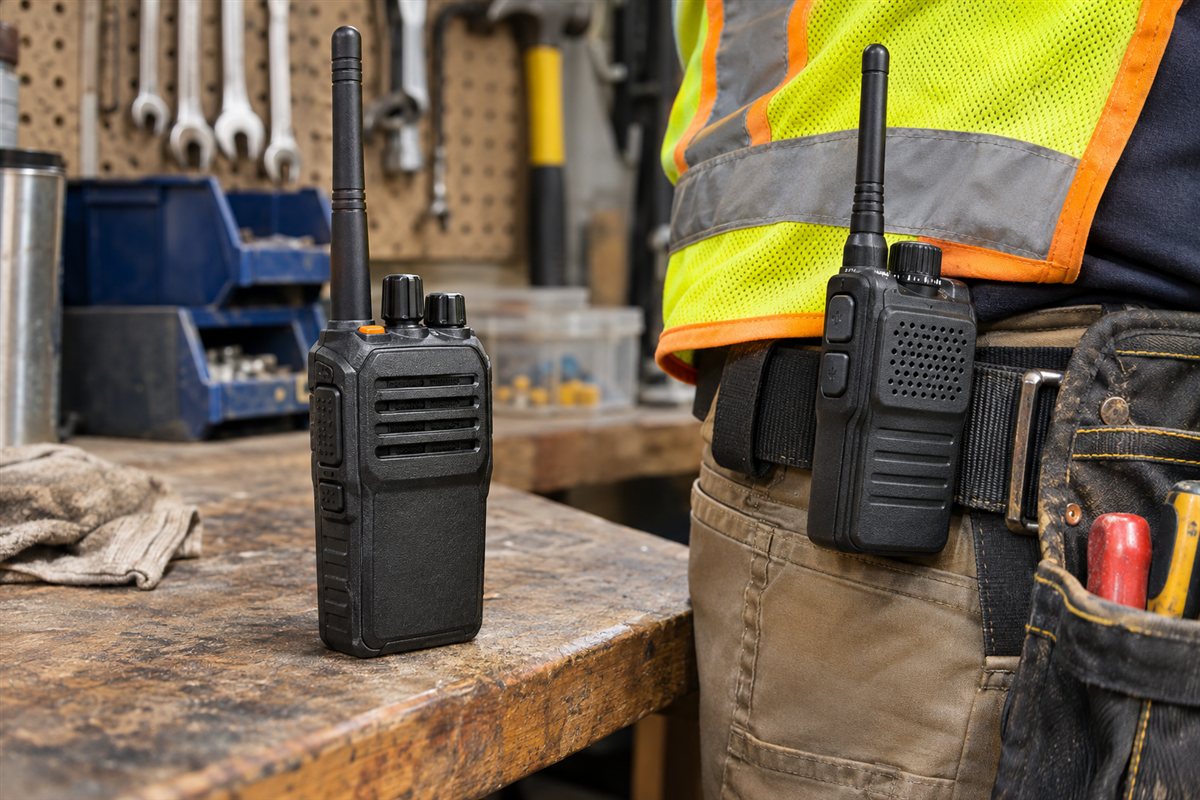
Two-way radios let a group talk without cell service, which suits job sites, hikes and events. We have not used these products ourselves, so this guide is about how to compare, not a field report. It lists the details that matter and the claims that deserve a closer look.
Think about where and how you will use them. Open country, dense forest and a busy building all change what the radio can do. Read the maker documents, check local rules about radio use, and use the table below to line up listings on the same points. Decide how many radios you need, how far apart people will be and whether you will use them indoors, outdoors or both.
As an Amazon Associate we earn from qualifying purchases. Links on this site are affiliate links, and they do not change the information we give.
In this guide
Quick Picks
| Pick | Product | Best For |
|---|---|---|
| Best Overall | Midland GXT1000VP4 GMRS Two-Way Radio (Pair) | Maximum power and features for outdoor groups |
| Best License-Free | Motorola Talkabout T470 Two-Way Radio (2-Pack) | Rugged FRS use with no license paperwork |
| Best Smart Features | Motorola Talkabout T803 Two-Way Radio (2-Pack) | Off-grid texting and location sharing by app |
| Best Value | Midland X-Talker T51VP3 Two-Way Radio (Pair) | Weather alerts and hands-free talk on a budget |
| Best for Teams | Retevis RT22 Two-Way Radio (4-Pack) | Crews, events and workplaces needing several radios |
Our Picks
1. Midland GXT1000VP4 GMRS Two-Way Radio (Pair) — Best Overall
The GXT1000VP4 is Midland’s flagship handheld pair and the most complete radio on this list. It works across 50 channels with 142 privacy codes, giving a group plenty of room to find a quiet combination at a crowded site. As a GMRS radio it transmits at the highest power allowed for a handheld, which is why Midland rates it at up to 36 miles in open conditions — treat that as a best case, as the guide above warns, but the extra power still helps in woods and hills. NOAA Weather Scan with automatic alerts, an SOS siren and a JIS4 water-resistant housing cover the safety side. Each radio runs on the included rechargeable NiMH pack or standard AA cells, and the box adds a desktop charger, headsets and a vehicle adapter. Remember that GMRS use requires an FCC license in the US. Choose it for hunting, overlanding and job sites where range and weather information matter most.
View Midland GXT1000VP4 GMRS Two-Way Radio (Pair) on Amazon
2. Motorola Talkabout T470 Two-Way Radio (2-Pack) — Best License-Free
The T470 keeps things simple: it is an FRS radio, so it needs no license and works straight out of the box. You get 22 channels with 121 privacy codes, a weatherproof IPX4 housing and a maker range claim of up to 35 miles under ideal conditions. Motorola adds the extras that outdoor users actually reach for — NOAA weather alerts, an emergency alert button and a built-in LED flashlight. Power is flexible, with a rechargeable NiMH pack for everyday use and the option to run on AA batteries when you are far from a charger, which answers the battery question the guide above tells you to ask. The black and yellow shell is easy to spot in a pack or on a workbench. Pick the T470 if your group hikes, camps or skis together and you want a tough, license-free radio pair without paying for GMRS range you will not use or a license you do not want to manage.
View Motorola Talkabout T470 Two-Way Radio (2-Pack) on Amazon

3. Motorola Talkabout T803 Two-Way Radio (2-Pack) — Best Smart Features
The T803 belongs to Motorola’s T800 series, the only consumer FRS line that pairs with a phone over Bluetooth. Through the Motorola Talkabout app, two T800-series radios can exchange text messages and share location pins off-grid, with no cell coverage at all — useful when voice would disturb a group or when a quick pin says more than directions. Underneath the smart layer it is a full FRS radio with 22 channels, a maker range claim of up to 35 miles and an IP54 rating against dust and splashing water, so it still works as a normal push-to-talk handset when the app stays closed. The pair ships with a charging dock and rechargeable NiMH packs, and the radios can also run on AA cells. Note that messaging only works between T800-series radios, not with other brands. Choose it for group trips where silent check-ins and shared locations are worth more than raw transmit power.
View Motorola Talkabout T803 Two-Way Radio (2-Pack) on Amazon
4. Midland X-Talker T51VP3 Two-Way Radio (Pair) — Best Value
The T51VP3 covers the core checklist from the guide above at the friendliest price in this group. It is a license-free FRS pair with 22 channels and 38 privacy codes, a channel scan function and Midland’s weather technology: NOAA Weather Scan plus a weather alert that sounds when severe conditions are reported nearby. The eVOX hands-free mode lets you talk without pressing the button, which helps on bikes, ladders and climbing walls, and call alert tones make it easier to get a partner’s attention before you speak. Midland rates the range at up to 28 miles in open terrain; expect a fraction of that around buildings or forest, as with every radio here. The pair includes rechargeable battery packs and a desktop charger, and the radios can also run on standard AAA cells for long days away from power. Choose it for family camping, caravans and casual outdoor use where weather alerts matter more than maximum power.
View Midland X-Talker T51VP3 Two-Way Radio (Pair) on Amazon
5. Retevis RT22 Two-Way Radio (4-Pack) — Best for Teams
When the question is not how far a radio reaches but how many people need one, the RT22 four-pack is the practical answer. These compact FRS radios are license-free, run on 16 preset channels and keep controls minimal, so a new user can be talking within a minute of picking one up. VOX voice activation supports hands-free use, an emergency alarm function is built in, and the upgraded design charges over USB Type-C, which makes topping up at a desk or in a vehicle easy. The slim body and belt clip suit retail floors, restaurants, schools, warehouses and event crews better than bulky outdoor handsets, and because they share the standard FRS channels, the RT22s can talk with other FRS radios on the same channel and code. Range is shorter than the big outdoor pairs here, which is fine indoors and around a site. Choose the RT22 when you are equipping a team rather than a trail partner.
View Retevis RT22 Two-Way Radio (4-Pack) on Amazon
What to Look For
| Factor | Why it matters | What to check |
|---|---|---|
| Radio service type | Some services need a license and others do not. | Check which service the radio uses and what local rules say. |
| Range claim | Maker range figures come from ideal open conditions. | Treat range as a best case and think about your terrain. |
| Channels and codes | More channels and privacy codes help reduce crowding. | Look at channel count, code options and scan features. |
| Battery | Run time and charging method affect long days out. | Compare battery type, charger style and whether you can use common cells. |
| Durability | Rain, dust and drops are normal outdoors. | Read the maker notes on water and dust resistance. |
| Extras | Weather alerts, hands-free modes and headset jacks vary. | Decide which extras you actually use. |
Setup and Care Tips
- Charge the batteries fully before the first outing and carry spares for long days.
- Agree on a channel and code with your group before you separate.
- Test the radios at short distance at home so everyone knows the controls.
- Hold the radio upright and speak a few inches from your mouth.
- Wipe the radio after wet or dusty use and store it away from heat.
Mistakes to Avoid
- Trusting the range figure on the box as a promise in all conditions.
- Ignoring license rules for the radio service you pick.
- Buying mixed radio types that cannot talk to each other.
- Forgetting to charge or pack spare batteries.
- Choosing extras you will never use over core features like battery life.
FRS or GMRS: which type of two-way radio fits you?
FRS radios need no license and suit casual groups, while GMRS radios use more power and need a license in the US. That single difference shapes most of the buying decision, so settle it before you compare anything else.
FRS handhelds are simple. You switch them on, pick a channel and a privacy code, and talk. They suit family trips, camping, ski days, school events and small workplaces. The Motorola Talkabout T470, the Motorola Talkabout T803, the Midland X-Talker T51VP3 and the Retevis RT22 in this guide all sit in that license-free group.
GMRS radios, like the Midland GXT1000VP4, can transmit with more power and are built for people who want extra reach in woods, hills and open country. The trade-off is paperwork. In the US a GMRS license from the FCC is required, so check the current rules and what the license covers before you order.
Here is a quick way to sort yourself:
- Choose FRS if you want to open the box and start talking, your group stays fairly close together, or you do not want to manage a license.
- Choose GMRS if you regularly work in rough terrain, want the most power a handheld can offer and are happy to handle the license step.
- Check local rules if you live outside the US, because radio services, channels and power limits differ from country to country.
A radio that suits the wrong service is a poor purchase, however good the specifications look. Read the product listing to see which service the radio uses, and look for the license note in the maker’s description.
How far do two-way radios really reach?
Real-world range is almost always much shorter than the figure on the box. Makers quote their best case, which means flat, open ground with nothing between the two radios.
Buildings, trees, hills, vehicles and even your own body block or weaken the signal. A group working inside a warehouse or across a busy site will see a fraction of the claimed distance, and dense forest cuts range further. That is why this guide keeps telling you to treat range as a best case rather than a promise.
These habits help you get the most from whatever radio you buy:
- Stand in the clearest spot you can, ideally on higher ground, before you transmit.
- Hold the radio upright and keep the antenna away from your body and from metal objects.
- Avoid talking from inside a car, a basement or a metal-clad building when you can step outside.
- Agree on a fallback plan, such as a meeting point and time, in case radios drop out.
Power matters, but placement matters just as much. A higher-power handheld helps in rough country, yet a lower-power pair used from a ridge can beat it in a valley. If your group will always be within sight of each other, extra power is money you do not need to spend, and a simpler radio will do the job.
When you read a listing, look for how the maker explains its range figure. A clear note about test conditions is a better sign than a big number with no context.
How do you choose the right two-way radios for your group size and setting?
Start with how many people need a radio and where they will use it, then match the radio to that setting. Pairs suit partners, while teams need packs of several radios on the same channel.
A couple hiking together needs a pair. A family trip with older kids may need three or four. A cafe, school event or warehouse crew may need many more, and it is cheaper and simpler to buy them in a multi-pack made for that purpose, such as the Retevis RT22 four-pack in this guide.
Think about the setting too:
- Outdoors in open country: prioritize power, weather alerts and a tough housing.
- Indoors and around a site: prioritize a slim body, a belt clip and easy charging over maximum range.
- Active sports and work at height: look for hands-free talk modes and a secure carry method.
- Cold or wet climates: check the water resistance notes and how the battery behaves in the cold.
Also consider who will carry them. Children and first-time users do best with a radio that has few buttons and a clear channel display. Experienced users may enjoy extra features such as scanning and privacy code options.
Finally, think about whether everyone will use the same model. Mixing models is possible on the same service and channel, but features like privacy codes and app messaging may not carry across brands.
Which two-way radio should you buy?
Pick the radio that matches your main use, not the one with the longest feature list. Here is how the five radios in this guide line up by buyer type.
- If you want the most power and a full accessory box, go for the Midland GXT1000VP4 GMRS Two-Way Radio (Pair). It suits hunting, overlanding and job sites, as long as you are comfortable with the GMRS license.
- If you want a tough radio with no license paperwork, choose the Motorola Talkabout T470 Two-Way Radio (2-Pack). It fits hikers, campers and skiers.
- If you like the idea of silent check-ins and shared location pins, choose the Motorola Talkabout T803 Two-Way Radio (2-Pack). Remember that messaging works only between T800-series radios.
- If you want weather alerts and hands-free talk on a tighter budget, choose the Midland X-Talker T51VP3 Two-Way Radio (Pair). It is a good fit for family camping and casual use.
- If you are equipping a crew, an event or a workplace, choose the Retevis RT22 Two-Way Radio (4-Pack). Its slim body and simple controls suit indoor teams.
If you are torn between two, ask which problem matters more. If range in rough terrain is the problem, lean toward the GMRS pair. If simplicity and no license are the goal, lean toward an FRS pair. If you need many radios at once, the multi-pack answers a different question from the others.
What to check before you buy two-way radios
Confirm the service type, the pack size and what is in the box before you click. A few minutes on the listing prevents most returns.
- Service and license: does the radio use FRS or GMRS, and do you accept the license rules that come with it?
- Pack size: does the listing say pair, two-pack or four-pack, and does that match the number of people?
- Power source: are rechargeable packs included, and can the radio also take common batteries on a long trip?
- Charger style: is it a desktop dock, a cable or both, and will it suit a desk, a car or a campsite?
- Accessories: are headsets, belt clips or vehicle adapters included, or sold separately?
- Weather and dust protection: read the maker’s note on water and dust resistance and match it to your climate.
- Compatibility: if you already own radios, check that the new ones use the same service and channel plan.
- Warranty and returns: read the terms on the listing so you know what happens if a unit fails.
- Manual and support: look for a clear manual, since you will want it for channel and code setup.
Once the radios arrive, charge them fully, set a shared channel and code, and run a short test around your home or site before the real outing. That is the cheapest way to catch a problem while returns are still easy.
Are two-way radios worth it, and who should skip them?
Two-way radios are worth it when cell coverage is unreliable or when your group needs instant, hands-free contact, and they are not worth it for people who always have a signal. Be honest about which group you belong to.
Common doubts, answered fairly:
- Is it worth paying more? Extra cost buys features such as higher power, more codes, weather alerts or app messaging. It only pays off if you will use them. A simple pair does the basics well.
- Is the range claim a lie? No, but it describes ideal conditions. Plan for less.
- Are they as private as a phone? No. Anyone on the same channel and code can listen, so do not share sensitive information over them.
- What are the downsides? Batteries need care, range depends on terrain, and a license may be needed for stronger radios.
You can probably skip a radio pair if you only walk in areas with good cell coverage, never separate from your group, or want private conversations. A phone may also be enough if your group is just two people who stay in sight.
Compare the picks above, check the current listing for the service type and what is included, then choose the radio that fits how your group will really use it.
FAQ
Do I need a license?
It depends on the radio service and your country. Some low-power services need no license, while others do. Check the maker notes and your local regulator. Read how the maker describes the charging cradle and whether the radios can run on common batteries during a long day.
Can different brands talk to each other?
Radios on the same service and channel can generally communicate, though extras like privacy codes and digital modes may not carry across. Read the compatibility notes before you mix models. Bring the manual to your first outing and learn the buttons for channel, code and volume before you need them.
What is the difference between FRS and GMRS radios?
FRS radios are license-free in the US and use lower power, while GMRS radios can use more power but require an FCC license. Both are handheld services used by families, hikers and work crews. Check the listing to see which service a radio uses.
Do two-way radios work without cell service?
Yes, two-way radios talk directly to each other and do not need a cell network. They only need to be within range and on the same channel and code. Terrain and buildings affect how far that range is.
Can anyone listen to my two-way radio conversation?
Yes, anyone nearby on the same channel can hear you, even if you use a privacy code. Privacy codes only reduce interference from other users. Avoid sharing personal or sensitive details on a radio.
How many radios do I need for a group?
You need one radio per person who must talk or listen, plus spares if you can. Pairs suit two people, while packs of four or more suit crews and events. Buying all the radios as one model keeps settings and features consistent.
Why does my two-way radio get less range than advertised?
Maker range figures come from open, flat conditions with nothing in the way. Trees, hills, buildings and vehicles reduce the distance a lot. Moving to higher ground and holding the radio upright usually helps.
How long do two-way radio batteries last?
Run time depends on the battery type, how often you transmit and the temperature. Cold weather and heavy use shorten it. Charge fully before each outing and carry spare cells if the radio takes common batteries.
Are two-way radios good for kids?
They can be, especially simple license-free models with few buttons. Set the channel and code before handing them over and explain when to press the talk button. Keep younger children within a short distance for best results.
Choosing two-way radios in Practice: A Deeper Look at the Details That Matter
The short checklists earlier in this guide name the main things to compare, but most buyers only discover what really matters after the first few weeks of use, when the two-way radio has to fit into a real routine in worksites, farms, events, and outdoor trips. This section slows the decision down and looks at each factor on its own, so you can weigh the trade-offs calmly instead of guessing from a product photo. None of these points replaces the maker’s own specifications or instructions, and you should always confirm the exact details on the listing for the model you are considering. What this section gives you is a way to read those listings with better questions in mind, and a clearer sense of which compromises are harmless for your situation and which ones will annoy you every single time you reach for the two-way radio.
Licensing: FRS, GMRS, or business use
Different radio services carry different rules, power levels, and licence requirements, which vary by country. Decide which service fits your use first, because it determines the radios you may legally operate and the performance you can expect, and no feature compensates for using the wrong service. For a two-way radio, this matters more than it first appears, because it shapes how the keeping a group in instant voice contact goes on an ordinary day rather than on the one careful occasion when everything is set up perfectly. Compare this point across the picks in this guide using the same test each time: picture the job you do most often, in the place you do it, with the time and space you actually have. If a model looks strong on paper but awkward under that test, trust the test. It is also worth writing down the one or two requirements you will not compromise on before you start comparing, because listings are designed to pull your attention toward whatever each maker does best, and a written priority list keeps the comparison honest from the first model to the last.
Realistic range expectations
Advertised range assumes ideal line of sight, while buildings, terrain, and vehicles shorten it dramatically. Judge radios by how they will perform in your actual environment, a warehouse, a wooded valley, or open farmland, and treat headline range as a best case rather than a promise. For a two-way radio, this matters more than it first appears, because it shapes how the keeping a group in instant voice contact goes on an ordinary day rather than on the one careful occasion when everything is set up perfectly. Compare this point across the picks in this guide using the same test each time: picture the job you do most often, in the place you do it, with the time and space you actually have. If a model looks strong on paper but awkward under that test, trust the test. It is also worth writing down the one or two requirements you will not compromise on before you start comparing, because listings are designed to pull your attention toward whatever each maker does best, and a written priority list keeps the comparison honest from the first model to the last.
Battery life and charging pattern
A radio that dies mid-shift or mid-hike is worse than a simpler one that lasts. Consider whether the set uses rechargeable packs, standard cells, or both, how charging works for a whole team, and how long a full working day really is in your setting. For a two-way radio, this matters more than it first appears, because it shapes how the keeping a group in instant voice contact goes on an ordinary day rather than on the one careful occasion when everything is set up perfectly. Compare this point across the picks in this guide using the same test each time: picture the job you do most often, in the place you do it, with the time and space you actually have. If a model looks strong on paper but awkward under that test, trust the test. It is also worth writing down the one or two requirements you will not compromise on before you start comparing, because listings are designed to pull your attention toward whatever each maker does best, and a written priority list keeps the comparison honest from the first model to the last.
Durability and water resistance
Radios get dropped, rained on, and carried by their clips. Build quality, water resistance ratings where stated, and a belt clip that actually holds decide whether the set survives its first season, especially for work and outdoor use. For a two-way radio, this matters more than it first appears, because it shapes how the keeping a group in instant voice contact goes on an ordinary day rather than on the one careful occasion when everything is set up perfectly. Compare this point across the picks in this guide using the same test each time: picture the job you do most often, in the place you do it, with the time and space you actually have. If a model looks strong on paper but awkward under that test, trust the test. It is also worth writing down the one or two requirements you will not compromise on before you start comparing, because listings are designed to pull your attention toward whatever each maker does best, and a written priority list keeps the comparison honest from the first model to the last.
Channels, privacy codes, and clarity
Privacy codes filter out other users on the same channel but do not make conversations private. What matters is clear audio, enough channels for your groups, and controls that can be worked with gloves or without looking, including volume and push-to-talk placement. For a two-way radio, this matters more than it first appears, because it shapes how the keeping a group in instant voice contact goes on an ordinary day rather than on the one careful occasion when everything is set up perfectly. Compare this point across the picks in this guide using the same test each time: picture the job you do most often, in the place you do it, with the time and space you actually have. If a model looks strong on paper but awkward under that test, trust the test. It is also worth writing down the one or two requirements you will not compromise on before you start comparing, because listings are designed to pull your attention toward whatever each maker does best, and a written priority list keeps the comparison honest from the first model to the last.
Accessories and expandability
Headsets, speaker microphones, and spare battery packs transform radios for noisy or hands-free work. If your use might grow, check the accessory ecosystem for the model now, because a radio that cannot take the headset your job needs will be replaced entirely. For a two-way radio, this matters more than it first appears, because it shapes how the keeping a group in instant voice contact goes on an ordinary day rather than on the one careful occasion when everything is set up perfectly. Compare this point across the picks in this guide using the same test each time: picture the job you do most often, in the place you do it, with the time and space you actually have. If a model looks strong on paper but awkward under that test, trust the test. It is also worth writing down the one or two requirements you will not compromise on before you start comparing, because listings are designed to pull your attention toward whatever each maker does best, and a written priority list keeps the comparison honest from the first model to the last.
Real-World Situations: Matching two-way radios to How You Will Actually Use Them
Specifications are tidy, but real use is not. The same two-way radio can feel like exactly the right purchase in one household and like a mistake in another, and the difference is usually the situation rather than the product itself. The scenarios below describe the patterns that come up most often for buyers of two-way radios. Find the one that sounds most like your life, and let it steer which pick you lean toward and which features you treat as essential rather than nice to have. If two scenarios both sound familiar, weight the one that happens more often, because a two-way radio earns its keep in the repeated weekly routine, not in the rare special case.
The worksite or warehouse team
Indoors, range is eaten by shelving and concrete, so reliability at short distance, clear audio over machinery noise, and headsets matter most. A multi-pack with a shared charging routine keeps the whole crew equipped without a daily battery hunt. In this situation, the sensible approach is to judge the two-way radio by how it behaves when you are busy, tired, or short on time, not by how it performs in a careful first trial. Think about where it will live between uses, who else might use it, and what happens on the day something goes slightly wrong. Buyers who think through those unglamorous details in advance tend to be far happier months later, because the frustrations that make people give up on a purchase are almost always about fit, access, and routine rather than about headline performance. A model that fits the routine survives; one that fights the routine ends up ignored, however impressive its listing looked.
The family ski or theme-park day
For families, licence-free simplicity, small size, and controls a child can manage beat raw power. Agree channels and a check-in rhythm at the start of the day, and the radios become the reason the group can split up without stress. In this situation, the sensible approach is to judge the two-way radio by how it behaves when you are busy, tired, or short on time, not by how it performs in a careful first trial. Think about where it will live between uses, who else might use it, and what happens on the day something goes slightly wrong. Buyers who think through those unglamorous details in advance tend to be far happier months later, because the frustrations that make people give up on a purchase are almost always about fit, access, and routine rather than about headline performance. A model that fits the routine survives; one that fights the routine ends up ignored, however impressive its listing looked.
The farm or large property
Open ground is where longer-range services earn their keep, and weather resistance matters because the radio lives outdoors with you. A set that reaches the far field reliably changes how a property gets worked, from moving stock to coordinating machinery. In this situation, the sensible approach is to judge the two-way radio by how it behaves when you are busy, tired, or short on time, not by how it performs in a careful first trial. Think about where it will live between uses, who else might use it, and what happens on the day something goes slightly wrong. Buyers who think through those unglamorous details in advance tend to be far happier months later, because the frustrations that make people give up on a purchase are almost always about fit, access, and routine rather than about headline performance. A model that fits the routine survives; one that fights the routine ends up ignored, however impressive its listing looked.
Events, parking, and volunteers
Coordinating many people in a crowd rewards clear audio, enough channels for separate teams, and earpieces that keep instructions discreet. Battery endurance across a long event day is the feature volunteers ask for by name. In this situation, the sensible approach is to judge the two-way radio by how it behaves when you are busy, tired, or short on time, not by how it performs in a careful first trial. Think about where it will live between uses, who else might use it, and what happens on the day something goes slightly wrong. Buyers who think through those unglamorous details in advance tend to be far happier months later, because the frustrations that make people give up on a purchase are almost always about fit, access, and routine rather than about headline performance. A model that fits the routine survives; one that fights the routine ends up ignored, however impressive its listing looked.
Hiking and camping groups
On trails, radios keep a spread-out group together through terrain that blocks sight and mobile signal. Light weight, weather resistance, and honest expectations about range in hills and forest make the difference between a useful tool and dead weight. In this situation, the sensible approach is to judge the two-way radio by how it behaves when you are busy, tired, or short on time, not by how it performs in a careful first trial. Think about where it will live between uses, who else might use it, and what happens on the day something goes slightly wrong. Buyers who think through those unglamorous details in advance tend to be far happier months later, because the frustrations that make people give up on a purchase are almost always about fit, access, and routine rather than about headline performance. A model that fits the routine survives; one that fights the routine ends up ignored, however impressive its listing looked.
Getting Started Step by Step
A careful first session sets the pattern for everything that follows. Rushing the first use of a new two-way radio is how small mistakes turn into habits, and habits are much harder to fix than a single slow start. Work through the steps below in order the first time, even if some of them feel obvious, and keep the maker’s manual open alongside them, because the manual is the authority for your exact model and this sequence is the general routine that applies across the picks in this guide.
Step 1: Charge or fit batteries before first use
Start with fully charged packs or fresh cells, following the maker’s charging guidance, and note how long charging takes so it fits your routine. A radio set that is never charged is a radio set that is never used. Take your time over this step rather than treating it as a formality. Small checks made now are far cheaper than corrections made later, and they teach you how your particular two-way radio behaves, which makes every later session faster and calmer. If something feels wrong at this point, stop and re-read the relevant part of the manual instead of pushing on and hoping it settles, because forcing a setup that is not right rarely improves it and can turn a simple adjustment into real damage or a job that has to be started again from the beginning.
Step 2: Agree channels and codes as a group
Set every radio to the same channel and privacy code, test each pairing, and write the settings down for the group. Most ‘broken radio’ stories are actually two radios on different codes, quietly ignoring each other. Take your time over this step rather than treating it as a formality. Small checks made now are far cheaper than corrections made later, and they teach you how your particular two-way radio behaves, which makes every later session faster and calmer. If something feels wrong at this point, stop and re-read the relevant part of the manual instead of pushing on and hoping it settles, because forcing a setup that is not right rarely improves it and can turn a simple adjustment into real damage or a job that has to be started again from the beginning.
Step 3: Learn the controls by touch
Practise volume, channel change, and push-to-talk until you can work them without looking, including with gloves if your use involves them. In the moment you need a radio, you will not be standing still reading a manual. Take your time over this step rather than treating it as a formality. Small checks made now are far cheaper than corrections made later, and they teach you how your particular two-way radio behaves, which makes every later session faster and calmer. If something feels wrong at this point, stop and re-read the relevant part of the manual instead of pushing on and hoping it settles, because forcing a setup that is not right rarely improves it and can turn a simple adjustment into real damage or a job that has to be started again from the beginning.
Step 4: Test range in your real environment
Walk the actual area, the far field, the warehouse aisles, the trail, and check in from the furthest points before the day it matters. A ten-minute survey teaches you the dead spots while they are still just interesting. Take your time over this step rather than treating it as a formality. Small checks made now are far cheaper than corrections made later, and they teach you how your particular two-way radio behaves, which makes every later session faster and calmer. If something feels wrong at this point, stop and re-read the relevant part of the manual instead of pushing on and hoping it settles, because forcing a setup that is not right rarely improves it and can turn a simple adjustment into real damage or a job that has to be started again from the beginning.
Step 5: Use simple radio discipline
Press, pause, speak clearly at a normal volume, and release; keep messages short and confirm important ones. Good discipline makes modest radios perform beautifully, while shouting over each other defeats expensive ones. Take your time over this step rather than treating it as a formality. Small checks made now are far cheaper than corrections made later, and they teach you how your particular two-way radio behaves, which makes every later session faster and calmer. If something feels wrong at this point, stop and re-read the relevant part of the manual instead of pushing on and hoping it settles, because forcing a setup that is not right rarely improves it and can turn a simple adjustment into real damage or a job that has to be started again from the beginning.
Step 6: End the day with a charging routine
Collect the radios, put them on charge or swap cells, and note any damage or weak battery while it is fresh. Teams that ritualise this step start every day with a working set, which is the entire point of owning them. Take your time over this step rather than treating it as a formality. Small checks made now are far cheaper than corrections made later, and they teach you how your particular two-way radio behaves, which makes every later session faster and calmer. If something feels wrong at this point, stop and re-read the relevant part of the manual instead of pushing on and hoping it settles, because forcing a setup that is not right rarely improves it and can turn a simple adjustment into real damage or a job that has to be started again from the beginning.
The Short Version
Match the service type, channels and battery to your plans, then compare durability and extras. Treat range as a best case figure and read the maker documents and local rules. List your group size and terrain first, then compare radios against that list.