A student flute is a C flute built for learning in school band or private lessons. The main choices are closed or open holes, an offset or in-line G key, and the material of the headjoint and body. Most come with a case.
The six flutes below mix closed-hole and open-hole designs, silver-plated bodies and one cupronickel model. Specs come from each product’s listing page. We have not used these flutes ourselves. Material and sound claims are the makers’ own.
As an Amazon Associate we earn from qualifying purchases. Links below are affiliate links, and they do not change the product information we give.
What to Look For
| Feature | Why it matters |
|---|---|
| Closed or open hole | Closed holes (plateau keys) are simpler to finger; open holes allow more effects |
| Offset G | Shifts the G key to suit the hand |
| Headjoint material | Nickel silver, silver plate and cupronickel feel and sound different |
| Foot joint | A B foot extends the low range; a C foot is standard |
| Case and kit | Cases, rods and cloths vary by listing |
Specs at a Glance
| Flute | Holes | Body | Notes |
|---|---|---|---|
| Gemeinhardt 1SP | Closed (plateau) | Silver-plated; nickel silver headjoint | Offset G; case included |
| Yamaha YFL-262 | Open | Nickel silver body; silver-plated keys | Offset G; footjoint; carrying bag; 2-year warranty |
| Armstrong AFL201 | Closed | Silver-plated; nickel headjoint | Offset G; 2-year warranty |
| Jean Paul FL-220 | Closed | Silver-plated | Offset G; split E; case; 1-year warranty |
| Pearl PF200 | Closed | Silver-plated body, foot, head | Offset G; C foot; ABS case and cleaning rod; 2-year warranty |
| Eastar EFL-2 | Open (16 keys) | Cupronickel | Offset G; split E; cleaning cloth; 1-year warranty |
The 6 Best Student Flutes
Top pickBest for a first closed-hole flute
1. Gemeinhardt 1SP Student Flute
A silver-plated student flute with a nickel silver headjoint, an offset G, plateau (closed hole) keys and a case, weighing 2.7 pounds.
Suits: a first closed-hole flute. Strengths: a nickel silver headjoint and an offset G. Weaknesses: the listing gives few other specs. Skip it if you want open holes.

Best for a player ready for open holes
2. Yamaha YFL-262 Open-hole Student Flute
An open-hole student flute with a nickel silver body, silver-plated keys, an offset G, a footjoint and a carrying bag, covered by a two-year warranty.
Suits: a player ready for open holes. Strengths: a known maker and a warranty. Weaknesses: the listing’s attribute table shows Instrument Key G, stainless steel and a microphone stand style, which do not describe a C flute, so rely on the title and bullets. Skip it if you want closed holes.

Best for a closed-hole school flute
3. Armstrong AFL201 Student Flute
A silver-plated student flute with a nickel headjoint, closed-hole keys and an offset G, under a two-year warranty.
Suits: a closed-hole school flute. Strengths: closed holes and a warranty. Weaknesses: the attribute table lists Instrument Key G, stainless steel and a microphone stand style, which conflict with a flute. Skip it if you need a full spec sheet.

Best for a closed-hole flute with a split E
4. Jean Paul FL-220 Silver Plated Flute
A silver-plated closed-hole flute in C with an offset G key, a split E mechanism, a case and a one-year warranty. The maker says each flute is set up before it ships.
Suits: a closed-hole flute with a split E. Strengths: a split E mechanism and a set-up claim. Weaknesses: the setup claim is the maker’s own. Skip it if you want open holes.
Best for a closed-hole flute with a hard case
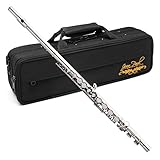
5. Pearl PF200 Belsona Student Flute
A student flute with silver-plated body, foot and head joints, an offset G, closed holes and a C foot. It ships in a stackable ABS case with a cleaning rod and has a two-year warranty.
Suits: a closed-hole flute with a hard case. Strengths: a stackable case and a cleaning rod. Weaknesses: plain extras. Skip it if you want a cupronickel body.
View Pearl PF200 Belsona Student Flute on Amazon
Best for an open-hole flute with a kit
6. Eastar EFL-2 16-Key Open Hole Flute
A 16-key open-hole C flute with a cupronickel body, offset G, split E, a cleaning cloth and a one-year warranty. The maker says the pads are leather.
Suits: an open-hole flute with a kit. Strengths: 16 keys and a split E. Weaknesses: the title says open hole while some text calls it a beginner flute. Skip it if you want the simplest fingering.
View Eastar EFL-2 16-Key Open Hole Flute on Amazon
Care and Setup
- Check whether the holes are open or closed.
- Confirm the case and cleaning items listed.
- Read the warranty terms on the listing.
- For assembly, cleaning and upkeep, follow the maker’s instructions.
Mistakes to Avoid
- Choosing open holes before finger placement is steady.
- Ignoring the case and cleaning items listed.
- Skipping the maker’s instructions.
- Trusting an attribute table that lists the wrong key.
Body Materials and What They Mean for a Beginner
Student flutes are made from a few common metals, and the label on the listing tells you what to expect. Nickel silver is a copper-based alloy that is widely used for student instruments because it is durable and takes plating well. Many student flutes are silver-plated, which means a thin silver layer sits over a base metal. The plating gives the traditional look and feel, and it may tarnish with time, which is normal and can be polished off with a proper cloth. Cupronickel is another copper-nickel alloy, and its use on a flute is mostly a matter of how the maker builds the instrument.
Material affects feel and care more than it affects whether a beginner can learn. At this level, the setup of the instrument, the quality of the pads and how well the keys seal matter more than the metal itself. A well-adjusted flute in any of these materials is easier to play than a poorly adjusted one in a fancier material. Material and sound claims on listings are the makers’ own, so treat them as descriptions rather than guarantees.
Headjoint material is listed separately on some models. The headjoint is where you blow, and many student flutes use a nickel headjoint on a plated body. Check the listing to see what is used, and look at the finish for even coverage. If your child has sensitivity to certain metals, check the maker’s materials information and ask the seller. Keep in mind that every flute needs cleaning after play, no matter what it is made from.
Open Holes, Closed Holes and Moving Between Them
Closed-hole flutes, sometimes called plateau flutes, have solid keys that you press with your fingertips. They are simpler to cover correctly, and most beginners start with them. Open-hole flutes have small holes in the center of several keys, which the fingers must cover directly. They are used by more advanced players because they allow certain techniques and can help with finger placement.
For a first instrument, closed holes are usually the more forgiving choice. A beginner who is still learning to place their fingers can leak air through an uncovered hole and struggle to get a clear tone. Some open-hole flutes come with plugs that fill the holes, so a student can start with them closed and open them later. If a listing includes plugs, check how many are provided and how they fit.
Ask your teacher before you choose. Many teachers and school programs have a preference, and some bands require a certain style. If the student already plays closed-hole at school, a closed-hole instrument at home keeps things consistent. If the student plans to continue to a higher level, an open-hole model with plugs might extend how long the flute will be useful. Either way, choose based on the student’s current skill, not future hopes, since a flute that is easy to play encourages practice.
Key Layout: Offset G, In-Line G and Split E
Key layout affects hand position. The G key can be offset, which means it sits slightly out of line with the others, or in-line, which keeps all the keys straight. The offset layout is designed to suit the natural curve of the hand and is common on student flutes. In-line G is often chosen for players with certain hand shapes or for those who prefer a straight alignment. All six flutes in this guide list an offset G, so this is mainly a point to check when you look at other models.
The split E mechanism is a feature that helps the upper E note speak more easily. It is a mechanical addition rather than something the player controls, and it can reduce the difficulty of that note. Some student flutes have it and some do not. Its presence is a convenience, but it is not necessary to learn the instrument.
Foot joint length is another detail. Most student flutes end at C, which is shorter and lighter than a B foot joint. A C foot is typical for beginners and works well for school music. Check the listing for the foot joint and any extra keys, and be wary of attribute tables that list a different key from the product description. If hand size is a concern, such as for a very young child, ask about curved headjoints, which bring the instrument closer to the body. Availability varies, so check the listing and ask the seller.
Fit, Size and Comfort for Young Players
A standard flute is a fixed size, and it can be a stretch for small hands and arms. Weight is part of the equation. Holding a flute out to the side for several minutes can tire young players, so a lighter instrument may be more comfortable. The listing for one of the flutes here gives a weight, and other makers may offer a figure on request. Check the listing for weight, and think about whether the student can hold it comfortably for a full practice session.
Posture and holding technique help. A teacher can show the right way to hold the instrument and where to rest it. A comfortable fit makes it easier to practice regularly. Pay attention to key spacing and how the student’s hand reaches the keys. If the student has trouble reaching, an in-line G or a curved headjoint may help, so talk to the teacher.
Consider the case too. A sturdy case protects the flute in a school bag and on the bus. Check whether the case has a shoulder strap or handle, and whether it fits in a locker or backpack. Cleaning items such as a rod and cloth are often included, and they make care easier. Finally, check what the listing says about assembly. A flute that fits together easily and smoothly is less likely to be damaged by a beginner, so look for descriptions of tidy, secure joints and a snug but not tight fit.
Warranty, Setup Quality and Teacher Checks
Warranty terms differ. Some listings state a one-year warranty, and others state two years. Read the terms carefully to see what is covered, such as defects in materials and workmanship, and what is not, such as damage from drops or poor care. Keep the receipt and record the purchase date. If the instrument arrives with a problem, contact the seller promptly.
Setup quality is a major factor in how a flute plays. Even a good flute can leak air if pads are poorly seated or springs are uneven. Some makers state that they check each instrument before shipping, but that is the maker’s own claim. When you receive the flute, check that all keys move freely and spring back, and that no pads look out of place. A teacher or repair technician can test the instrument and tell you if it needs adjustment.
It is worth having a music teacher or technician look at the flute before the student begins. A quick check can catch problems that a beginner would blame on themselves. Ask about maintenance, such as when to have the instrument serviced, and how to clean pads and keys. Follow the maker’s instructions for assembly and cleaning, and avoid using polish on the pads or springs. If a flute is hard to play, has sticking keys or repeated air leaks, ask for help before giving up, since a minor adjustment can solve a lot of frustration. Signs that it is time to move up include an instrument that cannot be adjusted to play reliably and a student who has outgrown the features of a beginner model.
Student Flute FAQ
Open or closed holes?
Closed holes are simpler. Open holes are for players who want to cover the holes with their fingers.
What is an offset G?
It is a G key placed to suit the hand, and all six of these list it.
How do I clean a flute after playing?
Follow the maker's instructions. Many players run a cleaning rod with a soft cloth through the body to remove moisture, then wipe the outside with a dry cloth. Do not use liquids on the pads.
How long does a student flute last?
With careful use and regular checks, a student flute can serve a player for several years. Pads and springs may need adjustment over time, and a technician can advise on service.
Does silver plating wear off?
Plating can wear on high-contact areas over time, and it may tarnish. Wipe the flute after use and avoid abrasive cleaners.
Should I buy a used flute?
A used flute can be a good value if it has been checked by a technician. Ask for a playing test and an inspection of pads, keys and the headjoint.
What accessories does a beginner need?
A cleaning rod and cloth, a sturdy case and a music stand are common needs. Some students also use a flute stand or a neck strap for support, depending on the teacher.
Can an adult beginner use a student flute?
Yes. Student flutes are designed for learning, regardless of age. Choose the key layout that suits your hand and check with a teacher.
Why does my flute sound airy?
It may be an embouchure issue, a pad that is not sealing or a hole that is not fully covered. A teacher can help you find which, and a technician can check the pads.
How often should a flute be serviced?
Ask your teacher or a technician. Many players have the instrument checked periodically, especially when keys feel sticky or the sound changes.
Headjoint Design, Scale and Intonation
The headjoint, the part you blow across, has more influence on tone and response than any other section of a flute. Student models usually come with a curved or straight cut that is meant to speak easily, so a beginner can get a clear note without perfect technique. Differences between brands exist, but at the student level the headjoint is designed to be forgiving rather than to offer a wide range of color.
Intonation, or how well the notes sit in tune with each other, depends on the scale the maker uses. A well-made student flute plays reasonably in tune across its three octaves when the headjoint is set correctly. Poor intonation often comes from pushing the headjoint in or pulling it out too far, so learn where your teacher wants the cork line before blaming the instrument. If one octave seems consistently sharp or flat, ask a teacher to check before you assume it is a defect.
A new player cannot judge tone on a flute that is leaking. Leaks at the pads make low notes fail to sound, which beginners often mistake for poor breath control. Before deciding a flute is hard to play, have someone experienced try it. A flute that sounds easy for a teacher but not for you is a technique problem, while one that is hard for both is a setup problem.
Renting Versus Buying a First Flute
Many families rent through a school or music shop for the first year, and that is often wise. Renting spreads out the cost, includes basic servicing in many programs and lets a student find out whether they will stick with the instrument. Some rental plans credit part of the payments toward a later purchase, so ask about that before signing.
Buying outright makes sense when you are confident the student will continue, when the rental terms are poor or when a good used or new instrument is available at a fair price. The flutes on this list are the kind that suit that route. Compare the total rental cost over a year against the purchase price, remembering that a flute bought now can be resold, though it will lose some value.
Whichever route you choose, check what the school band director recommends. Some programs prefer closed-hole flutes for the first year, and some require specific features, such as a particular key arrangement, for ensemble parts. A quick email can save an expensive mistake.
What the First Year Usually Looks Like
Expect the first weeks to focus on getting a sound at all. Producing a steady tone on the headjoint alone is a common starting exercise, and it is normal for the first notes to be breathy or to squeak. Short, regular practice sessions of fifteen to twenty minutes build the facial muscles that control the embouchure better than a single long weekend session.
Low notes and high notes both feel strange at first. Low notes need a relaxed, wide airstream, and high notes need a faster, narrower one, so progress often comes in jumps. Lightheadedness is common when breathing in new ways, and it passes with practice and a calmer breath.
A lesson with a teacher in the first month helps more than any equipment upgrade. A good teacher will spot habits such as a collapsing wrist or a rolled-in lip that are hard to fix later. If lessons are not an option, use a reputable method book and a tuner to check your progress, and record yourself occasionally to hear what you actually sound like.
Accessories and Costs Beyond the Flute
The flute is only part of the cost. A sturdy case, a cleaning rod with a soft cloth, a music stand and a method book are the basic extras. A tuner or metronome, whether a clip-on device or a phone app, is useful for practice. Most student flutes arrive with a case, but check that it closes securely, since a loose case is a common cause of bent keys.
Budget for maintenance too. Pads dry out and springs weaken, and an annual check by a repair technician is a better investment than waiting until the flute stops working. Ask a shop about the cost of a basic adjustment so there are no surprises.
Finally, store the flute in its case, away from heat, and avoid leaving it in a hot car. Rapid temperature changes can warp pads and make the instrument leak. Treating it carefully matters more than which of the six flutes you choose.
Teachers can also help you evaluate any flute before you commit. Bring the instrument to a lesson and ask the teacher to play a scale, a low note and a high note, listening for hissing leaks or notes that refuse to sound. A technician or a good music shop can check pad seating in a few minutes. If a flute arrives from an online order, inspect it right away for bent keys, loose rods or a case that does not close, and arrange a return while the window is open.
Frequently Asked Questions
Why won’t my flute make a sound?
The most common reasons are the lips being too tight, the air aimed too high or too low across the hole, or a leaking pad. Try the headjoint alone first, relax your lips and adjust the angle slowly. If a teacher gets a sound easily from your flute but you cannot, it is a technique issue.
How long should a beginner practice flute each day?
Short and regular beats long and rare. Fifteen to twenty minutes most days builds the embouchure and finger habits without tiring the lips. As stamina grows, sessions can lengthen. Stop if your lips or hands become painful, and ask a teacher to check your posture and grip.
Is it better to rent or buy a first flute?
Renting suits families unsure about long-term commitment, since the cost is spread out and servicing is often included. Buying makes sense when you are confident the student will continue and the price is fair. Ask about rent-to-own credit and compare a year of rental fees against the purchase price.
Why does my flute sound out of tune?
Common causes are the headjoint pulled out too far or pushed in too far, uneven air speed, or a cold instrument. Warm the flute with your breath before tuning, set the headjoint where your teacher advises, and use a tuner. If problems persist across all notes, have a technician check the pads.
The Short Version
For a plateau-key classic, the Gemeinhardt. For open holes and a warranty, the Yamaha. For a closed-hole school flute, the Armstrong. For a split E, the Jean Paul. For a stackable case, the Pearl. For 16 open keys, the Eastar.