A softbox is a fabric housing that sits in front of a flash or continuous light and spreads the output into a larger, gentler source. Sizes and shapes vary, and so do the mounting systems, which is where many buyers run into trouble. We have not used these products ourselves, so this guide focuses on how to read a listing and confirm compatibility with your lights.
Begin with what you shoot, whether that is portraits, products or video, and how much room you have. Then compare the size, shape, mount type, diffusion and portability. The table below lists each factor and what to check. Descriptions of light quality come from the maker, so rely on the stated dimensions and materials. Check the mount against your light before anything else, since a softbox that does not fit your light is simply unusable.
As an Amazon Associate we earn from qualifying purchases. Links on this site are affiliate links, and they do not change the information we give.
In this guide
Quick Picks
| Pick | Product | Best For |
|---|---|---|
| Best Large Key Light | Godox 47" Octagon Softbox with Grid | The softest single key light for studio portraits |
| Best Quick Setup | Aputure Light Dome III | Fast-folding 35-inch octagon for creators on the move |
| Best Value Octagon | NEEWER Basics 35.4" Octagonal Softbox (NS64P) | Quick-release octa with grid and double diffusion included |
| Best Rectangular | Godox 32"x48" Rectangular Softbox with Grid | Window-style light for portraits and products |
| Best Starter Kit | NEEWER 24"x24" Softbox Lighting Kit (2-Pack) | Two complete socket lights for beginners |
Our Picks
1. Godox 47" Octagon Softbox with Grid — Best Large Key Light
Size is the simplest way to buy softness, and at 47 inches across this octagonal softbox produces a broad, flattering key light for portraits, interviews, and product videos. The octagonal shape keeps catchlights round and natural in a subject’s eyes, and the included honeycomb grid narrows the beam when you need to keep light off a background or add contrast. It mounts through a Bowens speed ring, which makes it compatible with the huge ecosystem of Bowens-mount LED and strobe lights from Godox and many other brands. A modifier this large is happiest on a sturdy stand in a studio or a dedicated corner of a home setup; it is not the box you throw in a backpack for location work. If most of your shooting happens in one space and you want the softest single-light look in this roundup, this is the one to build around.
View Godox 47in Octagon Softbox on Amazon
2. Aputure Light Dome III — Best for Quick Setup and Travel
The Light Dome III is the 35.1-inch deep octagon in Aputure’s line, redesigned to fold flat for transport instead of collapsing into the bulky bundle most parabolic softboxes become. That quick-folding frame is the headline feature for solo creators and location shooters: setup and teardown are fast, and the modifier packs down far smaller than its open size suggests. The deep parabolic shape focuses the beam more than a shallow box, giving you directional soft light that works well for interviews, talking-head video, and portraits. It uses the universal Bowens mount, so it pairs with Aputure and amaran COB lights as well as Bowens-mount lights from other brands, and its diameter is a good middle ground: large enough for soft full-face light, small enough for apartments and small studios. Choose it if you move your lighting between locations and are tired of fighting with rod-style softboxes.
View Aputure Light Dome III on Amazon
3. NEEWER Basics 35.4" Octagonal Softbox (NS64P) — Best Value Octagon
NEEWER’s Basics line targets the same quick-setup octagonal format as premium modifiers at a friendlier point in the range. This 35.4-inch octagon uses a quick-release design with a detachable Bowens mount, so it opens fast and packs down without loose rods. The package is generous for the class: two diffusion layers and a honeycomb grid are included, along with a carrying bag, which means you can shoot soft and open for portraits, then add the grid for moodier, more controlled light. NEEWER lists compatibility with a wide range of Bowens-mount COB lights, including its own units, the amaran 150c and 200x S, the Godox SL60W, and SmallRig RC 120 and RC 220 models. At just under three feet across it suits headshots, product work, and small-room video. If you want the modern quick-fold octagon experience and the extras in the box matter to you, this is the value pick.
View NEEWER Basics 35.4in Octagonal Softbox on Amazon
4. Godox 32"x48" Rectangular Softbox with Grid — Best Rectangular Softbox
Rectangular softboxes imitate window light, and this 32-by-48-inch Godox is the classic large rectangle for that job. In vertical orientation it throws a tall, soft wash that flatters standing portraits and three-quarter shots; turned horizontal, it covers small groups and tabletop product scenes evenly. Godox builds it with double-layer diffusion cloth, so you can run one layer for more output or both for maximum softness, and the included beehive honeycomb grid tightens the spread when the light starts spilling onto your background. The Bowens speed ring fits the standard Bowens ecosystem of strobes and LED lights. Rectangular boxes are also a smart second modifier: pair this with an octagonal key light and you have a classic two-light setup for video and stills. Pick it when your work mixes portraits with products and you want one large, versatile source rather than a specialty shape.
View Godox 32x48in Rectangular Softbox on Amazon
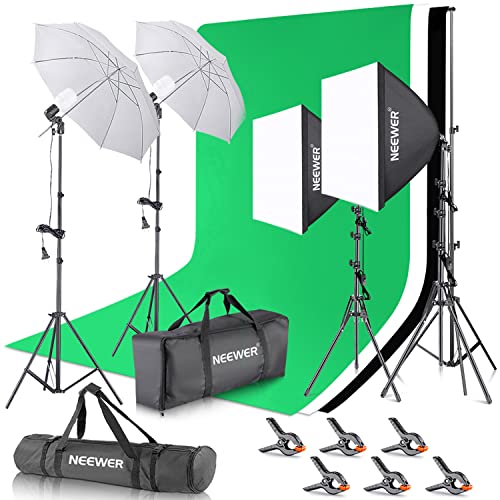
5. NEEWER 24"x24" Softbox Lighting Kit (2-Pack) — Best Starter Kit
Every other pick here is a modifier for a light you already own; this kit is for starting from zero. It pairs two 24-by-24-inch softboxes fitted with standard E26 screw-socket heads and includes two 35-watt, 5700K daylight LED bulbs, so you can light a scene the day it arrives. Continuous light is forgiving for beginners because what you see is what you get: no flash settings to learn, and it works just as well for video as for photos. The external diffuser on each box is removable, and the lamp holders tilt, so you can aim the pair as a classic key-and-fill arrangement for portraits, product shots, or a streaming desk. The trade-offs are output and control: socket bulbs cannot match a dedicated COB light for brightness, and there is no Bowens mount for grids or other modifiers. As a first lighting kit, though, it covers the fundamentals at minimal complexity.
View NEEWER Softbox Lighting Kit on Amazon
What to Look For
| Factor | Why it matters | What to check |
|---|---|---|
| Size | Larger sources give softer light but need space | Compare dimensions with your subject and shooting room |
| Shape | Changes the look of catchlights and light spread | Look at square, rectangle, strip, octagon and similar shapes |
| Mount type | Decides compatibility with your light | Check for the speed ring or mount named for your light brand |
| Diffusion | Controls how soft the output looks | See how many layers are included and whether a grid is offered |
| Build | Affects setup time and durability | Look for rods, fabric and seams, and whether it folds like an umbrella |
| Portability | Matters for location work | Check the packed size, weight and the carry bag |
Setup and Care Tips
- Mount the softbox to the stand with the light turned off and cool.
- Use a sturdy stand with a counterweight for larger sizes.
- Smooth out the fabric before folding it away.
- Keep heat sources away from the diffusion panels.
- Store the rods and speed ring together in the carry bag.
Mistakes to Avoid
- Skipping the mount check before ordering.
- Choosing a size that does not fit the room.
- Using a light stand too weak for the softbox weight.
- Leaving hot lamps against the fabric.
- Throwing away the speed ring packaging and parts.
Which softbox should you buy?
The best softbox is the one that fits your light’s mount, your room and your subject. Use these matches to narrow the list, then confirm the details on each listing.
- If you want the softest single key light for studio portraits, go for the Godox 47″ Octagon Softbox with Grid.
- If you move between locations and want fast setup and teardown, choose the Aputure Light Dome III.
- If you want a quick-release octagon with a grid and extra diffusion in the package, the NEEWER Basics 35.4″ Octagonal Softbox (NS64P) is the value route.
- If you shoot portraits and products and want window-style light, pick the Godox 32″x48″ Rectangular Softbox with Grid.
- If you own no lights yet and want a complete beginner setup, the NEEWER 24″x24″ Softbox Lighting Kit (2-Pack) is the one to look at.
If you already own a Bowens-mount light, any of the first four can work, so room size and travel habits decide. If you own nothing, the kit is the only pick here that includes the lights.
What to check before you buy a softbox
Before you buy a softbox, check the mount, the size, what is in the box and the return terms. A softbox that does not fit your light cannot be used, so mount comes first.
- Mount: identify the mount on your light head and match it to the speed ring named on the listing.
- Light compatibility: look for your light by name in the listed compatibility, and check the manual if it is missing.
- Size against your room: compare the listed dimensions with ceiling height and floor space, and hold up a piece of cardboard cut to size.
- What is included: note whether a grid, a second diffusion layer, a carry bag and the speed ring are in the package.
- Stand strength: make sure your stand and boom can hold the extra weight and leverage of a larger box.
- Heat limits: read the maker’s guidance on bulb type and distance from the fabric.
- Returns and warranty: confirm the seller’s return window and any maker coverage on the listing.
If a detail is unclear, check the product listing or the maker’s manual instead of assuming.
Octagon vs rectangular softbox: which shape is better?
An octagon softbox suits portraits and headshots because it makes round catchlights, while a rectangular softbox suits full-length subjects and tabletop work because it wraps light evenly. Many studios end up owning both.
Octagon softboxes give a broad, flattering wash with a natural look in the eyes. They are common for interviews, talking-head video and close portraits. They offer less directional control than a rectangle or a strip.
Rectangular softboxes imitate window light. Turned vertical, they cover a standing figure. Turned horizontal, they suit small groups and product scenes. They take more room on a stand and can spill onto the background if you do not use a grid.
A simple rule:
- Pick an octagon first if most of your work is faces.
- Pick a rectangle first if you shoot products, groups or standing portraits.
- Add a strip or second box later for rim light or fill.
Shape matters less than size and distance, so do not agonize over it if you will use the light for many kinds of work.
How big should a softbox be?
Choose the largest softbox that fits your room and that you can place close to your subject. Light looks softer when the source is large compared with the subject and near it.
For headshots and small products, a mid-size box often works well and is easy to place. For full-length portraits or groups, a larger box helps cover the subject evenly. In small rooms, a huge box can touch walls or the ceiling, which limits how close it can go.
- Measure the height of your ceiling and the clear width beside your subject.
- Allow for the stand base and the space needed to move around the set.
- Think about the background, since a big box placed close may spill onto it.
A grid can tighten the spread without changing the box, which helps when you want contrast or need to keep light off a backdrop. Extra diffusion layers soften the output further, but they can also lower brightness, so check what your light can supply.
How do you set up a softbox and fix common problems?
Set up a softbox by attaching the speed ring to the light, building the frame, fitting the diffusion panel, and mounting everything on a stable stand. Always do this with the light switched off and cool.
- Fit the speed ring to the light first and lock it before adding the frame.
- Open or assemble the frame fully, so the fabric sits taut and square.
- Attach the front diffusion panel, then add a grid only if you need tighter control.
- Place a counterweight or sandbag on the stand base for larger boxes.
- Raise the stand slowly and check that every lock is tight.
Common problems and quick fixes:
- Uneven light: the diffusion layer may be wrinkled or the light may sit off center, so smooth the panel and recheck the position.
- Color shifts or hot spots: move the light back slightly or add a second diffusion layer if the box allows it.
- Box that tips or droops: a stand that is too light or a boom extended too far is the usual cause, so shorten the arm and add weight.
- Light spill on the background: add a grid or turn the box slightly away.
Keep a small pouch with spare clips and tape near the stand. Check the speed ring and rods before each session, because small parts loosen with repeated assembly. When you finish, let the light cool, fold the box carefully and store it in its bag away from damp areas. These habits extend the life of the fabric and keep setup quick the next time you shoot.
Is a softbox worth it, and who should skip one?
A softbox is worth it if you shoot people, products or video with a continuous or flash light and want gentler shadows. It is not necessary for everyone.
Honest downsides to consider:
- Larger boxes need space, strong stands and a bit of setup time.
- A mount mismatch makes the box unusable, so a speed ring check is essential.
- Output drops with extra diffusion, which matters for low-power lights.
- Socket-bulb kits are simple but give less brightness and no Bowens mount for other modifiers.
Who might skip it: someone who shoots only in bright natural light, someone with a very small room who could use a reflector or window light instead, and someone who needs a light for rare, casual use. A smaller modifier or a bounce card may serve them better.
Is it worth paying more for a premium frame? It can be if you travel a lot and want faster folding and a sturdier build. For a fixed studio, a simpler model with good diffusion often does the job. Compare the picks above, check the current listing for the mount and what is included, then choose the one that fits your light and your space.
Choosing With Confidence: A Deeper Look at What Separates the Picks
By the time most readers reach this point in the guide, they have a shortlist — and the real question is no longer which softboxes exist, but which one will still feel like the right choice a year from now. That answer rarely comes from a single feature. It comes from how the whole product fits your space, your routine and your expectations. This section slows the decision down and walks through the judgment calls that experienced owners make, so you can apply the same thinking to the picks above.
Start with the job, stated plainly. A softbox bought for portraits lives a very different life from one bought for small home studios and location work where light needs to travel. Write down your main scenario in one sentence before you compare anything. Every feature, material and design choice in this category should be judged against that sentence. Options that serve your main scenario well and everything else adequately are almost always better buys than options that are brilliant at a scenario you will rarely face and merely acceptable at the one you face every week.
Next, look at the fundamentals that this guide keeps returning to: modifier mount, diffusion fabric, grid, speedring, light stand and strobe or continuous light. These are not marketing talking points; they are the parts you will interact with every single time you use the product. When you read the individual reviews above, pay closest attention to what each pick does with these fundamentals. A product that gets them right feels effortless in daily use. A product that cuts corners here will remind you of it constantly, no matter how appealing its extra features looked in a feature list.
Matching the pick to your space and routine
Measure and observe before you buy. Check the physical space the softbox has to live in or work in, including clearance to move around it, access for cleaning, and how it interacts with what is already there. Then walk through your actual routine: when do you reach for it, how much setup patience do you honestly have, and who else will use it? A pick that suits a careful single user can frustrate a busy household, and a pick designed for a busy household can feel like overkill for one person. The reviews above flag these differences; use them.
Also think about the unglamorous moments: putting it away, cleaning it after a messy job, moving it, or storing it during the season when it sees less use. Products earn their keep in those moments. If a design makes the routine easy, you will use it more and maintain it better. If every use ends with an awkward cleanup or a storage puzzle, even an excellent product slowly becomes a burden. When two picks look close on performance, choose the one with the easier routine.
Reading the trade-offs honestly
Every pick in this guide involves a trade-off, and the reviews name them rather than hiding them. One option trades convenience for durability, another trades a lower commitment for fewer refinements, another is specialized in a way that makes it superb for one scenario and ordinary for others. None of those trade-offs is automatically wrong. The mistake is choosing a trade-off without noticing it. As you compare, ask of each pick: what did the maker prioritize, what did they deprioritize, and does that priority order match mine? When the answer is yes, you have found your pick, even if another option scores better on a feature you care about less.
Budget deserves the same honesty. Set the amount you are comfortable spending before you fall in love with a flagship, and judge value inside that boundary. Within any tier in this guide there is a pick that represents the tier well. Overspending on capabilities you will not use does not buy satisfaction; it buys a quieter version of regret. Underspending has its own cost when the product sees heavy use: more friction, earlier replacement, and money spent twice. The middle path — the pick whose strengths match your main scenario at a tier you can justify by how often you will use it — is where most satisfied owners land.
Real-World Scenarios: Putting the Picks to Work
Specifications and feature lists only tell half the story. The scenarios below describe the situations readers most often describe when they write about softboxes — portraits, product photography, video interviews, small home studios and location work where light needs to travel. Thinking through which of them sounds most like your life is the fastest way to narrow the shortlist to one confident choice.
In the first scenario, the softbox is a daily workhorse. It gets used early, often and without ceremony, and it has to tolerate being handled by people who are in a hurry. For this life, prioritize the fundamentals — especially modifier mount and diffusion fabric — over refinement. Durability and an easy routine beat clever extras, because the product will be judged a hundred times a month on whether it simply works.
In the second scenario, the softbox is a specialist brought out for a particular job done properly. Here, the specialized pick in the lineup earns its place: the design choices that look narrow on paper turn out to be exactly what the job demands. If this is you, do not talk yourself into the generalist out of a vague feeling that versatility is safer. A specialist used for its specialty is satisfying every time; a generalist asked to do a specialist job is a compromise every time.
In the third scenario, space or storage is the binding constraint. The softbox has to fit a smaller footprint, share its home with other gear, or be set up and put away repeatedly. Judge the picks by their real occupied space and their setup routine, not by their capability list. Owners in this scenario consistently say the same thing afterwards: the best product was the one that fit their space gracefully, because a product that fights your space loses even when it wins on features.
In the fourth scenario, the softbox is shared — by a household, a team, a class or a crew. Shared use rewards intuitive design, forgiving construction and easy cleaning, and it punishes fiddly routines that only one person understands. If several people will use yours, weight the reviews accordingly: look for the picks described as straightforward and robust, and be skeptical of any option whose routine depends on one careful owner’s habits.
Getting the Most From Your Softbox: Use, Care and Long-Term Ownership
Ownership done well is a skill, and it is mostly a collection of small habits. The first habit is a proper first week. Unbox and inspect everything, confirm that all parts and accessories described in the guide and the product documentation are present, and run through the basic routine once at a calm moment rather than debuting the product under pressure. Note anything that feels loose, rough or not as described while the fix is still simple.
The second habit is cleaning as you go. Most wear on softboxes is not dramatic damage; it is the slow accumulation of grit, moisture and residue in exactly the places nobody wipes. After use, give the surfaces and contact points a quick clean appropriate to the materials, let anything damp dry fully before storage, and keep an eye on light stand and strobe or continuous light — the detail owners most often mention when a product ages early. The care guidance earlier in this guide covers the specifics; this is about rhythm. Small, frequent care beats occasional deep rescue almost every time.
The third habit is a short periodic inspection. Once in a while — monthly for daily-use items, seasonally for occasional ones — spend a few minutes checking fasteners, moving parts, wear surfaces and anything that flexes, seals or locks. Tighten what has loosened, clean what has built up, and address small issues while they are still small. This is also the moment to reconsider storage: a softbox stored dry, supported properly and out of punishing conditions will outlast a neglected one by years, whatever tier it came from.
Mistakes that shorten the life of softboxes
Beyond the mistakes covered earlier in this guide, a few ownership errors show up again and again. The first is using the product outside the job it was chosen for — asking a light-duty pick to do heavy-duty work, or a specialist to be a generalist — and then blaming the product. The second is skipping the boring setup steps: proper fitting, leveling, anchoring, charging, sealing or breaking in, depending on the category, exists because it prevents the failures that follow. The third is storing the product in the worst available place — damp, crushing, sun-baked or buried under other gear — for months at a time. Avoid those three, and you have avoided most premature replacements.
Finally, know the difference between wear and failure. Cosmetic marks from honest use are not a verdict on your purchase; they are evidence the product is doing its job. What matters is function: does it still do the thing you bought it for, safely and without growing frustration? Judged that way, a well chosen softbox has a long useful life, and the decision framework in this guide — main scenario first, fundamentals second, trade-offs made knowingly — is what gets you there.
Head to Head: How the Picks in This Guide Differ in Practice
Readers often ask for a plain-language comparison of the shortlisted options, so here is how the picks above separate when you live with them rather than line them up on paper. None of these notes introduce new claims about the products; they simply draw out the positioning already described in the reviews, so you can match each pick to the scenario it was chosen for.
Consider the Godox 32"x48" Rectangular Softbox with Grid — described in this guide as best rectangular softbox — if its role in the lineup matches how you actually live with softboxes. The strongest reason to choose it is fit for purpose rather than any single headline feature: check it against the modifier mount, the diffusion fabric, and the space or routine it has to fit into. If those line up with your priorities, it is a sensible pick; if you find yourself making excuses for a mismatch on the basics, one of the other options in this guide will almost certainly serve you better.
Consider the Aputure Light Dome III — described in this guide as best for quick setup and travel — if its role in the lineup matches how you actually live with softboxes. The strongest reason to choose it is fit for purpose rather than any single headline feature: check it against the modifier mount, the diffusion fabric, and the space or routine it has to fit into. If those line up with your priorities, it is a sensible pick; if you find yourself making excuses for a mismatch on the basics, one of the other options in this guide will almost certainly serve you better.
Consider the NEEWER Basics 35.4" Octagonal Softbox (NS64P) — described in this guide as best value octagon — if its role in the lineup matches how you actually live with softboxes. The strongest reason to choose it is fit for purpose rather than any single headline feature: check it against the modifier mount, the diffusion fabric, and the space or routine it has to fit into. If those line up with your priorities, it is a sensible pick; if you find yourself making excuses for a mismatch on the basics, one of the other options in this guide will almost certainly serve you better.
Consider the Godox 47" Octagon Softbox with Grid — described in this guide as best large key light — if its role in the lineup matches how you actually live with softboxes. The strongest reason to choose it is fit for purpose rather than any single headline feature: check it against the modifier mount, the diffusion fabric, and the space or routine it has to fit into. If those line up with your priorities, it is a sensible pick; if you find yourself making excuses for a mismatch on the basics, one of the other options in this guide will almost certainly serve you better.
Consider the NEEWER 24"x24" Softbox Lighting Kit (2-Pack) — described in this guide as best starter kit — if its role in the lineup matches how you actually live with softboxes. The strongest reason to choose it is fit for purpose rather than any single headline feature: check it against the modifier mount, the diffusion fabric, and the space or routine it has to fit into. If those line up with your priorities, it is a sensible pick; if you find yourself making excuses for a mismatch on the basics, one of the other options in this guide will almost certainly serve you better.
The pattern across all of them is the same one this guide has followed from the start: there is no single winner, only a best match. Identify your main scenario, weigh the fundamentals that you will touch every day, accept the trade-off that costs you least, and the right choice usually becomes obvious. If you are still torn between two, choose the one with the easier daily routine — it is the tiebreaker satisfied owners mention most.
FAQ
Is a bigger softbox always softer?
Generally a larger source relative to the subject gives softer transitions, but distance matters too. Compare size alongside how close you can place the light.
Do I need a grid?
A grid narrows the spread and reduces spill. It is optional and useful when you want to control where the light falls.
What size softbox is best for portraits?
A mid-size to large softbox works well for portraits, especially when placed close to the subject. Larger sources give softer transitions, while smaller ones are easier to use in tight rooms. Match the size to your space and the framing you shoot.
Can I use a softbox with an LED light?
Yes, if the mount matches. Many softboxes use a Bowens-style speed ring that fits compatible LED and strobe heads. Check the listed compatibility and the light's manual before ordering.
What is the purpose of a grid on a softbox?
A grid narrows the spread of light and reduces spill. It helps you keep light off a background and adds contrast. It usually lowers the width of coverage, so use it when control matters more than a wide wash.
Do softboxes work with speedlights?
Some do, through a dedicated bracket or adapter. Check that the softbox lists a speedlight option, since a Bowens ring alone will not hold a small flash. Read the maker's instructions for fit.
How far should a softbox be from the subject?
Closer usually means softer light, so place it as near as your framing allows. Moving it back makes the source appear smaller and the shadows harder. Adjust in small steps and check the result on your screen.
Is a deep softbox better than a shallow one?
A deep softbox focuses the beam and gives more directional light, while a shallow one spreads light more broadly. Choose by how much control you want over spill and contrast.
How do you clean a softbox?
Let the light cool, then wipe the diffusion panel gently with a dry or slightly damp soft cloth. Avoid harsh cleaners and heat sources near the fabric. Fold it only when it is dry.
What should I check in the first week of owning a new softbox?
Use the first week to confirm fit and function while returning or exchanging is still easy. Check that it works with your existing setup, that nothing about modifier mount feels off in real use, and that the day to day routine — setting it up, using it, putting it away — is as easy as you expected. Small annoyances in week one tend to become big annoyances by month six, so take them seriously.
How long should a good softbox last with regular use?
Longevity depends far more on care and conditions than on the badge. A well chosen softbox that is used as intended, cleaned on a sensible schedule, and stored or protected properly between uses should give years of service. The parts that usually age first are the wear points connected to modifier mount and light stand and strobe or continuous light, so inspect those regularly and deal with small issues early rather than waiting for a failure.
What maintenance do most owners of softboxes forget?
The unglamorous basics: wiping down surfaces before grit or moisture does quiet damage, checking fasteners and moving parts for looseness, and storing the softbox in the conditions the maker intends rather than wherever space happens to be free. Ten minutes of routine care after heavy use prevents most of the wear that owners later blame on build quality.
How do I get the most value from a softbox over its life?
Value comes from use and care in equal measure. Choose the pick that fits your main scenario, learn its routine properly in the first few weeks, keep up the simple cleaning and inspection habits covered in this guide, and avoid the common mistakes that shorten service life. Owners who do those four things consistently report the fewest regrets, whatever tier they bought at.
Can one softbox handle several different jobs well?
Often yes, within limits. Versatile options in this guide are designed to cover the common scenarios — portraits, product photography, video interviews, small home studios and location work where light needs to travel — without major compromise. Where a single choice struggles is at the extremes: the heaviest duty task, the tightest space, or a very specific requirement. If one scenario matters far more than the rest, choose for that scenario and let the others be a bonus.
How do I know if a softbox is the wrong choice for me?
The clearest signs are friction and workarounds: you avoid using it, you have to adapt your routine around its weaknesses, or the mismatch is with something fundamental like size, placement or the way it handles diffusion fabric. Features can be learned, but a basic mismatch in fit or purpose rarely improves, which is why matching the pick to your main use case matters more than chasing the longest feature list.
Is it worth paying more for a softbox, or is a basic one enough?
It depends on how often and how hard you will use it. If your softbox will see occasional, light use, a simpler option from this guide is often plenty. If it will be used daily, shared by several people, or relied on in demanding conditions, stepping up usually buys better materials, smoother operation and less frustration over time. The honest test is cost per use: frequent users feel the difference, occasional users rarely do.
Should I buy a softbox now or wait for a newer model?
For most buyers, waiting rarely changes the outcome. The fundamentals of a good softbox — sound construction around modifier mount, sensible design, and a good match for your use — change slowly. Buy when you have a real need and a pick in this guide matches it; a product that solves your problem today is worth more than a rumored improvement that may never matter to you.
Compatibility Checks
A softbox is only useful if it attaches cleanly to the light you already own. Confirm each of the following before ordering.
- Mount type: look at the mounting ring or adapter on your head or strobe, and match it to the listing.
- Head size: some rings fit a narrow range of reflector diameters, so measure yours.
- Heat and bulb type: continuous lights and flash heads have different needs, so check the maker’s manual and instructions.
- Stand and boom reach: a larger box adds leverage, so confirm your support can hold the extra bulk.
- Accessory fit: grids, extra diffusion layers, and carry bags are often size specific.
Feature Trade-offs
Most choices come down to balancing size, speed, and portability. This table sums up the usual give and take.
| Choice | Upside | Downside |
|---|---|---|
| Rectangular shape | Even wrap for full-length subjects | Takes more room on a stand |
| Octagonal shape | Round catchlights in the eyes | Less directional control |
| Quick-open frame | Fast to set up between shots | Often a little heavier |
| Rod-style frame | Packs flatter for travel | Slower assembly |
| Strip shape | Narrow edge light and rim effects | Less useful as a main light |
Matching It to Your Space
Room size should guide the size of the box. In a small bedroom or corner studio, a very large softbox can end up touching walls or ceiling, which limits how far you can move it from the subject. Distance matters because the light source appears larger and softer when it sits closer, so a mid-size unit that you can place near the subject often feels more useful than a giant one stuck at the edge of the room.
Think about ceiling height as well. Boom arms and overhead positions need vertical space, and a tall box may not fit under a low ceiling. Measure the area first, then sketch where the stand, subject, and backdrop will sit. If you shoot in several locations, a foldable design that fits in a single bag will make setup less of a chore.
One more habit worth building: keep a small kit with spare clips, a roll of tape, and a few clamps next to the stand. Fabric panels and speed rings can loosen over time, and a quick check before each session helps you catch wear early. Store the box folded in its bag, away from damp corners, and wipe the diffusion panel gently with a dry cloth when needed.
If you are unsure about a particular size, lay out a piece of cardboard cut to the listed dimensions and hold it where the softbox would go. This simple trick shows how it will fit your room, your subject, and your camera angle.
The Short Version
Check the mount first, then choose a size and shape for your subject and space. Look at diffusion layers, grid options and how easily the unit folds, and treat light quality statements as the maker’s own wording. Make a short list of the lights you own and the type of work you do, then match the mount and size to both. Look for clear photos of the folding mechanism and the speed ring, and keep a spare set of rods in mind if you travel often with the kit.