A silent gaming keyboard is built to cut down the clack of typing and the thud of bottoming out keys, while still giving the fast response that games demand. Makers use quiet switches, soft layers inside the case and softer keycap designs to do this. This guide is written for shoppers who want to understand the differences before choosing. We have not used these products ourselves, so we focus on features, construction and how the parts work together.
Most buying mistakes come from assuming that quiet means slow, or that every quiet board sounds alike. Switch design, case build and layout all play a part. Work through the factors below, compare the details on each product page, and confirm every maker claim on the listing itself. The table helps you decide what matters for your desk and your game library.
As an Amazon Associate we earn from qualifying purchases. Links on this site are affiliate links, and they do not change the information we give.
In this guide
Quick Picks
| Pick | Product | Best For |
|---|---|---|
| Best Overall | Logitech G515 LIGHTSPEED TKL (Linear) | Quiet low-profile wireless gaming |
| Best for Fast Response | Razer DeathStalker V2 Pro TKL (Linear Red) | Low-profile optical speed |
| Best Mechanical Feel | Keychron K2 (Silent K Pro Red) | True silent mechanical switches |
| Best Full Size | SteelSeries Apex 3 | Number pad and spill resistance |
| Best Compact on a Budget | SteelSeries Apex 3 TKL | Small desks and shared rooms |
Our Picks

1. Logitech G515 LIGHTSPEED TKL (Linear) — Best Overall
The G515 LIGHTSPEED TKL is built around the two ideas this guide keeps coming back to: a switch that makes less noise and a case that absorbs what noise remains. Its low-profile GL Linear switches are factory-lubed for a smoother, quieter press, and Logitech layers sound-dampening material into the construction so keystrokes land softly instead of echoing. The linear travel has no bump or click, and the short 1.3 mm actuation point keeps response quick for fast games, answering the worry that a quiet board has to feel slow. The tenkeyless frame is only about 22 mm tall, which leaves more desk room for mouse movement, and the double-shot PBT keycaps should resist shine better than plain ABS caps. Connection options cover most setups: LIGHTSPEED wireless for low-latency play, Bluetooth for a second device, or a wired USB-C mode. LIGHTSYNC RGB lighting is configured through Logitech G HUB, where you can also remap keys and set per-game profiles. Choose this board if you want a genuinely quiet wireless TKL that still feels like a competitive gaming keyboard.

2. Razer DeathStalker V2 Pro TKL (Linear Red) — Best for Fast Response
Razer takes a different route to quiet: instead of dampening a tall mechanical switch, it shortens the whole keystroke. The DeathStalker V2 Pro TKL uses low-profile optical Linear Red switches, so each press travels a short distance, registers by light rather than metal contacts, and bottoms out with a softer thud than a full-height board. Razer rates the switches for a 70 million keystroke lifespan, and the optical design suits players who care about the key response checks in the guide above. The slim case has an aluminum top plate, and the coated keycaps are designed to resist fading and fingerprints during long sessions. You get three connection modes — HyperSpeed wireless through a dongle, Bluetooth, and wired USB-C — with a maker-rated battery life of up to 200 hours depending on lighting use, plus Chroma RGB for lighting effects. The tenkeyless layout keeps the desk footprint small while retaining the function row. Pick this one if your priority is the fastest, lightest keystroke in a quiet, travel-friendly frame.
View Razer DeathStalker V2 Pro TKL on Amazon

3. Keychron K2 (Silent K Pro Red) — Best Mechanical Feel
Many quiet boards quieten the case and leave the switch alone; the Keychron K2 in this configuration does the opposite, using Keychron Silent K Pro Red switches that are built with dampers inside the switch itself. The linear Red action presses smoothly with no tactile bump or click bar, and the internal padding softens both the downstroke and the return, which is where much of a mechanical board’s clack comes from. The 75% layout packs 84 keys into a compact frame while keeping dedicated arrow keys, a sensible middle ground for gamers who still type a lot. It connects over Bluetooth to multiple devices or over a USB-C cable, and wired mode supports full N-key rollover for gaming, matching the anti-ghosting checks in this guide. The listing version here has a white LED backlight rather than full RGB, which keeps the look understated for shared desks and offices. Mac and Windows keycaps suit cross-platform users. Choose the K2 if you want a real mechanical feel with the noise engineered out at the switch level.

4. SteelSeries Apex 3 — Best Full Size
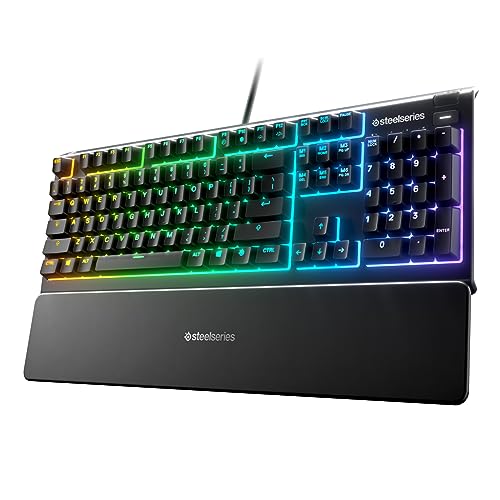
The Apex 3 is the straightforward answer for players who want quiet keys and a full-size layout with a number pad. SteelSeries builds it around its Whisper Quiet gaming switches, which use low-friction material to keep each press nearly silent and are rated for more than 20 million keypresses. Because the switches are not mechanical, there is no click mechanism to hear, and the soft travel suits the lighter touch this guide recommends for shared rooms and late sessions. The case adds IP32 water resistance, a small but real protection against the accidental spill that ends many budget boards, and the included premium magnetic wrist rest snaps on for longer sessions. Ten-zone RGB illumination gives you broad lighting zones to match a setup, and gaming-grade anti-ghosting keeps combination presses registering in busy fights. It is a wired USB board, so there are no batteries or dongles to manage, which some desks will prefer. Choose the Apex 3 if you want the quietest simple setup with full-size keys and media-friendly extras.


5. SteelSeries Apex 3 TKL — Best Compact on a Budget
The Apex 3 TKL takes the same quiet formula as its full-size sibling and trims it for smaller desks. It uses the same Whisper Quiet gaming switches, rated for over 20 million low-friction keypresses, so the typing sound stays soft in shared rooms, calls and streams, while gaming-grade anti-ghosting keeps fast inputs registering. Dropping the number pad gives your mouse hand more room to move, which matters in shooters, and the shorter frame travels more easily between rooms or to a second setup. The board keeps its IP32 water and dust resistance, unusual at this size, and eight-zone RGB illumination that can sync with other SteelSeries gear through PrismSync. It is wired only, which keeps the price and the setup simple: plug in the USB cable and play, with no charging routine to think about. The trade-offs to accept are the lack of a wrist rest in the box and zone lighting rather than per-key RGB. Pick the Apex 3 TKL if you want a genuinely quiet board that frees up desk space without moving into premium pricing.

What to Look For
| Factor | Why it matters | What to check |
|---|---|---|
| Switch type | Linear switches tend to sound smoother, while clicky and tactile types are louder | Switch name and feel described by the maker, and any silent version of it |
| Sound dampening | Foam and gasket layers soften the hollow noise inside the case | Listed dampening layers, case material, and stabilizers for the long keys |
| Layout and size | Compact boards save desk room, while full size boards keep the number pad | Full, tenkeyless or smaller layout, plus extra media keys and macro buttons |
| Key response | Fast actuation and low travel help in quick games | Actuation distance, polling rate, and anti-ghosting or key rollover claims |
| Connection | Wired links stay steady, and wireless links cut cable clutter | USB cable, wireless dongle or Bluetooth, battery life stated by the maker, and charging method |
| Keycaps and lighting | Material changes feel and sound, and lighting aids dim rooms | Keycap plastic type, legend printing style, and software controls for lighting |
Setup and Care Tips
- Place a desk mat or a thin pad under the keyboard to absorb the knock of keys on a hard surface.
- Learn the software, if the maker offers one, to set profiles for each game and remap keys.
- Keep the keyboard level and give your wrists room, so you do not hammer the keys harder than necessary.
- Brush crumbs and dust from between the keys with a soft brush, and wipe the surface with a slightly damp cloth.
- Update firmware only from the maker’s own site or app, and unplug the board before any deeper cleaning.
Mistakes to Avoid
- Expecting total silence, when even the quietest keys still make a soft sound against the frame.
- Choosing a compact layout without checking that your favorite game does not need the missing keys.
- Ignoring the wireless delay, which matters more in fast shooters than in slower titles.
- Judging sound from a video clip alone, since microphones and rooms change how a board seems.
- Buying a board with a stiff key press that tires your fingers during long sessions.
Which silent gaming keyboard should you buy?
The best silent gaming keyboard is the one that matches your desk size, connection preference and the way you like keys to feel. Use the matches below as a shortlist, then confirm details on each listing.
- If you want a quiet wireless TKL that still feels competitive, go for the Logitech G515 LIGHTSPEED TKL (Linear). It combines factory-lubed low-profile switches with sound-dampening material and multiple connection modes.
- If you want the lightest, fastest keystroke, choose the Razer DeathStalker V2 Pro TKL (Linear Red). Its short low-profile optical switches shorten the whole keystroke rather than only dampening it.
- If you want a real mechanical feel with the noise engineered out, pick the Keychron K2 (Silent K Pro Red). Its dampers sit inside the switch, and the 75% layout keeps arrow keys.
- If you want a full-size board with a number pad, the SteelSeries Apex 3 is the straightforward choice, with spill resistance and a wrist rest in the box.
- If you want a compact wired board for a small desk or shared room, the SteelSeries Apex 3 TKL gives the same quiet formula with more mouse room.
When two picks seem close, decide on connection first. Wireless gives a clean desk but means charging, while wired boards such as the two SteelSeries models need nothing but a cable.
Then decide on layout. Anyone who types a lot or uses spreadsheets may want the number pad, and competitive players often prefer the extra mouse room of a TKL.
Finally, think about noise in your own setting. A bedroom at night or a shared office needs the quietest option you can find, while a private desk with headphones leaves more room to choose by feel.
What should you check before you buy a silent gaming keyboard?
Before you buy a silent gaming keyboard, check the switch type, layout, connection method, what is included and the return terms. Quiet claims vary, so read the details rather than the headline.
- Switch type: Confirm whether the switch is a true silent or dampened design, a low-friction membrane-style switch or an optical one. They sound and feel different.
- Layout: Make sure your favorite games do not need keys that a compact layout drops.
- Connection: Check for wired, wireless dongle or Bluetooth, and read the maker’s battery claims if the board is wireless.
- Software: If you want key remapping or lighting profiles, confirm the software works on your system.
- Operating system: Check the keycaps and key mapping if you use Mac or Windows, or both.
- What is in the box: Some boards include a wrist rest, while others do not.
- Spill protection: Look for any stated water resistance if you drink at your desk.
- Warranty and returns: Read the seller, the warranty terms and the return window on the listing.
Sound is hard to judge from text. Videos vary by microphone and room, so use them only as a rough guide and read what the maker says about dampening.
It also helps to check the feel. A stiff press can tire your fingers in long sessions, while a very light press can cause accidental inputs. If you can, try a similar switch before you commit.
How do silent switch types compare for gaming?
Silent switch types differ in how they remove noise: some add dampers, some shorten travel and some replace the metal contact altogether. Each approach changes how the keyboard feels and sounds.
- Silent linear mechanical switches: Dampers inside the switch soften the downstroke and the return. The Keychron K2 (Silent K Pro Red) uses this approach and keeps a mechanical feel.
- Low-profile linear switches: Shorter travel means a softer bottom-out. The Logitech G515 LIGHTSPEED TKL uses factory-lubed switches of this kind.
- Optical switches: They register by light rather than metal contacts, and a low-profile version shortens the stroke. The Razer DeathStalker V2 Pro TKL takes this route.
- Low-friction quiet switches: The SteelSeries Apex 3 and Apex 3 TKL use Whisper Quiet gaming switches designed to keep presses nearly silent.
Linear switches tend to sound smoother than tactile or clicky types, because they have no bump or click mechanism. For gaming, this smooth action also helps with fast repeated presses.
The case matters as much as the switch. Foam or other dampening layers reduce the hollow sound, and well-fitted keycaps stop rattle. A board with quiet switches in a hollow case can still sound loud.
Keycap material plays a part too. Thicker, dense plastic often sounds lower and softer than thin plastic, so check the keycap description on the listing. Lastly, stabilizers on the long keys are a common source of rattle, so read about them where the maker lists them.
How do you keep a silent gaming keyboard quiet and in good shape?
You keep a silent gaming keyboard quiet by controlling the surface under it, how hard you type and how clean the keys stay. Small habits make a noticeable difference.
- Add a desk mat: A mat absorbs the knock of the case and the keys on a hard desk.
- Type lighter: Hammering the keys adds noise even on quiet switches.
- Clean regularly: Brush crumbs and dust from between the keys with a soft brush, and unplug the board before any deeper cleaning.
- Update firmware carefully: Use only the maker’s own site or app.
- Manage battery on wireless boards: Charge before long sessions and turn off lighting if it drains power, as makers often note.
Signs that it may be time to replace a keyboard include keys that stick or double-register, a case that creaks, worn legends, or a connection that drops out. If cleaning does not solve the problem, check the warranty terms on the listing.
Think about how your needs change. A board that suited a small apartment may feel cramped after a desk upgrade, and a player who moves to faster games may want quicker response. Review your setup once a year and decide if it still fits.
Remember that no keyboard is entirely silent. Even the quietest board makes a soft sound as keys reach the frame, so aim for quiet enough rather than silent.
If you use the board for both work and play, think about posture as well. A low-profile board with a wrist rest can reduce strain, while a taller board may feel better with a separate rest. Adjust the feet, keep your wrists neutral, and take short breaks during long sessions. Comfort affects how hard you press the keys, and that in turn affects how much noise you make.
Is a silent gaming keyboard worth it, and who should skip it?
A silent gaming keyboard is worth it if you share a room, stream or take calls while playing, or simply dislike clack. It is less important if you play alone with headphones and prefer a crisp, tactile sound.
Here are the honest trade-offs:
- Feel can differ: Dampers soften the stop, so some people find the feel less crisp than a standard switch.
- Quiet is not silent: A hard desk and heavy typing can still be heard.
- Premium features cost more: Wireless, per-key lighting and metal plates add to the price tier.
- Compact layouts drop keys: Check your games first.
- Wireless adds a charging routine: Wired boards avoid this.
Who should skip it? Typists who love a loud, clicky sound, players who never share a room, and anyone who wants the widest range of customization may do better with a standard mechanical board.
Who is it for? Late-night players, shared-room gamers, streamers and office workers who want a keyboard that does not annoy people nearby.
A cheaper wired model can be enough if you only want quieter keys. A pricier wireless model makes sense if you value a clean desk and multiple connections.
Compare the picks above, check the current listing for layout, connection and what is included, then choose the keyboard that fits your desk and how you play.
Where Keyboard Noise Really Comes From
Switches get the credit and the blame for keyboard noise, but a keyboard is a small acoustic system and the switch is only one voice in it. The loudest sound on many boards is not the switch at all; it is the keycap bottoming out against the switch housing, and the spacebar’s stabilisers rattling in their mounts. When you judge a silent keyboard, listen for the whole event: the press, the bottom-out, the release and the stabiliser behaviour on the large keys. A board with quiet switches and sloppy stabilisers is a loud keyboard wearing a quiet costume.
The case conducts and colours everything. A hollow case acts like a drum, amplifying each press and adding a hollow ring that reads as cheap noise even when its volume is modest. Denser cases and internal damping change the character of the sound as much as its loudness, turning a clack into a thock that housemates and microphone listeners find far less intrusive. This is why two keyboards with the same switches can sound completely different, and why listening to recordings of the exact board, not just its switch, matters when you shop.
Your desk is part of the instrument too. A keyboard on a hard, bare desk couples its vibrations straight into a large sounding board, while a desk mat breaks that coupling and softens both volume and tone. Before concluding that a keyboard is too loud for your space, test it on a mat, because the cheapest silence in this entire category is a layer of material under the board. Typing force matters as well: heavy-handed typists bottom out hard on any switch, and a week of consciously lighter typing quiets even a non-silent board noticeably.
Quiet for Whom? Rooms, Microphones and Other People
Silence is relative to a listener, so name yours before you shop. A sleeping partner in the same room is the strictest audience: they hear the keyboard in a silent house at night, through a door’s worth of nothing, and low, soft sounds matter more than technical measurements. A housemate in the next room is a kinder test, where a door and a wall absorb the sharper sounds and mainly the spacebar’s rattle travels. Colleagues on a call are a different audience again, because microphones, especially headset and laptop microphones near the keyboard, exaggerate typing far beyond what the room hears.
Streamers and regular callers should test through the microphone, not the room. Record yourself gaming and talking, then listen back as your audience will. Many keyboards that feel quiet to their user sound busy through a desk microphone, and the fixes are often positional: moving the microphone closer to your mouth and further from the desk, lowering its sensitivity, and choosing push-to-talk or noise suppression settings. A silent keyboard plus a well-placed microphone is the combination that actually delivers quiet broadcasts; either alone is half a solution.
Open-plan offices impose a social standard rather than an acoustic one. The question is not whether your keyboard can be heard but whether it draws attention, and irregular, sharp sounds draw more attention than a soft, even murmur of typing. If your board must serve office days and gaming nights, favour the keyboard whose sound is smoothest across all keys, including the spacebar and enter key, because those large keys are the ones your neighbours will learn to recognise.
Gaming Performance Without the Noise Trade-Off Myth
A persistent myth says silent switches must feel and perform worse for gaming, and it survives because early silent designs were genuinely mushy. The dampening that quiets a switch softens its bottom-out, and some players read that softness as slowness. In practice, actuation happens before the dampened landing, so a well-made silent switch registers a press as promptly as its loud sibling; what changes is the landing feel your finger reports, not the signal your game receives. Players who give a good silent board a full week usually stop noticing the landing entirely, while players who judge in five minutes often reject a board their hands would have loved by Friday.
What actually affects your gaming is consistency: every key actuating at the same point, no key sticking or double-registering, and a polling and connection setup that suits your games. Wired connections remain the simple, dependable choice for competitive play, while modern wireless boards serve most players indistinguishably in real matches. Judge a silent gaming keyboard by the same tests as any gaming board, rapid repeated presses on your movement keys, simultaneous keys in your busiest game moments, and comfort through a long session, and let silence be the bonus it should be rather than a compromise you excuse.
Your own technique interacts with the hardware here too. Players who rest their fingers heavily will pre-load silent switches and may prefer a slightly firmer spring so movement keys do not register from a resting hand. Players with a light touch can enjoy the softest silent switches without accidental presses. If a board offers hot-swappable sockets, this tuning becomes easy and cheap to explore; if it does not, choose the switch weight by your hand, not by a reviewer’s.
Keycaps, Profiles and the Sound of Your Fingertips
Keycaps shape both sound and feel more than most buyers expect. Taller, thicker caps tend to deepen the board’s voice; low, light caps brighten it. The profile, the sculpted shape of each row, changes how your fingers land and therefore how hard they strike. A typist who bottoms out heavily on a flat profile may type more gently, and more quietly, on a sculpted one that guides the fingers to centre. If a keyboard allows keycap changes, this is your cheapest sound upgrade and your most personal comfort adjustment in one.
Legends and layout matter during games as much as during typing. In a dim room, backlit legends you can actually read prevent the glance-down fumbles that cost matches, but shine-through caps can limit your material and profile choices. Decide which matters more in your room: the glow that helps you find a rarely used key at midnight, or the softer sound and feel of a cap set chosen purely for touch. Many players settle on a hybrid, keeping readable caps on the main cluster and their preferred caps elsewhere, which hot-swappable, standard-layout boards make painless.
Keep a small kit for experimentation if your board allows changes: a puller, a spare set of caps for the keys you strike hardest, and notes on what you changed and when. Keyboard feel is a slow conversation between your hands and your habits, and the players who enjoy their boards most are the ones who treat the first month as tuning rather than as a verdict. Silence, in particular, often arrives in stages, a mat, then caps, then a stabiliser adjustment, each step small and satisfying.
Stabilisers: The Spacebar Problem and Its Fixes
If one part of a silent keyboard betrays it, it is the stabilisers under the spacebar, shift, enter and backspace keys. Rattle here has a cheap, metallic character that carries through doors and into microphones, and it makes an otherwise quiet board sound broken. When you test a keyboard, press those large keys at their edges and corners, not just their centres, because edge presses are where stabiliser play announces itself. A board whose large keys feel and sound as composed as its letters is a board the maker finished properly.
Owners have several gentle remedies before considering a replacement. Ensuring the spacebar sits fully and evenly on its mounts cures a surprising share of rattle. Where the design allows, a small amount of appropriate lubricant on stabiliser wires, applied sparingly by someone comfortable opening the board, can transform the sound; tutorials for your specific model are worth following exactly, because stabiliser designs differ and enthusiasm with lubricant creates new problems. If your board is under warranty and the rattle is severe, treat it as the defect it arguably is and talk to the seller before reaching for tools.
Your spacebar technique helps too. Striking the very end of a long spacebar with a thumb tip excites the stabiliser most; striking nearer the centre, which a small adjustment of hand position achieves, quiets the same board noticeably. In games, the spacebar is often jump, struck in excitement at full force, so expect your loudest key in practice to be this one and judge boards by it ruthlessly in the shop.
The Modding Path: From Stock Silence to Personal Silence
Many silent keyboards are a starting point rather than a destination, and a gentle modding path exists for owners who enjoy it. The usual order is external before internal: desk mat first, then keycaps, then, if the board invites it, internal steps such as switch lubrication, case foam or tape-style modifications that some communities favour. Each step should be reversible and separated by days of use, so you learn which change actually pleased you. Modifying everything in one evening leaves you with a different keyboard and no idea why.
Know the warranty line before you cross it. Swapping keycaps and switches on a board designed for it is ordinary use; opening a sealed case and altering its internals may not be. If the board is new and expensive, live with it stock through its return window at least, because the right to send it back is worth more than an early experiment. Keep the original parts of anything you change, bagged and labelled, so the board can return to stock for resale or warranty without a scavenger hunt.
Modding is optional, and that point deserves emphasis in a category full of enthusiasts. A well-chosen stock silent keyboard, on a mat, in a suitable room, already delivers what most players need: gaming that does not disturb the house. Treat modifications as a hobby that may add pleasure, not as a tax the category imposes, and never let a forum convince you that a keyboard you enjoy is unfinished.
Care, Cleaning and Keeping It Quiet for Years
Dust and crumbs are the enemies of both feel and silence. Debris inside a switch makes it scratchy; debris under a keycap changes its landing; a stabiliser fouled with dust rattles where a clean one was composed. A weekly brush or blower pass over the board, a monthly removal of keycaps for a proper clean on boards that allow it, and a house rule about eating away from the gaming desk keep a silent board sounding as it did when it charmed you. Wash keycaps in mild soapy water when they shine with use, and dry them fully before refitting.
Cables and connections age quietly too. A wired board’s cable flexes at the same point every day; route it with a gentle loop rather than a tight bend, and if the cable is detachable, treat its connector as the wear item it is. Wireless boards need battery sense: charge before the battery is exhausted where you can, and if the board will sit unused for weeks, follow the maker’s storage guidance rather than leaving it flat or forgotten. A keyboard that wakes reliably is part of a quiet life in a way that is easy to undervalue until it does not.
Spills decide fates quickly. Keep drinks behind the keyboard rather than beside it where an elbow lives, and if the worst happens, disconnect immediately, turn the board over and let it drain and dry fully before testing. Sugary drinks are the true killers, leaving residue that makes switches sticky and noisy even when the board survives electrically. Many a silent keyboard’s voice has been ruined not by wear but by one cola, and the prevention costs nothing but a coaster placed with intent.
A Testing Routine Before the Return Window Closes
Give any new silent gaming keyboard a structured week rather than a first impression. Day one, type and play as you normally would and note the loud keys, the odd-feeling keys and your honest reaction to the landing feel. Midweek, test through your microphone with a friend or a recording, test in your quietest room at night if that is your real use case, and play your most demanding game to check for missed or doubled presses under pressure. By the end of the week, clean the board once, so you know what maintaining it actually involves on your desk.
Compare against your old keyboard directly, in the same session, on the same desk. Memory flatters and condemns unfairly; a side-by-side hour tells you whether the new board is quieter in the ways your household hears, and whether your hands prefer it once novelty fades. If the verdict is close, keep the board whose sound your strictest listener prefers, because your hands adapt to feel within weeks while a household’s ears never adapt to a spacebar they can hear through a wall.
If the board fails the week, return it without self-reproach and take the lesson with you: name the specific failure, a rattling stabiliser, a landing too soft, a layout your hands reject, and let it narrow the next choice. Silent gaming keyboards reward this patience because their differences are subtle and personal. The board at the end of a careful search disappears under your hands at midnight, your game fills your ears, and the rest of the house sleeps on undisturbed, which was the entire point of the exercise.
Layouts, Sizes and the Games You Play
Size is a sound decision as much as a space decision. A full-size board gives you a number pad and a familiar layout, and its larger case can sound deeper and more settled; a compact board frees mouse room, brings your hands closer together for long sessions, and often sounds tighter because there is less empty case to resonate. Neither is quieter by rule, so test the actual boards, but do not choose a size for gaming reasons alone and then blame its sound, because the two choices arrived together.
Your games decide which keys matter. A player whose games live on a movement cluster and a handful of abilities can thrive on a small board and enjoy the desk space; a player who uses many binds, macros or a number pad in strategy and simulation titles will fight a compact layout nightly. Map your busiest game’s keys onto any layout you consider, on paper, before buying. The exercise takes five minutes and prevents the most common silent-keyboard return of all, the board that sounded wonderful and fit the player’s hands but not the player’s games.
Wrist posture belongs in this decision too. A thick, tall keyboard without a rest can angle wrists upward through a long session, and discomfort makes players strike harder and louder as they tire. A rest, a lower profile board or a desk and chair height adjustment that levels your forearms will do more for both comfort and quiet than any switch choice. Treat the keyboard as one part of a workstation that includes your chair, desk and monitor height, and tune them together rather than asking a purchase to fix a posture.
Sharing the Board: Households, Guests and Second Users
A gaming keyboard in a shared home leads a double life, and designing for that fact prevents friction. If a partner uses the same desk for work, agree the simple things: where the board lives, whether keycap or profile changes are welcome, and which settings, lighting, macros and remapped keys, belong to whom if the software supports profiles. Many household keyboard arguments are really profile accidents, where one user’s remap ambushes another user’s spreadsheet, and a named profile each ends them permanently.
Guests and children will type on your board, and a silent board forgives them more than most gaming gear. Its quietness lowers the stakes of a borrowed desk, and its gaming manners, anti-ghosting and sturdy build, shrug off enthusiastic small hands better than a delicate office board would. If the board is precious, a cheap spare for visitors is a kinder solution than hovering, and it doubles as your emergency backup on the night your main board meets a drink.
When the time comes to sell or pass the board on, return it to stock settings, clean it properly and include the cable, puller and spare parts it came with. A well-kept silent keyboard holds its appeal because its qualities are demonstrable in ten seconds of typing in a quiet room. The care you took for your household’s ears becomes, in the end, part of the board’s value to its next owner as well.
Finally, keep perspective on what silence buys you. It is not a specification to win arguments with; it is later nights, easier households, calmer calls and a desk that other people are glad to live alongside. Judge every keyboard in this category by that standard, hours of real life rather than minutes of measurement, and the right board tends to identify itself. When your hands stop noticing the keyboard and your household stops hearing it, the search is over, whatever the forums say.
One practical way to close the search is to borrow before you buy. A friend’s board for a single evening, used on your desk, with your games and your household listening, teaches more than a shelf of specifications. If borrowing is impossible, buy from a seller whose returns you trust and use the full window honestly, playing every night rather than saving the board for a special occasion. Keyboards reveal themselves through repetition, and a decision made after a week of ordinary use is a decision you will still be pleased with when the season, the games and the household have all changed around it.
That is the quiet confidence a good silent gaming keyboard gives a household: the games go on, at full intensity, and nobody else has to live inside their sound.
FAQ
Are silent switches slower than regular ones?
Not by design. Silent linear switches use dampers to soften the stop, but many still offer short travel and quick actuation. The feel can be a little softer, so try to compare actuation details on the listings.
Will a quiet keyboard bother other people in the room?
Quiet boards cut most of the sharp clack, which helps in shared rooms or during calls. You will still hear some tapping, especially if you press hard, so a desk mat and a lighter touch go a long way.
What is the quietest type of gaming keyboard?
Quiet low-friction or dampened linear switches in a well-padded case are generally the quietest. Optical low-profile boards also help because the stroke is short. Check each maker's description, since quietness varies with the design.
Do silent switches feel different from regular ones?
Yes, often a little softer at the bottom of the stroke because dampers absorb the stop. The difference is subtle for many people. If you like crisp feedback, a standard linear switch may feel sharper.
Is a TKL or full-size keyboard better for gaming?
A TKL gives more mouse room, which helps in shooters. A full-size board keeps the number pad for typing and media. Choose based on your desk space and how much you use the number keys.
Does a wireless gaming keyboard have input lag?
Good wireless links use a dedicated dongle to keep delay low, while Bluetooth can be slower. Players of fast shooters often prefer a dongle or a wired link. Check the connection options on the listing.
Can I make a regular keyboard quieter?
Partly, with a desk mat, lighter typing and softer keycaps. Dampening rings or lubrication can reduce noise on some boards, though results vary. A board built to be quiet will usually do better.
Are PBT keycaps better than ABS?
PBT is generally considered more resistant to shine and wear, while ABS can feel smoother. The sound also differs a little. Check which material the listing states.
How long do gaming keyboard switches last?
Makers state switch lifespans in the listing, usually as a number of keypresses. These are manufacturer ratings, so treat them as guides. Care and use affect how long a board lasts in practice.
The Short Version
Decide how you play and where you sit, then match switch type, dampening, layout and connection to that setup. Read each listing carefully, confirm the maker’s stated details, and choose the keyboard whose features fit your desk rather than the longest feature list.
Related Guides
- 5 Best Mechanical Gaming Keyboards: Hot-Swap, Linear and Hybrid
- 6 Best Wireless Gaming Keyboards: Tri-Mode, TKL and 60%
- 6 Best TKL (Tenkeyless) Gaming Keyboards for FPS
- 6 Best 60% Gaming Keyboards: Compact, Hall Effect and Optical
- 6 Best Gaming Keyboards Under $50: Mechanical, TKL and Wireless