reviewstook.com is reader-supported. When you buy through links on our site, we may earn an affiliate commission.
Where to buy
Amazon and the specialist action-camera retailers stock most of this guide, while the one cinema-style pick sells through photo-video dealers. Readers choosing among the best digital video cameras for racing should know this guide means motorsport in the full sense: cameras mounted in and on cars, cameras in the pit lane, and cameras at the fence following machinery at speed. Racing punishes video equipment in ways no other subject combines — sustained vibration, heat, spray, dust, and subjects that cross the frame faster than any autofocus was promised to follow. Every pick below was judged inside that punishment, not in a studio.
Three distinct jobs hide inside the keyword, and the guide keeps them separate. The in-car job wants small, tough, stabilised cameras that survive a season of mounting and remounting. The pit-lane job wants a camera that starts instantly, tracks a face or a wheel gun, and behaves in mixed light. The trackside job — panning with a car at full speed from behind the fence — wants reach, a sensor that tolerates fast pans without wobbling, and frame rates that let a finish be slowed down and believed. Picks are labelled by the job they serve, because the most expensive racing mistake is a fine camera assigned to the wrong one.
Two technical themes run through everything that follows. Rolling shutter — the way most small sensors read their image line by line — turns fast pans and vibrating mounts into jelly unless the camera reads quickly or stabilises cleverly; and heat, the silent session-ender, decides whether a camera records a full stint or shuts down on the grid. This guide weighs both more heavily than headline resolution, because races are lost to wobble and overheating, never to a shortage of pixels.
Key Takeaways
- Match the camera to the racing job: in-car, pit lane and trackside are three different purchases.
- Rolling shutter behaviour and heat endurance matter more at a circuit than resolution bragging.
- Action cameras own the in-car job: small, sealed, stabilised and expendable enough to mount boldly.
- High frame rates earn their keep at finishes and in slow-motion analysis of suspension and tyre behaviour.
- A gimbal camera owns the pit lane, where faces, hands and machinery move at human speed.
- Serious trackside work still wants an interchangeable-lens body — the prose-only pick — with a telephoto.
In this guide
Quick Picks
| Pick | Badge | Why it earns its place |
|---|---|---|
| GoPro HERO13 Black | In-car standard | The paddock’s default: tough, stabilised, with an accessory ecosystem built for mounting anywhere. |
| DJI Osmo Action 5 Pro | Endurance and low light | Long battery life and a larger sensor that holds dusk sessions together. |
| Insta360 Ace Pro 2 | Sharpest action image | High-resolution capture with processing that flatters fast, contrasty circuit light. |
| Insta360 X4 | Reframe everything | A 360 camera that records the whole scene and lets you choose the shot afterwards. |
| DJI Osmo Pocket 3 | Pit-lane storyteller | A gimbal camera that tracks faces and machinery smoothly at walking pace. |
| Sony FX30 | Trackside telephoto tool | A cinema-line body, prose-only here, for fence-line panning with real lenses. |
How did we judge cameras for a sport measured in tenths?
We weighted the failures that actually end racing footage. First, stability under vibration: a mount on a roll cage or a helmet feeds the sensor a buzz that defeats weak stabilisation, so electronic stabilisation quality and horizon locking were scored from sustained-shake performance, not from a walking test. Second, shutter behaviour at pan speed: how the sensor’s readout handles a car crossing the frame and a background streaking behind it. Third, endurance — battery, heat and card capacity across a full session rather than a demo lap. Fourth, mounting truth: whether the camera’s ecosystem offers the clamps, cages and tethers a paddock actually uses, including the safety tethering scrutineers demand.
Image quality was scored in racing light, which is to say the worst light: midday glare on tarmac, dusk endurance sessions, floodlit night stints, and the contrast bomb of a car exiting a dark garage into sun. Cameras that hold highlight detail on white bodywork while keeping a readable cockpit earned their places; cameras that merely shine in soft light did not. Audio counted too, in its place — engine notes matter to racing footage, and wind management separates usable sound from shredded noise.

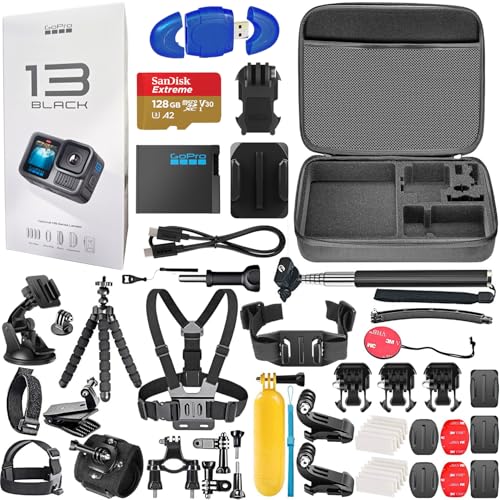
GoPro HERO13 Black — In-car standard
Walk any paddock and count the little black cubes on roll cages, helmets and dashboards: the GoPro is the in-car standard because it solved racing’s practical problems first. It is waterproof without a housing, small enough to mount where a scrutineer allows, stabilised well enough to turn cage-buzz into watchable footage, and supported by a mounting ecosystem so deep that any position a team dreams up has a bracket waiting. The HERO13’s high-resolution sensor and fast frame rates serve the two racing uses that matter — crisp broadcast-style running footage, and slowed-down analysis of a driver’s hands, a tyre’s behaviour, a suspension’s working.
Heat and session length are where owners must be adults. Like every sealed action camera, it will protect itself in a roasting cockpit if left recording in still air; experienced teams feed it airflow, use external power where regulations allow, and choose frame rates with the session length in mind. Managed that way, it is relentless. The interchangeable lens mods in its ecosystem — wider views, macro for detail work — extend it into jobs its rivals attempt with separate cameras, and its voice control matters more than it sounds when the driver is belted, gloved and helmeted before the out-lap.
For a first racing camera, this remains the default recommendation: not because it wins every specification, but because every problem you will meet has been met before by its enormous user base, and the answer is one search away. In a sport where the weekend is short and the sessions are precious, that community knowledge is a performance feature.
- Sensor: high-resolution action sensor, 5.3K-class video
- Stabilisation: advanced electronic with horizon lock
- Frame rates: high-speed options for slow-motion analysis
- Mounting: the deepest ecosystem in the paddock
- Body: waterproof without a housing
Strengths
- Mounts anywhere, survives the season, always understood
- Stabilisation that tames roll-cage vibration convincingly
- Slow-motion rates that serve genuine chassis analysis
Trade-offs
- Heat discipline required for long cockpit sessions
- Low-light running trails the DJI’s larger sensor
- Best accessories add cost beyond the camera
Teams add a footnote about data: the same files that entertain also testify. A disputed incident, a mechanical failure’s first symptom, a driver’s line through a corner — the in-car recording is evidence the sport increasingly runs on, which is why clubs mandate cameras in some series. Owning the paddock’s standard means your footage speaks the format officials expect, one more unglamorous reason the default is the default.
Best for: in-car and on-car footage at every level from track days to club racing. Not suited for: trackside telephoto work or long unattended recording in hot, still air.

DJI Osmo Action 5 Pro — Endurance and low light
DJI’s entry argues with the standard on two fronts racing cares about: endurance and dusk. Its battery life stretches notably beyond the class norm — the difference between swapping mid-meeting and forgetting the question — and its larger sensor gathers light that keeps evening sessions, floodlit finals and gloomy club circuits looking like footage rather than evidence. Subject tracking, borrowed from DJI’s drone brain, holds a car or rider centred with a persistence that flatters single-operator crews.
The mounting story is the modern one: a magnetic quick-release system that moves the camera between cage, chest and helmet mounts in seconds, which in a paddock — where the gap between sessions is measured in minutes and tempers — is worth real money. Stabilisation is excellent, colour science leans natural, and the front screen serves drivers checking their own framing before a stint. Water resistance is native, so a wet race is a footage opportunity rather than a retirement.
Choose it over the GoPro when your calendar leans toward long days and low light, or when you already live in DJI’s ecosystem of microphones and mounts. The paddock’s collective knowledge is thinner than GoPro’s, and the lens-mod ecosystem smaller — the honest taxes on a camera that, for endurance racing’s literal endurance problem, may be the most rational tool in this guide.
- Sensor: larger-format action sensor, strong low light
- Battery: class-leading endurance per charge
- Mounting: magnetic quick-release across mounts
- Tracking: subject tracking from DJI’s drone lineage
- Body: waterproof natively, dual screens
Strengths
- Battery life that outlasts a race meeting’s rhythm
- Dusk and floodlit footage stays clean and coloured
- Quick-release mounting speeds up paddock turnarounds
Trade-offs
- Smaller accessory and lens-mod ecosystem than GoPro’s
- Community troubleshooting knowledge still growing
- Maximum resolution bragging trails the Insta360
Endurance crews tell the defining story for this camera: a night stint where the DJI simply kept going — battery after battery outlasting the meeting’s rhythm, dusk footage holding together while rivals grain-choked. Reliability is a dull word until it is three in the morning and your content plan depends on a camera still awake. This is the pick for people whose racing is measured in hours rather than laps.
Best for: endurance events, evening meetings and DJI-ecosystem crews. Not suited for: teams who expect the widest mounting aftermarket from the first weekend.

Insta360 Ace Pro 2 — Sharpest action image
The Ace Pro 2 is the image-quality insurgent: a high-resolution sensor — 8K-class capture — behind a lens co-engineered with a famous German optical name, processed by dual AI chips that work hardest exactly where racing footage suffers. Harsh circuit contrast, white bodywork in noon sun, number boards flickering past — its processing holds detail and colour where rivals clip and smear, and its low-light mode cleans night-stint footage with a restraint that respects grain instead of smearing it into plastic.
For the trackside-adjacent jobs it is formidable: mounted at a corner’s exit, it records passes with a sharpness that survives cropping toward the car; on a pit wall, it catches a stop with broadcast crispness. The flip screen serves solo operators framing themselves for paddock pieces, and the body is waterproofed natively for the wet meeting. Rolling shutter behaviour at pan speed is competitive, though the pure 360 reframing trick belongs to its sibling below.
Its taxes are heat at the highest resolutions — sustained 8K in a hot cockpit is an ambition to manage, not a default — and a younger mounting ecosystem than GoPro’s. Creators who prioritise the image itself, and teams producing content where sharpness is the brand, will pay those taxes gladly. It is the connoisseur’s action camera, and racing’s contrast is where connoisseurship shows.
- Sensor: high-resolution, 8K-class video capture
- Optics: lens co-engineered with a heritage optical maker
- Processing: dual AI chips, strong low-light mode
- Screen: flip design for solo operators
- Body: waterproof natively
Strengths
- Sharpest, most detailed image in the action class
- Contrast handling flatters harsh circuit light
- Night and dusk processing stays natural
Trade-offs
- Top resolutions demand heat management in cockpits
- Mounting ecosystem younger than the leaders’
- Files from top modes are heavy to store and edit
Editors notice this camera in the timeline before they see its badge: the footage grades differently, holding highlight detail on liveries and letting shadows open without a fight. For a team whose output is judged on screens by sponsors, that post-production headroom is a commercial feature disguised as an image specification — and it is why the connoisseur’s pick keeps appearing in professional content kits.
Best for: content-led teams and corner cameras where image quality is the priority. Not suited for: set-and-forget cockpit recording at maximum settings.

Insta360 X4 — Reframe everything
The X4 breaks the framing problem that defines racing videography: you cannot know, in advance, where the moment will happen. A 360 camera records in every direction at once — the overtake on the left, the lock-up behind, the crowd’s reaction — and the edit afterwards chooses the shot, pans the virtual camera, and follows the action with a smoothness no operator at a fence can match. Mounted on a car, the invisible-selfie-stick trick erases its own mount, producing floating chase views that look like a drone the regulations would never allow.
The reframing workflow is the product: footage is shot loose and directed later, which suits racing perfectly because races are unrepeatable and incidents are unscheduled. Resolution spread across a sphere means each reframed view carries fewer pixels than a dedicated camera’s frame — the honest tax — yet at the sizes racing content is watched, the trade is routinely worth it. The body needs care: two protruding lenses live dangerously in a paddock, and lens guards are not optional equipment.
Choose the X4 as the second camera in any racing kit, or the first for a solo creator who can only mount one device and cannot afford to have aimed it wrongly. Its footage also feeds analysis — a coach can reframe a student’s lap toward the hands, the mirrors, the apex — making it a teaching instrument disguised as a novelty. In a sport of unrepeatable moments, recording everything is not a gimmick; it is insurance.
- Capture: full 360-degree video, reframed in editing
- Resolution: 8K-class across the sphere
- Mount trick: invisible selfie stick for floating views
- Modes: also works as a conventional wide action camera
- Care: exposed lenses demand guards in the paddock
Strengths
- Never misses the moment — direction is chosen later
- Floating chase angles no other mount achieves legally
- Coaching and analysis value from a single recording
Trade-offs
- Reframed views carry less resolution than dedicated cameras
- Twin lenses are vulnerable and need guarding
- Editing workflow is an extra step every time
A rally story makes the case concretely: a single X4 on a roof recorded a stage where the decisive moment — a rival’s spin — happened behind the car, outside every aimed camera’s world. The reframe found it, the clip led the weekend’s coverage, and the lesson entered local folklore. Racing is the subject that punishes aim most; this camera is the only pick that declines to aim at all.
Best for: solo creators, coaches, and second-camera coverage of anything unpredictable. Not suited for: buyers wanting maximum sharpness in a single fixed frame.

DJI Osmo Pocket 3 — Pit-lane storyteller
Every racing weekend has a second film playing in the pit lane — the driver’s face before the stint, the mechanic’s hands at the wheel gun, the team’s held breath at the wall — and that film belongs to the Pocket 3. Its three-axis gimbal stabilises mechanically, which reads completely differently from electronic correction: walking shots glide, pans stay level, and the one-inch sensor renders faces and dusk garages with a quality the action cameras cannot approach. It tracks subjects intelligently, starts in a second with a twist of the screen, and disappears into a jacket between moments.
Its racing limits must be stated as plainly as its gifts. It is not waterproof, not mount-and-forget tough, and no scrutineer will let it ride on a car; the gimbal is a precision instrument that treats gravel traps as obituaries. Within its arena — pit lane, paddock, garage, podium, the human documentary of a race weekend — it is untouchable at its size, and its audio ecosystem suits interviews that action cameras render as wind and shouting.
Pair it with any in-car pick in this guide and a racing weekend is covered at both of its speeds: the machinery’s and the people’s. Content teams increasingly treat that pairing as the standard kit, because audiences stay for the story, and the story is mostly faces. The Pocket 3 is how the faces get filmed properly.
- Sensor: one-inch class, the largest in this guide’s small cameras
- Stabilisation: mechanical three-axis gimbal
- Tracking: face and subject tracking for solo filming
- Audio: strong built-in and wireless microphone options
- Body: pocket-sized, not weather sealed
Strengths
- Gimbal smoothness no electronic system imitates
- Face and low-light quality for interviews and garages
- Starts instantly, tracks willingly, packs anywhere
Trade-offs
- Cannot be mounted on a car; fragile beside action cameras
- No weather sealing for wet pit lanes
- Fixed lens limits reach across a pit box
Drivers, it turns out, perform for this camera differently: its small size and quiet gimbal read as a conversation rather than a broadcast, so interviews loosen and garage moments stay candid. Content teams call it the paddock’s confessional. A tool that changes its subjects’ behaviour toward honesty is doing documentary work no specification can claim, and it is why this little gimbal outsells its dignity in professional kits.
Best for: pit-lane documentary, interviews and the human story of a race weekend. Not suited for: in-car mounting or any contact with the track itself.
Sony FX30 — Trackside telephoto tool
From behind the fence, racing photography’s real job begins: following a car at full speed through a long lens, holding it sharp against a streaking background, and slowing the finish down until the order is undeniable. That job belongs to an interchangeable-lens body, and Sony’s FX30 — a cinema-line camera on an APS-C sensor — is this guide’s prose-only representative of the class, presented without a link because it sits outside our verified pool. Its cinema heritage brings the tools trackside work actually uses: high frame rates for slow-motion finishes, colour science that grades beautifully, cooling designed for long recording, and a mount that accepts the telephoto lenses the fence demands.
The technique it enables deserves naming, because it is the opposite of the action cameras’ automation. The operator pans with the car, matching its speed so the machine stays sharp while wheels, spokes and background blur into velocity; shutter speed becomes the dial that tunes how much speed the frame shows. Rolling shutter, the fence-line enemy, is managed by the sensor’s fast readout and by panning smoothly rather than snatching. None of this is point-and-shoot — it is a craft, and the FX30 is the affordable end of the craft’s professional toolkit.
Budget honestly around it: the body is the beginning, and the telephoto lens is the real purchase, with a tripod or monopod and media behind it. For a photographer whose racing life is spectating, marshals’ posts and media days — and whose ambition is the definitive panning shot — that system is the correct destination, and the action cameras above become its companions rather than its rivals.
- Sensor: APS-C cinema-line sensor
- Video: high frame rates for slow-motion finishes
- Cooling: designed for extended recording sessions
- Mount: Sony E, telephoto lenses available widely
- Role: trackside system camera — prose-only in this guide
Strengths
- Telephoto panning with genuine craft control
- Cinema colour and slow-motion for finishes
- Recording endurance built for long race days
Trade-offs
- Lens and support costs dwarf the action cameras
- Skill-based: nothing about it is automatic
- Too large and precious for in-car mounting
Media accreditation is the honest horizon for this pick: the fence-line craft it teaches — panning discipline, shutter choice, position scouting — is precisely the portfolio that earns a young photographer a vest and a better fence. Buy it when the ambition is real, practise until the pans are silk, and let the action cameras handle the car while you become the person the teams call.
Best for: fence-line specialists and aspiring motorsport media. Not suited for: in-car use or beginners wanting automatic results.
Why does rolling shutter try to ruin racing footage?
Most small sensors do not expose a frame all at once; they read it line by line, top to bottom, over a fraction of a second. A stationary scene never notices. A racing scene — where a car crosses the frame during that fraction, or the whole camera vibrates at engine frequency — records each line at a slightly different moment, and verticals lean, wheels oval, and backgrounds wobble like jelly. The faster the sensor reads, the smaller the effect; the smoother the pan, the less the geometry shears. This is why this guide scores readout behaviour alongside resolution: at a circuit, a slightly softer camera with a fast readout produces truer footage than a sharper one that turns fence posts into italics.
Practical defences exist at every level. Stabilisation tuned for vehicles damps the high-frequency buzz that rolling shutter amplifies. Panning with the subject, rather than holding still and letting it cross, keeps the car in one set of lines while the background — where wobble reads as speed anyway — takes the distortion. And mounting rigidly, with tethers and short arms, removes the resonant waving that no sensor can outrun. Technique and hardware share this problem, which is why racing footage improves so dramatically in a creator’s second season.
How should you mount a camera in a race car safely?
Safety governs first, footage second, and scrutineers enforce the order. Mount to structure — roll cage, harness bar, solid chassis points — with clamps rated for the load, never suction alone on a competition car, and add a secondary tether for every device, so a failed mount leaves the camera dangling rather than loose in a footwell. Position for the story: over-the-shoulder framing catches hands, wheel and road in one composition; a low bumper mount sells speed like nothing else; a helmet mount shows the driver’s world but moves with every glance, which some viewers love and others cannot watch.
Then test at speed before the race that matters. Vibration lives at specific engine speeds, mounts resonate, and a camera that was stable in the pit lane may buzz into uselessness at full throttle in third. Record a practice session, review it large, adjust the mounting, and log what worked — racing teams keep setup notes for their cameras exactly as they do for their suspension. The footage that looks effortless on Sunday was engineered on Saturday, in the most literal sense.
Which frame rates does racing actually need?
Standard rates carry the narrative: the running footage, the pit stops, the interviews. High frame rates earn their storage in three specific theatres. At the finish, slowing a close order lets a result be shown rather than argued. In analysis, slow motion reveals what speed hides — a tyre deflecting under load, a damper working, a driver’s hands correcting — which is why coaches live in the high-rate modes of the action picks. And in drama, a slowed lock-up or a spray rooster-tail at a fraction of real speed is simply the most beautiful footage a race produces. Choose cameras whose high rates keep real resolution, because some headline rates are achieved by discarding the detail you slowed down to see.
Heat and light tax the ambition: high rates drink battery, fill cards and, in dim conditions, force sensitivity upward. The craft is choosing the rate per shot — narrative at standard, moments at high — rather than recording a whole meeting at maximum and melting both the camera and the edit. Racing rewards the deliberate here as everywhere.
How do you survive a full race day of recording?
Plan power, media and heat as a single system. Power: batteries rotate on a charger in the pit, or external power feeds the cameras where regulations permit, with swaps rehearsed like pit stops. Media: cards sized for the longest session, formatted in camera, and offloaded at every break to a laptop with a backup — because a full card at the restart is a self-inflicted retirement. Heat: shade the cameras between sessions, open housings where the design allows, favour airflow over still cockpits, and drop frame rates for the long unattended stints. Teams that treat the cameras as part of the car’s systems — checked, cooled, fed — finish with footage; teams that treat them as gadgets finish with gaps.
Audio deserves one line in the plan: an external microphone, placed out of the direct wind blast and close to the exhaust’s music or the driver’s radio, elevates racing footage more cheaply than any resolution upgrade. Wind is the enemy, foam and placement are the weapons, and the action picks’ audio accessories exist precisely because the paddock learned this years ago.
How does night racing rewrite the camera brief?
Darkness demotes resolution and promotes sensitivity, stabilisation and nerve. Under floodlights and into unlit countryside stages, the larger sensors in this guide — the DJI action camera’s, the Pocket 3’s one-inch, the FX30’s cinema chip — separate themselves from the pack, holding colour and detail where smaller sensors smear into noise. Headlight flare, dust in the beams and the contrast between a lit pit box and a black circuit all punish weak dynamic range, so night meetings reward the cameras that were chosen for their sensors rather than their frame rates. Frame rates themselves drop in value after dark: high rates demand light the night refuses to provide, and experienced night crews trade slow motion for clean standard-rate footage without regret.
There is also a human dividend to plan for: night footage looks cinematic almost by accident. Spray lit by following headlights, brake discs glowing at the end of a straight, a pit stop performed in a pool of work-light — the night race hands its filmmakers images no noon meeting can match. The beginner who brings a low-light-capable pick and the discipline to protect it from heat and spray will leave a night meeting with the best footage of their season, and it will not be close.
What changes when the racing is on two wheels?
Motorcycles intensify everything: the vibration is higher in frequency, the lean angles turn horizons theatrical, and the rider’s body becomes both mount and subject. Helmet and chest mounts dominate because the bike offers few rigid points a scrutineer will accept, and horizon locking earns its salary when the machine leans forty degrees through a favourite corner — footage without it looks like the world is ending, repeatedly. The 360 camera has a special motorcycle case: mounted behind the rider, reframing can follow an overtaking bike, the road ahead or the rider’s own inputs from a single recording, which is why solo track-day riders adopted it so quickly.
Wind becomes the primary enemy of both image and audio. A naked action camera at motorcycle speeds records a roar that buries the engine note riders actually want; placement in the rider’s wind shadow, foam protection, or a separate audio recorder in a pocket all belong to the two-wheeled craft. Heat, conversely, relaxes: airflow is the motorcycle camera’s birthright, and the cockpit shutdowns of car racing rarely trouble it. Every racing discipline rewrites the brief in its own dialect, and the wise buyer reads their own dialect first.
How should a beginner edit racing footage without drowning?
Racing generates footage the way its engines generate heat — continuously, and in quantities that bury the unprepared. The discipline that saves beginners is logging at the track: note the session, the camera position and the two moments worth finding again, on paper, before the next session starts. In the edit, build the story in the order the audience feels it — arrival, anticipation, the race’s turning points, the human release afterwards — and let the in-car footage serve that story in short, purposeful cuts rather than unspooling whole stints. Slow motion is seasoning: the finish, the save, the lock-up, each once, at the moment of maximum meaning.
Sound design is the beginner’s secret shortcut to professional feel. Lay the engine note continuously under cuts so the ear never notices the picture changing, drop music lower than instinct suggests, and keep the pit radio and paddock atmosphere in the mix — audiences describe the result as ‘cinematic’ without knowing why. Finally, export and archive the raw cards’ contents before formatting anything; the incident you did not notice live is next month’s most valuable clip, and it only exists if the originals survived.
What do professional motorsport crews do that beginners can copy?
They standardise. One camera platform across the team means one battery type, one card type, one menu language, one set of mounts — and a problem solved once is solved everywhere. They rehearse the media routine until it is muscle memory: cards out, offload started, batteries on charge, cameras cooled and checked, in the same order after every session. They protect the unglamorous assets — the logged notes, the labelled cards, the backed-up drives — with the same seriousness as the cameras, because they know a season’s footage is worth more than any single device that captured it.
They also scout light and position like photographers, not tourists: walking the circuit at the hour of the race, noting where the sun will sit for the finish, which fence sections allow a clean pan, where the spray will hang. A beginner can copy all of that in one weekend with one camera, and the improvement in their footage will exceed anything a camera upgrade could have bought. Professionalism in this field is mostly preparation wearing overalls.
How do you film other people’s racing respectfully and legally?
Circuits are workplaces with rules, and the camera does not exempt its owner from them. Respect restricted areas absolutely — fences and marshal posts mark lines drawn by accidents — and follow event media rules about where recording is permitted, especially in pit lanes where a distracted step can meet a moving car. In the paddock, a moment’s courtesy before filming faces, particularly children’s, keeps the sport’s open culture alive; teams are generous with access precisely because most visitors are considerate with it. Drones deserve a flat statement: they are prohibited at most organised motorsport, full stop, and no footage is worth the event’s anger or the law’s.
On public-road events and rallies, the duties sharpen: stand where marshals direct, never on the outside of a corner at car height, and keep escape routes in mind before framing the shot. The best racing filmmakers are invisible twice over — unhurt, and unnoticed. Build that reputation and doors open that no credential buys, including the pit-lane access where this guide’s Pocket 3 does its finest work.
How do you choose between stabilisation styles at speed?
Electronic stabilisation crops and warps the frame to cancel movement; at racing speeds its genius is vibration — the high-frequency buzz that makes footage unwatchable disappears as if the mount were made of glass. Its limits appear in violent pans and extreme shake, where the warping shows at the edges and the horizon can swim. Mechanical gimbal stabilisation, the Pocket 3’s way, cancels movement physically and looks effortlessly natural — but a gimbal cannot ride a race car, and its smoothness serves walking-pace subjects. Lens and sensor stabilisation in the FX30 class split the difference for handheld trackside work, steadying the operator’s tremor while the pan stays the operator’s craft.
The practical rule follows the job. In-car: electronic, always, with horizon lock. Pit lane: mechanical, whenever possible. Trackside: a stabilised lens on a monopod, with the pan supplied by a practised body. Beginners who match stabilisation to job stop fighting their footage; beginners who expect one style to serve all three spend the season wondering why every clip feels slightly wrong.
What does a realistic racing camera budget include beyond the camera?
Mounts first — plural, rated, and tethered — because a camera with one mount films one angle all season. Then power: spare batteries and a charger that lives in the pit, or the cables for external power where rules allow. Media in depth: cards enough for the longest day, plus the laptop or drive that receives them. Protection: lens guards for the 360, a case that organises the small army of brackets, and for the Pocket 3 a hard shell because gimbals forgive nothing. Finally, the unglamorous subscription nobody lists — replacement mounts and sacrificial parts, because racing consumes hardware and the season’s middle is no time to discover a clamp is irreplaceable.
Totals surprise beginners kindly, though: the entire supporting cast for an action camera costs a fraction of one telephoto lens for the trackside system, which is the economic reason the paddock films itself with action cameras and leaves the fence to the specialists. Budget by job, in this guide’s order, and the money lands where the footage is.
How will your racing footage improve across a season?
Month one is survival: footage exists, roughly framed, with the mount’s lessons learned the warm way. Month two brings position sense — you stop mounting where the camera fits and start mounting where the story is, and the in-car frame gains the driver’s hands and the road together. Month three, the edit tightens: stints become sequences, sound gets laid before picture, and slow motion appears only where it testifies. By season’s end the same cameras from this guide are producing work that looks like a different sport from month one’s, and nothing about the equipment changed.
That arc is the guide’s closing argument for buying well rather than buying big. Every pick here is good enough to grow on for seasons; the variable that compounds is the operator. Choose the camera matched to your job, mount it like an engineer, log it like a professional, and spend the savings on entry fees — because the best racing footage comes from being at more races.
What separates memorable racing films from mere recordings?
Intention about speed. A recording shows a car moving; a film makes the audience feel velocity — through the pan that holds the machine still while the world streaks, through the sound that rises before the car arrives, through the cut that leaves a corner a breath before the eye expects. Every camera in this guide can serve that intention, and none can supply it. The beginners who grasp it stop asking which camera the professionals use and start asking where the professionals stand, when they press record, and what they leave out. Those questions, pursued across a season, are the real syllabus this guide has been teaching under the cover of a buying list.
How do the six racing picks divide the race weekend?
| Pick | Job | Stabilisation style | Endurance character | Watch out for |
|---|---|---|---|---|
| GoPro HERO13 | In-car standard | Electronic, horizon lock | Session-length with heat care | Hot cockpits at top rates |
| DJI Action 5 Pro | In-car endurance | Electronic, subject tracking | Longest battery in class | Smaller mod ecosystem |
| Insta360 Ace Pro 2 | Corner and detail | Electronic, AI assisted | Strong, heat-managed at 8K | Heavy files |
| Insta360 X4 | Everywhere at once | Electronic, reframed later | Session-length | Exposed twin lenses |
| DJI Pocket 3 | Pit lane | Mechanical gimbal | Hours of interviews | No sealing, no mounting |
| Sony FX30 | Trackside telephoto | Lens and body options | Built for long recording | System cost and skill |
Most complete kits pair one row from the top four with the Pocket 3, adding the FX30 when the fence becomes a workplace. No single row covers a race weekend; the weekend is three jobs wearing one name.
Which racing filming mistakes end weekends early?
Mounting on hope ranks first: suction cups on competition cars, untethered cameras, arms long enough to resonate — each ends in a lost camera or a scrutineer’s refusal. Second, recording everything at maximum settings, and meeting heat shutdowns and full cards before the race does. Third, aiming only where the action is expected: racing’s moments happen at the edges, which is the X4’s whole argument. Fourth, neglecting the boring media discipline — unformatted cards, no offload routine, one copy of everything. Fifth, forgetting that the pit lane is half the story, and arriving with only in-car cameras to film a weekend that was actually about people. Each mistake is a planning failure wearing a technical costume, and each is cheap to prevent.
Final Recommendation
Start with the GoPro HERO13 if you can only mount one camera this season — it is the paddock’s language, and fluency matters. Choose the DJI Action 5 Pro instead when your meetings run long and light runs low, and add the Insta360 X4 the moment unpredictability starts costing you moments. Let the Pocket 3 tell the pit lane’s story, the Ace Pro 2 polish the corners, and the Sony FX30 wait at the fence for the day your panning hand is ready. Racing is three filming jobs at three speeds; this guide’s six answers respect all of them, and the trophies — on the shelf and in the edit — follow from matching camera to job.
Frequently Asked Questions
Can one camera really cover a whole race weekend?
One camera can cover one job well. An in-car action camera will record the race from inside, miss the pit lane’s faces, and never attempt the fence’s telephoto work — and that is fine if the in-car story is your whole ambition. Most creators grow into a pairing: an action camera for the machinery, the Pocket 3 for the people. Buy for the job you have now, in the order this guide ranks them, and let the weekend itself nominate the second purchase.
How do I stop my in-car footage shaking apart?
Attack vibration at the mount before the settings: shortest possible arm, clamped to structure, tethered, with the camera’s vehicle-appropriate stabilisation enabled and horizon lock on. Then check the resonance — vibration peaks at particular engine speeds, and a small change of mounting point often moves the camera out of the worst of it. Electronic stabilisation is remarkable but it is a cure with limits; the mount is the medicine, the setting is the bandage.
Is 360 footage a gimmick for racing?
No — it is the rational response to unrepeatable events. A reframed X4 recording guarantees the overtake, the incident and the celebration are all in the file, at a resolution cost that modern viewing sizes forgive. Professional coverage uses dozens of aimed cameras to buy the same certainty; the solo creator buys it with a sphere. Where a single fixed frame must be maximally sharp — a corner camera for broadcast — the Ace Pro 2 answers instead, which is why both are in this guide.
What settings should a beginner use at a first track day?
Keep it simple and robust: the camera’s standard resolution at a normal frame rate, stabilisation on, horizon lock on, exposure automatic with a slight negative compensation for bright tarmac, and the widest view that keeps the cockpit readable. Record a practice session and review it before changing anything. Fancy rates and modes earn their place after the basics survive a full day — heat, cards and mounts included — because a finished ordinary recording beats an abandoned spectacular one every time.
How important is audio in racing videos?
More than resolution, to an audience. Engine note, tyre protest and pit radio are the sport’s emotional soundtrack, and viewers forgive soft footage with great sound sooner than pristine footage with shredded wind noise. Use the wind protection the makers sell, place microphones out of the direct blast, and record a minute of pure paddock atmosphere at every meeting — editors call it gold, because it stitches scenes that pictures alone cannot.
When should a spectator graduate to the FX30 class?
When your panning hand is already good on lesser tools, your weekends are organised around the fence, and your frustration has a specific name — reach, slow-motion quality, grading control — that a system camera answers. The graduation is real money once the telephoto joins, so let a season of spectating prove the commitment first. Arriving at the FX30 with a practised hand is a joy; arriving with hope instead of technique is an expensive way to discover that the craft, not the camera, was the missing piece.
Do I need permission to mount a camera on a car at a track day?
Usually the organiser’s rules decide, and they commonly require rigid mounts, secondary tethers and a scrutineer’s glance — suction-only mounting is the frequent refusal. Ask before the day, bring clamps and tethers rather than arguments, and accept a refusal gracefully: the rules were written after incidents, and the paddock’s welcome depends on visitors honouring them. Club racing tightens the same logic into regulations, which the in-car picks’ mounting ecosystems were designed to satisfy.
Which camera should a rally fan start with?
The X4, for the spectator’s geometry: stages are unpredictable, sightlines are brief, and the decisive moment rarely happens where the crowd expected it. A 360 recording from a well-chosen, safe spectating position captures the car you came for and the incident you did not, and reframing at home replaces the impossible task of panning blind through trees. Pair it later with the Pocket 3 for the service park’s human story, and a rally season is covered at both its speeds.
How do I keep lenses clean in a dusty paddock?
Blower before cloth, always — dust at a circuit is abrasive, and wiping first grinds it across coatings. Keep cameras capped or bagged between sessions, change nothing optical in the open on a windy day, and treat the 360’s lens guards as consumables to be replaced when they scar. A clean front element is worth more resolution than any upgrade in this guide; the paddock’s veterans are recognisable by the blower in their pocket.
Should I record every session or only the races?
Record practice with intent and races without exception. Practice is where mounting, heat and framing experiments belong, because its footage costs nothing when it fails; the race is where experiments end. Many beginners invert that — cautious in practice, ambitious in the race — and learn the inversion’s price exactly once. Keep a simple rule taped inside the camera case if it helps: practice is the laboratory, the race is the laboratory’s exam, and nobody redesigns the experiment during the exam.
Related Guides
One last paddock truth, offered to whoever films their first meeting this season: the footage you bring home will be worse than the footage you imagined, and better than you feared — and the gap between the two closes faster than in any other kind of filming, because racing gives its students immediate, unignorable feedback at two hundred kilometres an hour. Mount the camera properly, press record earlier than feels necessary, and stay for the pit lane afterwards. The season will do the teaching.
Bring a notebook as faithfully as a camera. The teams whose footage improves fastest are the ones whose notebooks fill with mount positions, session times, heat behaviour and the two timestamps per session that mattered — because next meeting’s setup then starts from evidence rather than memory, and memory, at racing speed, is the least reliable storage medium in the paddock.
Keep exploring with our action-shots guide to burst speed and tracking, our favourite action cameras for underwater work, and our picks among cameras for action sports.


