reviewstook.com is reader-supported. When you buy through links on our site, we may earn an affiliate commission.
Where to buy
A quick translation before anything else: “dolares” is Spanish for dollars, and the search that brought you here — best cameras under 250 dolares — means cameras under 250 US dollars, whether it was typed in Madrid, Mexico City, Miami or Madrid’s time zone at 2 a.m. So: two hundred and fifty dollars. It is the most interesting budget in this entire series, because it is the first one where real cameras begin. Not great cameras, not forever cameras — but waterproof action cameras with honest stabilisation, a 4K webcam that professionals use, and entry points into ecosystems that continue far above the line. After the deserts of the smaller budgets, this one has water in it.
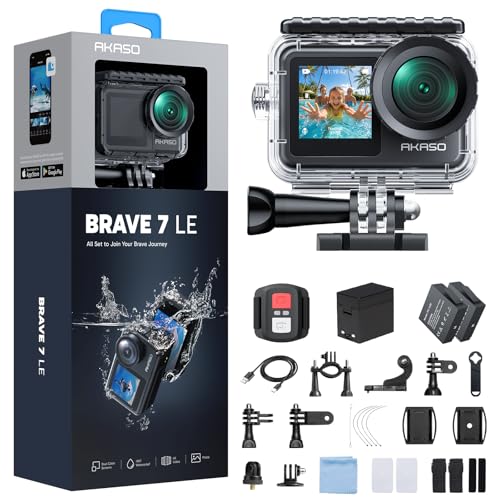
- AKASO Brave 7 LE: check price on Amazon
- GoPro Hero: check price on Amazon
- DJI Osmo Action 3: check price on Amazon
- Logitech Brio 4K: check price on Amazon
- AKASO EK7000: check price on Amazon
- NexiGo N60: check price on Amazon
Timing flatters this budget, too. The models below are mature rather than newborn: their firmware has settled, their quirks are documented in a thousand owner threads, their accessories have multiplied and cheapened, and their prices have completed the long slide from launch enthusiasm to honest value. A buyer at 250 today is purchasing proven instruments at the bottom of their depreciation — the opposite of the early adopter’s tax, and one more reason this line, of all the lines in the series, rewards decisiveness.
The shape of the budget should be understood before the picks. Two hundred and fifty dollars does not reach a new interchangeable-lens camera with a lens — that door opens higher, and this guide will not pretend a body-only listing is a camera. What the budget owns outright is the action-camera category, where three of the six picks live, and the premium webcam category, where two more sit. The sixth is the budget action camera that leaves half the money unspent for mounts, cards and a second battery — a legitimate strategy at this level, where accessories decide how much of a trip actually gets filmed.
Readers shopping from Spanish-speaking markets should note one practical point that has nothing to do with cameras: prices, warranty handling and even model availability vary by country, and a camera bought across a border may carry a warranty that stops at it. The recommendations below are about the cameras themselves, which are the same objects everywhere; the channel decisions — local dealer versus import — deserve the same care here as in any market, and the guide’s advice is the usual one: a warranty you can use beats a saving you cannot.
Spanish-language support is a small, practical blessing of the major brands in this list worth checking before purchase: manuals, support pages and warranty lines in Spanish exist for the makers named here, which matters when a camera is bought for a parent or a grandparent who will operate it in their own language. The no-name listings that crowd this price band rarely extend the same courtesy — one more place where the conservative shortlist quietly earns its conservatism.
Finally, a discipline borrowed from the neighbouring guides: at this budget the difference between models is real but the difference between a camera bought and a camera carried is larger. Every pick below is small, tough or desk-bound by design. None requires a bag, a ritual or a Sherpa. That is not an accident of the shortlist; it is the shortlist’s philosophy.
Key Takeaways
- AKASO’s Brave 7 LE is the value centre of the budget: touch screen, real stabilisation and weather sealing with money left over.
- GoPro’s compact Hero brings the famous ecosystem and stabilisation to the line in its simplest, lightest form.
- DJI’s Osmo Action 3 is the connoisseur’s action pick: superb colour, magnetic mounting and dual screens.
- Logitech’s Brio is the desk answer at this level — a genuine 4K webcam with autofocus and presence.
- AKASO’s EK7000 undercuts everything and spends the change on the accessories that make action cameras useful.
- NexiGo’s N60 covers the work-from-home basics so cheaply that the rest of the budget can go elsewhere entirely.
In this guide
Quick Picks
| Camera | Badge | Why it is here |
|---|---|---|
| AKASO Brave 7 LE | Best value under 250 | Touch-screen action camera with stabilisation and sealing, priced with room to spare. |
| GoPro Hero | Best simple GoPro | The lightest route into GoPro’s stabilisation, app and mounting universe. |
| DJI Osmo Action 3 | Best action image quality | Colour and dynamic range that flatter travel footage, in a quick-mount body. |
| Logitech Brio 4K | Best webcam under 250 | 4K, autofocus and light correction for professionals whose camera is a desk. |
| AKASO EK7000 | Best for leaving money over | The proven budget action camera, bought with its whole accessory kit inside the line. |
| NexiGo N60 | Best basic webcam value | 1080p calls with a privacy cover, for a small fraction of the budget. |
How were the best cameras under 250 dolares judged?
At this budget the judging changes character: the question stops being what a camera cannot do — the smaller budgets’ melancholy refrain — and becomes which of several genuinely capable cameras matches a given life. Action cameras were judged on stabilisation honesty, colour, mounting speed and the waterproofing’s real-world sealing; webcams on the picture a colleague actually sees, autofocus behaviour and light correction. Cross-category, the guide weighted the total cost of a working kit, because a camera at the line with no card, no mount and no spare battery is a camera priced above it in disguise.
One test was applied to every pick and is worth naming: the second-year test. Budget electronics die young at a rate their first reviews never capture, so brand accountability — support, spares, firmware, a company that answers — was treated as a specification throughout. All six picks pass it, which is more than can be said for most of the marketplace at this price, and is the quiet reason the list looks conservative. Conservative, at 250 dollars, is what reliable looks like.

AKASO Brave 7 LE — Best value under 250
The Brave 7 LE is the camera this budget seems designed to buy. It takes the formula of AKASO’s cheaper action cameras — waterproof, wide, cheerful — and adds the two refinements that transform daily use: a touch screen that makes the camera operable by a normal human without a phone in the other hand, and stabilisation that smooths walking and riding footage into something a family will actually rewatch. Under the line with room to spare, it is the pick against which the rest of this guide must argue.
Footage first, since footage is the point. Daylight video is bright, steady and colourful in the crowd-pleasing way holiday footage should be; the wide lens keeps riders, swimmers and skylines framed without aiming anxiety; and the camera’s handling of mixed light — out of a tunnel, into sun — is composed beyond its price. Underwater it goes where phones and compacts cannot, in its case, and returns with the snorkelling footage that justifies the entire purchase in one afternoon.
The touch screen deserves emphasis because small cameras live or die by it. Menus become taps instead of button-chords; reviewing a take happens on the spot, at the size the camera offers, while the moment can still be re-shot; settings change at the trailhead rather than at the hotel. Owners of button-only action cameras consistently report the same conversion after a week with a screen: they shoot more, because checking costs nothing.
Weather sealing and build put it a class above its cheaper sibling for the trips that involve actual weather — the rainy-season trek, the boat in spray, the ski lift in falling snow. Battery arrangements follow the action-camera pattern of spares, cheap and plentiful in this ecosystem, and the included accessories cover the first season’s mounting needs without a second order.
Its ceilings are the category’s, stated once for all three action picks and owned specifically here: night footage softens, stills are wide snapshots rather than photographs, and the lens’s wide view bends horizons at the frame’s edges. Audio in wind needs the usual forgiveness or a dead-cat accessory. None of this distinguishes it from rivals costing more; it is simply the shape of an action camera, and buyers wanting portraits and darkness should be reading about other categories entirely.
Value is the closing argument and it is not close. The Brave 7 LE leaves enough of the 250 unspent to fund the card, the spare battery, the floating grip and the case — the kit that decides whether a camera films a whole holiday or its first two days. A rival at the very line, naked, is the more expensive purchase by the end of the first trip. Buy the kit, not the spec sheet: that sentence is this pick’s whole review in miniature.
Families should note the handover factor. This is a camera a parent can pass to a teenager at the beach without a briefing or a wince, tough enough for the pass and simple enough — that screen again — for the teenager to return footage worth keeping. Equipment that circulates through a family earns its price several times over; equipment that must be guarded earns it once, resentfully.
- Type: action camera with touch screen
- Stabilisation: electronic, effective for walk and ride
- Build: weather-sealed, case for full waterproofing
- Kit position: leaves budget for card, battery, mounts
Strengths
- The most complete action package under the line
- Touch operation that multiplies how much gets shot
- Accessories affordable inside the same budget
Trade-offs
- Night footage and stills remain modest
- Wide-lens distortion shapes every frame
- Wind audio needs help or forgiveness
Best for: travellers, families and first action-camera owners wanting the whole kit. Not suited for: low-light work or stills-led photography.

GoPro Hero — Best simple GoPro
GoPro’s smallest current camera makes a specific promise: the famous parts of the GoPro experience — the stabilisation, the app, the mounting universe, the name that rental shops and resale buyers recognise — in the lightest, simplest body the company sells, at a price that fits this budget. For the buyer who wants a GoPro and not a lecture, the Hero (the compact model, distinct from the flagship Black line) is the honest entry ticket.
Simplicity is the design’s spine. The camera is small enough to disappear into a pocket or onto a chest mount and be forgotten, waterproof without a case for the swims and downpours of ordinary travel, and controlled with a minimalism that suits its role as a grab-and-go recorder. Its 4K video carries the family’s current house style — stabilised, wide, bright — and the footage flows into GoPro’s app and editing ecosystem, where automatic highlight assembly turns a day’s clips into a watchable film on the train home.
That ecosystem is the strategic reason to choose it over the AKASO above. Mounts multiply across every sport and vehicle; every rental counter and airport shop stocks its accessories; tutorials, presets and spare parts exist in depth; and when the owner upgrades within the brand, the mounts, habits and app library all carry over. Cameras are bought singly but owned as systems, and at this budget the GoPro system is the deepest water a new owner can step into.
The simplifications are real and should be inventoried. The battery is built in rather than swappable, which caps a heavy shooting day at what the internal cell and a power bank can give; the screen and control arrangement are minimal beside the flagship’s; low light is the small action camera’s usual negotiation; and some of the flagship line’s modes and lens options do not descend to this model. Buyers planning expedition-grade shooting days should compare the flagship’s swappable batteries honestly before choosing the lighter body.
Within its intended life, though, the trade is well judged. Most travel footage is shot in bursts — the viewpoint, the ride, the swim, the descent — and a light camera with a healthy battery and a power bank in the bag covers that life completely. What the Hero removes is not capability so much as ceremony, and ceremony is what keeps cameras in hotel rooms.
Resale and recognition close the case for the pragmatic. A used GoPro is the easiest camera in this guide to sell, lend or insure, because everyone in the chain knows what it is. For a buyer whose 250 must remain liquid — the student who may sell in a year, the traveller who trades up by generation — that liquidity is a financial feature no specification table lists.
Choose it when the words “just a GoPro” describe the actual desire: the swim, the ride and the trip, recorded well, without a new hobby’s learning curve attached. It is the name-brand pick of this guide and, for once, the name is buying something real — an ecosystem, a resale market and a decade of other people’s solved problems.
- Type: compact action camera, waterproof without case
- Video: 4K with GoPro stabilisation
- Battery: built-in — plan a power bank for long days
- System: full GoPro mount and app ecosystem
Strengths
- The lightest, simplest entry to the GoPro world
- Ecosystem depth no rival at the price can match
- Resale and accessory availability everywhere
Trade-offs
- Built-in battery caps expedition days
- Fewer modes than the flagship line
- Low light is the class’s usual compromise
Best for: travellers and swimmers wanting GoPro simplicity and ecosystem. Not suited for: all-day expedition shooting on swappable batteries.

DJI Osmo Action 3 — Best action image quality
DJI entered action cameras late and behaved like a company that had read every complaint about the incumbents. The Osmo Action 3, sold here in its outdoor combo with straps for hiking and cycling, is the image-quality pick of this budget’s action trio: colour and dynamic range that flatter real travel footage — bright skies held while faces stay lit, sunsets that grade rather than clip — delivered in a body whose magnetic quick-release mounting is the fastest in the class.
Colour is the argument owners make first, and they are right. DJI’s processing has a filmic restraint the category rarely attempts: skies deepen instead of bleaching, skin stays skin in mixed light, and the flat profile available for editors gives travel film-makers footage that accepts a grade gracefully. Cut beside the gimbal camera footage from DJI’s wider family, the Action 3 belongs; cut beside cheaper action cameras, it looks like the unit that brought a colourist.
The mounting system is the second argument, and it is about seconds. Magnetic quick-release means the camera moves from chest strap to helmet to tripod between activities without tools, clips or prayer — and action cameras live on such transitions, because the shot is always on the other mount. The combo’s straps cover the hiking and cycling cases most buyers actually have, which is why this listing, rather than the bare camera, is the one this guide links.
Dual screens serve the solo traveller: frame a self-shot piece to camera on the front display, check the rear one for the landscape work, and never return home to discover a day of footage composed around a nostril. Cold-weather battery behaviour is a quiet DJI specialty in this generation — mountain users report stamina in frost that empties rival cells — and the camera’s operating manners generally suggest a design team that skis.
Debits, for balance: the ecosystem of mounts, while growing and partly cross-compatible, is not GoPro’s ocean; the model sits a generation behind DJI’s own flagship action line, whose refinements — particularly in low light and tracking — it lacks; and its stills remain action-camera snapshots. Buyers choosing between this and the newer DJI flagship should know the gap is real but priced, and at this budget the Action 3’s discount is the point.
For the traveller whose footage is the souvenir — the one who edits, grades and posts films their friends actually finish — the Action 3 is this budget’s most rewarding action camera. The AKASO wins on value, the GoPro on ecosystem; the DJI wins on the picture, and the picture is what remains when the trip becomes a memory with a play button.
Cyclists and hikers, the combo’s named audience, should weigh the straps seriously: chest and backpack mounting change POV footage from a novelty into a narrative device, placing the viewer inside the effort of the climb. A camera bought with its mounts in the box gets mounted on the first weekend; a camera awaiting a separate accessories order gets carried in a pocket and reviewed, a month later, as underwhelming.
- Type: action camera, outdoor combo with straps
- Colour: DJI processing, flat profile for grading
- Mounting: magnetic quick-release
- Screens: front and rear displays
Strengths
- The most flattering travel footage under the line
- Fastest mount changes in the class
- Cold-weather stamina for mountain use
Trade-offs
- A generation behind DJI’s own flagship
- Mount ecosystem smaller than GoPro’s
- Stills remain snapshots
Best for: editing-minded travellers, hikers and cyclists who grade their footage. Not suited for: buyers wanting the newest flagship features or a stills camera.

Logitech Brio 4K — Best webcam under 250
Half the readers of a camera guide at this budget do not need a camera for the world; they need one for the rectangle. The Brio is the rectangle’s flagship-class answer within the line: a 4K webcam with autofocus, automatic light correction and a field of view that can be narrowed from room to face, built by the company whose webcams the world’s IT departments already trust. For the professional whose presence is their product — the consultant, the tutor, the streamer, the executive on a screen of other executives — it is the pick of this guide.
Resolution is the least interesting of its virtues and should be got out of the way: the 4K sensor’s practical gift is not 4K calls, which platforms mostly compress away, but headroom — the ability to crop to a tighter frame, or to record locally at quality the call never shows. The working virtues are autofocus that follows a presenter without hunting, and light correction that rescues the backlit, the lamplit and the window-side faces that home offices specialise in. Colleagues will not name what improved; they will simply upgrade their estimate of the person on screen.
Presence details accumulate. The adjustable field of view lets a tutor include a whiteboard’s edge or a seller include the product shelf, then tighten to a portrait for the board call. The privacy shutter answers the desk-lens anxiety definitively. The mount fits monitors, laptops and tripods, and the whole device asks nothing of its owner beyond plugging it in — a virtue professionals consistently rank above specifications they cannot pronounce.
Streaming is the second career. The Brio’s image, fed into the usual broadcasting software, gives a beginning streamer a picture that looks established — the soft authority of a camera that is not struggling — while they learn the crafts that actually build an audience. Several creators’ first years were filmed on this class of Logitech, and their archives show it: the face stays sharp, the light stays kind, the camera never becomes the story.
Its limits are a webcam’s, worn with the category’s usual honesty: tethered, desk-bound, blind to everything beyond the room, and dependent on the computer’s software for its cleverest tricks. Its price also sits near the line, leaving little of the 250 for the microphone that presenters should buy next — a sequencing problem the buying sections address by noting that a good webcam now and a microphone next month beats a mediocre pair bought together.
For the reader whose camera work is entirely seated, this is the guide’s most professional purchase: the one that will be seen, daily, by the people whose opinions pay the bills. Action cameras film adventures; the Brio films careers, and at this budget it films them at a standard that needs no apology in any meeting it will ever join.
Employers standardising home offices should note the fleet argument: one model, everywhere, with one software behaviour and one support path, is worth more to an IT department than a marginally better picture from a mixed fleet. The Brio’s ubiquity is, in that world, a feature with a budget line of its own.
- Type: 4K USB webcam
- Focus: autofocus with light correction
- View: adjustable field of view
- Extras: privacy shutter, tripod-ready mount
Strengths
- Professional presence for calls and streams
- Light correction that rescues real rooms
- Cropping headroom from the 4K sensor
Trade-offs
- Desk-bound and computer-tethered
- Near the line — microphone comes later
- Platforms compress away much of the 4K
Best for: consultants, tutors, executives and beginning streamers. Not suited for: any photography beyond the desk.

AKASO EK7000 — Best for leaving money over
The EK7000 returns from the neighbouring guide with a different argument. There, it was the best camera a tiny budget could reach; here, it is a strategy: buy the proven, waterproof action camera for a fraction of the line, and spend the substantial remainder on the kit that turns an action camera into a filming system — mounts for the bike and the chest, a floating grip for the water, spare batteries, fast cards and a case that organises them. Under 250 spent this way films more of a holiday than 250 spent on a naked flagship-adjacent body.
The camera itself keeps the virtues its long market life certifies. Daylight footage is bright and wide; the waterproof case takes it swimming and snorkelling; the remote and included mounts cover the first season; and the brand’s support and spares ecosystem — the thing that separates it from the no-name listings at its own price — means a lost door or tired battery is an errand, not a funeral. It has been the first action camera of a generation of travellers for reasons that compound: it works, it survives, it can be replaced without tears.
The accessory-first strategy deserves a fuller defence, because it generalises beyond this pick. Action footage is positional: the same camera produces a dull film from a hand and a thrilling one from a chest strap, a pole and a helmet in rotation. Owners consistently discover that their second mount improved their footage more than their second camera would have. A budget that buys positions buys cinema; a budget that buys only a sensor buys a view.
What the EK7000 does not buy, even surrounded by accessories, is refinement. Its stabilisation is a step behind the Brave 7 LE’s, its operation is buttons rather than touch, its low light is modest and its stills are snapshots. The strategy suits the buyer whose filming is bright, wet and active — which describes most holidays ever taken — and fails the buyer whose heart is set on night rides and polished edits. That buyer should walk one review up this page and buy the Brave.
There is also a fleet argument unique to this price. Two EK7000s — one on the rider, one on the bike — cost what one mid-range action camera costs, and multi-angle footage of a single adventure is the raw material of films that look produced. Clubs, schools and families filming group expeditions exploit this arithmetic routinely, and the cameras’ interchangeability of batteries and mounts makes the fleet a system rather than a pile.
As the guide’s second AKASO, it also serves as the honest floor of the whole list: everything above it in price must justify itself against a camera this capable bought this cheaply, with its kit included in the same money. Several famous names, held against that floor, justify themselves mainly in low light and stabilisation — which is exactly the comparison the torn buyer should perform, in the shop, with a trip in mind.
Buy it as a system, lend it without anxiety, and let the savings fund the journey it will record. That is not a consolation purchase; at this budget, it is arguably the most intelligent one on the page.
- Type: budget action camera, waterproof case included
- Strategy: camera plus full accessory kit under the line
- Support: established brand, cheap spares and batteries
- Fleet note: two units enable multi-angle filming
Strengths
- The whole filming system fits inside the budget
- Proven, lendable and cheap to keep alive
- Multi-angle fleets become affordable
Trade-offs
- Stabilisation and controls trail the Brave 7 LE
- Low light and stills are modest
- Refinement is not what the savings buy
Best for: system buyers, clubs, schools and multi-angle adventurers. Not suited for: night footage or buyers wanting touch-screen polish.

NexiGo N60 — Best basic webcam value
The final pick spends the least and, for one specific reader, solves the most. The NexiGo N60 is a 1080p webcam with a microphone and a privacy cover at a price that consumes a small fraction of this budget — which means the remote worker who needs a camera for calls and has other plans for the remaining money (a chair that does not hurt, a light, a microphone) can solve the camera line of the budget completely and move on. Not every pick in a guide must strain at the ceiling; some should duck under it and free the rest.
Its performance at its one job is the reason it survives in a guide whose other webcam is a 4K flagship. Set at eye level with a window or lamp in front of the sitter, the N60 produces the clear, level, properly exposed picture that separates a professional call presence from a laptop’s under-chin murk. The overwhelming majority of meetings are won or lost at exactly that level of quality — the level of being clearly seen and heard — and the N60 reaches it for the price of a team lunch.
The details are the working ones: plug-and-play connection that no employer’s software rejects, a privacy cover for the lens that watches the room all week, a microphone adequate for speech in a quiet space, and a mount that fits the monitor it will live on. There is no autofocus — the sitter’s distance is the focus, set once — and in dim evening rooms the picture is serviceable rather than flattering. The Brio above exists for readers who need those refinements; the N60 exists for readers who need the basics done properly and the budget back.
Students and job seekers are its natural owners, and for them its economics are close to perfect: the camera that carries the internship interviews and the first remote job costs less than the textbook it sits beside, and it will still be working, unremarked, when the career it helped start can afford the Brio. Equipment that arrives early in a career and never embarrasses itself has a claim on affection that flagships rarely earn.
Households should note the multi-room arithmetic: at this price, the home office, the child’s study desk and the spare laptop can all be camera-equipped inside the budget that buys one premium webcam. Families whose need is coverage rather than excellence — grandparents called from three rooms, homework supervised from two — will find the N60’s fleet logic as persuasive as the action cameras’.
It closes the guide as the reminder that a budget is a plan, not a target to be spent up to. The reader who needs calls covered and a holiday filmed can pair this webcam with the EK7000 above and own both answers inside the line — a combination no single 250-dollar camera in the world can beat for that household. Sometimes the best camera under a budget is two cameras, honestly chosen.
One setup paragraph, because it decides this webcam’s reputation in more homes than its sensor does: raise it to eye level, face the light, and sit a little further back than instinct suggests. Performed faithfully, those three free acts make the N60’s picture indistinguishable, to a meeting’s other participants, from cameras several times its price — which is the highest compliment a value pick can be paid.
- Type: 1080p USB webcam
- Extras: built-in microphone, privacy cover
- Setup: plug and play with all major platforms
- Budget role: frees most of the 250 for other needs
Strengths
- Professional-enough calls for a fraction of the budget
- Pairs with an action camera inside the same line
- Privacy cover and zero-fuss setup
Trade-offs
- Fixed focus — the sitter provides the sharpness
- Dim rooms are serviceable, not flattering
- One seated person is its whole world
Best for: remote workers, students and households equipping several desks. Not suited for: streamers or presenters who move while they talk.
How do the six compare side by side?
| Camera | Kind | Signature strength | Watch out for |
|---|---|---|---|
| AKASO Brave 7 LE | Action | Complete value package | Night footage modest |
| GoPro Hero | Action | Ecosystem and simplicity | Built-in battery |
| DJI Osmo Action 3 | Action | Colour and quick mounts | Older generation |
| Logitech Brio 4K | Webcam | Professional desk presence | Near the budget line |
| AKASO EK7000 | Action | Whole kit inside the budget | Basic stabilisation |
| NexiGo N60 | Webcam | Calls covered for a fraction | Fixed focus |
What should the rest of the 250 buy, pick by pick?
The action picks share one shopping list and differ only in how much of it the budget covers. A fast, genuine memory card comes first — counterfeit cards are this market’s endemic fraud, and a card that fails on the descent deletes the holiday more thoroughly than any camera fault. Spare batteries follow for the swappable models, a floating grip for anyone filming over water, and one mount beyond the included ones, chosen for the owner’s actual sport rather than a catalogue’s imagination. Bought in that order, the accessories convert each camera from a device into a system at the exact pace the trips demand.
The webcam picks spend differently: on light and sound, in that order. A small lamp or a repositioned desk transforms the N60 and flatters the Brio; a separate microphone, bought when the budget next allows, is the presenter’s true graduation. Webcam owners who spend their remainder on software subscriptions before light have the order backwards, and their pictures testify to it in every meeting.
And every pick in this guide shares one final purchase: storage with a backup habit. Footage that exists on one card in one camera is footage on loan from fortune. A drive, a cloud tier, a Sunday-evening copying ritual — the unglamorous tail of the 250 — is what makes the difference between a camera that was bought and an archive that survives.
Which mistakes do buyers make at the 250 line?
Reaching for the body-only interchangeable-lens listing leads the list: a camera body at the line, with no lens, is not a bargain but a down payment, and the lens that completes it carries the total far past the budget the buyer set. This guide excluded such listings deliberately; the complete cameras above all photograph on the day they arrive. Second is buying the flagship’s previous generation at the line, naked, over the complete current kit — the EK7000 review’s argument — when the trips being filmed would never know the difference but will certainly know the missing mount.
Third is the category error in its two common costumes: the action camera bought for a newborn’s portraits, all wide distortion and tiny-sensor darkness; and the webcam bought for a family’s events, tethered to a laptop like a kite. The six picks are labelled by the lives they fit because at 250 the wrong category is a total loss, while the wrong model within a category is a nuance. Fourth, quietly, is ignoring the return window’s test week — the batteries, seals and cards of this budget deserve the same prompt audition the smaller guides prescribed.
How do sun, salt water and altitude treat this budget’s cameras?
The readership behind the word “dolares” films in some of the most camera-testing geography on earth — Caribbean water, Andean altitude, desert noon — and the picks were quietly weighted for it. Salt water is the first examiner: every action camera here swims, but salt demands the rinse ritual, fresh water over seals and doors after every sea session, because crystallised salt on a gasket is how waterproof cameras eventually drown. The Brave and the EK7000 travel in cases that make the ritual easy; the GoPro Hero and the Action 3 seal natively and rinse in seconds. Owners who rinse own their cameras for years; the ocean keeps the rest.
Sun is the second examiner, and it taxes batteries and screens rather than seals. Action cameras left recording on a dashboard or a boat’s rail in tropical noon will meet their thermal limits and stop, politely, to cool — a behaviour beginners mistake for failure. Shade, airflow and shorter clips are the working answers, and the same sun that stops a camera also lights the best footage of the year, which is the trade every tropical film-maker learns to schedule around: shoot the water at ten, the shade at noon, the golden hour like it is a religion.
Altitude completes the examination quietly. Cold at four thousand metres drains batteries that performed at the beach; spares carried warm, against the body, are the mountain rule for every pick in this guide. Screens and fingers slow down together, which argues for the cameras with the simplest operation — the Hero’s minimalism and the Brave’s touch targets both earn marks here that a spec sheet cannot award. Geography is a specification in this market, and the shortlist was built by people who checked.
How do you choose between the three action cameras in one afternoon?
Shops and doorsteps permitting, the torn buyer between the Brave 7 LE, the Hero and the Action 3 can settle it with three tests that mirror the trips ahead. First, the mount test: handle each camera’s mounting with cold or gloved hands, because the mount that fumbles in a warm shop will not be used on a cold mountain — DJI’s magnetic system usually wins this test outright, which is information, not trivia. Second, the screen test: frame a face at arm’s length and review it outdoors, in the glare the camera will actually meet; the camera whose footage can be checked is the camera whose mistakes get re-shot.
Third, the colour test, which needs no shop at all: watch sample footage from each, on the television or monitor the holiday films will live on, and notice which rendering the household prefers before anyone explains which is technically superior. Colour taste is real, stable and personal — some families love DJI’s restraint, others want GoPro’s punch, others find AKASO’s cheerfulness exactly right — and a camera whose colour the owner loves will be used for years, while the objectively finer instrument whose look leaves them cold will be carried less and less. Buy the footage you want to watch.
If the tests tie, let the kit decide: price the whole working package — camera, card, spare battery, the mount for the owner’s sport — for each finalist, and buy the one whose complete figure respects the 250 with the most room to spare. Ties in cameras are broken by arithmetic, and the room to spare becomes the floating grip, the case, the second card: the accessories that, as this guide has argued throughout, decide how much of the trip gets filmed.
What makes a good first serious camera for a teenager at this budget?
Parents shopping this line for a teenager are really choosing which hobby gets a chance to start. The action picks suit the teenager whose life is already filmed in their head — the skater, the surfer, the cyclist — because the camera joins an existing passion rather than demanding a new one, and the footage feeds the editing habit that turns filming into film-making. Between them, the Brave’s screen suits the self-filmer, the Hero suits the brand-aware, and the Action 3 suits the one already talking about colour.
The webcams answer a different teenager entirely: the streamer, the online student, the young tutor earning from a desk. For that household the Brio is the serious instrument and the N60 the sensible one, and the choice between them should be made by how much of the teenager’s week is genuinely spent on camera. Equipment bought for an imagined streaming career has a poor survival rate; equipment bought for the three calls a week that actually happen pays for itself in a term.
Either way, the gift mechanics from the smaller guides apply with interest at this price: give the camera configured, with its first outing planned, and give the accessories with it rather than as later apologies. A teenager whose camera arrives complete starts filming that weekend. A teenager whose camera awaits a card, a mount and a parental order films, on average, next month — by which time the moment that inspired the gift has usually passed, and with it the habit the gift was meant to start.
When should a buyer at 250 save toward the next tier instead?
The honest exits from this budget deserve naming, as they did in the smaller guides. The stills photographer — the reader whose heart is set on portraits, on a child’s face rendered with a real lens’s depth — will find every pick here a compromise wearing the wrong shape, and should treat the 250 as the foundation of a system-camera fund rather than a sum to be spent on action cameras that will not satisfy. The same applies to the night-led film-maker and the wildlife hopeful: their cameras exist, higher up, and this budget’s role in their lives is as a milestone, not a destination.
Everyone else — the travellers, the swimmers, the riders, the desk professionals, the families — is home. This is the first budget in the series where the guide’s advice stops being about managing disappointment and becomes about choosing among goods, and the six picks above were selected to make that choice pleasant rather than anxious. If a reader’s need matches a pick’s label, the correct move is to buy it, kit it, and go filming — the next tier will still be there when this one has earned its replacement.
Final Recommendation
Choose by element and by desk. For the traveller wanting one complete action camera, the Brave 7 LE is the budget’s centre of gravity; for the traveller who edits and grades, the Osmo Action 3’s colour earns its place; for the buyer who wants the name, the ecosystem and the simplest possible ownership, the compact GoPro Hero is the honest ticket. The EK7000 is the strategist’s pick — camera plus kit, or a two-camera fleet — and it embarrasses nothing else on this page by existing.
For the seated professional, the Brio is the presence purchase and the N60 the coverage purchase, and the household that needs both a desk and a holiday answered can pair the N60 with either AKASO inside the same 250 — the combination this guide would buy for a family starting from nothing. Whichever leaves the shop, spend the remainder in the order given above: card, battery, mount, backup. Two hundred and fifty dollars, allocated that way, is no longer a small camera budget. It is a filming life, begun properly.
Related guides
- Best Digital Cameras Under 200 Dollars: Real Used Bodies, Premium Compacts and Action Cameras
- Best Digital SLR Cameras Under 750 Dollars: Real DSLRs, New and Used
Frequently Asked Questions
What does “dolares” mean, and is this budget in US dollars?
“Dolares” is the Spanish word for dollars, and the keyword is read throughout this guide as 250 US dollars — the intent behind the search in most markets where it is typed. Readers shopping in other currencies should treat the figure as the equivalent band; the categories and rankings travel, even where local prices shuffle the order slightly.
Can I buy a mirrorless or DSLR camera under 250?
Not new and complete. Body-only listings appear at the line, but a body without a lens takes no photographs, and the completing lens breaks the budget. Used mirrorless kits from reputable dealers occasionally approach the line and are the honest version of the idea; new, the complete cameras in this guide are what 250 buys.
Which of these is best for a family holiday?
The Brave 7 LE for one camera that does everything the holiday asks — water, rides, walks, swims — with its kit inside the budget. Families filming group adventures should also weigh the EK7000 fleet idea: two angles of the same day beat one angle at higher polish for most family films.
Is a 4K webcam worth it if calls are only 1080p?
Often, yes, for the headroom rather than the headline: the Brio’s sensor allows tighter cropping and better local recording, and its autofocus and light correction — the features colleagues actually perceive — ride along with the resolution. Buyers who never crop or record may find the N60’s fraction-of-budget answer entirely sufficient.
GoPro, DJI or AKASO — which action brand at this budget?
GoPro for ecosystem and resale, DJI for colour and mounting speed, AKASO for value and kit completeness. All three are supported, warrantied and honest at this level, which is more than the no-name field can claim; the choice among them is a matter of which virtue the owner’s trips will use most.
Are these cameras good gifts at this budget?
Unusually good ones, because the price band sits at the crossing of generosity and sense: substantial enough to feel like an occasion, modest enough that the recipient uses the thing without fear. The action cameras suit the traveller and the teenager, the Brio suits the professional with a new remote role, and the N60 suits the student leaving for university. Give them configured — card in, battery charged, first outing named — and the gift starts working the weekend it lands.
How much of the 250 should accessories take?
Roughly a fifth to a quarter for action cameras — card, spare battery, one chosen mount — and rather less for webcams, whose remainder belongs to light and, later, a microphone. A camera at the exact line with nothing left for its card is, in practice, a camera over budget.
One closing encouragement for the reader who has now read several of this series’ budget guides in a row, comparing lines at 120, at 250, at a lakh and at a thousand: the research has diminishing returns, and the cameras do not. Every pick above will be filming, this weekend, in the hands of someone who stopped reading one guide earlier. Join them at the first pick whose label matches your life — the water, the desk, the road — and let the remaining budget buy the journey the camera was always for.
Related Guides
Readers whose budget sits lower will find the honest limits mapped in the best cameras under 120 guide, while those planning the step to a system camera should read the best cameras under 1000 filmmaking roundup for where the money goes next. For the desk in depth, the best webcams for working from home guide compares the wider field.


