An acoustic panel kit is meant to tame echo and reflections in a home studio, a listening room, a podcast corner or a media room. The materials differ: foam tiles are light, fabric-wrapped fiberglass panels are denser, and diffusers scatter sound rather than absorb it. Panel count and thickness help you judge how much wall each set covers.
The six kits below cover foam tiles, fiberglass panels, velvet panels, a diffuser set and corner bass traps. Sizes and materials come from each product’s listing page. We have not used these kits ourselves, and sound claims in titles are the makers’ own.
As an Amazon Associate we earn from qualifying purchases. Links below are affiliate links, and they do not change the product information we give.

What to Look For
| Feature | Why it matters |
|---|---|
| Material | Foam, fiberglass and EVA behave and mount differently |
| Thickness | Thicker panels are usually described for lower frequencies |
| Panel count | Compare the wall area covered with your room |
| Mounting | Brackets, nails or adhesive change how it hangs |
In this guide
Specs at a Glance
| Kit | Size and count | Material | Notes |
|---|---|---|---|
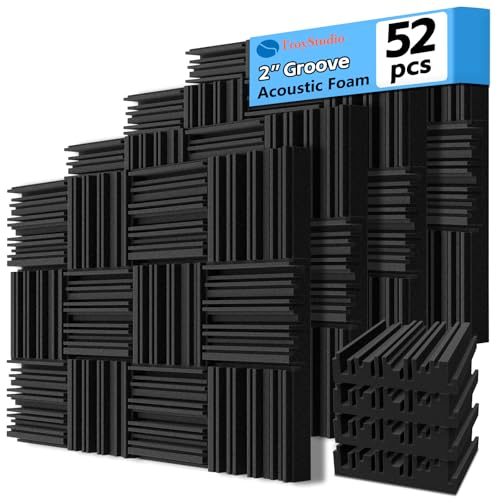
| TroyStudio foam | 12 x 12 x 2 in; 52 pieces | Foam, black | 7.83 lb; grooved 3D surface |
| UMIACOUSTICS | 23.6 in panels; 4 pack; 2 in thick | Polyester over fiberglass | Wall bracket or nail template |
| Waffle diffuser | Four 12 x 12 x 2 in modules | EVA foam board | 1.54 lb; forms a 24 x 24 in block |
| SKYROSS velvet | 50 x 50 x 5 cm; 2 pack | Velvet fabric | Mounting brackets included |
| Pyramid foam | 12 x 12 x 2 in; 24 pack | Polyurethane foam | 3 lb; no adhesive included |
| Corner bass traps | 12 pack; triangular pyramid | Foam | 4.41 lb; limited detail in the listing |
The 6 Best Acoustic Panel Kits
Top pickBest for covering a large wall with tiles
1. TroyStudio Acoustic Foam Panels, 52 Pack
A set of 52 black foam tiles at 12 by 12 by 2 inches, listed at 7.83 pounds, with a grooved 3D face described as broadband absorbing for studios and walls or ceilings.
Suits: covering a large wall with tiles. Strengths: a large piece count. Weaknesses: sparse detail in the listing. Skip it if you want fabric-wrapped panels.
View TroyStudio Acoustic Foam Panels 52 Pack on Amazon

Best for denser, wrapped panels
2. UMIACOUSTICS Fiberglass Acoustic Panels, 4 Pack
Four 2 inch thick panels with a polyester fabric wrap over a fiberglass core, supplied with a metal template and nails or wall brackets. The title says 23.6 by 11.8 inches while the size field says 23.6 by 23.6, and a stated coverage of 432 square feet for four panels cannot be right.
Suits: denser, wrapped panels. Strengths: a removable mount. Weaknesses: contradictory size and coverage data. Skip it if you need exact dimensions.
View UMIACOUSTICS Fiberglass Acoustic Panels 4 Pack on Amazon

Best for scattering reflections on a rear wall
3. Waffle Acoustic Diffuser Panels, 4-Piece Kit
Four 12 by 12 by 2 inch molded EVA foam modules with a stepped waffle pattern that join into a 24 by 24 inch block, listed at 1.54 pounds. The maker calls it QRD-inspired and pairs it with foam and bass traps.
Suits: scattering reflections on a rear wall. Strengths: a light, modular, white design. Weaknesses: it diffuses rather than absorbs. Skip it if you only want absorption.
View Waffle Acoustic Diffuser Panels 4-Piece Kit on Amazon
Best for panels that look like wall art
4. SKYROSS Velvet Acoustic Panels, 2 Pack
Two velvet-covered diffusing and absorbing panels of 50 by 50 by 5 centimeters with mounting brackets for vertical walls. The maker advises construction adhesive for ceilings, and the size field shows 19.69 by 19.69 by 2.09 inches.
Suits: panels that look like wall art. Strengths: fabric faces and brackets. Weaknesses: only two panels. Skip it if you need to cover a lot of wall.
View SKYROSS Velvet Acoustic Panels 2 Pack on Amazon

Best for a mid-size room
5. Pyramid Acoustic Foam, 24 Pack
Twenty-four 12 by 12 by 2 inch polyurethane foam pyramids, listed at 3 pounds in total, sold without adhesive. The product size field reads 0.1 inch thick, which conflicts with the 2 inch title.
Suits: a mid-size room. Strengths: a pyramid face and low weight. Weaknesses: mounting is up to you. Skip it if you want adhesive included.
View Pyramid Acoustic Foam 24 Pack on Amazon

Best for low frequency corner treatment
6. Corner Bass Trap Foam, 12 Pack
Twelve triangular pyramid foam pieces for wall corners, listed at 4.41 pounds with a 24 by 20 by 2.09 inch size that is hard to match to the shape. The listing text is limited, so treat the details as unconfirmed.
Suits: low frequency corner treatment. Strengths: a corner-specific shape. Weaknesses: thin listing detail. Skip it if you need confirmed specs.
View Corner Bass Trap Foam 12 Pack on Amazon
Care and Setup
- Follow the maker’s instructions for mounting and adhesive.
- Measure the wall area against the panel count and size.
- Mix absorption with diffusion if the maker suggests it.
- Keep the mounting hardware with the instructions.
Mistakes to Avoid
- Buying by piece count without working out the covered area.
- Assuming foam tiles and fiberglass panels do the same job.
- Trusting coverage figures that disagree with the panel size.
- Forgetting that some sets do not include adhesive.
Questions to Ask Before You Buy
- What problem am I trying to fix: echo, flutter between bare walls, or sound leaking to the next room?
- How much wall or ceiling area can I realistically cover with the kit?
- Will the mounting method suit my wall surface, or does it need adhesive, hooks or screws?
- Does the maker’s listing describe the fire behavior of the material, and does that matter in my building?
- Do I want a plain look, or a design that works as wall decor too?
- Can I remove the panels later without damaging the wall, for example in a rental?
Matching It to Your Room
Hard, bare rooms with parallel walls tend to ring, so first reflection points beside and behind your listening or speaking position are usually the sensible places to begin. A small closet-sized booth needs different coverage than a spare bedroom used for music or a home office used for calls. Measure the wall sections you plan to cover, sketch the layout on paper, and compare it with the dimensions in the maker’s listing before ordering. Thickness and density matter as well, because thin panels and thick panels do different jobs. Treat the listing and the instructions as your guide to realistic expectations.
Who Should Skip It
If your main concern is noise from neighbors, traffic or a shared wall, surface panels alone are not built to block sound from passing through. That job calls for mass, sealing gaps and construction changes, so a kit may disappoint. Skip them too if you cannot attach anything to the walls, or if you need a certified material for a commercial space. In those cases, rugs, heavy curtains and bookshelves may be a better first step, and a professional can advise on structural work.
Absorption Versus Diffusion Explained
Most people buying a kit expect it to make a room quieter, but panels do two different jobs. Absorbers soak up some of the sound that hits them, which reduces echo and the sense of a hard, ringing room. Diffusers scatter sound in many directions, which keeps a room lively without strong, distinct reflections. A treated room often uses a mix, and the right balance depends on how you use the space.
For speech, such as a podcast corner or a video call setup, absorption is usually the first priority because it makes voices clearer and less hollow. For music listening or mixing, many people also want some scattering on the rear wall so the room does not feel dead. A diffuser that only scatters will not reduce echo as much as an absorber, so do not expect it to behave like foam.
- Absorbers suit small rooms with flutter echo and bare walls.
- Diffusers suit rooms where you want to keep some liveliness.
- Bass traps in corners address low-frequency buildup, according to the makers.
- Treat the listing language about effectiveness as the maker’s description, not a measured result.
If you are unsure, start with a small amount of absorption at the main reflection points, listen, and add more only if the room still sounds harsh. Covering every wall at once can make a space feel dull and unnatural.
Foam, Fiberglass and Fabric Compared
Material shapes how a panel looks, how it hangs and what it is meant to do. Foam tiles are light and cheap to ship, and they are easy to cut and place, but they vary in density and many people find them less tidy looking. Fabric-wrapped panels with a fiberglass or mineral core are heavier and denser, and they tend to look more finished on a wall, which matters in a living area or office.
Velvet or fabric-faced panels often double as decor, so they suit rooms where appearance counts. Diffuser modules made of molded foam board are light and modular, but their purpose is scattering. Corner pieces are shaped for a specific location, so they only help if you have free corners to fill.
Some points are worth checking on every listing:
- What the core is made of, and whether the maker describes any fire-related behavior.
- Whether the panel is meant for a wall, a ceiling or both.
- Whether the fabric is attached, and how it handles dust and pet hair.
- Whether the mounting parts are in the box.
Handle fiberglass-core panels as the maker instructs, and read any safety notes in the box before cutting or moving them. If fire safety rules apply to your building, ask the landlord or a qualified professional what is allowed.
Placing and Mounting Panels Step by Step
Good placement does more than quantity. A simple way to find reflection points is to sit in your listening or speaking position while a helper slides a small mirror along the side walls. Wherever you can see the speaker or sound source in the mirror, that spot is a first reflection point and a sensible place for a panel. Repeat for the ceiling if you can.
- Empty the area and mark the planned spots lightly in pencil.
- Check the wall for pipes, wiring and studs before drilling or nailing.
- Decide whether to use brackets, nails, screws or adhesive, and follow the maker’s instructions.
- Hang the first panel and check it is level and secure.
- Listen, then add or move panels one at a time.
Adhesive can damage paint or plaster and is hard to reverse, so renters should consider options that leave minimal marks. Do not place foam near heaters, lamps or other heat sources. Keep clear of electrical sockets and any ventilation openings, and make sure the panels cannot fall onto a person or equipment if a fixing fails.
Budget Tiers and Realistic Goals
You can treat a room at several levels. At the lowest level, a small set of foam tiles or a pair of panels placed at key reflection points can calm a small booth or a video-call corner. This will not transform a large, bare room, but it can make a noticeable difference to how voices sound.
In the middle, a kit that combines absorption with a diffuser or bass traps gives more flexibility for a music room. You get more control, but also more to place and tune, and you will need enough wall area to make it worthwhile.
At the higher end, thicker, denser panels and custom-built treatments cover more of the spectrum, but they take more space, more effort and often a professional opinion. For most home users, the sensible approach is to start small, listen, and expand if needed.
- Match the amount of treatment to the room size, not to the biggest pack.
- Remember that panels improve the sound inside a room, not the noise passing through walls.
- Keep the packaging and instructions until you are sure of the layout.
A Checklist Before You Order Panels
Treating a room works best when you plan before buying. These points help you avoid a kit that does not match the space.
- Measure the length, width and ceiling height of the room.
- Sketch the position of the desk, speakers or microphone and sofa.
- Clap once and listen for a ringing echo, which tells you where reflections are strongest.
- List the wall areas you can use, leaving space for doors, windows and outlets.
- Decide whether you can drill, or whether you need a no-damage hanging method.
- Read the maker’s page for any fire safety information and follow it for your location.
Reading a Panel Listing Carefully
A kit title may mention a big panel count, but the useful numbers are thickness, panel size and total coverage. Multiply the area of one panel by the number in the box to see how much wall it can cover. Check the material description, since foam, fiberglass and wrapped fabric behave differently. Look at the mounting method too, because some kits ship with adhesive and others expect screws or clips. Then compare the photos with the written specs. If the page shows a finished studio that clearly uses many more panels than the kit contains, treat the photo as inspiration rather than a promise.
Thin Foam Tiles Versus Thick Panels
| Question | Thin foam tiles | Thick panels |
|---|---|---|
| Weight | Very light | Heavier, need firm mounting |
| Typical aim | Tame high-pitched flutter | Reach into lower frequencies |
| Look | Wedge or pyramid shapes | Flat, fabric-wrapped |
| Install effort | Quick | More planning |
| Fit for rentals | Easy to remove | Depends on mounting |
Neither type turns a room into a soundproof booth. They shape how sound behaves inside the room.
Short Glossary for Room Treatment
- Reverberation: sound that lingers after the source stops.
- First reflection point: a wall spot where sound bounces to your ears.
- NRC: a single number that sums up how much sound a material absorbs.
- Bass trap: a thick treatment placed in corners.
- Flutter echo: rapid ringing between parallel walls.
- Standoff: a gap left behind a panel for extra effect.
Which Kit Fits Which Situation
- Podcast corner: a small set of panels behind and beside the microphone is often enough.
- Home theater: focus on the side walls and the wall behind the seats.
- Music practice room: combine absorption with some scattering so the space does not sound dead.
- Home office with calls: treat the wall facing you and one side wall.
- Rental bedroom: choose light panels that hang with removable hardware.
When to Follow the Maker’s Manual or Call a Professional
Mounting instructions, weight limits and fire information come from the manufacturer, so read them before you hang anything. If a wall is plaster, brick or has hidden wiring, ask a qualified tradesperson before drilling. A room that needs serious soundproofing, such as a drum space, may call for an acoustic consultant and a contractor. Panels alone will not stop noise from passing through walls.
Layout and Care Notes
Hang panels at ear height first, then add more as needed. Leave the center of each wall for last, and avoid covering every surface evenly. Dust fabric faces gently with a soft brush or the vacuum brush attachment on a low setting. Keep foam out of direct sunlight, which can fade or harden it over time. Listen again after each addition so you know when the room sounds balanced.
A Simple Listening Routine
Play a familiar track and walk around the room. Clap in several spots and note any ring. Make small changes, then listen once more.
Common Layout Mistakes to Sidestep
Many first-time buyers cover one wall densely and leave the rest bare, which can make the room sound lopsided. Others place panels too high, above the point where sound actually bounces toward the listener. A third slip is ignoring the ceiling and the floor, which reflect just as much as walls. Spread the treatment across several surfaces, keep a rug or soft furniture in the room, and add a little at a time. If something still sounds odd, move the speakers or microphone before adding more material, because position often matters more than quantity.
Choosing Acoustic panel kits in More Depth: What Separates a Good Buy From a Regret
The reviews above give you the shortlist. This section slows the decision down, because most disappointment with acoustic panel kits does not come from choosing a bad product outright. It comes from choosing a good product for the wrong job, the wrong space or the wrong routine. A few minutes spent matching the design to your home studio, office, bedroom or media room, your habits and the people who will share it will do more for your satisfaction than any single feature on a specification list. Work through the points below in order, and keep returning to one question: how will this actually be used on an ordinary week, not on the best day you can imagine?
What problem you are solving
Panels tame reflections and echo inside a room; they do not soundproof it against a neighbour’s music, so naming your real problem honestly decides whether a kit will delight or disappoint.
In practice, this is easy to test before you buy. Picture the acoustic panel kits in your home studio, office, bedroom or media room during improving room sound and reducing echo, and walk through the first ten minutes of a typical session in your mind. Where does it sit, who is nearby, what do you touch first, and what could get in the way? If the design you are considering makes that imagined session smoother, it is probably the right direction. If it adds a step, a workaround or a small daily friction, believe that signal, because small frictions are exactly what decide whether equipment gets used for years or quietly abandoned after a month.
Coverage and placement
A modest amount of panel placed at first reflection points usually beats the same amount scattered decoratively, so plan positions before counting pieces.
In practice, this is easy to test before you buy. Picture the acoustic panel kits in your home studio, office, bedroom or media room during improving room sound and reducing echo, and walk through the first ten minutes of a typical session in your mind. Where does it sit, who is nearby, what do you touch first, and what could get in the way? If the design you are considering makes that imagined session smoother, it is probably the right direction. If it adds a step, a workaround or a small daily friction, believe that signal, because small frictions are exactly what decide whether equipment gets used for years or quietly abandoned after a month.
Panel thickness and material
Thicker, denser panels generally work across a wider range of sound, while thin decorative foam mainly touches higher frequencies, which shapes realistic expectations.
In practice, this is easy to test before you buy. Picture the acoustic panel kits in your home studio, office, bedroom or media room during improving room sound and reducing echo, and walk through the first ten minutes of a typical session in your mind. Where does it sit, who is nearby, what do you touch first, and what could get in the way? If the design you are considering makes that imagined session smoother, it is probably the right direction. If it adds a step, a workaround or a small daily friction, believe that signal, because small frictions are exactly what decide whether equipment gets used for years or quietly abandoned after a month.
Mounting method and walls
Adhesive, clips and frames differ in permanence and wall damage, an important question in rentals and in rooms that get rearranged.
In practice, this is easy to test before you buy. Picture the acoustic panel kits in your home studio, office, bedroom or media room during improving room sound and reducing echo, and walk through the first ten minutes of a typical session in your mind. Where does it sit, who is nearby, what do you touch first, and what could get in the way? If the design you are considering makes that imagined session smoother, it is probably the right direction. If it adds a step, a workaround or a small daily friction, believe that signal, because small frictions are exactly what decide whether equipment gets used for years or quietly abandoned after a month.
Look and layout
Panels are visible design as much as treatment, so colour, pattern and symmetry decide whether the finished wall looks intentional or improvised.
In practice, this is easy to test before you buy. Picture the acoustic panel kits in your home studio, office, bedroom or media room during improving room sound and reducing echo, and walk through the first ten minutes of a typical session in your mind. Where does it sit, who is nearby, what do you touch first, and what could get in the way? If the design you are considering makes that imagined session smoother, it is probably the right direction. If it adds a step, a workaround or a small daily friction, believe that signal, because small frictions are exactly what decide whether equipment gets used for years or quietly abandoned after a month.
Matching Acoustic panel kits to Real-Life Situations
No single recommendation suits everyone, and the picks in this guide differ precisely because households differ. The situations below cover the ways people most commonly use acoustic panel kits. Find the one closest to your life first, use it to narrow the shortlist to one or two options, and only then compare the remaining details. That order matters: starting from your situation prevents the common mistake of buying for an imagined lifestyle and then trying to adapt your routine to the product.
For home offices and calls
Treating the wall behind and beside a desk calms the hollow sound callers hear, often with fewer panels than people expect.
Whatever else changes between households, the pattern is the same: the right choice is the one that fits the space you have, the time you realistically give to improving room sound and reducing echo and the other people involved. Be honest about the constraints rather than optimistic about them. A slightly simpler option that fits your home studio, office, bedroom or media room perfectly will outperform a more ambitious one that has to be worked around every single time, and it will still be in regular use long after the novelty has worn off.
For music practice and small studios
For instruments and recording, placement around the playing position and corners gives a clearer, more honest sound to practise with.
Whatever else changes between households, the pattern is the same: the right choice is the one that fits the space you have, the time you realistically give to improving room sound and reducing echo and the other people involved. Be honest about the constraints rather than optimistic about them. A slightly simpler option that fits your home studio, office, bedroom or media room perfectly will outperform a more ambitious one that has to be worked around every single time, and it will still be in regular use long after the novelty has worn off.
For media rooms and gaming
Panels at reflection points sharpen dialogue and game audio without turning up the volume, which the rest of the household usually appreciates.
Whatever else changes between households, the pattern is the same: the right choice is the one that fits the space you have, the time you realistically give to improving room sound and reducing echo and the other people involved. Be honest about the constraints rather than optimistic about them. A slightly simpler option that fits your home studio, office, bedroom or media room perfectly will outperform a more ambitious one that has to be worked around every single time, and it will still be in regular use long after the novelty has worn off.
For bedrooms and rest spaces
Softening echo makes a hard-surfaced bedroom feel calmer, and fabric-faced panels double as visual warmth on a large blank wall.
Whatever else changes between households, the pattern is the same: the right choice is the one that fits the space you have, the time you realistically give to improving room sound and reducing echo and the other people involved. Be honest about the constraints rather than optimistic about them. A slightly simpler option that fits your home studio, office, bedroom or media room perfectly will outperform a more ambitious one that has to be worked around every single time, and it will still be in regular use long after the novelty has worn off.
Getting Set Up and Building a Routine That Lasts
Setup day sets the tone for everything that follows, so resist the urge to rush it. Unpack and inspect everything first, read the manufacturer’s guidance once all the way through rather than dipping into it when something goes wrong, and assemble or position the acoustic panel kits in good light with the tools and space the job deserves. Check every moving part, closure and adjustment before first use, because a small defect or a missed step is far easier to resolve on day one than after weeks of use have made it hard to tell what changed.
Then give yourself a short settling-in period. In the first week or two, use the acoustic panel kits in the simplest way possible and pay attention to what feels awkward: the position, the order you do things in, the spot where accessories end up, the moment someone else in the household gets involved. Adjust one thing at a time. Move the storage, change the position, shorten the session or add the one accessory that removes a recurring annoyance. These small corrections, made early, are what turn a new purchase into an established habit rather than another thing to step around.
A sustainable routine also has a realistic rhythm. Decide in advance where the acoustic panel kits lives when it is not in use, what has to happen before a session can start, and what the two-minute tidy-up afterwards looks like. If starting requires ten minutes of clearing and hunting for parts, sessions will quietly stop happening. If everything is to hand and the reset is quick, the opposite happens: use becomes casual, frequent and enjoyable, which is the entire point of buying well in the first place.
Finally, involve anyone else who will use or share it. Agree the basic house rules early, while everyone is still enthusiastic: how it is set up, what is not allowed, and how it is left for the next person. Most household friction about shared equipment is not really about the equipment at all. It is about one person finding it dirty, moved, damaged or tangled. A shared two-minute standard, agreed once, prevents almost all of it.
Cleaning, Storage and Long-Term Care
Dust panels with a soft brush or vacuum attachment so pores stay open, keep them dry and away from steamy rooms unless designed for it, check mounts after the first weeks, and keep spare fixings so a loose panel is dealt with promptly.
Care works best as a rhythm rather than a rescue. A quick wipe, check or tidy after use takes moments and prevents the slow build-up that eventually needs an afternoon of scrubbing, unpicking or untangling. Once a month or so, go a little deeper: look at the parts you normally ignore, the undersides, backs, seams, hinges, connections and storage corners where dust, moisture and wear collect unnoticed. Catching a loosening fitting, a small tear or early corrosion at that stage is the difference between a five-minute fix and a replacement.
Storage deserves the same thought as use. Keep the acoustic panel kits in the conditions its materials prefer: dry rather than damp, out of relentless direct sun where that applies, and somewhere it is not crushed, leaned on or used as a shelf for unrelated clutter. If it came with a case, cover or specific storage position, use it; manufacturers design those around the product’s weak points. And keep any instructions, spare parts and accessories together in one labelled place, because the small part you need in eighteen months is only useful if you can find it.
Know, too, when care becomes repair and repair becomes replacement. Worn consumables, tired seals, frayed edges and parts that no longer hold their adjustment are signals, not failures of character. Deal with them promptly and the product keeps performing as it should. Ignore them and performance fades gradually, which is how people end up believing a good product was never much good. A brief note in a calendar, a few times a year, is all the system most households need.
How the Picks in This Guide Compare With Each Other
Readers often ask which of the reviewed options is simply the best, and the honest answer is that the picks above were chosen to cover different priorities rather than to crown one winner. One will suit the buyer who wants the simplest route into improving room sound and reducing echo. Another will suit the household that needs flexibility, because several people, spaces or situations have to be served by the same purchase. Another earns its place through durability and ease of living with, the qualities that matter most once the first month has passed. Comparing them is therefore less about ranking and more about recognising which trade-off you are happiest to live with.
A useful way to compare is to score each shortlisted option against your own three non-negotiables, the things you decided in the criteria section above that you will not compromise on. Ignore, for a moment, every other feature. The option that meets all three usually reveals itself quickly, and the features it lacks tend to be the ones you would rarely have used. If two options still tie, choose the one that is easier to clean, store and live with in your home studio, office, bedroom or media room, because those everyday qualities are what you will experience most often, long after the headline differences have faded into the background.
It is also worth rereading the honest limitations noted in each review above with fresh eyes. A limitation only matters if it touches your situation: a product that is less suited to heavy, daily use may be perfect for weekend use, and one described as basic may be exactly right for a beginner who needs confidence rather than complexity. The reviews were written to surface those distinctions, so use them as a matching tool rather than a league table, and let your circumstances, not a ranking, make the final call.
Common Mistakes, Troubleshooting and Staying Safe
Most problems people report with acoustic panel kits follow a familiar pattern, and nearly all of them are avoidable. The first is buying for the wrong size or scale: measuring nothing, guessing generously or pessimistically, and discovering the mismatch only when the product is in the room. The second is skipping the unglamorous preparation, the levelling, anchoring, charging, seasoning, cycling or practising stage that the instructions insist on for good reason. The third is judging too early, deciding in the first session that something does not work, when a small adjustment to position, settings or technique would have solved it.
When something does go wrong, troubleshoot in a calm order. Return to the simplest setup. Check the obvious causes first: power, fit, cleanliness, alignment, whether a part is reversed, blocked or due for replacement. Change one thing at a time and test after each change, so you actually learn what fixed it. If the problem involves damage, unusual noise, heat, smell or anything that makes the product feel unsafe, stop using it and contact the maker or a qualified professional rather than improvising a fix.
On safety, the essentials are straightforward. Use fixings rated for the panel weight and wall type, keep panels away from heaters and candles, and check any fire-related guidance for the materials you choose, especially in bedrooms and studios. Beyond those specifics, keep the general habits that apply to almost everything in a home: supervise children around equipment that was not designed for unsupervised play, keep instructions and warnings where you can find them again, and never let familiarity breed carelessness. The safest users are not the most anxious ones; they are the ones whose checks and habits are so routine that they happen automatically, every time, without needing to be remembered.
More Questions Buyers Ask
How long should acoustic panel kits last with normal use?
There is no honest single number, because lifespan depends far more on use and care than on the calendar. A well-matched product that is cleaned, stored and checked as described above will usually serve for years of regular use, while the same product neglected, overloaded or stored badly can disappoint within a season. Judge longevity by how it is built and supported, keep up the small maintenance habits, and treat changes in feel, sound or performance as early prompts to inspect rather than as surprises to ignore.
What should a complete beginner buy first?
Start with the option in the reviews above that best matches your space and your most common situation, and resist adding extras until you have used it for a few weeks. Beginners benefit most from simplicity, because it lets them learn the fundamentals of improving room sound and reducing echo without fighting the equipment. Once your routine is established, you will know exactly which accessory or upgrade would genuinely help, and that second purchase, made with experience, is almost always money better spent than a bundle bought on day one.
Is it worth paying more for a premium option?
It can be, but only when the extra cost buys something you will actually feel: better materials where hands and weather meet the product, smoother adjustments you will use weekly, easier cleaning, or construction that stays tight and true for longer. Premium pricing that buys only styling or features you will try twice is poor value at any budget. Decide your non-negotiables first, find the level that meets them properly, and treat anything above that level as a considered luxury rather than a necessity.
How do I know when to repair, adjust or replace?
Adjust when the product works but the fit, position or settings no longer suit you, because that is normal as routines and households change. Repair, or have serviced, the parts that are designed to wear: consumables, seals, blades, filters, fasteners and similar items listed in the product’s own guidance. Replace when the structure itself is damaged, when safety is in question, or when performance has faded in ways that cleaning and adjustment no longer restore. If you are ever unsure where a problem sits on that scale, err toward inspection by someone qualified.
What is the single best habit for getting value from this purchase?
Use it little and often, and leave it ready for next time. Short, regular use builds skill and enjoyment far faster than rare, ambitious sessions, and a two-minute reset afterwards, cleaned, checked and stored properly, is what makes the next session effortless to start. Almost every long-term success story with equipment like this comes down to that unglamorous pairing: modest sessions, consistently repeated, with the kit always ready to go.
A Final Pre-Purchase Checklist
Before you order, run through this short checklist against the option you have chosen. You have measured the space in your home studio, office, bedroom or media room and confirmed the fit with room to spare. You have named the main job the purchase must do, and the option matches that job rather than a secondary one. You have read its honest limitation in the review above and decided it does not affect you. You know where it will be stored, how it will be cleaned, and who else will use it. And you have a simple plan for the first two weeks of use. If every answer is yes, you are buying with your eyes open, and that, more than any feature list, is what predicts a purchase you will still be pleased with next year.
Acoustic Panel FAQ
Which are fabric-wrapped?
The UMIACOUSTICS uses polyester and the SKYROSS uses velvet.
Which scatters sound?
The waffle set is the diffuser. The SKYROSS is described as both diffusing and absorbing.
Will acoustic panels soundproof my room?
No. Panels reduce echo and reflections inside a room, but they are not designed to stop sound passing through walls. Soundproofing needs mass, sealed gaps and construction changes.
How many panels do I need for a small room?
It depends on the room and the problem, so there is no single answer. Many people begin with panels at the first reflection points and add more after listening. Compare the covered area in the listing with your wall measurements.
Can I put foam tiles on the ceiling?
Some makers describe ceiling use, but mounting a ceiling panel safely needs care. Follow the maker's advice on adhesive or hardware, and make sure nothing can fall. If you are unsure, ask a professional.
Do thicker panels work better?
Thicker panels are generally described for lower frequencies, while thin ones mainly affect higher ones. The material and density also matter, so read the listing details rather than going by thickness alone.
Where should bass traps go?
Makers usually suggest room corners, where low-frequency energy tends to build up. Check the instructions for your product, and be aware that thin foam in a corner may only do so much for deep bass.
Can I remove panels without damaging my walls?
It depends on the mounting method. Pieces held by hooks or brackets are usually easier to remove than those held by strong adhesive. Test a small area or ask your landlord if you rent.
Are foam panels safe around heat and flames?
Check what the listing says about fire behavior, and keep foam away from heaters, lamps and open flames. If you need a certified material for a business or shared building, ask for documentation first.
How do I clean acoustic panels?
Follow the maker's care steps. Many suggest gentle vacuuming with a soft brush for fabric faces and light dusting for foam. Avoid soaking them, since water can damage the core and the fabric.
The Short Version
For many tiles, the TroyStudio. For wrapped fiberglass, the UMIACOUSTICS. For a diffuser, the Waffle kit. For fabric panels, the SKYROSS. For pyramid foam, the 24 pack. For corners, the bass trap set.