Disclosure: As an Amazon Associate, reviewstook.com earns from qualifying purchases. If you buy through a link on this page, we may earn a commission at no extra cost to you.
Where to Buy
Three picks lead our aio liquid cooler black friday deals shortlist. Start with the Corsair iCUE Link Titan 360 RX RGB if you want the complete modern flagship package, the ARCTIC Liquid Freezer III Pro 360 A-RGB if raw cooling per dollar is the whole argument, or the Thermalright Aqua Elite 360 V6 ARGB if a 360mm radiator at a genuinely budget sighting is what your build needs. Every price in this guide is a dated sighting checked against Amazon’s own catalog data on November 20, 2026 — confirm the live price at checkout, because Black Friday pricing moves by the hour.
AIO Liquid Cooler Black Friday Deals: Six Radiators, Verified One by One
Amazon Black Friday Week runs November 19–30, 2026, with Black Friday itself on November 27 and Cyber Monday closing the event on November 30. Cooling is the quiet winner of this year’s sale season: the current processor generation runs hot enough that a 360mm all-in-one liquid cooler has moved from enthusiast garnish to sensible default, and the aio liquid cooler black friday deals reflect that shift — flagship models with unified-cable fan systems and LCD pump caps are discounted alongside the budget radiators that made liquid cooling cheap. This guide verifies six of them, at three radiator sizes and five price tiers, so the choice becomes a matter of case space and workload rather than guesswork.
The six coolers verified against Amazon’s catalog on November 20, 2026 span the full argument. At the top, Corsair’s Titan 360 RX brings the iCUE LINK single-cable ecosystem to a sighting under $140, and NZXT’s Kraken Elite 360 RGB carries the big circular LCD for display-driven builds at about 10% off its reference price. ARCTIC’s Liquid Freezer III Pro 360 undercuts both on price while out-cooling most of the field, Lian Li’s Galahad II Trinity 360 serves the showcase-RGB crowd at about 19% off, NZXT’s Kraken Plus 240 shrinks the LCD formula into compact cases, and Thermalright’s Aqua Elite 360 V6 delivers a full 360mm radiator for a sighting barely above forty dollars. Four of the six listings returned reference prices, so four picks carry checkable percentages; the other two are priced on their sightings alone, and the guide says so wherever it matters.
Fit notes before the picks: a 360mm radiator needs a case with a 360mm mount (usually top or front), a 240mm fits almost anywhere, and every cooler here supports both current platforms — AMD AM5/AM4 and Intel LGA1700/1851 appear across the range. If the cooler is part of a wider platform move, our Amd Ryzen Black Friday Deals guide prices the processors these radiators will sit on, and our Cpu Black Friday Deals 2026 guide covers the Intel side with the same verified sightings.
In this guide
Quick Picks
| Pick | Best for | Dated sighting | Deal |
|---|---|---|---|
| Corsair iCUE Link Titan 360 RX RGB | Best overall | Seen at $139.45 on November 20, 2026 (no reference price returned) | Check on Amazon |
| ARCTIC Liquid Freezer III Pro 360 A-RGB | Best cooling per dollar | Seen at $76.99 on November 20, 2026 (no reference price returned) | Check on Amazon |
| NZXT Kraken Elite 360 RGB (White) | Best display cooler | Seen at $269.99 on November 20, 2026 (reference $299.99, about 10% off) | Check on Amazon |
| Lian Li Galahad II Trinity 360 | Best for showcase RGB builds | Seen at $155.99 on November 20, 2026 (reference $192.99, about 19% off) | Check on Amazon |
| NZXT Kraken Plus 240 | Best 240mm for compact cases | Seen at $119.99 on November 20, 2026 (reference $139.99, about 14% off) | Check on Amazon |
| Thermalright Aqua Elite 360 V6 ARGB | Best budget 360mm | Seen at $43.12 on November 20, 2026 (reference $53.90, about 20% off) | Check on Amazon |
How These Deals Were Chosen
Every pick in this guide was verified the same way: we searched Amazon’s catalog data for the exact cooler model, matched the returned listing title against the unit we intended to cover, and recorded the price, the reference price where one was returned, and the official product image from that same listing. AIO listings need care: the same model family appears in 240mm, 280mm, 360mm and 420mm sizes, in black and white, with and without LCD pump caps, and in renewed condition at prices designed to be misread as new. Every pick here is the new, sealed cooler in the size and color named in its review, verified as such on November 20, 2026; renewed listings that surfaced in the same searches were set aside, because a refurbished price cannot be honestly compared with a new one.
The selection logic shaped the list around the decisions builders actually face. Radiator size is the first fork (360mm for flagship chips and quiet operation, 240mm for compact cases), the pump cap is the second (a plain cap, an infinity-mirror cap, or a true LCD screen), and the fan ecosystem is the third (unified single-cable frames versus three individually wired fans). Each pick owns one combination: the complete flagship (Titan 360 RX), the performance-value outlier (Liquid Freezer III Pro), the display flagship (Kraken Elite), the showcase-RGB design (Galahad II Trinity), the compact LCD option (Kraken Plus 240) and the budget radiator (Aqua Elite V6). Coolers that duplicated a stronger sibling’s argument at sighting prices were left out rather than padded in.
One more filter deserves naming: cooling headroom honesty. A cooler’s job is defined by the processor under it, and this guide weights picks by the chips they can genuinely serve. Every 360mm pick here can hold a flagship processor’s sustained boost in a well-ventilated case; the 240mm pick is specified for mainstream and mid-range chips, and its review says plainly where its ceiling sits. A sale is the worst time to buy cooling on optimism, because the mismatch only announces itself months later, under a summer workload, outside the return window.
We also weighted the ownership details that listings underplay: warranty length, fan cabling, and software. A sealed liquid loop cannot be refilled or repaired at home, so the warranty is the product’s real lifespan promise, and the reviews note it where the brands differ. Unified-cable fan systems genuinely reduce build time and cable clutter; three separately wired fans genuinely cost less. Neither is a trick — but they are different products wearing the same radiator size, and the sighting gap between them is the honest price of the convenience.

Top pick
1. Corsair iCUE Link Titan 360 RX RGB — Best Overall
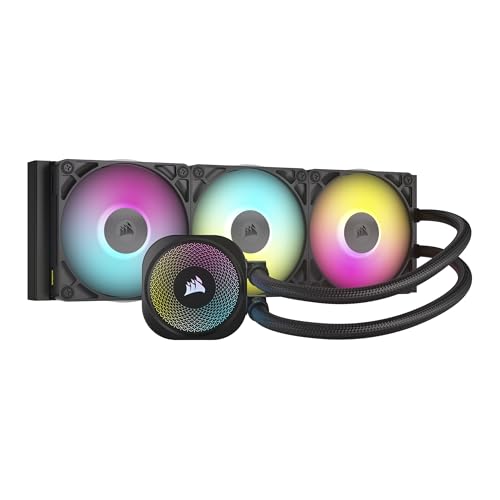
Badge: Best Overall. The Titan 360 RX is what the modern flagship AIO looks like when every subsystem gets the memo: a 360mm radiator, three RX120 RGB fans on Corsair’s iCUE LINK system, and the low-noise FlowDrive cooling engine in the pump block. It was seen at $139.45 on November 20, 2026; the listing returned no reference price, so no percentage is claimed — the sighting itself is the argument, because it places Corsair’s current flagship platform at the price tier where last-generation mid-range coolers usually sit. For a builder who wants one purchase to settle cooling, cabling and lighting for a whole system, this is the pick the rest of the guide is measured against.
The iCUE LINK system is the substantive difference, not a garnish. The three fans connect to each other and to the included system hub with a single reversible cable run, which removes the rat’s nest of individual fan and RGB leads that makes most 360mm installs an afternoon of cable management. The RX fans themselves are built for radiator duty — high static pressure through the fin stack — and the FlowDrive pump is tuned for low noise at the speeds a 360mm loop actually runs. Cooling performance sits in the flagship class: this radiator holds high-end Ryzen and Core processors at sustained boost without the fans needing to work audibly hard, which is the entire point of buying 360mm of radiator.
The honest edges: the ecosystem is the commitment. iCUE LINK fans and hubs interoperate beautifully with each other and not at all with other brands’ unified systems, so the Titan is the first step into Corsair’s wiring world — a pleasant world, but a walled one. The sighting also carries no reference price, so the deal must be judged against the field rather than a claimed discount: against the ARCTIC below it is $62.46 more for the cabling system, the software and the brand’s warranty network, and against the LCD flagships it is the cooler for buyers who want flagship function without paying for a screen. Judged exactly that way, it earns Best Overall.
Mini specs (verified from the listing and model specification):
- Radiator: 360mm, 3x RX120 RGB fans
- Pump: FlowDrive cooling engine, low-noise design
- System: iCUE LINK, system hub included
- Socket support: Intel LGA1851/1700, AMD AM5/AM4
- Color: Black
Strengths
- Flagship cooling and the cleanest cabling system in the guide at a sub-$140 sighting.
- Quiet pump design matched to high-static-pressure radiator fans.
- The hub is in the box — no second purchase to make the system work.
Trade-offs
- iCUE LINK is a walled ecosystem; future fans should be Corsair’s.
- No reference price returned, so the deal is a sighting judgment, not a percentage.
- No display on the pump cap — the LCD crowd should look at the Kraken Elite.
Verdict: Best for: new flagship and high-end builds that want cooling, cabling and lighting settled in one box. Not suited for: mixed-brand fan ecosystems, or buyers who want a screen on the pump.
Deal details: Seen at $139.45 on November 20, 2026; the listing returned no reference price, so no percentage is claimed. The verified listing is the black 360mm model with the system hub included. Confirm the live price at checkout.
Check on Amazon · See the current Black Friday price · View this deal on Amazon

2. ARCTIC Liquid Freezer III Pro 360 A-RGB — Best Cooling Per Dollar
Badge: Best Cooling Per Dollar. ARCTIC’s Liquid Freezer line has spent years embarrassing coolers at twice its price, and the Pro generation continues the habit: seen at $76.99 on November 20, 2026, with no reference price returned and none needed. The Liquid Freezer III Pro 360 pairs its 360mm radiator with the design detail nobody else in this guide offers — a small fan built into the pump block that blows directly over the motherboard’s voltage regulators. VRM cooling sounds like a footnote until a flagship processor holds an all-core workload for an hour; boards throttle on hot power delivery long before the CPU itself gives up, and ARCTIC is the only pick here that cools the neighborhood as well as the chip.
The rest of the formula is ARCTIC orthodoxy executed well: a thick radiator with more fin area than the standard 27mm class, an offset mounting position for AMD sockets that places the cold plate over the chiplet hotspot, and A-RGB fans for builders who want light without an ecosystem tax. In independent testing across generations, this family’s calling card is sustained-load temperatures at the top of the AIO field, and the Pro revision keeps the trait while tidying the cabling. At a $76.99 sighting it is not merely the value pick — it is the cooler that makes the flagship picks justify themselves, out loud, in dollars.
Its trade-offs are about fit and finish rather than performance. The thick radiator plus fans needs more clearance than slim designs — measure the top-mount space in smaller cases before ordering. The pump block is tall, and its VRM fan makes it taller in spirit: low-profile memory and some motherboard heatsinks crowd it. And the aesthetic is industrial rather than showcase; the Galahad and Kraken picks below exist for builders who want the cooler to be seen. If the build brief is temperatures per dollar with a flagship chip underneath, none of that matters. This is the performance answer.
Mini specs (verified from the listing and model specification):
- Radiator: 360mm, high-fin-density design
- Pump block: integrated VRM cooling fan
- Mounting: offset position for AMD chiplet layouts
- Socket support: Intel LGA1851/1700, AMD AM5/AM4
- Lighting: A-RGB fans
Strengths
- Flagship-class sustained cooling at a $76.99 sighting — half the Titan’s price.
- The pump-block VRM fan cools the motherboard’s power delivery, uniquely in this guide.
- Offset AMD mounting targets the actual hotspot on chiplet processors.
Trade-offs
- Thick radiator and tall pump block demand case and clearance checks.
- Industrial looks; not the showcase pick.
- No reference price returned — judged on the sighting and the field.
Verdict: Best for: flagship processors, sustained workloads, and any builder ranking temperatures above theater. Not suited for: tight-clearance cases or glass-showcase aesthetics.
Deal details: Seen at $76.99 on November 20, 2026; the listing returned no reference price, so no percentage is claimed. The verified listing is the 360 A-RGB model. Measure radiator clearance before ordering, and confirm the live price at checkout.
Check on Amazon · See the current Black Friday price · View this deal on Amazon

3. NZXT Kraken Elite 360 RGB (White) — Best Display Cooler
Badge: Best Display Cooler. The Kraken Elite exists for the builder who looks at the pump cap and sees a screen waiting to happen: a 2.36-inch circular LCD on the pump block, a 360mm radiator behind it, and NZXT’s single-frame F360 RGB Core fan unit simplifying the wiring. The white model verified here was seen at $269.99 on November 20, 2026 against a $299.99 reference price — about 10% off. That is the highest sighting in the guide by a wide margin, and the guide will not pretend otherwise: you are paying for the display and the design language. The question the review answers is whether the cooler underneath earns its place once the screen’s novelty is priced in — and it does, because the Elite’s cooling hardware is genuinely flagship-grade rather than a radiator attached to a monitor.
The display itself is the best implementation of the idea in this guide. Through NZXT’s CAM software it shows coolant or CPU temperatures, system stats, images and animated GIFs, with the ring lighting synced to the fans. In a white showcase build — the audience this exact listing serves — it is the visual center of the machine, and it replaces the separate sensor panels builders otherwise mount inside cases. The single-frame fan unit deserves its own sentence: three fans on one frame with one cable run is the same wiring philosophy as Corsair’s LINK system, arrived at independently, and it makes the Elite one of the two easiest 360mm installs here.
The discipline this pick requires is budget honesty. The $130 gap between the Elite and the Titan buys the screen, the white finish and CAM’s polish; it buys no additional cooling a benchmark could find. Builders whose cases sit under a desk, or whose GPU is still a tier below the plan, should let the ARCTIC or the Titan take the money. Builders finishing a white showcase rig — the ones who will actually look at the pump cap every day — are buying the guide’s best version of exactly that thing, at a verified 10% cut. Our Best Black Friday Gaming Pc Deals 2026 guide shows the class of build this cooler belongs on, priced with the same dated sightings.
Mini specs (verified from the listing and model specification):
- Radiator: 360mm, F360 RGB Core single-frame fan unit
- Display: 2.36-inch LCD on pump block, CAM-controlled
- Socket support: Intel LGA1700/1851, AMD AM5/AM4
- Color: White
- Software: NZXT CAM for display, lighting and fan curves
Strengths
- The best pump-cap display in the guide, on genuinely flagship cooling hardware.
- Single-frame fan unit keeps the 360mm install to one cable run.
- The white finish matches showcase builds the other picks cannot serve.
Trade-offs
- The guide’s highest sighting — the premium is display and design, not degrees.
- CAM software is one more background app to own.
- About 10% is the shallowest percentage cut among the referenced picks.
Verdict: Best for: white showcase builds and display-first rigs where the pump cap is part of the design. Not suited for: closed or under-desk cases, or budgets where the GPU tier is still unfunded.
Deal details: Seen at $269.99 on November 20, 2026, against a $299.99 reference price returned by Amazon’s catalog data — about 10% off. The verified listing is the white RGB model with the LCD pump cap. Confirm the live price at checkout.
Check on Amazon · See the current Black Friday price · View this deal on Amazon

4. Lian Li Galahad II Trinity 360 — Best for Showcase RGB Builds
Badge: Best for Showcase RGB Builds. Lian Li builds the coolers that case designers secretly hope you will install, and the Galahad II Trinity 360 is the purest expression: a 360mm radiator, a pump block with interchangeable covers that change the cap’s lighting character, and ARGB throughout, tuned for glass-panel cases. It was seen at $155.99 on November 20, 2026 against a $192.99 reference price — about 19% off, the second-deepest verified cut among the 360mm picks. Where the Kraken Elite sells a screen, the Trinity sells light itself — layered, diffused, and designed to be photographed — while remaining a serious cooler underneath the presentation.
The Trinity name refers to the pump cap system: swappable covers let the same cooler wear different lighting faces, which makes it the rare component that can be restyled when the build’s theme changes rather than replaced. Cooling hardware is the expected flagship specification — a high-density 360mm radiator and fans tuned for static pressure — and in practice it holds high-end processors at boost in showcase cases, which often have worse airflow than the test benches coolers are rated on. That last point matters more than it reads: a cooler that performs in a glass showcase case, with its restricted intakes, is doing harder work than the same temperatures in an open mesh chassis.
Position it against its neighbors. Against the Titan, it trades the unified-cable ecosystem for the interchangeable caps and Lian Li’s design language, at $16.54 more. Against the Kraken Elite, it is $114 less and offers light instead of a screen. Against the ARCTIC, it is twice the price for presentation the ARCTIC does not attempt. The buyer it suits is specific and numerous: the showcase builder whose case, fans and cables already speak Lian Li’s visual language, finishing the composition with the cooler that was designed for exactly that glass.
Mini specs (verified from the listing and model specification):
- Radiator: 360mm, ARGB fans
- Pump cap: interchangeable covers, layered lighting
- Socket support: Intel LGA1700/1851, AMD AM5/AM4
- Color: Black
- Control: motherboard ARGB sync / Lian Li software
Strengths
- Interchangeable pump covers make the cooler restylable, uniquely in this guide.
- Verified 19% cut on a showcase-class cooler.
- Performs in airflow-restricted glass cases, its natural habitat.
Trade-offs
- Presentation is the premium; the ARCTIC cools for half the sighting.
- No unified-cable system — fan wiring is conventional.
- No display; buyers wanting data on the cap should take the Kraken Elite.
Verdict: Best for: glass showcase builds and Lian Li-themed systems where the cooler is part of the composition. Not suited for: value builds, closed cases, or screen seekers.
Deal details: Seen at $155.99 on November 20, 2026, against a $192.99 reference price returned by Amazon’s catalog data — about 19% off. The verified listing is the black Trinity (non-LCD) 360mm kit. Confirm the live price at checkout.
Check on Amazon · See the current Black Friday price · View this deal on Amazon

5. NZXT Kraken Plus 240 — Best 240mm for Compact Cases
Badge: Best 240mm for Compact Cases. Not every case takes a 360mm radiator, and not every processor needs one. The Kraken Plus 240 shrinks NZXT’s formula — customizable LCD pump cap, Turbine pump, CAM control — into the 240mm size that fits compact and small-form-factor cases, and it was seen at $119.99 on November 20, 2026 against a $139.99 reference price, about 14% off. It is the only sub-360mm pick in the guide, included because the compact-build audience is the one most often told to settle for a plain pump cap: the Plus line’s entire argument is that a small case deserves the screen too.
The Turbine pump is the engineering headline NZXT leads with for this generation — a redesigned pump intended to move more coolant at lower noise — and in a 240mm loop that matters disproportionately, because a smaller radiator asks its pump and fans to work closer to their ceilings. Paired with a mainstream or mid-range processor (the Ryzen 7 and Core i7 class and below), the Plus 240 holds boost clocks quietly in cases where a 360mm simply cannot go. Its LCD is the same CAM-driven canvas as the Elite’s in miniature: temperatures, stats, or an image, visible through the small case’s window.
The ceiling must be stated plainly: a 240mm radiator is not the tool for a flagship processor’s sustained all-core load. Put a top-tier chip under it and the fans will announce the compromise. Buyers with full-size cases should also walk past it — the ARCTIC’s 360mm is $43 less and cools in another class. The Plus 240 is for the compact build specifically: the small case, the mid-range chip, the owner who wants the finished thing to look and sound considered. Inside that brief, nothing else in the guide competes with it.
Mini specs (verified from the listing and model specification):
- Radiator: 240mm, 2x 120mm fans
- Pump: NZXT Turbine pump; customizable LCD pump cap
- Socket support: Intel LGA1700/1851, AMD AM5/AM4
- Color: Black
- Software: NZXT CAM
Strengths
- The LCD formula in the 240mm size compact cases actually fit.
- Turbine pump targets the noise that small radiators usually cause.
- Verified 14% cut against a real reference price.
Trade-offs
- 240mm ceiling: not for flagship sustained all-core loads.
- Costs more than the guide’s 360mm value pick — you pay for the size and screen.
- Full-size cases should take a 360mm instead.
Verdict: Best for: compact and small-form-factor builds with mainstream or mid-range processors. Not suited for: flagship chips under sustained load, or any case that fits a 360mm radiator.
Deal details: Seen at $119.99 on November 20, 2026, against a $139.99 reference price returned by Amazon’s catalog data — about 14% off. The verified listing is the black 240mm model. Confirm your case’s 240mm mount before ordering, and confirm the live price at checkout.
Check on Amazon · See the current Black Friday price · View this deal on Amazon

6. Thermalright Aqua Elite 360 V6 ARGB — Best Budget 360mm
Badge: Best Budget 360mm. The Aqua Elite 360 V6 is the pick that resets what a budget cooler is allowed to be: a full 360mm radiator, three 120mm ARGB PWM fans, and a sighting of $43.12 on November 20, 2026 against a $53.90 reference price — about 20% off. A generation ago, forty dollars bought a competent air tower; this Black Friday it buys liquid, three fans, and lighting. Thermalright’s V6 revision is the current iteration of a line that has quietly become the default recommendation for budget gaming builds, and the sighting makes the reason obvious: for a six- or eight-core gaming processor, this radiator is not a compromise at all.
Calibrate expectations precisely, because the budget tier rewards honesty. The Aqua Elite’s fans and pump are built to a price: they move the coolant and the air the specification requires, without the acoustic refinement of the flagship picks, and the fit and finish — sleeving, cap design, cable quality — reads as functional rather than premium. Under a gaming load on a mid-range chip, none of that is audible or visible in temperatures that matter. Under a flagship’s sustained all-core render, the flagship picks pull ahead and stay quieter doing it. The Aqua Elite’s buyer is not that buyer; the Aqua Elite’s buyer is building the machine where every $30 is contested by the GPU, and for that machine this is the correct radiator.
One caution belongs in this review rather than the fine print: Thermalright sells several Aqua Elite generations (V3, V5, V6) in near-identical listings at near-identical prices. The verified pick here is the V6 ARGB in black; the differences between generations are modest, but the model string in the listing title is the only guarantee of which one arrives. Check it before checkout — the guide’s how-to section below turns that habit into a method for the whole category.
Mini specs (verified from the listing and model specification):
- Radiator: 360mm, 3x 120mm ARGB PWM fans
- Pump: PWM-controlled pump
- Socket support: AMD AM4/AM5, Intel LGA115X/1200/1700/1851
- Color: Black
- Generation: Aqua Elite V6 (verify the model string)
Strengths
- A genuine 360mm radiator at a $43.12 sighting — the guide’s lowest price by far.
- Verified 20% cut against its reference price.
- ARGB fans and full platform support at a budget tier that used to mean compromises.
Trade-offs
- Acoustics and finish are built to the price; flagship picks run quieter.
- Not the tool for a flagship processor’s sustained all-core workload.
- Multiple generations share similar listings — verify V6 in the title.
Verdict: Best for: budget and mid-range gaming builds where the GPU should get the money instead. Not suited for: flagship sustained workloads or silence-first builds.
Deal details: Seen at $43.12 on November 20, 2026, against a $53.90 reference price returned by Amazon’s catalog data — about 20% off. The verified listing is the Aqua Elite 360 V6 ARGB in black. Confirm the live price at checkout.
Check on Amazon · See the current Black Friday price · View this deal on Amazon
Comparison Table
Read this table as the category drawn flat. Radiator size decides the cooling ceiling, the pump cap decides the theater, and the sighting column decides which argument wins this week. Every price is the November 20, 2026 sighting — confirm the live price on the listing before you buy.
| Model | Key specs | Dated sighting |
|---|---|---|
| Corsair iCUE Link Titan 360 RX RGB | 360mm, iCUE LINK unified cabling, FlowDrive pump | $139.45 on Nov 20, 2026 |
| ARCTIC Liquid Freezer III Pro 360 A-RGB | 360mm, pump-block VRM fan, offset AMD mount | $76.99 on Nov 20, 2026 |
| NZXT Kraken Elite 360 RGB (White) | 360mm, 2.36-inch LCD, single-frame RGB fan | $269.99 on Nov 20, 2026 |
| Lian Li Galahad II Trinity 360 | 360mm, interchangeable pump covers, ARGB | $155.99 on Nov 20, 2026 |
| NZXT Kraken Plus 240 | 240mm, LCD pump cap, Turbine pump | $119.99 on Nov 20, 2026 |
| Thermalright Aqua Elite 360 V6 ARGB | 360mm, 3x ARGB PWM fans, budget build | $43.12 on Nov 20, 2026 |
How to Choose an AIO Liquid Cooler This Black Friday
Size the radiator to the processor, honestly. A 360mm radiator is the correct default for flagship processors and for anyone who values quiet, because more surface area means slower fans for the same temperatures. A 240mm serves mainstream and mid-range chips well and fits the cases 360mm cannot. What does not work is the hopeful middle: a flagship chip on a small radiator is a loud machine that still runs hot. Match the radiator to the processor you own or are buying this week — our Cpu Black Friday Deals 2026 guide prices both halves of that pairing with verified sightings.
Check the case before the cooler. Radiator fit is a measurement, not a vibe: the case needs a 360mm or 240mm mount, plus clearance for the radiator’s thickness and the fans together, plus room for the tubes to reach the CPU without kinking. The ARCTIC’s thick radiator is the pick most likely to punish a guessed measurement. Front mounts trade GPU length for radiator space; top mounts are the default for a reason. Five minutes with the case manufacturer’s specification page prevents the most common AIO return in the hobby.
Decide what the pump cap is for. Three philosophies compete here: nothing (the ARCTIC and Thermalright spend the money on radiator), light (the Galahad’s interchangeable covers), and information (the NZXT screens). None is wrong; each prices differently. If the case has no window, the answer is nothing, and the saving is real money. If the build is a showcase, the cap is the most-seen surface in the machine and deserves its budget line.
Count the ecosystem, not just the cooler. Unified-cable systems (Corsair’s iCUE LINK, NZXT’s single-frame fans) make this build cleaner and the next fan purchase a same-brand decision. Conventional ARGB fans stay brand-agnostic forever. Neither is a trap, but the choice compounds: pick the ecosystem you would happily buy case fans from in two years, because you probably will.
Weight the warranty as the lifespan. A sealed loop’s pump is a wear item with a finite life, and the warranty length is the manufacturer’s own estimate of it, printed in the open. When two coolers sight within a few dollars of each other, the longer warranty is the better deal even at identical temperatures — and it is the specification most likely to matter in year four.
How to Check a Deal Is Real — and Install the Cooler Safely
Verify the exact model string. AIO families share names across sizes, colors, generations and renewed condition. The Aqua Elite alone exists as V3, V5 and V6 in similar listings. Match the full string — brand, model, generation, radiator size, color, and the word “renewed” being absent unless you chose it — against the review you are acting on before you read the price as a deal.
Use the sighting method on anything else you consider. Every price in this guide is a dated sighting, with its reference price printed beside it wherever the catalog returned one. That is the standard to hold other deals to: a percentage whose reference you cannot see is a claim, not a fact. Two picks here carry no reference price at all, and the guide says so rather than inventing one — judge those two, and any cooler you find elsewhere, against the verified field in the comparison table.
Mount the radiator with the pump below its top. Air collects at the loop’s highest point; if that point is the pump, the pump runs dry and noisy. Top-mounting the radiator is ideal. If you front-mount, orient the tubes at the bottom where the case allows, and never mount the radiator at the case floor. This single decision decides more AIO lifespans than any specification on the box.
Install in the forgiving order. Fit the fans to the radiator on the bench, mount the radiator, then the pump block with fresh thermal paste (most blocks ship with paste pre-applied — check before adding more), and route pump and fan cables to their correct headers: the pump to its designated header at full speed, the fans to the CPU fan header so the motherboard can protect the processor if a fan fails. Set fan curves in BIOS or the vendor software afterward, not before the first boot confirms everything spins.
Validate inside the return window. Idle temperatures should settle quickly; a stress run should plateau rather than climb indefinitely. Listen for pump gurgling (air in the block — tilt the case gently to move it to the radiator), check for leaks at both fittings after the first heat cycles, and confirm the motherboard reports sane fan and pump speeds. A week of real use inside the return window is the cheapest quality control in the hobby.
Common Mistakes
Buying the radiator before measuring the case. The 360mm deal is only a deal if it fits. Thickness plus fans is the dimension that bites, and it is printed in every case manual and cooler specification — check both before checkout, not during the build.
Paying for a screen nobody will see. An LCD pump cap in a closed case, or a case under a desk facing a wall, is a $130 screensaver. The display picks are excellent for visible builds and pure waste for invisible ones; the ARCTIC and Thermalright exist for the second kind.
Undersizing for a flagship chip. A 240mm on a top-tier processor does not fail dramatically — it fails as noise, heat and quietly lowered boost clocks, forever. The radiator is the one component whose undersizing taxes every other component’s performance.
Mounting the radiator at the bottom of the case. It fits, it looks tidy, and it puts the pump at the top of the loop where the air gathers. Bottom-mounted radiators are the leading cause of “my AIO died in a year” stories. The pump must never be the loop’s highest point.
Confusing generations at checkout. V3, V5 and V6 Aqua Elites; Trinity and Trinity Performance Galahads; Kraken, Kraken Plus and Kraken Elite — the families are ladders, and the rungs price within a few dollars of each other during a sale. The model string in the title is the product. Read it.
Final Recommendation
Most builders: the Corsair Titan 360 RX at $139.45 settles cooling, cabling and lighting in one flagship box. Performance-first builders: the ARCTIC Liquid Freezer III Pro 360 at $76.99 is the cooling-per-dollar answer and the guide’s easiest recommendation to defend. Showcase builders: the Galahad II Trinity at $155.99 for light, the Kraken Elite 360 RGB at $269.99 for the screen. Compact builders: the Kraken Plus 240 at $119.99, sized honestly for mid-range chips. Budget builders: the Aqua Elite 360 V6 at $43.12, a full 360mm radiator at an air-cooler price. Every pick was verified on November 20, 2026; confirm the radiator fits your case, the model string is exact, and the live price still resembles the sighting before you order.
FAQ
When do AIO liquid cooler Black Friday deals start in 2026?
Amazon Black Friday Week runs November 19–30, 2026. Black Friday is November 27 and Cyber Monday is November 30. Every price in this guide was sighted on November 20, 2026. Cooler pricing tends to hold through the event, but the deepest budget sightings — the Aqua Elite class — are the ones most exposed to stock exhaustion.
Is a 360mm AIO better than a big air cooler?
At the flagship end, they are close in peak cooling and differ in character: the AIO moves heat to the case edge, tolerates short boost spikes gracefully, and keeps the socket area clear for memory and VRM airflow; the air tower is simpler, immortal by comparison, and cheaper. For mid-range processors a good air cooler is entirely sufficient. For flagship chips in glass cases, the 360mm AIO is the more comfortable tool — which is why this guide’s picks concentrate there.
How long does an AIO liquid cooler last?
The pump is the wear item, and the warranty is the honest estimate: expect the warranty period as the designed lifespan, with many units running well beyond it. Mounting the radiator so air never reaches the pump, keeping coolant paths unkinked, and avoiding bottom-mounted radiators are the habits that decide whether a given unit reaches the far side of its warranty.
Do I need to refill or maintain an AIO?
No. These are sealed loops, designed to run maintenance-free for their service life; a tiny amount of coolant permeation over years is normal and accounted for in the design. Maintenance is external: dust the radiator fins, keep the fans clean, and confirm fan curves still match your noise preference after hardware changes.
Which radiator size does my processor need?
As a working rule: 240mm for mainstream and mid-range chips, 360mm for flagship chips, sustained all-core workloads, or any build where quiet is a priority. The processor’s power draw under your actual workload — not its nameplate alone — is the input; a gaming load and a rendering load on the same chip are different cooling problems.
Can I install an AIO in any case?
No — the case needs a radiator mount of the right size and the clearance for radiator plus fans. Most mid-towers take a 360mm at the top or front; compact cases often top out at 240mm. Check the case specification for radiator support before buying, and prefer a top mount where the layout allows it.
Why does this guide not print star ratings?
Ratings and review counts on Amazon listings change constantly during a sale event, so any fixed number printed in a guide goes stale within days. We judge picks on verified listings, dated prices and manufacturer specifications instead.