The best salt tablets for POTS are the products that people living with postural orthostatic tachycardia syndrome, usually shortened to POTS, commonly buy when they need a measured amount of sodium in tablet form. Sodium intake is a topic that comes up often in POTS care, and salt tablets are one of the ways people take a known quantity of sodium each day. This roundup gathers six such products, compared on the facts stated in their listings: how much sodium each serving contains, how many tablets are in the bottle, and what form the tablets take.
This article makes no medical claims. It does not say that any product treats, improves, or manages POTS, and it does not recommend a sodium intake for any reader. Sodium needs vary widely from person to person, and anyone considering salt tablets should discuss it with their own clinician first, especially if they take medication or have other health conditions. The information below is limited to what the listings state: the sodium content, the count, the form, and the way each product is presented.
The six picks cover the range of what is actually sold as salt tablets. Two are Vitassium capsules formulated for POTS, one standard strength and one extra strength, with the sodium content stated per serving in the listing. Two are SaltStick products, one a sugar-free capsule and one a chewable tablet in a variety pack. The last two are plain sodium chloride tablets, one from Vitamatic at 1000mg per tablet and one from CitraGen at 1 gram per tablet, for buyers who want the simplest product with the fewest extra ingredients.
Before choosing, note the difference between a capsule and a chewable tablet, between a product that states its sodium content per serving and one that states it per tablet, and between a bottle of 100 tablets and a bottle of 365. The guide below explains how to read those numbers, and the care section explains how to store the tablets and how to keep track of what is taken. The comparison table gives the headline facts for all six picks at a glance.
One more note on how to use this guide. The comparison table is the fastest way to see the sodium figures side by side, but it cannot show the serving size, so read the entries as well as the table. The buying guide explains the serving-size trap in detail, because it is the mistake that most often leads to the wrong purchase. And the recommendation at the end names a pick for each situation, so a buyer who knows their form and their strength can go straight to the entry that fits.
In this guide
Quick picks: best salt tablets for pots
| # | Product | Where to buy |
|---|---|---|
| 1 | Vitassium Electrolytes Salt Pills for POTS | Check on Amazon |
| 2 | Vitassium Extra Strength Electrolyte Capsules | Check on Amazon |
| 3 | SaltStick Sugar Free Electrolytes Salt Pills | Check on Amazon |
| 4 | SaltStick FastChews Variety Pack | Check on Amazon |
| 5 | Vitamatic Sodium Chloride 1000mg | Check on Amazon |
| 6 | CitraGen Sodium Chloride Tablets 1 gm | Check on Amazon |
How the picks were chosen
The picks were chosen for relevance to POTS, for clarity of labeling, and for variety of form. Relevance means the listing names POTS or describes the product as a salt tablet for electrolyte and sodium intake, rather than as a general sports product with no connection to the topic. Clarity means the listing states the sodium content and the count, so the buyer can compare products on numbers rather than on slogans. Variety means the roundup covers capsules, chewable tablets, and plain sodium chloride tablets, because different people prefer different forms.
Every product was verified against its listing title, so the brand, the product name, the sodium content, and the count in each entry match the listing exactly. The Vitassium standard product states 500mg of sodium per 2 capsules in a 100-count bottle. The Vitassium Extra Strength states 750mg of sodium in 100 salt pills. The SaltStick sugar-free product states 0 calories and 0 grams of sugar in a 100-count bottle. The SaltStick FastChews variety pack states 90 tablets. The Vitamatic product states 1000mg of sodium chloride per tablet in a 365-tablet bottle, made in the USA. The CitraGen product states 1 gram of sodium chloride per tablet in a 300-tablet bottle.
The selection also avoids products that are not salt tablets at all. Sports drinks, electrolyte powders, and water softener salt are different products, and they do not appear here, even though the search results for salt tablets include them. The six picks below are all tablets or capsules that contain sodium chloride or an electrolyte salt blend, sold in a bottle with a stated count.
One more check was made, which is that none of the picks is a prescription product. All six are sold as over-the-counter supplements, which is the category this roundup covers. That does not make them suitable for every reader, and the disclaimer at the start of this article stands: discuss sodium intake with a clinician before starting any salt tablet.
What salt tablets for POTS actually are
A salt tablet is a tablet or capsule that contains sodium chloride, sometimes with other electrolytes such as potassium, magnesium, or calcium. The amount of sodium is stated on the listing, usually per tablet, per capsule, or per serving of two capsules, and that number is the main fact to compare. A tablet that states 1000mg of sodium chloride per tablet contains more sodium per tablet than a capsule that states 500mg of sodium per two capsules, and the buyer who compares them needs to read both numbers carefully.
POTS is a condition in which standing up causes a rapid increase in heart rate and symptoms such as lightheadedness, and it is a topic where sodium intake is often discussed between patients and clinicians. This article does not describe the condition in detail and does not advise any reader about it. The reason the condition matters here is only that it explains why these products exist and why their listings name it: they are sold for people whose clinicians have discussed sodium intake with them.
The products in this roundup fall into three groups. The first group is capsules formulated for POTS, represented by the two Vitassium products, which state their sodium content per serving and name POTS in their listings. The second group is electrolyte salt tablets for general use, represented by the two SaltStick products, which are sugar-free and sold for electrolyte replacement. The third group is plain sodium chloride tablets, represented by Vitamatic and CitraGen, which state a single ingredient and a single number.
The form matters as much as the number. A capsule is swallowed whole with water, a chewable tablet dissolves in the mouth, and a plain tablet may be either. Some people find capsules easier to take with a routine, while others prefer a chewable tablet that needs no water. The entries below note the form of each pick, so the choice can be made on comfort as well as on sodium content.
What to compare when choosing salt tablets
Sodium per serving is the first number to compare, and it must be read carefully. Some listings state the sodium per tablet, and some state it per serving of two capsules, and those are different numbers. The Vitassium standard product states 500mg of sodium per 2 capsules, which is 250mg per capsule, while the Vitamatic product states 1000mg of sodium chloride per tablet. Read the serving size as well as the headline number, and compare servings rather than tablets.
Count is the second number. A bottle of 100 tablets lasts a different length of time from a bottle of 365 tablets, and the count matters more than the bottle size. The Vitamatic bottle holds 365 tablets, which is a year of daily use at one tablet a day, while the Vitassium and SaltStick bottles hold 100 tablets or fewer. Divide the count by the number taken each day to see how long a bottle lasts, and remember that the daily number should come from a clinician, not from this article.
Form is the third consideration. Capsules are swallowed whole, chewable tablets dissolve in the mouth, and plain tablets may be either. A chewable tablet that is sugar-free suits a buyer who avoids sugar, and the SaltStick sugar-free product states 0 calories and 0 grams of sugar in its listing. A capsule suits a buyer who wants no taste at all. The form does not change the sodium content, but it changes whether the product is easy to take every day.
Other ingredients are the fourth consideration. Some products contain only sodium chloride, while others add potassium, magnesium, or other electrolytes. The plain sodium chloride tablets in this roundup state a single ingredient, while the electrolyte products state a blend. A buyer who wants the simplest product should choose the plain tablets, and a buyer whose clinician has discussed other electrolytes should look at the blends, while keeping in mind that this article does not advise on which electrolytes anyone needs.
Finally, check the listing for the exact product. Salt tablets are sold in many strengths and counts under similar names, and a bottle of 100 tablets is not the same as a bottle of 200. Match the brand, the product name, and the count in the entry below to the listing before ordering, because a similar name with a different strength is a different product.
Quick picks at a glance
| Product | Form | Sodium | Count |
|---|---|---|---|
| Vitassium Salt Pills for POTS | Capsules | 500mg sodium per 2 capsules | 100 |
| Vitassium Extra Strength | Capsules | 750mg sodium | 100 |
| SaltStick Sugar Free | Capsules | Electrolyte blend | 100 |
| SaltStick FastChews Variety | Chewable tablets | High sodium | 90 |
| Vitamatic Sodium Chloride | Tablets | 1000mg per tablet | 365 |
| CitraGen Sodium Chloride | Tablets | 1 gm per tablet | 300 |
The best salt tablets for POTS

Vitassium Electrolytes Salt Pills for POTS
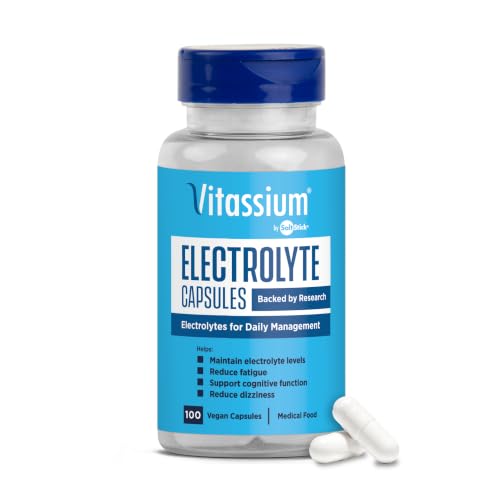
The Vitassium Electrolytes Salt Pills for POTS are the standard-strength capsules in this roundup. The listing states a scientifically formulated product in a 100-count bottle, with 500mg of sodium per 2 capsules. That is 250mg of sodium per capsule, and the two-capsule serving is the unit the listing uses, so it is the unit to compare against the other picks.
Vitassium is the brand that names POTS directly in its listing, and its products are the ones most often discussed in POTS communities. The standard strength suits a buyer whose clinician has discussed a moderate sodium intake, and the capsule form is swallowed whole with water, with no taste to manage. The 100-count bottle is a straightforward size, and the sodium content is stated clearly enough to compare with the extra-strength version below.
Key specs:
- Vitassium Electrolytes Salt Pills for POTS
- 500mg sodium per 2 capsules
- 100-count bottle
- Capsule form
Strengths:
- Sodium content stated clearly per serving, so it is easy to compare
- Capsule form with no taste to manage
- Formulated for POTS, so the listing matches the topic exactly
Trade-offs:
- Two capsules per serving, so the bottle lasts half as long as the count suggests at full serving
- Capsules need water and cannot be chewed
- Standard strength may not suit a buyer whose clinician discussed a higher intake
This product fits a buyer whose clinician has discussed a moderate sodium intake and who prefers capsules. It is the pick for a straightforward, clearly labeled starting point.
Best for: a clearly labeled capsule for a moderate sodium intake. Not suited for: a buyer who prefers chewable tablets, or whose clinician discussed a higher strength.
Check price on Amazon: Vitassium Electrolytes Salt Pills for POTS

Vitassium Extra Strength Electrolyte Capsules
The Vitassium Extra Strength Electrolyte Capsules are the higher-strength version of the standard product above. The listing states 750mg of sodium in 100 salt pills, in size 00 capsules, unflavored. The higher number is the point of the product: more sodium per serving for a buyer whose clinician has discussed a higher intake.
The extra-strength capsules share the standard version capsule form and the unflavored character, so the choice between the two is a matter of the number, not of the form. A buyer should not choose the higher strength simply because it is stronger; the sodium intake should come from a clinician. But for a buyer who has had that discussion, the extra-strength bottle gives a higher dose per serving in the same capsule form.
Key specs:
- Vitassium Extra Strength Electrolyte Capsules
- 750mg of sodium
- 100 salt pills
- Size 00 capsules, unflavored
Strengths:
- Higher sodium per serving than the standard version
- Capsule form with no flavor to manage
- Clear sodium figure in the listing
Trade-offs:
- Higher strength is not suitable for every buyer, and the intake should be discussed with a clinician
- Capsules need water and cannot be chewed
- 100-count bottle at a higher strength lasts the same length as the standard bottle at the same serving count
This product fits a buyer whose clinician has discussed a higher sodium intake and who prefers capsules. It is the pick for a higher strength in the same form.
Best for: a higher sodium strength in capsule form. Not suited for: a buyer starting out, or anyone who has not discussed sodium intake with a clinician.
Check price on Amazon: Vitassium Extra Strength Electrolyte Capsules

SaltStick Sugar Free Electrolytes Salt Pills
The SaltStick Sugar Free Electrolytes Salt Pills are the sugar-free capsules in this roundup. The listing states a 100-count bottle with 0 calories and 0 grams of sugar, which is the detail that sets it apart: a salt pill with no sugar and no calories, for a buyer who avoids sugar or who counts calories.
SaltStick is a long-established electrolyte brand, and its products are sold for electrolyte replacement in general rather than for POTS specifically. The capsule form is swallowed whole, and the blend includes electrolytes beyond sodium, which is the difference from the plain sodium chloride tablets below. A buyer who wants a sugar-free electrolyte capsule, rather than a plain salt tablet, will find this the straightforward choice.
Key specs:
- SaltStick Sugar Free Electrolytes Salt Pills
- 0 calories, 0 grams of sugar
- 100-count bottle
- Capsule form
Strengths:
- Sugar-free with 0 calories, so it suits a buyer who avoids sugar
- Long-established electrolyte brand
- Capsule form with no taste to manage
Trade-offs:
- Sodium per serving is not stated as a headline number in the listing title
- Electrolyte blend, not plain sodium chloride, so the buyer should check the label
- Capsules need water and cannot be chewed
This product fits a buyer who wants a sugar-free electrolyte capsule and who prefers a general electrolyte product. It is the pick for sugar-free electrolyte replacement in capsule form.
Best for: a sugar-free electrolyte capsule. Not suited for: a buyer who wants a stated sodium figure in the headline, or plain sodium chloride only.
Check price on Amazon: SaltStick Sugar Free Electrolytes Salt Pills

SaltStick High Sodium Electrolyte FastChews Variety Pack
The SaltStick High Sodium Electrolyte FastChews Variety Pack is the chewable pick in this roundup. The listing states a 90-tablet variety pack of high-sodium electrolyte chewable tablets, which dissolve in the mouth rather than being swallowed whole. That form suits a buyer who dislikes capsules, or who needs to take a tablet without water.
The variety pack covers several flavors, so the buyer can find one that is easy to take regularly. A chewable tablet that tastes acceptable is more likely to be taken consistently than a capsule that is dreaded, and consistency is what matters for a daily routine. The 90-tablet count is a little smaller than the 100-count bottles, so the buyer should check how long a bottle lasts at the intended daily number.
Key specs:
- SaltStick High Sodium Electrolyte FastChews Variety Pack
- 90 tablets
- Chewable tablet form
- High sodium electrolyte blend
Strengths:
- Chewable form, no water needed to take it
- Variety pack, so the buyer can find a flavor that suits
- High sodium content for a chewable tablet
Trade-offs:
- Chewable tablets have a taste, which not every buyer likes
- 90-count bottle is smaller than the 100-count bottles
- Sodium per tablet is not stated as a headline number in the listing title
This product fits a buyer who prefers chewable tablets to capsules, or who needs to take a tablet without water. It is the pick for a chewable, high-sodium option.
Best for: a chewable tablet for buyers who dislike capsules. Not suited for: a buyer who wants capsules, or who wants a stated sodium figure in the headline.
Check price on Amazon: SaltStick FastChews Variety Pack
Vitamatic Sodium Chloride 1000mg
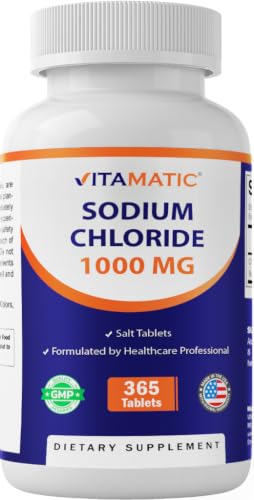
The Vitamatic Sodium Chloride 1000mg tablets are the plain, high-count pick in this roundup. The listing states 1000mg of sodium chloride per tablet in a 365-tablet bottle, made in the USA, with a description that mentions electrolyte replenishment and hydration support. The 365 count is the headline: a full year of daily use at one tablet a day, in a single bottle.
Plain sodium chloride is the simplest product in this roundup, with a single ingredient and a single number. A buyer who wants no blend, no flavor, and no extra electrolytes will find this the straightforward choice. The 1000mg per tablet figure is the highest per-tablet number in the roundup, so the buyer should read it carefully and discuss the intake with a clinician, because a higher number per tablet is not better on its own.
Key specs:
- Vitamatic Sodium Chloride 1000mg per tablet
- 365 tablets
- Made in USA
- Tablet form
Strengths:
- Plain sodium chloride with a single, clear number per tablet
- 365-count bottle lasts a full year at one tablet a day
- Made in the USA
Trade-offs:
- 1000mg per tablet is a high figure, so the intake should be discussed with a clinician
- Plain tablets may be less pleasant to take than flavored chewables
- No other electrolytes, so it is sodium chloride only
This product fits a buyer who wants plain sodium chloride in a large bottle, with a clear per-tablet number. It is the pick for simplicity and for a long supply.
Best for: plain sodium chloride in a large, clearly labeled bottle. Not suited for: a buyer who wants an electrolyte blend, or who prefers capsules or chewables.
Check price on Amazon: Vitamatic Sodium Chloride 1000mg

CitraGen Sodium Chloride Tablets 1 gm
The CitraGen Sodium Chloride Tablets are the pharmaceutical-grade plain pick in this roundup. The listing states 1 gram of sodium chloride per tablet, USP grade, in a 300-tablet bottle from CitraGen Pharmaceuticals. USP grade means the product meets the standards of the United States Pharmacopeia, which is a mark of quality control for a simple product.
One gram is the same as 1000mg, so the CitraGen tablet carries the same sodium chloride per tablet as the Vitamatic product above, in a smaller bottle of 300 tablets. The difference is the USP grade and the pharmaceutical presentation, which suits a buyer who wants a plain tablet made to a recognized standard. As with the Vitamatic product, the intake should be discussed with a clinician, because the per-tablet figure is high.
Key specs:
- Sodium Chloride Tablets 1 gm, USP
- 300 tablets
- By CitraGen Pharmaceuticals
- Tablet form
Strengths:
- USP grade, a recognized quality standard
- Plain sodium chloride with a clear 1-gram figure per tablet
- 300-count bottle is a substantial supply
Trade-offs:
- 1 gram per tablet is a high figure, so the intake should be discussed with a clinician
- Plain tablets with no flavor or blend
- Fewer tablets than the 365-count Vitamatic bottle
This product fits a buyer who wants a USP-grade plain sodium chloride tablet from a pharmaceutical maker. It is the pick for a recognized quality standard in a simple product.
Best for: a USP-grade plain salt tablet. Not suited for: a buyer who wants an electrolyte blend, or who prefers capsules or chewables.
Check price on Amazon: CitraGen Sodium Chloride Tablets 1 gm
Buying guide: reading a salt tablet listing
Read the sodium figure and the serving size together
A listing may state sodium per tablet, per capsule, or per serving of two capsules, and those are different numbers. The Vitassium standard product states 500mg of sodium per 2 capsules, while the Vitamatic product states 1000mg per tablet. Compare servings, not tablets, and check whether the number is sodium or sodium chloride, because the two are not the same weight. When in doubt, read the supplement facts on the listing before ordering.
Choose the form that will actually be taken
A capsule needs water and has no taste. A chewable tablet needs no water but has a flavor. A plain tablet may be either. The form that is easiest to take every day is the right form, because a bottle that sits unused helps nobody. Try a small bottle first if the form is unfamiliar, and switch forms if the first choice proves hard to take regularly.
Count the days, not just the tablets
Divide the bottle count by the number taken each day to see how long a bottle lasts. A 100-count bottle at two capsules a day lasts 50 days, while a 365-count bottle at one tablet a day lasts a year. The daily number should come from a clinician, not from this article, and it should be written down so the routine stays consistent.
Check for sugar, flavor, and other ingredients
Some products are sugar-free, some are flavored, and some contain other electrolytes such as potassium or magnesium. The SaltStick sugar-free product states 0 calories and 0 grams of sugar, while the plain sodium chloride tablets state a single ingredient. Read the ingredient list on the listing, and choose the product whose ingredients match what was discussed with a clinician.
Talk to a clinician before starting
Sodium intake affects blood pressure, medication, and other conditions, and the right amount varies widely from person to person. Discuss salt tablets with a clinician before starting, and bring the listing with its sodium figure and serving size to the conversation. This article does not recommend an intake for any reader, and it should not be used as a substitute for medical advice.
Compare the total cost, not just the bottle price
A bottle of 365 tablets may cost more than a bottle of 100, but it costs less per tablet and lasts far longer. Divide the bottle cost by the count to get the cost per tablet, and then by the serving size to get the cost per serving. A large bottle of plain sodium chloride is often the cheapest per serving, while a small bottle of a branded blend costs more per serving for the convenience of the form.
Storing and taking salt tablets
Store them dry and cool
Salt tablets absorb moisture, so keep the bottle closed, in a cool, dry place, away from a bathroom cabinet where steam collects. Do not transfer the tablets to an unmarked container, because the label carries the sodium figure and the serving size that the clinician needs to see. Keep the bottle out of reach of children, because salt tablets are not sweets.
Keep a simple routine
Take the tablets at the same time each day, with water unless the product is chewable, and keep a note of how many were taken. A simple routine, such as a tablet with breakfast, is easier to maintain than a complicated schedule. If a dose is missed, do not double up without discussing it with a clinician.
Watch the expiry date
Check the expiry date when the bottle arrives and again before ordering a replacement. A large bottle such as the 365-count Vitamatic product lasts a year, so the expiry date matters more than it does for a small bottle. Do not use tablets past their expiry date, and dispose of them according to local guidance.
Common mistakes with salt tablets
Comparing tablets instead of servings
A product that states 500mg per 2 capsules is not the same as a product that states 500mg per tablet, and comparing the headline numbers without the serving size leads to the wrong choice. Always read the serving size as well as the sodium figure, and compare like with like.
Choosing strength by guesswork
A higher sodium figure is not better on its own, and the right intake varies widely. Choosing the strongest product without discussing it with a clinician is a mistake. Bring the listings to the conversation, and let the clinician advise on the number.
Buying the wrong form
Capsules, chewables, and plain tablets feel very different to take, and a form that is disliked will not be taken regularly. Try a small bottle first when the form is unfamiliar, and switch if the first choice proves hard to take.
Treating the listing as medical advice
A product listing describes what is in the bottle, and it is not medical advice. Marketing language on a listing, including phrases about support or replenishment, should not be read as a recommendation for any individual. The clinician is the source for advice about sodium intake, not the listing.
Storing tablets in a damp bathroom
Salt tablets absorb moisture, and a bathroom cabinet is one of the dampest places in a house. Tablets left there can stick together, crumble, or lose their shape, and a damaged tablet is hard to dose. Store the bottle in a cool, dry place such as a kitchen cupboard, with the lid closed, and keep it out of reach of children.
Our recommendation
For most buyers, the Vitassium Electrolytes Salt Pills for POTS are the recommendation, because the listing names POTS directly, states the sodium content clearly per serving, and comes in a straightforward 100-count bottle of capsules. Buyers whose clinician has discussed a higher intake should look at the Vitassium Extra Strength capsules, which give 750mg of sodium in the same form.
For buyers who prefer a chewable tablet, the SaltStick FastChews Variety Pack is the pick, and for buyers who want a sugar-free capsule, the SaltStick Sugar Free product is the answer. For buyers who want the simplest product, the Vitamatic Sodium Chloride 1000mg tablets give a clear per-tablet number in a 365-count bottle, while the CitraGen 1-gram tablets give the same per-tablet figure to a USP standard. Whichever pick fits, discuss the sodium intake with a clinician first, read the serving size as well as the headline number, and choose the form that will actually be taken every day.
Finally, keep the routine simple once the choice is made. Store the bottle in a cool, dry place, take the tablets at the same time each day, and keep a note of the count so the bottle can be replaced before it runs out. A salt tablet routine only works when it is easy to follow, and the best product in this roundup is the one whose form, strength, and count fit the routine that the buyer and their clinician agreed on.
Related reading on Reviewstook: see our guides to health and heart rate watches, blood pressure smartwatches for more on this topic.
Frequently asked questions
What does POTS stand for?
POTS stands for postural orthostatic tachycardia syndrome, a condition in which standing up causes a rapid increase in heart rate. Sodium intake is a topic that often comes up in POTS care, which is why salt tablets are sold with POTS named in their listings. This article does not describe the condition in detail and does not advise any reader about it.
How much sodium is in a salt tablet?
It varies by product and by serving size. The Vitassium standard product states 500mg of sodium per 2 capsules, the Vitassium Extra Strength states 750mg of sodium, and the Vitamatic and CitraGen products state 1000mg or 1 gram of sodium chloride per tablet. Always read the serving size as well as the headline number.
Are salt tablets the same as electrolyte tablets?
They overlap. A salt tablet contains sodium chloride, sometimes alone and sometimes with other electrolytes such as potassium or magnesium. The plain products in this roundup state sodium chloride only, while the electrolyte products state a blend. Read the ingredient list on the listing to see what is actually in the bottle.
Should I take salt tablets without talking to a clinician?
No. Sodium intake affects blood pressure, medication, and other conditions, and the right amount varies widely. Discuss salt tablets with a clinician before starting, and bring the listing with its sodium figure and serving size to the conversation.
What is the difference between a capsule and a chewable tablet?
A capsule is swallowed whole with water and has no taste, while a chewable tablet dissolves in the mouth and has a flavor. A chewable needs no water, which suits some buyers, while a capsule suits buyers who prefer no taste at all. The form does not change the sodium content.
How long does a bottle of salt tablets last?
Divide the bottle count by the number taken each day. A 100-count bottle at two capsules a day lasts 50 days, while a 365-count bottle at one tablet a day lasts a year. The daily number should come from a clinician, not from this article.
What does USP mean on a salt tablet listing?
USP stands for United States Pharmacopeia, and it means the product meets recognized standards for identity, strength, and quality. The CitraGen product in this roundup states 1 gram of sodium chloride per tablet to USP grade.
Can salt tablets replace sports drinks?
They are different products for different situations. A salt tablet gives a measured amount of sodium with little or no fluid, while a sports drink gives fluid and a smaller amount of electrolytes together. Which one fits depends on the situation and on what a clinician has discussed, and this article does not advise on that choice.