reviewstook.com is reader-supported. When you buy through links on our site, we may earn an affiliate commission.
Where to buy
Point-of-view footage makes a promise no other camera angle can: you were there, and now the viewer is too. The best cameras for POV shooting are the ones that disappear — small enough to forget on a chest strap or a cap brim, tough enough to survive the activity they are documenting, stabilised enough that the viewer’s stomach stays settled, and wide enough of eye that hands, handlebars, tools, ingredients and trails all stay in frame without the wearer ever checking a screen. A POV camera that demands attention has failed before the record button matters.
- Insta360 GO 3S: check price on Amazon
- GoPro HERO13 Black: check price on Amazon
- DJI Osmo Action 5 Pro: check price on Amazon
- Insta360 Ace Pro 2: check price on Amazon
- DJI Osmo Action 4: check price on Amazon
- Insta360 X4: check price on Amazon
The people searching this phrase are not one audience but several sharing a mount. Mountain bikers and skiers want the trail and the descent as they lived it. Anglers, climbers, cooks, makers and mechanics want hands-free documentation of hands at work — the cast, the crux move, the knife work, the engine bay. Urban explorers and travellers want the walk through the market as it felt. And a rising group of creators wants the first-person format itself, because POV has become a storytelling language: the viewer does not watch the activity, they perform it.
All six cameras below are linkable picks from the verified pool, and they divide the POV world by philosophy. One is a thumb-sized camera that mounts magnetically almost anywhere and vanishes entirely. Two are DJI’s action cameras, strong in low light and battery endurance. Two carry GoPro’s and Insta360’s flagship ambitions in the classic brick format. And one shoots in every direction at once, letting the wearer forget framing entirely and choose the view afterwards. Each was chosen for POV work specifically — mounting, field of view, stabilisation and wearability weighed ahead of general action-camera bragging rights.
A note on what POV punishes: weight, heat and fuss. A camera that is merely excellent becomes unwearable at gram counts a spec sheet calls trivial, because it sits on a head or a chest for hours. Battery swaps mid-activity, overheating in a sealed housing, a mount that loosens on the third bump — these are the failures that end POV sessions, and the verdicts below weigh them as heavily as image quality. The best POV camera is the one still recording, unnoticed, at the moment the day peaks.
Key Takeaways
- Wearability is the first POV specification: grams on a head or chest mount compound across hours in a way bench reviews never feel.
- Field of view decides whether hands and context stay in frame; the widest options forgive imperfect mounting angles.
- Stabilisation quality separates watchable POV from seasick POV — every pick here stabilises electronically to a high standard.
- The Insta360 GO 3S is the invisibility champion; the X4 is the reframe-later champion; the brick cameras split the difference with battery and toughness.
- Mounts are half the purchase: budget for the chest, head or magnetic mount your activity actually needs.
In this guide
Quick Picks
| Camera | Badge | Why it is here |
|---|---|---|
| Insta360 GO 3S | Best for true invisibility | A thumb-sized magnetic camera that mounts anywhere and disappears — POV as it was meant to feel. |
| GoPro HERO13 Black | Best ecosystem | The flagship brick with the deepest mount ecosystem and lens mods for every POV angle. |
| DJI Osmo Action 5 Pro | Best battery and low light | Long recording endurance and a large sensor for dawn patrols and dusk sessions. |
| Insta360 Ace Pro 2 | Best image quality | An 8K-capable flagship with low-light processing tuned for detailed first-person footage. |
| DJI Osmo Action 4 | Best value brick | The previous DJI flagship formula — big sensor, magnetic mounts — at a friendlier commitment. |
| Insta360 X4 | Best for reframing | Shoots 360 degrees, so the POV angle is chosen in editing, never missed in the moment. |
How did we choose these cameras for POV shooting?
POV selection started with mounting, because a camera that cannot go where the point of view lives is a spectator. Each candidate was judged on the mounts it supports natively or through its ecosystem: chest harnesses for hands-at-work footage, head and cap mounts for true eye-line, magnetic options for the quick placements — a fridge door for the cook, a car panel for the mechanic — that define modern POV content. Size and weight were scored as mounting qualities, not portability trivia; on a head, twenty grams is a posture.
Field of view came second. Genuine POV needs the wearer’s hands and a margin of environment in frame at conversational distance, which pushes toward the widest lenses in the class and digital lens modes that trade a little resolution for a lot of angle. The 360-degree pick abolishes the question entirely, at the price of an editing step. Stabilisation ran a close third: first-person footage amplifies every head movement, and the difference between the best electronic stabilisation and the merely good is the difference between footage viewers finish and footage they abandon queasily.
Endurance formed the third filter — battery life measured in activity hours, heat behaviour in summer sun, and the practicalities of swapping power without removing gloves or breaking flow. The DJI pair score heavily here; the tiny Insta360 answers with a charging case that doubles as a controller and a second battery in effect. Finally, each camera had to produce footage a viewer can grade, share and rewatch: colour that survives a forest’s greens and a kitchen’s mixed light alike, and audio that captures the wearer’s breathing, commentary and environment without a separate recorder for casual work.
What was deliberately not weighted: headline resolution races and slow-motion extremes, except where they serve POV specifically. An 8K badge matters here only when it buys reframing room or low-light cleanliness — the Ace Pro 2’s case — and not as a number to admire. POV is a wearing discipline before it is a recording one, and the selection honoured that order throughout.

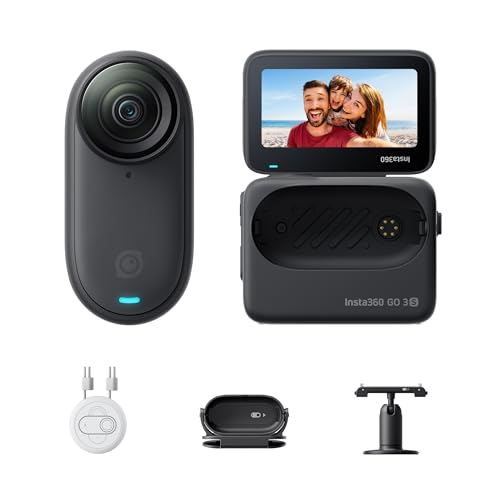
Insta360 GO 3S — Best for true invisibility
The GO 3S is what POV was always supposed to be: a camera the size of a thumb that sticks magnetically to a cap, a shirt, a pendant mount, a fridge, a guitar headstock — anywhere ferrous or fitted with its adhesive and clip accessories — and records 4K from exactly where your eyes or your hands are. At its weight, the wearer genuinely forgets it, and forgotten cameras produce the footage this genre dreams about: unselfconscious, continuous, framed by life rather than by the act of filming. Cooks wear it for the knife-work shot. Anglers clip it for the cast and the strike. Parents wear it and are, miraculously, in the family video and behind it at once.
The engineering compromises are honest and worth naming. The camera pod’s own battery is small, sized for clips and sessions rather than all-day recording; the Action Pod case recharges it, extends control and adds a screen, functioning as the system’s base camp. Waterproofing applies to the pod itself within limits, with deeper work needing the case considerations checked before a swim. Image quality from the small sensor is a step below the big bricks in dim light, though 4K detail in daylight is genuinely crisp. None of this dents the core proposition: if your POV problem is that cameras are too present, this is the only pick that solves it by disappearance.
- Sensor: compact, in a thumb-sized pod
- Video: 4K from the pod, magnetic mounting
- Mounting: magnetic pendant, clips and adhesive options
- System: Action Pod case for charging, screen and control
Strengths
- The only camera here the wearer truly forgets
- Magnetic mounting invents angles other cameras cannot reach
- Hands-free POV for crafts, cooking and parenting
Trade-offs
- Pod battery suits sessions, not expeditions
- Low-light quality trails the larger-sensor bricks
- Small size demands respect around drains and grass
Best for: hands-at-work creators and anyone who hates wearing a camera. Not suited for: all-day trail recording or deep-water work.

GoPro HERO13 Black — Best ecosystem
The HERO13 is the POV establishment: the flagship of the company that invented the category, carrying the deepest accessory ecosystem in the field. For POV specifically, its trump cards are the lens mods and mounts. An ultra-wide lens mod stretches the view toward the full width of human peripheral attention; the standard mounts — chest, head, helmet, handlebar, suction, magnetic — cover activities not yet invented. If a POV angle exists, someone sells the GoPro hardware to hold it, and that ecosystem depth is a genuine feature no specification table captures.
The camera itself is the mature brick: 5.3K recording that leaves reframing room in the edit, stabilisation that remains the class reference for violence absorbed gracefully, and a rugged waterproof body that treats crashes as content. Its POV weaknesses are the format’s traditional ones — it is noticeable on a head mount across a long day, its battery life is measured in sessions rather than expeditions, and summer heat management needs the usual respect. But as the default choice for the rider, skier or surfer whose activity is the point and whose mounting needs are exotic, it remains the safest pair of hands in the genre.
- Sensor: action sensor with 5.3K recording
- Lens: interchangeable lens mods, including ultra-wide
- Stabilisation: flagship-grade electronic smoothing
- Mounting: the deepest accessory ecosystem available
Strengths
- Every POV mount and angle is covered by accessories
- Resolution headroom for reframing and cropping
- Toughness proven across a decade of abuse
Trade-offs
- Noticeable weight on head mounts over long days
- Battery endurance trails the DJI pair
- Heat needs managing in still summer air
Best for: riders, skiers and surfers with exotic mounting needs. Not suited for: wearers who prioritise invisibility or all-day battery.

DJI Osmo Action 5 Pro — Best battery and low light
The Action 5 Pro is the endurance athlete of this guide, and POV is an endurance sport. Its battery endurance stretches recording sessions that end other cameras’ days — the long ride, the full fishing morning, the market walk that becomes an afternoon — while its larger sensor keeps the dawn start and the dusk finish cleaner than the class average. For the POV shooter whose best light is the low kind, and whose sessions are measured in hours, those two qualities outrank every other line on the specification sheet.
DJI’s mounting system deserves its sentence: the magnetic quick-release has become the genre’s convenience standard, letting the camera move from chest to helmet to handheld in seconds without tools — a genuine POV virtue, because the best angle changes as the activity does. Subject tracking and strong stabilisation serve the moving wearer; dual screens serve the vlogger who narrates to camera between POV passages. Its ecosystem is younger than GoPro’s, and exotic mounts occasionally arrive later or cost more. But for the core POV brief — wear it for hours, in real light, and bring home watchable footage — the Action 5 Pro is the most complete brick here.
- Sensor: larger action sensor, strong low-light behaviour
- Battery: class-leading recording endurance
- Mounting: magnetic quick-release system
- Screens: front and rear, for narration segments
Strengths
- Sessions measured in hours, not in battery swaps
- Dawn and dusk footage that stays clean
- Mount changes in seconds, mid-activity
Trade-offs
- Accessory ecosystem still trails GoPro’s depth
- Still a presence on a head mount
- Premium positioning among the bricks
Best for: long-session POV — rides, fishing days, travel walks. Not suited for: wearers needing the most exotic mounts today.

Insta360 Ace Pro 2 — Best image quality
The Ace Pro 2 is the image-quality maximalist’s POV camera. Its large sensor and dual-chip processing — one processor devoted to image quality and noise reduction — produce first-person footage with a cleanliness in mixed and low light that the rest of the class chases: the night market walk, the workshop under fluorescents, the forest trail under canopy all hold detail and colour where lesser bricks smear. Its 8K ceiling is best understood as reframing and cropping capital for POV editors rather than a delivery format, and its flip screen serves the creator who alternates POV passages with to-camera narration.
Insta360’s software is the supporting argument: the app ecosystem, subject tracking and editing tools are built for people who publish, and POV creators publish or perish. The compromises are the flagship’s usual ones — it is the heavyweight in spirit among the bricks, battery life is good rather than DJI-class, and the price of admission sits at the top of this guide. For the creator whose POV channel is a business and whose footage must survive a television screen, those are acceptable taxes. For the casual wearer, the Action 4 below delivers most of the experience with less commitment.
- Sensor: large action sensor with dual-chip processing
- Video: up to 8K, with strong low-light modes
- Screen: flip design for narration and review
- Software: mature app and editing ecosystem
Strengths
- The cleanest low-light POV footage here
- Resolution headroom for reframing in the edit
- Creator software that shortens the path to publishing
Trade-offs
- Flagship price among the bricks
- Battery endurance good, not class-leading
- Overkill for casual, daylight-only POV
Best for: POV creators publishing seriously, especially in mixed light. Not suited for: budget buyers or battery-first expeditions.

DJI Osmo Action 4 — Best value brick
The Action 4 is the previous-generation DJI flagship, and POV buyers should read that as an opportunity rather than a demotion. The formula that made it a flagship — the larger sensor that still embarrasses most rivals in low light, the magnetic quick-release mounting, waterproofing without a case, stabilisation that handles trail violence calmly — remains entirely intact, at a commitment level the newer model has vacated. For the rider or angler buying a first serious POV camera, it is the value summit of this guide.
Against its successor it concedes battery endurance, some tracking polish and the newest processing, and against GoPro it concedes ecosystem depth. What it does not concede is the footage: dawn starts, forest shade and evening sessions all record with the big-sensor cleanliness that defines DJI’s line, and the mounting system means the accessory investment survives an eventual upgrade. POV careers often begin with exactly this calculation — flagship image quality, previous flagship price — and the Action 4 is the cleanest expression of it available.
- Sensor: larger action sensor, strong in low light
- Mounting: magnetic quick-release, shared with the newer model
- Body: waterproof without a housing
- Stabilisation: mature electronic smoothing
Strengths
- Flagship low-light quality at a reduced commitment
- Mounts and batteries carry forward to newer DJI bodies
- Simple, tough and immediately capable
Trade-offs
- Battery life a step behind the Action 5 Pro
- Fewer of the newest tracking refinements
- Ecosystem still younger than GoPro’s
Best for: first serious POV buyers wanting flagship footage sensibly. Not suited for: marathon sessions where battery is the brief.

Insta360 X4 — Best for reframing
The X4 abolishes POV’s oldest anxiety — did I aim it right? — by recording in every direction at once. Worn on a chest mount, a helmet or a selfie stick that edits itself invisible, it captures the full sphere at 8K, and the angle becomes an editing decision: the trail ahead, the wearer’s face at the summit, the friend alongside, the view behind, all harvested from one recording. For travel POV and group activities, where the best moment refuses to announce its direction, this is not a novelty. It is insurance against the missed shot, written in optics.
The costs are workflow and form. Reframing takes editing time the brick cameras do not demand, the dual-lens body must be protected from the knocks that a lens on each side invites, and battery and file sizes grow with the sphere. Single-lens mode exists for ordinary wide POV when the sphere is unnecessary. But for the creator whose format is the immersive walk, the group ride, the climb where looking down matters as much as looking ahead, the X4 does something no other pick attempts: it makes the camera’s aim the editor’s problem, and the wearer’s only job is to live the activity. That division of labour is POV’s future arriving early.
- Sensor: dual lenses recording the full sphere
- Video: 8K 360-degree, with single-lens mode
- Reframing: angle chosen in editing, not in the moment
- Mounting: chest, helmet and invisible-stick setups
Strengths
- Never misses the moment’s direction
- One recording yields many angles and formats
- Immersive travel and group POV without a camera operator
Trade-offs
- Reframing adds real editing time
- Exposed lenses demand care and guards
- Files and batteries are consumed at sphere rates
Best for: travel, group activities and immersive creators. Not suited for: shooters who want finished footage with no edit.
Chest mount, head mount, or clip: where should a POV camera live?
Each position tells a different story, and choosing is a narrative decision before a technical one. The chest mount is the hands-at-work champion: it frames hands, tools and task with a stable, torso-damped view, and it is the default for cooking, crafting, fishing and riding where the handlebars fill the lower frame naturally. Its lie is subtle — the view sits lower than the eyes, so head movements and glances vanish from the record — but for task footage that lie is a fair trade for stability and for footage that never makes a viewer seasick.
The head or cap mount tells the truth of attention: the frame goes where the wearer looks, glances and all, which makes it the most immersive and the most demanding position. Every head shake is the viewer’s head shake. It rewards wearers who learn to move their heads like camera operators — slowly, deliberately — and punishes everyone else with unwatchable footage. The clip and magnetic positions, the GO 3S’s home turf, are the improvisers: a cap brim for eye-line without a strap’s ceremony, a collar for conversation, a surface mount for the fixed witness angle. Match the mount to the story’s grammar, and own at least two positions, because activities change their minds mid-day.
Why does POV footage make some viewers seasick, and how do you prevent it?
Because the viewer’s inner ear disagrees with their eyes, and sloppy first-person footage maximises the disagreement. The causes are specific and fixable. Excessive head movement is the first: the wearer must learn the slow pan, turning the whole torso for wide moves and reserving head turns for glances. A horizon that rolls is the second, answered by the horizon-lock modes these cameras offer, which keep the world level while the wearer leans into corners and life. A too-narrow field of view is the third — wide angles read as natural to peripheral vision, while tight crops feel like looking through a tube that someone else is shaking.
Stabilisation quality is the foundation under all three, and it is where this guide’s picks earn their keep collectively: modern electronic stabilisation in the DJI, GoPro and Insta360 lines absorbs the footstep bounce and trail chatter that defined amateur POV a decade ago. Shoot at the frame rates the activity deserves, keep clips’ beginnings and ends trimmed of the mount-fiddling seconds, and your viewers will finish your longest ride with their stomachs and your channel both intact. Watchable is a technical achievement in this genre, and it is mostly these four disciplines stacked.
What settings serve POV across activities?
Start with the widest field of view that keeps the footage honest, because POV’s information lives at the edges — the other hand, the trail’s shoulder, the pan’s far side. Enable horizon lock for anything with a horizon worth keeping, which is nearly everything outdoors. Choose frame rate by motion: standard rates for walking and working, higher rates when the activity is fast or when slow motion will serve the edit — the catch, the jump, the strike — accepting that higher rates tax batteries and low-light cleanliness. The cameras here all automate exposure well enough that the wearer’s job is composition by body position, which is as it should be.
Audio deserves a deliberate decision rather than a default. The wearer’s commentary, breathing and the environment’s own sound are half of POV’s immersion, and the built-in microphones on these bodies capture them serviceably in calm conditions. Wind is the enemy, and the answers are physical: the foam windscreens and muffs every ecosystem sells, positioned before the ride rather than regretted after it. For creators narrating seriously, the wireless microphone ecosystems that DJI and Insta360 support turn a chest camera into a broadcast position. Decide what your footage should sound like before the activity, because audio, unlike angle on the X4, can never be reframed afterwards.
How do you shoot POV of hands at work?
The maker genre — cooking, woodworking, repair, art — has its own grammar. The camera must see the work surface and both hands without the wearer’s chin intruding, which makes the chest mount angled slightly down, or the magnetic pendant, the standard positions. Light matters more here than in any outdoor genre: workshops and kitchens mix colour temperatures cruelly, and the larger-sensor picks — the DJI pair and the Ace Pro 2 — hold colour and detail in that murk where smaller sensors smear the very detail the viewer came to learn from. Frame wider than feels natural; viewers forgive context and resent cropped-off knife work.
Pacing is the maker’s second discipline. Real processes contain dead time that live viewers forgive and recorded viewers do not, so the craft is in the edit’s courage: compress the waiting, linger on the decisive seconds, and let the hands’ competence carry the narration even without commentary. Many of the genre’s best creators shoot long and cut hard, which argues for battery endurance and storage as genuine creative features — one more reason the endurance picks score so heavily in this guide. The viewer’s trust in a maker’s hands is built in the uncut moments; the editor’s job is choosing which uncut moments earn their length.
What does POV add to travel footage that a normal camera cannot?
Presence without a presenter. Conventional travel footage shows the traveller in the place, or the place without the traveller; POV dissolves the distinction, putting the viewer in the traveller’s body for the market negotiation, the scooter ride, the first step into the temple courtyard. For solo travellers it solves the oldest problem in the genre — the photographer is finally in the film — without a tripod’s choreography or a stranger’s mercy. The wearable picks here, the GO 3S for invisibility in crowds and the X4 for the unmissable sphere, were chosen with exactly this traveller in mind.
The format also respects places better than traditional filming does. A chest camera in a market is a participant; a gimbal rig is a production. Locals react to the two differently, and POV footage of human places is consistently warmer, closer and less performed than footage gathered behind obvious equipment. There are permissions to mind — some venues and cultures draw lines the traveller must honour regardless of the camera’s size — but within them, the small wearable camera is the most welcome witness travel has ever had. It records the journey as it was lived, which is the only version worth rewatching.
How long can a POV session run, honestly?
As long as the weakest of three budgets: battery, storage and the wearer’s comfort. Battery is the budget spec sheets discuss, and the spread in this guide is real — the DJI endurance picks record for hours, the bricks for solid sessions, the GO 3S pod for clips replenished by its case. Storage is the quiet budget: high-resolution POV consumes cards at rates that surprise first-time wearers, and the 360 camera consumes them at sphere rates. Comfort is the budget nobody lists: a head mount that is charming at minute ten can be a headache at hour two, and chest straps chafe on summer rides in ways only experience teaches.
Plan sessions the way expeditions plan anything: know each budget, carry the spares the activity allows — batteries ride in pockets happily, the GO 3S’s case is its own spare — and build the day’s filming around the peaks rather than recording the valleys at full fidelity. Many seasoned POV shooters run a two-tier system, a long-endurance setting for the journey and full quality reserved for the moments that justify it. The cameras here all support that discipline. What they cannot do is repeal arithmetic, and the wearer who respects the three budgets brings home the whole day.
How does POV work underwater and in winter?
Water and cold interrogate wearable cameras differently from trails. Underwater, every pick here is waterproof in its native form within its rated depth, but POV’s specific demand is operation by feel: buttons and voice control that work with gloves, numb fingers and no visibility to spare. The bricks’ physical controls and the magnetic mounts’ positive engagement matter more at ten metres than any resolution figure. Colours drain with depth in a sequence physics dictates, and the larger-sensor picks hold the remaining colour with more grace; a red filter or a dive light, both standard ecosystem accessories, restores what the water took.
Winter attacks batteries and screens. Cold saps recording endurance across the whole class, which argues for the endurance picks, for batteries kept warm in an inside pocket until the descent, and for sessions planned around swaps at the lift rather than mid-slope. Touchscreens sulk under gloves; voice control and big record buttons earn their keep. Snow’s brightness also exposes lazy exposure — the cameras here meter it well, but the wearer who locks exposure for a run rather than letting it hunt between trees and sky brings home calmer footage. Extreme environments reward the boring virtues: endurance, controls, sealing. This guide weighted them accordingly.
What separates a POV channel from a pile of clips?
Structure. The creators who build audiences on first-person footage treat the camera position as a storytelling grammar: the POV passage establishes being there, the cutaway — a companion’s camera, a fixed witness angle, the X4’s reframed reverse — supplies the reaction, and the narration or ambient sound binds them. Pure unbroken POV, however immersive, fatigues viewers the way a single unbroken sentence fatigues readers. The cameras in this guide support the grammar differently: the bricks and the GO 3S specialise in the POV passage itself, the X4 manufactures its own cutaways from one recording, and the flip-screen picks make the to-camera interlude a flick rather than a production.
The second separator is series thinking. A route, a recipe, a restoration — POV rewards processes with episodes, because the viewer’s pleasure is apprenticeship by proxy: they learn the trail, the dish, the engine by wearing the expert’s eyes. Gear serves that format by disappearing, which loops this guide back to its first principle. The channel is the wearer’s skill and consistency; the camera’s entire job is to not be the reason an episode failed. Choose the pick whose failures your activity can tolerate, and then make the format, not the footage, your obsession.
How do you handle bystanders and permissions when wearing a camera?
A wearable camera records people who did not audition, and the genre has developed manners worth learning with the mounts. In public spaces, laws vary and this guide is not a lawyer, but the working etiquette is consistent: be visibly a person enjoying an activity rather than covertly harvesting one, respect any venue’s posted rules absolutely, and treat a direct objection as the end of the discussion — delete, apologise, move on. Small cameras cut both ways here: the GO 3S’s invisibility is a creative virtue that carries a responsibility to be more considerate, not less, precisely because bystanders cannot see the recording they are part of.
Practically, most POV contexts police themselves. Trails, slopes, kitchens and workshops are populated by people engaged in the same activity, generally relaxed about the genre’s presence. The friction lives in intimate or commercial spaces — gyms, pools with children, others’ businesses — where the rule is to ask first and accept the answer. A creator’s reputation is a long asset and a single discourteous clip is a long liability. The cameras record what the wearer does; make sure the doing is defensible, and the footage will never need to be.
Which accessories actually matter for POV?
The mount for your activity, bought first and fitted properly, outranks every other accessory combined — it is effectively half the camera. Second comes power: the spare battery or, for the GO 3S, the discipline of the charging case, because POV moments do not reschedule around a dead cell. Third is wind protection for the microphones, a few dollars of foam that rescues more published footage than any lens. Fourth, for the X4, lens guards, because a sphere camera’s eyes are its exposed frontier and a scratched lens taxes every subsequent recording.
Beyond those four, the accessory industry will happily sell a POV shooter a drawer of almosts. Resist until a named failure demands a named solution: the ND filter when motion blur becomes the look you are missing, the dive housing when depths exceed the native rating, the wireless microphone when narration outgrows the built-ins. Accessories bought against failures compound into a kit; accessories bought against reviews compound into a drawer. The genre’s veterans travel light because the camera’s position, not its entourage, makes the footage.
How do you review and improve your own POV technique?
Watch your footage at the viewer’s speed, on the viewer’s screen, with the sound on — the three conditions creators skip when they scrub timelines for highlights. The faults announce themselves in order: head movement that felt small and reads enormous, chest angles a degree from where memory swears they were, audio drowned by a jacket’s rustle against the microphone. Keep a short written list after each session, three faults maximum, and fix them in order of embarrassment. POV technique is a physical skill, closer to a golf swing than to camera settings, and it improves in exactly the same way: filmed, reviewed, drilled.
Drills exist and they work. Walk a familiar route wearing the camera and practise torso pans until the horizon moves like a dolly. Cook one simple dish on a chest mount and study where your hands leave the frame. Ride one easy trail thinking only about stillness. The cameras here forgive a great deal through stabilisation, but they cannot forgive a wearer who has never watched themselves wear one. A month of honest review turns the same hardware into a different instrument — the cheapest upgrade in this entire guide, and the only one that transfers to every camera you will ever own.
What is the future of the first-person camera?
Smaller, wider and more editorial. The GO 3S’s form — a sensor that goes anywhere and a base that stays home — points at one future, where the camera dissolves into clothing and objects. The X4’s sphere points at another, where recording everything and framing later becomes the default grammar of personal video. The bricks, meanwhile, keep absorbing the phone’s lessons: better processing, smarter tracking, microphones that listen selectively. What will not change is the genre’s founding insight, which is why this guide’s criteria will age well: a point of view is a body position before it is a specification, and the winning camera is the one that occupies the position most faithfully for longest.
For today’s buyer the futures argue for ecosystem sanity rather than speculation. Mounts, batteries and apps are the parts of a POV kit that outlive a body, and the ecosystems represented here — GoPro’s depth, DJI’s momentum, Insta360’s software energy — are all credible places to build. Buy the camera your activity needs this season, in the ecosystem whose accessories fit your life, and let the future arrive as an upgrade rather than a regret. The trail is not waiting for next year’s model.
How should a beginner’s first POV session be planned?
Short, familiar and forgiving. Choose an activity you can already do without thinking — the usual dog walk, the easy trail, the recipe you could cook in your sleep — because the session’s curriculum is the camera, and a demanding activity leaves no attention for it. Fit the mount the night before, record test clips around the house, and review them for angle and audio before the real thing. Set the camera to its most forgiving configuration: widest view, strongest stabilisation, horizon lock on. Then go and live the activity, pressing record and deliberately forgetting the device for stretches, because learning to forget it is the skill the whole genre rests on.
Afterwards, review everything once, kindly, with the three-fault notebook open. Beginners reliably discover the same trio — angle, head movement, wind — and reliably fix them within a few sessions, which is why the second outing should be planned before the first one’s discouragement can set in. Every expert POV creator’s archive contains a first session they would not publish. The difference between them and everyone else is that they treated it as tuition. Your first session is not content. It is the deposit on every session after it.
How do cycling, fishing and cooking each bend the rules?
Every activity smuggles in one demand that reorders this guide’s priorities. Cycling is vibration: a handlebar’s buzz and a road’s chatter test stabilisation and mount security together, and the chest position usually wins because the rider’s torso is the best suspension in the system — which is why so much great riding footage is chest footage, with the bars and front wheel composing the lower frame like a dashboard. Fishing is patience punctuated by violence: hours of low event in harsh reflective light, then ten seconds that are the entire video, which argues for endurance, for loop or highlight features that protect the moment, and for waterproofing that treats the strike’s chaos as routine. Cooking is heat, steam and proximity: lenses fog, hands occlude, and the camera rides a chest or pendant inches from splatter, favouring the small, wipeable and wide.
The lesson generalises. Before buying, name your activity’s one tyrannical demand — the vibration, the wait, the steam, the cold, the water — and let it arbitrate between these six, because in every other respect they are all capable. Buyers who shop by general excellence end up with a fine camera and a specific frustration. Buyers who shop by their tyrant end up with footage. The tyrant list is short and personal, and writing it down is the most valuable ten minutes in the whole purchase.
What does good POV audio actually consist of?
Three layers, in descending order of importance. The environment first: water, wind in trees, trail crunch, market noise — the soundscape that tells the viewer’s body where it is. The activity second: the reel’s click, the knife’s rhythm, the drivetrain’s hum, which carry information no narration matches. The wearer’s voice third, and usually least — breathing, effort, the occasional unguarded sentence that does more for presence than a scripted commentary. Cameras capture the layers together or not at all, and the enemies are wind blast and clothing rustle, both physical problems with physical fixes: windscreens fitted before the start, microphones positioned away from zips and straps.
Creators graduating to narration should record it as its own layer whenever the format allows — the wireless microphone options in these ecosystems exist for exactly this — because a voice captured cleanly at the collar can be mixed under the environment rather than fighting it. The amateur’s error is treating audio as the camera’s problem; the professional treats it as a position, like the mount. Get the microphone’s position right and even the built-in systems in this guide produce audio viewers describe, without knowing why, as “being there.”
How do you protect the lens that lives in the weather?
A POV camera’s lens leads the life its owner leads — spray, dust, knuckles, the occasional branch — and it has no cap ritual to protect it, because a capped camera records nothing. The working habits are small and cumulative. A sacrificial lens protector, offered in every ecosystem here, takes the scratches the optic would otherwise keep. A microfibre cloth lives in the pocket the camera’s owner actually uses, because the best cloth in the car cleans nothing at the summit. And the pre-record wipe becomes as automatic as the record button itself: ten seconds of smeared footage at the day’s peak is the tuition everyone pays once.
The X4 deserves its specific warning, since both of its lenses protrude into the world and a scratch on either taxes the whole sphere. Its guards are not optional accessories for anyone whose activities include gravity. The broader point is about the genre’s economics: POV cameras are consumable-adjacent tools, bought to be risked, and the owners who accept a protector’s small optical tax in exchange for fearlessness bring home braver footage than the owners nursing pristine glass. Protect the lens enough to keep shooting, never so much that the shooting becomes careful.
Comparison: all six picks at a glance
| Camera | Sensor | Character | Choose it if… |
|---|---|---|---|
| Insta360 GO 3S | Compact pod | Invisible witness | You want POV without wearing a camera |
| GoPro HERO13 Black | Action | Ecosystem flagship | Your mounts are exotic and many |
| DJI Osmo Action 5 Pro | Large action | Endurance athlete | Sessions are long and light is low |
| Insta360 Ace Pro 2 | Large action | Quality maximalist | Your channel demands the cleanest footage |
| DJI Osmo Action 4 | Large action | Value flagship | You want the big-sensor look sensibly |
| Insta360 X4 | Dual-lens 360 | Reframe everything | The moment’s direction is unpredictable |
What are the most common mistakes in POV shooting?
Mounting at eye level and moving like a spectator
Head-mounted footage fails when the wearer keeps scanning the scene like a tourist. Learn the operator’s body: torso turns for pans, head steady for the subject, glances kept brief. Ten minutes of practice before the real activity saves the whole recording, and the first session should always be treated as rehearsal footage.
Aiming the chest mount at the sky or the ground
Chest mounts tilt with posture, and the classic failure is an hour of handlebars and sky, or an hour of shoes. Angle the mount deliberately, record a ten-second test, and check it before the activity starts. The cameras with front screens and phone previews exist precisely to end this mistake’s career.
Recording everything and editing nothing
POV’s abundance is its trap: hours of footage in which the good minutes drown. Mark moments as you go — most of these cameras support voice or button highlights — and edit with the courage to cut ninety percent. The viewer’s gratitude, and your channel’s retention, live in that discarded ninety.
Final Recommendation
Choose by how you wear your day. If the camera must vanish, the GO 3S stands alone, and it is worth pausing on how completely it changes the wearer’s behaviour: people who would never strap on a brick will clip the little pod to a cap without a thought, and that difference in willingness, compounded across a year of activities, is worth more footage than any resolution advantage in this guide. If the session is long and the light is low, the Action 5 Pro is the endurance answer, with the Action 4 as its value shadow. Take the HERO13 when mounts multiply, the Ace Pro 2 when footage quality is the business, and the X4 when the moment will not say where it will happen. Whichever you choose, buy the mount for your actual activity in the same order, rehearse once before it matters, and learn to move like the camera is your viewers’ head — because for the length of every clip, it is.
Frequently Asked Questions
What is the best mount for POV?
Chest mounts for hands-at-work and riding stability, head or cap mounts for true eye-line immersion, magnetic clips for improvised positions. Most serious POV shooters own two and choose per activity, often adding a small tripod or clamp for the fixed witness angle that completes a sequence. The mount matters as much as the camera; budget for both together, and treat the first mount’s fit as something to test at home before it is trusted on the trail.
Can I use an action camera for POV, or do I need a special one?
Modern action cameras are POV cameras — wide lenses, stabilisation and mounts are their native language. The special cases are the GO 3S, when invisibility is the requirement, and the X4, when you want to choose the angle after the fact.
How do I keep POV footage from looking shaky?
Use the camera’s strongest stabilisation with horizon lock, move your torso rather than snapping your head, and keep the mount snug — a loose strap manufactures shake no software fully removes. A ten-second test recording, reviewed before the activity, catches most problems.
Is 360 footage worth the extra editing?
When the action surrounds you — group rides, travel scenes, climbs, crowded markets, family gatherings where the best moment keeps happening behind you — yes: one recording becomes many finished angles. For a fixed forward view of a trail or a workbench, a conventional brick is faster from record to published with no reframing step, and that speed is its own creative virtue on a weekly publishing rhythm.
What about battery life for a full day out?
Plan around the endurance picks or carry spares. The DJI Action 5 Pro leads this group for long recording; the GO 3S system recharges its pod from its case between clips. Every camera here benefits from a pocket spare and a lower-resolution setting for the journey between highlights.
Do I need an external microphone for POV?
Not for casual footage — the built-in microphones handle commentary and ambience well in calm air. Add wind protection first; it fixes the commonest audio failure. Creators who narrate constantly should consider the wireless microphone options in the DJI and Insta360 ecosystems, which keep the voice at a consistent distance from the mouth no matter how the camera itself is mounted, and which free the wearer to move, turn and work without the audio perspective swinging wildly with every gesture.
Related Guides
Keep exploring with our companion reading: best action cameras for every adventure, best cameras for mountain biking and trail sports and best cameras for travel vlogging.


