reviewstook.com is reader-supported. When you buy through links on our site, we may earn an affiliate commission.
Where to buy
Five of the six field cameras below carry Amazon links; the sixth is discussed in prose because no verified listing sits in our pool. Field kit is bought differently from studio kit: order early enough to test seals, straps and batteries at home, because the outcrop you reach after a two-hour scree climb will not offer a returns desk.
- OM SYSTEM Olympus Tough TG-7: check price on Amazon
- GoPro HERO13 Black: check price on Amazon
- DJI Osmo Action 5 Pro: check price on Amazon
- Insta360 X4: check price on Amazon
- Nikon Z50 II: check price on Amazon
The keyword arrived with a typo, and we are answering the question underneath it honestly: what are the best cameras for geology, meaning cameras that survive fieldwork and serve the science of it? A geology camera is not bought for gallery prints. It is bought to document an outcrop before the light changes, to photograph a fossil exactly as it sits in the bedding plane, to record the grain of a hand specimen at the scale of millimetres, and to come home from dust, drizzle and one accidental drop onto basalt with the evidence intact. The best cameras for geolgy fieldwork, spelled however the search box mangled it, are judged here on toughness, macro honesty, location discipline and the unglamorous ability to work with gloves on.
That framing rearranges the usual rankings. A flagship mirrorless body is a liability in a quarry unless its job justifies the risk, while a rugged compact that focuses a centimetre from a crystal face becomes the most scientific instrument in the rucksack. Scale, position and context are the geologist’s three evidentiary needs: every photograph must say how big the feature is, where on Earth it sits, and what surrounds it. The six picks below divide those duties between them, from pocketable toughness to one interchangeable-lens body reserved for camp-based documentation.
Buy the camera for the worst hour of the field season, not the best. Rain on a coastal section, grit in a desert pavement wind, a river crossing on the way to a measured section: the camera that documents geology is the one still working after all three, with its lens clean, its card uncorrupted and its battery holding enough charge for the walk back.
Key Takeaways
- The Tough TG-7 is the field geologist’s default: sealed, drop-tolerant and macro-honest.
- GPS position logging matters as much as resolution when a photograph becomes evidence.
- Action cameras document traverses and dangerous faces nobody should linger beneath.
- A 360 camera captures an entire outcrop’s context in one exposure for later reframing.
- One mirrorless body belongs at camp for specimen portraits, never loose in the scree.
- Gloves, grit and drizzle eliminate more cameras than image quality ever will.
In this guide
Quick Picks
| Camera | Badge | Why it is here |
|---|---|---|
| OM SYSTEM Olympus Tough TG-7 | Best Field Camera Overall | Sealed toughness plus microscope-grade macro for hand specimens. |
| GoPro HERO13 Black | Best for Traverse Video | Helmet and chest footage of approaches, climbs and river sections. |
| DJI Osmo Action 5 Pro | Best for Long Field Days | Endurance and stabilisation for walking whole measured sections. |
| Insta360 X4 | Best for Outcrop Context | One shot records the full sphere of a face, bed and surroundings. |
| Nikon Z50 II | Best Camp Documentation Body | Interchangeable lenses for specimen and landscape records at base. |
| Pentax WG-90 | Best Ring-Light Macro (Prose-Only) | LED ring illumination around the lens for shadowless specimen detail. |
How did we choose cameras for geology fieldwork?
We weighted survival first. Every candidate was asked the quarry questions: is it sealed against dust and water, rated for drops onto hard ground, and operable when its owner wears gloves and cannot wipe a touchscreen dry? Cameras failing those tests could only enter this guide in protected roles, at camp or inside a housing, and the rankings say so openly rather than pretending a spec sheet equals fieldworthiness.
Second came evidentiary quality. Geology photographs are measurements wearing pictures as a disguise, so we favoured cameras with close focusing that resolves crystal habit and grain, honest colour under mixed daylight, and position logging that pins each frame to coordinates a colleague can revisit years later. A beautiful photograph of an unidentified location is a postcard; an ordinary photograph with coordinates, scale and context is data.
Third, we considered the division of labour across a real field day. Nobody carries one camera up a mountain section; they carry a system in which each tool covers the others’ blind spots. The traverse is filmed, the face is captured in context, the specimen is macro-photographed, and the evening’s finds are documented properly at camp. These six picks were chosen as that system, not as six rivals for a single slot.
The picks in detail

OM SYSTEM Olympus Tough TG-7 — Best Field Camera Overall
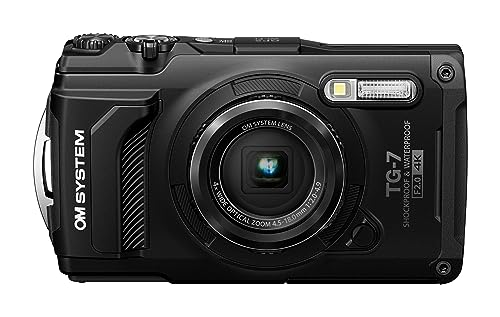
Every geology department, survey team and field school eventually converges on a camera like the TG-7, and the reasons are written in the conditions rather than the brochure. It is waterproof, dustproof, freezeproof and rated to survive drops and crushing loads that would retire a conventional compact, which means it rides in a chest pocket or on a belt through weather that sends lesser cameras into dry bags and out of the record entirely. The best field photograph is the one that exists, and this camera exists in places where photography usually stops.
Its scientific party trick is close focusing. The microscope-style modes let it focus about a centimetre from the subject, resolving crystal faces, oolites, cross-lamination and fossil detail at a scale the naked eye strains to see, and focus stacking in camera can hold a rough specimen’s depth in a single frame. For hand-specimen documentation in the field, before the sample bag swallows context forever, that macro honesty is worth more than any megapixel race. Add position and environmental logging that travels with the files, and each frame arrives home carrying where and under what conditions it was taken.
The compromises are a small sensor’s familiar ones: low-light noise arrives earlier than on big-sensor bodies, and the zoom range is a field tool rather than a telephoto reach. Neither matters much at an outcrop at noon. Buy it as the department’s shared instrument or the solo researcher’s constant companion, and insure the science rather than the camera: it is built to be the thing that survives.
- Form: sealed rugged compact
- Macro: focusing down to roughly a centimetre
- Logging: position and field data with frames
- Build: waterproof, dustproof, drop-rated
- Role: outcrop, specimen and site documentation
Strengths
- Works in weather that benches ordinary cameras.
- Macro modes resolve genuine geological detail.
- Position logging turns pictures into revisit-able data.
Trade-offs
- Small sensor limits dusk and underground work.
- Modest zoom reach for distant faces.
- Controls are compact for the largest gloves.
Best for: field geologists, students and survey teams documenting sites daily. Not suited for: gallery landscape printing or deep low-light work.

GoPro HERO13 Black — Best for Traverse Video
Some geological evidence is a route, not a rock: the approach up a gorge, the traverse along a fault scarp, the descent into a quarry whose access path explains half the safety briefing. The HERO13 films those journeys from helmet or chest with stabilisation that keeps strata readable instead of nauseating, and its waterproof, knocks-for-breakfast build suits a discipline where the operator’s hands are busy with hammer, compass and notebook. Mounted and forgotten, it produces the contextual video that stills never capture: how the beds relate as you walk them.
Its wide field of view is a geological virtue on a traverse. Cliff sections, fold geometries and valley cross-sections fit in frame from distances where a narrow lens would crop the story into fragments, and its accessory lens ecosystem widens or corrects that view further. Stills pulled from its video make serviceable record shots when the moment will not repeat, a rockfall, a river in spate, a light effect on a face that lasts one minute.
Battery appetite and a fixed lens are the honest costs, and its tiny screen is a framing aid rather than a review tool. Carry spare batteries in an inside pocket where body warmth protects them, treat it as the expedition’s moving-image recorder, and let the TG-7 handle the deliberate stills. Together they cover a field day almost completely.
- Form: waterproof action camera
- Mounts: helmet, chest, pole and tripod
- View: very wide, accessory lenses available
- Stabilisation: strong electronic smoothing
- Role: traverses, approaches, hazardous faces
Strengths
- Films routes and relationships stills cannot show.
- Hands-free mounting keeps hands on the rock.
- Survives the knocks fieldwork guarantees.
Trade-offs
- Batteries drain quickly in the cold.
- Fixed wide lens distorts close specimen work.
- Small screen frustrates detailed review.
Best for: documenting traverses, access routes and dynamic field conditions. Not suited for: careful specimen macro or archival stills.

DJI Osmo Action 5 Pro — Best for Long Field Days
Where the GoPro is the sprinter, the Action 5 Pro is the distance walker. Its endurance is the headline for geology: long traverses, full-day measured sections and boat-based coastal surveys punish batteries, and this camera’s stamina, paired with strong stabilisation and a larger sensor than action cameras traditionally carry, keeps recording after rivals have retired to the rucksack. Its front and rear screens help a lone researcher frame a narrated outcrop explanation without an assistant, a growing need as field documentation becomes video reporting.
Subject tracking and reliable colour under harsh midday sun suit the geologist’s worst lighting, which is also the geologist’s usual lighting. Rock does not schedule golden hour. The camera’s low-light improvement over older action models extends the working day into dawn starts and shaded gorges, and its waterproofing shrugs off the estuary work, stream sections and beach traverses where sections so often hide.
It shares the action camera family’s limits: a fixed wide lens, no true optical zoom for the far side of the valley, and stills that serve records rather than publications. Within its role, the walking, narrating, all-day recorder, it is arguably the most complete tool in this guide, and expeditions that film their science for funders and the public will feel the difference first.
- Form: waterproof action camera, dual screens
- Endurance: built for extended recording days
- Sensor: larger than classic action format
- Tracking: subject tracking for solo narration
- Role: long traverses, coastal and river sections
Strengths
- Battery life matched to real field days.
- Solo narration is practical with dual screens.
- Handles glare and shade with less fuss.
Trade-offs
- No optical zoom for distant exposures.
- Stills are documentation grade only.
- Accessories add up across a full kit.
Best for: researchers filming whole sections and narrated field reports. Not suited for: telephoto work or publication stills.

Insta360 X4 — Best for Outcrop Context
Context is geology’s eternal photographic problem. A fold means little without the cliff it sits in; a cliff means little without the valley. The X4 attacks the problem by refusing to choose: its twin lenses record the entire sphere around the camera in 8K 360 video, and the geologist reframes later, extracting the face, the overview and the relationship shots from a single capture made in seconds beneath an unstable slope. For hazardous faces, road cuts and fleeting access, that speed is a safety feature disguised as a convenience.
The reframing workflow also serves teaching beautifully. A lecturer can revisit a virtual outcrop with students, panning across beds the original visit photographed once, and the invisible-selfie-stick effect yields floating traverse shots that look like a drone flew them. Waterproofing covers stream and shore work, and single-lens mode behaves like a conventional wide action camera when 360 is overkill.
The costs are workflow weight and lens vulnerability. Spherical files are large, reframing takes desk time, and the protruding lenses demand a guard and a moment’s care in a pack full of hammers. Treat it as the context instrument, deploy it deliberately at each station, and it repays the discipline with an archive no flat camera can match.
- Form: 360 action camera, waterproof
- Capture: full-sphere 8K video
- Workflow: reframe any direction afterward
- Modes: 360 or single-lens wide
- Role: outcrop context, teaching archives, hazard faces
Strengths
- One capture preserves an entire station’s context.
- Fast deployment under hazardous faces.
- Revisitable archives transform field teaching.
Trade-offs
- Large files and slower desk workflow.
- Exposed lenses need guarding among tools.
- Overkill for simple specimen records.
Best for: structural documentation, teaching collections and dangerous exposures. Not suited for: quick snapshots or tiny file archives.

Nikon Z50 II — Best Camp Documentation Body
Every expedition has two photographic theatres: the outcrop and the camp table. The Z50 II owns the second. As a compact mirrorless body with interchangeable lenses, it photographs the day’s specimens properly in the evening, with a macro lens for the fossils, a standard zoom for camp and landscape context, and colour and resolution that carry into reports, papers and museum records. Its modern subject detection and easy wireless sharing also make it the expedition’s communications camera, sending the day’s verified images to base and sponsors.
We place it at camp deliberately. It is not sealed like the TG-7 and was never promised to survive a drop onto scree, so its field appearances should be planned ones: the accessible viewpoint, the dry day, the carried-with-two-hands assignment. Used with that honesty, its image quality ceiling towers over the rugged picks, and its stills are the ones that end up printed.
Costs are the system costs: lenses to choose and carry, a body to protect, batteries and cards to manage. For a research programme producing publications, that is money spent where readers look. For a solo student on a first mapping project, it is the upgrade to grow into after the rugged compact has taught the discipline of documentation.
- Form: APS-C mirrorless, interchangeable lenses
- Sharing: wireless transfer for reporting
- Lenses: macro to telephoto system choice
- Colour: Nikon’s dependable stills rendering
- Role: camp specimen work, publication stills
Strengths
- Publication-grade specimen and landscape stills.
- Lens system grows with the research.
- Fast sharing keeps base and sponsors current.
Trade-offs
- Not built for drops, dust storms or drenching.
- System cost rises with each lens.
- Needs deliberate protection on location.
Best for: expedition documentation, specimen archives and publication images. Not suited for: loose carry in scree, rain or quarries.
Pentax WG-90 — Best Ring-Light Macro (Prose-Only)
We discuss the WG-90 without a link because it sits outside our verified pool, but no honest geology guide can omit its idea: a ring of LED lights around the lens that floods a hand specimen with shadowless illumination at macro distances. In a tent at midnight, photographing the trilobite that cannot travel home, that built-in lighting solves the field macro problem more elegantly than any accessory torch balanced on a rucksack. Its rugged body follows the same sealed, drop-tolerant philosophy as the TG-7, making it a legitimate alternative for specimen-led projects.
Its macro modes and digital microscope heritage come straight from a line of compacts long favoured by field scientists and inspectors, and its small-sensor limitations mirror the class: daylight and lit macro excel, darkness beyond the ring light’s reach does not. Availability and pricing vary enough that we leave the purchase to your own search rather than a link we cannot verify today.
Choose it when specimen photography dominates the project and the ring light’s convenience outweighs the TG-7’s broader logging and ecosystem. Either way, the lesson stands: in field geology, illumination at the lens is a scientific feature, and the camera that brings its own light to the fossil earns its pack space nightly.
- Form: sealed rugged compact
- Lighting: LED ring around the lens
- Macro: microscope-style close modes
- Build: waterproof and drop-tolerant class
- Role: specimen-led projects, tent documentation
Strengths
- Shadowless macro light built into the body.
- Rugged sealing for daily field carry.
- Superb for finds photographed after dark.
Trade-offs
- No verified listing in our pool today.
- Small sensor limits unlit low light.
- Ring light reach is macro distance only.
Best for: palaeontology and specimen-heavy fieldwork. Not suited for: buyers who need a verified one-click purchase today.
Comparison table
| Camera | Form | Best at | Standout | Choose it for |
|---|---|---|---|---|
| OM SYSTEM Tough TG-7 | Rugged compact | Daily field documentation | Macro plus position logging | Every field geologist |
| GoPro HERO13 Black | Action camera | Traverse video | Helmet and chest mounting | Routes and hazardous access |
| DJI Osmo Action 5 Pro | Action camera | All-day recording | Endurance and dual screens | Long measured sections |
| Insta360 X4 | 360 camera | Context capture | Full-sphere reframing | Structural and teaching archives |
| Nikon Z50 II | Mirrorless | Camp stills | Lens system and quality | Publications and specimens |
| Pentax WG-90 | Rugged compact | Lit macro | Ring light at the lens | Night specimen work |
What makes a photograph count as geological evidence?
Three companions must travel with every frame: scale, orientation and location. Scale is the humblest: a scale bar, a coin, a hammer of known length placed in the plane of the feature, because a photograph of bedding without scale is an abstract artwork. Orientation means a recorded strike direction, a compass in frame or a notebook discipline that ties frame numbers to measured bearings. Location is coordinates, ideally logged by the camera itself, acceptably written the moment the shutter fires. A camera system supports evidence when it makes those three habits easy rather than heroic.
Colour honesty is the fourth companion. Rocks are identified partly by colour, and a camera that beautifies aggressively betrays the record. Choose the most neutral picture profile available, photograph a grey card or colour checker at each new locality, and resist filters that warm a sandstone into a lie. The picks above were favoured partly for offering restrained, workmanlike rendering alongside their showroom modes.
Finally, evidence survives through metadata and backup. Rename nothing in the field; copy cards nightly to two devices; let the notebook’s station numbers bind photographs, samples and measurements into one retrievable story. Ten years later, the value of a field archive is measured by whether a stranger can reconstruct the day from it, and that is a workflow achievement, not a sensor specification.
How do you photograph specimens and outcrops well?
Work the outcrop in three distances
Professional field photographers shoot every station three times: the wide establishing frame that shows the face in its landscape, the medium frame that shows the structure itself, and the close frame that shows grain, fossils or contact detail with scale in place. The habit costs ninety seconds and rescues more theses than any equipment upgrade, because examiners and reviewers always ask for the distance you skipped. The TG-7 and WG-90 cover the close work; the action and 360 cameras cover the wide; discipline covers the rest.
Light macro like you mean it
Specimens photographed in raking light reveal relief; photographed in flat light they reveal colour. Shoot both. A headtorch held low across a fossil at dusk carves its ridges into readability, while the WG-90’s ring light or an overcast noon gives the true-colour record. Wetting a specimen, the oldest field trick, deepens colour and contrast for the camera, but note the wetting in the record, because the archive must know which colours were assisted.
Protect the lens from the science
Hammers chip, dust coats and rivers splash. Assign one pocket, one cloth and one ritual: lens checked and wiped at every station, camera cased before the hammer swings, silica gel in the evening’s storage box. More field images are lost to a fingerprint of sunscreen than to any sensor limitation, and the geologist who builds the ritual into the station routine stops losing them.
What mistakes do geology photographers make?
Photographing without scale
The hammer belongs in the frame, in the plane of the feature, not leaning decoratively against the cliff base three metres in front of it. Scale placed carelessly is worse than none, because it lies with authority. Practise the placement until it is automatic, and audit the day’s frames nightly for the stations where enthusiasm outran method.
Trusting a phone-grade seal in a real storm
Splash resistance is not immersion, and dust resistance is not a sandblasted desert pavement. The rugged picks in this guide carry genuine ratings for a reason. Match the camera to the worst credible hour of the trip, keep the mirrorless body for the hours that deserve it, and never let optimism do a specification’s job.
Letting the notebook and the card drift apart
Frame 214 means nothing in November if October’s notebook calls the station by a name the files never heard. Speak the station number aloud on video, photograph the notebook page at each station’s start, and reconcile files against notes the same evening. Archives fail at the joins between systems, and the joins are human habits, not camera features.
Cleaning a gritty lens with a dry shirt
Grit dragged across a coating writes permanent calligraphy on your evidence. Rinse or blow first, then wipe. The rugged compacts forgive much, but their front elements are still glass, and the desert does not care that the camera was expensive.
Final Recommendation
Start with the Tough TG-7: it is the camera that will actually be present, working, at the moment the science happens, and its macro and logging serve the record directly. Add the Action 5 Pro or HERO13 when traverses and reporting enter the work, the X4 when structures and teaching archives matter, and keep the Z50 II for the camp table and the publication file. Consider the WG-90 where lit macro dominates. Geology rewards the prepared documenter, and this small fleet, carried with scale bars and discipline, prepares you completely.
Frequently Asked Questions
Is a rugged compact really better than my mirrorless camera for fieldwork?
For daily documentation, usually yes, because presence beats potential. The mirrorless body produces finer files on the days it is carried and the weather behaves; the rugged compact produces files on every day, including the ones that write the interesting geology. Most professionals end up owning both and assigning them exactly as this guide does.
How important is GPS logging on a geology camera?
Important enough to influence this ranking. A photograph that cannot be relocated is a claim that cannot be checked, and field science runs on checking. Camera-logged coordinates remove a whole class of notebook errors, though a disciplined manual record remains an acceptable substitute and a wise backup.
Can action cameras replace a real camera for outcrop stills?
They can record them, and their wide views suit big faces, but their fixed lenses distort close work and their stills serve records rather than analysis. Use them for context, traverses and hazards; let a macro-capable compact or the camp body carry the evidentiary stills.
What should a geology student buy first?
The rugged compact, without hesitation. It survives the degree, teaches documentation discipline, and its macro mode will photograph specimens better than an entry mirrorless with a kit lens. Add the mirrorless system later, when publication work and lens choice become real questions.
How do I keep cameras alive through a wet field season?
Dry them nightly, store them with desiccant, keep contacts clean, rotate batteries, and never seal a damp camera in an airtight bag to ferment. Rugged ratings buy tolerance, not immortality, and the evening drying ritual is the difference between a season’s archive and a mid-season failure.
How does underwater and river work change the choice?
Sections hide in rivers, estuaries and the intertidal zone, and the camera that documents them must treat immersion as routine. The TG-7’s genuine waterproofing and the action cameras’ sealed bodies make them the river party, while the X4’s 360 view captures a gorge cross-section from mid-stream in seconds. Work tethered: a wrist strap or float on everything, because geology’s most photogenic rivers are also its most efficient camera thieves, and a sunk camera takes the morning’s evidence with it.
Underwater, colour drains with depth and controls shrink to the buttons gloves can find. Shoot close, shoot shallow where possible, and let the record note the water conditions with the same honesty as the rock description. The archive forgives imperfect colour; it does not forgive missing stations.
What does a field photography kit weigh, and why does it matter?
Every gram on a mapping traverse is carried up the section and down again, which is why this guide’s fleet is deliberately small-sensor at the sharp end. The TG-7 rides a belt; the action camera rides a helmet; the X4 rides a pole. Only the camp body asks for a real bag, and it earns the weight in the evening rather than on the climb. Geologists who ignore the weight equation end up leaving the heavy camera at the vehicle, and a camera at the vehicle documents nothing but good intentions.
Plan the carry before the purchase: if the camera has no home on your body while both hands work, it has no role in your field system, whatever its specifications promise. The most scientific camera is the one at the outcrop, charged, clean and ready, and the fleet above was assembled to be exactly that, station after station, season after season.
How does a mapping project use photographs differently from a research visit?
A research visit photographs what it came for: the known fossil bed, the measured type section, the fault exposure the literature argues about. A mapping project photographs everything, because the map’s whole purpose is discovering which outcrops matter, and the camera becomes the project’s memory at walking scale. On a mapping traverse the cadence changes completely. Instead of three careful distances at one celebrated station, the geologist shoots brisk documentary frames at every exposure, often a dozen stations an hour, and the camera’s speed, battery life and position logging matter more than any refinement of image quality. This is the TG-7’s home terrain and the reason departments issue it to mapping parties: it wakes fast, focuses close or wide without a lens decision, stamps its coordinates, and survives being swung against a gate post on a farm track.
Mapping also changes the evening workflow. The day’s frames are plotted against the traverse line, and photographs that cannot be placed on the map are treated as rumours rather than evidence. A camera whose files carry position data collapses that plotting from an hour of notebook archaeology into minutes, and over a six-week mapping season those saved hours compound into an extra week of fieldwork. When supervisors ask why this guide ranks logging alongside sealing and macro, the mapping season is the answer: the camera is not documenting the project, it is one of the project’s instruments, and instruments are judged by the data they return.
The action cameras earn their keep on mapping too, in a supporting role students underestimate. A chest-mounted HERO13 or Action 5 Pro running during a traverse records the exposures nobody stopped for, the fleeting glimpse of a contact in a ditch, the bed glimpsed through a hedge gap. Reviewing that footage at camp regularly rescues one or two stations per week that the map would otherwise have lost, and on ground that cannot be revisited, private land, tidal sections, a quarry face scheduled for blasting, that rescue is the difference between a complete map and an honest blank.
What should fossil and specimen photography never do?
It should never improve the specimen. The ethics of geological photography are the ethics of evidence: no cloning out the distracting pebble, no saturating the ammonite into jewellery, no compositing a sky the morning never had. Adjust exposure and white balance to reach honesty, document any wetting or lighting assistance in the record, and leave the frame’s contents exactly as the rock presented them. Journals and museums increasingly ask how images were processed, and the field photographer who can answer “balanced, never altered” protects the whole team’s credibility with one sentence.
It should also never cost the site its science. Photograph the fossil in place before any extraction is contemplated, with scale and orientation recorded, because the in-situ frame is frequently worth more than the prepared specimen: it holds the bedding, the neighbours and the story. Where collecting is permitted and justified, the sequence is inviolable, wide frame, medium frame, close frame, notebook entry, then and only then the hammer. Cameras have quietly reformed field practice here; the cheapest instrument in the rucksack now enforces the discipline that a generation of lost-context specimens taught the hard way.
Finally, specimen photography should respect the next visitor. A face hammered into rubble for one photograph is a face nobody else can study, and several picks in this guide exist precisely to reduce that pressure: macro modes that resolve detail without fresh breaking, 360 capture that records a face completely in seconds, traverse video that documents without touching. The best geology camera, in the end, is partly an ethical instrument, and the fleet above was chosen with the outcrop’s future readers in mind as well as its present one.
How do photographs travel from outcrop to publication?
The pipeline begins in the field notebook, where station numbers bind frames to samples, and it ends in a figure caption that a stranger can trust. In between sit the unglamorous stations this guide keeps returning to: nightly copying to two devices, position data checked while the traverse can still be re-walked, colour references filed with the frames they calibrate. Research groups that build this pipeline deliberately publish figures their reviewers believe; groups that improvise it spend their writing months apologising for archives.
Selection is the pipeline’s creative act. A season returns thousands of frames; a paper carries six. The geologist who shot three distances at every station chooses figures the way an editor chooses paragraphs, wide for setting, medium for structure, close for proof, and the discipline of the field routine becomes the clarity of the published argument. This is why the picks above emphasise complementary roles rather than a single champion: the fleet is a figure-making system, and its output is measured in accepted papers, defended theses and maps that other geologists can build on.
Keep the raw archive with the same care as the samples. Institutions lose field photographs far more often than they lose rocks, because rocks sit visibly on shelves while drives fail silently in drawers. Two copies, one off-site, an index a successor can read: that modest liturgy is the difference between a department’s century of field memory and a shelf of beautiful specimens nobody can place on Earth anymore. The cameras in this guide make the frames; the pipeline makes them permanent, and permanence is the whole point of writing anything down in stone country.
Which camera settings serve rock rather than scenery?
Field geology has its own settings dialect, learned the season a student returns with beautiful, useless photographs. Aperture stops down further than landscape habit suggests, because a dipping bed must stay legible from foreground hammer to background contact, and depth of field is the outcrop photograph’s grammar. The rugged compacts handle this gracefully in their scene and aperture modes; the camp body rewards a deliberate small aperture and a support, even if the support is a rucksack and a two-second timer. Sharpness across the frame, not glow at its centre, is what a structural geologist zooming into your figure will judge.
Exposure discipline matters in the field’s violent light. Sunlit limestone beside shadowed shale defeats casual metering, so expose for the feature that carries the argument, check the histogram rather than the flattering screen, and bracket the station when the range defeats a single frame. White balance locked to daylight keeps a week’s frames consistent for the colour comparisons that identification depends on; automatic white balance drifting between stations quietly falsifies the archive. None of this requires expensive equipment. It requires the settings conversation to happen once, at the season’s start, on whichever pick from this guide the team carries, and then to become habit.
File discipline completes the dialect. Record the largest, least-compressed files the cards allow, because the frame nobody examines for five years may become the figure a re-examination depends on, and compression artefacts are forever. Cards are cheaper than field seasons. The geologist who treats storage as a consumable, like sample bags and notebook pages, never has to choose which outcrop deserved a full-quality record, and the archive thanks them at exactly the moment a distant colleague zooms in.
How should departments and field schools equip a whole party?
Institutional buying follows different logic from personal buying, and this guide’s fleet maps onto it neatly. The shared workhorse should be the rugged compact, issued per pair of students, because its losses hurt least and its survival rate across a cohort is a matter of record. One 360 camera per party transforms the teaching archive, letting staff rebuild the day’s stations in the classroom. One action camera per traverse team captures the route evidence. The mirrorless body stays with staff or the camp documenter, producing the season’s publication and publicity stills under controlled conditions.
Standardisation is the hidden saving. A party running one compact model shares chargers, batteries, menus and muscle memory; a student can pick up any unit and work. Mixed fleets breed the twin field diseases of flat batteries in unique sizes and photographs stranded on unfamiliar cards. Buy the boring fleet, label every unit, log every card, and spend the saved improvisation on geology. Departments that have run field schools for decades converge on exactly this pattern, and their archives, complete, indexed and still growing, are the proof that camera systems, like field methods, reward the disciplined over the dazzled.
Budget one more line that novices omit: replacement and repair float. A rugged camera is tough, not immortal, and a season plan that assumes zero losses is fiction. One spare compact in the camp box converts a catastrophe into an anecdote, and the anecdote rate, across enough seasons, is the truest review any field camera ever receives.
What changes when the field site is underground or underwater?
Mines, caves and adits strip photography down to light and nerve. Below ground there is no ambient gift to meter from; every photon in the frame is one the party carried in, which reverses the usual camera virtues. Sensor size and high-sensitivity cleanliness, luxuries at a sunlit outcrop, become the whole game, and the camp body with a fast lens, borrowed carefully for a planned underground session, outperforms the rugged compacts it loses to on the surface. The compacts still earn their passage as the record cameras of first resort, because dust underground is abrasive, water is everywhere, and a camera that fears the environment stops being carried at exactly the depth where documentation matters most.
Lighting underground is a team sport. One geologist holds the specimen, one holds the lamp at the raking angle that carves relief into visibility, and the photographer exposes for the lit plane while the blackness swallows the rest. Headtorches double as focusing aids and modelling lights, and the WG-90’s ring light, designed for macro at a lens’s length, turns out to be a cave instrument in disguise. Record the lighting arrangement in the notebook with the same care as the bearing, because a future reader comparing two underground frames deserves to know why their shadows disagree.
Safety governs every underground frame, and no photograph justifies lingering under unsupported ground for a better angle. This is where the X4’s speed becomes an ethical feature again: plant it, capture the whole chamber sphere in seconds, and do the framing scholarship later at the surface. The archive gains a complete record, the party gains minutes back in safe ground, and the camera’s supposed gimmick reveals itself as the most serious tool in the bag.
How do seasons and climates rewrite the field camera brief?
A tropical season attacks with humidity and fungus; a desert season with grit and glare; a high-latitude season with cold that turns batteries into bricks and screens into slow, dim ghosts. The fleet above was chosen to degrade gracefully across all three. Sealed compacts shrug off the rainforest’s daily drenching provided they are dried with desiccant each night rather than sealed damp into a box where fungus farms on lens coatings. Desert parties learn to change nothing, not a card, not a battery, in open wind, and to treat the camera’s seals as a budget spent carefully rather than a force field. Cold parties carry batteries against the body, rotate them like sentries, and accept shorter recording days from the action cameras while the simple compact, with fewer electronic appetites, keeps documenting.
Glare deserves its own sentence in every climate. Rock photography happens at the hours other photographers avoid, under a vertical sun that flattens bedding into glare and bleaches colour from the record. A polarising filter on the camp body, a hand shading the compact’s lens, a station revisited under cloud: these humble techniques rescue more field archives than any dynamic-range specification. The experienced field geologist reads the sky the way a sailor does, scheduling the glare-prone faces for the day’s edges and the macro work for the brutal noon, when the light that ruins cliffs kindly serves a hand specimen under a shading rucksack.
None of this seasonal craft appears on a specification sheet, which is precisely why buying advice for geology must come from the field rather than the studio. The cameras recommended here were ranked by people imagining your worst Tuesday in the rain, not your best Saturday in the showroom, and every section of this guide, from seals to settings to the evening drying ritual, exists to keep the record complete when the season turns hostile, as seasons reliably do.
A first field season, photographed properly
Picture the student this guide most hopes to reach: first mapping season, borrowed boots, a notebook whose early pages are neater than its later ones will be. Her camera decision looks small beside the season’s geology, yet it will quietly decide how much of that geology survives into her report. Give her the TG-7 and a short liturgy, scale in every frame, station number spoken at every video’s start, cards copied every night, and her archive will out-perform the archives of better-funded parties carrying finer cameras carelessly. The instrument matters; the liturgy matters more; this guide has tried to hand over both.
By the season’s third week her habits will have become invisible to her, which is what habits are for. She will shade the lens without thinking, place the scale bar in the feature’s plane by reflex, and feel a small professional unease whenever a frame lacks its coordinates, the same unease she feels at an unlabelled sample bag. That unease is the sound of a scientist forming. Cameras do not create it, but the right camera, present at every station because it fears nothing the weather sends, gives the unease a thousand chances to become craft.
Years later she will open that first archive during some argument about a contact’s position, and the frames will answer, placed, scaled and dated, while a colleague’s prettier photographs from the same summer shrug in beautiful ambiguity. That moment is the entire return on the decisions in this guide. Buy the camera that will still be answering questions in a decade, carry it everywhere the rocks are, and let the record, not the brochure, be the judge.
One last word on drones, phones and the cameras not ranked here
Readers will ask why no drone headlines a geology guide in this decade. Aerial frames are magnificent for structure and access, and many surveys now fly them as standard, but they answer to aviation rules, landowner permissions and wind limits that vary by site, and they complement rather than replace the ground record this guide ranks. The geologist still walks the section, still kneels at the contact, still needs a camera on her belt at that moment. When a drone joins the fleet, let it join as the X4 joined, as a context instrument layered over a ground system that already works.
Phones deserve the same honest placement. A modern phone photographs a hand specimen respectably and logs its position automatically, and for a lone researcher it is a legitimate backup when the main camera fails. Its weaknesses are the field’s strengths inverted: fragile glass, sealed batteries that end the day when they end, and an interface designed for dry thumbs. Carry one by all means; build the system on the tools above. The season a phone becomes the only camera is the season the archive starts gambling, and geology, of all disciplines, should know better than to gamble against deep time.
One practical footnote before the recommendations close. Straps and tethers decide field camera survival more often than armour does: a wrist loop on the compact, a lanyard on the action camera at river stations, a chest harness that keeps the body off the hammer’s swing arc. Fit them the day the camera arrives, not the morning of the first traverse, and replace frayed cords without sentimentality. The archive’s most common obituary is a short fall onto hard rock, and it is almost always a carrying failure wearing a camera failure’s clothes.
And insure the archive, not just the hardware. A camera can be replaced in a week; a season’s unrepeatable stations cannot be replaced at any price, which is why the nightly double-copy ritual outranks every purchase in this guide. Travelling researchers should separate the two copies across bags and, where the work is funded, across people, so that no single theft, flood or vehicle fire can erase the evidence. It takes four minutes an evening. It is the cheapest scientific integrity ever sold, and it is sold nowhere, only practised, nightly, by every field party whose archive still answers questions decades after the boots wore out and the outcrop itself weathered away.
Related Guides
Field scientists heading uphill should also read our hiking and camping camera roundup. For the traverse footage itself, see our helmet camera guide, and for camp-based nature work, our high quality photo camera picks.


