reviewstook.com is reader-supported. When you buy through links on our site, we may earn an affiliate commission.
Where to Buy a Camera That Understands Skin
The best cameras for beauty gurus are judged by an audience that pauses, zooms and screenshots. Beauty viewers study texture the way wine judges study tannins: they want to see whether a foundation truly melts in, whether a highlighter reads as glow or glitter, whether a lip shade is honest. A camera for this work must render skin truthfully but kindly, hold focus on an eye while its owner talks with their hands, and survive three hours under hot lights without a murmur.
Beauty creation is also a peculiar filming geometry. The camera sits close, the creator leans in and out of the focal plane constantly, products are thrust toward the lens for macro inspection, and the same face must look consistent across a hundred videos filmed months apart. Autofocus behaviour, colour consistency and close-focus ability therefore outrank almost everything else in this guide — ahead of resolution, ahead of ruggedness, ahead of prestige.
Four of these cameras carry links from our verified pool, while two creator favourites appear in prose only, without links. A plain warning before the list: within a month of serious filming, lighting will matter more than any camera body, and the guide sections repeat that truth deliberately. The camera remains the foundation everything else stands on, though, and the six foundations below are the ones working beauty creators genuinely build channels upon.
Key Takeaways
- Skin rendering is the whole game: colour that flatters without lying keeps both viewers and brands happy.
- Eye autofocus must survive leaning, turning and product demonstrations without hunting or giving up.
- Close-focus ability decides whether a swatch or brush tip reads crisply when thrust toward the lens.
- Consistent colour across months of videos matters more than any single spectacular frame.
- Heat tolerance under studio lights separates creator cameras from cameras that merely visit studios.
- A flip screen you can trust replaces a mirror, a monitor and half your reshoots.
In this guide
Quick Picks
| Pick | Badge | Why it made the list |
|---|---|---|
| Sony ZV-1F | Best for seated tutorials | A face-first compact whose wide lens, product showcase manners and simplicity suit desk-based beauty work beautifully. |
| DJI Osmo Pocket 3 | Best for routines and vlog segments | Gimbal grace for morning routines, hauls on the move and smooth get-ready-with-me storytelling. |
| Sony Alpha 7 IV | Best for flagship channel quality | Full-frame polish, lens choice and focus authority for creators whose channel is now a business. |
| Canon EOS R6 Mark II | Best for colour-critical creators | Canon’s beloved skin rendering plus autofocus that treats a talking face as its favourite subject. |
| Sony ZV-E10 II | Best interchangeable creator starter | A prose-only favourite: lens flexibility and creator tools in a compact body for growing channels. |
| Canon PowerShot G7 X Mark III | Best pocket beauty compact | Bright lens, flattering colour and coat-pocket size, covered prose-only for creators who film everywhere. |
How Did We Choose the Best Cameras for Beauty Gurus?
We judged colour the way beauty audiences do: on skin, under mixed creator lighting, across a range of tones. Cameras whose processing keeps skin dimensional — texture visible, harshness forgiven — outranked cameras that either plasticise faces or render every pore as a headline. Consistency mattered as much as beauty itself, because a channel’s back catalogue should look like one creator, not a decade of different cameras arguing.
Autofocus was the second gate, tested against beauty-specific movement: leaning toward a mirror, turning to profile to show contour, holding a palette centimetres from the lens, applying product with the face half-turned. Picks here hold an eye through that choreography or refocus with a grace that edits invisibly. Product-focus features that snap to a held-up item and return to the face earned particular respect.
Third came the working day: hours under lights without overheating drama, screens bright enough to judge makeup by, audio options for the lavalier every serious creator eventually adopts, and vertical-video manners for the platforms where beauty now breaks new products first. A beauty camera is a studio employee; we hired accordingly.
Which Beauty Camera Fits Your Channel’s Stage?
New creators filming at a desk should begin with the ZV-1F or the prose-only ZV-E10 II and spend the difference on light, because audiences forgive a modest camera under beautiful light and forgive nothing under bad light. Established channels monetising brand deals will feel the full-frame picks immediately — in focus authority, in low-light headroom for evening routines, and in files that survive aggressive platform compression.
Match the tool to your dominant format too. Seated tutorials reward the desk picks; routine and lifestyle content rewards the gimbal; creators who photograph products and flat-lays seriously should weight the interchangeable-lens bodies. Your camera should flatter the content you actually publish weekly, not the content you might publish someday.

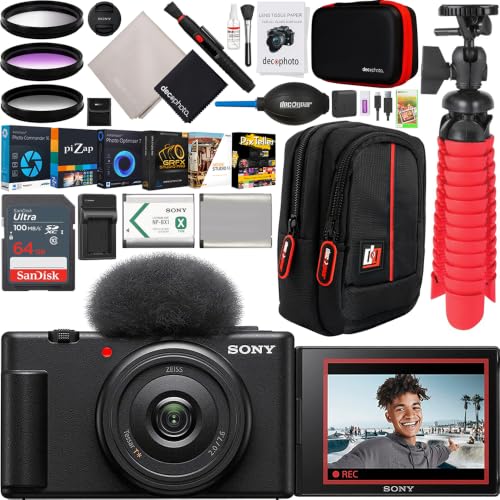
Sony ZV-1F — Best for seated tutorials
Sony designed this camera around a seated, talking creator, and beauty work is its home turf: a wide flattering frame, face priority that behaves, and product presentation that snaps into focus when you present a compact to the lens. Beginners can grow a real channel on it.
A seated tutorial is a peculiar performance: one person, one chair, two hands in constant motion, and an audience studying every pore. The Sony ZV-1F was shaped for exactly that stage. Its wide lens frames head, shoulders and workspace without pushing the desk against the opposite wall, while face priority keeps attention on the creator rather than the brush pot behind them. When a compact is lifted toward the lens for inspection, focus shifts to the product smoothly and returns just as politely. Nothing about the setup asks the creator to think like a technician, so the talking — the actual product being sold — stays natural, warm and unhurried. The flip screen completes the solo-filming loop, letting a creator check framing and flyaway hairs without leaving the chair.
Long filming days expose cameras that looked charming in a ten-minute test. This little Sony keeps its composure through a full foundation wear-test, recording the morning application, the midday check-in and the evening verdict without overheating drama or battery panic. Skin colour stays truthful across those hours, which matters because a wear-test is evidence, and evidence must not drift. Creators describe the relief of a camera that simply continues, take after take, while they concentrate on blending. Its simplicity also protects spontaneity: a sudden idea can be filmed immediately, before the enthusiasm cools, using whatever window light the room currently offers. Its battery likewise suits the working pattern of filming in bursts between life, topping up quickly and never demanding a charging ritual the night before a planned tutorial.
Beginners gravitate to the ZV-1F because the first videos come out looking intentional. The framing flatters without distorting, the background softens just enough to hide a cluttered bedroom, and the microphone handles a normal speaking voice kindly. That early competence builds the confidence to publish, and publishing consistently is the unglamorous engine of every beauty channel. There are no lenses to research, no sensor formats to decode, no forum arguments to referee. A new creator can spend their limited evenings learning makeup presentation and lighting instead of camera operation, which is the correct order of priorities for a channel’s first year. The wide lens also forgives small filming spaces, which describes most first channels honestly: a desk in a bedroom corner becomes a studio the moment this camera is switched on.
The camera’s relationship with skin deserves emphasis, because beauty audiences forgive many things but not dishonest colour. Foundations must read as their true shade, blush must not turn orange under lamplight, and the Sony’s rendering respects those obligations. Creators filming evening routines under warm bathroom lighting report faces that still resemble the person their subscribers met in daylight videos. That consistency across a channel’s catalogue builds the trust on which recommendations, and eventually brand partnerships, depend. A small camera that treats colour seriously punches far above its size in a genre where colour is the entire subject matter. Products benefit equally, since a lipstick’s undertone and a foundation’s finish are reproduced with the fidelity subscribers need when they shop from a creator’s recommendations.
There is a business case for starting here even when a flagship is affordable. Money not spent on a body can buy the key light, the backdrop and the microphone that audiences actually perceive as quality. The ZV-1F then serves as the reliable desk camera while the channel finds its voice, and later becomes the second angle or the travel body. Nothing about it embarrasses a grown channel. For a creator whose talent is makeup rather than machinery, beginning with the camera that asks the least and delivers the most honest skin is simply sound strategy. It is also light enough to mount on the small tripods new creators actually own, removing another hidden cost from the first setup.
- 1-inch sensor
- Fixed 20mm wide lens
- 4K video recording
- Compact vlogging design
Strengths
- Pocket-camera simplicity that directly serves long-session heat reliability
- Controls that stay learnable during an evening routine under warm bathroom lighting
- Support, lenses and accessories around long-session heat reliability
Trade-offs
- Accessories for eye focus through constant movement add up quietly
- Overkill if your beauty content creation stays casual
- Menus reward setup before a brand-deal shoot with a producer watching the clock
Best for: desk tutorials and new channels
Not suited for: creators needing interchangeable lenses now

DJI Osmo Pocket 3 — Best for routines and vlog segments
The Pocket 3 owns the moving half of beauty content — routines, hauls, travel get-ready sessions — where its gimbal and face tracking turn walking footage into polished segments. Many established creators pair it with a desk camera rather than choosing between them.
The DJI Osmo Pocket 3 covers the half of beauty content that leaves the desk: morning routines filmed while moving between bathroom and wardrobe, hauls carried through a flat, travel get-ready sessions in hotel light. Its gimbal turns walking footage into something smooth enough to publish without apology, and the rotating screen flips between horizontal filming and vertical clips for short-form platforms in one gesture. Face tracking follows a creator who keeps turning to mirrors, shelves and windows, which is to say it follows real routine choreography rather than a seated performance. For creators whose lives are the content, this little machine is liberation. Its audio, captured close to the creator rather than across a room, keeps routine narration intimate without a separate microphone in many settings. The device also slips into a handbag for filming opportunities that arise away from home — a salon transformation, a store’s new display — where pulling out a full camera would change the atmosphere it was meant to record.
Working creators praise the Pocket 3 for speed of deployment above almost everything else. A skincare routine that occurs to its creator in the shower can be filming within a minute of the towel coming off, because the device wakes instantly and stabilises itself. That immediacy captures the authentic, unpolished segments audiences increasingly prefer over studio perfection. Its screen is large enough to check framing and product labels without squinting, and the vertical format support means a routine filmed once can serve two platforms. In an attention economy measured in seconds, a camera that removes setup friction effectively manufactures extra content from the same day. The touchscreen’s clarity helps when checking whether a product’s shade name is legible, a small detail that separates useful hauls from frustrating ones. Creators filming alone repeatedly cite this confidence: what the screen shows is what the audience will get, with no focus surprises waiting in the edit.
Heat and stamina matter during the long filming sessions brand work demands, and the Pocket 3 handles extended recording with a reliability that surprises people who remember earlier pocket cameras wilting. A sponsored routine can run through multiple takes, outfit changes and lighting adjustments while the device simply continues. Its sensor, unusually large for the category, keeps indoor footage clean when hotel rooms and rented studios offer only indifferent light. Creators travelling for brand trips trust it as the camera that will definitely work when the schedule has no slack. Reliability of that order becomes part of a creator’s professional reputation. Battery endurance matches the stamina story, carrying a travel day of segments without the creator rationing clips. Its quick charging during a lunch break restores enough power for an evening routine, which suits the opportunistic rhythm of content trips where the schedule belongs to a brand rather than the filmmaker.
The Pocket 3 also changes how products appear on screen. A creator can carry a new palette from the door to the desk in one unbroken, floating shot, letting anticipation build the way it does in a shop. Close inspection moments benefit from the gimbal’s steadiness, because viewers can actually read shade names and textures instead of watching them swim. Tutorials gain a cinematic grammar — walk, reveal, settle, demonstrate — that static cameras cannot easily imitate. Channels that adopt it often restructure their formats around movement, and audiences respond to the energy. It is a format decision as much as a camera purchase. Its presence also relaxes contributors — friends, makeup artists, family members — who might perform stiffly in front of an obvious production camera, and relaxed people make better footage.
No single tool wins every beauty brief, and the Pocket 3 is honest about its territory: motion, spontaneity and vertical content. Paired with a desk camera it completes most channels’ needs; used alone it still covers routines, vlogs and travel with polish. Its size invites filming in shops, salons and backstage areas where a full rig would attract permission problems. Creators who film their real lives between tutorials find it becomes the most-used device they own. Usage, as always, is the metric that matters, and by that metric this small gimbal camera earns its place near the top. Charging from common cables and its tolerance of being tossed into a tote keep the ownership experience as frictionless as the filming itself.
- 1-inch CMOS sensor
- 3-axis gimbal stabilisation
- 4K video recording
- Rotating touchscreen design
Strengths
- Build quality suited to regular beauty content creation
- Files with editing headroom for beauty content creation
- Support, lenses and accessories around truthful flattering skin colour
Trade-offs
- Video depth outruns most beauty content creation needs
- Menus reward setup before a product thrust toward the lens for macro inspection
- Lens costs rival body costs in beauty content creation
Best for: routines, hauls and moving segments
Not suited for: static tripod tutorials as the only format

Sony Alpha 7 IV — Best for flagship channel quality
When a channel becomes a business, the Alpha 7 IV is the business camera: full-frame depth that makes products look expensive, focus that producers trust, and a lens shelf covering every beauty focal length ever argued about. It is the long-term flagship pick.
The Sony Alpha 7 IV is where a beauty channel becomes a production company. Its full-frame images give products a depth and separation that make them look expensive before a word is spoken, and its focus behaviour under presenter movement is trusted by creators who film alone and cannot check every take. Hybrid design means the same body shoots the tutorial, the thumbnail stills and the polished brand deliverables without compromise in any direction. The lens catalogue behind it covers every focal length a beauty desk could want, from wide room views to flattering portrait compression. This is infrastructure, bought once and used daily. Its dual recording security and deep customisation let an established creator build a repeatable house style into the body itself, so assistants and future editors inherit a consistent starting point.
Colour-critical work is the Alpha’s quiet triumph. A creator comparing six foundations across a video needs each shade rendered truthfully relative to its neighbours, under lights that may mix daylight with LED panels. The Sony’s files hold those distinctions cleanly, and its handling of skin avoids both the plastic smoothness and the cruel sharpness that plague lesser systems. Editors can grade footage from different filming days into a seamless series, because the underlying capture is consistent. For a channel whose credibility rests on showing products honestly, that consistency is not a luxury feature; it is the product being sold to the audience. The extensive lens shelf adds a further creative dimension: a longer portrait lens for campaign stills, a macro for product texture, each rendering with the same family character.
Composure under pressure defines professional tools, and the Alpha behaves like one during sponsored shoots. When a producer is watching the clock and the light is changing, the camera’s controls fall under the fingers without menu expeditions, and its focus simply does its job while the creator performs. Nobody on a paid set forgives a camera that hunts during the one expressive take. The Sony’s steadiness lets a solo creator deliver agency-grade material without hiring a camera operator. That capability changes the economics of a channel, because brand budgets previously reserved for production crews become reachable by one person at a desk. Its wireless and tethering options suit studio workflows where a client or producer reviews frames on a larger screen as they are captured, shortening approval cycles during paid work.
Long sessions reveal the value of the Alpha’s thoughtful ergonomics and heat management. A creator filming a full-face tutorial, then a hair segment, then product close-ups, can keep one body mounted and working rather than rotating devices and rebuilding the set. Its files withstand the cropping and reframing that vertical edits demand, so horizontal masters keep feeding short-form platforms for weeks. Thumbnail photographs pulled from the same session match the video’s look, tightening a channel’s visual identity. These are unglamorous, compounding advantages, and they are exactly what separates a sustainable production routine from a heroic weekly effort. Storage and battery systems are equally grown-up, supporting long recording days with the card capacity serious schedules require. Weather sealing, rarely discussed in beauty contexts, protects the investment during location shoots and travel, where a channel’s calendar increasingly takes its flagship body.
Choosing the Alpha is also a statement about direction. It suits the creator who expects brand deals, licensing requests and perhaps a product line of their own, and who wants footage that will still look current when repurposed years later. Beginners can grow into it, though the guide’s smaller picks serve a first year more kindly. Its resale strength protects the investment if the channel pivots. Above all, it removes the camera from the list of things limiting a channel’s growth, which is the most valuable service a flagship can perform for a serious beauty business. Its stills quality also future-proofs a creator’s move into print, book covers or product packaging, territories where phone-era files would quickly show their limits.
- Full-frame sensor
- Interchangeable-lens mirrorless body
- Hybrid stills and video design
- Extensive native lens catalogue
Strengths
- Controls that stay learnable during a contour tutorial with constant profile turns
- Support, lenses and accessories around long-session heat reliability
- Files with editing headroom for beauty content creation
Trade-offs
- Menus reward setup before a product thrust toward the lens for macro inspection
- Overkill if your beauty content creation stays casual
- Lens costs rival body costs in beauty content creation
Best for: established channels and brand work
Not suited for: beginners wanting the simplest start

Canon EOS R6 Mark II — Best for colour-critical creators
Creators who obsess over skin choose Canon for a reason that predates mirrorless: colour that treats faces kindly without erasing them. Add autofocus that adores a talking subject and you have the colour-critical creator’s body of choice.
The Canon EOS R6 Mark II wins colour-critical creators before they ever press record, because Canon’s rendering of skin has decades of goodwill behind it. Faces emerge warm, dimensional and recognisably human, with reds and neutrals handled in a way beauty audiences instinctively trust. Add autofocus that adores a moving, talking subject — turning to mirrors, leaning toward the lens, presenting products at arm’s length — and the body becomes a specialist instrument for beauty work disguised as a general camera. Creators switching to it often describe their older footage as a draft of what they meant. Its in-body stabilisation deserves a specific mention for beauty work, because it smooths the slight tripod knocks and desk bumps that otherwise ripple through close-up footage during filming.
Sponsored work is where the Canon justifies itself commercially. A brand paying for a campaign expects footage that survives their own review process, and this body’s combination of tracking reliability and flattering colour passes those reviews without reshoots. Its stabilisation steadies handheld segments when a creator films a routine away from the tripod, keeping the professional finish intact. Long filming days are handled without the overheating anxiety that haunts some rivals, so a full-face tutorial and its accompanying shorts can be captured in one session. The camera’s dependability becomes part of the creator’s pitch: hire me, and the technical side will not be the problem. The body’s professional connections — dependable tethering, serious audio options, robust file formats — complete the commercial picture, giving a creator’s small studio the infrastructure a brand’s production team expects to find.
Consider the contour tutorial, beauty filming’s focus obstacle course. The creator turns to profile, tilts toward the light, raises a brush between face and lens, then returns to centre — repeatedly, for twenty minutes. The Canon follows the eye through that choreography with a calm that lets the performer forget the camera exists. Forgetting the camera is the precondition of the relaxed, funny, trusted delivery that builds audiences. Lesser systems announce themselves with focus pulses exactly when concentration matters. This body’s discretion is therefore a creative feature, not merely a technical one, and creators feel the difference in their performances. Its silent shooting options also help during stills work at events, where a creator documenting a launch should be heard by nobody and noticed only in the results.
The R6 Mark II also serves the stills side of a beauty business gracefully. Product photography for a creator’s own line, portraits for press features, and thumbnails with genuine depth all come from the same mounted body. Its files edit generously when a campaign requires matching footage shot weeks apart under different weather. Controls reward the experienced while automatic modes stay courteous on tired days. For the creator whose channel has become their livelihood, this combination of kindness to skin and seriousness under contract makes the Canon the guide’s recommendation for colour above all. The eye-tracking’s behaviour with glasses, lashes and partial profiles — the daily reality of beauty filming — is particularly assured, sparing creators the focus compromises other systems impose.
There is a longevity argument too. Bodies at this level stay in professional kits for years, and Canon’s lens ecosystem ensures the beauty desk can evolve — a macro for product detail, a fast prime for portraits — without replacing the centre. The creator’s skill compounds on a stable platform instead of resetting with every upgrade. Audiences notice the resulting consistency as a channel’s signature look, and signature looks are what separate memorable creators from interchangeable ones. Buy this Canon when colour is your credibility, and it will guard that credibility daily. Its video specifications comfortably exceed current platform requirements, giving editors reframing room for vertical cutdowns without sacrificing the polish subscribers associate with the channel.
- Full-frame sensor
- 24.2 megapixel CMOS sensor
- In-body stabilisation
- Fast continuous shooting
Strengths
- Controls that stay learnable during a brand-deal shoot with a producer watching the clock
- Controls that stay learnable during a product thrust toward the lens for macro inspection
- Support, lenses and accessories around long-session heat reliability
Trade-offs
- Honest weight checks precede a product thrust toward the lens for macro inspection
- Honest weight checks precede a contour tutorial with constant profile turns
- Honest weight checks precede a contour tutorial with constant profile turns
Best for: colour-obsessed creators and portrait crossovers
Not suited for: creators on the tightest budgets
Sony ZV-E10 II — Best interchangeable creator starter
The ZV-E10 II is the starter with a future — interchangeable lenses, modern creator tools and compact manners, covered prose-only here. It suits the guru whose desk setup will evolve lens by lens rather than arriving all at once.
The Sony ZV-E10 II is the thoughtful middle path: a creator camera with interchangeable lenses, sized for a desk and priced for a growing channel. Its creator-focused tools — product showcase behaviour, easy background control, straightforward streaming — address the actual tasks of beauty filming rather than photography in the abstract. Because the mount accepts Sony’s extensive lens range, the camera evolves with its owner: the kit lens this year, a fast prime when brand work begins, perhaps a wider option when the filming room changes. Prose-only in this guide, it is nonetheless the starter we recommend to gurus who already know they will want glass choices later. Its compact body also mounts happily on the small gimbals and desk arms growing creators already own, integrating into an evolving rig instead of demanding a new one.
Focus behaviour during makeup application is this Sony’s audition piece, and it passes. A creator applying eyeliner is looking in a mirror, not at the lens; a creator blending foundation turns constantly between profile and front. The camera maintains the eye through that movement without the nervous hunting that makes tutorials unwatchable. When a product is presented, focus transfers to it and returns to the face as the presentation ends, choreography the audience reads as professionalism. Solo creators cannot monitor focus while performing, so the camera must be trustworthy in their absence. The ZV-E10 II earns that trust in the genre’s most demanding routine. Its colour profiles publish kindly with minimal grading, an important mercy during launch weeks when a creator films daily and editing time is the scarcest resource in the business. Battery life across a filming day, plus painless USB charging between segments, keeps the production moving without a pocketful of spares.
Its size changes filming habits for the better. Mounted on a small tripod it leaves the desk free for products; carried into a bathroom it films a routine where the routine actually happens. Creators report filming more often simply because setup shrank to minutes. The modern creator tools shorten editing too, with colours that publish well straight from the camera on busy weeks. For a growing channel balancing filming against a job or studies, those saved minutes compound into consistency, and consistency is the algorithm’s favourite virtue. This Sony is engineered around a creator’s calendar as much as their desk. Its screen and menus speak creator language rather than photographer dialect, shortening the distance between unboxing and a publishable first tutorial to a single afternoon.
Growth headroom distinguishes it from fixed-lens starters. The first time a creator films a hair tutorial and wants a wider view, or a get-ready session and wants a softer background, the answer is a lens rather than a new camera. That upgrade path protects early investment and teaches cinematography gradually, one focal length at a time. Its video quality already satisfies brand-review standards, so the growth is about range, not rescue. Channels that began on this body often keep it as a second angle after graduating to a flagship, because its creator tools remain genuinely useful in a multi-camera setup. Sony’s lens range includes compact options that keep the whole rig proportionate to a small filming room, an underrated virtue in flats where the studio shares space with life.
For the guru filming in a bedroom corner with ambitions beyond it, the ZV-E10 II threads the needle: simple enough for week one, deep enough for year three. Its colour flatters skin honestly, its focus respects choreography, and its system invites the future in affordable steps. That combination is rare at its level, where cameras usually specialise in either simplicity or growth. Choose it when the channel is real but the rig is still evolving, and it will keep pace with both the audience and the artist behind the desk. Its streaming readiness adds a further growth path, since live shopping and question sessions increasingly reward creators whose picture quality stays professional when the format turns unscripted.
- APS-C mirrorless body
- Creator-focused video tools
- Interchangeable E-mount lenses
- Compact travel-friendly size
Strengths
- Controls that stay learnable during a product thrust toward the lens for macro inspection
- Controls that stay learnable during a foundation wear-test filmed across a full day
- Support, lenses and accessories around close-focus product clarity
Trade-offs
- Lens costs rival body costs in beauty content creation
- Menus reward setup before a brand-deal shoot with a producer watching the clock
- Menus reward setup before a product thrust toward the lens for macro inspection
Best for: growing creators wanting lens options
Not suited for: shooters wanting a fixed-lens no-decision setup
Canon PowerShot G7 X Mark III — Best pocket beauty compact
The G7 X legend was built partly in beauty bags: bright lens, kind colour, real pocketability for filming life between tutorials. Prose-only in this guide, it remains the compact creators reach for when the big rig stays home.
The Canon PowerShot G7 X Mark III carries a legend in beauty bags, earned across years of creators filming their lives between tutorials. Its bright lens flatters in the imperfect light of real rooms — hotel bathrooms, backstage corridors, a friend’s kitchen before a night out — where beauty content increasingly lives. Straight from the camera, its colour has the warmth audiences associate with this model’s devoted following. It fits the bags creators actually carry, so it attends the events that bigger rigs miss. Prose-only here, it remains the compact that beauty culture adopted as its own, and the reasons remain sound. Its microphone input and streaming features, unusual in compacts, hint at how seriously Canon took the creator market when designing it, and beauty creators were among the first to notice.
Close-focus product work is a hidden strength. A creator showing a lipstick’s bullet texture or a highlighter’s shift in the light needs the camera to focus at intimate distances without drama, and the little Canon obliges while its lens gathers enough light to keep the shot luminous. The resulting clips slot into desk-camera tutorials as inserts, or stand alone as short product studies. Its live-streaming support adds another professional string, letting creators host launches and question sessions with quality their phones cannot match. For a pocket device, its working range is remarkably complete, covering the informal majority of a beauty creator’s filming life. Its zoom range covers the walk from a full desk view to a tight product frame without moving the tripod, a small convenience repeated a dozen times in every filming session. The lens’s character at its widest settings flatters faces in vlog segments, avoiding the stretched edges that make wide phone footage feel cheap.
Evening routines under warm bathroom lighting are this camera’s home fixture. Skin stays flattering, shadows stay soft, and the lens’s brightness avoids the noisy, strained look that betrays small sensors in dim rooms. A creator can film a full routine on the spot where the routine happens, products lined along the sink, instead of rebuilding it at the desk. Authenticity of setting is a currency audiences value, and this Canon trades in it naturally. Its size also keeps household members relaxed about being filmed incidentally, which preserves the candid domestic texture that scripted content cannot manufacture. Its controls reward muscle memory quickly, so a creator can adjust exposure mid-routine by touch while keeping their eyes, and the tutorial, on the mirror.
The G7 X Mark III suits the creator whose channel mixes tutorials with life. On tutorial days it serves as a capable second camera or a streaming body; on life days it is simply the camera in the bag, ready for the salon visit, the product launch and the unplanned golden-hour portrait. Its controls are quick enough for moments and its output polished enough for sponsors. Nothing about it demands a production mindset, which is precisely why it gets used on the days when content is found rather than planned. Found content, increasingly, is what audiences trust most. Resale values for well-kept examples stay strong, reflecting the model’s cult status, so the purchase carries less financial risk than most compacts aimed at working creators.
Longevity in beauty culture is its own credential. Cameras cycle through creator favour quickly, yet this Canon persists in kits and recommendations year after year, because its particular blend — bright lens, kind colour, genuine pocketability — keeps matching the job. Resale demand reflects that persistence, protecting the purchase. For the guru who wants one beloved compact rather than a rotating cast of gadgets, it remains the default answer. Its absence of interchangeable lenses is a philosophy, not a failure: everything needed, nothing to configure, beauty first. That clarity of purpose is why the legend refuses to fade. Its output also prints beautifully for creators who sell portraits or press kits, a reminder that a beloved compact can serve the paper side of a beauty business as gracefully as the video side. Generations of tutorials filmed on this line give new owners a deep well of settings advice and community knowledge to draw on.
- 1-inch sensor compact
- Pocketable fixed zoom lens
- Live-streaming support
- Bright maximum aperture
Strengths
- Support, lenses and accessories around long-session heat reliability
- Build quality suited to regular beauty content creation
- Composed behaviour during a get-ready-with-me filmed in morning window light
Trade-offs
- Honest weight checks precede a product thrust toward the lens for macro inspection
- Overkill if your beauty content creation stays casual
- Lens costs rival body costs in beauty content creation
Best for: filming beauty life beyond the desk
Not suited for: studio productions needing full rigging
How Do the Best Cameras for Beauty Gurus Compare?
Beauty cameras divide by format and ambition — this table maps each pick to the corner of a beauty channel it serves best.
| Pick | Badge | Standout quality |
|---|---|---|
| Sony ZV-1F | Best for seated tutorials | Purest desk-tutorial simplicity |
| DJI Osmo Pocket 3 | Best for routines and vlog segments | Unmatched moving-routine polish |
| Sony Alpha 7 IV | Best for flagship channel quality | Deepest flagship quality and lens choice |
| Canon EOS R6 Mark II | Best for colour-critical creators | Kindest skin colour of the group |
| Sony ZV-E10 II | Best interchangeable creator starter | Most flexible creator starting point |
| Canon PowerShot G7 X Mark III | Best pocket beauty compact | Finest pocket option for beauty life |
What Should a Beauty Creator Check Before Buying a Camera?
Film your face before you buy, or study footage of similar creators on the same body under similar light. Skin rendering is personal and tonal; the camera that flatters your favourite guru’s complexion and lighting may treat yours differently. Pay particular attention to how reds and foundations read, because beauty audiences notice lip and blush honesty before anything else.
Check the close-focus story and the product-focus story next, in that order. Your lens must focus at the distance of an outstretched arm holding a palette, and the body should handle the face-to-product-to-face transition without a visible hunt. These two behaviours appear in every tutorial you will ever publish; a camera that fumbles them taxes every edit.
Finally, budget honestly for light and sound alongside the body. A key light that flatters, a way to mount the camera at eye level, and clean audio will lift a modest camera past a flagship in a dim room. The camera is the foundation of a beauty studio, but foundations are not the house.
How Do You Set Up a Beauty Filming Corner That Flatters?
Place the key light slightly above eye level and close enough to wrap gently, then let the camera sit at or just above eye height — the geometry every flattering tutorial quietly shares. Set white balance deliberately rather than leaving mixed lamps to argue, and lock exposure once your face is framed, because drifting brightness across a tutorial reads as carelessness to an audience trained to stare at skin.
Build a consistency ritual: mark your chair position, note your light settings, and film a ten-second colour reference at the start of each session. Months later, when a series needs matching, those habits save hours. Beauty channels are built on trust in repetition — the setup ritual is how a camera becomes a signature rather than a variable.
Before You Commit: Notes on Beauty Content Creation
Before committing to the Canon EOS R6 Mark II, weigh what its colour authority means for a beauty business. Sponsors approve footage faster when skin looks right in the first export, and reshoots — the silent profit-killer of sponsored content — become rare. Its tracking handles the full choreography of tutorials, from profile turns to product presentations, without a camera operator. Those two virtues together, colour and focus, are the exact two on which beauty filming stands or falls. The rest of the specification list is supporting cast; these are the leads, and they are excellent. Its price, weighed against a creator’s sponsored rates, typically returns itself within a small number of campaigns, after which the reliability is pure margin.
Heat reliability during long sessions is the Canon’s third, quieter virtue. A creator filming a detailed tutorial, then immediately recording the short-form cutdowns, needs a body that does not ration its own performance. This one sustains the day, which lets filming be scheduled around creativity and light rather than around a camera’s stamina. Combined with stabilisation for handheld routine segments, the result is a single body covering a channel’s entire working week. Fewer devices means fewer failure points, fewer chargers, fewer excuses — and a setup the creator can reproduce identically in a hotel room on a brand trip. Its file quality also survives the heavy compression platforms apply, emerging with skin texture intact where lesser captures smear into wax.
The Canon also respects the solo creator’s workflow in small, telling ways. Controls can be customised until the filming routine lives under the fingers, settings survive between sessions so the desk setup is reproducible, and files move into editing with colour that needs encouragement rather than correction. Over a year of uploads, those small efficiencies free whole working days. A camera purchase is really a purchase of future time, and by that accounting this body is cheaper than it looks. Beauty creators selling their hours to sponsors should do that arithmetic carefully before choosing anything lesser. The lens ecosystem waiting behind it — macro options for product work, fast primes for portraits — means the body will not become the ceiling on a growing studio’s ambitions.
Finally, consider the audience’s experience of consistency. Subscribers may not name colour science, but they feel when a creator’s face looks like itself in every video, across seasons and rooms. The R6 Mark II delivers that recognisability, which compounds into trust, and trust is the asset sponsors are actually buying. A channel is a long conversation; this camera keeps the speaker’s face honest throughout it. For colour-critical creators, that is the complete argument, and it is why this body anchors the guide’s advice for professionals. Its professional reputation among photographers lends a creator credibility in rooms where beauty work is still underestimated, a soft advantage that should not be discounted.
Which Mistakes Do Beauty Creators Make With Cameras?
Chasing sharpness that punishes skin
Ultra-sharp rendering is a liability at beauty distances. Audiences want truth with kindness — texture visible, cruelty removed. Choose colour and gentle rendering over clinical detail, and let lighting do the flattering your lens should not attempt alone.
Filming under whatever light the room came with
Ceiling downlights carve shadows into faces and turn careful makeup into a rumour. The camera gets blamed for lighting’s crimes constantly in beauty work. Fix the light first; every camera in this guide improves dramatically the moment you do.
Ignoring focus behaviour until the edit
A tutorial with hunting focus is unwatchable no matter how good the advice. Test any camera against your real choreography — leaning, turning, presenting products — before committing, because beauty autofocus is a performance feature, not a specification.
Rebuilding the setup for every video
Inconsistency exhausts creators and confuses audiences. A fixed corner, fixed settings and a fixed camera turn filming into a routine you can sustain for years, which matters more to a channel’s life than any single upgrade.
Final Recommendation
Start at the desk with the Sony ZV-1F, grow into the prose-only ZV-E10 II or straight to the full-frame pair when the channel pays, and add the Pocket 3 when your content starts moving. The Canon R6 Mark II is the colour purist’s answer; the little G7 X remains the beloved pocket companion. Every route here leads to a working beauty studio.
Buy the camera your current format deserves, light it like you mean it, and film this week rather than researching next month. Beauty audiences reward consistency and honesty far beyond specifications — give them a camera that lets both shine through.
Frequently Asked Questions
Do beauty gurus need 4K cameras?
Not strictly, but the headroom helps: reframing in post, cropping to products, and surviving platform compression all favour starting with more detail than you publish. More important than the badge is how the camera renders skin and holds focus at your filming distance.
Which matters more, the camera or the lighting?
Lighting, once the camera clears a competence bar — and every pick here clears it. A modest camera under a flattering key light will outperform a flagship under ceiling spots in every tutorial. Buy competence, then spend on light.
How do creators keep focus while applying makeup?
They choose cameras with face and eye priority that tolerates turns and partial profiles, position within the lens’s happy distance, and test the choreography before filming. The picks here were selected for exactly this behaviour under beauty-specific movement.
Can one camera do tutorials and vlogs?
Yes, with honest trade-offs. The Pocket 3 plus a desk camera is the classic two-tool answer, but the interchangeable picks cover both jobs respectably, and the ZV-1F handles seated work and casual vlogging in one small body.
What lens suits beauty tutorials best?
A focal length that frames head and shoulders at your desk distance without distortion — wide enough for products and gestures, gentle enough for faces. Fast, close-focusing options earn their keep at beauty distances more than exotic glass does.
Related Guides
Beauty creation overlaps these creator guides — continue with the one closest to your format: best cameras for vlogging best cameras for youtube best cameras for content creators


