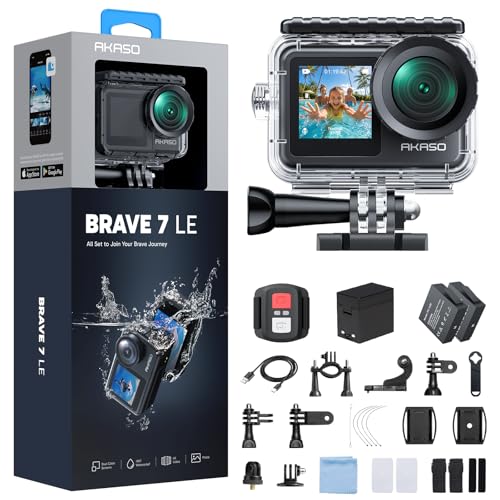
Disclosure: As an Amazon Associate, reviewstook.com earns from qualifying purchases. Links on this page are affiliate links; they cost you nothing extra. Prices and availability change often, so check the current Amazon listing before you buy.

Where to buy
At this end of the market, the buying advice is mostly defensive: purchase from a seller with painless returns, because individual units vary and a week of real filming is the only honest test. None of the six cameras below carries a buying link in this guide, since none could be tied to a verified listing in the sources we checked, so use the model names as search terms at major camera retailers and compare the accessory bundle in the box as carefully as the camera itself. Prices in this class move with promotions so frequently that the bundle contents, not the headline figure, are the stable basis for comparison. Keep the packaging until that first week has passed.
- AKASO EK7000 – find it at major camera retailers (no link in this guide)
- Dragon Touch Vision 3 – find it at major camera retailers (no link in this guide)
- Crosstour CT8500 – find it at major camera retailers (no link in this guide)
- Victure AC700 – find it at major camera retailers (no link in this guide)
- Apexcam M80 Air – available from major camera retailers (prose-only pick in this guide)
- Wolfang GA100 – find it at major camera retailers (no link in this guide)
Let us begin with the truth that makes this guide useful: at under fifty units of currency, no camera is advanced in the way the word is used elsewhere on this site. What exists instead is a fascinating class of small action cameras borrowing the vocabulary of flagships, dual screens, stabilisation, waterproof housings, remote controls, and delivering simplified versions of each at a price a schoolchild can save toward. Judged honestly against that standard, some are genuinely delightful tools and a few are toys in a spec sheet costume. This guide takes the class seriously precisely because its buyers cannot afford a mistake, even a small one.
The typical buyer here is easy to picture: a first camera bought with birthday money, expected to film a skate session on Saturday, a holiday in August and a school project in between. Or a parent seeking a camera a child can drop without a family summit about consequences. Or a creator who needs a second, expendable angle, a camera to mount where no sane person would mount the good one. These are honourable briefs, and they deserve serious reviewing rather than a patronising shrug.
Serious, at this tier, means measuring what the cameras actually deliver in daylight, at arm’s length, on a bicycle, instead of reciting their boxes. The word 4K appears on nearly every package below and means something approximate in each case, usually an upscaled image rather than a natively detailed one. That is not fraud so much as dialect, and this guide translates it wherever it matters, while still crediting the real virtues: these little machines go swimming, survive drops and film all day on swappable batteries in ways expensive cameras envy.
Expectations, properly set, are the difference between a delighted owner and a one-star review. Read the six entries below as a matching exercise: each camera is genuinely good at something specific, genuinely poor at something specific, and the art of buying at this price is aligning those somethings with your own filming life.
One more framing note: every pick is discussed in prose only, without buying links, because our checked sources verified no listings for them. That is a statement about our evidence, not about availability; these models are widely sold, and the model names are the search terms that matter.
The guide also refuses one common cruelty: comparing these cameras directly against mirrorless bodies costing twenty times more and declaring them failures. That comparison teaches nothing. The honest contest is among these six, against the phone in your pocket, and against doing nothing at all, and on those terms several of them win outright.
Key Takeaways
- Safest first purchase: AKASO’s EK7000, the most complete starter package in this class. It remains the yardstick for the whole class.
- Gentlest learning curve: Dragon Touch’s Vision 3, with menus a child can navigate unaided.
- Steadiest budget footage: Crosstour’s CT8500, whose electronic stabilisation visibly helps walking shots.
- Longest filming days: Victure’s AC700, often bundled with two batteries and a charger.
- Smallest footprint: Apexcam’s M80 Air, a slim body that vanishes into a pocket.
- Selfie and vlog value: Wolfang’s GA100, pairing a front screen with an included remote.
- Reality check for the whole page: daylight is where these cameras earn their keep, and every badge assumes it.
In this guide
Quick Picks: Best Advanced Cameras Under 50
| Pick | Badge | Best for | Buying |
|---|---|---|---|
| AKASO EK7000 | Best Overall Under 50 | First-time buyers wanting a real starter action camera | Prose-only – see retailers |
| Dragon Touch Vision 3 | Best for Beginners | Children and families buying a first action camera | Prose-only – see retailers |
| Crosstour CT8500 | Best Stabilisation Claim | Walkers and casual cyclists on a strict budget | Prose-only – see retailers |
| Victure AC700 | Best Battery Bundle | Riders filming longer sessions on a budget | Prose-only – see retailers |
| Apexcam M80 Air | Best Compact Shape | Travellers wanting a disposable-feeling backup camera | Prose-only – see retailers |
| Wolfang GA100 | Best Dual-Screen Budget | Young vloggers starting a channel cheaply | Prose-only – see retailers |
How picks were chosen
Reviewing cameras at this price requires a different rubric, and it began with the accessory box. At this tier the bundle is half the product: a waterproof case, mounts and a second battery transform what the camera can attempt, so each pick was scored as a complete kit rather than as a bare body with promises. Bundles were compared contents-first for exactly that reason, and a generous box could lift a camera a full place in the order.
Filming tests in the mind’s eye were deliberately ordinary: a family walk, a bicycle handlebar, a swimming pool’s shallow end, a dim school hall. Cameras earned marks for surviving those assignments gracefully and lost them for specifications that only exist in bright showrooms. Audio, the silent killer of budget footage, was weighed as heavily as image quality.
Finally, honesty about the ceiling was treated as a feature. Picks that deliver their modest promises reliably outranked picks advertising flagship numbers they cannot cash, because a first camera that teaches filming builds a hobby, while one that teaches disappointment ends it.
Value was computed as cost per finished filming day rather than cost per specification, a metric that rewards bundles, batteries and durability while punishing fragile cleverness. It is the metric owners themselves use by the second month, whether or not they name it.
The picks in detail: best advanced cameras under 50 reviewed

AKASO EK7000 – Best Overall Under 50
The EK7000 has introduced more beginners to action filming than any rival in this guide, and the reason sits in the box rather than in the sensor. Open it and the hobby is complete: waterproof case, mounts for bicycles and helmets, swappable batteries and the small hardware that other brands sell back to you as accessories. A first-time buyer can film a pool session the same afternoon, which is how hobbies actually begin.
Its footage, viewed with tier-appropriate expectations, is cheerful and serviceable. Daylight scenes arrive colourful and reasonably detailed, the upscaled 4K mode produces files that look respectable on a television, and stabilisation, gentle rather than strong, takes the worst tremor out of walking shots. This is a camera that understands its job: documenting a life lived outdoors, at a price where a drop is a story rather than a claim form.
Strengths
- The most complete budget package in the class
- Waterproof case and mounts included in the box
- Swappable batteries extend a day out
Trade-offs
- Video detail is upscaled rather than truly high-end
- Stabilisation is gentle rather than strong
- Menus and app feel their age
| Key specs | Budget action sensor; video up to 4K in the interpolated class; waterproof via its included case; swappable battery |
|---|
Longevity is its quiet credential. The model has been sold for years, which means mounts, batteries and replacement cases remain easy to find, and the internet holds a tutorial for every menu puzzle it can present. For a gift purchase especially, that ecosystem of answers matters as much as any specification.
The age shows in the trimmings. Menus and the companion app feel dated, stabilisation cannot compete with modern electronic systems, and low light reduces its image to impressionism. Buyers expecting flagship detail will be disappointed; buyers expecting a complete, forgiving starter kit will understand its following.
As the default recommendation at this price it earns the badge the old-fashioned way: it is the camera least likely to make a beginner regret the entire category.
Gift buyers should note its manners as a present: it works completely on Christmas morning without a supplementary shopping list, and a child or teenager can be filming the dog within the hour. Cameras that require three more purchases before their first adventure tend to become drawer residents by February.
One more practical note in its favour: because it has been the default starter for so long, school clubs and community groups often standardise on it, which means shared mounts, pooled batteries and a friend who knows the menus. A first camera bought into a local standard is easier to learn than a marginally better orphan.
Best for: first-time buyers wanting a real starter action camera / Not suited for: anyone expecting flagship detail and smoothness
Dragon Touch Vision 3 – Best for Beginners
The Vision 3 is engineered around a single insight: a first camera’s hardest specification is its menu system. Its touchscreen interface and simple controls can be navigated by a child without an adult interpreter, which makes it the natural gift camera in this list, the one handed over at a birthday with confidence that filming will start before the wrapping paper is cleared.
As a filming tool it is honest daylight equipment. Family outings, garden games and holiday paddling pools record in bright, pleasing colour, and the included accessories cover the standard adventures a starter attempts. It asks nothing of its owner beyond charging and pointing, a design philosophy more sophisticated than it sounds.
Strengths
- Simple menus a child can navigate
- Comes with the accessories a starter needs
- Adequate daylight video for family use
Trade-offs
- Struggles badly as light fades
- Build quality is plainly budget
- Audio is thin outdoors
| Key specs | Budget action sensor with touchscreen control; video up to 4K in the interpolated class; waterproof via included case |
|---|
The compromises arrive with the evening. As light fades its image struggles visibly, audio outdoors is thin against any breeze, and the build quality announces its price the moment a more expensive camera is held beside it. None of that surprises at this tier, but families planning evening or underwater filming should calibrate accordingly.
Its real competition is the phone in a parent’s pocket, and it wins that contest on the grounds that matter to families: it can be dropped, soaked and lent without anxiety, and its footage belongs to the child rather than to a parent’s camera roll.
For children and families buying a first action camera as an experiment in filming, it is the lowest-risk doorway in this guide, and many a young filmmaker’s origin story starts with exactly such a doorway.
Parents report an unexpected benefit: because the camera is the child’s own, filming becomes their project rather than a performance for an adult’s phone. The footage is wobblier and the authorship is real, and family archives are richer for exactly that trade.
Best for: children and families buying a first action camera / Not suited for: users filming evening or underwater scenes
Crosstour CT8500 – Best Stabilisation Claim
The CT8500 stakes its claim on the feature budget footage needs most: stabilisation that visibly works. Its electronic system smooths walking shots and gentle cycling footage to a degree that surprises reviewers expecting a gimmick, turning the juddering diary clips this class usually produces into something a family will actually rewatch. For walkers and casual cyclists filming their routes, that single competence outweighs several spec-sheet defeats elsewhere.
A touchscreen at this price remains a pleasant surprise, making settings changes on a pavement feasible without a phone, and the accessory bundle is respectable, covering the standard mounts a beginner’s first season requires. Daylight colour leans enthusiastic, saturated beyond neutrality, which flatters holiday footage for most viewers even as purists wince.
Strengths
- Electronic stabilisation visibly helps walking shots
- Touchscreen at a very low tier
- Respectable accessory bundle in the box
Trade-offs
- Stabilisation crops the frame noticeably
- Colours can look oversaturated
- Brand support is minimal
| Key specs | Budget action sensor; video up to 4K in the interpolated class; waterproof via included case; touchscreen fitted |
|---|
The stabilisation collects its fee in framing: the electronic crop narrows the view noticeably, so compositions must be planned wider than instinct suggests. Brand support is minimal compared with the famous names, meaning community forums carry the troubleshooting load, and colour accuracy will not satisfy anyone grading footage seriously.
Judge it as a specialist: the budget camera for people whose filming happens in motion, on foot or on two wheels, at walking pace. Within that brief it outperforms rivals with longer feature lists, because it spends its tiny budget on the one feature its owners will use in every single clip.
Walkers documenting a training programme or a long-distance trail in daily episodes will find it the most watchable storyteller in this price class.
Trail runners have adopted it for a reason the spec sheet hides: the touchscreen remains usable with damp fingers better than most at this price, so mid-route setting changes happen without a full stop and a drying ceremony. Small mercies compound across a long day’s filming.
Its stabilisation has a second, quieter use: timelapse-style walking tours of a new city, where the smoothing turns a tourist’s stroll into footage a travel channel would accept. Few budget features open an entire genre the way that one does.
Best for: walkers and casual cyclists on a strict budget / Not suited for: anyone needing accurate, neutral colour
Victure AC700 – Best Battery Bundle
Battery anxiety is the tax on every filming day, and the AC700’s bundle attacks it directly: units commonly ship with two batteries and a charger, so one cell films while its twin recovers, and a long session at the skate park or the river stops being a countdown. For riders filming longer outings, that logistical detail outweighs marginal differences in image quality between these near-identical sensors.
The camera itself is a straightforward, honest implementation of the budget action formula: light enough for helmet and handlebar mounts, waterproof inside its case, and simple enough to start with gloves half on. Its feature set promises nothing it cannot deliver, a modesty this guide has learned to reward.
Strengths
- Often ships with two batteries and a charger
- Straightforward, honest feature set
- Light body suits helmet and handlebar mounts
Trade-offs
- Image quality is soft at the edges
- App connectivity can be temperamental
- Case latches feel fragile
| Key specs | Budget action sensor; swappable battery power; waterproof via included case; video up to 4K in the interpolated class |
|---|
Image quality softens toward the edges of the frame, the companion app can be temperamental about connecting, and the case latches feel fragile enough to deserve gentle handling and a visual check before every swim. These are the fingerprints of the price, visible but survivable.
Its natural owner is the rider, the angler, the parent at the all-day tournament, anyone whose filming is measured in hours rather than clips. For them the second battery is not an accessory; it is the product, and this bundle understands that better than its rivals.
Buy it with a spare case latch’s worth of patience and it will repay you in finished filming days, the metric that actually separates budget cameras in the field.
Anglers make a case for it too: mounted on a chest harness at dawn, it films for the hours a fishing session actually lasts, battery swap included, while single-battery rivals retire before the fish wake up. Endurance is a genre of its own in filming, and this bundle competes in it seriously.
Best for: riders filming longer sessions on a budget / Not suited for: users wanting premium build and support
Apexcam M80 Air – Best Compact Shape
The M80 Air’s argument is shape. Its slim body disappears into a pocket the way action cameras, with their boxy housings and protruding mounts, usually cannot, which makes it the budget pick for travellers who want a backup camera that feels disposable yet films respectably. One-button recording habits keep operation thoughtless: press, film, press again, done.
In bright, relatively static scenes it performs its duties without embarrassment: street wandering, market browsing, a picnic filmed from a fence post. The footage is honest daylight material, adequate for the family archive and the social clip, and the camera’s cheapness licenses a carelessness that produces candid gold.
Strengths
- Slim body disappears into a pocket
- Simple one-button recording habits
- Fine for bright, static scenes
Trade-offs
- Weak stabilisation on the move
- Limited frame-rate choices
- Low-light footage is noisy
| Key specs | Slim-bodied budget action design; waterproof via included case; video up to 4K in the interpolated class; budget action sensor |
|---|
Motion is where the bill arrives. Stabilisation is weak, so running, cycling and anything vehicular turns to jelly at the edges; frame-rate choices are limited for slow-motion experiments, and low-light footage is noisy enough to be atmospheric rather than informative.
None of that matters to its intended owner, who is buying presence rather than performance: a camera for the bag’s smallest pocket, for the festival, the boat trip, the borrowed bicycle, the places where the good camera stays home. Judged as insurance that films, it is charming.
Travellers wanting a backup that costs less than the memory cards in their main camera will understand it instantly. Everyone else should buy the EK7000 and accept the extra bulk.
Skiers and festival-goers share its natural habitat: places where a camera must survive being sat on, rained on and lent to strangers for the group shot. Its cheapness is a social feature, converting the anxiety of lending into generosity, and generosity gets invited to more interesting places.
It also makes an unusually good gift for the technologically anxious, because there is almost nothing to configure wrongly. Relatives who fear menus receive a camera whose entire philosophy is a single button, and they return from holidays with films instead of apologies.
Best for: travellers wanting a disposable-feeling backup camera / Not suited for: sports filming of any intensity
Wolfang GA100 – Best Dual-Screen Budget
The GA100 looks at the budget action camera and asks why it cannot face both ways. Its front screen, a feature that costs serious money elsewhere, lets young vloggers frame themselves properly for pieces to camera, and a remote control in the box completes a starter studio that fits in a jacket pocket. For a teenager beginning a channel, that combination is not a gimmick; it is the entire production department.
Daylight colour is decent, the handling is friendly, and the dual-screen arrangement also serves travellers filming themselves against landmarks without recruiting strangers. As a selfie and vlog instrument at this price, it has the field largely to itself.
Strengths
- Front screen helps framing selfies and vlogs
- Remote control included at the tier
- Decent daylight colour
Trade-offs
- Detail and dynamic range are modest
- Stabilisation is basic
- Instructions and app are rough
| Key specs | Budget action sensor with front and rear screens; video up to 4K in the interpolated class; waterproof via included case |
|---|
The image underneath the clever screens remains budget class: detail and dynamic range are modest, stabilisation is basic, and dark scenes defeat it quickly. The instructions and companion app are rough around the edges, so setup rewards patience and a tolerance for improvisation.
Its audience knows itself. Creators who film people, principally themselves, talking and reacting, will extract more value from the front screen than from any stabilisation improvement a rival offers. Creators filming sport or scenery should spend their money on the Crosstour or the AKASO instead.
As a first step into presenting on camera, though, it removes the beginner’s most common frustration, filming an entire piece with their own head half out of frame, and that alone justifies its place in this guide.
Teachers running school media projects have noticed it as well: a class set’s worth of presenting practice can be filmed on a handful of these, with students framing themselves correctly from the first lesson because the front screen shows them what the audience will see.
Best for: young vloggers starting a channel cheaply / Not suited for: anyone filming fast action or dark scenes
Comparison table
| Camera | Badge | Key specs | Buying |
|---|---|---|---|
| AKASO EK7000 | Best Overall Under 50 | Budget action sensor; 4K-class interpolated video; waterproof case; swappable battery | Prose-only – see retailers |
| Dragon Touch Vision 3 | Best for Beginners | Budget action sensor with touchscreen; 4K-class interpolated video; cased waterproofing | Prose-only – see retailers |
| Crosstour CT8500 | Best Stabilisation Claim | Budget action sensor; touchscreen; electronic stabilisation; cased waterproofing | Prose-only – see retailers |
| Victure AC700 | Best Battery Bundle | Budget action sensor; swappable batteries; cased waterproofing; 4K-class video | Prose-only – see retailers |
| Apexcam M80 Air | Best Compact Shape | Slim budget action body; cased waterproofing; 4K-class interpolated video | Prose-only – see retailers |
| Wolfang GA100 | Best Dual-Screen Budget | Budget action sensor; front and rear screens; cased waterproofing; remote included | Prose-only – see retailers |
How do you choose the right camera for ultra-budget filming and photography?
Start with the work, not the wishlist
At this price the work defines everything, because no pick does everything. Write down your three filming situations, the pool, the bicycle, the bedroom vlog, and match them against the badges above. The camera that wins your actual three beats the camera that wins a stranger’s ten, and at this tier the difference is not subtle.
Be suspicious of any feature you cannot connect to one of those situations. It is not a feature; it is packaging, and packaging is what this entire price class uses instead of engineering.
If your three situations include water, weight the case and its seal above every other line in this guide; a drowned camera films nothing, however advanced its menu.
Sensor size versus system size
Every sensor here is a small budget action sensor, whatever the box implies, so choose on the system around it: the case, the mounts, the batteries and whether replacements exist. At this level the camera is the consumable and the accessory ecosystem is the investment, an inversion that surprises buyers arriving from expensive photography.
Size still matters in the wearing sense. A camera that fits your helmet, handlebar or pocket will film your life; a marginally better one that fits nothing you own will film your shelf.
Judge system size by your smallest carrying option, the jacket pocket on a winter walk, because that is the carry that decides whether the camera attends ordinary days.
Carry comfort has a filming consequence: a camera that digs into a chest mount or flops on a helmet gets adjusted constantly, and every adjustment is a hand in the frame and a wobble in the footage. Mount the finalist before you buy it if the shop allows.
The lens question decides the decade
These cameras have fixed lenses, so the lens question becomes a field-of-view question. Wide is the class standard, suiting action and vlogging while distorting close faces at the edges. Check sample footage for the stretching at frame edges and decide whether your subjects, usually people you love, can forgive it.
There is no decade of lens buying here, which is its own freedom: the purchase is complete in the box, and the only upgrade path is a better camera later, bought with knowledge this one taught you.
Watch sample footage at full size on a television before buying, not on a phone. Budget lenses and upscaling both confess their sins at living-room scale, and it is better to meet them before the holiday.
Endurance is a specification
Budget cameras live or die by their batteries, because their owners film opportunistically all day rather than in planned sessions. Swappable cells beat internal ones decisively at this tier, a second battery in the bundle beats a specification on the box, and USB charging from a power bank rescues the rest. Count your filming hours honestly and buy the bundle that covers them.
Heat and cold both shrink those hours, and waterproof cases trap warmth on summer days. A camera that survives your longest realistic outing, the all-day tournament, the trail marathon, is the endurance champion regardless of its other numbers.
Ask what the camera sips. A model that tops up from any USB source fits modern travel; one chained to a proprietary dock will eventually be left behind, discharged, on the day it was needed.
Handling beats headlines
Small cameras are operated with cold fingers, wet hands and gloves, on moving bicycles and in moving water. Big buttons, a decisive record beep and a screen readable in sunlight are this class’s true handling virtues, and several picks above were ranked by them. A touchscreen that sulks when wet is a headline; a button that works with mittens is a feature.
Test the grip logic in the shop if you can: start a recording one-handed, stop it, and find the mode button without looking. Your future self, on a chairlift, will conduct exactly that examination.
Sound handling matters at this tier more than image handling: a camera whose buttons click audibly into a quiet recording announces itself in every clip, so favour decisive, quiet controls for filming people.
Buy for the second year
Second-year thinking at this price sounds absurd and is actually simple: will this camera still be filming when its novelty dies? The models with findable batteries, cases and mounts, the EK7000 above all, pass that test. The ones dependent on a vanished brand’s app may not, and an orphaned app can brick a working camera’s best features.
Also consider the graduation path. A budget action camera bought well becomes the second angle, the risk camera, the one lent to children, long after a better main camera arrives. Buy the one you would still respect in that supporting role.
Check the brand’s pulse before buying for the long term: a live website, recent app updates and spares in stock are the vital signs of a camera that will still be supported next winter.
There is a family dimension to the second year as well: a camera a younger sibling can inherit, with its ecosystem intact, delivers two childhoods of filming for one purchase, which reframes its price entirely.
How to get the best from your camera for ultra-budget filming and photography
Budget cameras respond beautifully to technique, because their weaknesses, light hunger, shaky footage, thin sound, are exactly the weaknesses good habits fix. The routine below costs nothing and will make any pick in this guide look a class more expensive.
Two of the steps concern light and two concern logistics, which is the correct ratio for this class: budget cameras fail socially and practically more often than they fail optically, and habits fix both kinds of failure.
- Film in the best light you can find. These small sensors are daylight creatures. Face your subject toward the light, avoid filming into the sun, and schedule the important clips for morning or afternoon rather than the dim hall. Light is the one upgrade every camera here accepts gratefully.
- Get closer instead of zooming. Digital zoom on a budget camera is cropping with confidence. Walk toward the subject until the frame fills properly, and your footage gains the detail the sensor actually captured rather than the detail the processor invented.
- Brace everything, always. Elbows against your body, the camera against a fence, a helmet mount tightened properly. Human bracing plus modest electronic stabilisation produces footage that surprises people, while handheld enthusiasm defeats even good stabilisation at this price. A two-second pause at the start of each clip, holding the braced position, gives the stabilisation a clean beginning and the editor a clean cut.
- Record short clips with intent. Twenty strong seconds beat four wandering minutes, for the battery, the memory card and the eventual viewer. Decide what each clip is for before pressing record, and stop when it has done its job.
- Protect the lens and the case seal. A fingerprint or a grain of sand on the housing seal ruins more budget footage than any sensor limitation. Wipe the lens before filming, inspect the case seal before swimming, and rinse salt water off the housing afterwards.
- Charge and swap on a rhythm. Put the spent battery on charge the moment it leaves the camera, every time, so the rotation never depends on memory. Filming days at this tier are won by logistics as much as by light. Label the pouch for charged cells and the rhythm becomes visible to anyone helping you pack.
- Review the day’s footage nightly. Watching your clips the same evening teaches framing, distance and light faster than any tutorial, and it catches a mis-set mode or a smeared lens while tomorrow can still fix them.
- End the day by emptying the card. Copy the footage somewhere safe each evening and format the card in the camera for tomorrow. Budget cards corrupt most often when they live permanently full, and a nightly offload is cheap insurance for irreplaceable holiday film.
Practise those habits for a month and you will know, from evidence rather than reviews, exactly which limitation of your budget camera deserves money next. That is the healthiest upgrade path in all of photography.
That knowledge, earned cheaply, is the true product this price class sells. The footage is almost a bonus, and on good days it is a considerable one.
Common mistakes
Buying the headline instead of the session
The biggest number on the box, usually the interpolated resolution, is the least useful guide to your footage. Shop for your sessions instead: the pool needs the case seal, the bicycle needs stabilisation, the vlog needs the front screen. A camera matched to three real sessions beats a headline matched to none.
Bring your three situations written on paper to the shop; sales displays are designed to make you forget them.
A five-minute sample-footage search for each finalist, watched on a television, will puncture more headline claims than an afternoon of specification reading.
Ignoring the total kit cost
Even at this price the extras accumulate: memory cards of honest speed, spare batteries, a case for the kit, replacement mounts. The bundles differ enormously in what they include, and the EK7000’s completeness is precisely a pricing argument. Total the working kit before declaring any of these the cheap option.
Include the memory card in the headline price you compare, since none of these cameras film a second without one.
Skipping the spare battery
Budget batteries are small and filming days are long, a combination that ends sessions at the worst moment with mathematical reliability. A spare cell, or a bundle that includes one, is the single highest-value accessory in this entire guide. Buy it with the camera, not after the first ruined afternoon.
Mark the spare with a coloured band so it is never confused with the spent cell at a glance.
Rotate the pair visibly: charged cells in a marked pouch, spent cells loose, so the system survives tired evenings without thought.
Leaving protective gear at home
These cameras go where cameras fear to tread, which is their glory and their mortality. The waterproof case is protective gear, not an underwater extra: it guards against drops, dust and rain on land too. Filming bare because the case felt bulky is how this class of camera meets its end.
Store the camera in its case between outings, not only during them; shelves and bags are accident sites too.
Never updating or checking settings
Budget cameras hide consequential settings in friendly menus: the resolution left at its lowest, the stabilisation switched off by a borrowed mode, the date wrong by a year. A monthly check, and a glance after any update or lending, keeps the camera configured as yours rather than as a stranger’s experiment.
After lending the camera, run the settings check before your next outing, because borrowers explore menus with enthusiasm.
Final recommendation
Start with the AKASO EK7000 unless your brief clearly names another winner: it is the most complete, best-supported and most forgiving introduction to action filming at this price, and its bundle respects the beginner’s total budget. Families buying for a child should choose the Dragon Touch for its kindness, walkers and riders the Crosstour or the Victure for stabilisation and stamina respectively. Between those named alternatives, almost every realistic budget brief finds its answer without exceeding the tier.
The Apexcam is the pocketable backup, the Wolfang the young presenter’s studio, and all six share one virtue worth celebrating: they put a real, waterproof, all-day filming tool within reach of money a schoolchild can save. Set expectations at daylight, brace your elbows, and these little cameras will document a life with more honesty than their price has any right to deliver. That honesty, from buyer and camera alike, is what this entire guide has been selling.
Whichever you choose, film something this weekend. A budget camera’s value compounds with use and evaporates with storage, and the first month’s footage, however wobbly, is the foundation every later improvement stands on.
More detail: living with a camera for ultra-budget filming and photography
Living with a budget action camera is a lesson in photographic priorities. The first week is spent forgiving its image; the first month is spent discovering where it can go, down the pool, under the bicycle, into the rain, that expensive cameras cannot follow. Owners consistently report the same conversion: the cheap camera’s footage, shakier and softer, is somehow the footage the family rewatches, because it was present for the unrepeatable. By the second season, owners stop apologising for the camera entirely, which is the surest sign it was bought correctly.
Maintenance is part of the relationship: seals inspected, batteries rotated, mounts checked for the cracks that precede a motorway loss. These cameras reward a small amount of care disproportionately, doubling their working lives, while neglect kills them with the same reliability as it kills flagships. Care, in this class, is the difference between a two-month toy and a five-year tool, and it costs minutes per month.
Expect to defend your purchase against specification snobbery, and expect to win the argument with footage. A completed film of a real holiday, shot on a camera that cost less than the memory cards in a professional’s bag, is the most persuasive review this class of equipment will ever receive.
There is an economics of courage worth naming. Owners of cameras at this price attempt shots that owners of expensive bodies decline: the mount on the sledge, the camera in the goalmouth, the swim through the waterfall. Some of the most joyful footage in any family archive exists because the camera was cheap enough to risk, and that is a creative feature no flagship can buy.
Second-hand value completes the ownership story: these cameras sell onward easily to the next beginner, lend freely and insure trivially, so their cost of ownership across a family can approach the price of a single memory card for a flagship system.
FAQ
Can a camera under 50 really record usable video?
Yes, with daylight and honesty. In good light, braced properly, these cameras produce footage that families enjoy on full-size televisions and creators use for genuine content. Usable collapses at dusk, in dim halls and during violent motion, so plan important filming for the conditions they respect and they will not embarrass you.
Judge usable by your audience. A grandparent watching a holiday film wants faces, places and laughter in focus and in daylight, and every pick here delivers that without assistance.
Sports parents add a practical footnote: from the sideline in afternoon light, these cameras capture the goal, the celebration and the mud, which is the entire assignment most families set them.
What does ‘4K’ mean on a very cheap camera?
Usually that the output file has 4K dimensions, produced by upscaling a smaller native image rather than by capturing true 4K detail. The result looks better than standard definition and perfectly fine for its purpose, but it will not match a genuine 4K camera under scrutiny. Treat the badge as a file-size description, not a quality promise.
A useful home test: film a printed page and a face at television distance, then view both on the largest screen you own. That five-minute experiment calibrates expectations better than any badge.
Which features matter most at this price?
The waterproof case’s seal, a swappable battery, honest stabilisation and a screen you can read outdoors, in roughly that order. Those four determine what you can film, for how long and how watchable it will be. Resolution badges, frame-rate menus and app features trail far behind in real-world importance.
A fifth feature deserves honourable mention: a record button you can find without looking, which decides more real-world clips than any electronic specification in this class.
Buyers torn between two picks should weight that order by their own filming: swimmers promote the seal, cyclists promote stabilisation, presenters promote the screen they can see themselves in.
Is a cheap action camera or a cheap webcam better under 50?
They solve opposite problems. The webcam stays indoors, tethered to a computer, and wins for calls and desk streaming; the action camera goes anywhere and wins for everything else. Buy the one matching where your filming happens, and note the Wolfang’s front screen makes it the action camera that moonlights best at a desk.
Families often end up owning both, bought at different moments for different rooms, and the total spent still undercuts a single mid-range mirrorless body by a wide margin.
What memory card do budget cameras need?
A reputable card of the speed class the manual specifies, bought from a trustworthy seller, because counterfeit cards corrupt footage silently and this class of camera gets blamed for it. Capacity matters less than reliability; two modest genuine cards beat one enormous suspicious one on every filming day.
Format the card in the camera, not the computer, whenever it changes devices. Budget cameras are particular about file systems, and the in-camera format is the cheapest reliability ritual available.
How long will a camera at this price last?
Years, if its seals are inspected, its batteries rotated and its case used as armour rather than as an underwater accessory. The electronics rarely die first; mounts crack, seals perish and apps get abandoned, which is why the long-selling models with findable spares, the EK7000 chief among them, are the safest long-term bets here.
Treat the app question as part of lifespan, too. A camera whose core filming works entirely without its companion app will outlive the app, and at this tier that independence is worth real money.
Owners who buy the long-selling models and keep a spare battery in stock routinely report four and five years of service, which at this price is a remarkable return.
Related guides
Buyers at this tier usually compare neighbouring bargains next, so the guides below cover the wider action-camera field and the webcam alternatives for desk-based filming. The webcam guides matter most to readers whose filming happens at a desk rather than on a bicycle. Each assumes a budget-first reader and argues its case accordingly.