Disclosure: As an Amazon Associate, reviewstook.com earns from qualifying purchases. Links on this page are affiliate links; they cost you nothing extra. Prices and availability change often, so check the current Amazon listing before you buy.
This philips fidelio x2hr headphone review exists because the X2HR occupies a special place in the headphone world: it is the open-back model that listeners most often recommend to each other as a first serious pair, and one of the few headphones that has stayed relevant across many product cycles without changing its formula. The short verdict is that the reputation is earned — with conditions. The Fidelio X2HR offers a warm, spacious, comfortable listening experience that flatters almost every genre, it is easy to drive from ordinary devices, and its detachable cable and solid build suit it to years of home use. The conditions are the ones that apply to every open-back headphone: it leaks sound freely, it lets the room in, and it is a stay-at-home product through and through. If your listening happens in a private room, the X2HR is easy to recommend. If it does not, no review score should talk you into it.
A note on how this review is written. The X2HR’s product identity and headline specifications have been verified against Amazon’s own catalogue data, and the main product link in this article points to that verified listing. The sound description reflects the model’s well-documented character — its tuning has been measured and discussed extensively across the headphone community for years, and it has remained consistent, which is precisely why the model endures. We do not claim fresh laboratory measurements or hands-on testing we have not performed; instead we explain, carefully and in detail, what this headphone’s established character means for different listeners, who it suits, who it does not, and how it compares with the three alternatives buyers most often cross-shop it against. Every alternative linked here has likewise been checked against catalogue data.
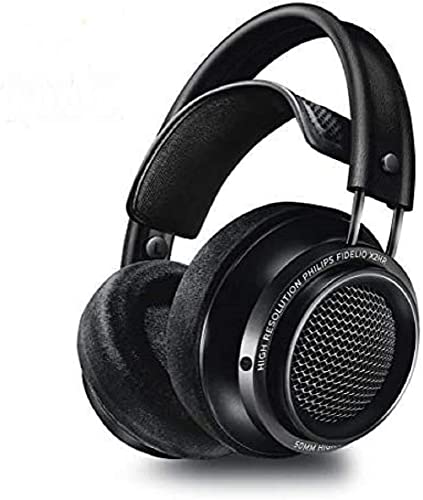
Philips Fidelio X2hr Headphone Review: The Quick Verdict
Key takeaways
- Warm, spacious open-back sound with generous bass for the category — an easy listen across most genres.
- Very comfortable for long sessions, with a suspension-style fit and plush pads.
- Easy to drive: low impedance means phones, laptops, and controllers give you full volume without a dedicated amplifier.
- Detachable cable and a sturdy build make it a practical long-term home headphone.
- Fully open design: it leaks sound and admits room noise, so it is for private rooms only.
- Wired only — no Bluetooth, no noise cancelling, no microphone built in.
Where to buy: the Fidelio X2HR is sold through major audio retailers and Amazon. This article’s product links point to the catalogue-verified listing; check the current listing for the exact configuration and availability before you buy, and buy from a seller with a fair returns policy if you are unsure about fit or open-back life — your room, not the specification sheet, decides whether this headphone works for you.
Our pick for spacious home listening — Philips Fidelio X2HR

In this guide
Philips Fidelio X2HR
- Type: Open-back, over-ear, wired
- Driver: 50mm, per the manufacturer’s catalogue listing
- Impedance: Low (30 ohms class) — easy to drive from phones and laptops
- Cable: Detachable, with an adapter included in the box for larger jacks
- Fit: Suspension headband with large, plush ear pads
- Use case: Home listening — music, films, and single-player gaming
The X2HR’s design makes its intentions clear before you hear a note. The ear cups are large and openly vented behind mesh grilles, the pads are deep and soft, and a hammock-style inner band distributes the weight of what is, by the numbers, a fairly substantial headphone. Nothing about it folds, collapses, or pretends to be portable. It is furniture for your ears — a headphone designed to live beside a favourite chair, a desk, or a hi-fi stack, and to be picked up daily for years. That honesty of purpose is part of its charm, and it frames every judgement in this review: the X2HR should be assessed as a home listening instrument, not as a competitor to travel headphones.
Strengths
- Broad, relaxed soundstage with warm, generous bass for an open-back
- Comfort that holds up across long films and listening sessions
- Runs happily from almost any source thanks to its low impedance
Trade-offs
- Open-back leakage rules out shared rooms, offices, and travel
- Detail and treble precision are good, not class-leading — ease is the priority
- Large and non-folding; it stays at home
Best for: home listeners who want spacious, forgiving sound for music, films, and relaxed gaming. Not suited for: commuters, office workers, recording work, or anyone who needs privacy or isolation.
Design, Build, and Comfort
Build quality is one of the X2HR’s quiet triumphs. The frame mixes metal and sturdy plastics in a way that feels a class above typical consumer headphones, with an outer headband wrapped in a leather-effect material and the self-adjusting inner hammock beneath it. There are no fragile folding hinges to loosen, because there are no hinges at all — the cups adjust by sliding, and the whole structure feels assembled for permanence. Owners commonly report years of daily service from a pair, and the parts most likely to wear — the cable and, eventually, the pads — are the parts you can replace. The cable deserves specific praise: it is detachable at the ear cup with a standard connection, so a damaged cable is a small purchase rather than a funeral, and a shorter or longer aftermarket cable is an easy swap for different listening spots.
Comfort is the other half of the design story, and for many owners it is the deciding half. The suspension band spreads the load across the top of the head with no hard contact points, the clamp is gentle rather than vice-like, and the pads are deep enough that most ears sit inside without touching the driver covers. The X2HR is not a light headphone, yet it rarely feels heavy in use, because weight distribution matters more than the scale number — a lesson this model teaches well. Glasses wearers generally get on with it: the pads are soft enough to seal around most frames without painful pressure, though as with all open-backs the “seal” is about comfort rather than isolation. Heat is the main long-session caveat — plush pads and warm rooms are a mediocre combination — and listeners in hot climates often rotate to something lighter for midday listening.
One design consequence deserves plain statement: the open grilles that give the X2HR its sound also expose it to the room. Dust settles where it settles, a splash of rain is a genuine event rather than a shrug, and the headphone offers no protection against a noisy household. Store it on a stand or hook, away from the edge of desks and the curiosity of pets, and it will repay the small courtesy with a long life. Our explainer on how much sound open-backed headphones actually leak quantifies the social side of that openness, situation by situation.
Sound: Bass, Midrange, Treble, and That Famous Soundstage
Bass
Bass is the X2HR’s party trick, because open-back headphones are not supposed to have much — and the Fidelio has plenty. Its low end is fuller and warmer than the lean, analytical open-back stereotype, with enough weight to make electronic music, hip-hop, film scores, and rock genuinely satisfying rather than merely audible. The character of that bass matters as much as the quantity: it is rounded and generous rather than tight and forensic, favouring atmosphere over scalpel precision. Listeners arriving from bass-heavy closed headphones will find the X2HR civilised; listeners arriving from studio-neutral open-backs will find it lush. Both are right, and that positioning — fun without bloat, warmth without mud at sane volumes — is the core of the model’s appeal. Deep sub-bass extension is the honest limit: like most open dynamic designs, the very lowest rumble is present but not physical in the way a sealed headphone or a subwoofer delivers it.
Midrange
Voices and the instruments that live in the midrange — guitars, pianos, strings — come through with a natural, slightly laid-back warmth. Nothing is pushed aggressively forward, which makes the X2HR forgiving of imperfect recordings: older albums, compressed streams, and live recordings that would sound harsh on a brighter headphone remain listenable and often charming. The trade is a degree of immediacy; listeners who want vocals presented with spotlight intensity, or who edit audio and need every flaw exposed, will find the Fidelio’s politeness a limitation rather than a virtue. For recreational listening — which is the job — the midrange tuning is close to ideal: present, warm, and never tiring across a long evening.
Treble
The treble follows the same philosophy: smooth, extended enough to give cymbals and strings their shimmer, and restrained enough to avoid the sharp peaks that make some open-backs fatiguing or sibilant. Detail retrieval is good rather than microscopic — you will hear the texture of recordings clearly, but the X2HR does not perform the “X-ray” trick of hyper-detailed models that some listeners love and others find exhausting. This is a deliberate, coherent tuning choice across the whole frequency range: the X2HR consistently chooses ease over analysis. Whether that is praise or criticism depends entirely on which kind of listener you are, and it is the single most important thing to understand before buying.
Soundstage and imaging
Soundstage is where the X2HR justifies its open design most completely. Music is presented with genuine width and a sense of air around instruments, films gain spatial scale, and games with good audio design place sounds convincingly around you. The presentation is wide rather than surgically precise — imaging is good enough for immersive play and film, while competitive players chasing pinpoint footsteps may prefer a more analytical tool. The overall effect is of listening in a room rather than inside a helmet, and it is the quality owners mention most when explaining why they keep the headphone for years. It is also inseparable from the open design’s costs: the same openness that creates the stage creates the leakage, a trade examined from the physics side in whether bigger drivers actually make headphones better — where the X2HR’s own 50mm driver serves as a case study in why size alone explains so little.
One final sound note concerns consistency, an underrated virtue in long-running models. Because the X2HR’s design and tuning have remained stable across its production life, the extensive body of measurements, impressions, and comparisons published about it over the years describes the headphone you can buy today with unusual reliability. With frequently revised products, a glowing review from three years ago may describe a subtly different item; with the Fidelio, the accumulated record is a single, coherent account, and new buyers can lean on it with more confidence than usual. That stability also explains the confidence of this review’s character descriptions: when a tuning has been documented this thoroughly, for this long, without meaningful drift, describing it plainly is not a risk — it is simply reporting the most thoroughly evidenced sound signature in its class.
Driving the X2HR: Do You Need an Amplifier?
One of the X2HR’s most practical virtues is how undemanding it is electrically. With low impedance and healthy sensitivity, it reaches satisfying volume from a phone, a laptop, a tablet, a game controller, or a console — no dedicated amplifier required to enjoy it properly. This is a meaningful ownership advantage over the classic open-back studio models that genuinely need a strong headphone output to wake up. A good amplifier or DAC-amp can still be a worthwhile later upgrade — owners commonly report a sense of greater control and refinement from quality amplification — but it is an upgrade path, not an entry fee, and anyone who tells you the X2HR is unlistenable without one is selling something. Buy the headphone first, live with it on your existing sources, and let any later electronics purchase be driven by curiosity rather than necessity.
Setup is correspondingly simple, and a few habits get the best from it. Use the included adapter where a larger jack is needed rather than forcing connections; keep the cable untwisted and unstrained at the cup connector; set your source volume sensibly and use the headphone at moderate levels, remembering that the open design gives you no isolation to hide behind — in a loud room you will be tempted to push the volume, and the correct response is to move rooms, not to push harder. If you use EQ, the X2HR responds gracefully to small adjustments: a gentle lift in the presence region adds clarity for listeners who want it, and a small trim to the upper bass tightens the presentation for analytical moods. Small moves, honestly assessed, beat dramatic curves.
Who the X2HR Suits — and Who Should Walk Past
The X2HR suits the home listener whose sessions are long, private, and varied: albums in the evening, films at the weekend, single-player games with rich sound design, and video essays or podcasts where comfort matters as much as clarity. It suits the first-time buyer of a serious headphone who wants one purchase to reveal what the fuss is about, because its character — spacious, warm, forgiving — demonstrates the open-back difference immediately without punishing imperfect recordings. It suits glasses wearers, warm-room listeners who can manage the pads, and anyone whose source is an ordinary phone or laptop.
It does not suit commuters or travellers in any way; office workers in shared spaces; anyone recording with a microphone, whose tracks will pick up the leakage; partners of light sleepers; listeners who prioritise analytical detail above all; or bass listeners whose reference point is sealed, club-weight low end. None of those are flaws in the product — they are the boundaries of its design, stated plainly so that the right buyers find it and the wrong buyers are saved a return. Choosing between headphone families more broadly is covered in headsets versus headphones — which fits your use.
The Alternatives Buyers Actually Cross-Shop
Three models account for most of the comparisons shoppers make with the X2HR. Each is verified against catalogue data, and each wins in a specific direction.
The lighter, brighter open-back alternative — Sennheiser HD 599

Sennheiser HD 599
- Type: Open-back, over-ear, wired
- Fit: Lightweight with plush pads
- Character: Clear, natural, vocal-forward ease
Choose the HD 599 over the Fidelio if your taste runs lighter: it presents voices and acoustic music with a clarity and naturalness that many listeners prefer, its fit is even more forgettable over long sessions, and its whole demeanour is gentler. Choose the X2HR if you want the fuller low end, the grander sense of scale, and the more substantial build. Both leak identically — this is a choice about flavour, not about privacy — and it is one of the happiest dilemmas in the category, because neither answer is wrong.
Strengths
- Natural, clear way with vocals and acoustic recordings
- Feather-light long-session comfort
- Equally easy to live with as a first open-back
Trade-offs
- Bass is polite where the Fidelio is generous
- Build feels less substantial in the hand
- Same open-back leakage and zero isolation
Best for: listeners prioritising vocal clarity and lightness. Not suited for: bass-led listening or shared spaces.
The studio open-back alternative — beyerdynamic DT 990 Pro (250 Ohm)

beyerdynamic DT 990 Pro (250 Ohm)
- Type: Open-back, over-ear, wired studio headphone
- Impedance: 250 Ohm — best from a headphone amp or audio interface, per the manufacturer’s listing
- Pads: Velour
- Cable: 3m coiled
The DT 990 Pro is the analytical counterpoint: brighter, more incisive, and built for studio work, with a treble emphasis that reveals detail the Fidelio smooths over — and that some listeners find fatiguing for exactly the same reason. Its 250 Ohm design expects proper amplification, which makes it a better choice for listeners who already own an interface or amp and a poorer one for phone-first buyers. Its velour pads and proven studio durability are real virtues. Pick it for scrutiny; pick the Fidelio for ease.
Strengths
- Revealing, detail-forward presentation for critical listening
- Proven studio build with comfortable velour pads
- A long-standing reference for mixing-adjacent work
Trade-offs
- Treble emphasis divides listeners; some find it sharp
- 250 Ohm design wants an amp or interface to shine
- Long coiled cable and open design keep it desk-bound
Best for: detail-first listeners with a proper source. Not suited for: phone-only buyers or treble-sensitive listeners.

The closed-back alternative — Audio-Technica ATH-M50x

Audio-Technica ATH-M50x
- Type: Closed-back, over-ear, wired
- Driver: 45mm
- Cables: Detachable, multiple included
- Character: Punchy, focused, immediate
The M50x is the answer when the comparison is not really about flavour but about life circumstances: shared rooms, recording sessions, listening while others sleep. Its sealed design keeps your music yours and the room’s noise out, its tuning is energetic and engaging, and it folds into a bag in a way the Fidelio never will. What you surrender is the X2HR’s spaciousness — the M50x presents music closer and more intensely. Households with both patterns of listening often end up owning one of each, and cross-shopping between them is really a question about your rooms, as the troubleshooting-minded discussion in fixing headphone problems starts with fit and seal also underlines.
Strengths
- Isolation for shared spaces and microphone-safe for recording
- Energetic tuning with strong bass presence
- Portable, folding, with detachable cables
Trade-offs
- Soundstage is intimate next to the Fidelio’s width
- Intensity can fatigue over long sessions
- Less of the airy, relaxed character open-back fans seek
Best for: shared homes, recording, and listeners wanting impact. Not suited for: soundstage-first home listening.

Comparison at a Glance
| Model | Design | Character | Source needs | Choose it if… |
|---|---|---|---|---|
| Philips Fidelio X2HR | Open-back, wired | Warm, spacious, generous bass | Any phone or laptop | You listen privately at home and value ease and scale |
| Sennheiser HD 599 | Open-back, wired | Light, clear, vocal-natural | Any phone or laptop | You prioritise clarity and feather-light comfort |
| beyerdynamic DT 990 Pro (250 Ohm) | Open-back, wired | Bright, detailed, analytical | Amp or audio interface preferred | You want scrutiny and already own a strong source |
| Audio-Technica ATH-M50x | Closed-back, wired | Punchy, focused, energetic | Any phone or laptop | You need privacy, isolation, or recording safety |
Genre by Genre: Where the X2HR Shines and Where It Coasts
Rock and pop. The Fidelio’s home turf. Guitars have body, drums have weight without bloat, and the forgiving treble keeps loud, bright masters enjoyable rather than edgy. Stadium recordings benefit most from the staging; dense modern pop sounds big and unforced.
Electronic and hip-hop. Strong by open-back standards, with the caveat about ultimate sub-bass physicality. The warmth and scale suit synth-heavy production beautifully, and listeners whose reference is a sealed bass specialist should simply understand they are trading impact for space — a trade many make happily and some never accept.
Jazz and acoustic. Lovely. Natural midrange timbre, air around instruments, and an unhurried presentation that suits small-ensemble recordings. The HD 599 alternative argues its case here with lighter clarity, but the Fidelio’s fuller body wins as many listeners as it loses.
Classical and orchestral. The soundstage earns its keep: large-scale works gain genuine breadth, and the smooth treble keeps massed strings civilised over long works. Detail-first listeners may want more micro-texture in quiet passages, but for enjoyment rather than analysis, the X2HR is a satisfying orchestral companion.
Films and dialogue. A quiet strength. Voices are natural and easy to follow, scores have scale, and the comfort carries three-hour films without negotiation. Late-night film fans must simply remember the household rule: the room hears your film too.
Podcasts and spoken word. Effortless, if arguably overqualified — the comfort and vocal warmth make long listening easy, and the open design lets you hear a doorbell or a child. Many owners keep the Fidelio on for exactly this ambient awareness during the day.
What We Would Change: The Honest Wish List
No long-running product is beyond improvement, and listing the X2HR’s genuine shortcomings is part of reviewing it honestly. The pads, for all their comfort, are not the most straightforward to replace compared with the twist-lock or clip systems of some rivals, and Philips could make the renewal path clearer. The stock cable is serviceable rather than luxurious, and many owners eventually replace it — cheap to do, thanks to the standard detachable connection, but a reminder of where the budget went. The headphone’s size and weight, well distributed as they are, still rule it out for smaller heads on long sessions more often than the marketing admits; a test fit matters. There is no folding or travel provision of any kind, which is a defensible design purity that nonetheless ends the conversation for anyone with one bag and many journeys. And the open design’s total lack of isolation, while definitional rather than defective, is worth restating in a wish list because it is the limitation buyers most often discover too late. None of these points overturns the verdict; all of them belong in a buyer’s head before the purchase rather than after it.
The X2HR in Context: Why It Has Lasted
Longevity in headphones is rarely an accident. Models endure when they get a fundamental balance right — sound character, comfort, build, and price tier in proportion — and when the maker resists the urge to reinvent them annually. The X2HR’s run is a case study: while wireless flagships cycle through generations with new processors, codecs, and driver sizes (a churn examined in whether driver size changes actually change the sound), the Fidelio has simply continued being the thing it is, accumulating owners by word of mouth. Its second-hand market tells the same story: pairs change hands at healthy demand because a wired headphone with a replaceable cable does not expire. For buyers fatigued by annual upgrade theatre, that steadiness is not a lack of innovation; it is the product’s deepest feature. Buy it, and you are opting out of the cycle for as long as the pads and cable hold — which, with renewals, is a very long time indeed.
Living With the X2HR: Care, Pads, and Longevity
Ownership is pleasantly low-maintenance. Keep the headphone on a stand or hook so the pads keep their shape and the grilles stay clear of desk dust; a soft brush or a blast of air keeps the mesh tidy. The pads will eventually soften and compress with years of use — that is normal for every plush headphone — and since pad condition shapes both comfort and sound, replacing them when they are visibly tired restores much of the as-new experience; take care to fit replacements made for this model so the fit and tuning stay as designed. Treat the detachable cable as the consumable it is: if it ever becomes intermittent, replace the cable before suspecting the headphone, a diagnostic order that the general guidance in what to do when headphones stop working also recommends for every wired model. Store the X2HR indoors and dry, keep it out of prolonged direct sunlight, and resist the urge to “seal” the grilles against dust with covers while listening — the openness is the product.
Durability expectations should be set by the design: with no hinges, no battery to age, no firmware to abandon, and a replaceable cable, the X2HR’s lifespan is governed mostly by pads and by how kindly it is handled. That is a rare profile in modern audio, where wireless models carry batteries that define their lifespan from the day of purchase. For buyers tired of disposable electronics, a wired open-back like this one is close to a buy-it-for-a-decade proposition, and its enduring second-hand demand reflects exactly that.
Buying Advice: Getting the Right Pair at the Right Tier
The X2HR sits in the market’s sensible middle tier — the band where buyers pay for real materials, real tuning work, and longevity rather than for either bare adequacy or luxury finishing. Framed by tier rather than by price: it costs meaningfully more than entry open-backs, and the difference shows in build, comfort, and the coherence of its tuning; it costs meaningfully less than flagship open-backs, and the difference there shows in ultimate detail retrieval, refinement, and accessories rather than in everyday enjoyment. For most home listeners, that middle is the value sweet spot, and the X2HR is one of its defining products.
Practical buying notes: confirm you are looking at the X2HR itself rather than the older X2 or the newer Fidelio X3, which are different models with different characters and requirements; check the listing’s seller and returns terms, since fit and open-back suitability are personal; and if you are choosing between this and a closed-back, decide with your room in mind first and your genre preferences second. If a listing bundles cases or stands, value them honestly — the headphone itself is the purchase. Finally, ignore any urgency theatre around stock or pricing: this is a long-running model, and a calm purchase from a reputable seller beats a rushed one every time. The same calm applies to feature headlines in general — what the Headphone Pro label does and does not promise is a good inoculation before any headphone purchase.
The X2HR at a Desk: Work, Focus, and Long Days
A large share of X2HR pairs live at desks, so its working-day character deserves direct treatment. For focused work with music, it is superb in a private or home office: comfortable across a full day, spacious enough to keep background listening from feeling claustrophobic, and open enough that you hear a delivery at the door or a colleague-family member calling your name — a feature, at home, that sealed headphones cannot offer. The absence of a microphone and of wireless convenience defines its limits for the modern desk: video calls require a separate microphone (a laptop’s built-in mic will do in a pinch, a desk mic does it properly), and wandering to the kitchen mid-album means taking the music off your head. In a shared or open-plan office, of course, the leakage discussion ends the matter before it begins — the X2HR is a home-office headphone, and the home part is load-bearing.
Desk practicalities are all favourable. The detachable cable can be swapped for a length that matches your setup, keeping the run tidy rather than coiled across the keyboard. A simple stand keeps the pads aired and the grilles clear. If your computer’s headphone output is noisy — audible hiss or interference from a cheap onboard implementation is a common complaint with sensitive headphones — the honest fixes are a modest external DAC-amp or a different output, not a different headphone; the X2HR is revealing enough of source noise to make the distinction audible, while remaining easy to drive in terms of sheer volume. Judge your source with the volume up and nothing playing: silence should sound like silence.
Listener Profiles: A Decision Shortcut
The evening album listener. Buy with confidence. This is the exact life the X2HR was designed for, and its warmth, scale, and comfort will likely end your search for years.
The film-first viewer. Buy, if your viewing room is private. Dialogue clarity, score scale, and three-hour comfort are a rare combination at this tier.
The story-game player. Buy, and add a separate microphone if you ever join voice chat. For solo adventures the staging is a genuine upgrade to the experience.
The detail analyst. Hesitate. You will respect the X2HR and reach for something brighter and more incisive — start with the DT 990 Pro comparison above.
The bass devotee. Listen first if you possibly can. The Fidelio’s bass is generous for its class, but if your reference is sealed, physical low end, the M50x direction will make you happier.
The one-headphone-for-everything shopper. Walk past, kindly. No open wired headphone can be a commuter, office, gym, and home solution, and pretending otherwise wastes your money and this headphone’s talents. A sealed wireless model for the world plus, one day, an X2HR for home is the two-step path many listeners end up taking — in either order.
The Case Against: Steel-Manning the Critics
A fair review should state the strongest version of the opposing view, and the X2HR has thoughtful critics whose points deserve better than dismissal. The first criticism is that its warmth is a veil: that the same tuning which forgives poor recordings also rounds off the fine detail and attack that make great recordings thrilling, and that listeners who grow into the hobby often graduate toward more resolving headphones and rarely return. There is truth in it — the Fidelio is a beginning for many audiophiles precisely because its priorities are pleasure before scrutiny, and some owners do move on. The counterweight is that many owners, including experienced ones, move on and then come back for exactly the ease they left, keeping the X2HR as the long-evening pair beside something sharper.
The second criticism is physical: that a headphone this large, this open, and this firmly wired belongs to a desktop era that wireless convenience has ended. For listeners whose lives are genuinely mobile, the criticism is decisive — but it is a criticism of the category, and the X2HR makes no claim on that life. The third criticism is value-shaped: that at its tier, rivals offer either more detail, more features, or a more fashionable badge. Each rival claim is locally true and globally beside the point, because the X2HR’s proposition was never any single superlative; it is the balance — sound, comfort, build, driveability — held in proportion. Products that win on balance rarely win arguments conducted one specification at a time, which is why this review has insisted on judging the whole. Read the criticisms, weigh them against your own listening life, and the right decision usually becomes obvious in one direction or the other.
Accessories and Add-Ons Worth Considering (and Skipping)
The X2HR needs nothing to be enjoyed, which makes accessory advice pleasantly short. Worth considering: a simple headphone stand, which protects pads and grilles and gives the headphone a home; a replacement cable in the length your room actually wants, the one upgrade that changes daily life; and, in time, fresh ear pads when the originals compress, restoring both comfort and the intended sound. A modest DAC-amp belongs in the “later, if curious” column discussed earlier — an exploration, not a correction. Worth skipping: any cover, case insert, or pad swap sold as a way to make the X2HR quieter or more isolating for shared spaces, since muffling an open-back degrades its sound while still leaking; decorative or exotic cables bought for promised sound transformations rather than for length, feel, or durability; and hard travel cases for a headphone that should not be travelling — buy the case only if you genuinely move the headphone between homes or studios, and even then, its size makes the exercise deliberate. Spend on the renewables and the stand, skip the theatre, and the ownership experience stays as uncomplicated as the headphone itself.
Common Mistakes Buyers Make With the X2HR
Buying it for the office or the commute. It is an open, wired, non-folding home headphone. Every disappointing X2HR story begins with ignoring that sentence.
Expecting an analytical studio tool. Its tuning chooses warmth and ease. Buyers who need flaws exposed should look at the DT 990 Pro comparison above, or at dedicated studio models.
Buying an amplifier before the headphone. The X2HR runs well from ordinary sources. Live with it first; upgrade electronics later only if curiosity persists.
Judging it in a noisy shop. Open-backs in a loud room sound thin and disappointing because the room pours in. Judge it in the quiet room you will actually use — or trust the returns policy.
Confusing it with the X2 or X3. Similar names, different products. Check the exact model name on the listing against this review before ordering.
Final Verdict
The Philips Fidelio X2HR earns its reputation the old-fashioned way: a coherent, listener-first tuning, comfort that respects long sessions, build quality without theatrics, and electrical manners that let it sing from the devices people already own. Its warm bass, natural midrange, smooth treble, and wide staging make it one of the easiest recommendations in headphones — inside its one non-negotiable condition, a private room. Outside that condition it is the wrong tool no matter how good it is, and this review has tried to be as clear about the boundary as about the brilliance within it. If your listening life is at home, unhurried, and yours alone, the X2HR is very likely the headphone you were looking for — and quite possibly the last “first serious headphone” you will ever need to buy. That is not a claim every review can make with a straight face, and it rests on the whole of the evidence above rather than on any single specification: a tuning chosen for pleasure and documented consistently for years, comfort engineered for the length of real sessions rather than showroom minutes, a build with no planned point of failure, and electrical demands so modest that the phone already in your pocket is a perfectly respectable source. Products that align all four of those virtues at a middle-tier position are rare in any category of electronics. The Fidelio X2HR is one of them, and this review recommends it — within its stated boundaries — without hesitation.
Living with the X2HR long-term: comfort over months, parts, and honest expectations
A review verdict is formed in days; ownership is measured in years. This section covers what the X2HR asks of its owner over that longer span — the comfort behaviour that only appears across months, the parts that wear, and the expectations that keep owners satisfied rather than quietly disappointed.
The headband and the long session
The self-adjusting hammock-style headband is the design decision owners feel most. It spreads weight without manual adjustment and suits long sessions well, but its behaviour depends on head shape more than a conventional padded band does: some owners find the pressure perfectly even, others notice the inner band long before the drivers give them anything to complain about. Judge it across your longest realistic session, with glasses if you wear them, because a headphone this oriented toward home listening earns its keep in hour three, not minute ten.
Pads, and the sound of ageing
The deep, soft pads are central to both the comfort and the sound of this headphone, and they are also its main consumable. As pads compress and their covering ages over years of use, the distance between driver and ear changes, and the sound shifts subtly with it — usually toward a slightly different bass balance than the one you bought. Replacement pads restore the original geometry and most of the original character. Owners planning to keep the X2HR for the long term should treat pads as a scheduled refresh rather than a repair, and should be wary of very cheap third-party pads whose different foam and depth change the tuning more than honest wear ever did.
The cable, the connector, and everyday robustness
The detachable cable is a genuine ownership advantage: cables are the most commonly damaged part of any home headphone, and here a damaged cable is a small, replaceable part rather than a funeral. The build elsewhere suits its indoor life — this is a headphone for a desk, a sofa, and a listening chair, not for a gym bag or a rainy commute, and owners who respect that division get many years from it. Store it on a stand or in its resting place rather than under books and monitors; the open backs and their mesh deserve the small courtesy.
Amplification: what owners actually end up buying
The X2HR was designed to be easy to drive, and for most owners a phone, a laptop, or a modest desktop setup is genuinely sufficient — that accessibility is part of its appeal. Owners who do add a dedicated amplifier or a better digital-to-analogue stage usually report the gains as tidiness rather than transformation: cleaner low-level detail, composure at higher volumes, and the simple pleasure of a proper volume knob. Buy such additions for those reasons if you enjoy the hobby layer of audio, but do not let anyone persuade you the headphone is incomplete without them. It was engineered not to be.
Who is still happy three years later
The pattern among satisfied long-term owners is consistent: they bought it for home listening, they value its warm, spacious, forgiving character, they listen at civilised volumes in rooms where leakage harms no one, and they never asked it to be a travel, office, or studio tool. Disappointed owners usually wanted one of those other jobs, or wanted a leaner, more analytical sound than this headphone ever promised. The X2HR is a characterful specialist, and specialists reward owners who bought the character on purpose.
Frequently Asked Questions
Does the Philips Fidelio X2HR need an amplifier?
No. Its low impedance and healthy sensitivity mean phones, laptops, tablets, and game controllers drive it to satisfying volume with ease. A quality amplifier or DAC-amp can be a pleasant later upgrade and some owners enjoy the added refinement, but it is optional in a way that higher-impedance studio open-backs are not. Buy the headphone first and judge it on your existing sources.
Is the Fidelio X2HR good for gaming?
For immersive, single-player, and story-driven gaming, yes — its wide soundstage and comfortable fit suit long sessions, and positional audio is presented convincingly. It has no built-in microphone, so voice chat requires a separate mic solution, and competitive players who want the most analytical footsteps presentation may prefer a brighter studio-style model. It is also, like all open-backs, unsuitable if your gaming happens beside a sleeping household.
How much does the X2HR leak sound?
As much as any true open-back: at normal volumes, people in the same room will hear a thin, recognisable version of your audio, and the headphone provides essentially no isolation from the room in return. At low volume in a private room with a closed door it is a non-issue; on a sofa beside a partner or in a shared bedroom it is the deciding factor. Our dedicated sound-leak explainer walks through the situations one by one.
What is the difference between the X2HR, the X2, and the Fidelio X3?
They are three distinct models. The X2HR is the refined version of the original X2 design — the warm, easy-to-drive headphone reviewed here. The Fidelio X3 is a later, different flagship with its own tuning, balanced-cable options, and higher amplification expectations. Names are close enough to cause real ordering mistakes, so confirm the exact model on any listing before you buy.
Can I use the X2HR for recording or streaming?
Not while a microphone is live in the room: the open cups leak your backing track or game audio straight into sensitive microphones, which is why studios track with closed-back headphones like the ATH-M50x compared above. For editing, mixing-checks at moderate volume, and listening back — no microphone involved — the X2HR is perfectly serviceable and its spacious presentation can even be an asset.
How long will a pair of X2HR last?
With ordinary care, years of daily use is a realistic expectation: there is no battery to age and no folding hinge to fail, the cable is detachable and replaceable, and the main wear item is the ear pads, which can be renewed when they compress. Store it on a stand, keep it dry and indoors, and treat the cable kindly, and the X2HR is one of the more decade-friendly purchases in modern audio.
Does the X2HR need a break-in period before it sounds its best?
Owners commonly report that the headphone seems to open up over the first days of use, but the honest explanation is mostly the listener, not the driver: your hearing adapts to a new tuning, the pads settle to your head, and unfamiliar recordings reveal themselves gradually. Mechanical changes in a new driver, if any, are small beside those effects. The practical advice is simply to live with the headphone for a week of normal listening before judging it or changing anything in your chain — and to make any return decision on that settled impression rather than the first evening’s surprise.
How does the X2HR handle films and dialogue compared with music?
Very comfortably, and for structural reasons: the wide presentation gives film soundtracks room to breathe, effects sit naturally around the listener rather than inside the skull, and the warm tuning keeps dialogue full and intelligible at modest volumes late in the evening. Viewers who prioritise pinpoint competitive gaming cues should read the gaming discussion earlier in this review carefully, but for films, streamed series, and story-driven games, the same qualities that make it an easy music companion make it an easy screen companion — provided, as always with an open-back, that the room and the hour allow the leakage.
Is the X2HR a good first open-backed headphone?
For the right listener, it is one of the easiest first steps into open-back listening available: it asks for no special amplifier, forgives ordinary sources and imperfect recordings, and presents the open-back virtues — space, ease, and natural tone — without the analytical edge that makes some rivals fatiguing for newcomers. The cautions are the ones running through this whole review rather than anything specific to beginners: it leaks, it does not isolate, and it belongs at home. A first-time buyer who understands those three facts and wants a warm, spacious sound for music and films is exactly the owner this headphone keeps happy.