Disclosure: As an Amazon Associate, reviewstook.com earns from qualifying purchases. Links on this page are affiliate links at no extra cost to you; prices and availability change frequently, so check Amazon for the latest.
Best Bluetooth Tracker For Travel Under $40
The best bluetooth tracker for travel under $40 sounds like a single product, but it is really three decisions wearing one title: which finding network your phone belongs to, which shape your most-lost item needs, and how many tags your household actually misplaces things with. This guide makes all three decisions explicitly. Picks were verified through the Creators API on 2026-11-20, and each review names the network, the battery arrangement its listing states and the honest limitation its marketing omits.
The use case in mind throughout is the baggage-hall moment when every black suitcase on the belt looks identical and yours is not among them. Travel is where trackers prove themselves in public: a tag inside checked luggage tells you whether your bag made the connection before the carousel even starts, and a passport-holder tag turns a hotel-room panic into a map pin. The network matters more than the hardware here — the more phones pass your bag, the fresher its location. Six tags survived the cut for this tier. If you are still deciding how much to spend, compare Best Bluetooth Tracker For Travel Under $50 for the tier above and Best Bluetooth Tracker For Travel Under $25 for the tier below before committing; if you already know, the quick picks are your shortlist and the full reviews are your evidence.
Where to Buy
Every pick below is an Amazon listing verified for reviewstook.com through the Creators API on 2026-11-20. Prices are deliberately not printed — tracker pricing moves with pack promotions — so follow a name or a button to see the live figure for the exact tag being reviewed.
- Life360 Tile — 1 Pack (Black) (Best All-Rounder) — Check on Amazon
- Life360 Tile Slim — 1 Pack (Black) (Best for Wallets) — Check on Amazon
- Samsung Galaxy SmartTag2 — 1 Pack (Black) (Best for Galaxy Owners) — Check on Amazon
- UGREEN FineTrack Air Tracker Tags — 4 Pack (iOS Only) (Best Find My Value) — Check on Amazon
- UGREEN Finder Duo Air Tracker Tags — 4 Pack (iOS and Android) (Best for Mixed Households) — Check on Amazon
- KIUP Air Tags — 4 Pack for Android and Apple (with 4 Cases) (Best Dual-Network Pick) — Check on Amazon
In this guide
Quick Picks
Best All-Rounder — Life360 Tile — 1 Pack (Black): chosen because a genuine keyring hole in the body — it goes straight on keys with no holder purchase.
Best for Wallets — Life360 Tile Slim — 1 Pack (Black): chosen because actually fits a wallet — the one place round and fob tags simply cannot go.
Best for Galaxy Owners — Samsung Galaxy SmartTag2 — 1 Pack (Black): chosen because smartThings Find taps Samsung’s enormous Galaxy device base for crowd location updates.
Best Find My Value — UGREEN FineTrack Air Tracker Tags — 4 Pack (iOS Only): chosen because certified Find My finding with a stated 2-year battery, four tags in the box.
Best for Mixed Households — UGREEN Finder Duo Air Tracker Tags — 4 Pack (iOS and Android): chosen because the rare tag a mixed iPhone/Android household can standardise on instead of running two ecosystems.
Best Dual-Network Pick — KIUP Air Tags — 4 Pack for Android and Apple (with 4 Cases): chosen because one tag model that can join Google Find Hub or Apple Find My, cases included.
How These Picks Were Chosen
Every tag in this guide was verified against the reviewstook pick sheet, which records the product, its ASIN and the exact listing title returned by Amazon’s Creators API on 2026-11-20. That verification matters in a category full of lookalike listings: a tag only made this list if its listing title confirms the network it works with — Apple Find My, Google Find Hub, the Tile/Life360 app or Samsung SmartThings Find — because the single most expensive mistake in this category is buying a well-made tag your phone cannot talk to.
From the verified pool, six tags were chosen to fit the best bluetooth tracker for travel under $40 brief honestly. Tier fit came first: at this budget the guide favours tags whose real-world selling position matches the tier, favouring multi-packs where per-tag value is the story and first-party tags where the budget genuinely reaches them. Ecosystem coverage came second — the six span the networks a buyer at this tier plausibly owns, and each review states its ecosystem in plain words so nobody buys an iOS-only tag for an Android phone. Form factor came third: the set covers key rings, bags and, where the tier allows, the wallet and stick-on shapes that solve different problems.
What was excluded, and why: satellite GPS trackers with SIM cards and monthly data plans (a different product category with different running costs, whatever the keyword suggests), pet-collar trackers designed only for animals, and any tag whose listing could not confirm its network. No prices are printed in this guide because tracker pricing moves constantly with multi-pack promotions; every pick says ‘check the latest price on Amazon’ instead, and the tier in the keyword is the budget frame, not a promise about today’s listing.
Best Bluetooth Tracker For Travel Under $40 — The Six Picks Reviewed

Best All-Rounder — Life360 Tile — 1 Pack (Black)
Strengths: A genuine keyring hole in the body — it goes straight on keys with no holder purchase; Phone Finder works in reverse: press the tag to ring a phone buried in the couch; Runs on both phone platforms, so it survives your next handset switch either way.
Trade-offs: The Tile network is smaller than Apple’s, so far-away location updates depend on other Tile/Life360 users passing by; Some alert features sit behind Life360’s subscription tiers — the free tier covers basic finding; Single pack pricing is the highest per-tag way to buy into the system.
| Network and app | Tile network via the Life360/Tile app (iOS and Android) |
|---|---|
| Pack | 1 pack |
| Body style | Square key-fob tag with a real keyring hole |
| Listing highlight | Works with iOS and Android |
| Listing highlight | Phone Finder — double-press rings your phone |
| Listing highlight | Made for keys, bags and more |
The Life360 Tile — 1 Pack (Black) is built around one idea: put square key-fob tag with a real keyring hole on the item, pair it once, and let Tile network via the Life360/Tile app (iOS and Android) do the finding. In daily use that means the map view answers the big question — which building, which neighbourhood, which end of the house — and the sound alert handles the last few metres among in overhead bins, hotel safes, airport lounges, rental-car boots and the wrong carousel entirely. For checked luggage, a carry-on, a passport holder, a daypack and a camera pouch, that two-stage hunt is exactly the right shape: most losses are ‘somewhere nearby but hidden’, and the rest are ‘left somewhere I was earlier today’, which the location history in the app reconstructs honestly.
Battery details are not spelled out in the listing title, so confirm the service arrangement on the listing itself — it decides whether a tired tag gets a cheap cell swap or gets retired. No waterproof rating is advertised in the listing title, so mount it inside a pocket or case if the item lives outdoors. Set expectations correctly and the weaknesses are predictable ones: Bluetooth crowd-finding is brilliant in towns, stations and offices, and slower in empty countryside; and the sound alert is a homing beacon in a quiet room, not a foghorn in a loud street. Within those honest limits, this is a dependable way to keep track of your own checked luggage and the rest of your daily kit.
Who should buy it: any phone owner — iPhone or Android — who wants one proven tag for a key set and the phone-finder trick in reverse. Who should skip it: anyone outside its ecosystem, anyone expecting live GPS-style tracking of a moving item, and anyone who will not enjoy the small ritual of naming tags and checking the app when something goes missing.
Verdict — Best for: any phone owner — iPhone or Android — who wants one proven tag for a key set and the phone-finder trick in reverse. Not the pick for: households on the wrong side of the Life360 Tile ecosystem line, or anyone shopping for a GPS tracker with a data plan.
Best for Wallets — Life360 Tile Slim — 1 Pack (Black)
Strengths
- Card shape that genuinely fits a wallet slot
- Doubles duty in passport holders and luggage tags
- Phone finder included
Trade-offs
- Sealed card design — whole-tag replacement at battery end-of-life
- Quietest speaker in the Tile family
- Useless for keys — one shape, one job
| Network and app | Tile network via the Life360/Tile app (iOS and Android) |
|---|---|
| Pack | 1 pack |
| Body style | Credit-card-shaped wallet tag |
| Listing highlight | Card shape slides into a wallet card slot |
| Listing highlight | Also sized for luggage tags and passport holders |
| Listing highlight | Phone Finder included |
Judge the Life360 Tile Slim — 1 Pack (Black) by the job it is shaped for. As credit-card-shaped wallet tag, it mounts on its item and stays out of the way; the intelligence lives in Tile network via the Life360/Tile app (iOS and Android), which supplies the map pins, the location history and the crowd that makes far-from-home finding possible at all. Attached to the inside pocket of the checked suitcase, the passport holder and the daypack you carry on board, it answers the two questions that matter — ‘which place did I leave it in?’ from the map, and ‘where in this room is it?’ from the speaker — without asking you to learn a new app ecosystem beyond the one your phone already runs.
Battery details are not spelled out in the listing title, so confirm the service arrangement on the listing itself — it decides whether a tired tag gets a cheap cell swap or gets retired. No waterproof rating is advertised in the listing title, so mount it inside a pocket or case if the item lives outdoors. Set expectations correctly and the weaknesses are predictable ones: Bluetooth crowd-finding is brilliant in towns, stations and offices, and slower in empty countryside; and the sound alert is a homing beacon in a quiet room, not a foghorn in a loud street. Within those honest limits, this is a dependable way to keep track of your own checked luggage and the rest of your daily kit.
Who should buy it: anyone whose worst lost-item scenario is a wallet left in a taxi, café or hotel room. Who should skip it: anyone outside its ecosystem, anyone expecting live GPS-style tracking of a moving item, and anyone who will not enjoy the small ritual of naming tags and checking the app when something goes missing.
Choose it if anyone whose worst lost-item scenario is a wallet left in a taxi, café or hotel room. Skip it if your phone sits outside the Life360 Tile fit described above, or if you need live satellite tracking rather than Bluetooth crowd-finding.
Best for Galaxy Owners — Samsung Galaxy SmartTag2 — 1 Pack (Black)
Strengths: SmartThings Find taps Samsung’s enormous Galaxy device base for crowd location updates; The metal-reinforced ring hole is the sturdiest built-in attachment in this roundup; Lives inside the SmartThings app Galaxy owners already have for other smart-home gear.
Trade-offs: Galaxy-only in practice — it will not pair with an iPhone or a non-Samsung Android phone; Despite the words ‘GPS Locator’ in the listing title, this is a Bluetooth tag that relies on nearby Galaxy devices, not a satellite GPS tracker; A single tag covers a single item; Samsung multi-packs are separate listings.
| Finding network | Samsung SmartThings Find network (Galaxy phones/tablets, Android 11 or later) |
|---|---|
| Pack size | 1 pack |
| Form factor | Oval tag with an integrated ring hole |
| Listing highlight | Built for Samsung Galaxy phones and tablets on Android 11 or later |
| Listing highlight | Integrated ring hole — no holder needed |
| Listing highlight | Made for keys, wallet, luggage and more |
The Samsung Galaxy SmartTag2 — 1 Pack (Black) is built around one idea: put oval tag with an integrated ring hole on the item, pair it once, and let Samsung SmartThings Find network (Galaxy phones/tablets, Android 11 or later) do the finding. In daily use that means the map view answers the big question — which building, which neighbourhood, which end of the house — and the sound alert handles the last few metres among in overhead bins, hotel safes, airport lounges, rental-car boots and the wrong carousel entirely. For checked luggage, a carry-on, a passport holder, a daypack and a camera pouch, that two-stage hunt is exactly the right shape: most losses are ‘somewhere nearby but hidden’, and the rest are ‘left somewhere I was earlier today’, which the location history in the app reconstructs honestly.
The listing title does not headline a replaceable cell for this model, so treat battery service as a check-the-listing detail before you buy, and factor the tag’s whole-life cost into the comparison rather than assuming a coin-cell swap. There is no headline waterproof rating in the listing title, so this is a tag to keep in a pocket, case or bag rather than one to expose to weather on the outside of a pack. The honest limitation is the one every Bluetooth tracker shares: it has no satellite radio of its own, so a location update only happens when a compatible phone passes within Bluetooth reach. In busy places that is constant; in a quiet rural layby it can mean waiting. Judge it as a finding aid for your own belongings — which is all it claims to be — and it performs that job well.
Buy it if Samsung Galaxy owners who want the Android-side equivalent of the AirTag experience. Pass if your phone lives in the other ecosystem, if you need satellite tracking rather than Bluetooth crowd-finding, or if a subscription-gated app feature is the specific thing you were shopping for — read the listing’s feature list before assuming.
Verdict — Best for: Samsung Galaxy owners who want the Android-side equivalent of the AirTag experience. Not the pick for: households on the wrong side of the Samsung ecosystem line, or anyone shopping for a GPS tracker with a data plan.

Best Find My Value — UGREEN FineTrack Air Tracker Tags — 4 Pack (iOS Only)
Strengths
- Certified Find My access without Apple’s per-tag price
- A stated 2-year replaceable battery
- Four tags, keyring-friendly body
Trade-offs
- iOS only — no Android app path
- Close-range finding is sound-based, not directional
- Plan to live in Apple’s Find My app, not UGREEN’s
| Finding network | Apple Find My network (iOS only, Apple Find My Certified) |
|---|---|
| Pack size | 4 pack |
| Form factor | Flat key-fob style tag |
| Battery | 2-year replaceable battery |
| Listing highlight | Apple Find My Certified |
| Listing highlight | 2-year replaceable battery |
| Listing highlight | Made for keys and luggage |
Start with the network, because with trackers the network is the product. The UGREEN FineTrack Air Tracker Tags — 4 Pack (iOS Only) reports through Apple Find My network (iOS only, Apple Find My Certified), and that choice decides how fresh your map pins are far more than the plastic around the radio does. As flat key-fob style tag, it disappears onto its item and stays there; the day-to-day experience is a quiet one until the morning you need it, when the app shows the last place a phone heard it and the speaker talks you the rest of the way through in overhead bins, hotel safes, airport lounges, rental-car boots and the wrong carousel entirely.
Power comes from a 2-year replaceable battery, which stretches the gap between battery errands to the point where most owners simply forget about it until the app sends a low-battery nudge. There is no headline waterproof rating in the listing title, so this is a tag to keep in a pocket, case or bag rather than one to expose to weather on the outside of a pack. The honest limitation is the one every Bluetooth tracker shares: it has no satellite radio of its own, so a location update only happens when a compatible phone passes within Bluetooth reach. In busy places that is constant; in a quiet rural layby it can mean waiting. Judge it as a finding aid for your own belongings — which is all it claims to be — and it performs that job well.
The fit, in one line: iPhone users who want AirTag-style network finding on several items without paying Apple’s per-tag price. If that sentence describes your household and your phone, this pick needs no further justification. If it does not — wrong ecosystem, wrong shape, wrong idea of what Bluetooth finding is — the other five reviews in this guide exist precisely so you can land on the tag that does fit.
Choose it if iPhone users who want AirTag-style network finding on several items without paying Apple’s per-tag price. Skip it if your phone sits outside the UGREEN fit described above, or if you need live satellite tracking rather than Bluetooth crowd-finding.
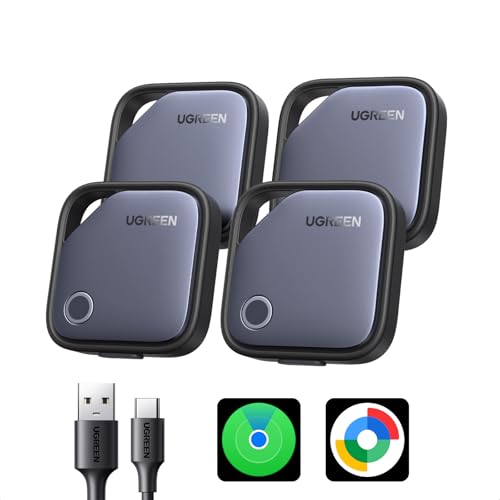
Best for Mixed Households — UGREEN Finder Duo Air Tracker Tags — 4 Pack (iOS and Android)
Strengths: One tag family for both iPhone and Android homes; Rechargeable — no coin-cell purchases, ever; Four tags in the box.
Trade-offs: Relies on the maker’s platform support rather than one single native network; A flat tag needs a charge, not a quick cell swap; Newer line, shorter track record.
| Network and app | Dual-platform — works with iOS and Android phones |
|---|---|
| Pack | 4 pack |
| Body style | Flat key-fob style tag |
| Battery | Rechargeable battery |
| Listing highlight | Compatible with iOS and Android |
| Listing highlight | Rechargeable battery — no coin cells to buy |
| Listing highlight | Made for keys, luggage and more |
Judge the UGREEN Finder Duo Air Tracker Tags — 4 Pack (iOS and Android) by the job it is shaped for. As flat key-fob style tag, it mounts on its item and stays out of the way; the intelligence lives in Dual-platform — works with iOS and Android phones, which supplies the map pins, the location history and the crowd that makes far-from-home finding possible at all. Attached to the inside pocket of the checked suitcase, the passport holder and the daypack you carry on board, it answers the two questions that matter — ‘which place did I leave it in?’ from the map, and ‘where in this room is it?’ from the speaker — without asking you to learn a new app ecosystem beyond the one your phone already runs.
Battery arrangements are refreshingly explicit: rechargeable battery, per the listing title. No water-resistance figure appears in the listing title, so treat the tag as pocket-and-case equipment rather than exterior-mounted gear. The limits deserve the same clarity as the features: crowd-finding updates arrive when compatible phones pass, so a tag in a busy station refreshes constantly while one in an empty car park waits for company; and the speaker is a homing aid for the final room, not a siren. None of that is a defect — it is the physics of every Bluetooth tracker in this guide, stated here so the purchase is an informed one.
Who should buy it: households split between iPhone and Android that refuse to maintain two different tracker systems. Who should skip it: anyone outside its ecosystem, anyone expecting live GPS-style tracking of a moving item, and anyone who will not enjoy the small ritual of naming tags and checking the app when something goes missing.
Best for: households split between iPhone and Android that refuse to maintain two different tracker systems. / Not suited for: buyers outside the UGREEN ecosystem fit described above, or anyone needing satellite GPS tracking.

Best Dual-Network Pick — KIUP Air Tags — 4 Pack for Android and Apple (with 4 Cases)
Strengths
- Genuinely dual-network: the same tag can be found through Google’s Find Hub or Apple’s Find My — unique flexibility in this list
- Four protective cases included, so the keyring-holder tax other brands charge is already paid
- IP65 sealing shrugs off rain, splashes and a drop in a puddle
Trade-offs
- Dual-system tags ask you to pick a primary ecosystem per tag at setup — read the pairing steps carefully
- A newer brand with a shorter owner track record than Tile or Apple
- Sound volume on budget tags is modest; quiet rooms find them faster than loud stations
| Network and app | Dual network — Google Find Hub and Apple Find My |
|---|---|
| Pack | 4 pack with 4 cases |
| Body style | Round tag with included protective case |
| Battery | 2-year battery life |
| Water resistance | IP65 waterproof |
| Listing highlight | Works with Google Find Hub and Apple Find My |
| Listing highlight | 2-year battery life |
| Listing highlight | IP65 waterproof, four cases included in the box |
The KIUP Air Tags — 4 Pack for Android and Apple (with 4 Cases) is built around one idea: put round tag with included protective case on the item, pair it once, and let Dual network — Google Find Hub and Apple Find My do the finding. In daily use that means the map view answers the big question — which building, which neighbourhood, which end of the house — and the sound alert handles the last few metres among in overhead bins, hotel safes, airport lounges, rental-car boots and the wrong carousel entirely. For checked luggage, a carry-on, a passport holder, a daypack and a camera pouch, that two-stage hunt is exactly the right shape: most losses are ‘somewhere nearby but hidden’, and the rest are ‘left somewhere I was earlier today’, which the location history in the app reconstructs honestly.
Power comes from a 2-year battery life, which stretches the gap between battery errands to the point where most owners simply forget about it until the app sends a low-battery nudge. The IP65 waterproof rating matters more than it sounds: tags live in gym bags, coat pockets and suitcases that get rained on, and a sealed tag keeps working after the kind of soaking that kills unprotected electronics. The honest limitation is the one every Bluetooth tracker shares: it has no satellite radio of its own, so a location update only happens when a compatible phone passes within Bluetooth reach. In busy places that is constant; in a quiet rural layby it can mean waiting. Judge it as a finding aid for your own belongings — which is all it claims to be — and it performs that job well.
Buy it if mixed households and travellers who want one 4-pack that works whichever phone ecosystem they land in. Pass if your phone lives in the other ecosystem, if you need satellite tracking rather than Bluetooth crowd-finding, or if a subscription-gated app feature is the specific thing you were shopping for — read the listing’s feature list before assuming.
Choose it if mixed households and travellers who want one 4-pack that works whichever phone ecosystem they land in. Skip it if your phone sits outside the KIUP fit described above, or if you need live satellite tracking rather than Bluetooth crowd-finding.
Comparison Table
| Pick | Network | Pack | Battery (as listed) | Water rating (as listed) |
|---|---|---|---|---|
| Life360 Tile 1 Pack | Tile network via the Life360/Tile app (iOS and Android) | 1 pack | See listing | Not stated |
| Life360 Tile Slim | Tile network via the Life360/Tile app (iOS and Android) | 1 pack | See listing | Not stated |
| Samsung Galaxy SmartTag2 | Samsung SmartThings Find network (Galaxy phones/tablets, Android 11 or later) | 1 pack | See listing | Not stated |
| UGREEN FineTrack 4 Pack | Apple Find My network (iOS only, Apple Find My Certified) | 4 pack | 2-year replaceable battery | Not stated |
| UGREEN Finder Duo 4 Pack | Dual-platform — works with iOS and Android phones | 4 pack | Rechargeable battery | Not stated |
| KIUP Air Tags 4 Pack | Dual network — Google Find Hub and Apple Find My | 4 pack with 4 cases | 2-year battery life | IP65 waterproof |
Only figures a listing itself states appear in the battery and water columns; ‘see listing’ means the title is silent, not that the tag lacks the feature. Readers comparing across budgets should also see Best Bluetooth Tracker Under $40 for how this tier’s money is spent on a different use case.
How to Choose a Bluetooth Tracker Without Buying the Wrong Network
Rule one: the network is the product. A Bluetooth tracker has no GPS radio and no mobile connection of its own. It whispers a Bluetooth signal; nearby compatible phones hear the whisper and report the location to the network. That is why the ecosystem line in every review above matters more than any other spec. Apple Find My tags only work with iPhones and iPads. Google Find Hub tags need Android. Tile tags run through the Life360/Tile app on either platform but depend on other Tile and Life360 users for crowd density. Samsung’s SmartTag2 needs a Galaxy phone. Buy the network your phone belongs to — everything else is secondary.
Rule two: crowd density decides real-world freshness. In a city centre, an airport or a university, thousands of compatible phones pass your lost bag every hour and its map pin stays fresh. In a village or on a hiking trail, updates thin out. No tag in this guide escapes that physics, whatever the marketing implies; the honest difference between networks is how many phones are listening, and Apple’s and Google’s networks are the largest simply because they ship with the phones themselves.
Rule three: match the shape to the item. Key-fob tags with real holes or loops belong on key rings. Flat card tags exist for wallets and passport holders. Adhesive stick-on tags rescue remotes and tool cases. Round disc tags are flexible but usually need a holder for keys. The wrong shape is not a minor inconvenience — a tag that does not fit the wallet does not get carried, and an uncarried tracker finds nothing.
Rule four: decide your battery religion. Replaceable coin cells (CR2032 where a listing names it) cost pennies and swap in seconds, and several picks here stretch a cell to a stated two-year life. Rechargeable tags trade the swap for a cable session once or twice a year. Sealed tags are fit-and-forget until they are fit-and-replace. None of these is wrong; pick the one your future self will actually maintain, because a tracker with a dead battery is a keyring ornament.
What a Tracker at This Tier Can and Cannot Do
At the under-$40 tier, what your money mostly buys is coverage and network quality, not exotic features. The core finding experience — map pin, sound alert, left-behind history — is broadly similar across every pick in this guide. Moving up tiers buys first-party hardware, slimmer or tougher shapes, louder speakers, longer stated battery life and, above all, more tags in the box. Moving down buys the same networks through certified third-party hardware with plainer cases and quieter speakers.
What no tier buys: live satellite tracking. If an item is stolen and driven across the county, a Bluetooth tag reports where phones last heard it, not a moving dot on a map. That limitation is worth stating plainly because it decides whether this category is right for you at all. For the everyday reality — in overhead bins, hotel safes, airport lounges, rental-car boots and the wrong carousel entirely — it is not much of a limitation at all. For anti-theft fantasies, buy a different product category and a data plan to go with it.
Water resistance deserves a tier-independent word. Ratings that appear in listing titles above (IP65, IP67) describe survival against splashes and brief immersion; tags without a stated rating should live inside a pocket or case. Sound volume, similarly, is rarely stated numerically — treat every tag’s speaker as a quiet-room tool and lean on the map and any directional finding features for the approach.
From Box to Working System: A Setup That Sticks
Unbox everything first. Lay the tags out, pair them one at a time, and only start attaching when every tag exists in the app with a proper name. Half-finished setups — two tags paired, two still in the box — are how multi-packs quietly become single tags.
Place for the hunt you will actually run. Your future self will stand in a doorway, phone in hand, listening. Place tags so that doorway test works: outer pockets, holders, the face of the item that points at the room. The load-out that works for most readers of this guide is one tag inside the checked suitcase’s inner pocket, one in the passport holder, one in the daypack, and a test ring of every tag at home before the trip, not at the gate.
Switch on the alert, then earn its trust. Enable left-behind alerts immediately, add home and work as trusted places in the same sitting, and live with the configuration for a week before judging it. Alerts tuned in week one protect you for years; alerts disabled in week one protect nobody.
Problem: a tag shows in the app but will not play a sound -> fix: you are likely out of direct Bluetooth range — the app can show a crowd-reported pin for a tag it cannot currently reach. Walk toward the pin; the sound button wakes up when your phone hears the tag itself.
Problem: two tags keep swapping identities in your head -> fix: rename ruthlessly and mark the physical tags — a dot of nail varnish, a coloured holder, a label. Digital names and physical marks must tell the same story.
Problem: the whole household shares one phone login -> fix: use the network’s item-sharing feature instead, so each person hunts from their own phone with their own alerts. Shared logins break notifications and muddy trusted places.
Trackers fail silently, so give them a monthly twenty-second audit: every tag reporting, every battery healthy, every alert still on. It is the cheapest insurance in this entire guide, and it protects you precisely against the baggage-hall moment when every black suitcase on the belt looks identical and yours is not among them. Your finding app lives on your phone, so the handset matters too — Android Phone Buying Guide rounds up the phone side of the setup.
Common Mistakes
Buying the wrong ecosystem. The number one return in this category is a Find My-only tag bought for an Android phone, or a Galaxy-only tag bought for an iPhone. The ecosystem is printed in every review above; check it against your phone before anything else.
Tagging everything except the keys. Novelty tagging is fun for a weekend; the losses that hurt are the boring ones. Cover the everyday set — {L[‘setup_scene’]} — before a single exotic item gets a tag.
Leaving trusted places unconfigured. Left-behind alerts that fire at your own front door train you to ignore alerts entirely. Five minutes of trusted-place setup on day one protects the feature’s credibility for years.
Sharing set up during the emergency. Item sharing with family members involves invitations and permissions. Configure it on a calm evening; mid-crisis is when you discover the invitation expired.
Hiding the tag where sound cannot escape. Deep inside a padded, zipped, foil-lined pocket, both the Bluetooth signal and the speaker are smothered. Mount tags toward a bag’s outer wall or in a holder on the item itself.
Using a tracker on someone else’s belongings. These are tools for finding your own property. Modern finding networks include unwanted-tracking alerts precisely so tags cannot be used to follow people; respect that design, and if a tag you do not recognise is travelling with you, use your phone’s built-in detection tools and follow the guidance they give.
Final Recommendation
If you only buy one thing from this guide, make it the Life360 Tile 1 Pack: it is the pick that best balances network strength, shape and value for a best bluetooth tracker for travel under $40 brief, and it covers checked luggage the way most people actually lose it. Add the Life360 Tile Slim when a second item — or a second ecosystem in the house — needs covering, and you have the setup most households end up with after a month of experimentation.
Buyers on a tighter leash should not feel short-changed by the budget end of this list: the networks do the heavy lifting, and a certified third-party tag on a big network beats a famous logo on the wrong one every single time. Buyers at the top of the tier are paying for coverage — more tags, tougher shapes, longer battery intervals — and that is a rational purchase when the alternative is one untagged bag on one bad morning.
Whichever of the six you choose, the follow-through matters more than the choice: pair it, name it, alert it, rehearse once. Then forget about it — the highest praise a tracker can earn is months of silence punctuated by one smug, thirty-second rescue. Adjacent budgets and angles live at Best Bluetooth Tracker Under $40, Best Bluetooth Tracker For Travel Under $50 and Best Bluetooth Tracker Under $40.
A Short Word on Privacy and Unwanted-Tracking Alerts
Every major finding network now builds in protection against misuse, and it is worth understanding before you buy. If an unknown tracker travels with you over time, both iPhones and Android phones can alert you that a tag you do not own is moving with you, and the tag itself will eventually play a sound when separated from its owner. These safeguards exist so that trackers remain tools for finding your own belongings — keys, bags, luggage — and cannot quietly become tools for following people.
Practically, this means two things for honest buyers. First, expect a tag in a borrowed car or a partner’s bag to announce itself eventually; that is the system working, not a fault. Second, if your phone ever warns you about an unknown tracker travelling with you, take it seriously: the alert flow on your phone explains how to make the tag play a sound, find it, and disable it. Used as intended — on your own property, findable by you and your chosen family members — a tracker is one of the least intrusive and most useful gadgets in this entire category.
Why Bluetooth Won the Belongings War (and Where GPS Still Rules)
GPS trackers are better technology by almost every spec-sheet measure — self-sufficient positioning, live movement, global reach. Bluetooth tags won the belongings market anyway, on the three measures that decide daily life: size, battery and cost. A beacon that runs for a year or two on a coin cell can live permanently on your keys; a GPS unit needs charging like a phone and a subscription like a phone, and it gets left in a drawer like a phone.
GPS still rules where the tracked thing travels alone through empty places, or where live movement is the entire point. Everywhere else — the populated, phone-dense world where keys, bags and wallets actually get lost — the borrowed positions of a crowd network are fresher than a dead GPS battery. Buy the technology that matches the map of your own losses.
Frequently Asked Questions
Will an Apple Find My tag work with my Android phone?
No. Find My tags, including certified third-party ones, pair only with iPhones and iPads. Android owners should look at Google Find Hub tags, Tile tags (which use their own app on both platforms) or, for Galaxy phones, Samsung’s SmartTag2.
Do Bluetooth trackers need a subscription?
Core finding is free on Find My, Find Hub and SmartThings Find. Tile keeps basic finding free and reserves some premium alerts for its paid plan. Where a listing in this guide advertises no monthly fees, that claim is quoted from the listing itself.
Can I use a tracker to follow my car or another person?
They are the wrong tool, deliberately. Finding networks alert people when an unknown tag travels with them, and tags report crowd sightings rather than live movement. Vehicle tracking needs a dedicated GPS unit with a data plan.
How long do tracker batteries last?
It depends on the model, and this guide only quotes figures a listing itself states — you will see 2-year replaceable batteries and 1-year rechargeable claims among the picks above. Tags whose listings do not state a figure should be checked on the product page before buying.
What happens when my tagged bag is somewhere with no people around?
The map shows the last place a phone heard it, and the tag keeps broadcasting so the next passing phone updates it. In a busy place that is minutes; in an empty one it can be longer. The tag also still answers your own phone the moment you walk back into Bluetooth range.
Can family members help find my tagged items?
On several networks, yes — item sharing lets chosen people see and ring your tags from their phones. One pick above advertises sharing with up to five people in its listing title. Set sharing up before you need it; the middle of a loss is the wrong time to discover permissions.
Is a tracker worth it for a wallet?
A wallet only forgives a card-shaped tag. Anything thicker gets fished out and left in a drawer, and a tracker in a drawer finds nothing. If the wallet is the priority, the Slim-style pick is the starting point; keys come second.