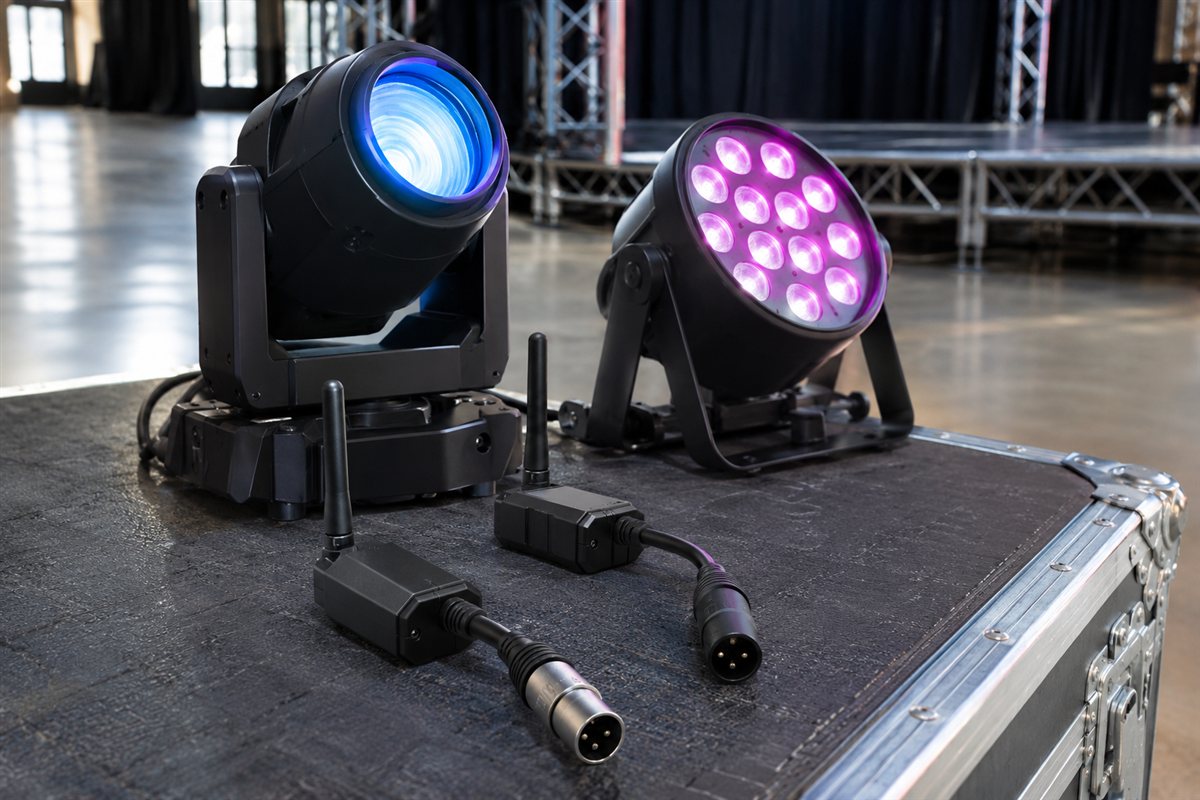
A wireless DMX system sends lighting control data through the air instead of through a long cable run. A transmitter connects to your console or controller, and receivers connect to each fixture or group of fixtures. Systems differ in range, channel count, and the way they handle radio interference.
We have not used these products ourselves, so this guide has no rankings and no personal results. It shows how to compare listings: which numbers describe real capacity, how power and connectors affect your rig, and which details are worth confirming with the maker before you build a setup around one system.
As an Amazon Associate we earn from qualifying purchases. Links on this site are affiliate links, and they do not change the information we give.
In this guide
Quick Picks
| Pick | Product | Best For |
|---|---|---|
| Best Large Kit | Donner Wireless DMX512 System, 1 Transmitter + 7 Receivers with Built-in Batteries | Uplighting and rigs with many fixtures |
| Best Mid-Size Kit | Donner Wireless DMX512 System, 1 Transmitter + 5 Receivers with Built-in Batteries | Mobile DJ and event rigs |
| Best Pro Receiver | CHAUVET DJ D-Fi XLR RX Wireless DMX Receiver (DFIXLRRX) | Adding a receiver to a D-Fi setup |
| Best Small Kit | JERRAY DMX512 Wireless System, 1 Transmitter + 2 Receivers | A few fixtures on a budget |
| Best Starter Pair | Donner DMX512 Wireless Pair, 1 Transmitter + 1 Receiver (TS-WDMX01A) | A single wireless link |
Our Picks
1. Donner Wireless DMX512 System, 1 Transmitter + 7 Receivers with Built-in Batteries — Best for Large Rigs
This Donner kit is built around coverage: one 2.4 GHz transmitter and seven receivers, so a single console output can feed seven separate fixtures or short fixture chains with no cable runs between them. The receivers in this version have built-in rechargeable batteries and the light-dome style housing, which makes them practical for uplights placed around a room where running power and data to every position is awkward. Donner’s DMX512 platform uses automatic frequency hopping across 126 channels in the 2.4 GHz ISM band and seven color-coded ID groups, so you can keep this system separate from another wireless system working the same venue. Donner states a communication distance of up to 500 meters in open line of sight for this system family; plan on much less indoors, and place the transmitter high and clear of truss as the guide above advises. Connections are 3-pin XLR, so if your rig is built on 5-pin cable you will need adapters. For a working DJ or event tech who regularly lights a whole room, this is the most complete pack here.
View Donner Wireless DMX512 System, 1 Transmitter + 7 Receivers with Built-in Batteries on Amazon
2. Donner Wireless DMX512 System, 1 Transmitter + 5 Receivers with Built-in Batteries — Best Mid-Size Kit
If seven receivers is more than your rig needs, this version of the Donner system trims the count to five battery receivers with the same transmitter and the same 2.4 GHz radio platform. The receivers carry built-in batteries and the light-dome indicator tip, so each one plugs straight into a fixture’s DMX input and shows its link state at a glance. As with the larger kit, the system sends one DMX universe, hops frequencies automatically to work around interference, and uses ID groups to pair receivers to their own transmitter. Five receivers is a natural fit for a typical mobile setup: a pair of movers, two wash fixtures, and one spare or effects light, each placed without a data cable. Check that your fixtures use 3-pin XLR, since that is the connector this family is built around, and budget setup time to charge every receiver before the event, because a wireless rig is only as reliable as its battery plan.
View Donner Wireless DMX512 System, 1 Transmitter + 5 Receivers with Built-in Batteries on Amazon
3. CHAUVET DJ D-Fi XLR RX Wireless DMX Receiver (DFIXLRRX) — Best Pro Receiver
The D-Fi XLR RX takes a different approach from the kit systems: it is a single battery-powered receiver that plugs directly into the XLR input of a DMX fixture, with no cable tail and no separate box to mount. It receives DMX and master/slave signals from a CHAUVET DJ D-Fi transmitter, so it is an add-on for people already working in the D-Fi ecosystem rather than a complete system on its own — you will need a D-Fi XLR TX, a D-Fi hub, or a compatible Freedom-series fixture to send the signal. Chauvet rates the D-Fi XLR line at up to 165 feet (50 m) unobstructed, which is a shorter claim than the budget kits make, but it is stated conservatively for real venues. Charging is by contact pins on a multi-charger rather than a cable per unit, which keeps a case of receivers tidy between jobs. For a Chauvet-based rig that needs one or two more wireless drops, this is the cleanest way to add them.
View CHAUVET DJ D-Fi XLR RX Wireless DMX Receiver (DFIXLRRX) on Amazon

4. JERRAY DMX512 Wireless System, 1 Transmitter + 2 Receivers — Best Small Kit
Not every rig needs a case full of receivers. This JERRAY set covers the smallest useful layout, one 2.4 GHz transmitter and two receivers, which is enough to split a console feed to two positions — for example a pair of uplight groups on opposite walls, or a front wash and a back light that cannot share a cable run. The receivers output standard DMX512, so each one can also feed a short daisy chain of wired fixtures, which stretches a two-receiver kit further than the count suggests. As with every 2.4 GHz system in this roundup, real-world range depends on the venue, and the maker figures assume a clear path, so test the link at the site with your other wireless gear running. If you are trying wireless DMX for the first time on a small show and want to keep the outlay modest while you learn where it helps, this is a sensible size to start with, and it can stay in the case as a backup link later.
View JERRAY DMX512 Wireless System, 1 Transmitter + 2 Receivers on Amazon
5. Donner DMX512 Wireless Pair, 1 Transmitter + 1 Receiver (TS-WDMX01A) — Best Starter Pair
The Donner TS-WDMX01A pair is the simplest form of the idea: one transmitter at the console and one receiver at the fixture, linked over 2.4 GHz with the same automatic frequency hopping and color-coded ID group system used across Donner’s DMX512 line. The units use the light-dome housing and run from plug-in power adapters rather than internal batteries, which removes charging from your routine but means each end needs an outlet — fine for a fixed position such as a balcony fixture or a hard-to-reach truss drop where a battery would be a chore to service. Donner states up to 500 meters of communication distance in open conditions for this system family; treat that as a best case and test at your venue. A single link like this is often bought to solve one specific cable problem — crossing a doorway, a dance floor, or a gap between two truss sections — and it does that job without committing you to a full multi-receiver system.
View Donner DMX512 Wireless Pair, 1 Transmitter + 1 Receiver (TS-WDMX01A) on Amazon
What to Look For
| Factor | Why it matters | What to check |
|---|---|---|
| Universe count | Limits how many fixtures you can control. | Number of DMX universes per transmitter. |
| Range | Depends on the venue and the radio band. | Maker’s stated distance and any line-of-sight note. |
| Radio band | Affects interference in busy venues. | 2.4 GHz or 900 MHz, and frequency hopping. |
| Connectors | Must match your cables and fixtures. | 3-pin or 5-pin XLR, plus input and output options. |
| Power | Receivers need a steady source. | Battery, DC adapter, or USB power, and runtime. |
| Pairing | Affects how quickly you set up. | Button, switch, or app-based linking. |
| Build | Gear travels and gets knocked about. | Case material, antenna design, and mounting options. |
Setup and Care Tips
- Place the transmitter high and clear of metal truss to give the signal a clean path.
- Pair every receiver at the venue before the event to confirm the link.
- Label each receiver by fixture or zone so troubleshooting is faster.
- Keep spare batteries or adapters in the road case.
- Coil cables loosely and wipe connectors clean between jobs.
Mistakes to Avoid
- Buying receivers with 3-pin connectors when your rig uses 5-pin.
- Assuming the stated range will hold in a crowded venue.
- Forgetting to check how many universes your controller needs.
- Running on weak batteries during a long event.
- Placing the antenna behind a metal panel or inside a closed rack.
How Wireless DMX Differs From a Cabled Run
Standard DMX travels over a daisy-chained cable, with each fixture passing the signal on to the next. Wireless DMX replaces that cable run with radio links, so the transmitter sends the control data and receivers convert it back into a standard DMX signal for the fixtures. The fixtures themselves are the same, so you can use wireless where cable is awkward and cable where it is simple.
The practical difference is where failure can occur. In a cabled system, a damaged cable or a loose connector usually breaks the chain at a clear point. In a wireless system, problems tend to come from the radio environment, such as interference, obstruction or a weak battery. That is why planning and testing matter. Systems differ in how they handle this, and makers describe techniques such as frequency hopping or automatic channel selection.
Wireless is attractive in situations where cable would be impractical, dangerous or visually distracting. Examples include outdoor events, moving or hanging fixtures, long distances between stage and fixtures, and installations in historic buildings where running cable is restricted. It also reduces the setup time for temporary events.
- Use wireless where cable is awkward, temporary or hazardous.
- Keep cable for short, fixed or critical runs.
- Check the maker’s description of how each receiver outputs the signal.
- Think about how a failed link will show up and what the fallback is.
Many professionals use a mix, running cable where it is easy and wireless where it saves effort.
Transmitter and Receiver Layouts, One-to-Many and Beyond
Different layouts suit different jobs. The simplest is a single transmitter sending to several receivers, each connected to a fixture or short chain. This is common for small shows, mobile DJs and event lighting. Some systems support multiple transmitters on the same site, which matters if more than one console or controller is in use. Others allow receivers to be paired to specific transmitters, or to listen to a specific universe, which keeps data from mixing.
Check how a system handles universes. If your rig uses more than one, find out whether the transmitter can send several universes through a single unit or whether you need a transmitter for each. Also check how a receiver is assigned to a universe, whether by a switch, a menu or an app, and how easily you can change that setting at a venue.
Some devices act as both transmitter and receiver, and some systems let receivers repeat the signal to extend range. Others are one-directional. Read the maker’s description to understand the options.
- Decide how many universes and receivers you need now and later.
- Check whether receivers can be assigned to individual universes.
- Find out whether the system supports multiple transmitters at the same venue.
- Look at whether you can add more receivers without replacing the transmitter.
Choosing a layout that matches your typical job saves rewiring and re-pairing.
Radio Planning and Dealing With Interference
Wireless DMX shares the airwaves with other devices, and venues often contain a lot of them. The 2.4 GHz band is widely used for wireless networks, Bluetooth devices and other wireless products, so it can be crowded. Other bands are available in some regions, with different rules and characteristics. Check which bands a system uses and whether it is legal to use where you work, since radio regulations differ by country.
Frequency hopping, automatic channel selection and similar techniques help a system avoid busy parts of the band, and makers describe these in their own way. They improve resilience but cannot guarantee a clean link, so the physical setup still matters. Keep the transmitter’s antenna clear and elevated, with line of sight to the receivers when possible. Avoid placing antennas close to metal truss, dense crowds, large screens or other transmitters.
Visit the venue early if you can. Test the link with all other wireless equipment operating, including microphones, in-ear monitors, wireless networks and phones. If problems arise, try changing positions, reducing the number of nearby wireless sources or adjusting channel settings as described in the manual.
- Do a full test with all wireless gear running before the event.
- Place antennas high and clear of metal.
- Keep a cable backup for important fixtures.
- Check the maker’s guidance on legal use in your region.
Power, Batteries and Field Reliability
Receivers need a stable power source, and this is where many failures begin. Options include internal rechargeable batteries, replaceable batteries, DC adapters, USB power, and power taken from a fixture. Each has tradeoffs. Internal batteries are convenient but have a limited runtime, which the maker states, and the actual time depends on use and temperature. DC adapters give steady power but require outlets and cable, which partly defeats the purpose of going wireless.
Plan power for the full length of the job, including setup and testing time. Charge everything before leaving, carry spare batteries or power banks and know how to check charge levels. Look at how the unit signals low power, and at what happens when power drops: does it hold the last state, go dark or behave unpredictably? Check the maker’s notes.
Build quality matters in touring and outdoor use. Consider the case material, connector strength, antenna design and any ingress protection the maker claims. Take care of the equipment by storing it in a padded case, avoiding extreme heat, and keeping connectors clean. Update firmware only when the maker advises and test afterward, since changes can affect pairing.
- Carry spares for batteries, adapters and cables.
- Label each receiver with its universe and address.
- Inspect antennas and connectors regularly.
- Replace worn batteries before they fail on a job.
Matching the System to Your Kind of Work
The right system depends on the work you do. A mobile DJ with a few fixtures needs simplicity: quick pairing, small receivers and long battery life. A small theater may value stable links, multiple universes and clear labeling. A touring band might want rugged cases and fast setup. A wedding or corporate lighting designer might prioritize discreet receivers and low visibility. An architectural installer may want wired power and a permanent setup.
Think about growth. If you expect to add fixtures, choose a system that scales by adding receivers, rather than one that fits only your current rig. Consider whether the system can be controlled from software, an app or a lighting console, and whether it supports features like remote configuration. Be careful about proprietary features that lock you into one family of equipment, and check the maker’s compatibility notes.
Ask the maker or seller direct questions before buying. How many universes per transmitter? What is the stated range and under what conditions? What connectors do receivers use? What are the power options? What does the warranty cover? Having answers in hand makes comparison fair and avoids unpleasant surprises at a job.
- Match features to the work you do most.
- Plan for growth in fixtures and universes.
- Ask about support, warranty and firmware updates.
- Test the system on a small job before relying on it for a big one.
A Practical Decision Workflow Before You Buy
Most disappointing purchases in this category do not happen because the product itself is poor. They happen because the buyer skipped a short round of honest homework and ordered on a single headline feature. A wireless DMX system has to fit a specific space, a specific routine and a specific set of habits, and those three things differ far more between households than any specification sheet suggests. The workflow below takes about fifteen minutes, needs nothing more than a tape measure, a notebook and your phone, and it will narrow the picks in this guide down to one or two clear candidates.
Start with the space, not the product. Measure the area where the DMX transmitter will live or be used, and write down the fixed obstacles as well: doors that swing through the space, sockets that are already spoken for, furniture that cannot move, and anything that generates heat, moisture or dust nearby. Photograph the space from two angles. It sounds excessive, but a photograph taken now will answer questions later that memory will not, especially once you are comparing dimensions on a product page late in the evening.
Next, write down the job in one sentence. Not a wish list, just the main job: what should be different the week after this arrives? Keep that sentence visible while you shop. Every feature you consider after that has to earn its place by serving that sentence. Features that do not serve it are not bargains; they are future clutter, extra cleaning, or settings you will scroll past for years without touching.
Then list your constraints honestly. Budget is only one of them. Time is another: how many minutes a week will you genuinely give to cleaning, charging, adjusting or maintaining this purchase? Storage is a third: where does it, and everything that comes with it, go when it is not in use? Noise tolerance, the patience of other people in the household, and any physical limits such as lifting weight or reaching height all belong on the same short list.
Only now open the product pages, and read them in a fixed order. First the dimensions and requirements, because a mismatch there ends the discussion. Second the controls and the everyday operating steps, because those are what you will live with daily. Third the care requirements, because they decide whether the product still pleases you in month six. Marketing language comes last, if at all. When two picks look identical, the one whose everyday steps are simpler almost always wins in real life.
Finally, do a short reality check against the picks above. The option labelled as the best overall choice earns that label by balancing the most common needs, which makes it the sensible default if your written job sentence sounds ordinary. The more specialised picks earn their place when your constraints list contains something unusual: a very small space, a very heavy workload, a strict noise limit, or a user with specific physical needs. If none of your constraints are unusual, resist paying extra for specialisation you will never call on.
Use Cases in Detail: Matching the Pick to the Situation
Abstract advice only goes so far, so it helps to walk through the situations buyers describe most often and see how the decision changes in each one. Read the scenarios below and find the one closest to your own household; the right choice usually becomes obvious once the situation is stated plainly.
A mobile dj lighting a different venue each week
In this situation the priority is reliability under daily repetition. The DMX transmitter will be used when people are tired, rushed or distracted, so controls need to be forgiving and the basic setup needs to stay put without constant adjustment. Choose the pick whose everyday operation is described most simply in the reviews above, set it up once with care, and then leave the settings alone for the first week so you learn its normal behaviour before you start fine-tuning anything.
A small theatre running cue-based shows
Here the deciding factor is usually comfort over long stretches rather than peak performance in short bursts. Think about posture, reach, noise and heat over hours, not minutes. A wireless DMX system that feels fine in a five-minute test can become irritating by the third hour, so weight the comments in this guide about sustained use more heavily than the headline features. It is also worth planning the surrounding details: lighting, seating, cable routes or storage within arm’s reach make as much difference as the product itself.
A church or school hall with regular events
When several people share the same DMX transmitter, the purchase has to survive handovers. Settings get changed, parts get moved, and nobody reads instructions twice. Favour the pick with the clearest controls and the fewest fragile accessories, agree one house rule for how it is left after use, and keep any small parts together in one labelled container. Shared use also raises the value of easy cleaning, because a product that is simple to wipe down or empty actually gets cleaned, while a fiddly one quietly gets worse.
A band adding lighting without long cable runs
This last situation rewards planning for the awkward moments rather than the average day. Think about the hottest, coldest, busiest or most tiring version of the routine, and choose the pick that still works then. Capacity, reach and durability matter more than refinements. It is also the situation where buying once, properly, beats buying cheaply twice: a DMX transmitter that struggles at the edges of its range tends to be replaced within a year, which costs more than starting with the stronger option would have done.
Comparing the Picks Head to Head
Comparison tables compress a lot of judgement into a few rows, which makes them useful starting points and poor finishing points. The paragraphs below slow the comparison down and look at each pick in this guide on its own terms, using only what the reviews above already establish. Work through them with your constraints list open, and cross picks off rather than ranking them: the right purchase is usually the last one standing, not the one with the longest feature list.
Donner Wireless DMX512 System, 1 Transmitter + 7 Receivers with Built-in Batteries. Its role in this guide — best for large rigs — tells you the job it was picked for, so judge it against that job rather than against every other pick at once. Re-read its section above with your written job sentence beside you, and note the one honest limitation mentioned there. If that limitation touches something you do every day, move on to the next pick; if it touches something you rarely do, it is a fair trade for the strengths the review describes.
Donner Wireless DMX512 System, 1 Transmitter + 5 Receivers with Built-in Batteries. Its role in this guide — best mid-size kit — tells you the job it was picked for, so judge it against that job rather than against every other pick at once. Re-read its section above with your written job sentence beside you, and note the one honest limitation mentioned there. If that limitation touches something you do every day, move on to the next pick; if it touches something you rarely do, it is a fair trade for the strengths the review describes.
CHAUVET DJ D-Fi XLR RX Wireless DMX Receiver (DFIXLRRX). Its role in this guide — best pro receiver — tells you the job it was picked for, so judge it against that job rather than against every other pick at once. Re-read its section above with your written job sentence beside you, and note the one honest limitation mentioned there. If that limitation touches something you do every day, move on to the next pick; if it touches something you rarely do, it is a fair trade for the strengths the review describes.
JERRAY DMX512 Wireless System, 1 Transmitter + 2 Receivers. Its role in this guide — best small kit — tells you the job it was picked for, so judge it against that job rather than against every other pick at once. Re-read its section above with your written job sentence beside you, and note the one honest limitation mentioned there. If that limitation touches something you do every day, move on to the next pick; if it touches something you rarely do, it is a fair trade for the strengths the review describes.
Donner DMX512 Wireless Pair, 1 Transmitter + 1 Receiver (TS-WDMX01A). Its role in this guide — best starter pair — tells you the job it was picked for, so judge it against that job rather than against every other pick at once. Re-read its section above with your written job sentence beside you, and note the one honest limitation mentioned there. If that limitation touches something you do every day, move on to the next pick; if it touches something you rarely do, it is a fair trade for the strengths the review describes.
Two patterns are worth watching for as you compare. First, the gap between the best overall pick and the specialised picks is rarely about quality; it is about fit. A specialised pick is not a lesser product, it is a narrower one, brilliant inside its niche and merely adequate outside it. Second, accessories and extras sway decisions out of proportion to their value. Ask of every extra whether you would use it weekly. If the honest answer is monthly or never, let it go, and let the core performance, the controls and the care routine decide instead.
If you finish this comparison with two picks still standing, break the tie with ownership questions rather than performance questions. Which one will be easier to clean in your actual space? Which one’s controls will the other people in the household understand without asking you? Which one stores more neatly when it is not in use? Those unglamorous questions predict satisfaction six months from now far better than any single specification does.
Day-to-Day Use, Cleaning and a Simple Care Routine
The first week with a new DMX transmitter sets habits that tend to stick, so spend a little of that week deliberately. Run through the full operating cycle slowly once, from start to finish, while you are not in a hurry. Notice the order things have to happen in, where your hands naturally go, and which step feels awkward. Awkward steps are where mistakes and breakages concentrate later, so rearrange the surrounding space now, while changing it is still easy.
Build cleaning into the routine the product already has, rather than treating it as a separate chore. A quick wipe, shake, rinse or empty at the natural end of each use takes seconds and prevents the slow build-up that eventually needs a deep clean. Keep whatever you use for that quick job within arm’s reach of where the DMX transmitter lives; supplies stored in another room might as well be stored in another house, because the quick job simply stops happening.
A workable care schedule
After each use: return everything to its resting state, clear away residue, moisture or loose debris, and leave the DMX transmitter somewhere air can reach it if it needs to dry. Weekly: give the surfaces and contact points a proper clean with a soft cloth and mild cleaner suited to the material, check moving parts and connections for looseness, and deal with small issues while they are still small. Monthly: do the deeper job — the full wash, descaling, sharpening, re-tightening or inspection the manual describes — and look honestly at wear. Seasonally: review storage, replace anything consumable that has quietly expired or worn out, and reconsider placement if the household’s routine has changed.
Storage deserves the same thought as use. Keep the DMX transmitter dry, out of direct extremes of heat and cold, and away from the crush zone at the back of a cupboard or the bottom of a pile. Small parts belong in one container, labelled, stored with the main item rather than near it. If the original packaging includes shaped inserts that protect fragile parts, consider keeping it; flat-pack storage boxes look tidier but protect less.
When something goes wrong, troubleshoot in order of likelihood before assuming failure. Check power, connections and settings first, then positioning, then cleanliness, then wear. Most problems reported with products in this category trace back to one of those four, and most are fixed in minutes without tools or spare parts. Keep the manual, or a photo of its troubleshooting page, somewhere you can find it on a bad evening rather than at the bottom of a drawer.
More Mistakes That Shorten a Product’s Life
Beyond the mistakes covered earlier in this guide, a few quieter habits do most of the long-term damage. The first is running the DMX transmitter at its maximum setting as a default. Maximum settings exist for occasional peaks; used constantly, they raise noise, heat and wear while often delivering little extra benefit. Find the lowest setting that does the job properly and treat anything above it as a reserve.
The second is ignoring the environment. Dust, steam, direct sun, cramped airflow and unstable surfaces all age a wireless DMX system faster than ordinary use does. You cannot always choose the environment, but you can usually improve it by a few centimetres: a small gap for air, a mat for stability, a move away from a heat source. Those tiny adjustments compound over years.
The third is postponing small maintenance until it becomes a repair. A loose fitting, a frayed edge, a filter or part that is past its best — each is cheap and quick to address when noticed, and expensive or impossible later. The weekly check in the care schedule above exists precisely to catch these while they are still trivial.
The fourth is buying replacement parts, refills or accessories on price alone without checking fit. Incompatible extras are a false economy: they perform poorly, can damage the main product, and usually cannot be returned once opened. Match the part to the model exactly as the manual specifies, and keep a note of the model details on your phone so the information is with you when you need it.
The last is letting the purchase drift away from its original job. Households change, and a DMX transmitter bought for one routine gets pressed into another it was never suited to. When that happens, the honest options are to adapt the routine back, accept the compromise knowingly, or replace the product with one designed for the new job. Blaming the product for a job it never claimed to do helps nobody, and recognising the mismatch early saves both money and frustration.
One more practical note for wireless DMX system buyers: revisit your original job sentence after the first month of ownership. Many households find the DMX transmitter has quietly taken on a second job — a neighbouring task it handles well enough that the routine has shifted around it. That is fine, and often a pleasant surprise, but it is worth noticing, because the second job changes what matters when you clean, store and eventually replace it. Note the change in the same place you kept your measurements, set a reminder to review any consumables or accessories the new job depends on, and adjust the weekly care check to cover the parts the second job uses most. Buyers who do this short review tend to get noticeably more value from the same purchase, simply because the product’s real role in the household is understood rather than assumed, and small mismatches between the role and the setup get corrected before they turn into daily irritations.
One more practical note for wireless DMX system buyers: revisit your original job sentence after the first month of ownership. Many households find the DMX transmitter has quietly taken on a second job — a neighbouring task it handles well enough that the routine has shifted around it. That is fine, and often a pleasant surprise, but it is worth noticing, because the second job changes what matters when you clean, store and eventually replace it. Note the change in the same place you kept your measurements, set a reminder to review any consumables or accessories the new job depends on, and adjust the weekly care check to cover the parts the second job uses most. Buyers who do this short review tend to get noticeably more value from the same purchase, simply because the product’s real role in the household is understood rather than assumed, and small mismatches between the role and the setup get corrected before they turn into daily irritations.
FAQ
Is wireless DMX as reliable as cable?
Cable gives a direct link, while wireless depends on radio conditions. Many systems use frequency hopping to cope with crowded bands. Plan a backup cable for critical runs.
What is a DMX universe?
A universe is a block of 512 control channels. Larger rigs use several universes, so check how many a transmitter can send before you plan the fixture list. Many small rigs fit in a single universe, but moving lights and pixel fixtures can use many channels each, so add up the footprint of every fixture first.
Can I mix wireless and wired DMX in one rig?
Yes. Receivers output a standard DMX signal, so they can feed a cabled chain of fixtures. Many rigs use cable for short, fixed runs and wireless for hard-to-reach or temporary positions.
Does wireless DMX add delay?
Radio links can add a small amount of latency, and makers describe this differently. For most uses it is not noticeable, but check the maker's information if timing is critical.
Can two systems operate at the same venue?
Often yes, but they can interfere with each other if they use the same band or channels. Check the maker's guidance on multiple systems and test them together before the event.
What is frequency hopping?
It means the radio changes channels rapidly to avoid interference. Makers implement it differently, so read the description. It helps in busy environments but does not guarantee a clean signal.
How do I pair receivers with a transmitter?
Methods vary, including buttons, switches, menus and apps. Check the manual and try pairing before the event. Label each receiver afterward so you can find it easily.
Do all receivers need to see the transmitter?
A clear path generally gives the best link, but some systems tolerate obstructions better than others. Check the maker's range description and test in the actual venue.
What should I carry as a backup?
Spare batteries or power adapters, a few DMX cables, a spare receiver if possible and a plan for critical fixtures. A cable backup for key runs is a sensible precaution.
How long should a wireless DMX system realistically last?
Longevity depends far more on routine care and a suitable environment than on the badge on the front. A DMX transmitter that is cleaned on the simple schedule described in this guide, stored dry and used within the job it was bought for will normally serve for years of regular household use. The earliest signs that replacement is approaching are usually a slow decline in performance, controls or fittings becoming loose or unreliable, and replacement parts getting hard to find. When two of those three appear together, start planning a replacement rather than spending on repairs.
Is it worth paying more for the top pick in this guide?
Only if the extra money buys something your own constraints list actually asks for. The top pick earns its place by balancing the needs most buyers share, which makes it the safest choice for an ordinary household. Paying more for a specialised model makes sense when your situation is genuinely specialised — an unusually large or small space, a much heavier workload than average, or a user with specific needs. If your written job sentence sounds like most people’s, the balanced pick will satisfy you, and the saving is better kept for the accessories or consumables you will genuinely use.
What should I check in the first week of ownership?
Check fit, controls and routine, in that order. Confirm the DMX transmitter sits, fits or operates in your space exactly as you measured it, and that doors, sockets and neighbouring items still work as they should. Run every control once so nothing is a surprise later. Then watch your own routine: note anything you keep working around, because small rearrangements made in week one are easy, while workarounds left for a month become permanent habits. Keep packaging until the end of that first week in case an exchange is needed.
How do I know whether to repair or replace?
Compare three things: the cost of the repair against the remaining life you would get from it, the availability of the correct parts, and whether the fault is isolated or part of a general decline. A single failed part on an otherwise sound DMX transmitter is usually worth repairing. Repeated faults, declining performance and worn fittings arriving together signal that the product is wearing out as a whole, and money spent on one repair tends to be followed by another. Safety always overrides the calculation: anything electrical, load-bearing or heat-related that behaves unpredictably should be taken out of use until it is checked.
Can I use a DMX transmitter for jobs beyond what it was bought for?
Sometimes, cautiously, and only within the limits the manual describes. Products in this category are designed and tested around a particular job, load and environment. Occasional light use outside that pattern is unlikely to cause harm, but making an unsuitable job part of the regular routine accelerates wear and can create safety risks the design never anticipated. If a new job has become a regular part of your household’s life, that is a sign to look at a product designed for it, rather than asking the current one to stretch further every week.
What is the single most useful habit for getting value from this purchase?
The end-of-use reset. Returning the DMX transmitter to a clean, dry, ready state every time you finish with it takes under a minute and does more for long-term satisfaction than any other habit. It prevents build-up, reveals small problems while they are still trivial, means the product is always ready when the next person reaches for it, and quietly extends its working life. Most products that disappoint early were not badly made; they were badly reset, day after day, until small neglects added up.
The Short Version
Begin with your universe count and connector type, then compare range, radio band, and power options. A well-matched system with a clear antenna path and spare power makes setup easier at every venue. Write down how many fixtures you run, which connectors they use, and how far the farthest one sits from the console. With those three facts in hand, a listing is much easier to judge, and you can ask the maker pointed questions about range and channel limits.
Related Guides
- How to Choose the Best Wireless Alarm Systems: A Buyer's Guide
- How to Choose the Best Wireless Security Systems (2026 Guide)
- How to Choose the Best Wireless Earbuds: Buyer's Guide (2026)
- How to Choose the Best Wireless Ergonomic Mice: A Buyer's Guide
- How to Choose the Best Closet Systems: Buyer's Guide (2026)