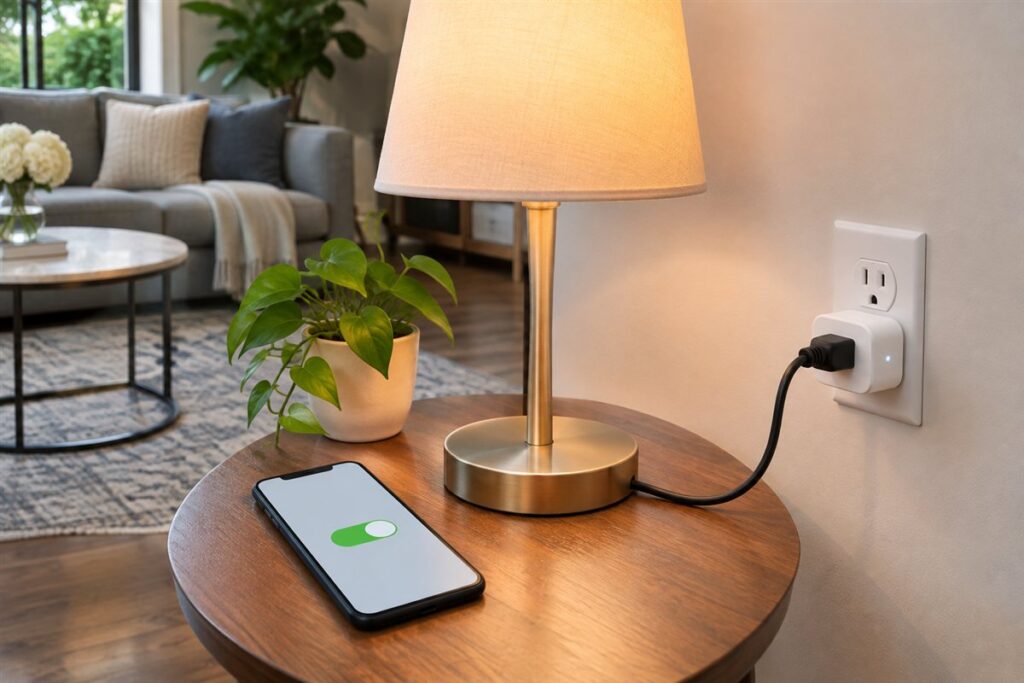
We have not used these products ourselves, so this guide does not claim any personal results. It describes how to choose a smart plug by looking at load limit, connection type, size, scheduling and energy readouts, so you can match a plug to the lamps, fans and small devices in your home. Use the table below to compare features, then check the maker details against your own outlets and habits before you decide.
A smart plug sits between a wall outlet and a device, and lets you turn that device on or off through an app, a schedule or a voice assistant. It does not make the device itself smart, it only controls the power to it. Every plug has a stated maximum load, and some devices, such as heaters or motors, call for extra care, so read the maker limits closely. Think about how many plugs you want, what you will connect, and whether the plug body will block the neighboring outlet.
As an Amazon Associate we earn from qualifying purchases. Links on this site are affiliate links, and they do not change the information we give.
In this guide
Quick Picks
| Pick | Product | Best For |
|---|---|---|
| 1 | Kasa Smart Plug EP25 (4-Pack) | Best overall with energy monitoring |
| 2 | Kasa Matter Smart Plug KP125M (4-Pack) | Matter and mixed-assistant homes |
| 3 | Emporia Energy Monitoring Smart Plug | Detailed energy analytics |
| 4 | Kasa Outdoor Smart Plug EP40 | Outdoor lights and decorations |
| 5 | Philips Hue Smart Plug | Hue lighting setups |
Our Picks
1. Kasa Smart Plug EP25 (4-Pack) — Best Overall
The EP25 is the plug to start with if you want one model that covers most of the checklist in this guide. It is rated for a 15 amp maximum load, connects directly to 2.4 GHz Wi-Fi with no hub, and its mini body is shaped to leave the second wall outlet free. Inside the Kasa app you get schedules, timers and an away mode, plus energy monitoring that reports how much power the connected device is drawing and how that builds up over time. It works with Alexa and Google Assistant, and it is also one of the few plugs that supports Apple HomeKit, so Siri households are not left out. This four-pack listing makes it easy to put lamps and fans around the house on the same app and the same set of routines.
View Kasa Smart Plug EP25 (4-Pack) on Amazon
2. Kasa Matter Smart Plug KP125M (4-Pack) — Best for Matter Homes
The KP125M is Kasa’s Matter plug, built for homes that mix assistants instead of settling on one. Because it speaks Matter over Wi-Fi, the same plug can be added to Apple Home, Alexa, Google Home or SmartThings, which matters if your household uses more than one phone platform. It is rated at 15 amps and 1800 watts, and the compact body is designed not to block the neighboring outlet. Energy monitoring is built in and reported in the Kasa app, alongside schedules and timers. Setup runs through the Kasa app or a Matter controller, and it connects on 2.4 GHz Wi-Fi only, so check your router band before ordering. Pick this version over the EP25 if cross-platform support matters more to you than HomeKit-specific features.
View Kasa Matter Smart Plug KP125M (4-Pack) on Amazon
3. Emporia Energy Monitoring Smart Plug — Best for Energy Analytics
Emporia comes at smart plugs from the energy side: the company also makes whole-home energy monitors, and this plug is built mainly to report what a device uses. The Emporia app shows live wattage and estimated running costs, with schedules and timers on top, and the plug works with Alexa and Google Assistant over 2.4 GHz Wi-Fi. Read the load rating carefully before you buy. Emporia rates this plug at 10 amps continuous, with a 15 amp peak allowed for up to an hour a day, which is lower than the 15 amp plugs above. That suits lamps, entertainment gear and most small appliances, but it is not the plug for a space heater or other heavy continuous loads. For tracking down standby drain around the house, though, it is the most measurement-focused option here.
View Emporia Energy Monitoring Smart Plug on Amazon
4. Kasa Outdoor Smart Plug EP40 — Best for Outdoor Use
Most plugs in this guide are indoor-only, and the EP40 is the one made for the yard. It carries an IP64 weather-resistance rating, and its two sockets can be controlled individually from the Kasa app, so the patio lights and a fountain pump can run on different schedules. It connects directly to Wi-Fi with no hub, works with Alexa and Google Assistant, and supports sunrise and sunset scheduling, which suits holiday decorations that should come on at dusk. It is ETL certified. The body hangs from the outlet on a short cord rather than sitting flat against the wall, which helps it fit covered outdoor receptacles. Keep the load limits in the listing in mind, and remember that weather resistance is not the same as waterproof: it still belongs in a covered outdoor outlet.
View Kasa Outdoor Smart Plug EP40 on Amazon
5. Philips Hue Smart Plug — Best for Hue Homes
The Hue Smart Plug is the pick for homes already built around Philips Hue lighting. Out of the box it talks to the Hue app over Bluetooth, which is enough for simple on-off control of a lamp in the same room. Add a Hue Bridge and it joins your wider Hue setup, with schedules, routines and voice control through Alexa, Google Assistant and Apple HomeKit. Philips markets it for turning ordinary lights into smart lights, so it is aimed at lamps rather than heavy appliances, and you should check the rating on the listing before plugging in anything larger. It has no energy monitoring, so if usage readouts matter, choose one of the plugs above instead. For a Hue household that wants one more lamp on the same system, it is the natural fit.
View Philips Hue Smart Plug on Amazon
What to Look For
| Factor | Why it matters | What to check |
|---|---|---|
| Load limit | Each plug has a stated maximum for the device it controls. | Compare the plug limit with the label on your device. |
| Connection | Direct network, hub and short-range links behave differently. | Match the type to your router, hub or voice assistant. |
| Size and shape | A bulky body can block the second outlet. | Check dimensions and look for slim or angled designs. |
| Scheduling | Timers and sunrise rules save daily taps. | Read what the app allows and whether schedules stay saved offline. |
| Energy readout | Some plugs report usage over time. | See how often readings update and whether history is kept. |
| Outdoor use | Weather needs a plug made for it. | Look for a maker label for outdoor use, and do not use indoor plugs outside. |
Setup and Care Tips
- Read the load limit and the device label before you plug anything in.
- Add each plug to the app one at a time and give it a clear room name.
- Keep plugs dry and away from water and heat sources.
- Unplug a smart plug before you clean around it.
- Use a plug only with the device types the maker lists.
Mistakes to Avoid
- Connecting a device that draws more than the plug limit.
- Chaining plugs and power strips together.
- Using an indoor plug outdoors.
- Buying several plugs that need different apps.
- Forgetting that the device must be switched on at its own control.
How do you choose the right smart plug for your home?
Choose a smart plug by matching three things: the device you want to control, the assistant or app system your household already uses, and the wireless band your router offers. If those three line up, the rest of the features are extras.
Start with a short list of jobs. A lamp that should come on at dusk, a fan that should switch off at night and a coffee station that needs a timer are all light, simple jobs. A heater, a window air conditioner or a pump is a different kind of job, and the plug rating matters far more there.
Then decide how much you care about extras:
- Energy readouts help you find which devices use power while idle.
- Outdoor construction is only needed if the plug leaves the house.
- Multi-assistant support matters if family members use different phones.
- Slim bodies matter if your outlets are close together.
It also helps to buy for the system rather than the single plug. Plugs that share one app are easier to name, group and schedule together, while a mix of apps means opening several screens for simple tasks. Packs of several plugs often make sense for that reason, because every plug in the house then behaves the same way.
Finally, remember that a smart plug only controls power. It cannot make a device with its own power button start itself unless the device resumes when power returns, so check how the appliance behaves after a power cut before you rely on a schedule.
Wi-Fi, Matter or hub: which smart plug connection type fits?
A direct Wi-Fi plug is the simplest choice for most homes, a Matter plug is the better choice for mixed-phone households, and a hub-based plug suits people who already run a larger smart lighting system.
Direct Wi-Fi plugs connect to your router with no extra hardware. The main limit is that most connect on the 2.4 GHz band only, so check your router settings if your network combines bands under one name. The Kasa Smart Plug EP25 and the Emporia plug in this guide follow this pattern.
Matter plugs are built to work across several platforms. The Kasa Matter Smart Plug KP125M is the example here, and the post notes it can be added to Apple Home, Alexa, Google Home or SmartThings. That flexibility helps if one person uses an iPhone and another uses an Android phone, or if you might change assistants later.
Short-range or hub-linked plugs, such as the Philips Hue Smart Plug, join a lighting system you may already own. They make sense when a lamp should sit alongside your existing bulbs in the same app and routines.
A few practical points apply to all three:
- Placing plugs far from the router can cause dropped connections, so test the signal in the spot first.
- Read how the plug behaves if the internet is down, since some keep local schedules and some do not.
- Check which voice assistants the listing names before you buy.
If you are unsure, pick the connection type that matches the apps already on your phone.
Which smart plug should you buy?
The right pick depends on what you plug in and which ecosystem you use. Here is how the five plugs in this guide map to common buyer types.
- If you want one plug that covers most needs, go for the Kasa Smart Plug EP25 (4-Pack). It combines energy monitoring, direct Wi-Fi and a slim body, and it is the one the post highlights as the best overall.
- If your household mixes Apple, Alexa and Google devices, choose the Kasa Matter Smart Plug KP125M (4-Pack). Matter support is the reason to pick it over the EP25, though the post notes HomeKit-specific features favor the EP25.
- If you want to track down standby drain and learn what devices cost to run, choose the Emporia Energy Monitoring Smart Plug. Its load rating is lower than the Kasa plugs, so keep it for lamps, entertainment gear and small appliances.
- If you need to control patio lights, holiday decorations or a fountain pump, choose the Kasa Outdoor Smart Plug EP40. It is the only outdoor-rated plug in the group, and it still belongs in a covered outlet.
- If your home already runs on Philips Hue, choose the Philips Hue Smart Plug. It adds a lamp to the same system but has no energy monitoring.
If you are still undecided, the multi-pack Kasa options are the easier starting point because you can spread plugs around the house on one app. Buy the single-purpose plugs only when you have a clear single purpose, such as the yard or an existing lighting system.
How much power can a smart plug handle safely?
A smart plug can safely control only what its stated rating allows, and the rating printed on the plug and in the manual is the limit that counts, not the outlet or the app.
Look for two numbers on your device: the power draw in watts or the current in amps, usually on a label near the cord or on the back panel. Compare that figure with the plug rating. The post points out that the Emporia plug has a lower continuous rating than the 15 amp Kasa plugs, which shows why you should read each listing separately.
Some device types need extra caution:
- Heaters and other heat-producing appliances draw heavy, steady current and many makers advise against timers or plug controllers for them.
- Motors, such as those in pumps, compressors and some fans, can surge when they start.
- Appliances with their own safety controls may not expect power to be cut and restored automatically.
Light loads such as lamps, phone chargers, decorative lights and small electronics are the usual fit.
Never chain a smart plug into a power strip that feeds other heavy devices, and avoid stacking two plugs. If the plug or the wall outlet feels warm in normal use, unplug it and check the manual. When in doubt about a particular appliance, ask the appliance maker whether it supports use with a plug-in controller.
What to check before you buy a smart plug
Before you order, confirm that the plug fits your outlets, your network and your device, and that the listing tells you what is in the box. A short checklist avoids most returns.
- Load rating: compare it with the label on the device you plan to control.
- Wi-Fi band: confirm the plug supports the band your router broadcasts, and that your phone can reach the router from the setup spot.
- Assistant support: check that Alexa, Google Assistant, Apple Home or SmartThings is named, whichever you use.
- Pack size: count how many plugs you really need, and whether a multi-pack saves you from mixing apps.
- Body shape: look at the dimensions so the plug does not cover the second outlet.
- Indoor or outdoor: only use a plug marked for outdoor use outside, and keep it in a covered outlet.
- App features: check for schedules, timers, away mode and, if you want them, energy reports.
- Returns and warranty: read the terms on the listing so you know what happens if setup does not work.
- Care notes: keep the plug dry and away from heat sources, as the manual states.
It is also worth checking whether the app needs an account and whether the plug works with your phone version. Keep the box and the manual until you are sure everything connects, so a return stays simple if you need one.
Is a smart plug worth it, and who should skip one?
A smart plug is worth it when you have a small, repeatable job to automate, and it is not worth it when you expect it to make an ordinary appliance truly smart. Being honest about the trade-offs saves frustration.
The main benefits are convenience and awareness. Schedules cut down on daily taps, voice control helps when your hands are full, and energy readouts can show where idle power goes. A multi-pack usually spreads that benefit across several rooms.
The downsides are real, though:
- The device still needs its own switch left on, and some appliances do not restart on their own.
- Remote control depends on your Wi-Fi and the maker app, so a router change means re-pairing plugs.
- Bulky plugs can crowd an outlet.
- Paying more usually buys features such as energy monitoring or Matter support, so only pay for those if you will use them.
You may want to skip smart plugs if you mainly want to switch heavy heating appliances, if you dislike apps and accounts, or if your outlets are so tight that nothing else would fit. In those cases, a simple mechanical timer or a hardwired smart switch installed by a qualified person can be a better route.
If a plug fits your jobs, compare the picks above, check the current listing for the load rating and what is included, then choose the one that fits how you will use it.
Matching Smart plugs to Real Life: Four Situations Buyers Describe Most
Most disappointment with smart plugs does not come from a bad product. It comes from a good product bought for the wrong job, the wrong room or the wrong routine. The picks above were chosen for different strengths, and the clearest way to choose between them is to start with the situation that sounds most like yours, then check the details of that pick against your own space, habits and expectations. Work through the four situations below honestly, because the best smart plug for a neighbour, a colleague or an online reviewer may be a poor match for the way you actually live.
Lamps on a daily schedule
Here, the classic first job, where a plug turns a basic lamp into lighting that follows sunset, bedtime and holiday routines without new wiring. Buyers in this position often focus on the wrong headline detail and only notice the mismatch once the smart plug is in daily use. A calmer approach is to write down the one outcome you need, the one frustration you want to avoid, and the space or routine the smart plug must fit, then score each pick above against those three lines. The pick that wins on your own list will serve you better than the pick that wins on a generic list, and it will usually be obvious once your priorities are written down.
Seasonal decorations and tree lights
For this kind of use, a plug with a schedule saves crawling behind furniture twice a day, and an outdoor rated model handles porch and garden displays. Think about who else is involved, how often the smart plug will be used each week, and what happens on the busiest or worst day rather than the best one. A choice that copes gracefully with the awkward day, the guest, the bad weather or the rushed morning is worth more than a choice that only shines in ideal conditions. Compare the picks above with that harder day in mind, and be wary of paying for strengths you will rarely call on while missing a basic that you will need constantly.
A fan or small appliance in a bedroom
In this situation, voice or app control from bed is genuinely useful, provided the appliance restarts sensibly when power returns and the load suits the plug. That starting point changes what you should look for first when you read the pick descriptions above. Instead of comparing every feature in order, begin with the one or two details that decide comfort and success here, and let the rest be secondary. It also helps to picture the second week, not just the first day: routines settle, novelty fades, and the smart plug has to keep earning its place when you are tired, busy or in a hurry. If a pick still looks right under those conditions, it is very likely the right direction.
Checking what an old appliance costs to run
Here, an energy monitoring plug left in place for a few weeks gives you real habits to judge, rather than guesses from a label. Buyers in this position often focus on the wrong headline detail and only notice the mismatch once the smart plug is in daily use. A calmer approach is to write down the one outcome you need, the one frustration you want to avoid, and the space or routine the smart plug must fit, then score each pick above against those three lines. The pick that wins on your own list will serve you better than the pick that wins on a generic list, and it will usually be obvious once your priorities are written down.
The Details Behind the Details: Reading Smart plug Listings Like an Owner
The main buying guide above introduces the criteria that matter for smart plugs. This section slows down and looks at how to judge each one from a listing, a box and a first week of ownership, without needing specialist knowledge. None of these checks requires special tools. They require attention, a tape measure where size is involved, and a willingness to believe your own measurements and routines over attractive presentation.
Load rating matched to the appliance
The short version: check the maker maximum for the plug against the appliance you plan to run, and give heaters, kettles and motors extra caution or a different solution. This factor also interacts with the others, so avoid judging it in isolation: a strong showing here can compensate for a modest showing elsewhere, and a weakness here can undermine an otherwise excellent smart plug. As you read the individual pick reviews above, keep this criterion in mind and notice which picks the guide itself associates with it. That pattern is deliberate, and following it is the fastest route to a shortlist of one or two.
Size and whether it blocks the next socket
What this means in practice: a bulky plug that covers the neighbouring outlet wastes half the wall point, so compare body size with your sockets and power strips in mind. When you read a listing, look for this point described in plain, specific language rather than in slogans, and compare how each pick above presents it. If two picks look similar overall, this is often the factor that should break the tie, because it is the one you will feel every single time you use the smart plug. After purchase, it is also the first thing to check during any return window: if this detail is wrong for you, the rest of the product rarely makes up for it.
Connection and ecosystem fit
Put simply, Wi-Fi, Matter and hub based plugs differ in setup and reliability, and the right choice is the one your existing home system handles happily. A useful habit is to separate what the maker states from what the maker implies. Stated details can be compared between the picks above; implied promises cannot. Ask what evidence the listing gives, what it leaves vague, and whether the vague part happens to be the part you care about most. Owners who do this before ordering tend to keep their smart plug for years, while buyers who skim this factor are the ones writing frustrated comments a month later.
Energy monitoring usefulness
The short version: plugs that report usage help you find wasteful appliances and confirm a device actually ran, which some people use daily and others never open. This factor also interacts with the others, so avoid judging it in isolation: a strong showing here can compensate for a modest showing elsewhere, and a weakness here can undermine an otherwise excellent smart plug. As you read the individual pick reviews above, keep this criterion in mind and notice which picks the guide itself associates with it. That pattern is deliberate, and following it is the fastest route to a shortlist of one or two.
Living With Your Smart plug: Setup, Everyday Use and Care in Practice
A calm first setup
The best first session with any smart plug is a slow one. Begin by plugging the smart plug directly into the wall socket, pairing it close to the router, naming it for the appliance it controls, and testing the schedule before relying on it. Resist the urge to judge the purchase in the first ten minutes, because most smart plugs feel unfamiliar before they feel right, and many early complaints are really setup details that take minutes to correct. Keep the packaging and paperwork until you have lived with the result for a few days, and make notes on anything you adjust, so you can return to a setting or arrangement that worked instead of rediscovering it later.
The daily routine that makes it feel effortless
Ownership settles down once a small routine forms. For smart plugs, that routine is checking that manual switches on lamps and appliances stay in the on position, because a plug can only control a device that is ready to run. None of this takes long, and that is the point: thirty seconds of attention at the right moment prevents most of the problems that owners later blame on the product. Households share these habits best when they are simple and visible, so agree the routine with anyone else who uses the smart plug, and keep any needed accessories within reach of the place where the routine happens.
Cleaning without damaging anything
Cleaning is where good intentions most often cause harm, usually through water, sprays or force in the wrong place. The safe pattern here is dusting around the plug and socket, checking it sits fully home in the outlet, and removing it if it ever feels warm, loose or damaged. Always follow the maker instructions for your specific model where they differ, because materials and constructions vary across the picks above. Little and often beats a rare, aggressive deep clean: grime, dust and residue are easy to shift when they are fresh and stubborn once they have been left through a season of use.
Storage and the quiet months
How a smart plug is stored decides how it greets you next season or after a break. Good practice is keeping indoor and outdoor plugs stored separately and labelled, so a non weatherproof plug never migrates outside by mistake. Before storing, give everything a final check for damage, looseness or wear that will be easier to sort now than later, and make a short note of anything that needs replacing. That note, kept with the smart plug, turns the next setup from an inspection into a simple, confident start.
Accessories worth considering, and those to skip
Useful additions around smart plugs include a spare plug for seasonal use, labels for what each plug controls, and a simple plug in energy meter if you want readings without smart features. Buy accessories to solve a problem you have actually met, in the order you meet it, rather than collecting every add on at the point of purchase. Equally, skip accessories that duplicate what your chosen pick already includes, that only suit a different model, or that promise to fix a mismatch that should really be solved by choosing a different pick in the first place.
Head to Head: How the Picks in This Guide Differ in Practice
Readers often ask for a single winner, but the honest answer is that each pick above was included for a different reader. This comparison uses only the roles the guide itself gives each product, and translates those roles into the question you should ask before ordering. If your answer points at the same pick from several angles, you have found your match. If it points at two, use the criteria section above to break the tie.
Kasa Smart Plug EP25 (4-Pack) earns its place here as best Overall. It will suit you best when that strength is the one your situation demands most, and when any trade offs described in its review are ones you can accept without thinking about them weekly. If you find yourself hoping the review said something different about a basic point, take that as useful information and move your attention to the pick whose stated role already matches what you were hoping for.
Consider Kasa Matter Smart Plug KP125M (4-Pack), described above as best for Matter Homes, when that role is your deciding factor. Before ordering, re-read its individual review with your measurements, your routine and your household in mind, and check the parts of the listing that confirm the details the guide highlights. If those checks pass, this is a confident choice; if they raise doubts, the guide gives you alternatives in the same category rather than leaving you to start the search again.
Emporia Energy Monitoring Smart Plug is presented in this guide as best for Energy Analytics. Choose this direction if that description matches the outcome you wrote down earlier, and if the details of the review above line up with your space, routine and expectations. Look elsewhere in the list if your priority is different, not because this pick falls short, but because another pick was included precisely for readers whose needs point the other way. That distinction, fit rather than rank, is the most reliable way to use a guide like this one.
Kasa Outdoor Smart Plug EP40 earns its place here as best for Outdoor Use. It will suit you best when that strength is the one your situation demands most, and when any trade offs described in its review are ones you can accept without thinking about them weekly. If you find yourself hoping the review said something different about a basic point, take that as useful information and move your attention to the pick whose stated role already matches what you were hoping for.
Consider Philips Hue Smart Plug, described above as best for Hue Homes, when that role is your deciding factor. Before ordering, re-read its individual review with your measurements, your routine and your household in mind, and check the parts of the listing that confirm the details the guide highlights. If those checks pass, this is a confident choice; if they raise doubts, the guide gives you alternatives in the same category rather than leaving you to start the search again.
Planning the Purchase: Timing, Checks and Total Cost of Ownership
The purchase itself is only the first commitment. Owning smart plugs well involves consumables, wear parts, occasional accessories and, above all, your own time, so think about the whole period you expect to keep the smart plug rather than the day it arrives. None of this needs a spreadsheet. It needs a realistic look at how often you will use it, what will need replacing or refilling, and whether those items are easy to find for the model you choose. A pick that is simple to maintain and easy to source parts for will usually cost you less effort over its life than a pick that is marginally more impressive on day one.
Timing deserves a thought as well. Measure and prepare before you order, not after a box is sitting in the hall, and avoid buying in a rush the night before the event, trip, season or project that depends on it, because rushed buyers skip exactly the checks that prevent returns. If you are buying as a gift, keep the receipt route simple, favour the pick whose stated role is the most versatile, and remember that fit, size and personal routine matter more with smart plugs than with most purchases, so an easy exchange is part of a thoughtful gift.
Finally, do a last, deliberate pass before you confirm an order. Re-read the one pick review that matters, confirm the size, shape, fitting or compatibility detail that applies to your home, check what is included in the box against what you assumed, and confirm the delivery and returns arrangements while they are still easy to change. That five minute pass is unglamorous, and it is also the difference between the confident owners and the disappointed ones in almost every category, including this one.
FAQ
Can a smart plug control any appliance?
Not always. The device needs its own switch left on, and the plug has a stated load limit. Check the maker notes, and read the device manual about use with timers.
Do smart plugs work without internet?
Some keep saved schedules running offline, while remote control needs a connection. The product page describes how each model behaves.
Do smart plugs use electricity when they are off?
Yes, a smart plug draws a small amount of power so it can stay connected and listen for commands. The exact amount varies by model, so check the listing or manual if standby use matters to you.
Can I use a smart plug with a space heater?
Only if the plug maker and the heater maker both allow it. Heaters draw heavy continuous current, and many makers advise against plug controllers for them, so read both manuals before trying.
Do I need a hub for a smart plug?
Not for most Wi-Fi models, which connect directly to your router. A hub is only needed for plugs that are part of a hub-based lighting or home system.
Why won't my smart plug connect to Wi-Fi?
The most common cause is a band mismatch, because many plugs connect on 2.4 GHz only. Move closer to the router during setup, confirm the band and try again with the plug powered normally.
Can a smart plug work with Alexa and Google Home at the same time?
Many plugs support both assistants, but each needs to be linked in its own app. A Matter plug is designed to be shared across several platforms, so check the listing for the systems it names.
Are smart plugs safe to leave plugged in all day?
They are designed for continuous use within their stated rating. Keep the load under the limit, avoid chaining plugs, and unplug the unit if it feels hot or shows damage.
Can I use an indoor smart plug outside?
No, indoor plugs are not built for weather. Use a plug made for outdoor use and keep it in a covered outdoor outlet.
How many smart plugs do I need?
Count the devices you actually want to schedule or control, then add one or two spares for later. Buying a multi-pack on one app is often simpler than collecting single plugs.
Can I plug a smart plug into an extension lead?
Makers usually advise plugging directly into the wall, and you should follow the instructions for your model, especially with higher load appliances, rather than stacking adapters. This is one of the questions owners most often wish they had asked earlier, because the answer shapes daily satisfaction with a smart plug far more than most headline features do. Read the relevant pick reviews above with this question in mind, and let the answer steer you between picks rather than trying to make one pick fit every situation.
What happens after a power cut?
Most plugs restore their previous state or follow their schedule once power returns, but you should test yours with the appliance you care about so there are no surprises. As with most questions about smart plugs, the details of your own home and routine decide the final answer, so use this as the starting point and then check the specific guidance for the pick you are considering. If the question matters enough to affect the purchase, it is worth resolving before you order rather than discovering the answer afterwards.
Can a smart plug dim a lamp?
A standard smart plug only switches power on and off, so dimming needs a lamp or bulb designed for it, or a plug the maker specifically sells as a dimmer model. This is one of the questions owners most often wish they had asked earlier, because the answer shapes daily satisfaction with a smart plug far more than most headline features do. Read the relevant pick reviews above with this question in mind, and let the answer steer you between picks rather than trying to make one pick fit every situation.
Why does my plug click or feel warm?
A soft click from the relay is normal, while noticeable warmth, buzzing or a loose fit is a reason to unplug it, check the load and replace the plug if in doubt. As with most questions about smart plugs, the details of your own home and routine decide the final answer, so use this as the starting point and then check the specific guidance for the pick you are considering. If the question matters enough to affect the purchase, it is worth resolving before you order rather than discovering the answer afterwards.
How do I use plugs while I am on holiday?
Schedules that vary lamp times slightly look more natural than a single fixed switch on, and you should tell a trusted neighbour the home is not empty by accident. This is one of the questions owners most often wish they had asked earlier, because the answer shapes daily satisfaction with a smart plug far more than most headline features do. Read the relevant pick reviews above with this question in mind, and let the answer steer you between picks rather than trying to make one pick fit every situation.
Questions to Ask Before You Buy
Smart plugs look alike, but small differences affect how well they fit your home. Use these questions to focus your search.
- Which voice assistant or app system does your household already use?
- Does your home network run on a band that the plug supports?
- Will the plug block the neighbouring outlet on a wall socket or power strip?
- What will you plug into it, and does the maker allow that kind of device?
- Do you want schedules, timers or energy readouts?
- Will several people need to share control of it?
Compatibility Checks
Before you order, match the plug to your phone, your wireless network and your assistant. Check whether setup needs a particular app and whether that app works on your phone. Read the maker’s manual and instructions for the maximum load the plug is built to handle, and confirm the plug shape fits your wall outlets.
Network Notes
Plugs placed far from the router may connect less reliably. Consider where your signal is strongest, and think about whether a hub-based system suits you better than one that connects directly.
Feature Trade-offs
| Option | Benefit | Consideration |
|---|---|---|
| Compact body | Leaves neighbouring sockets free | May lack extra features |
| Energy readout | Shows how much a device draws | Adds app complexity |
| Hub-based system | Can work well across many devices | Needs a separate hub |
| Built-in button | Manual control if the app is down | Can be pressed by accident |
Who Should Skip Them
A smart plug may be a poor fit if you mostly want to control devices that need to stay on all the time, or if your household prefers not to rely on a network connection. Renters with limited outlets may find the bulk awkward. Anyone unsure whether an appliance suits remote control should leave it on a regular outlet and consult the appliance maker.
Matching Them to Your Home
Lamps and Lighting
Lamps are a common first use, because a schedule can switch them on in the evening. Confirm the lamp itself suits being switched at the outlet.
Seasonal Decorations
Holiday lights and fans are often used only part of the year, so a plug with simple scheduling can be handy. Label each plug in the app so you always know which one controls what.
The Short Version
Pick a smart plug by load limit, connection, size, scheduling and energy readouts. Match it to the device label, follow the manual and keep it dry.
Related Guides
- How to Choose the Best Smart Air Purifiers: Buyer's Guide (2026)
- How to Choose the Best Smart Blinds: Buyer's Guide (2026)
- How to Choose the Best Smart Ceiling Fans: Buyer's Guide (2026)
- How to Choose the Best Smart Home Devices: Buyer's Guide (2026)
- How to Choose the Best Smart Leak Detectors: A Buyer's Guide