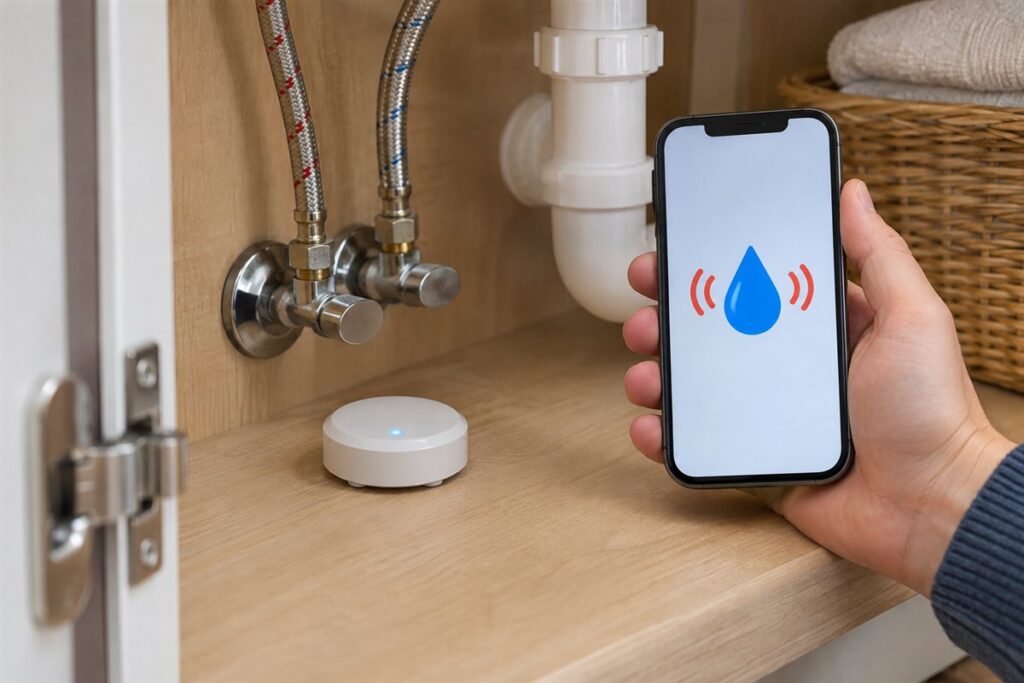
We have not used these products ourselves, so this guide does not claim any personal results. It describes how to choose a smart leak detector by looking at the sensor design, the way alerts reach you, the connection type and the power source, so you can match a unit to the spots in your home where water may collect. Use the table below to compare features, then check the maker details against your own layout and habits before you decide.
A smart leak detector is a small sensor that senses moisture at floor level and sends a notice through an app, a hub or a loud built-in alarm. Some have probes on a cable, others have contacts on the underside of the body. Common spots include under sinks, behind toilets, near water heaters, beside washing machines and in basements. Remember that a sensor only reports what it touches, so placement matters, and the maker claims should be read as their own statements. Think about how many rooms you want to cover and whether your wireless signal reaches them.
As an Amazon Associate we earn from qualifying purchases. Links on this site are affiliate links, and they do not change the information we give.
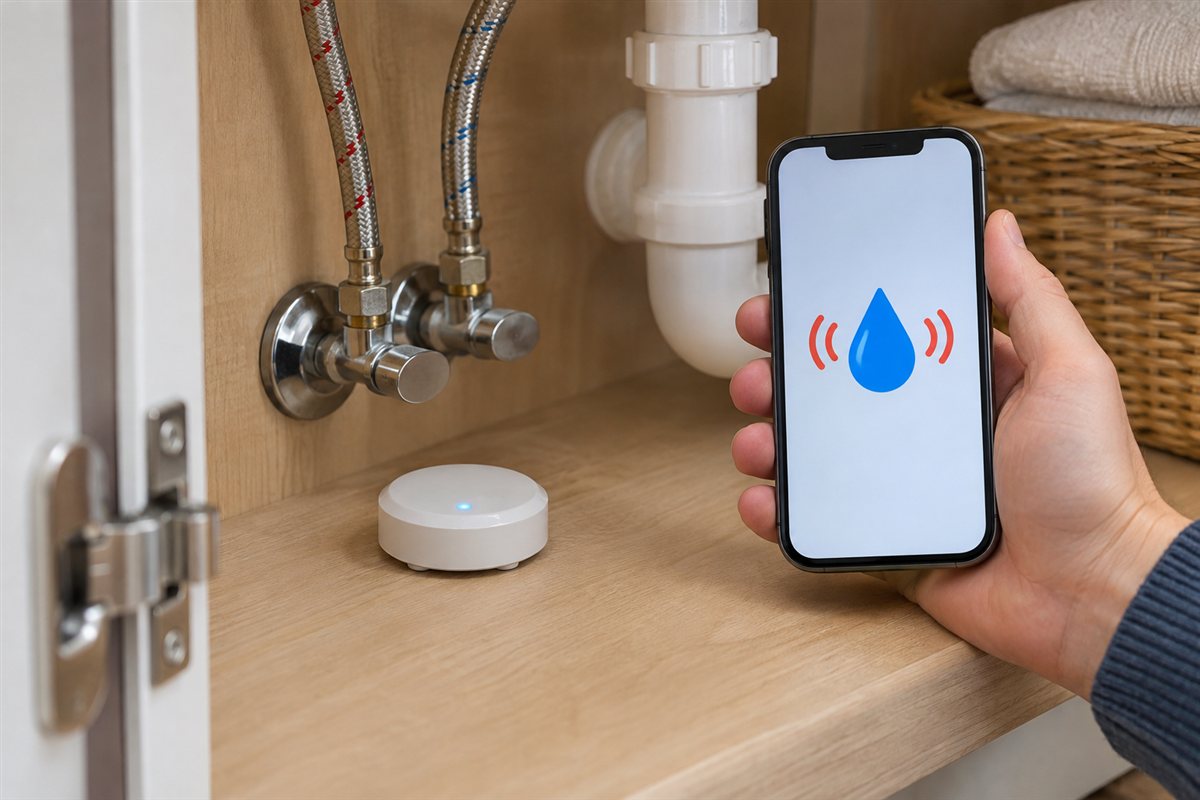
In this guide
Quick Picks
| Pick | Product | Best For |
|---|---|---|
| Best Overall | YoLink Water Leak Starter Kit (Hub + 4 Sensors) | LoRa long range with app, SMS and email alerts |
| Best Wi-Fi Kit | Govee WiFi Water Sensor 3-Pack | Gateway kit with a 100 dB alarm and drip probes |
| Best for Freeze Warnings | Ring Alarm Flood & Freeze Sensor | Leak plus low-temperature alerts for Ring Alarm homes |
| Best Without a Hub | Honeywell Home Wi-Fi Water Leak and Freeze Detector (CHW3610W1001) | Direct Wi-Fi with a cable sensor for wider coverage |
| Best Battery Life | GoveeLife Water Leak Detector 1s (3-Pack) | Long-range Sub-1G link with a maker-rated 5-year battery |
Our Picks
1. YoLink Water Leak Starter Kit — Best overall leak detection kit
This kit pairs a YoLink hub with four Water Leak Sensor 1 pucks, and range is its headline feature: the LoRa link is rated for up to a quarter mile in open air, far beyond what in-home Wi-Fi sensors manage, which matters for basements, outbuildings and the far corners the guide below tells you to cover. The sensors sit flat on the floor and report contact with water to the hub, which sends app, SMS and email alerts. YoLink’s device-to-device pairing can also trigger linked devices, such as a valve controller, even if the internet connection drops. Each sensor runs on two AAA batteries that YoLink rates for up to five years. The sensors themselves are silent, so alerts come from your phone and the hub rather than a siren at the leak. It suits larger homes and anyone who wants one kit that covers many wet spots at once.
View YoLink Water Leak Starter Kit on Amazon
2. Govee WiFi Water Sensor 3-Pack — Best Wi-Fi gateway kit
The Govee kit connects three H5054 sensors through an H5040 gateway on your 2.4 GHz Wi-Fi, so alerts reach you as email and app push notifications without a separate smart home hub. Each sensor carries two groups of probes on the back for pooling water and a front probe group for drips from pipes above, which covers both sensor layouts the guide below describes. When water touches a probe, the sensor also sounds a 100 dB alarm that you can lower or mute at the unit, useful when a leak starts in a basement you rarely visit. In the Govee app you name each sensor by its location, so an alert tells you which room to check first. Govee says the gateway can pair with up to 20 sensors if you want to expand later. It suits most homes that want phone alerts plus a loud local alarm in one box.
View Govee WiFi Water Sensor 3-Pack on Amazon
3. Ring Alarm Flood & Freeze Sensor — Best for Ring Alarm homes
If your house already runs a Ring Alarm system, this disc is the natural add-on. It reports over Z-Wave to a Ring Alarm or Alarm Pro base station placed within about 250 feet, and sends alerts to the Ring app when its underside contacts touch water. It watches for a second problem the guide below flags: low temperatures that can freeze pipes, warning you before a cold snap turns into a burst line. The sensor is a 2.95-inch disc that slides behind toilets, under sinks and beside water heaters without tools. Power comes from an included 3V lithium battery that Ring rates for up to three years. The trade-off is the requirement in the table below: no base station, no alerts, and some app features sit behind a Ring subscription. For homes already invested in Ring Alarm, though, setup is the quickest of any pick here.
View Ring Alarm Flood & Freeze Sensor on Amazon
4. Honeywell Home Wi-Fi Water Leak and Freeze Detector (CHW3610W1001) — Best without a hub
This detector connects straight to your home Wi-Fi, so there is no hub to buy or place. It senses water at the unit itself and through the included cable sensor, which extends the detection area along a floor or around a water heater — the cable layout the guide below recommends for wide, flat risk zones. The same unit logs temperature and humidity, and warns about freeze-risk conditions as well as leaks. When water is detected it sounds a 100 dBA buzzer and sends alerts through the Resideo app and by email, and each detector can be named for its room during setup. Power is three included AA batteries, and the detector is reusable after it dries out. It suits single-spot protection — one water heater, one laundry room — where you want remote alerts without building a whole sensor network first.
View Honeywell Home Wi-Fi Water Leak and Freeze Detector on Amazon
5. GoveeLife Water Leak Detector 1s (3-Pack) — Best battery life and range
The GoveeLife 1s kit is built for set-and-forget coverage. Its three H5059 sensors talk to the included gateway over a Sub-1G connection that GoveeLife rates for up to 1,804 feet of range, a design meant to hold a signal through several walls between a basement sensor and the gateway upstairs. The maker rates battery life at up to five years, the longest claim in this group, and the sensors carry an IP67 waterproof rating. A leak triggers a sound alarm at the sensor — with adjustable volume levels — plus SMS, email and app push alerts through the gateway’s 2.4 GHz Wi-Fi. As with the other Govee kit, you name each sensor by location in the app. It suits larger or multi-storey homes, second homes and rental properties where you cannot check sensors in person very often.
View GoveeLife Water Leak Detector 1s on Amazon
What to Look For
| Factor | Why it matters | What to check |
|---|---|---|
| Sensor design | Contacts, probes and cables reach different spots and surfaces. | Check whether the sensor sits flat, on a cable or on a wall bracket. |
| Alert method | A loud alarm helps when you are home, while app notices help when you are away. | Look for both a local sound and a phone notice. |
| Connection | Wireless range varies, and basements can be weak spots. | Check whether it needs a hub, a home network or a direct link. |
| Power source | Replaceable batteries or built-in cells change upkeep. | Read the stated battery life and what the low-power warning looks like. |
| Extra readings | Some units also report temperature or humidity. | See which readings the app shows and how often it updates. |
| Size and mounting | Tight gaps behind appliances limit what fits. | Compare dimensions and look for flat, adhesive or screw options. |
Setup and Care Tips
- Place each sensor flat at the lowest point near the spot you want to watch.
- Test the alert path after setup by following the maker steps in the manual.
- Wipe the contacts now and then so dust and residue do not build up.
- Check battery status on a regular schedule and keep spares on hand.
- Keep the app updated and make sure notices are allowed on your phone.
Mistakes to Avoid
- Placing a sensor on a shelf or counter where water would never reach it.
- Buying a hub-based set without checking that the hub fits your network.
- Ignoring low-battery warnings until the unit goes quiet.
- Covering a sensor with clutter that blocks the contacts.
- Counting on a detector alone instead of also checking pipes and hoses by eye.
Which smart leak detector should you buy?
The best smart leak detector depends on your home size, your network and whether you already use a smart home system. The picks above fit different buyers, so match your situation to one of them.
- If you have a large home, a basement or outbuildings and want long range, go for the YoLink Water Leak Starter Kit.
- If you want phone alerts plus a loud local alarm without a smart home hub, choose the Govee WiFi Water Sensor 3-Pack.
- If you already own a Ring Alarm system and worry about frozen pipes, the Ring Alarm Flood & Freeze Sensor fits best.
- If you want to protect one spot such as a water heater or laundry room with no hub, look at the Honeywell Home Wi-Fi Water Leak and Freeze Detector, whose cable sensor covers a wider area.
- If you manage a second home or rental and cannot check sensors often, choose the GoveeLife Water Leak Detector 1s (3-Pack) for its long-range link and long maker-rated battery life.
Count the places that need coverage first. A single appliance may need only one sensor, while a house with a kitchen, two bathrooms, a laundry room and a water heater needs several. Kits give you more sensors for each purchase, but a single unit can be enough for a small apartment.
Decide where water could collect and which alert style you need, then choose the pick whose connection type fits your home.
Where should you place water leak sensors around the house?
Place water leak sensors flat on the floor at the lowest point near each risk spot. Water flows downhill, so a sensor on a shelf will not notice a leak until it is too late.
Prioritize these locations:
- Water heater: tanks can fail and leak, so place a sensor in the drain pan or on the floor beside it.
- Washing machine: hoses and valves are common trouble spots, so put one by the hoses or in the drip pan.
- Under sinks: kitchen and bathroom cabinets collect drips from supply lines and drains.
- Behind toilets: small supply line leaks often show up here first.
- Dishwasher and refrigerator: a sensor near the supply line or ice maker line can help.
- Basement low points: place one near a sump pump, a floor drain or the lowest corner.
Keep each sensor clear of clutter, and make sure the contacts face the floor if the design needs it. Cable-style sensors work well along a wall where water may spread across a wide area. For each location, think about where water would travel first, then put the sensor there. If a sensor is behind an appliance, check that it fits through the gap.
Wi-Fi vs hub-based leak sensors: which connection is better?
Wi-Fi sensors are simpler to set up, while hub-based sensors usually reach farther and run longer on batteries. The better choice depends on how many sensors you need and where they will sit.
Direct Wi-Fi sensors connect to your router without a separate hub. The Honeywell Home detector in this guide works this way. They suit one or two spots close to the router, but each unit uses your wireless network, and basements can be weak spots for signal.
Gateway kits use a small hub that connects to your router, and the sensors talk to the hub on a low-power link. The Govee and GoveeLife kits work like this, and the YoLink kit uses a hub with a long-range link. This design can reach basements and far corners more reliably and tends to be easier on batteries.
Smart home platform sensors such as the Ring disc need the matching base station. They are convenient if you already own it, but useless without it.
Check these points on the listing:
- Whether a hub or base station is required and included.
- Which Wi-Fi band the device supports, since many gateways use 2.4 GHz only.
- Whether the system keeps working if the internet drops.
- Whether some alerts or history need a paid subscription.
How do smart leak detectors alert you?
Smart leak detectors alert you through a phone notification, a text or email message, a built-in siren, or a mix of these. The best setup uses both a local sound and a remote alert.
A loud siren helps when you are at home, because you can hear a leak start in another room. A phone alert helps when you are away, because it can reach you at work or on vacation. Some systems also send alerts to other people, so a family member or neighbor can check the house.
Think about these alert factors:
- Silent sensors: some sensors have no siren and rely on the hub and phone. That suits owners who always carry a phone but may miss a leak in an empty house.
- Volume control: adjustable or muteable alarms avoid false alarm stress once you have checked the leak.
- Sensor names: naming each sensor by room tells you where to look first.
- Phone settings: make sure notifications are allowed and not silenced by focus modes.
Test the alert path after setup by following the maker steps. Touch the contacts with a damp cloth, confirm that the alert arrives, and then dry them. Repeat the test now and then so you know the system still works.
What to check before you buy a leak detector
Check the connection, the power source, the size and the terms before you buy. These details decide whether the detector works in your home.
- Connection requirements: confirm whether you need a hub, a base station or only your Wi-Fi.
- Network fit: check the supported Wi-Fi band and signal in the spot where the sensor will sit.
- Number of sensors: count your risk spots and see how many sensors the kit includes and how many you can add.
- Power source: read the battery type, the stated battery life and what the low-battery warning looks like.
- Size and placement: compare the dimensions to the gap behind or under the appliance.
- Alerts: confirm local siren, app alerts and any text or email options.
- Extra features: check for freeze or temperature alerts if cold pipes are a worry.
- Subscriptions: check whether any features need a paid plan.
- Warranty and returns: read the terms on the listing.
Also confirm that your phone works with the app. Look at the app description on the listing, and make sure the maker supports your phone system.
How do you maintain a smart leak detector over time?
Check batteries, wipe the contacts and test the alert on a regular schedule. A sensor that sits quietly for years still needs light upkeep to be trusted.
Batteries are the most common reason a sensor goes silent. Makers state battery life in their own figures, but real life varies with signal strength, temperature and how often the sensor reports. Look for a low-battery warning in the app and keep spare batteries of the right type on hand.
A simple routine works well:
- Every few months, open the app and confirm every sensor shows as online.
- Wipe the contacts or probes with a dry cloth to remove dust and residue.
- Touch the contacts with a damp cloth to confirm that an alert arrives, then dry them.
- After a router change or a new Wi-Fi password, reconnect the hub or sensors.
- Replace any sensor that has been soaked beyond what the maker allows.
If a sensor goes offline, move it closer to the hub or router and see whether the signal improves. Thick walls, metal appliances and basements can weaken wireless links. Also keep an eye on the pipes and hoses themselves. A sensor is a backup, and a look at the supply lines for corrosion, bulges or drips remains worthwhile.
Are smart leak detectors worth it, and who should skip them?
Smart leak detectors are worth it if water damage would be costly or hard to notice, such as in a basement, a rental or a house you leave empty. They are less useful if you are home all day and already check your appliances.
Here are the honest trade-offs:
- Is it worth paying more? Long range and long battery life help in large or hard-to-reach homes. A simple Wi-Fi unit may be enough for one spot.
- They detect, not stop: a sensor tells you about water but does not shut off the supply. For that you would need a separate valve device.
- Upkeep: batteries need checking and sensors need wiping.
- False alarms: a wet floor from a spill can trigger an alert.
Who should skip them? Anyone with no wireless signal at the risk spots and no plan to add a hub, and people who want automatic shutoff and will not buy a valve device. A basic alarm without smart features may suit very simple needs.
Compare the picks above, check the current listing for the connection type and what is included, then choose the detector that fits the spots you need to cover.
Matching Smart leak detectors to Real Life: Four Situations Buyers Describe Most
Most disappointment with smart leak detectors does not come from a bad product. It comes from a good product bought for the wrong job, the wrong room or the wrong routine. The picks above were chosen for different strengths, and the clearest way to choose between them is to start with the situation that sounds most like yours, then check the details of that pick against your own space, habits and expectations. Work through the four situations below honestly, because the best leak detector for a neighbour, a colleague or an online reviewer may be a poor match for the way you actually live.
A laundry room above finished rooms
Here, a leak here travels downward fast, so a sensor behind the machine plus an alert that reaches you at work is the core of the setup. Buyers in this position often focus on the wrong headline detail and only notice the mismatch once the leak detector is in daily use. A calmer approach is to write down the one outcome you need, the one frustration you want to avoid, and the space or routine the leak detector must fit, then score each pick above against those three lines. The pick that wins on your own list will serve you better than the pick that wins on a generic list, and it will usually be obvious once your priorities are written down.
A basement with a water heater and sump
For this kind of use, distance and concrete challenge signals, so range, hub placement and a sensor at each appliance matter more than app extras. Think about who else is involved, how often the leak detector will be used each week, and what happens on the busiest or worst day rather than the best one. A choice that copes gracefully with the awkward day, the guest, the bad weather or the rushed morning is worth more than a choice that only shines in ideal conditions. Compare the picks above with that harder day in mind, and be wary of paying for strengths you will rarely call on while missing a basic that you will need constantly.
A rental property you manage from afar
In this situation, alerts that reach both you and the tenant, plus sensors that need little attention, protect the building without constant visits. That starting point changes what you should look for first when you read the pick descriptions above. Instead of comparing every feature in order, begin with the one or two details that decide comfort and success here, and let the rest be secondary. It also helps to picture the second week, not just the first day: routines settle, novelty fades, and the leak detector has to keep earning its place when you are tired, busy or in a hurry. If a pick still looks right under those conditions, it is very likely the right direction.
A kitchen and bathroom refresh
Here, new plumbing deserves new protection while access is easy, with sensors placed before cabinets and flooring make later fitting awkward. Buyers in this position often focus on the wrong headline detail and only notice the mismatch once the leak detector is in daily use. A calmer approach is to write down the one outcome you need, the one frustration you want to avoid, and the space or routine the leak detector must fit, then score each pick above against those three lines. The pick that wins on your own list will serve you better than the pick that wins on a generic list, and it will usually be obvious once your priorities are written down.
The Details Behind the Details: Reading Leak detector Listings Like an Owner
The main buying guide above introduces the criteria that matter for smart leak detectors. This section slows down and looks at how to judge each one from a listing, a box and a first week of ownership, without needing specialist knowledge. None of these checks requires special tools. They require attention, a tape measure where size is involved, and a willingness to believe your own measurements and routines over attractive presentation.
Sensor reach where water actually escapes
The short version: place protection at washing machines, water heaters, under sinks and beside toilets, because a detector only helps where its probes touch water. This factor also interacts with the others, so avoid judging it in isolation: a strong showing here can compensate for a modest showing elsewhere, and a weakness here can undermine an otherwise excellent leak detector. As you read the individual pick reviews above, keep this criterion in mind and notice which picks the guide itself associates with it. That pattern is deliberate, and following it is the fastest route to a shortlist of one or two.
Connection type and range through the home
What this means in practice: direct Wi-Fi suits a few points, while hub based systems often travel better through walls and floors to distant or basement sensors. When you read a listing, look for this point described in plain, specific language rather than in slogans, and compare how each pick above presents it. If two picks look similar overall, this is often the factor that should break the tie, because it is the one you will feel every single time you use the leak detector. After purchase, it is also the first thing to check during any return window: if this detail is wrong for you, the rest of the product rarely makes up for it.
Alert speed and who receives it
Put simply, check how alerts reach you away from home, whether several people can receive them, and whether a loud local alarm sounds for anyone in the house. A useful habit is to separate what the maker states from what the maker implies. Stated details can be compared between the picks above; implied promises cannot. Ask what evidence the listing gives, what it leaves vague, and whether the vague part happens to be the part you care about most. Owners who do this before ordering tend to keep their leak detector for years, while buyers who skim this factor are the ones writing frustrated comments a month later.
Battery life and maintenance burden
The short version: sensors are forgotten by design, so long battery life, low battery warnings and easy battery changes decide whether the system still works in year three. This factor also interacts with the others, so avoid judging it in isolation: a strong showing here can compensate for a modest showing elsewhere, and a weakness here can undermine an otherwise excellent leak detector. As you read the individual pick reviews above, keep this criterion in mind and notice which picks the guide itself associates with it. That pattern is deliberate, and following it is the fastest route to a shortlist of one or two.
Living With Your Leak detector: Setup, Everyday Use and Care in Practice
A calm first setup
The best first session with any leak detector is a slow one. Begin by pairing each sensor beside the hub or router first, naming it by its exact spot, then placing it and testing with a damp cloth or a small amount of water as the maker directs. Resist the urge to judge the purchase in the first ten minutes, because most smart leak detectors feel unfamiliar before they feel right, and many early complaints are really setup details that take minutes to correct. Keep the packaging and paperwork until you have lived with the result for a few days, and make notes on anything you adjust, so you can return to a setting or arrangement that worked instead of rediscovering it later.
The daily routine that makes it feel effortless
Ownership settles down once a small routine forms. For smart leak detectors, that routine is treating every alert as worth a look the same day, even when it turns out to be a mop bucket or a spill, so the habit of responding stays strong. None of this takes long, and that is the point: thirty seconds of attention at the right moment prevents most of the problems that owners later blame on the product. Households share these habits best when they are simple and visible, so agree the routine with anyone else who uses the leak detector, and keep any needed accessories within reach of the place where the routine happens.
Cleaning without damaging anything
Cleaning is where good intentions most often cause harm, usually through water, sprays or force in the wrong place. The safe pattern here is wiping the sensor probes and the floor beneath them, checking for corrosion or dust, and keeping sensors out of standing cleaning water. Always follow the maker instructions for your specific model where they differ, because materials and constructions vary across the picks above. Little and often beats a rare, aggressive deep clean: grime, dust and residue are easy to shift when they are fresh and stubborn once they have been left through a season of use.
Storage and the quiet months
How a leak detector is stored decides how it greets you next season or after a break. Good practice is keeping spare batteries in the correct sizes with the detector spares, and a written list of sensor locations and when each battery was changed. Before storing, give everything a final check for damage, looseness or wear that will be easier to sort now than later, and make a short note of anything that needs replacing. That note, kept with the leak detector, turns the next setup from an inspection into a simple, confident start.
Accessories worth considering, and those to skip
Useful additions around smart leak detectors include extension probe cables where the maker offers them, spare batteries, and labels for naming each sensor location clearly. Buy accessories to solve a problem you have actually met, in the order you meet it, rather than collecting every add on at the point of purchase. Equally, skip accessories that duplicate what your chosen pick already includes, that only suit a different model, or that promise to fix a mismatch that should really be solved by choosing a different pick in the first place.
Head to Head: How the Picks in This Guide Differ in Practice
Readers often ask for a single winner, but the honest answer is that each pick above was included for a different reader. This comparison uses only the roles the guide itself gives each product, and translates those roles into the question you should ask before ordering. If your answer points at the same pick from several angles, you have found your match. If it points at two, use the criteria section above to break the tie.
YoLink Water Leak Starter Kit earns its place here as best overall leak detection kit. It will suit you best when that strength is the one your situation demands most, and when any trade offs described in its review are ones you can accept without thinking about them weekly. If you find yourself hoping the review said something different about a basic point, take that as useful information and move your attention to the pick whose stated role already matches what you were hoping for.
Consider Govee WiFi Water Sensor 3-Pack, described above as best Wi-Fi gateway kit, when that role is your deciding factor. Before ordering, re-read its individual review with your measurements, your routine and your household in mind, and check the parts of the listing that confirm the details the guide highlights. If those checks pass, this is a confident choice; if they raise doubts, the guide gives you alternatives in the same category rather than leaving you to start the search again.
Ring Alarm Flood & Freeze Sensor is presented in this guide as best for Ring Alarm homes. Choose this direction if that description matches the outcome you wrote down earlier, and if the details of the review above line up with your space, routine and expectations. Look elsewhere in the list if your priority is different, not because this pick falls short, but because another pick was included precisely for readers whose needs point the other way. That distinction, fit rather than rank, is the most reliable way to use a guide like this one.
Honeywell Home Wi-Fi Water Leak and Freeze Detector (CHW3610W1001) earns its place here as best without a hub. It will suit you best when that strength is the one your situation demands most, and when any trade offs described in its review are ones you can accept without thinking about them weekly. If you find yourself hoping the review said something different about a basic point, take that as useful information and move your attention to the pick whose stated role already matches what you were hoping for.
Consider GoveeLife Water Leak Detector 1s (3-Pack), described above as best battery life and range, when that role is your deciding factor. Before ordering, re-read its individual review with your measurements, your routine and your household in mind, and check the parts of the listing that confirm the details the guide highlights. If those checks pass, this is a confident choice; if they raise doubts, the guide gives you alternatives in the same category rather than leaving you to start the search again.
Planning the Purchase: Timing, Checks and Total Cost of Ownership
The purchase itself is only the first commitment. Owning smart leak detectors well involves consumables, wear parts, occasional accessories and, above all, your own time, so think about the whole period you expect to keep the leak detector rather than the day it arrives. None of this needs a spreadsheet. It needs a realistic look at how often you will use it, what will need replacing or refilling, and whether those items are easy to find for the model you choose. A pick that is simple to maintain and easy to source parts for will usually cost you less effort over its life than a pick that is marginally more impressive on day one.
Timing deserves a thought as well. Measure and prepare before you order, not after a box is sitting in the hall, and avoid buying in a rush the night before the event, trip, season or project that depends on it, because rushed buyers skip exactly the checks that prevent returns. If you are buying as a gift, keep the receipt route simple, favour the pick whose stated role is the most versatile, and remember that fit, size and personal routine matter more with smart leak detectors than with most purchases, so an easy exchange is part of a thoughtful gift.
Finally, do a last, deliberate pass before you confirm an order. Re-read the one pick review that matters, confirm the size, shape, fitting or compatibility detail that applies to your home, check what is included in the box against what you assumed, and confirm the delivery and returns arrangements while they are still easy to change. That five minute pass is unglamorous, and it is also the difference between the confident owners and the disappointed ones in almost every category, including this one.
When Something Feels Wrong: A Troubleshooting Mindset
Most problems with smart leak detectors announce themselves small: a change in feel, sound, fit or result that was not there in the first weeks. Treat that change as information rather than as a verdict on the whole purchase. Work from the simplest explanations first, because setup drift, wear, dirt, batteries, connections and environment explain far more cases than genuine faults do. Change one thing at a time, test honestly, and give the change a fair chance before moving to the next possibility, otherwise you will never know what actually helped.
Keep a few notes as you go, even if they are only dates and a line each in your phone. A short record of when a problem started, what changed around the same time and what you tried turns a vague frustration into a pattern you, a maker support team or a repairer can act on. And know the point at which to stop troubleshooting: anything involving damaged electrics, structural parts, safety features or a problem that keeps returning after the maker guidance has been followed belongs with the maker, a qualified professional or a replacement, not with another evening of hopeful adjustment.
FAQ
Where should a smart leak detector go?
Common spots are under sinks, beside the washer, near the water heater and in low corners of a basement. Put it flat on the floor where water would settle first.
Do I need a hub for a smart leak detector?
Some models connect to your home network directly, while others rely on a hub or bridge. Check the connection type on the product page and compare it with the devices you already own.
How many leak sensors do I need for a house?
Plan one sensor per risk spot, such as the water heater, washer, each sink and each toilet. A small home may need only a few, while a large house may need more. Choose a kit that lets you add sensors later.
Do smart leak detectors shut off the water?
Most do not. They detect water and send an alert, and shutting off the supply needs a separate valve device. Check the listing to see whether a shutoff feature is included.
How long do leak detector batteries last?
It depends on the model, and makers state their own figures. Some units are rated for years, but real life varies with signal strength and alerts. Check the low-battery warning in the app.
Will a smart leak detector work if the Wi-Fi goes down?
A local siren can still sound, but remote alerts need a working connection. Some systems keep a local link between devices. Read the maker notes to see what continues during an outage.
Can a leak detector sense a leak behind a wall?
No. A sensor only reports water that reaches its contacts or probe. Hidden leaks inside walls need other checks, such as inspecting pipes and watching your water bill.
Do water leak sensors give false alarms?
They can trigger on a spill, a wet mop or condensation. Dry the contacts and the alert clears on most models. Placing the sensor away from normal splash zones helps.
What is a freeze sensor on a leak detector?
It is a temperature reading that warns when the air near pipes gets cold. It can give you time to act before a pipe freezes. The Ring and Honeywell picks above include this feature.
Are cable sensors better than flat sensors?
A cable sensor covers a wider strip of floor, while a flat sensor watches one spot. Cable styles suit water heaters and long walls. Choose by the area you need to cover.
Where should I put the first sensor?
Behind or beside the appliance most likely to leak over a finished floor, commonly the washing machine or water heater, because that single spot covers a frequent and costly failure. This is one of the questions owners most often wish they had asked earlier, because the answer shapes daily satisfaction with a leak detector far more than most headline features do. Read the relevant pick reviews above with this question in mind, and let the answer steer you between picks rather than trying to make one pick fit every situation.
Will a detector work without internet?
The local alarm on the sensor usually still sounds, while phone alerts need a connection, so a system with both gives you cover at home and away. As with most questions about smart leak detectors, the details of your own home and routine decide the final answer, so use this as the starting point and then check the specific guidance for the pick you are considering. If the question matters enough to affect the purchase, it is worth resolving before you order rather than discovering the answer afterwards.
How do I test a sensor safely?
Follow the maker test method, often touching the probes with a damp finger or cloth, and confirm both the local sound and the phone alert arrive before you trust the placement. This is one of the questions owners most often wish they had asked earlier, because the answer shapes daily satisfaction with a leak detector far more than most headline features do. Read the relevant pick reviews above with this question in mind, and let the answer steer you between picks rather than trying to make one pick fit every situation.
Can sensors go under appliances?
Slim sensors and probe cables are made for tight spots, but check the clearance and keep the main body where you can reach it for battery changes. As with most questions about smart leak detectors, the details of your own home and routine decide the final answer, so use this as the starting point and then check the specific guidance for the pick you are considering. If the question matters enough to affect the purchase, it is worth resolving before you order rather than discovering the answer afterwards.
What should I do after an alert turns out to be a real leak?
Turn off the water to that appliance if you can, dry the area, find the source before resetting the sensor, and only place it back once the floor is properly dry. This is one of the questions owners most often wish they had asked earlier, because the answer shapes daily satisfaction with a leak detector far more than most headline features do. Read the relevant pick reviews above with this question in mind, and let the answer steer you between picks rather than trying to make one pick fit every situation.
The Short Version
Pick a smart leak detector by sensor design, alert method, connection, power source and size. Place each unit where water would collect, follow the manual and check batteries on a steady schedule.
Related Guides
- 6 Best Water Leak Detectors for Ice Maker Lines (2026)
- How to Choose the Best Metal Detectors: Buyer's Guide (2026)
- How to Choose the Best Smart Air Purifiers: Buyer's Guide (2026)
- How to Choose the Best Smart Blinds: Buyer's Guide (2026)
- How to Choose the Best Smart Ceiling Fans: Buyer's Guide (2026)