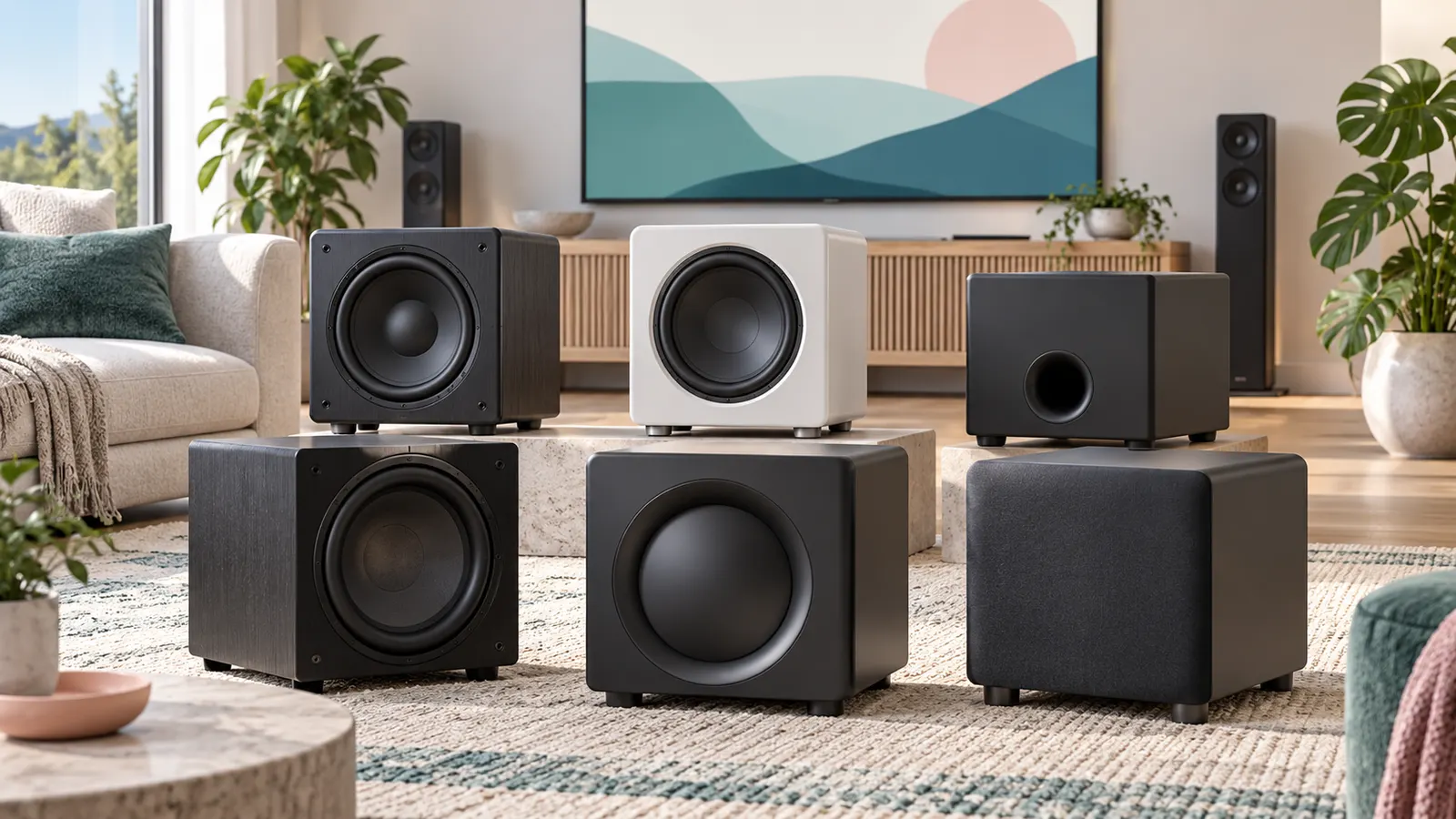
A powered subwoofer adds the low end that small speakers and soundbars cannot reproduce on their own. It has a built-in amplifier, so you only need a signal cable and a power outlet. We have not used these products ourselves, so this guide makes no claims about results. Instead, it shows how to read a product page and match a unit to your space.
The right choice depends on your room, your speakers and what you play most. A small apartment needs a different design than a large basement theater. Work through the factors below, compare listings with the same checklist, and you will avoid most of the common mismatches.
As an Amazon Associate we earn from qualifying purchases. Links on this site are affiliate links, and they do not change the information we give.
In this guide
Quick Picks
| Pick | Product | Best For |
|---|---|---|
| 1 | Polk Audio PSW10 10″ Powered Subwoofer | Best budget pick for small rooms |
| 2 | BIC America F12 12″ Powered Subwoofer | Best value 12-inch for movies |
| 3 | Klipsch R-12SW 12″ Powered Subwoofer | Best for big bass in larger rooms |
| 4 | Klipsch R-12SWi 12″ Wireless Subwoofer | Best wireless option |
| 5 | SVS SB-1000 Pro Sealed Subwoofer | Best sealed design with app control |
Our Picks
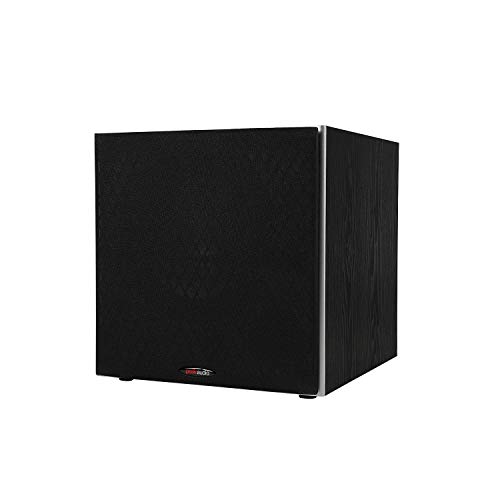
1. Polk Audio PSW10 10″ Powered Subwoofer — Best budget pick for small rooms
The PSW10 is the compact end of this list: a front-firing 10-inch woofer in a ported cabinet that uses Polk’s Power Port venting to keep port noise down. The built-in amplifier is rated at up to 100 watts of dynamic power, which the maker aims at small to medium rooms rather than large theaters. Connection flexibility is a strength for a budget unit. Alongside the line-level input, it offers speaker-level inputs and outputs, so it can join a stereo amp or older receiver that has no dedicated subwoofer output at all. The back panel carries the controls the guide above asks for: a volume dial, an adjustable low-pass crossover and a phase switch, so you can blend it with bookshelf speakers by ear. The cabinet is roughly 14 inches wide, which helps in apartments and bedrooms. If your speakers are small and your room is modest, this is the straightforward way to fill in the low end they cannot reach.

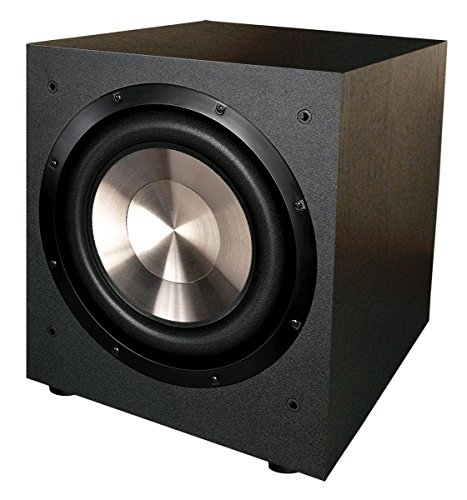
2. BIC America F12 12″ Powered Subwoofer — Best value 12-inch for movies
The F12 steps up to a 12-inch front-firing, injection-molded long-throw woofer, driven by a BASH-designed amplifier rated at 475 watts peak and 150 watts RMS. BIC rates the frequency response down to 25 Hz, and the cabinet uses the maker’s Venturi port design, intended to cut turbulence noise when effects get loud. That combination is why this model is the value pick for movie watchers: it aims at the depth and output the guide associates with ported designs, in a cabinet about 17 inches wide that still fits beside most TV stands. Inputs cover both line-level RCA and speaker-level connections with gold-plated terminals, and the back panel has crossover and volume controls plus an auto on/off setting, so the unit wakes with your receiver and sleeps when it is off. It suits medium rooms where a 10-inch sub feels stretched but a premium model is more than the system needs.
View BIC America F12 on Amazon

3. Klipsch R-12SW 12″ Powered Subwoofer — Best for big bass in larger rooms
Klipsch builds the R-12SW around a 12-inch front-firing woofer with the maker’s signature copper-spun cone, paired with an all-digital amplifier rated at up to 400 watts. The listed frequency response is 29 to 120 Hz, and the ported cabinet is tuned for the output and depth that action soundtracks demand in bigger spaces. At 14 inches wide, 16 inches tall and 18.5 inches deep, it is one of the larger cabinets here, so measure your intended spot against those dimensions before ordering, as the guide above advises. The rear panel keeps setup conventional: line-level and LFE inputs for a receiver’s subwoofer output, plus low-pass crossover and phase controls for blending with your main speakers. The brushed black polymer veneer finish is understated enough for a living room corner. Choose this one if your room is on the large side and movie impact matters more than a compact footprint.
4. Klipsch R-12SWi 12″ Wireless Subwoofer — Best wireless option
The R-12SWi takes the same basic formula as the wired pick above — a 12-inch front-firing, spun-copper woofer and a 400-watt amplifier — and removes the long signal cable from the equation. A 2.4 GHz wireless transmitter is included in the box and comes pre-paired with the subwoofer, so setup is a matter of connecting the transmitter to your receiver and placing the sub where it works best in the room. That freedom is the real benefit: as the setup tips in this guide note, bass changes a lot with placement, and a wireless link lets you try corners and side walls without routing a cable across the floor. The sub still needs a power outlet nearby, and a wired input remains available if you prefer it. The brushed black vinyl cabinet matches the rest of the Klipsch Reference line. Pick this version if your best subwoofer spot is nowhere near your receiver.
View Klipsch R-12SWi on Amazon

5. SVS SB-1000 Pro Sealed Subwoofer (Black Ash) — Best sealed design with app control
The SB-1000 Pro is the sealed entry in this list, and it follows the pattern the guide describes for the type: a 12-inch driver in a compact sealed cabinet, roughly 13 to 14 inches in each dimension, aimed at tight, controlled bass rather than maximum output. SVS rates the amplifier at 325 watts RMS and the response as reaching down to 20 Hz. What sets it apart is the control side. Instead of only back-panel dials, it works with the maker’s smartphone app, which adjusts volume, crossover, phase and parametric EQ and stores presets, so you can fine-tune the blend from your seat rather than behind the cabinet. Line-level RCA inputs and outputs make it easy to connect to a receiver or to add a second sub later. This Black Ash version suits music-first listeners and smaller rooms that want a discreet cabinet, and anyone who expects to spend time dialing in the crossover and EQ.
View SVS SB-1000 Pro on Amazon
What to Look For
| Factor | Why it matters | What to check |
|---|---|---|
| Driver size | Larger drivers usually move more air, which helps with deep bass in bigger rooms. | Match the driver to your room size and how loud you listen. |
| Enclosure type | Sealed designs tend toward tight, controlled bass, while ported designs favor depth and output. | Decide whether music or movie effects matter more to you. |
| Inputs | The connection decides which receivers, soundbars and TVs will work. | Look for a line-level or low-frequency input that fits your gear. |
| Controls | Crossover and phase controls let you blend the sub with your main speakers. | Check for a dial or app that adjusts crossover, level and phase. |
| Wireless option | A wireless link reduces cable clutter across a living room. | Confirm the transmitter is included and works with your source. |
| Cabinet and footprint | Cabinet size and finish affect placement and how well it blends in. | Measure the space and compare to the listed dimensions. |
Setup and Care Tips
- Try a few spots in the room, because bass changes a lot with placement near walls and corners.
- Set the crossover so the sub handles only the lowest notes and your main speakers handle the rest.
- Adjust the level slowly by ear with familiar music until the bass blends in rather than stands out.
- Keep the cabinet away from curtains and clutter that can block a port or rattle.
- Dust the grille with a soft dry cloth and keep drinks away from the unit.
Mistakes to Avoid
- Choosing the largest driver for a small room, which can overwhelm the space.
- Ignoring the input type until the unit arrives and does not match your receiver.
- Pushing the level too high instead of fixing placement and crossover settings.
- Placing the sub on a hollow shelf that vibrates and adds buzzing.
- Assuming a wireless link removes the need for a power outlet nearby.
How a Powered Subwoofer Fits Into a System
A powered subwoofer combines a driver, a cabinet, and a built-in amplifier in one box. Its job is to handle the lowest part of the sound spectrum, the rumble in an action film or the weight of a bass line, so that your main speakers or soundbar can focus on voices and detail. Because the amplifier is built in, you only need to connect it to a source and a power outlet.
There are two common ways to connect. A line-level input, usually a single RCA jack labeled LFE or sub in, carries a signal from a receiver or amplifier. Speaker-level inputs tap the signal from the speaker terminals, which is useful with stereo amplifiers lacking a dedicated output. Some models are wireless, with a small transmitter that avoids a long cable run, though they still need mains power.
- Check which inputs your receiver or soundbar provides before you buy.
- Note the length of cable you will need between the subwoofer and the source.
- Confirm whether the model has a power switch, an auto-on feature, or both.
Understanding the Specifications
Subwoofer listings are full of numbers, and not all of them are equally useful. Driver size is the one most people notice. Ten and twelve-inch drivers are common, with larger drivers generally moving more air. Amplifier power is often quoted in watts, yet different makers measure it differently, so use it as a rough guide rather than a direct comparison.
Frequency response describes the range the unit can reproduce. A lower number at the bottom end suggests deeper bass, but the figure depends on how it was measured. Treat any single number with caution, and look for descriptions that explain the conditions.
What matters more than the headline figures
Cabinet design, driver quality, and how the unit behaves in your room often matter more than the figures. If specifications are close between two models, think about the features that affect daily use: a clear level control, a phase switch, and a crossover adjustment.
Placement and the Role of Your Room
Bass behaves differently from other sounds. Low frequencies have long wavelengths that interact with walls, corners, and furniture, creating peaks and dips in different seats. A subwoofer that sounds boomy in one spot can sound balanced a few feet away.
A well-known trick is the crawl test. Place the subwoofer where you normally sit, play a bass-rich track, and crawl around the room to find the spot where the bass sounds clearest. Then put the subwoofer in that spot. It sounds odd, but it is a practical way to find a good position.
- Try the front of the room near the main speakers first.
- Move it a short distance along the wall and listen again.
- Avoid placing it directly in a corner unless you want extra, sometimes overpowering, output.
- Keep it away from thin shelves that might rattle.
Setting Crossover, Level, and Phase
The crossover tells the subwoofer where to take over from your main speakers. If your speakers are small, a higher setting hands more of the low range to the subwoofer. With larger speakers, a lower setting leaves them to carry more. Consult your speaker documentation for a suggested value, and adjust by ear.
Level is easy to overdo. Bass that draws attention to itself is usually too high. Aim for a blend where the subwoofer supports the music instead of announcing itself. Turn the volume down slightly after setting it, then listen to a familiar recording.
The phase control, when available, flips the timing of the subwoofer relative to the speakers. Choose the setting that sounds fuller at your seat. If your receiver has an automatic room calibration feature, it can help, but listening checks are still worthwhile.
Sealed Versus Ported: A Practical Comparison
| Feature | Sealed cabinet | Ported cabinet |
|---|---|---|
| Bass character | Tight and controlled | Louder and deeper for its size |
| Cabinet size | Often more compact | Often larger |
| Best for | Music and smaller rooms | Movies and larger rooms |
| Placement | More flexible | Needs room around the port |
Neither is better in every case. A sealed design can feel precise in music, while a ported design can add impact in films. If your room is small and shared with neighbors, tighter bass may be the more considerate option.
Matching a Subwoofer to Your Listening Habits
How you listen shapes what you need. Someone who mainly watches films at moderate volume may be happy with a compact unit that adds weight to explosions and low musical notes. A person who loves electronic music or organ recordings may crave deeper, more controlled output. Think honestly about the content you play most often and the volume you actually use.
Room size matters, too. A small bedroom can be filled by a modest driver, and a very large unit may overwhelm the space instead of improving it. In a big open room, a small unit may run at its limits. Match the scale of the unit to the room, and leave headroom so it does not strain on peaks.
Movies
Film soundtracks have a dedicated low-frequency channel, so a subwoofer with solid output adds impact. Look for units that handle sudden bursts without sounding strained.
Music
Here, speed and clarity count. A well-blended subwoofer should be hard to notice until you switch it off and feel that something is missing.
Gaming and streaming
Gaming adds sudden effects, and many streaming services use compressed audio, so a well-set unit helps keep bass from dominating dialogue.
Connection Choices Step by Step
- Switch off all equipment before connecting anything.
- Plug one end of a subwoofer cable into the sub or LFE output on your receiver or soundbar.
- Connect the other end to the line input on the subwoofer.
- Plug the power cable into a wall outlet, ideally through a surge protector.
- Set the volume knob to a low or middle position and the crossover as advised in your speaker manual.
- Switch on the system and play a familiar track, then fine-tune the level.
If your system has no dedicated subwoofer output, check the manual for alternatives such as speaker-level inputs. Do not guess with wiring, and follow the maker’s instructions closely.
Glossary of Subwoofer Terms
- LFE: the low-frequency effects channel used in movie soundtracks.
- Crossover: the point where bass hands over between the subwoofer and speakers.
- Port: a tube or slot that lets air move to reinforce low notes.
- Driver: the moving speaker cone that produces sound.
- Room gain: the natural boost that low frequencies receive in small rooms.
- Phase: the timing relationship between the subwoofer and other speakers.
Living With Neighbors and Walls
Bass travels through floors and walls more easily than higher sounds. If you live in an apartment or share a wall, lower the level at night and consider placing the unit on a firm isolation pad. A decoupling mat reduces vibration passing into the floor. Avoid stacking it on hollow furniture that can buzz.
Many models include a night mode or a simple level knob you can turn down quickly. Talk to your neighbors if you plan a movie night with big effects, because courtesy goes a long way.
Care and Long-Term Handling
A subwoofer needs little attention, but a few habits extend its life. Dust the cabinet with a dry cloth and keep the grille free of fluff. Never press on the driver cone, because a dent changes how it moves. Leave space behind and around the unit so that the amplifier can shed warmth, and keep drinks away from the top surface.
If you move house, pack the unit upright in its original box when you still have it, and protect the driver and the controls. Unplug during storms or long absences if you wish, and follow the maker’s instructions on power and handling.
Common Mistakes and Quick Fixes
- Muddy bass: move the unit away from the corner and reduce the level.
- Hum or buzz: check cable connections and try a different outlet; keep audio cables away from power cords.
- Rattles: tighten screws on nearby shelves and put felt under loose objects.
- No sound: confirm the input, power switch, and receiver subwoofer output setting.
- Bass seems weak: check the phase, crossover, and whether the receiver is set to send low frequencies to the subwoofer.
Who Should Choose Which Type
Small rooms and desk systems suit a ten-inch design with modest output. Larger living rooms and home cinemas may call for a twelve-inch driver or bigger. Those who dislike running cables may like a wireless model, as long as a nearby power outlet is available. If you are building a stereo music setup, prioritize accuracy and integration over sheer output.
Quick Pre-Purchase Checklist for Subwoofer Shoppers
Before you add a subwoofer to your cart, run through these points. They are short, but they prevent most of the disappointments new buyers run into.
- Check the back panel of your receiver or soundbar for a subwoofer output, or find out whether it supports wireless pairing.
- Measure the spot where you plan to place the box, including height and depth.
- Decide how loud you can play in your home without disturbing neighbors or family.
- Think about the size of your room, since a small room may not need a very large driver.
- Confirm that you have the cable you need, usually a single shielded subwoofer cable.
- Read the maker’s description of controls so you know what you can adjust.
Ticking these off in advance saves time and avoids returns caused by simple mismatches.
Comparing Two Connection Styles in a Table
Another way to narrow your choice is to compare wired and wireless connections, since the way the box links to your system affects where it can sit.
| Point | Wired link | Wireless link |
|---|---|---|
| Placement freedom | Limited by cable length | Greater, within range |
| Cable clutter | One extra cable | Only a power cable |
| Setup steps | Plug in and set levels | Pair and then set levels |
| Possible drawbacks | Visible cable runs | Needs a clear connection and may add delay |
Both approaches can sound good. The right one depends on your room layout and how much you value flexibility.
When to Check the Manual or Ask for Help
If you hear a constant hum, a rattle, or no bass at all, begin with the simple checks. Make sure the power switch and input selection are correct, confirm the cable is firmly seated at both ends, and try a different input if one is available.
For anything beyond that, consult the owner’s manual and the maker’s support information. Do not open the cabinet yourself, because the amplifier inside carries electrical parts. A qualified technician is the right person for internal faults.
It is also worth keeping the original box for a while. If you need to return or send the unit in for service, the proper packaging protects the driver and cabinet during transport.
Mistakes New Buyers Make With Room Layout
Even a good subwoofer can disappoint when the room is working against it. A few common slips are easy to avoid.
- Hiding the box behind a sofa or inside a closed cabinet, which can muffle the output.
- Pushing the volume level too high, so bass swamps voices and music.
- Placing it directly on a hollow floor without a base or pad, which may add rattles.
- Skipping the maker guidance on crossover and phase settings.
Take a few minutes to adjust one setting at a time, and play familiar material while you do so. Small changes to position and level often make a bigger difference than people expect.
Choosing Powered subwoofers in More Depth
The main sections of this guide cover the headline differences between powered subwoofers. This section slows down and looks at the decisions underneath those headlines, written for listeners adding low bass to films and music without a separate amplifier. None of the points below require specialist knowledge. They require something rarer in online shopping: a clear picture of your own situation in living rooms, home cinemas, music rooms and small studios, written down before the comparison tables start to blur together. Work through the four points in order, note which ones matter most to you, and then return to the picks above with those priorities fixed. Buyers who do this usually choose quickly and confidently, because the right answer tends to stand out once the criteria are personal rather than generic.
Driver size and cabinet type for the room volume you need to fill
Start with driver size and cabinet type for the room volume you need to fill. This sounds like a small detail when you read a listing, but it is usually the first thing you notice in daily use with powered subwoofers. Think about your own routine in living rooms, home cinemas, music rooms and small studios: how often the item is used, who else uses it, and what happens on the busiest or most awkward day, not just on an easy one. Write your real requirements down before you compare models, because listings are written to make every version sound suitable for everyone. If a product page does not state this point clearly, treat that as useful information in itself and check the maker’s own documentation rather than guessing. A choice that matches your written requirements will still feel right months later, while a choice made on a headline feature often disappoints once the novelty fades. Where two models look equal, prefer the one whose approach to this point is simpler to live with, easier to check and easier to put right if your needs change.
Built-in amplifier controls, crossover and phase adjustment
Next, look closely at built-in amplifier controls, crossover and phase adjustment. Buyers often skip this because it is less exciting than the main selling point of powered subwoofers, yet it quietly decides how much effort each use takes. Picture the whole job from start to finish: getting the item out, using it in living rooms, home cinemas, music rooms and small studios, and putting everything away afterwards. Any step that feels clumsy in your imagination will feel worse on a wet, busy or tiring day. Compare how the picks in this guide handle this point using only what their descriptions actually say, and be wary of vague language that promises convenience without explaining how it is achieved. If you are buying for someone else, ask them about this point directly, because the person using the item every day notices friction that a purchaser browsing photographs never sees. Getting this right rarely costs more money; it mostly costs a few minutes of honest thought before ordering.
Connection options for your receiver, soundbar or stereo amplifier
Give real weight to connection options for your receiver, soundbar or stereo amplifier. For listeners adding low bass to films and music without a separate amplifier, this is where cheaper and better-designed options separate. A useful test is to ask what goes wrong when this aspect is underspecified: usually the answer is wasted time, a workaround you repeat every single use, or an early replacement you did not budget for. Look for clear information in the listing, consistent terminology and a design that does not depend on you being unusually careful or unusually strong. Also consider how this point interacts with the others in this section, because improving one area sometimes compromises another, and the right balance depends on whether your use in living rooms, home cinemas, music rooms and small studios is occasional or daily. If you are torn between two finalists, this criterion is a sensible tiebreaker, since it affects every session rather than only the best or worst ones.
Cabinet size, finish and where the subwoofer can realistically sit
Finally, do not overlook cabinet size, finish and where the subwoofer can realistically sit. This is the aspect most likely to decide whether your powered subwoofer is still in regular use a year from now or sitting in a cupboard, garage or spare room. Think about storage, about who tidies up, and about the small recurring jobs this aspect creates. A design that respects your space and your time earns its place; one that demands a special routine usually gets abandoned, however impressive its main feature looked in photographs. Check dimensions, weights and practical details against your own space in living rooms, home cinemas, music rooms and small studios rather than against a showroom picture, and remember that delivery, packaging removal and the first setup all belong to this point too. Buyers who consider it early rarely regret the purchase, because there are no surprises waiting when the box is opened.
Four Situations Where the Right Choice Matters Most
Specifications only make sense inside a situation. The same powered subwoofer can be perfect for one household and wrong for another, even when both buyers read the same reviews. Below are four situations that come up again and again for powered subwoofers. Find the one closest to your life in living rooms, home cinemas, music rooms and small studios, and let it steer which pick you favour and which features you can safely ignore.
A film fan who wants explosions and soundtracks to carry real weight
Consider a film fan who wants explosions and soundtracks to carry real weight. In this situation, the priority is rarely the maximum specification; it is a powered subwoofer that behaves predictably when conditions are not ideal. Work through the sequence of the task before choosing: what you prepare, what can go wrong halfway, and what finished looks like. The picks in this guide suit this scenario in different ways, so match the scenario to the positioning in the Quick Picks table rather than assuming the first-listed option is automatically right for you. If this is your main situation, weight it heavily in your decision and be willing to trade away features aimed at other users. Features you will never use are not value, however impressive they look in a comparison table, and they sometimes bring extra cost, size or complexity that this scenario does not need.
A music listener whose main speakers sound thin on bass guitar and kick drum
Now picture a music listener whose main speakers sound thin on bass guitar and kick drum. Here the deciding factor is usually fit: fit with the space, fit with the other equipment already there, and fit with the habits of the people involved. Measure and note the constraints honestly, including the awkward ones people tend to ignore, such as doorways, storage corners, other users and the time of day the item gets used. A powered subwoofer chosen with those constraints in mind slots into the routine; one chosen in the abstract creates a small daily negotiation. This is also the scenario where reading the existing sections of this guide on setup and mistakes pays off most, because the common errors listed there are exactly the ones this situation produces. Take the extra ten minutes to plan, and the purchase tends to succeed the first time.
A small flat where bass must stay controlled so neighbours are not disturbed
Think about a small flat where bass must stay controlled so neighbours are not disturbed. The temptation here is to buy for the most demanding version of the task and assume it covers everything else, but with powered subwoofers the opposite is often true: an oversized or overcomplicated choice can be slower, heavier or harder to manage in everyday conditions. Judge each pick by how it handles the ordinary version of this scenario repeated many times, since repetition is what turns small inconveniences into reasons to stop using something. Durability of the parts you touch most, clarity of the controls or fittings you use most, and the effort of resetting everything for the next use all matter more here than peak performance on a single occasion. Buyers in this situation usually report the highest satisfaction when they choose the option that feels boringly well matched to the routine.
A growing system where a second subwoofer might be added later
Finally, imagine a growing system where a second subwoofer might be added later. This scenario rewards planning for the people and the place as much as the product itself. Think about who maintains the item, who notices when something is wrong, and how problems get fixed when the nearest help is not in the room. Choosing a widely understood design, with straightforward parts and clear instructions, reduces the burden on everyone involved. It also helps to decide in advance where accessories, spares and instructions will live, so the powered subwoofer can be used properly without a search through drawers and boxes. When this scenario describes you, treat simplicity and support as headline features, and let them outrank marginal gains elsewhere.
Getting Set Up, Everyday Use and Looking After Your Powered subwoofer
Good results with powered subwoofers come less from the purchase itself than from the first setup and the small habits that follow. Start by reading the maker’s instructions fully before the first use, even if the product looks self-explanatory, and keep those instructions somewhere you can find them again. Check every part against the contents list while the packaging is still at hand, because reporting a missing piece is far easier in the first days than months later. Set the item up in living rooms, home cinemas, music rooms and small studios in daylight or good light, at a comfortable working height, and give the first use more time than you expect it to need. Rushing the first session is how most early damage and most early frustration happen.
In everyday use, build a short routine and keep it the same each time. Prepare what you need before you start, work in the order the instructions suggest, and pay attention to the first signs that something is not right: unusual resistance, new noises, uneven results or parts that feel loose or strained. Those signals are information, not inconveniences to push through. With powered subwoofers, forcing a task almost always costs more than pausing, checking and starting that step again. If other people in the household use the same item, agree on the routine together, because most wear and most breakages come from well-meaning improvisation by someone who was never shown the intended method.
Cleaning and storage decide how long a powered subwoofer stays pleasant to use. Clean it in the way the maker describes, with the products and tools they allow, and avoid improvised chemicals, abrasive pads or pressure that the instructions do not mention. Let washed or wiped parts dry fully before storage, since trapped moisture quietly damages finishes, fabrics, joints and electrical parts alike. Store the item where it will not be knocked, stacked under heavier things or left in damp, very hot or very cold conditions, and keep its accessories together in one labelled place. A five-minute tidy after use is far cheaper than the repair, replacement part or early new purchase that neglected storage eventually produces.
Once a season, or at the interval the maker suggests, do a slightly deeper check. Look over the parts that move, flex, seal, fasten or carry load, and deal with small issues while they are still small: a loose fitting tightened, a worn accessory replaced, a surface cleaned properly at last. Keep a simple note of when you bought the item, when consumable parts were changed and anything unusual you noticed, because that note turns guesswork into evidence if you ever need warranty help or advice. Finally, be honest about the end of the road: when a powered subwoofer can no longer do its job safely or reliably despite proper care, replacing it is better value than repeated repairs, and the criteria in this guide will help you choose its successor with the benefit of experience.
How the Picks in This Guide Compare With Each Other
Readers often ask why this guide lists several powered subwoofers instead of naming a single winner. The honest answer is that the picks were chosen for different jobs, and the Quick Picks table already signals that: each one is labelled with the use it suits best. Placement and crossover setup usually change the sound more than a small difference in driver size, so plan the corner or wall position before you buy. The paragraphs below restate those differences in plain terms, using only the positioning given earlier in this guide, so you can confirm that the pick you are leaning towards matches the job you actually have.
The Polk Audio PSW10 10″ Powered Subwoofer is presented in this guide as best budget pick for small rooms. Take that label seriously: it describes the buyer who will be happiest with this choice, and by implication the buyer who should look elsewhere in the list. If that description sounds like you, then the detailed review above is the one to re-read most carefully, checking its stated strengths and its honest limitation against your own list of priorities. If the description does not sound like you, do not talk yourself into it because of a single attractive feature; the limitation noted in its review will be the thing you live with every week. The best pick in any guide is the one whose compromises you barely notice.
The BIC America F12 12″ Powered Subwoofer is presented in this guide as best value 12-inch for movies. Take that label seriously: it describes the buyer who will be happiest with this choice, and by implication the buyer who should look elsewhere in the list. If that description sounds like you, then the detailed review above is the one to re-read most carefully, checking its stated strengths and its honest limitation against your own list of priorities. If the description does not sound like you, do not talk yourself into it because of a single attractive feature; the limitation noted in its review will be the thing you live with every week. The best pick in any guide is the one whose compromises you barely notice.
The Klipsch R-12SW 12″ Powered Subwoofer is presented in this guide as best for big bass in larger rooms. Take that label seriously: it describes the buyer who will be happiest with this choice, and by implication the buyer who should look elsewhere in the list. If that description sounds like you, then the detailed review above is the one to re-read most carefully, checking its stated strengths and its honest limitation against your own list of priorities. If the description does not sound like you, do not talk yourself into it because of a single attractive feature; the limitation noted in its review will be the thing you live with every week. The best pick in any guide is the one whose compromises you barely notice.
The Klipsch R-12SWi 12″ Wireless Subwoofer is presented in this guide as best wireless option. Take that label seriously: it describes the buyer who will be happiest with this choice, and by implication the buyer who should look elsewhere in the list. If that description sounds like you, then the detailed review above is the one to re-read most carefully, checking its stated strengths and its honest limitation against your own list of priorities. If the description does not sound like you, do not talk yourself into it because of a single attractive feature; the limitation noted in its review will be the thing you live with every week. The best pick in any guide is the one whose compromises you barely notice.
If you are still split between two picks after this comparison, choose by tiebreakers that listings rarely mention: which one fits your space better, which one you can return or get serviced more easily, and which one’s routine you can picture yourself following without effort. Those practical points decide long-term satisfaction with powered subwoofers far more reliably than small differences in headline features, and they are entirely within your knowledge, even without seeing the products in person.
FAQ
Do I need a subwoofer if I already have a soundbar?
Not always. Many soundbars handle bass well enough for casual viewing. A separate sub helps if you want fuller effects and music, and some soundbars offer a dedicated output for one.
Is a sealed or ported cabinet better?
Neither is better for everyone. Sealed cabinets are often described as tighter and more compact, while ported ones are often described as louder at low frequencies. Pick based on your room and listening habits.
How long should a good powered subwoofer last?
There is no single honest figure, because lifespan depends on how often it is used in living rooms, home cinemas, music rooms and small studios, how hard each use is, and whether the cleaning and storage advice in this guide is followed. A well-matched powered subwoofer used as intended and looked after as the maker describes should give years of ordinary service, while one that is undersized for its job, forced through tasks or stored badly can disappoint quickly. Judge value over the whole period of ownership, including any consumable parts, rather than by the purchase day alone.
What should I check first if my powered subwoofer stops working as expected?
Start with the simplest causes before assuming a fault: read the relevant part of the instructions again, check connections, fittings and settings, and look for blockages, wear or parts that have worked loose. Work through the troubleshooting list in the maker’s manual in order, and do not open or modify anything the manual does not tell you to. If the problem remains, contact the maker or seller with your purchase details and a clear description of what happens. That methodical approach solves most issues with powered subwoofers without cost, and it protects your warranty if the fault turns out to be real.
Is the cheapest powered subwoofer a false economy?
It can be, but not automatically. A lower-priced pick in this guide exists because it suits a lighter or narrower job well, and for that job it is sensible value. It becomes a false economy only when it is asked to do heavier, more frequent work than it was chosen for, so it wears early or needs workarounds at every use. Match the pick to the workload described in the situations section above, and the honest budget option usually performs exactly as hoped.
Which accessories are actually worth having?
Only the ones your routine genuinely uses. Before adding extras, live with the basic powered subwoofer for a few weeks and note what actually slows you down or feels missing; that short list is your accessory list. Buy accessories designed or approved for your model where the maker requires it, keep them stored with the item itself, and resist bundles bought on the fear of missing out. With powered subwoofers, two well-chosen accessories that get used weekly beat a drawer of clever extras that never leave their packaging.
When is it better to replace a powered subwoofer than to repair it?
Replace it when the fault affects safety, when the same problem keeps returning after proper repair, or when the parts it needs are no longer available or sensible in cost compared with a new purchase. Repair is the better call for single, clearly identified faults on an item that otherwise suits you well. Either way, use what the old item taught you: the criteria and situations in this guide will read differently once you know exactly which compromises you noticed and which you never thought about again.
The Short Version
Match the driver and cabinet type to your room, confirm the inputs fit your gear, and look for useful controls. Careful placement matters as much as the unit itself, so plan to adjust and listen before settling on a spot.
Related Guides
- How to Choose the Best Car Subwoofers: Buyer's Guide (2026)
- How to Choose the Best Studio Subwoofers: Buyer's Guide (2026)
- 6 Best Curved and Manual Treadmills: Self-Powered (2026)
- How to Choose the Best Bluetooth Jukeboxes: Buyer's Guide (2026)
- How to Choose the Best Home Theater Receivers: A Buyer's Guide