A Dobsonian is a reflector telescope on a simple rotating base that moves up and down and side to side by hand. The design puts most of the cost into the mirror rather than complicated mounts, which is why it has a loyal following among people who want to see faint galaxies, nebulae and globular clusters. The trade-off is size: a larger instrument is bulkier to carry and store.
We have not used these products ourselves, so this guide offers no viewing reports. It describes the features that decide how a Dobsonian behaves, and shows how to read a listing before you commit. Use the table below to compare candidates, and ask the maker about anything that looks vague.
As an Amazon Associate we earn from qualifying purchases. Links on this site are affiliate links, and they do not change the information we give.

In this guide
Quick Picks
| Pick | Product | Best For |
|---|---|---|
| 1 | Sky-Watcher Classic 200P Dobsonian 8″ (S11610) | Best Overall |
| 2 | Sky-Watcher Classic 150P Dobsonian 6″ (S11600) | Best for Beginners |
| 3 | Celestron StarSense Explorer 8″ Dobsonian (22470) | Best App-Guided |
| 4 | Celestron StarSense Explorer 10″ Dobsonian (22471) | Best for Faint Deep-Sky Objects |
| 5 | Sky-Watcher Flextube 200P SynScan GoTo Dobsonian (S11800) | Best GoTo and Collapsible |
Our Picks
1. Sky-Watcher Classic 200P Dobsonian 8″ (S11610) — Best Overall
The Classic 200P is the traditional solid-tube Dobsonian most beginners are pointed toward: a 203 mm (8-inch) parabolic primary mirror with a 1200 mm focal length, giving an f/5.9 focal ratio that is forgiving of eyepiece choice and collimation alike. The tube rides on a wooden rocker-box base with Sky-Watcher’s tension control handle for altitude movement, and the 2-inch rack-and-pinion focuser accepts both 2-inch and 1.25-inch eyepieces through an adapter. Two eyepieces and an optical finder are included in the box, so it is usable the first night. Eight inches of aperture is the sweet spot the guide describes: enough light grasp for galaxies, nebulae and globular clusters under a dark sky, in a tube and base that one adult can still carry out in two trips. If you want the classic manual Dobsonian formula with the most viewing power per step up in size, this is the default recommendation.
View Sky-Watcher Classic 200P Dobsonian 8″ on Amazon
2. Sky-Watcher Classic 150P Dobsonian 6″ (S11600) — Best for Beginners
The Classic 150P applies the same formula at 6 inches: a 152 mm parabolic mirror, 1200 mm focal length and a slower f/7.9 ratio, which makes focus easier to find and is gentler on simple eyepieces. It shares the family design, with a solid tube on a rocker-box base, a tension control handle, a 2-inch rack-and-pinion focuser with a 1.25-inch adapter, a 6×30 finder and two Plössl eyepieces in the box. The whole kit weighs about 40 pounds split between a roughly 15-pound tube and a 25-pound base, so it is noticeably easier to move and store than the 8-inch model, and the 44.5-inch tube fits in most cars. You give up some light grasp on the faintest objects, which is the trade the guide’s aperture section describes. For a first telescope that will actually get carried outside often, that trade is usually worth it.
View Sky-Watcher Classic 150P Dobsonian 6″ on Amazon
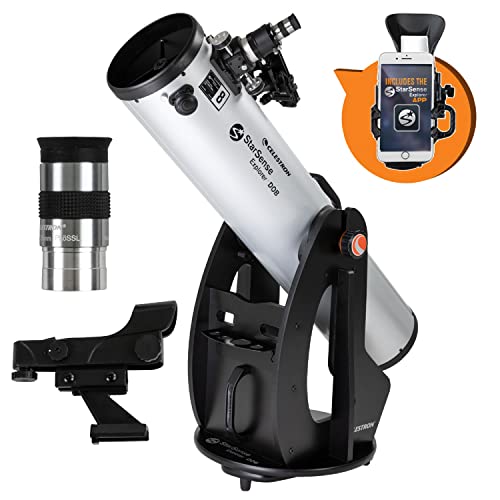
3. Celestron StarSense Explorer 8″ Dobsonian (22470) — Best App-Guided
Celestron’s StarSense Explorer 8 answers the FAQ question about finding objects: you dock your smartphone on the tube, and the StarSense app uses the phone camera to recognize the sky pattern overhead and calculate the telescope’s position in real time, then gives on-screen arrows to push the tube toward your target. Under the electronics it is a full 8-inch Dobsonian, with a 203 mm parabolic mirror, XLT coatings, a 1200 mm f/5.9 focal length, a 2-inch Crayford focuser and a manual altazimuth base with adjustable tension. A 25 mm eyepiece (48x) and a StarPointer red-dot finder are included, and the app also builds a list of objects currently visible from your location and time. The complete kit weighs about 43 pounds. Choose this version if star-hopping with charts sounds like a barrier and you want full 8-inch aperture with guidance built in.
View Celestron StarSense Explorer 8″ Dobsonian on Amazon

4. Celestron StarSense Explorer 10″ Dobsonian (22471) — Best for Faint Deep-Sky Objects
The 10-inch StarSense Explorer keeps the same smartphone guidance system and scales the optics up to a 254 mm mirror, which gathers roughly 56 percent more light than the 8-inch version — the difference that matters for the faint galaxies and nebulae this guide is aimed at. Its 1200 mm focal length works out to a faster f/4.7, so the tube stays about the same length as the 8-inch despite the wider mirror, though the wider tube and base are heavier to move. The package follows the family pattern: StarSense dock and app, a 2-inch Crayford focuser, a red-dot finderscope and a 25 mm Plössl eyepiece giving 48x. Read the listing’s weight and dimensions carefully against your storage space and vehicle, exactly as the guide’s weight section advises. This is the pick for observers under reasonably dark skies who know they will use the extra aperture.
View Celestron StarSense Explorer 10″ Dobsonian on Amazon
5. Sky-Watcher Flextube 200P SynScan GoTo Dobsonian (S11800) — Best GoTo and Collapsible
The Flextube 200P SynScan is the motorized option the FAQ hints at. Its 8-inch, 1200 mm f/5.9 optics sit in a collapsible truss tube that shortens for transport and storage, solving the main drawback of a solid 8-inch tube. The base carries Sky-Watcher’s SynScan GoTo system: after alignment, the mount slews to objects from its built-in database and tracks them as they drift, and dual encoders (Sky-Watcher’s Freedom Find design) let you push the tube by hand without losing alignment. That makes it the most convenient option here for showing objects to a group, since the target stays in the eyepiece. The costs are the ones you would expect: more setup steps, a power supply to manage, and a higher weight and price class than the manual Classics above. Pick it if GoTo finding and tracking, plus a tube that collapses down, matter more to you than manual simplicity.
View Sky-Watcher Flextube 200P SynScan GoTo Dobsonian on Amazon
What to Look For
| Factor | Why it matters | What to check |
|---|---|---|
| Aperture | Mirror diameter controls how much light is collected and how faint an object you can see. | Compare mirror size with how far you are willing to carry and store the tube. |
| Focal ratio | It affects tube length, field of view and the eyepieces you need. | Read the focal length and ratio, and note whether the tube collapses. |
| Base and bearings | Smooth motion makes tracking a target easier. | Look for the base material, bearing surfaces and tension adjustment. |
| Focuser | A sloppy focuser makes sharp images hard to find. | Check for a rack-and-pinion or a Crayford type, and the barrel size it accepts. |
| Finder and eyepieces | You need a way to aim and to change magnification. | See what is included, such as a red-dot finder and eyepieces, and what you must add. |
| Weight and assembly | Heavier parts can limit how often you set up. | Read the listed weights and whether the tube and base separate for transport. |
Setup and Care Tips
- Set the telescope outdoors about half an hour before use so the mirror can match the air temperature.
- Choose a dark spot away from streetlights, and let your eyes adapt for several minutes.
- Check mirror alignment, called collimation, as described in the manual, and recheck after moving the telescope.
- Never point the instrument toward the sun without proper certified solar filters made for that purpose.
- Keep dust caps on when not in use, and store the telescope in a dry spot away from sudden temperature swings.
Mistakes to Avoid
- Choosing the largest tube available without thinking about how you will move it.
- Expecting high magnification to fix poor sky conditions.
- Cleaning the mirror too often, when dust is usually harmless and rubbing risks scratches.
- Overlooking the focuser and eyepiece quality included in the box.
- Skipping a red flashlight, which protects your night vision at the eyepiece.
Where a Dobsonian Fits Among Telescope Types
Telescopes come in a few broad families, and placing a Dobsonian among them clears up a lot of confusion. Refractors use a lens at the front and are known for sharp, contrasty views in compact tubes, but large lenses are costly to make. Catadioptric designs fold the light path with both mirrors and lenses, producing a short tube that suits travel and automatic mounts. A Dobsonian is a Newtonian reflector on a simple rocker box, and it spends its budget on the main mirror instead of on a complex mount.
That choice has a clear consequence. For the same outlay, a Dobsonian usually gives you more light-gathering area than other designs. More area means fainter, more detailed views of nebulae, galaxies and clusters. The trade is bulk and the lack of built-in tracking on the standard models, which suit people who enjoy hunting for objects by hand.
Quick comparison of families
| Type | Main strength | Main limitation |
|---|---|---|
| Refractor | Crisp views, low upkeep | Aperture is costly to scale up |
| Catadioptric | Compact, good for tracking mounts | Less aperture per unit of spending |
| Dobsonian | Large aperture, simple mount | Bulky, manual pointing on classic models |
Understanding Focal Length and Focal Ratio
Two numbers on a listing describe how the tube is built: aperture and focal length. Dividing focal length by aperture gives the focal ratio, written with an f in front. A lower ratio means a shorter, wider-field instrument; a higher ratio means a longer, narrower one. On a given tube, the focal length stays fixed, and your eyepieces then set the magnification.
The simple formula is focal length of the telescope divided by focal length of the eyepiece. A longer eyepiece gives lower power and a wider sweep of sky, which is the best way to locate objects. A shorter eyepiece gives higher power for small targets such as planets and tight clusters. Atmospheric steadiness limits useful power on most nights, so a huge magnification figure on a box is not a mark of quality.
What this means in practice
- Fast, low-ratio tubes are often more compact and show wide fields easily.
- Slower, higher-ratio tubes are generally more forgiving with eyepieces.
- Check the maker’s notes for the eyepieces supplied, and plan to add a couple of your own over time.
Transport, Storage and Weight
A Dobsonian that is too big to move will not get used, and that is the most common reason people stop observing. Before you order, measure the doorway, the stairs and the space in your car. Tubes are long, and the rocker base is wide and awkward to carry alone. Many models split into two main pieces, the tube and the base, which makes lifting more manageable.
Collapsible truss designs shrink the tube for carrying. They add a little setup time but can be the difference between a telescope you use weekly and one that sits in a garage. Check the listing for the shipped weight and the length of the tube, then ask yourself honestly whether you can handle each piece on your own.
Storage matters too. A dry, dust-free spot at stable temperature is best for the optics. A cover for the tube and a cap for the open end protect the mirror between sessions.
Eyepieces and Finders
The eyepieces shipped with a telescope are an initial set, not a final answer. Most makers include one or two, enough for low and medium power. Over time many owners add a wide-field piece and a higher-power one, plus perhaps a Barlow lens that multiplies the effective focal length of whatever eyepiece it is paired with.
The finder is just as important as the eyepiece. A red-dot finder gives a simple reference point with no magnification, while a finder scope shows a small magnified field. Some models offer app-guided pointing that tells you which direction to push the tube, which suits beginners who find hopping between objects intimidating. Whichever you pick, align the finder with the main tube in daylight on a distant object, since that is far easier than doing it in the dark.
Small accessories that help
- A red flashlight preserves your night vision while you read charts.
- A comfortable chair or stool lowers fatigue at the eyepiece.
- A dew shield can reduce moisture on the front opening in humid conditions.
Collimation Explained Simply
Collimation is the alignment of the mirrors so light travels along the intended path. Newtonian reflectors can drift out of alignment through transport and handling, and a poorly aligned tube gives soft, distorted views. The good news is that the adjustment is a routine task, and most owners learn it quickly.
Many makers supply a basic procedure, often with a small tool or cap to help centre the view. Follow their instructions exactly, and make small changes rather than large ones. Check alignment before important sessions, particularly after moving the telescope in a vehicle.
- Place the tube on its base in a well-lit room.
- Look down the focuser with the alignment aid supplied or recommended.
- Adjust the screws on the secondary mirror holder first, a little at a time.
- Adjust the primary mirror cell screws next.
- Recheck after each change and stop when the view matches the maker’s diagram.
If anything seems unclear, the maker’s manual or a local astronomy club can walk you through it in person.
Choosing a Good Observing Site
Where you set up matters as much as what you set up. Light pollution washes out faint objects, so the darker your location, the more your large mirror can show. Even moving from a bright driveway to the shadow of a house or the edge of a field can make a visible difference.
Watch for heat as well. Telescopes need time to reach the temperature of the surrounding air, because a warm mirror creates currents that blur the image. Carry the instrument outside well before you plan to observe and give it time to settle, with the tube open and uncovered. Maker guidance on cool-down periods varies by size, so check the manual.
Site checklist
- A clear view of the part of the sky you want, free from trees and roofs.
- Level, firm ground that does not shake when you move.
- Shielding from nearby lamps, even with a simple cloth or board.
- A safe path to carry equipment, especially in the dark.
What You Can Realistically Expect to See
Setting honest expectations avoids disappointment. At the eyepiece, deep-sky objects usually look like soft grey patches instead of the vivid colour photographs you see online, because the human eye does not accumulate light the way a camera does. Brighter nebulae, open clusters and the nearest large galaxies show structure with a decent aperture and dark conditions.
Planets are different. The Moon, Jupiter and Saturn offer rewarding detail even from suburban areas. Jupiter shows banding and its moons, and Saturn reveals its rings. Seeing improves with patience; the eye picks up finer detail the longer you look.
Because every site and sky varies, treat the descriptions on any listing as a general idea, not a promise of what you will see on a particular night.
Dobsonian or Tracking Mount: Which Suits You
The big decision for many buyers is whether to push the tube by hand or let a motor do the work. A standard Dobsonian is quick to set up, quiet and mechanically simple. It rewards patience and a willingness to learn the sky. A tracking or goto version takes the hunt out of finding objects and follows them as the sky turns, which helps with long viewing and with sharing a view among several people.
Powered models need batteries or a power source, and their electronics add another thing to maintain. A manual model has nothing to fail apart from the optics and the bearings. Think about how you like to spend an evening: learning constellations with a chart, or simply entering a target and looking.
Matching the mount to your habits
- Pick manual if you value simplicity, learning and low upkeep.
- Pick motorised if you want quick finds or plan to show many guests.
- Consider an app-guided option if you want help without electronics.
Common Mistakes With a First Large Telescope
New owners of big reflectors tend to run into the same few problems. The first is chasing power. Pushing a high-magnification eyepiece into a wobbly, warm tube gives a dim, shaky view, while a low-power eyepiece in a settled tube shows far more. Begin with your widest eyepiece for every target, then step up only when the image holds steady.
The second is skipping the cool-down and the alignment check. Both take minutes and change the view dramatically. The third is picking a spot that looks convenient but has a lamp or a heat source nearby, such as a wall that has been in the sun all day and releases warmth after dark.
A fourth slip is overtightening the altitude tension or leaving the base on soft ground. Smooth motion depends on the bearings moving freely, so follow the maker’s guidance on balance and friction. If you add a heavy eyepiece or finder, the tube may need a counterweight or a small change to the tension to stay put when you let go.
Fixes at a glance
- Use low power first and step up gradually.
- Let the tube cool outdoors before serious viewing.
- Recheck collimation after any journey.
- Keep the base on firm, level ground.
- Adjust balance whenever you change accessories.
Simple Glossary
- Aperture: the diameter of the main mirror, which sets how much light is gathered.
- Focal length: the distance light travels to reach a focus, usually given in millimetres.
- Focuser: the part that holds the eyepiece and moves it in and out to sharpen the view.
- Rocker box: the base that lets the tube swing left and right.
- Altitude: up and down movement of the tube.
- Azimuth: left and right movement of the base.
- Barlow lens: an accessory that multiplies eyepiece power.
Pre-Order Checklist
- Measure the space where the telescope will live and the route out of your door.
- Check the weight of each piece against what you can lift.
- Decide whether a collapsible tube is worth the extra setup step.
- Confirm which eyepieces and finder come in the box.
- Read the maker’s collimation notes before the first night.
- Think about your observing site and how dark it really is.
Spending ten minutes on this list tends to prevent the most common regrets and helps the telescope become a tool you reach for regularly.
A Deeper Look at Choosing Dobsonian Telescopes
The shortlists above give you a strong starting point, but the right choice among dobsonian telescopes depends far less on any single feature than on how well a product fits your space, your routine and your expectations. This extra section slows the decision down and works through the questions experienced buyers ask before they commit. None of it replaces the details in the individual reviews above; instead, it gives you a framework for reading those reviews with your own situation in mind, so the strengths and compromises of each pick become easier to weigh.
Start by writing down the job you actually need done, in plain language, before you look at any product names again. Many disappointing purchases happen because the buyer solved a slightly different problem from the one they had: they bought for the largest, loudest or most occasional scenario instead of the ordinary Tuesday that repeats all year. If your honest description mentions one main use, one secondary use and one frustration you want to avoid, you already have a better buying brief than most shoppers ever make, and you can test every option among the dobsonian telescopes against those three lines.
Size, Fit and the Space You Really Have
Measure before you fall in love with a particular model. Record the width, depth and height of the space, then add the clearance needed to open, move, clean or comfortably use the product once it is in place. Doorways, stairs, cupboard doors and tight corners all count, because a product that technically fits its final spot can still be miserable to get there. With dobsonian telescopes, the difference between a good fit and a daily annoyance is often a small margin that only a tape measure will reveal, so take the measurements twice and keep them in your phone while you shop.
Fit also means fitting the people involved. Consider heights, reach, strength and mobility in your household, and whether children, older relatives, guests or pets will interact with the product as well. Controls, handles, openings and adjustments should be comfortable for the person who will use them most, not just acceptable in a showroom moment. If two people will share the dobsonian telescopes, agree in advance whose priorities win on the points where you disagree, because shared products that suit nobody in particular tend to be replaced fastest.
Materials, Build Quality and Honest Durability
You can learn a lot about likely durability without any technical knowledge. Look for even finishes, tidy joins or seams, parts that move without grating or wobbling, and fixings that feel firmly seated rather than decorative. Where the maker describes materials, think about what those materials are good at and what they ask of you in return: some shrug off moisture but mark easily, others feel premium yet need regular care. The right answer among dobsonian telescopes is the material whose maintenance rhythm matches the time you will genuinely give it.
Pay particular attention to the parts that will be touched, loaded or exposed every day, because those are the places wear appears first. Hinges, handles, edges, feet, fastenings and contact surfaces tell you more about long-term satisfaction than a rarely used extra feature. If a listing is vague about the parts that matter, treat that vagueness as information in itself and favour the option whose construction is described clearly and modestly. Honest descriptions that mention limits usually come from makers who expect their dobsonian telescopes to be used hard and judged fairly.
Ease of Use in Ordinary Daily Life
Imagine the full routine, not just the main event. How does the product arrive, where does it live between uses, how long does setup take, and what has to be cleaned, charged, emptied, folded or put away afterwards? A design that saves a minute during use but costs five minutes of fiddly preparation will quietly fall out of favour. The most satisfying dobsonian telescopes tend to disappear into the routine: they are ready when needed, forgiving when you are tired, and simple to hand over to someone else without a long explanation.
Think about the total picture rather than a single headline feature. The products that satisfy owners over years tend to be the ones that balance the main job, everyday convenience and straightforward upkeep, instead of chasing one impressive claim while making daily life harder. As you read the picks above, keep returning to your own shortlist of priorities and notice which option keeps matching it for calm, practical reasons.
Getting the Most From Your Dobsonian Telescopes
Setup and the First Few Days
Unpack carefully and keep everything together until you are sure the product is staying. Photograph the unboxing if parts are numerous, lay pieces out in the order the instructions use them, and resist the urge to force anything that resists: a pause to reread one step is cheaper than a damaged fitting. Once your dobsonian telescopes are assembled or installed, run through the basic functions gently, check that everything operates as described, and only then move packaging out of the way. Register the warranty if the maker offers one, and save the receipt and manual somewhere you can actually find them again.
Treat the first week as a trial you are conducting, not a verdict you have already reached. Use the product in the situations you bought it for, notice where you hesitate or improvise, and adjust placement, settings or accessories before deciding anything is wrong. Small changes in position, order or routine often transform the experience. If a genuine fault or mismatch appears, early notes with dates and photographs make any conversation with the seller far easier, and they help you distinguish a real defect from a setup detail among your dobsonian telescopes that simply needs correcting.
Cleaning, Care and Storage Habits
Regular light care beats occasional heroic cleaning almost every time. Wipe, empty, shake out or inspect on the rhythm the maker recommends, using the mildest cleaning approach that does the job, and dry parts fully before storing or closing them away. Damp left in seams, folds or enclosed spaces is a quiet cause of odours and deterioration, whatever the product. Build the care step into the routine it belongs to, such as after the last use of the day or the end of the week, so maintaining your dobsonian telescopes never becomes a separate project you keep postponing.
Storage matters as much as cleaning. Keep the product in the conditions the maker describes, away from extremes of heat, cold or damp where possible, with any cables, accessories or small parts stored together rather than scattered through drawers. If space is tight, store the items you use together in one place so setup stays quick. Before a longer period without use, clean everything, check for wear while you can still act on it, and make a note of anything that needs attention when the dobsonian telescopes come back into service, rather than discovering it at the busiest moment.
It also helps to think about the second year of ownership, not just the first week. Parts wear, households change and routines shift, so ask how easy the dobsonian telescopes will be to clean, repair, move or pass on when your needs change. A purchase that can adapt, be maintained with ordinary tools and be understood by other people in the household will usually serve you better than one that only impresses on day one.
How the Picks in This Guide Compare
Read the individual reviews above as a set rather than as a ranking to obey blindly. Each pick earned its place for a particular kind of buyer, and the short labels are the quickest guide to those differences. The notes below simply restate the positioning already given in the guide, in a form that makes side-by-side thinking easier when two options both look appealing.
The Sky-Watcher Classic 200P Dobsonian 8″ (S11610), presented above as the choice for best overall, is best understood through that role. If the situation described in its review sounds like your household, its compromises are probably the ones you will mind least; if that situation belongs to somebody else, a different pick will likely serve you better even if this one first caught your eye. Return to its section above for the specific strengths, limitations and who-should-skip guidance before deciding, and compare it honestly against the alternative you are considering rather than against an imaginary perfect product.
The Sky-Watcher Classic 150P Dobsonian 6″ (S11600), presented above as the choice for best for beginners, is best understood through that role. If the situation described in its review sounds like your household, its compromises are probably the ones you will mind least; if that situation belongs to somebody else, a different pick will likely serve you better even if this one first caught your eye. Return to its section above for the specific strengths, limitations and who-should-skip guidance before deciding, and compare it honestly against the alternative you are considering rather than against an imaginary perfect product.
The Celestron StarSense Explorer 8″ Dobsonian (22470), presented above as the choice for best app-guided, is best understood through that role. If the situation described in its review sounds like your household, its compromises are probably the ones you will mind least; if that situation belongs to somebody else, a different pick will likely serve you better even if this one first caught your eye. Return to its section above for the specific strengths, limitations and who-should-skip guidance before deciding, and compare it honestly against the alternative you are considering rather than against an imaginary perfect product.
The Celestron StarSense Explorer 10″ Dobsonian (22471), presented above as the choice for best for faint deep-sky objects, is best understood through that role. If the situation described in its review sounds like your household, its compromises are probably the ones you will mind least; if that situation belongs to somebody else, a different pick will likely serve you better even if this one first caught your eye. Return to its section above for the specific strengths, limitations and who-should-skip guidance before deciding, and compare it honestly against the alternative you are considering rather than against an imaginary perfect product.
The Sky-Watcher Flextube 200P SynScan GoTo Dobsonian (S11800), presented above as the choice for best goto and collapsible, is best understood through that role. If the situation described in its review sounds like your household, its compromises are probably the ones you will mind least; if that situation belongs to somebody else, a different pick will likely serve you better even if this one first caught your eye. Return to its section above for the specific strengths, limitations and who-should-skip guidance before deciding, and compare it honestly against the alternative you are considering rather than against an imaginary perfect product.
Choosing Between Two Close Options
When two options among the dobsonian telescopes remain after you have eliminated the rest, stop looking for new features and start looking at friction. Which one will be easier to live with on a tired evening, quicker to clean, simpler to store, or less annoying for the other people who share your space? Which one has the limitation you are more willing to accept for years? Buyers rarely regret choosing the product with the kinder daily routine, whereas a small advantage on paper that demands constant workarounds wears thin remarkably quickly.
It can also help to imagine owning each finalist after the novelty has gone. Picture the product a little dusty, the household a little busier, and your enthusiasm replaced by habit. The option that still seems sensible in that picture is usually the right purchase. If you remain torn, revisit the measurements and the original three-line brief you wrote at the start of this section; one of the finalists almost always answers that brief more directly, and that answer matters more than any extra flourish either dobsonian telescopes can offer.
A Final Practical Check Before You Decide
Decision-making gets easier when you separate needs from preferences. Needs are the points where the wrong choice stops the product working for you at all, such as a size that does not fit, a function you rely on daily, or a care requirement you cannot meet. Preferences are everything else: finishes, styling details and nice-to-have extras. Among dobsonian telescopes, spend your attention and your budget on the needs first, let preferences break ties between otherwise equal options, and be suspicious of any product that asks you to trade a genuine need for an attractive extra.
Talk to the people who will share the product before you order, not after it arrives. A five-minute conversation about where the dobsonian telescopes will live, who will clean or move them, and what would genuinely annoy each person prevents the quiet resentment that builds around a purchase nobody else chose. Households that agree the practical basics in advance almost always end up happier with the result, and the discussion often surfaces a requirement, such as storage space or noise, that the main buyer had not considered at all.
Think about accessories and consumables as part of the purchase, even if you buy them later. Some dobsonian telescopes need covers, refills, replacement parts, batteries, cleaning products or a particular storage solution to work at their best, and discovering that afterwards can turn a bargain into a false economy. You do not need to buy everything at once, but knowing what ownership involves helps you compare options fairly and plan the order in which extras are genuinely worth adding.
Keep a simple ownership note once you have bought. The date of purchase, where the receipt lives, any warranty registration, and a line about settings or arrangements that worked well will save you surprising amounts of time later. When something eventually needs adjusting, repairing or replacing, that note turns a vague memory into clear information, and it helps anyone else in the household understand the dobsonian telescopes without having to repeat your whole learning process from the beginning.
Finally, give yourself permission to choose the sensible option. Marketing rewards the newest, largest and most feature-filled version of everything, yet most households are best served by the product that matches their space, does the main job reliably and asks little of them in return. If one of the dobsonian telescopes above keeps meeting your brief while the others need excuses, that consistency is the answer. A calm, well-matched purchase used happily for years beats an exciting one that never quite fits your life.
Seasonal changes are a useful prompt to reassess. When the weather, your schedule or the household changes, walk through how the dobsonian telescopes are performing: what gets used, what gets avoided, and what small adjustment would help. Moving a product to a better spot, changing the order of a routine or replacing a worn accessory can restore most of the original satisfaction without a new purchase, and it teaches you what to prioritise if you do buy again in the future.
When you read any guide, including this one, remember that recommendations assume an average household that may not resemble yours. Treat the picks above as a well-researched shortlist to test against your measurements, your routine and your honest limitations, rather than as instructions. That mindset protects you from the two commonest disappointments with dobsonian telescopes: buying the most praised option for somebody else’s life, and dismissing a modest option that would have suited your own life perfectly.
FAQ
Do Dobsonians track objects automatically?
Standard models do not. You nudge the telescope by hand as objects drift across the field. Some makers offer computerized or tracking versions, so read the listing closely if you want that feature.
Is a larger aperture always better?
It gathers more light, which helps with dim objects, but it also adds weight and bulk. The best size is the one you will actually carry outside and set up regularly.
How do I know which size or style of dobsonian telescopes is right for me?
Start from the space and the people, not from the product page. Measure where the item will live and be used, think about who will use it most often, and match those facts against the guidance in the reviews above. If you fall between two sizes or styles, the safer choice is usually the one that leaves you comfortable clearance and room to adjust, rather than the one that only just fits on paper and leaves no margin for ordinary life.
What should I check as soon as my dobsonian telescopes arrive?
Check the contents against the packing list, look over seams, surfaces, moving parts and fastenings for transit damage, and test the basic functions before you throw any packaging away. Photograph anything that looks wrong straight away. A calm ten-minute inspection on delivery day is far easier than discovering a problem weeks later, and keeping the packaging until you are satisfied protects your options if an exchange turns out to be necessary.
How often should I clean and maintain dobsonian telescopes?
Follow the maker’s guidance first, and otherwise adopt a little-and-often approach: a brief wipe, empty or inspection after regular use, and a more thorough clean at sensible intervals such as the change of season or before storage. Maintenance done early is almost always quicker, because dirt, moisture and loose fittings are easier to deal with before they combine into a bigger problem that affects how the product works.
What is the most common mistake people make with dobsonian telescopes?
Buying for an imagined routine instead of the real one. People overestimate how much time they will spend on setup and care, underestimate the space a product needs in use, and choose features for rare occasions while tolerating daily inconveniences. The reviews above flag the honest limitations of each pick; take those limitations seriously, because living with a limitation every day feels very different from reading about it once.
Can I return or exchange dobsonian telescopes if they do not suit my home?
That depends on the seller and on the condition of the product, so read the returns terms before you order and keep receipts, packaging and accessories together during the first days. Use the product fairly but carefully while you decide, note any problem promptly, and contact the seller sooner rather than later if something is wrong. Clear, polite messages with dates and photographs usually resolve issues faster than waiting and hoping the problem will settle by itself.
How long should good dobsonian telescopes be expected to last?
There is no single honest answer, because lifespan depends on materials, frequency of use, conditions and care far more than on the calendar. Well-made products that are used as intended, cleaned on a sensible rhythm and stored properly will generally serve for years, while heavy use in harsh conditions shortens the life of almost anything. Judge value over the whole period of ownership, including how easy the product is to maintain, rather than by the purchase moment alone.
What else is worth knowing before buying dobsonian telescopes?
Read the individual review of the pick you favour one more time, paying attention to the limitation it names and the buyer it is said to suit. Most returns and regrets come from details that were visible before purchase but easy to skim past. Confirm your measurements, your storage plan and your care routine, and make sure everyone who will use the product is comfortable with the choice. That final, unhurried check takes minutes and protects years of use, which is why experienced buyers treat it as part of the purchase rather than an optional extra to skip when a product looks appealing at first glance.
The Short Version
Match aperture to what you can carry, check the focuser and base, and see what comes in the box. A telescope that is easy to set up will see more use than a bigger one left in storage.
Related Guides
- How to Choose the Best Refractor Telescopes: A Buyer's Guide
- How to Choose the Best Computerized Telescopes: A Buyer's Guide
- How to Choose the Best Night Vision Binoculars: A Buyer's Guide
- How to Choose the Best 8×42 Binoculars: Buyer's Guide (2026)
- How to Choose the Best Activity Centers: Buyer's Guide (2026)